

Welcome to Carbon Brief’s DeBriefed.
An essential guide to the week’s key developments relating to climate change.
This is an online version of Carbon Brief’s weekly DeBriefed email newsletter. Subscribe for free here.
This week
Unprecedented heat
‘RED ALERT’: The UN’s World Meteorological Organization (WMO) issued a “red alert” on climate change, after 2023 saw record heat, ice-melt and greenhouse gas emissions, the Associated Press reported. The WMO’s report confirmed that 2023 was the hottest year on record, with the average global temperature reaching 1.45C, noted the Guardian. The world is getting ever closer to temporarily breaching 1.5C, the ambition set under the Paris Agreement, the Independent said.
IMPACTS REVEALED: According to the WMO, extreme weather events are having an “alarming” impact on food insecurity, the Financial Times reported. The FT said there were 333 million people in 2023 who were “acutely food insecure”, compared to 149 million people before the Covid-19 pandemic. Elsewhere, Al Jazeera reported that “over 90% of ocean waters experienced heatwave conditions at least once” in 2023.
SCIENTISTS STUNNED: Reacting to the report, Prof Jonathan Bamber, a glaciologist at the University of Bristol, told the i newspaper: “The pace of climate breakdown that we’re witnessing is faster than I think the vast majority of climate scientists were anticipating five or 10 years ago. Things are changing so rapidly that myself and quite a few of my colleagues do have concerns that some of our estimates could be on the conservative side.” It comes as leading climate scientist Dr Gavin Schmidt published a piece in Nature saying that researchers are finding 2023’s extremes “hard to explain” and that Earth could be entering “uncharted territory”.
Big Oil backtracks
TEXAS HOLD ‘EM: As Earth continues to face record-breaking extremes, executives from the world’s leading oil-and-gas companies gathered this week to “pour scorn” on efforts to move away from fossil fuels, reported the Guardian. According to the newspaper, Amin Nasser, the chief executive of state firm Saudi Aramco, told the industry’s annual Cera Week summit in Texas: “We should abandon the fantasy of phasing out oil and gas and instead invest in them adequately.”
BUSINESS AS USUAL: Also reporting on the summit, Reuters noted that many oil-and-gas CEOs shared Nasser’s views, adding: “Shell’s Wael Sawan point[ed] to government bureaucracy in Europe as slowing needed development. Petrobras CEO Jean Paul Prates said caution should overrule haste. Exxon Mobil CEO Darren Woods also said regulations governing clean fuels have still not been resolved.” It came as the Guardian covered a new report from Global Witness suggesting that emissions connected to top oil and gas firms could cause 11.5 million additional heat deaths by 2100.
Around the world
- CLIMATE MINISTERIAL: At a climate ministerial in Copenhagen, a “troika” made up of the United Arab Emirates, Azerbaijan and Brazil – the hosts of COP28, COP29 and COP30, respectively – urged countries to update their international emissions pledges by 2025, the Hindustan Times reported.
- SCHOOL CLOSURES: South Sudan has closed all its schools for an expected two weeks as temperatures are forecast to reach 45C, BBC News reported. It comes as Carbon Brief covered a new attribution analysis finding climate change made recent heat in west Africa 10 times more likely.
- US TRANSPORT: The Biden administration announced new rules to tackle pollution from the nation’s cars and light trucks, “imposing tailpipe emission limits so stringent they will compel automakers to rapidly boost sales of battery-electric and plug-in hybrid models”, Bloomberg reported.
- UK COURTS: The UK Court of Appeal has ruled that climate activists prosecuted in England and Wales for criminal damage can no longer use the “consent defence” – that they believe the property owner would have given their consent to the action if they understood the reason for the protest – the Financial Times reported.
- GREEN STEEL: A new report found that China is “falling short” in decarbonising its steel sector, due to “slowing demand, low recycling rates and lingering overcapacity concerns” impeding the transition to lower-emission production, said Reuters.
- BRAZIL HEATWAVE: Following a record “heat index” (which factors in the impact of humidity) of up to 62C in the Brazilian capital Rio de Janeiro last weekend, O Globo reported that heatwaves may become more frequent in the country.
13 million
The number of residents in India’s southern tech capital of Bengaluru who are running out of groundwater following an “unusually hot” February and March, the Associated Press reported.
Latest climate research
- Over the past 60 years, livestock grazing has reduced soil carbon stocks by 46bn tonnes of carbon at a depth of one metre, a study in Nature Climate Change found.
- Research in Nature Cities found that only 43% of 793 cities studied have implemented green recovery plans in response to the Covid-19 pandemic.
- A study in Climatic Change gathered the opinions of 20 policymakers and practitioners from different countries about the readability of figures drafted for the latest Intergovernmental Panel on Climate Change (IPCC) report on how to tackle climate change. It recommended ways that the figures could be improved, based on the feedback.
(For more, see Carbon Brief’s in-depth daily summaries of the top climate news stories on Monday, Tuesday, Wednesday, Thursday and Friday.)
Captured

New Carbon Brief analysis debunked 18 of the most common and persistent myths about heat pumps. Heat pumps can significantly cut greenhouse gas emissions (see chart above) and are the “central technology in the global transition to secure and sustainable heating”, according to the International Energy Agency. Yet, in major economies such as the UK and Germany, heat pumps are the subject of hostile and misleading reporting across many mainstream media outlets, according to Carbon Brief’s new factcheck.
Spotlight
Rare-earth mining in Myanmar
This week, Carbon Brief interviews an expert about how rare-earth mining in Myanmar has increased since the country’s military coup in 2021, its impacts on local communities and the environment, plus how it can be better monitored and controlled.

Myanmar is rich in natural resources. It is home to a wealth of gemstones, energy sources, such as coal and uranium, as well as vast amounts of rare earths.
Dysprosium and terbium are two rare earths that are heavily mined in Myanmar. They are used in a range of everyday technologies, such as light bulbs, but are increasingly being used for renewable energy, including for electric vehicles and wind turbines.
As countries race to achieve their climate targets, demand for these rare earths is substantially increasing. The Irrawaddy reported that Myanmar exported more than 140,000 tonnes of rare-earth deposits to China between May 2017 and October 2021, valued at more than $1bn.
However, much of Myanmar’s mining industry is illicit and controlled by armed groups. Illegal mining has grown since the country’s military coup in 2021, particularly along the Chinese border in Kachin State.
China, the world’s biggest low-carbon technology producer and the largest processor of rare earths, is now increasingly outsourcing its mining activities into neighbouring Myanmar amid growing national concerns over the highly polluting process.
Below, Carbon Brief speaks to Vicky Bowman (pictured above), director of the not-for-profit Myanmar Centre for Responsible Business, about escalating issues with rare-earth mining in the country. The interview has been edited for clarity and length.
Carbon Brief: Please can you give an overview of rare-earth mining in Myanmar and how it has developed since the military coup in 2021?
Vicky Bowman: Rare-earth mining has been taking place in Kachin state, north-eastern Myanmar, on China’s border for around a decade, mainly by Chinese miners in areas under the control of the pro-military Kachin militias. Chinese companies started to source more from Kachin state because of a clampdown on rare-earth mining in Yunnan due to environmental pollution.
Satellite footage commissioned by Global Witness showed that rare-earth mining has significantly expanded since the coup. It also takes place to a lesser extent in areas controlled by the Kachin Independence Organisation (KIO), which is opposed to the Myanmar military. The KIO planned to expand rare-earth mining to raise funds for their armed struggle, but they faced significant local backlash and dropped the expansion plans in 2023.
CB: What impacts is rare-earth mining having on people, particularly Indigenous peoples, and the environment in Myanmar?
VB: Indigenous peoples in the areas where rare-earth mining is taking place in Kachin state, mostly Kachin ethnic minority, rely on agriculture and forests for their livelihood and culture. These areas are also rich in biodiversity. The leaching process for extracting rare-earth ores requires leaching it from the soil using ammonia and other chemicals. These chemicals enter the environment and poison the streams and fields, killing trees, cattle and local nature and making local people sick.
CB: What needs to happen to better monitor and control the impacts of rare-earth mining in Myanmar?
VB: The vast majority of mining in Myanmar nowadays is unplanned, unregulated and unlicensed. The national Mining Law is not fit for purpose. It fails to align with other laws, such as those concerning investment, environmental protection and land use. There are few, if any, officials in any of the ministries who understand how to regulate mining. Corruption is rife. If and when Myanmar’s political crisis is resolved, the policy and legal framework for mining needs to be completely overhauled into a federal system, which can ensure effective land-use planning and environmental protection, and transparent tax revenues for central and sub-national governments and local communities.
Indeed, creating an effective framework for responsible mining is central to resolving conflicts between local people and the central government, and should be a priority for anyone working on peace.
Watch, read, listen
WHEN HEAT KILLS: A new documentary by Deutsche Welle investigated the effects of extreme heat on human health, particularly for outdoor workers, as the climate warms.
CLIMATE OF FEAR: Atmospheric scientist Prof Adam Sobel unpacked coping with the daunting uncertainties of climate change in an article in Nature.
RIGHTS FOR NATURE?: The latest episode of the Guardian’s Science Weekly podcast explored the contested concept of whether nature should have rights.
Coming up
- 18-29 March: First part of the 29th annual session of the International Seabed Authority, Kingston, Jamaica
- 23 March: UN observed World Meteorological Day
- 24 March: Senegalese presidential election
- 26 March: IEA-Power Africa – Data-driven electrification in Africa webinar, remote
Pick of the jobs
- Science Media Centre, internship | Salary: London Living Wage (£13.15 an hour). Location: London
- Climate Analytics, head of climate science and impacts team | Salary: Unknown. Location: Berlin, Germany
- British Antarctic Survey, glacial sedimentologist | Salary: £39,375-£43,313. Location: Cambridge, UK
- Work On Climate, founders programme manager | Salary: $70,000-90,000. Location: Remote, US
- European Energy Research Alliance, clean energy transition expert | Salary: Unknown. Location: Brussels, Belgium
DeBriefed is edited by Daisy Dunne. Please send any tips or feedback to debriefed@carbonbrief.org


The post DeBriefed 22 March 2024: ‘Red alert’ for Earth; Heat-pump myths factchecked; Myanmar’s rare-earth mining crisis appeared first on Carbon Brief.

For the first time, new-energy vehicles (NEVs) made up 67% of new car sales in China in September, according to the latest data from the China Passenger Car Association (CPCA).
The figures show that NEVs, which include battery electric cars and plug-in hybrids, captured a record share of sales, even though fewer were sold than last year.
This is because sales of combustion-engine cars are falling steeply, a trend that the CPCA has attributed to rising petrol prices following the start of the Hormuz crisis.
Indeed, sales of fuel-only cars were down 31% year-on-year in the first nine months of 2026, with plug-in hybrid sales down 26% – whereas battery EV sales were only down 4%.
One analyst tells Carbon Brief that China’s rapidly growing EV fleet has offset demand for 143m barrels of oil since the start of the Hormuz crisis.
Another says that the crisis is “reinforcing China’s electrification of road transport”.
Meanwhile, amid slowing domestic sales, Chinese carmakers’ exports of NEVs more than doubled [in 2026 to date / in September] from a year earlier.
NEV record
A record two out of every three cars sold in September in China were NEVs, according to CPCA data, as shown in the figure below.
(NEVs predominantly include battery electric vehicles – BEVs – and plug-in hybrids – PHEVs. BEVs only run on electricity, whereas PHEVs also have a combustion engine.)
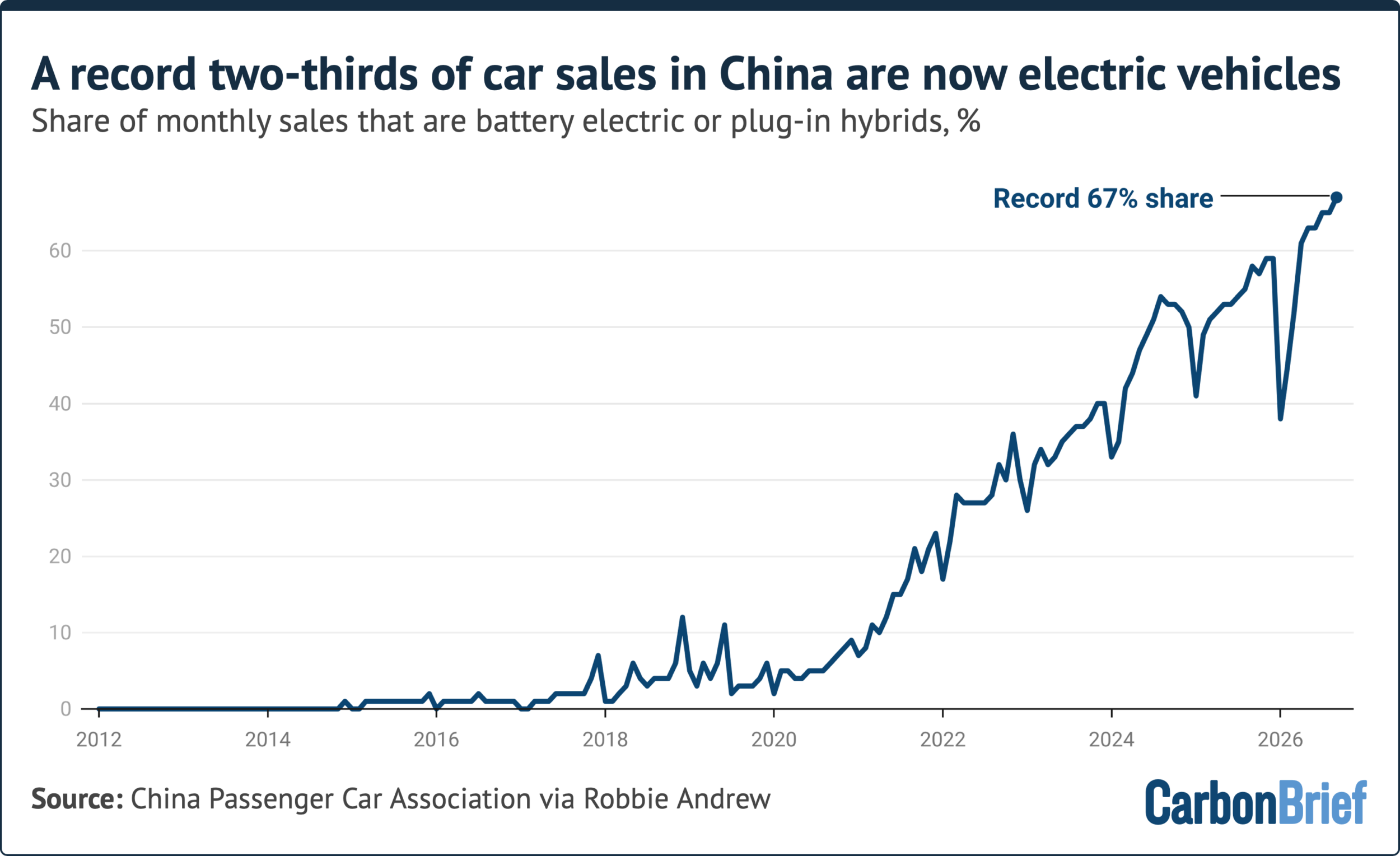
This marks a rapid rise for NEVs from just 6% of new car sales in 2020 up to 58% in 2026 to date – and a record 67% in the month of September.
This year, NEVs’ share of sales has also bounced back from a low of 39% in January, after the full purchase tax exemption that had been in place for more than a decade came to an end in December 2025.
The gain in NEV share in 2026 has come amid a slowdown across the wider domestic passenger-car market, which has hit sales of combustion-engine vehicles particularly hard.
This September, passenger-car retail sales across all categories declined, with overall sales volumes falling 28% year-on-year.
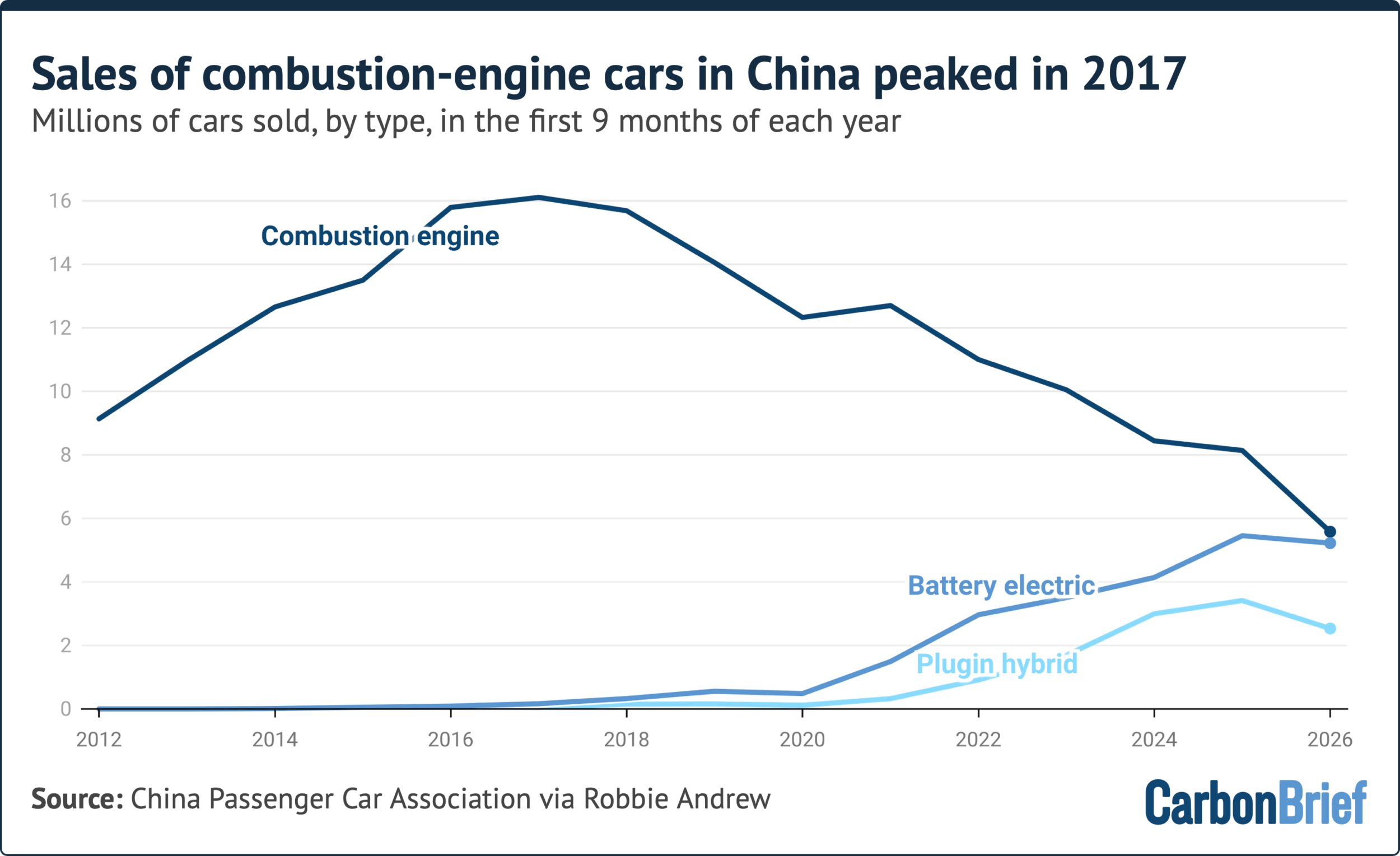
The contraction was led by combustion-engine vehicles, which saw sales fall 43% year-on-year in September and 31% in 2026 to date.
However, sales of PHEVs also fell by 36% year-on-year in September and by 26% in 2026 to date. By comparison, BEVs performed better, although sales still declined 8.5% from a year earlier in September and 4% in 2026 to date.
As a result, NEV sales overall fell by 17% in September and 13% in 2026 to date.
While the market changes in 2026 to date were particularly dramatic, they reflect a broad continuation of trends seen over the past decade.
Indeed, sales of combustion-engine cars in China peaked in 2017 and they have been declining ever since, shown in the figure below.
Impact of Hormuz
Part of the reason for the advance of NEVs in 2026, said Chinese technology news outlet OFweek, was petrol cars “giving up market share” as they were outperformed by electric alternatives.
Cui Dongshu, secretary-general of the CPCA, cited higher petrol prices as an explanation for September’s weak combustion-car sales, in comments to financial news outlet National Business Daily.
Imports of oil into China in January-September have fallen 15% compared to 2025, equivalent to 470m barrels, as ongoing conflict tightened supply and drove up prices.
China’s passenger-car NEV fleet has displaced 143m barrels of oil so far during the strait of Hormuz crisis, Euan Graham, senior energy analyst at thinktank Ember, tells Carbon Brief.
EVs “accounted for 12% of the decrease in China’s oil use post-Hormuz”, according to an estimate provided to thinktank the Brookings Institute by an unnamed analyst.