Welcome to Carbon Brief’s DeBriefed.
An essential guide to the week’s key developments relating to climate change.
This week
Three years to 1.5C
‘DOOMED TO BREACH’: At current carbon dioxide (CO2) emission levels, the world is “doomed to breach the symbolic 1.5C warming limit” in as little as three years, according to research by 60 climate scientists covered by BBC News. (Carbon Brief carried a guest post by two scientists involved in the study.) Co-author and Carbon Brief climate science contributor Dr Zeke Hausfather told the Washington Post: “Some reports, there’s a silver lining. I don’t think there really is one in this one.”
FLOODED AFRICA: South Africa declared a national disaster after floods killed more than 90 people in four of the country’s nine provinces, Bloomberg reported. This is the “second time in about seven months” that the government has invoked the measure to “free up funds for relief and reconstruction”, it added. Separately, 29 people were confirmed to have died “after heavy rains at the weekend triggered floods and landslides” in Kinshasa, the capital of the Democratic Republic of the Congo, the Associated Press reported.
CHINA DELUGE: Heavy rainfall fuelled by Typhoon Wutip has caused the “worst flood in a century” in China’s southern province of Guangdong, with the Sui river in the Huaiji county swelling to “over five metres above the official danger level…the highest on record”, reported state broadcaster CGTN. Local authorities have declared a “top-level emergency” as economic losses from the floods are estimated at $5.7m, the outlet added.
HURRICANE AND HEAT DOME: In North America, forecasters have warned that parts of the US could see “dangerously high temperatures and extreme humidity” from an incoming heat dome, the Wall Street Journal reported. The Associated Press reported that a “fast-moving brush fire” burned hundreds of acres and forced the evacuation of 50 Maui residents in Hawaii, even as 2023 wildfire survivors struggle with declining health, per the Guardian. Hurricane Erick made landfall on Mexico’s Pacific coast on Thursday “shortly after being downgraded slightly from an ‘extremely dangerous’ category 4” storm, noted BBC News.
Bonn talks turn ‘bitter’
BEGIN AGAIN: The Bonn climate talks – the annual two-week preparatory talks held each June deemed “critical to thrash out differences” before each year’s COP – began on Monday “amid severe geopolitical turmoil and renewed tensions”, the Hindustan Times reported. It added that the meetings are shrouded by a “shadow of failed climate-finance talks” at COP29 in Baku, Azerbaijan last year and “divergent views” on a roadmap to raise climate finance to $1.3tn.
AGENDA FIGHT: The start of the talks was delayed by an “agenda row”, after Bolivia – on behalf of the Like-Minded Group of Developing Countries (LMDC) – sought to include items on climate finance from developed nations and “climate change-related trade-restrictive unilateral measures”, Climate Home News reported. Donald Trump’s administration “decided…not to send a delegation to the preparatory meetings” – meaning the US was absent in Bonn for the first time ever, it added.
‘BITTER EXCHANGES’: After 30 hours of “bitter exchanges”, the agenda was adopted on Tuesday “to polite applause and a bigger sense of discontent”, another Climate Home News article said. The Bonn chairs agreed to hold “substantive consultations” on climate finance and report back in Belém at COP30, it continued. Negotiators can now “turn their full attention to equally thorny discussions” on climate adaptation indicators and fossil fuels, it added. (Carbon Brief’s Josh Gabbatiss and Molly Lempriere will report live from Bonn next week.)
Around the world
- BRUSSELS BAN: The European Commission tabled a bill that, according to Euractiv, “would phase out the large volumes of Russian gas still flowing into the EU until the end of 2027”, adding that the ban would stand “irrespective of whether there is peace” in Ukraine.
- UK-CHINA MEET: UK officials including energy secretary Ed Miliband, climate envoy Rachel Kyte and nature envoy Ruth Davies sat down with Chinese counterparts, including the head of China’s Ministry of Economy and Environment, in London this week to discuss the “next steps of climate cooperation”, according to Chinese business publication Jiemian News.
- AMAZON OIL BID: Brazil’s national oil agency has “auctioned off” several oil sites near the mouth of the Amazon river and two inland sites near Indigenous territories months before the country is due to host COP30, the Associated Press reported.
- BLACKOUT BLACK BOX: Spain announced the findings of a 49-day probe into the “catastrophic” Iberian blackout, the Financial Times reported, “spread[ing] the blame…between its grid operator and electricity companies”. (See Carbon Brief’s updated Q&A.)
- MISINFORMATION MEASURED: A review of 300 studies found that action on climate change is being “obstructed and delayed by false and misleading information stemming from fossil-fuel companies, rightwing politicians and some nation states”, the Guardian said.
- OIL PEAK EARLY: According to the International Energy Agency (IEA), China’s oil demand will peak in 2027, two years earlier than previously forecast, Bloomberg reported. At the same time, India’s “thirst for oil will rise more than any other country” over the next five years, wrote the Times of India.
120 kcal
The amount of calories the average person could lose per day for every 1C of warming, due to climate change’s impact on six key crops, according to research covered by Carbon Brief.
Latest climate research
- New forests larger than the size of North America would need to be planted to offset the potential CO2 emissions from fossil fuel reserves held by the world’s top 200 fossil fuel companies, found new analysis in Communications Earth & Environment.
- According to new research in Science Advances, human-driven climate change will remove coral habitat faster than corals can expand into higher-latitude, cooler waters. It found that severe coral cover declines will likely occur over the next 40-80 years, while large-scale expansion “requires centuries”.
- New rapid analysis by World Weather Attribution estimated that climate change will make Saturday’s “widespread heat” of 32C in southeast England “about 100 times” more likely.
(For more, see Carbon Brief’s in-depth daily summaries of the top climate news stories on Monday, Tuesday, Wednesday, Thursday and Friday.)
Captured
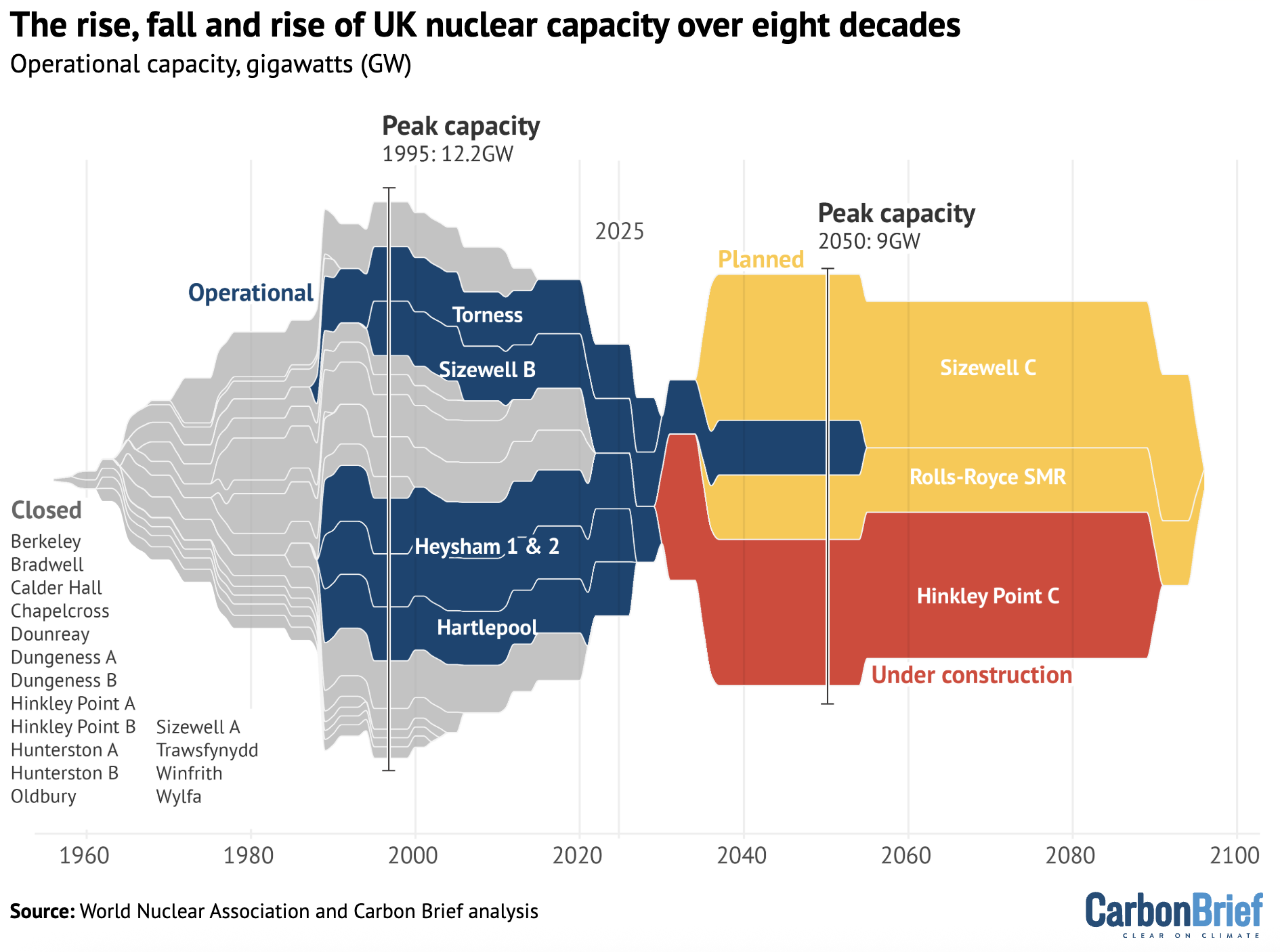
Carbon Brief charted eight decades of the UK’s nuclear energy fleet – from setting up the world’s first commercial reactor in Cumbria in 1956 to UK chancellor Rachel Reeves greenlighting the Sizewell C reactor last week. The chart shows the contribution of each of the UK’s nuclear plants to the country’s overall capacity, according to when they started and stopped operating. It also shows timelines for new planned nuclear capacity yet to come on board, plus known planned closure dates.
Spotlight
Forecasting Mumbai’s fierce monsoon
This week, Carbon Brief visits Mumbai’s official monsoon monitoring centre and “war room” to examine how the city is responding to its earliest downpour on record.
If extreme weather had a poster-child capital, it would be Mumbai. The megacity has it all – catastrophic urban flooding every monsoon, sea level rise, landslides, climate-change induced tropical cyclones, heatwaves across all its seven islands – and, with further climate change, it will only get worse.
Famed for its “spirit”, Mumbai’s 26 million metropolis dwellers have come to loathe the term that valorises their resilience every monsoon, evident from the memes that flooded the internet on 26 May when the monsoon arrived earlier than ever before in the city’s history.
On its first monsoon day of the year, the city received 135.4mm of rainfall rather than its normal of 0.2mm – an excess of 67,600%. Visuals of a flooded metro line that opened only 17 days ago went viral.
Faced with criticism, the state’s deputy chief minister Eknath Shinde equated the rains to a “cloudburst” and admitted that the country’s richest civic body – that he heads in the absence of elected representatives – was caught off-guard this year.
Despite having a year to prepare, Shinde admitted that pumps meant to remove water from a city that is barely above sea level were not working to full capacity. They stand in sharp contrast to the billion-dollar highways that have robbed the city of its natural flood defences and now dominate its skyline and waterfront, but are already being overwhelmed by extreme weather.
In India’s financial capital – where 73% of all offices and commercial establishments are within 500m of a flood hotspot and 69% of all employees experience “hindered access” from waterlogging trying to get to or leave work – forecasting the monsoon is fraught, essential and getting trickier with climate change.
Forecasting the monsoon
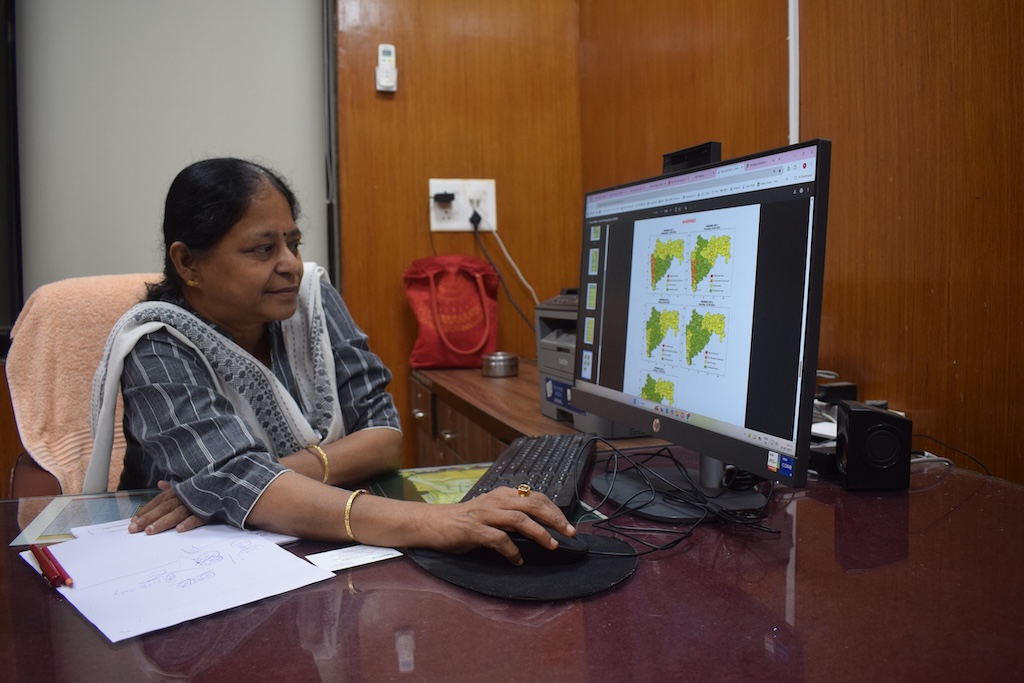
Dr Sushma Nair, a meteorologist with the India Meteorological Department’s (IMD) regional monitoring centre, has the unenviable job of getting it right.
Nair and her team work out of the Colaba Observatory, at the southernmost tip of the city. Established in 1826 by the East India Company, it is one of world’s longest-running observatories and is older than the IMD itself – as well as many parts of the city that have been reclaimed from the sea.
“As weather-in-charge, it’s a 24/7 job,” Nair told Carbon Brief during a visit to the observatory.
Nair’s day begins at 8:30am, when her team prepares a forecast, checks upper air observations, runs models and decides what colour – yellow, orange or red – to assign the region for the next 24 hours, before hopping on a video call with her regional contemporaries and the IMD HQ.
“No journalist will get a forecast from us before 11:30 or 12:30, because we are discussing the weather,” she said.
Meteorological Centre has a Nowcast that refreshes every three hours, allowing forecasters to account for sudden changes in the weather and upgrade the city to a red alert, based on satellite and radar warnings.
Nair confesses that she “normally” checks the Nowcast at 4am, “because I lose my sleep at 3am”, and has the city’s chief disaster manager on speed dial for a red nowcast, no matter what the hour. “I am an insomniac, so don’t take that as a regular forecaster’s sleep hours,” she joked.
Her biggest source of dread is two-hour intense downpours in which the island city receives more than 150mm of rain, caused by an offshore vortex that is a “very small-scale, sub-grid system” that weather models cannot capture. She said:
“Low-pressure cyclonic systems, we can see coming. [But] this is the goblin that I haven’t seen who rushes in usually at night, creates havoc and leaves. Climate change is already contributing to these types of events: a whole lot of rain in smaller spells.”
As a coastal city, scientists told Carbon Brief that the city should be prepared to soak in 300mm of rain, but, because of choked drains, rivers and built infrastructure, it currently cannot even take in 100mm.
Mumbai’s monsoon ‘war room’
Fifteen minutes away from the observatory, a whiteboard in the Brihanmumbai Municipal Corporation’s (BMC) “monsoon war room” shows the state of affairs: rivers that should have been desilted by May are still only 66% done.
In its disaster control room three flights down, the phones will not stop ringing. The city’s residents, police and fire brigades are calling to report waterlogging, fallen branches and landslides.
While one giant screen streams live CCTV footage from 25 of the city’s worst traffic chokepoints, another screen shows live Doppler radar footage – when it is working.
“Whatever resources an emergency needs, we mobilise them from this control room,” a senior BMC disaster management official told Carbon Brief:
“If we get an orange alert from the IMD, all of our agencies, the navy, army: all of them get an alert message from us asking them to stand by.”
Many fault the BMC for delayed alerts, desilting and a city dug up beyond recognition. Officials say they are using all platforms – from X to SMS – to warn people about monsoon impacts. They blame TV channels that have “stopped carrying the news” – and people who have stopped watching it for weather updates – for a lack of awareness. The official told Carbon Brief:
“We have sufficient funds. You can’t reduce natural hazards and, in such a crowded city, to survive, the only thing that can save you is your wits.”
Watch, read, listen
ET TU, PETROSTATE? A Foreign Affairs essay by two US professors argued that, as the US’s energy exports have grown, it has “begun to behave more like a classic petrostate”, less likely to “embrace multilateralism and cooperate on international rules”.
ADRIAN VS ADANI: BBC World Service’s Life at 50C had a new documentary following Indigenous Queenslander Adrian Burragubba’s “battle against Adani[‘s]” coal mine in Australia’s Galilee Basin.
NO SHADE: Adaptation policy researcher Aditya Valiathan Pillai spoke to the Migration Story about heat stress and the “politics of shade”.
Coming up
- 16-26 June: SB42 climate talks, Bonn
- 16-20 June: 79th meeting of the World Meteorological Organization’s Executive Council, Geneva
- 23 June-4 July: International Seabed Authority legal and technical commission meeting (Part II), Kingston
- 23-27 June: States parties to the United Nations Convention on the Law of the Sea, 35th meeting, New York
Pick of the jobs
- Bruegel, energy and climate economist | Salary: Unknown. Location: Brussels
- The Economist, editorial intern for the digital department | Salary: £30,000. Location: London
- Bertha Foundation, fellowship for filmmakers, lawyers and jouranalists | Fellowship: Up to $64,900 for a year. Location: Remote
DeBriefed is edited by Daisy Dunne. Please send any tips or feedback to debriefed@carbonbrief.org.
This is an online version of Carbon Brief’s weekly DeBriefed email newsletter. Subscribe for free here.


The post DeBriefed 20 June 2025: Three years to ‘keep 1.5C alive’; Bonn talks turn ‘bitter’; Inside Mumbai’s monsoon ‘war room’ appeared first on Carbon Brief.

Next week, diplomats from around the world will descend on Yerevan, Armenia, to negotiate a series of decisions under the UN Convention on Biological Diversity (CBD).
Between 19 and 30 October, 196 parties will gather to hammer out the precise wording of the dozens of legal texts that make up the decisions under the Conference of the Parties (COP) to the CBD.
This year’s summit is particularly significant, as it marks the halfway point between the agreement of the Kunming-Montreal Global Biodiversity Framework and the deadline for achieving its targets.
The CBD has found that countries are currently not on track to meet 22 out of the framework’s 23 targets.
During the fortnight, delegates will also be negotiating decisions relating to the two supplemental protocols to the CBD: the Cartagena Protocol, which covers biosafety; and the Nagoya Protocol, which covers access and benefit-sharing for the use of genetic resources.
(The Cartagena and Nagoya Protocols, which are each governed by a “meeting of the parties”, or “MOP”, have fewer parties than the CBD as a whole, with 173 and 141, respectively.)
Carbon Brief is tracking the progress of countries towards consensus on dozens of negotiating texts using the interactive table below.
The tracker includes texts from the COP, as well as the MOPs for the Cartagena and Nagoya protocols. It also includes draft decisions from the most recent subsidiary body meetings, as these form the starting point for the negotiations in Yerevan.
The CBD has three subsidiary bodies: the subsidiary body on scientific, technical and technological advice (SBSTTA), the subsidiary body on implementation (SBI) and the subsidiary body on article 8(j) and other provisions (SB8J).
SB8J focuses on issues related to the Indigenous peoples and local communities. It was established at COP16 in Cali, Colombia, in 2024.
The first two columns of the interactive tracker list the topic of each agenda item and the relevant body, with subsequent columns including dates, page counts and links to the original documents.
The table is searchable and can be sorted using the arrows in the header.
Areas of disagreement in UN draft texts are denoted by square brackets. Counting the brackets in a particular iteration of a text therefore gives a sense of how far parties are from reaching consensus.
The bracket column is colour-coded, with dark green indicating a low number of brackets and red indicating a high number of brackets remaining.
Texts can also present parties with choices using “options” or alternatives (“alt”), which are counted together in the sixth column of the table.
The key discussions in Yerevan will centre around two agenda items in particular. The first is the global review, which will assess progress towards the GBF and make recommendations for accelerating action.
The second is finance, which can be separated into two parts: resource mobilisation and the financial mechanism. On resource mobilisation, biodiverse global south countries are likely to push for an increased amount of international finance for conservation.
Disagreement over the creation of the financial mechanism led to the suspension of COP16 in Cali in October 2024, as parties failed to find agreement on the mobilisation of finance before the end of the summit.
Global south countries want the establishment of a separate financial mechanism under the control of the CBD; global north countries largely prefer to maintain the existing mechanism, which sits under the Global Environment Facility.
At the resumed session of COP16 in Rome in early 2025, countries agreed on a roadmap that would lead to the establishment of a permanent mechanism.