

Welcome to Carbon Brief’s DeBriefed.
An essential guide to the week’s key developments relating to climate change.
This week
Oil prices rebound
OIL UP AGAIN: Oil prices surged by more than 7% and back above $100 a barrel on Monday after US-Iran peace talks faltered and US president Donald Trump ordered the blockading of Iranian ports, reported BBC News. The jump came after prices fell last week in the wake of the announcement of a conditional two-week ceasefire, it said.
RESCUE PLANS: European countries unveiled plans to protect citizens and businesses from rising energy prices. Ireland announced a support package worth €505m, reported BBC News, while Germany agreed on measures worth €1.6bn, said Bloomberg. Meanwhile, Reuters reported on a draft EU proposal due to be unveiled next week that would see the bloc reduce electricity prices and roll out clean energy more quickly in response to the crisis.
UNSOLICITED ADVICE: Trump renewed his criticism of UK energy policy and called on the government to “drill, baby drill”, reported the Independent. Via social media, the president said: “Europe is desperate for energy, and yet the United Kingdom refuses to open North Sea oil, one of the greatest fields in the world. Tragic!!!” (See Carbon Brief’s recent factcheck of various false claims about the North Sea.)
Around the world
- C-WORD: Faced with pressure from the US, countries attending spring meetings of the International Monetary Fund and World Bank were urged to “not mention the climate”, reported the Guardian. It added that plans to agree a new “climate change action plan” for the World Bank “may be shelved, along with substantive discussion of the climate crisis”.
- NEW DIRECTION: Péter Magyar’s landslide victory over Victor Orbán in Hungary’s elections “presents new opportunities for the country to reduce emissions and invest in clean energy”, reported Time. Carbon Brief explored what it means for European climate action.
- ‘FURNACE’ SUMMER: There was widespread coverage – including in the Boston Globe, ABC News, CNN, Euro Weekly News, Guardian and New Scientist – of warnings from meteorologists of the development of a “super” El Niño phenomenon that could ramp up temperatures and drive extreme weather.
- ANTALYA COP: The Turkish government unveiled the dates and venues for the “leaders’ summit” segment of November’s COP31 conference, according to Climate Home News.
- PACIFIC PRE-COP: Meanwhile, the Guardian reported that Tuvalu will host a special meeting of world leaders before the climate summit in Antalya.
€10bn a year
The amount of state support that French prime minister Sébastien Lecornu has pledged for electrification through to 2030 in a bid to reduce the country’s dependence on fossil fuels. In a speech late on Friday 10 April, Lecornu noted the figure amounted to a “doubling” of existing support.
Latest climate research
- Over a four-month period of 2023, more than 70% of editorials discussing net-zero in four right-leaning UK newspapers included “at least one misleading statement” | Climate Policy
- Air pollution from global transport currently has a net cooling effect that offsets 80% of the warming impact of the sector’s CO2 emissions | npj Climate and Atmospheric Science
- The incorporation of “observational constraints” into climate-model projections suggests that the Atlantic Meridional Overturning Circulation could weaken by 50% by 2100 in a medium-emissions scenario | Science Advances
(For more, see Carbon Brief’s in-depth daily summaries of the top climate news stories on Monday, Tuesday, Wednesday, Thursday and Friday.)
Captured
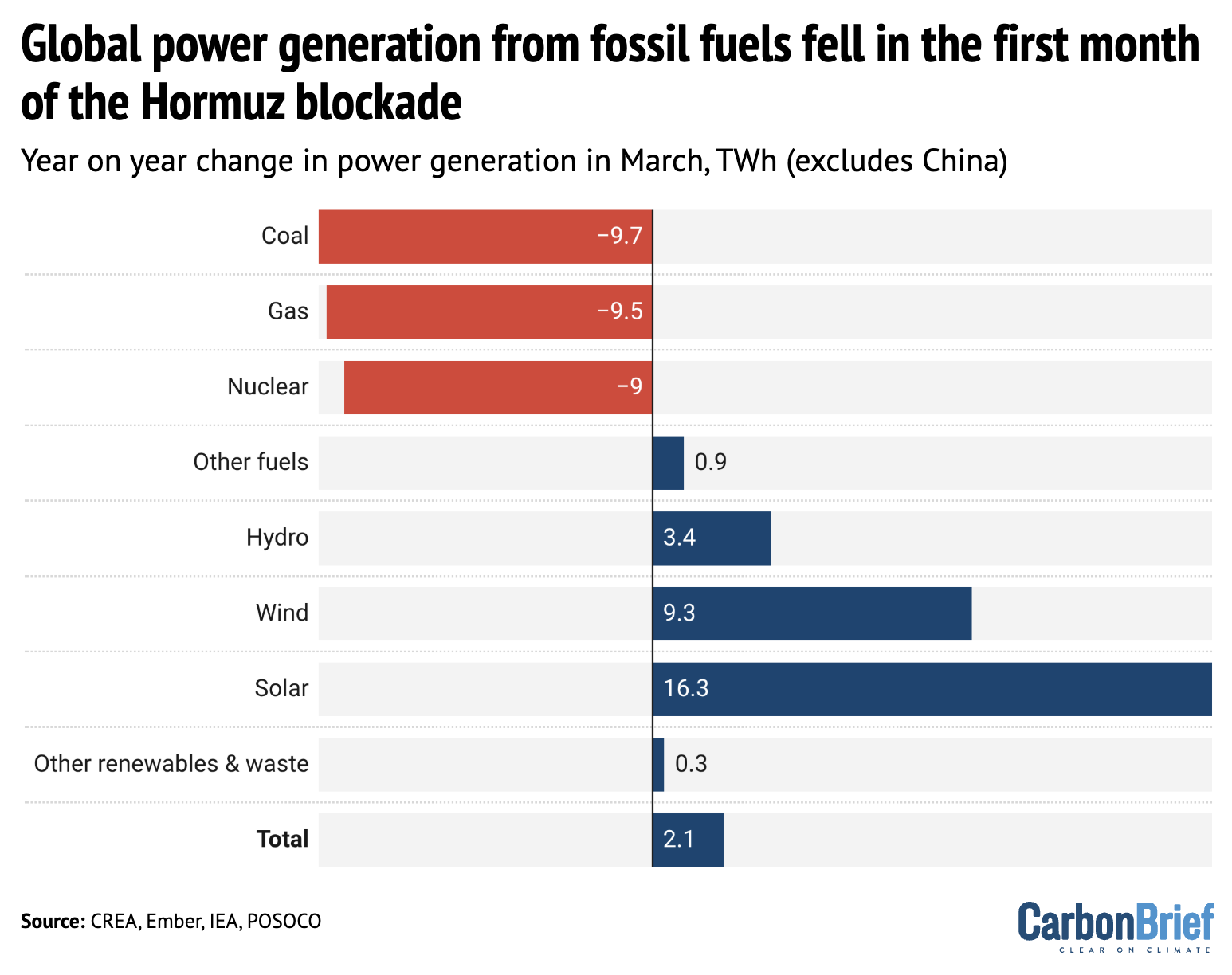
Analysis by the Centre for Research on Energy and Clean Air (CREA) found that global electricity generation from fossil fuels fell in the first month of the closure of the Strait of Hormuz. Across all countries with real-time electricity data outside of China, coal-fired power generation fell 3.5% and gas-fired power generation fell 4.0%, according to CREA. This was offset by a rise in solar power and wind generation, which increased by 14% and 8%, respectively. Hydropower generation also saw a small increase, the analysis showed, but this was “more than offset” by a drop in nuclear power generation.
Spotlight
How climate change affects Afghan lives
This week, Carbon Brief reports on the impact of climate change in Afghanistan, following deadly floods this year.
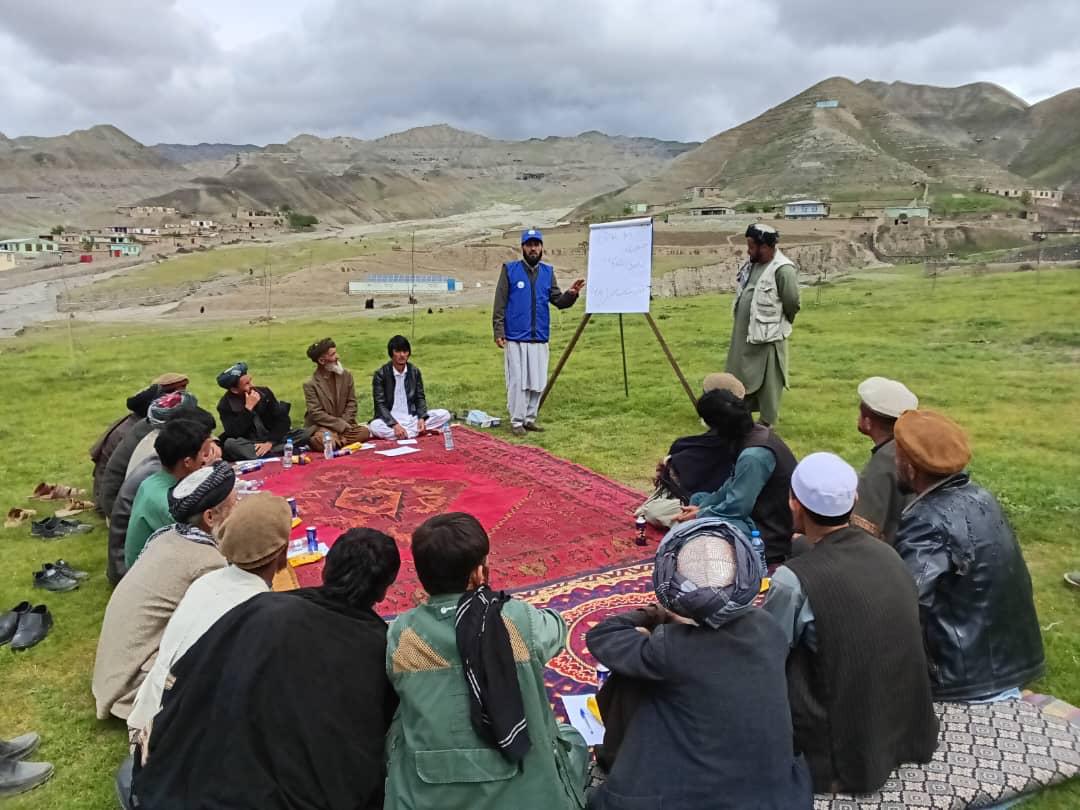
Earlier this month, heavy rains, flash floods and landslides struck large parts of Afghanistan, damaging thousands of homes, destroying crops, bridges and roads and taking nearly 100 lives.
The flooding – reported to have affected 74,000 people in 31 of 34 provinces – is the latest weather-related catastrophe to afflict the nation, whose communities have suffered the brunt of repeated flash floods, droughts and landslides in recent years.
Hameed Hakimi, non-resident senior fellow at the Atlantic Council’s South Asia Center, told Carbon Brief the recent floods would hurt livelihoods and food security, noting reports of destroyed wheat and rice crops in the most affected eastern parts of the country. He said:
“This is common. For at least a decade now, [we have seen] these flash floodings and the damage that happens to rural life, farming, the disruption to crops…Flash flooding physically eats up the land. So, it not only damages where people live, but also people’s livelihoods, based on what they grow.”
The damage to crops will be felt acutely, he explained, given that food security in the landlocked nation is already strained by the blockage of its main transit trade artery through Pakistan and international sanctions that have frozen long-term development aid.
Speaking to Carbon Brief, Abdulhadi Achakzai, founding CEO of the Environmental Protection Trainings and Development Organization (EPTDO), an Afghan NGO, described flooding in Afghanistan as a “chronic situation”.
Achakzai, whose organisation runs projects that help urban and rural communities adapt to climate impacts, says climate change hurts the country in four key ways: extreme drought; extreme temperature; “natural hazards”, including landslides and dust storms; and, finally, flash flooding. He said:
“Climate change is a serious matter in Afghanistan. Every nation and every corner within this country is severely affected.”
Ranked 176 of 187 on the University of Notre Dame “global adaptation index”, Afghanistan is among the countries most vulnerable to climate change.
Average temperature across the country has increased from 12.2C in 1960 to 14.2C in 2024, according to the World Bank’s climate change knowledge portal. Drought is widespread, severe and persistent – harming food and water security in a nation of subsistence farmers.
Meanwhile, extreme weather events are the leading driver of internal displacement in the country. More than three-quarters of the 710,000 people who relocated within Afghanistan in 2024 did so driven by “environmental hazards”, such as drought and flood, according to a recent climate vulnerability assessment from the International Organization for Migration.
Finance struggles
Despite feeling the impacts of extreme weather, Afghanistan has been barred from UN climate negotiations and had limited access to climate finance since 2021. (The government attended COP29 in Baku as guests of the Azerbaijan hosts, but did not take part in formal negotiations.)
This is because the international community does not recognise the Taliban government, which resumed power in 2021, due to its record on human rights and its repression of women and girls in particular.
Almost all financing from key climate funds has been suspended, with the exception of a few projects where UN agencies and NGOs act simultaneously as a “requesting” and “implementation” partner.
Aid from UN climate funds fell from $5.9m annually over 2014-20 to $3.9m annually over 2021-24, according to recent analysis by the Berghof Foundation. Multilateral development banks provided a further $337m of funds badged as “climate finance” over 2021-23, it said.
By comparison, Afghanistan’s national climate plan, submitted to the UN Framework Convention on Climate Change (UNFCCC) in 2016, requested $17.4bn in climate finance over 2020-30. An updated national climate plan seen by Carbon Brief – completed in 2021 and later endorsed by the Taliban government, but not accepted by member governments of the UNFCCC – called for $20.6bn through to 2030.
Achakzai, whose organisation attends the COP climate summit each year in an observer capacity, has in the past been the sole delegate from Afghanistan to the conference.
He is calling on the UNFCCC to accept the country’s latest climate plan – and to find an “alternative solution” that would give the people of the country a voice in negotiations. He said:
“Every year we are losing hundreds, thousands of people because of climate change-related matters. Every year we are losing hundreds, thousands of hectares of crops. We are affected by [the decisions of] other countries. Why are we not part of this process?”
Watch, read, listen
BLOSSOM WATCHER: The Guardian reported on the successful search to find a researcher to continue Japan’s 1,200-year cherry blossom record.
COP OUT: Deutsche Welle spoke to experts to understand why India walked away from its bid to host COP33 in 2028.
‘BOMBS AND PORN’: The New Republic looked at who is set to benefit from the rapid build-out of energy-intensive AI datacentres.
Coming up
- 20-24 April: Intergovernmental Panel on Climate Change (IPCC) working group one report author meeting, Santiago, Chile
- 22 April: Earth day
- 22 April: Launch of third edition of the Lancet Countdown’s Europe report
- 24-29 April: First conference on transitioning away from fossil fuels, Santa Marta, Colombia
Pick of the jobs
- International Organization for Migration, senior thematic associate (climate action) | Salary: UN G-6 salary grade | Location: Dakar, Senegal
- Climate Action Network UK, several board member roles | Salary: Unknown. Location: Unknown
- UK Department for Energy, Food and Rural Affairs, G7 science lead | Salary: £56,375. Location: Bristol, London, Newcastle-upon-Tyne or York, UK
- Save the Children UK, senior climate change advisor | Salary: £62,000-£65,000. Location: London
DeBriefed is edited by Daisy Dunne. Please send any tips or feedback to debriefed@carbonbrief.org.
This is an online version of Carbon Brief’s weekly DeBriefed email newsletter. Subscribe for free here.


The post DeBriefed 17 April 2026: Fossil-fuel power slumps | ‘Super’ El Niño warning | Afghanistan’s climate struggle appeared first on Carbon Brief.

An Lambrechts is a biodiversity politics expert at Greenpeace International with extensive experience in biodiversity-related multilateral negotiations. She is the head of the Greenpeace delegation at the Convention on Biological Diversity (CBD) COP17 happening in Yerevan, Armenia.
In 2022, COP15 delivered the landmark Kunming-Montreal Global Biodiversity Framework to halt and reverse biodiversity loss by 2030. With COP17 starting in Yerevan, we are now halfway to the deadline, and according to the first Global Review of progress, countries are not on track to meet the biodiversity targets, and implementation must accelerate fast.
One of the main findings of the Global Review is that funding falls far short of the scale needed to halt and reverse nature loss. But the crisis facing the world’s biodiversity is not an absolute scarcity of capital – it is a profound public policy distortion.
The global economy currently spends roughly $30 destroying nature for every single dollar invested in its protection. According to a report from the Intergovernmental Science-Policy Platform on Biodiversity and Ecosystem Services, a staggering $2.4 trillion is spent in public subsidies for fossil fuels, agriculture and water use, while global investment in biodiversity conservation and restoration stands at a mere $220 billion.
Countries urged to ramp up “insufficient” nature policies at COP17
Yet, discussions about how to close the biodiversity finance gap continue to claim that salvation lies in mobilising private capital, scaling offsets and “derisking” investments in nature. This is a fundamental misunderstanding of both the nature of ecological stewardship and of the global financial architecture.
Biodiversity conservation is not a speculative investment portfolio – it is the foundation of human survival. The health of our planet is a non-monetisable, non-excludable public good. Expecting profit-seeking private capital to protect nature perpetuates the structural drivers of ecosystem destruction in the first place.
But if private market mechanisms cannot save biodiversity, where will the necessary public resources come from?
Money going to the wrong places
The answer lies in recovering the vast public wealth currently drained by cross-border tax abuse, financial secrecy and corporate impunity. Finance and environment ministers meeting in Yerevan must give a strong political signal that, to avert ecological breakdown, countries need to take swift action to reform global tax rules, eliminate harmful public subsidies and cancel unsustainable sovereign debts for the public revenues to end up where they belong.
Extractive sectors such as industrial agriculture, fishing, timber and mining continue business-as-usual, often heavily subsidised by public treasuries, while voluntary carbon and biodiversity offset markets pose a serious risk to nature conservation. Offset schemes have delivered only a negligible fraction of the funding needed to preserve ecosystems, allowing industries to continue with their destructive business-as-usual practices.
-
Global deforestation slowed in 2025 but Brazil’s election could undo “fragile” gains
Countries remain 70% off track to meet a goal to end deforestation by 2030, as progress in Latin America offset by failures in Africa -
Brazil confident new rainforest fund will reach $10bn donor milestone
Brazil’s environment minister said the Tropical Forest Forever Facility has raised billions in record time – which he hopes will convince more investors


In advanced economies, public funding often actively undermines biodiversity. In Europe, over €5.3 billion in public subsidies is funnelled annually into intensive forest biomass harvesting under renewable energy directives, degrading primary forest ecosystems and undermining long-term climate resilience. Pleading with private investors to fill a “finance gap” while pouring billions into ecological destruction is an exercise in futility.
Developing countries struggle with debt burden
For developing countries, reliance on private finance is further compounded by a crushing sovereign debt crisis. In 2024, public debt in developing economies reached record levels, with net interest payments alone absorbing $921 billion. A record 61 developing countries now spend more than 10% of government revenue on foreign debt service, with many climate-vulnerable nations spending twice as much servicing external debt as they receive in climate and biodiversity finance combined.
This burden acts as a structural driver of ecosystem destruction. Under pressure from external creditors and international financial institutions to avoid default and secure foreign exchange, governments are routinely forced into austerity measures and pushed to expand raw commodity exports into pristine biomes.
Comment: World Bank and IMF should lead the financial system in responding to the climate crisis
The current negotiations for a United Nations Framework Convention on International Tax Cooperation (UNFCITC) also offer a way forward. An estimated $492 billion in tax revenue is lost every year to offshore tax havens. Multinational corporations account for around $348 billion of this total by shifting profits away from the countries where real economic extraction and environmental degradation occur.
In the mining sector alone, developing nations lose tens of billions annually to corporate tax dodging. Furthermore, international financial secrecy shields environmental criminals, with illicit financial flows from illegal logging draining between $51 billion and $152 billion annually.
At COP17, leaders must seize the opportunity to build a bridge between the two conventions and enhance cooperation. Governments must put the world on a firm path to securing predictable, sufficient, sovereign public finance for biodiversity conservation. It’s the only path to a restorative, rights-based future for people and the planet.
The post Protecting nature is a public duty, not a Wall Street profit opportunity appeared first on Climate Home News.
Protecting nature is a public duty, not a Wall Street profit opportunity
Climate Change
Greenpeace delivers 47 metre-long petition with half a million signatures to Woodside HQ following major gas protest
Greenpeace delivers 47 metre-long petition with half a million signatures to Woodside HQ following major gas protest
PERTH, Monday 19 October 2026 — Dozens of Perth community members delivered a giant petition, signed by almost half a million people, to Woodside’s corporate headquarters this morning, calling on the government to save Scott Reef from Woodside’s reckless Browse gas proposal.
Dressed in sea creature costumes and hats, supporters carried one of Australia’s biggest environmental petitions to Woodside’s headquarters, and a local choir performed a ‘Scott Reef’ rendition of Angie McMahon’s iconic cover of ‘Reckless’ by Australian Crawl.
On the sidelines of the Perth Global Citizen Now event, it comes following a two day-long protest at Woodside’s Scarborough gas platform that saw activists scale and occupy the Floating Production Unit calling to “Stop Woodside’s Dirty Gas” and “Save Scott Reef”. The activists were taken from the platform by police helicopter on Sunday afternoon.
David Ritter, CEO at Greenpeace Australia Pacific, said: “Less than a day after two Greenpeace Australia Pacific activists were arrested for their peaceful protest at Woodside’s Scarborough gas platform to save Scott Reef, we are here again with another message to Woodside: half a million of us do not want your dirty gas at Scott Reef.
“Community pressure on Woodside is rising. Today we are here to show Woodside that they can’t ignore half a million people who want Scott Reef protected, not turned into an industrialised gas zone.
“Woodside can’t be trusted with our oceans. Woodside’s plans to drill up to 57 toxic wells at Scott Reef, Australia’s largest oceanic reef, putting endangered pygmy blue whales at risk, and jeopardising a nesting ground for unique green sea turtles.
“We Australians love our oceans and this is an opportunity for our governments to do the right thing, to reject Woodside’s reckless drilling plans, and save Scott Reef.”
-ENDS-
Media contact
Kate O’Callaghan on +61 406 231 892 or Emma Sangalli on +61 431 513 465