

Welcome to Carbon Brief’s Cropped.
We handpick and explain the most important stories at the intersection of climate, land, food and nature over the past fortnight.
This is an online version of Carbon Brief’s fortnightly Cropped email newsletter. Subscribe for free here.
Snapshot
At the UN general assembly in New York, climate change was one of the main agenda items, with the secretary general convening the first-ever “climate ambition” summit.
As part of a new week-long series, Carbon Brief examined the ins and outs of carbon-offsetting.
A landmark Brazil supreme court ruling on land rights was widely hailed as a “great victory for Indigenous peoples”.
Key developments
UN’s first-ever ‘climate ambition’ summit
‘DANGEROUS AND UNSTABLE’: As part of the UN general assembly in New York, secretary-general António Guterres convened the first-ever “climate ambition” summit, inviting 34 leaders to speak “in recognition of their strong action on climate change”, notably omitting the US, UK, China, India and COP28 hosts the United Arab Emirates, Reuters reported. At the summit, Guterres warned that society was moving “towards a dangerous and unstable world”, citing “distraught farmers watching crops carried away by floods” as one of the “horrendous effects” of unabated fossil-fuel use, according to Politico. Dennis Francis, a diplomat from Trinidad and Tobago, warned the summit of “potential catastrophe” due to sea level rise, adding that “fertile river deltas like the Mississippi, Mekong and Nile – the world’s breadbaskets – are sinking”, a UN News story said.
AMBITION AND ASSISTANCE: Brazil “brought the biggest news to the table” at the summit, Climate Home News wrote, announcing its plan to “undo former president Jair Bolsonaro’s cuts to its climate ambition and strengthen its targets further”. The country now plans to cut emissions by 48% by 2025 and 53% by 2030. Meanwhile, leaders from several island nations castigated rich countries at the general assembly, with Marshall Islands president David Kabua calling for “the establishment of an international financing facility to assist small island and low-lying atoll nations facing natural disasters”, according to a separate Reuters piece. Another event at the general assembly was the first-ever meeting of the Commonwealth environment and climate ministers. At the meeting, the ministers “noted the role of ecosystem-based approaches, ocean action, land restoration and food-systems transformations in climate resilience and sustainable development”, said a press release from the Commonwealth.
HIGH-SEAS SIGNATORIES: Also at the general assembly, 76 nations and the EU signed the high-seas treaty, “signalling interest in ratifying the agreement designed to protect marine biodiversity in international waters”, Mongabay said. The signing marks a “significant step” towards conserving the high seas, which make up around two-thirds of the world’s oceans, the outlet added. Each country must now ratify the treaty according to its own procedures; once 60 nations have done so, the treaty can finally come into force. The Pacific Islands News Association quoted Pacific Ocean commissioner Dr Filimon Manoni, who said that “to be truly paradigm-shifting, we must aim towards universal participation” in the treaty.
Carbon offsets series
NEW SERIES: Carbon Brief examined the topic of carbon-offsetting in a new week-long series of articles delving into the impact, history and controversies of offsets. As part of the series, Aruna Chandrasekhar wrote an in-depth Q&A on ‘biodiversity offsets’, which have been promoted as one of the key ways to support nature conservation and its goals. Biodiversity-offsetting “sits at the heart” of tensions between biodiversity-rich developing countries demanding more public finance and “debt forgiveness” to help them meet biodiversity targets and rich countries rolling out new “nature markets”. The piece discussed the history, concerns and use of these offsets.
ALL THINGS OFFSETS: In the main article of the series, Carbon Brief examined all aspects of carbon-offsetting. The outlet’s international team of journalists explained what offsets are, how they are used by businesses and nations and why they can be a problematic climate solution. It also explored whether the carbon-offsetting system, which one expert described as “deeply broken”, could ever be effectively reformed. This infographic further explained how offsets work by following the journey of a fictional carbon offset purchased on the voluntary market. Elsewhere, a recent report found that rainforest conservation offset projects are not suitable and a different approach should be used to safeguard critical ecosystems, according to the Guardian.
CLOSER LOOK: In a separate Carbon Brief piece, Daisy Dunne and Yanine Quiroz trawled through news stories and investigations into individual carbon-offset projects to create a detailed map showing the global scale of these initiatives. They found that 70% of the articles examined showed evidence of the projects causing harm to Indigenous peoples and local communities. Almost half of the reports found evidence of offset projects overstating their ability to reduce emissions. To round out the week of reporting, Carbon Brief is hosting a free webinar at 3pm UK time tomorrow, Thursday 28 September, where a group of expert panellists will discuss how carbon-offsetting could be reformed. Click here to register.
Brazil Indigenous victory
LAND RIGHTS: Brazil’s supreme court ruled against a “highly controversial time-frame proposal” that would have “stripped Indigenous rights” to land, according to Mongabay. Indigenous chief Arakuã Pataxó told the outlet: “Without a doubt this is a great victory for Indigenous peoples.” The “time-frame thesis”, if approved, would have prevented Indigenous claims to traditional lands that they had not physically occupied before 5 October 1988, when Brazil’s constitution was enacted. Brazil Reports said this would have “overlooked that during Brazil’s military dictatorship (1964-85), many Indigenous peoples were persecuted and forced from their lands”, alongside the “obvious challenges” in obtaining proof of land occupation.
TENSIONS RUN ON: The ruling will “reshape the way the state approaches Indigenous land rights in Brazil”, according to the Guardian, setting a precedent that will have “widespread implications for all land-boundary disputes in Brazil”. However, the newspaper said that the ruling will not fully solve long-standing tensions around land conflicts. Indigenous leaders told the newspaper that they remain “anxious about attacks by non-Indigenous tenants”. Farmers said they are also worried about potential conflicts as “frictions emerge when Indigenous ranchers and farmers live in the same region”, the piece noted.
NEW DEAL: Elsewhere, the Cameroon government reached an agreement with the Indigenous Baka people to provide them with “more access to natural resources in the country’s protected forest areas”, Radio France Internationale reported. This expanded on a 2019 deal that gave Baka communities “unfettered access” to two national parks in the south-east of the country, the radio network said. The “original forest dwellers” will now have access to another national park and a wildlife reserve. The country’s minister of forestry and wildlife, Jules Doret Ndongo, said this is “another milestone moment in our efforts to promote the rights of Indigenous people and local communities in the preservation of biodiversity”.
News and views
AG EMERGENCY: Uruguay has extended its agricultural state of emergency until at least the end of the year. The declaration encompasses “livestock, dairy, horticulture, fruit, agriculture, beekeeping, poultry and forestry”, according to the South American news agency MercoPress. The initial declaration was signed on 25 October 2022 due to ongoing drought in much of the country. Uruguayan livestock minister Fernando Mattos said that the country is “on the way to normal rainfall, [but] there is still a long way to go to recover and reach the ideal point”. MercoPress added that the onset of El Niño “is likely to bring above-average rainfall”.
BURNED OUT: Canada’s record-breaking wildfire season – with more than 200 fires still burning across the country – have turned its “vast forests from carbon sink into super-emitter”, the Guardian wrote. The blazes have emitted around 2bn tonnes of CO2, or “triple the country’s annual carbon footprint”, the newspaper said. It added: “Decades of large wildfire and the mass die-off of trees from insects transformed the boreal from carbon sink to source.” Carbon Brief recently attended a US National Academies workshop on measuring greenhouse gas emissions from wildland fires, where experts noted that such emissions are “considered natural and, therefore, are not included in national greenhouse gas inventories”.
FRAUGHT FARM BILL: With the possibility of a US government shutdown looming, “it will be difficult or even impossible for Congress to enact a new farm bill”, Ag Insider wrote. The current bill expires on 30 September – the same day that the government is slated to shut down, although funding for many programmes follows a separate schedule. “There is little peril until dairy subsidies terminate on 31 December,” according to a separate Ag Insider article, which noted that December “is the new target” for the bill’s passage. The farm bill is projected to contain more than $1.5tn of spending, including on nutrition programmes, international aid, conservation work and crop subsidies.
SOMETHING IN THE WATER: The biggest freshwater lake in Ireland and Britain has hit a “crisis point” due to toxic blue-green algae, the Irish Times reported. This cyanobacteria – a type of bacteria that can photosynthesise – has made Lough Neagh “dangerous to anyone or anything that enters the water”, the newspaper added. The “underpinning drivers” of the issue, according to the Northern Ireland department of environment, include “excess nutrients from agricultural and wastewater systems” along with “climate change and the associated weather patterns, with the very warm June, followed by the wet July and August”. The Social Democratic and Labour party launched a motion to recall the devolved government in Northern Ireland, which has been at a standstill since last year, to discuss the “ecological crisis” on Lough Neagh, BBC News said.
COP28 GREENWASHING: DeSmog released a guide to the “greenwashing” terms that “the world’s largest food and farming companies will be using to sway debates” at COP28 in Dubai. Making the list are “regenerative agriculture”, which the outlet wrote “has ‘limited potential’ to mitigate climate change”; “sustainable intensification”, which is “the idea that industrial farming can continue to grow…but can do so while causing less damage”; and “nature-based solutions”, which DeSmog wrote is likely to be invoked during negotiations around the global carbon-credit market. In a separate piece, DeSmog examined the “Pathways to Dairy Net-Zero” group, a collaboration between the UN Food and Agriculture Organization and several other “international groups connected to the dairy industry” that focuses on climate change “solutions that can serve the industry”. DeSmog argued that its focus on improving “efficiency”, rather than reducing pollution, “has only enabled it to produce more milk – and with it, more emissions”.
KIWI FARMERS: “Rural voter anger” towards policies to tackle climate change and reduce emissions may bolster a “return of right-wing parties to power” during an upcoming general election in New Zealand, according to Reuters. Rural voters, who had a “flirtation” with the country’s Labour party in 2020, are looking to conservative candidates on 14 October to “unwind or delay” policies such as “planting pine forests on grazing land and taxing livestock methane burps”. Farmers have staged several protests in the past two years against these regulations, Reuters noted. Similar protests in the Netherlands saw a farmers’ party winning “sufficient support to shake up the country’s senate”, the newswire said, acquiring 16 of the 75 senate seats.
Watch, read, listen
SPROUTING: For Hawai’i Magazine, Kevin Allen wrote about the 150-year-old Lahaina Banyan Tree, which is acting as a “ray of hope” for locals devastated by last month’s Maui wildfires.
INCLUSIVE AG: In the Kathmandu Post, two researchers discussed the “multifaceted challenges” facing the agriculture sector in the mid-hills of Nepal, and how they can be addressed through gender-inclusive policies.
BIODIVERSITY CHATS: BBC Sounds podcast, the Life Scientific, spoke to Alexandre Antonelli, the director of science at the Royal Botanic Gardens, Kew, about his “life spent in the wild”.
CHARRED: A piece by Max Graham in Grist looked at whether the production of biochar – described as a “focal point” in efforts to turn agriculture into a climate solution – can be scaled up.
New science
Earthworms contribute significantly to global food production
Nature Communications
New research found that earthworms contribute to around 6.5% of the world’s grain production. Researchers looked at maps of earthworm abundance, soil properties and crop yields alongside earthworm-yield responses to estimate the impact these invertebrates have on the global production of key crops. They found that impacts were “especially notable” in the global south – for example, earthworms contributed to 10% of overall grain production in sub-Saharan Africa. The scientists concluded that while the earthworm impact is important, they “suspect that other soil biota may be equally as important and that further study is needed”.
Intentional creation of carbon-rich dark earth soils in the Amazon
Science Advances
Ancient peoples in the Amazon used soil management practices to improve soil fertility and crop productivity, according to a new study. Researchers compared modern fertile soil called “dark earth” to that of ancient times, then used studies of present-day Indigenous practices to propose a model of how dark earth may have formed previously. They found that the “ancient and modern dark earth deposits have similar compositions and spatial distributions”, indicating that the former may have also been intentionally cultivated by Indigenous peoples of the time. The researchers wrote that the study “highlight[s] the value of Indigenous knowledge for sustainable rainforest management”.
Likely impacts of the 2022 heatwave on India’s wheat production
Environmental Research Letters
The spring 2022 heatwave in India reduced wheat production in some regions by up to 15% compared to a normal year, a new study found. The researchers built a statistical model using weather and wheat-production data from 1967-2018 across five Indian states that together produce around 90% of the country’s wheat. The results showed that the heatwave reduced wheat yields by 4.5% on a national scale. The likelihood and intensity of heatwaves are due to continue as a result of climate change, the researchers wrote, so “timely forecasts of their impacts on agriculture are critical”.
In the diary
- 29 September: UN International day of awareness on food loss and waste reduction
- 2-6 October: FAO 30th session of the Asia-Pacific Forestry Commission | Sydney
- 3-6 October: EUROPARC conference 2023 | Leeuwarden, Netherlands
- 3-6 October: UNEP Fifth forum of ministers and environment authorities of Asia Pacific | Colombo, Sri Lanka
- 4-5 October: FAO Rome water dialogues | Rome
- 9-13 October: UNEP Final intergovernmental consultations on nature-based solutions | Nairobi
Cropped is researched and written by Dr Giuliana Viglione, Aruna Chandrasekhar, Daisy Dunne, Orla Dwyer and Yanine Quiroz. Please send tips and feedback to cropped@carbonbrief.org
The post Cropped 27 September 2023: UN’s ‘climate ambition’ summit; Carbon offsets series; Brazil Indigenous victory appeared first on Carbon Brief.

The launch of the Africa Energy Bank (AEB) has been put back yet again, raising doubts about the institution’s future ability to finance fossil fuel projects – its main objective – as global lenders retreat from such investments over climate concerns, experts told Climate Home News.
The bank, which had been billed to launch in September after a series of delays, is now scheduled to begin operations in November, according to the head of the African Energy Chamber, an advocacy body for the continent’s oil and gas sector.
Even as the world aims to transition away from fossil fuels, many African leaders have made clear they want to continue exploring and extracting the continent’s large oil and gas deposits – estimated at around 125 billion barrels of crude and over 600 trillion cubic feet of gas – to boost economic development.
As a group, Africa sided with a number of powerful oil-and-gas producing nations in blocking progress on negotiations to craft a global roadmap to transition away from fossil fuels at last year’s UN COP30 climate talks, although some countries did individually support the proposal.
-
Campaigners oppose Dangote’s planned Kenya refinery over climate and ecological risks
Plans to build Africa’s second largest oil refinery in ecologically sensitive region criticised as “environmental recklessness” -
Tanzania pushed African nations to oppose fossil fuel transition at COP30
While chairing the African group at the summit, the gas-dependent nation advised the continent’s ministers to block language on transitioning away from fossil fuels


Meanwhile, major projects under development across the continent – including the 1,443-km East African Crude Oil Pipeline (EACOP) and Dangote’s 700,000-barrel-per-day Kenyan refinery – show that African governments see oil and gas as playing a significant role in meeting their energy and economic needs for many years to come.
In 2022, at a gathering of the African Petroleum Producers’ Organization (APPO) in oil-rich Angola, ministers from its member states adopted a resolution to create the Africa Energy Bank to finance projects for the production, use and trade of oil, gas and broader energy sources.
African control over energy resources
An article on the APPO website explains that the bank was conceived as a way to overcome “disenchantment” with fossil fuels among “the international community” which it said had crystallised around the “energy transition” concept.
“If Western countries, after having long taken advantage of the energy sources they now revile to develop, can afford the luxury of abandoning them, this is not the case in Africa,” it adds, noting that many of the continent’s economies are still largely dependent on oil and gas revenues.
A separate web page about the bank, also hosted on APPO’s website, says its objectives include financing the exploration, production and refining of oil and gas, as well as supporting member states in transitioning from fossil fuels to cleaner energy sources “while ensuring energy security”.
Said Addi, a former executive with Shell and energy commodities trading house Gunvor, said the new bank was judged necessary because financing for hydrocarbons from many traditional international lenders has become constrained.
In trying to fill this financing gap, Africa is not simply setting up another fund to support oil and gas, he added. “It is also an attempt to give African countries greater control over how their energy resources and infrastructure are financed,” he explained.
Nigeria to host the AEB
The energy bank – a joint initiative of APPO and the African Export–Import Bank (Afreximbank) – has so far suffered several delays and is almost two years behind schedule. The initial plan was to start operations in January 2025, with Nigeria as the host country, but the bank’s opening was delayed to June of that year to allow Nigeria time to finalise the construction of the bank’s headquarters in Abuja.
After the government announced the completion of the offices in late November 2025, a new launch date was set for January 2026, which was moved back to April, June and then September. Now it has shifted again to November, raising concerns that the institution may be losing momentum.
Former Shell executive Addi said that if the capital is eventually paid in, the bank becomes operational and its first projects are commercially credible, then the delays will be regarded as normal teething troubles in setting up a multilateral institution. But, he added, scepticism will be justified if it continues to stall.
Uganda may see lower oil revenues than expected as costs rise and demand falls
Baron Lamarré, an oil and gas expert and former Petronas oil trader, said that missing “three deadlines in a row is not normal”, and warned that if the timeline slips again, “the story flips from ‘ambitious institution finding its footing’ to ‘good idea that lost momentum before it found any’.”
The Nigerian government, APPO and Afreximbank did not respond to requests for comment by the time of publication.
The funding challenge
The Africa Energy Bank is targeting base capital of $5 billion, with plans to scale up to $120 billion within five years by mobilising private-sector funds. However, it is expected to start operations with initial seed capital of $500 million.
The funding plan is to have the 18 member countries of the APPO contribute $83 million each to the bank as equity for a combined $1.5 billion. Afreximbank, other non-APPO African countries and investors outside the continent are expected to provide the remaining $3.5 billion.
But even the initial $500 million has not been easy to mobilise. In May, APPO Secretary-General Farid Ghezali called on members to deliver on their pledges towards the startup goal before the end of June. But the delays suggest this may not have been met, with experts saying Africa may be finding it difficult to self-fund its oil and gas projects in the absence of international capital.
Lamarré said every extension of the deadline points to the fact that “raising fossil fuel capital in Africa without the majors and their financing networks is brutally hard”.
Why the global electrification agenda misses the point on Africa’s energy crisis
Since 2020, Western lenders, export credit agencies and insurers have been in steady retreat from African hydrocarbons, he said, while oil majors are divesting their African assets, handing over fields to smaller local operators whose credit ratings are not high enough to borrow cheaply.
Even capital from China and the Gulf, which has partially filled the gap, cannot match the volume, tenor or pricing that Western investors once offered, Lamarré argued.
“If mobilising the first $500 million of seed capital [for the AEB] has taken this long, that’s the clearest signal yet of how steep the climb to $120 billion looks,” he said, noting that the continent’s energy financing gap is as large as $30 billion-$45 billion per year.
Africa’s investment landscape, meanwhile, has been shifting. While foreign direct investment dropped from a 2024 peak, inflows remained roughly one-third above the continent’s long-term average in 2025, according to the 2026 World Investment Report from UN Trade and Development (UNCTAD). They are concentrated in a few sectors including critical minerals needed for renewable energy technologies, battery manufacturing and advanced industrial production.
At the same time, data on global energy investment from the International Energy Agency (IEA) shows that fossil fuel investment in Africa has declined over the last decade.

“Trojan horse” for fossil fuels
While the Africa Energy Bank struggles to get off the ground, climate campaigners have criticised its primary aim of financing oil and gas on the continent at a time when the world is starting to move away from high-carbon fuels to cleaner alternatives.
Bhekumuzi Dean Bhebhe, founder of Africa Change Lab, described the bank as a “Trojan horse”, arguing that its focus on fossil fuel financing runs counter to the global energy transition and the African Union’s Agenda 2063 goals of sustainable development and inclusive growth.
The energy bank, he warned, “risks locking Africa into a new cycle of debt, dependency and fossil fuel entrenchment”, adding that its financing blueprint does not pave the way for a climate-resilient future. “In truth, it is to deepen the same extractive, carbon-heavy pathways that the continent should be moving away from,” he added.
Ugandan farmers use British court to try to stop East Africa oil pipeline
Kenya-based climate and energy expert Joab Okanda said the AEB’s plan to finance oil and gas is “a misplaced priority” and it should instead back clean energy in line with the policies of some of Africa’s major export markets like Europe.
In addition, the new bank could struggle to mobilise enough resources to advance large-scale oil and gas projects, he added, noting that its proposed $5-billion initial capital is equivalent to the cost of the East African Crude Oil Pipeline alone.
The AEB’s aim of backing more fossil fuels should be flipped “to support countries that are oil-dependent to start working on their transition plans”, Okanda said.
The post Launch of Africa Energy Bank delayed again in blow to oil and gas hopes appeared first on Climate Home News.
Launch of Africa Energy Bank delayed again in blow to oil and gas hopes
A booklet published by the UK’s opposition Conservative party includes a “cost of net-zero” that appears to have been doubled by a spreadsheet error.
The “common sense” policy document argues that “what people ultimately want is a government competent enough to solve the problems for which it takes responsibility”.
In a section that says “sophisticat[ed]…modelling” should not be a substitute for “political judgement”, the “Right Way” document disparages various estimates of the cost of net-zero.
The Conservative document then claims – incorrectly – that the government’s official adviser, the Climate Change Committee (CCC), had put the cost of net-zero at close to £1tn. It says:
“In 2020, the CCC estimated that its route to net-zero would cost £957bn.”
In fact, the CCC’s 2020 estimate was exactly half this amount – £478bn – and last year it published a revised figure of £108bn, largely as a result of the falling cost of electric vehicles (EVs).
Spreadsheet error
The Conservative party’s erroneous claim appears to stem from another report that had accidentally added up numbers twice, using a spreadsheet published by the CCC in 2020.
The 2020 spreadsheet contains a table listing the additional investments that would be needed to build a net-zero economy, from low-carbon electricity generation through to heat pumps and EVs.
These extra capital expenditures, listed as “CAPEX”, add up to a total of £1.38tn over the 30 years of 2020-50. They are set against operational savings, listed as “OPEX”, of £0.90tn.
Added up over 2020-50, the combined CAPEX and OPEX figures come to a total of £478bn.
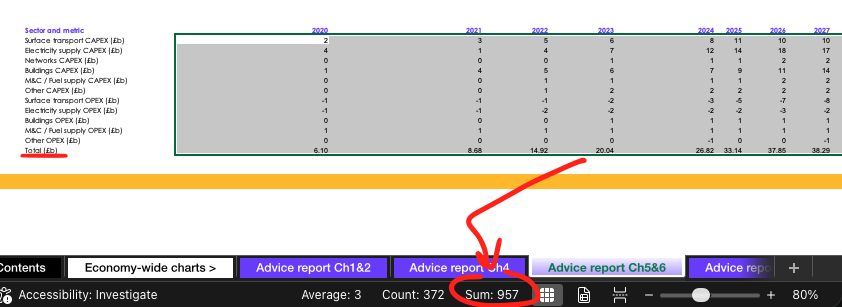
In addition to the annual sectoral CAPEX and OPEX figures, the CCC’s 2020 spreadsheet also has a line giving combined totals for each year. It appears that someone has added all of these numbers together, resulting in the savings and costs being counted twice.
This double-counted total for the cost of net-zero amounts to £957bn – as shown in the image below – and it appears to be the source of the claim in the Conservative booklet.
At the time of publication in 2020, the CCC said that the £478bn net cost of net-zero amounted to less than 1% of GDP over 30 years – and that the large investment needed would not only result in savings due to lower fossil-fuel imports, but that it would boost GDP overall, by around 2%.
In 2025, the CCC revised its estimates for investment costs and operating savings to £670bn and £562bn respectively, giving a net total of £108bn over 2025-50, or less than 0.2% of GDP.
Earlier this year, the committee said that cutting emissions to net-zero would cost less than a single fossil-fuel price shock and that doing so would have benefits worth £110bn per year.
Paper trail
The erroneous claim in the Conservative document is referenced to the CCC’s 2020 advice on the UK’s sixth “carbon budget”, which, as explained, does not contain the £957bn figure.
The earliest online use of the £957bn figure found by Carbon Brief is a 12 January 2026 article in the Spectator, by retired engineer and self-described “accidental energy analyst” David Turver.
A day later, Turver repeated the mistaken number in a