

Welcome to Carbon Brief’s Cropped.
We handpick and explain the most important stories at the intersection of climate, land, food and nature over the past fortnight.
Key developments
UK election impacts
LABOUR’S ENVIRONMENT PRIORITIES: The UK’s new Labour government has started to outline its priorities, with the new minister for the Department for Environment, Food and Rural Affairs (Defra), Steve Reed, setting out his five priorities in a video posted to Twitter. These were, he said: “Cleaning up British rivers, lakes and seas; creating a roadmap to move Britain to a zero-waste economy; supporting farmers to boost Britain’s food security; ensuring nature’s recovery; and protecting communities from flooding.” Edie reported that the UK “ranks in the bottom 10% of nations globally in terms of biodiversity intactness”, and that it is nowhere near its national goal of protecting 30% of its land and sea by 2030.
AGRICULTURE PLANS: However, a budget for farming was notably absent from the Labour manifesto. Nick von Westenholz, the National Farmers Union’s (NFU) director for strategy, told Euractiv last week that setting the budget for the environmental land management schemes (Elms), which will replace the EU’s multimillion farming subsidy programme by 2027, was “crucial”. Under Elms, farmers can receive subsidies for actions such as reducing pesticide use, planting wildflowers and preventing groundwater pollution. (See Carbon Brief’s 2023 explainer for more details.) Making the Elms subsidies financially attractive to farmers was a key issue, von Westenholz said: “There is a concern about the budget not being sufficient and that there won’t be enough of a business case for farmers to adopt the scheme”. Last week, Carbon Brief analysed the climate issues that the new Labour government will have to address, including those on land, agriculture and nature.
CONSERVATIONISTS REACT: Inkcap Journal summarised the positive, but cautious, reactions of conservation champions to Labour’s victory. Charities including the RSPB and CPRE urged the new prime minister to “act quickly on nature”, highlighting that upcoming decisions will “affect all UK wildlife immensely”. The Wildlife Trusts commended Labour’s “welcome commitments on nature and climate”, but published a list of priorities for the new government, including a review of the Environmental Improvement Plan and increasing the budget for wildlife-friendly farming. Experts also shared their views with Carbon Brief on what Labour’s priorities should be for climate action.
African farmers’ woes
DOUBLE THREAT: In the Conversation, University of Cape Town researcher Dr Vuyisile Moyo described the challenges facing farmers in Zimbabwe due to the “combination of heat, droughts and floods caused by climate change, and water contamination and damaged land caused by illegal, small-scale mining”. There are an estimated 400,000 illegal, small-scale miners in the country and their operations have resulted in “deforestation, land degradation, water pollution and loss of biodiversity”, Moyo wrote. One farmer told Moyo: “My farm was encroached by the artisanal miners who believed that there is a lot of gold there. My farmland was dug all over and now I no longer have land for crop production.”
MALNUTRITION AND DROUGHT: Al Jazeera carried a gallery of photos from drought-stricken Zimbabwe, with one farmer telling the outlet: “I did not harvest anything after all my effort and using all our savings to buy seeds.” Malnutrition is on the rise in the eastern Zimbabwean district of Mudzi, with cases jumping “by about 20%” over the past three months. The outlet added that “Zimbabwe and neighbouring Malawi and Zambia are among the countries in southern Africa most affected by malnutrition” amid the drought. In nearby Namibia, cattle sales have increased by nearly 50% as farmers facing the “biting effects of drought” have been forced to sell off their herds, the Namibian reported. As a result of the influx of cattle to the market, producers’ prices declined by nearly 4% since last year, the outlet added.
‘FOOD SECURITY CRISIS’: In South Africa’s Western Cape province, “informal settlements have been waterlogged for days” following heavy rains, Ground Up reported. Many of the people living in these settlements are “farm workers who have been evicted from farms they used to live at”, the South African outlet wrote. The Associated Press reported that “a food security crisis lies ahead” for Kenya following devastating floods that impacted the country beginning in mid-March. And local NGOs told Devex that flooding across east Africa has left children at risk of malnutrition “because of lack of food and medical services”.
Spotlight
Murky waters
In this spotlight, Carbon Brief unpacks the agenda ahead of the International Seabed Authority, as it resumes negotiations to frame rules for deep-sea mining.
The controversial possibility of mining the deep sea for critical minerals has been catapulted to the spotlight in the past few years, from investigations into the work of the International Seabed Authority (ISA) to late-night comedians in the US running dedicated segments.
Triggered by a move by Nauru in 2021, the ISA has been “under pressure” to finalise rules to regulate deep-sea mineral exploitation or risk the possibility of assessing mining applications without them.
That “what-if” scenario has become one of “what-now”, as the ISA’s 36-member council has already passed the July 2023 deadline to draw up this mining code. This atmosphere of uncertainty has since been met by a growing chorus of 27 governments that have called for some form of ban, moratorium or pause on deep-sea mining.
On Tuesday, the ISA resumed its 29th annual session in Kingston, Jamaica, with three crucial points on the agenda for its council and assembly: the debate over the mining code and a moratorium, the election of its secretary general and, for the first time ever, a discussion on the need for a general policy to protect and preserve the marine environment.
“All states have said that they don’t want [mineral] exploitation without regulation, but just how robust that regulation is, that’s the fault line,” Julian Jackson, project director of seabed mining at Pew Charitable Trusts, told Carbon Brief. According to Jackson, there are still “30 outstanding, big policy issues” to be resolved, from “permissible levels of environmental harm” – such as thresholds for toxicity – to issues of compensation and liability. He added:
“These are very technical negotiations, with yet more detailed standards and guidelines remaining to be addressed, all being done in an international, multilateral setting with very divergent views and not enough time.”
While the groundswell calling for a moratorium has grown, with banks and companies joining the fray, senior lecturer at the Borneo Marine Institute Dr Sharifah Nora Syed Ibrahim points to the fact that developed countries such as Norway have moved in the opposite direction. She told Carbon Brief:
“Norway wants to keep the option of deep-sea mining open, including within its national waters, because if oil is being phased out due to the climate movement, what other main natural resources does Norway have, other than fisheries?”
Who secures the ISA’s top post, which holds sway over the deep sea’s future, has been the subject of a huge scandal in recent weeks. Earlier this month, a New York Times investigation pointed to “allegations of possible payments to help secure votes” and attempts “to entice a candidate to withdraw from a race” amid complaints of misuse of agency funds by ISA chief Michael Lodge, who is currently eyeing a third term at the top.
While Lodge responded to the Times in a six-page statement describing the story as a “collation of vague, unsubstantiated, unfounded and anonymous rumours”, observers told Carbon Brief the allegations were being discussed on the first day of the talks.
“The science [on impacts] is way behind, the regulations are also way behind,” said Jackson:
“In the meanwhile, how do you have a multilateral organisation mired in allegations of conflicts of interest governing what is still so poorly understood?”
News and views
ARGENTINA BEEF: The consumption of beef in Argentina has fallen to a historical low, with demand forecasted to fall to the “lowest level in a century”, according to the Buenos Aires Times. A report from the Rosario Board of Trade found that annual beef consumption is now around 45kg per person, down from a peak of more than 100kg in the 1950s. Bloomberg attributed the decline to skyrocketing beef prices amidst a national recession. However, a shift to poultry, pork and plant-based diets due to greater nutritional awareness amongst consumers is also contributing, the newswire said. Argentina remains one of the biggest beef consumers globally, surpassing the UK and US (18 and 38kg per capita, respectively).
EU POLICY: The farmers’ organisation European Coordination Via Campesina has called on the EU to control agricultural prices and abandon free-trade agreements, including the long-stalled deal with the Mercosur South American trading bloc, Euractiv reported. “Farmers fear the Mercosur deal would result in markets being flooded with cheaper products”, it said. A separate Euractiv piece said that the European People’s Party is aiming to take the post of agriculture commissioner in the European Parliament in a move to solidify itself as “the farmers’ party”. Meanwhile, US paper producers have warned that new EU regulations requiring them to trace the sources of timber will cause price increases and shortages of diapers, sanitary pads and hygiene products, with Bloomberg reporting that “pulp supply chains are too diffuse to track all trees”.
‘CARBON LAUNDRY’: Brazil is “rac[ing]” to launch “one of the first major carbon emissions trading systems in the developing world”, Dialogue Earth reported. The emissions trading system aims to cover major polluting companies from sectors such as steel and cement, it added, but they would also be allowed to offset their emissions by buying credits from the voluntary market. This would need “careful regulation”, experts told the outlet, to ensure Brazil does not become “the carbon laundry of the world”. Dialogue Earth also covered controversies around “blue carbon” trading in China, where “most of the credits…involve the scientifically contentious matter of carbon sequestration by shellfish and seaweed”. Scroll.in, meanwhile, reported on “dubious” credits being generated by Himalayan hydropower projects.
WATER WARS: Amid ongoing drought in the south-western US, the country is “looking to parched northern Mexico to solve its water shortage”, Excelsior reported. The newspaper noted that the latest agreement between the two countries marks “the third consecutive year of water cuts from the Colorado River to Mexico”. In return for the reduction, Mexico will receive $65m “that will be used to improve water resources infrastructure”. Nearly two-thirds of northern cities and towns are already impacted by water shortages, including “a dozen municipalities living in a state of emergency”, Excelsior said. It added that 14 members of congress from Texas have requested the US “suspend aid to Mexico…until Mexico pays off its current water debt”.
DEFORESTATION DECREASE: Last year, Colombia “achieved its lowest deforestation rate ever recorded”, reporting a 36% decrease compared to the previous year, City Paper Bogota said. (Historical records in the country go back to 2000.) The figure represents a decrease of more than 50% over the last two years, “surpassing the initial target” set in the country’s national development plan, the outlet said. It quoted Colombian environment minister Susana Muhamad, who said: “It is a truly iconic year in this fight against deforestation.” However, Colombia Reports said that the reduction is “feared to be temporary” and that “the first quarter of this year indicated that deforestation had been going up again”.
DISPUTED MAPS: Indigenous communities in India’s western state of Gujarat have complained that district authorities rejected their forest rights claims based solely on satellite imagery collected by an autonomous state body, over other evidence such as testimonies and site inspections, IndiaSpend reported. Activists accused the GEER Foundation of “a lack of transparency”. Villagers asked to vacate their lands within 10 days told the outlet that the “notices came as a shock, as GPS and satellite imagery exercises conducted by local NGOs” support their claims. An official told IndiaSpend that the foundation “has now agreed to share their maps”, but said that “people give arbitrary estimates” of the size of their forest plots. Separately, the Financial Times reported that Australia has asked for a delay of the EU deforestation law regime citing “incorrect data”, with a spokesperson stating that “[t]he EU’s map is not a single source of truth”.
Watch, read, listen
BALANCING ACT: On her Feed the Planet podcast, Prof Sarah Bridle talked to researcher Barbara Bray about how to balance humans’ health with that of the planet.
COMEBACK KID: Mongabay carried a two-part series on the “re-introduction” of the Spix’s macaw that went extinct in the wild, but now faces an “uncertain future”.
STICKER SHOCK: In a new video, Al Jazeera explored how climate change has played a role in the global increases in food prices and inflation.
PORK OUT: Vox carried a long read that looked at how factory farming was “shoring up public support” by “funding favourable research” from US public university scientists.
New science
Mitigation and Adaptation Strategies for Global Change
Grape growers in parts of the Mediterranean should consider reducing their crop’s exposure to sun and optimising water usage to help vineyards adapt to climate change, according to new research. The researchers aimed to understand how climate change will impact wine-growing areas in Portugal, Italy, Turkey and Morocco. Using scenarios under moderate (RCP4.5) and very high emissions (RCP8.5), the researchers compared the main climate-related challenges these locations will face and assess the “best strategies to reduce the impacts of climate change at the national and regional levels”. The conclusions of the study “may support local growers” in optimising “sustainable production under changing climates”, the researchers wrote.
Severe droughts reduce river navigability and isolate communities in the Brazilian Amazon
Communications Earth & Environment
A new study found that severe droughts “routinely disrupt inland water transport and isolate local populations” in the Brazilian Amazon, resulting in restricted access to food, medicine, education and more. By combining historical records of river streamflow, maps of human settlements and news reports, researchers analysed the impacts of lowered river levels on communities near the Amazon River. They found that droughts over the past two decades “have not only caused exceptional low-water anomalies across the Amazon basin, but also dramatically increased the duration of the low-water period”, contributing to communities’ isolation. They concluded: “Given this new reality, Amazon countries must develop long-term strategies for mitigation, adaptation and disaster response.”
Science Advances
New research found that planted mangroves store nearly three-quarters of the amount of carbon stored by untouched mangroves over 20 to 40-year timescales. Analysing data from 684 planted mangrove stands around the world, researchers looked at the carbon storage both below and above ground and determined how carbon storage rates change over time. They found that planted stands that incorporate more than one mangrove species “would maximise [carbon] accumulation within the biomass compared to monospecific planting”. The authors concluded: “Our models also facilitate goal setting; performance measure development; and progress tracking in restoration, rehabilitation or afforestation projects.”
In the diary
- 15 July-2 August: Second part of the 29th Session of the International Seabed Authority Assembly and Council | Kingston, Jamaica
- 22-26 July: 27th Session of the FAO Committee on Forestry | Rome
- 27 July-2 August: 61st Session of the Intergovernmental Panel on Climate Change (IPCC-61) | Sofia, Bulgaria
This is an online version of Carbon Brief’s fortnightly Cropped email newsletter. Subscribe for free here.
Cropped is researched and written by Dr Giuliana Viglione, Aruna Chandrasekhar, Daisy Dunne, Orla Dwyer and Yanine Quiroz. Please send tips and feedback to cropped@carbonbrief.org.

The post Cropped 17 July 2024: Climate change and wine; Seabed mining talks; Argentina’s beef habit appeared first on Carbon Brief.
Cropped 17 July 2024: Climate change and wine; Seabed mining talks; Argentina’s beef habit

Drought and heatwaves occurring together – known as “compound” events – have “surged” across the world since the early 2000s, a new study shows.
Compound drought and heat events (CDHEs) can have devastating effects, creating the ideal conditions for intense wildfires, such as Australia’s “Black Summer” of 2019-20 where bushfires burned 24m hectares and killed 33 people.
The research, published in Science Advances, finds that the increase in CDHEs is predominantly being driven by events that start with a heatwave.
The global area affected by such “heatwave-led” compound events has more than doubled between 1980-2001 and 2002-23, the study says.
The rapid increase in these events over the last 23 years cannot be explained solely by global warming, the authors note.
Since the late 1990s, feedbacks between the land and the atmosphere have become stronger, making heatwaves more likely to trigger drought conditions, they explain.
One of the study authors tells Carbon Brief that societies must pay greater attention to compound events, which can “cause severe impacts on ecosystems, agriculture and society”.
Compound events
CDHEs are extreme weather events where drought and heatwave conditions occur simultaneously – or shortly after each other – in the same region.
These events are often triggered by large-scale weather patterns, such as “blocking” highs, which can produce “prolonged” hot and dry conditions, according to the study.
Prof Sang-Wook Yeh is one of the study authors and a professor at the Ewha Womans University in South Korea. He tells Carbon Brief:
“When heatwaves and droughts occur together, the two hazards reinforce each other through land-atmosphere interactions. This amplifies surface heating and soil moisture deficits, making compound events more intense and damaging than single hazards.”
CDHEs can begin with either a heatwave or a drought.
The sequence of these extremes is important, the study says, as they have different drivers and impacts.
For example, in a CDHE where the heatwave was the precursor, increased direct sunshine causes more moisture loss from soils and plants, leading to a drought.
Conversely, in an event where the drought was the precursor, the lack of soil moisture means that less of the sun’s energy goes into evaporation and more goes into warming the Earth’s surface. This produces favourable conditions for heatwaves.
The study shows that the majority of CDHEs globally start out as a drought.
In recent years, there has been increasing focus on these events due to the devastating impact they have on agriculture, ecosystems and public health.
In Russia in the summer of 2010, a compound drought-heatwave event – and the associated wildfires – caused the death of nearly 55,000 people, the study notes.

The record-breaking Pacific north-west “heat dome” in 2021 triggered extreme drought conditions that caused “significant declines” in wheat yields, as well as in barley, canola and fruit production in British Columbia and Alberta, Canada, says the study.
Increasing events
To assess how CDHEs are changing, the researchers use daily reanalysis data to identify droughts and heatwaves events. (Reanalysis data combines past observations with climate models to create a historical climate record.) Then, using an algorithm, they analyse how these events overlap in both time and space.
The study covers the period from 1980 to 2023 and the world’s land surface, excluding polar regions where CDHEs are rare.
The research finds that the area of land affected by CDHEs has “increased substantially” since the early 2000s.
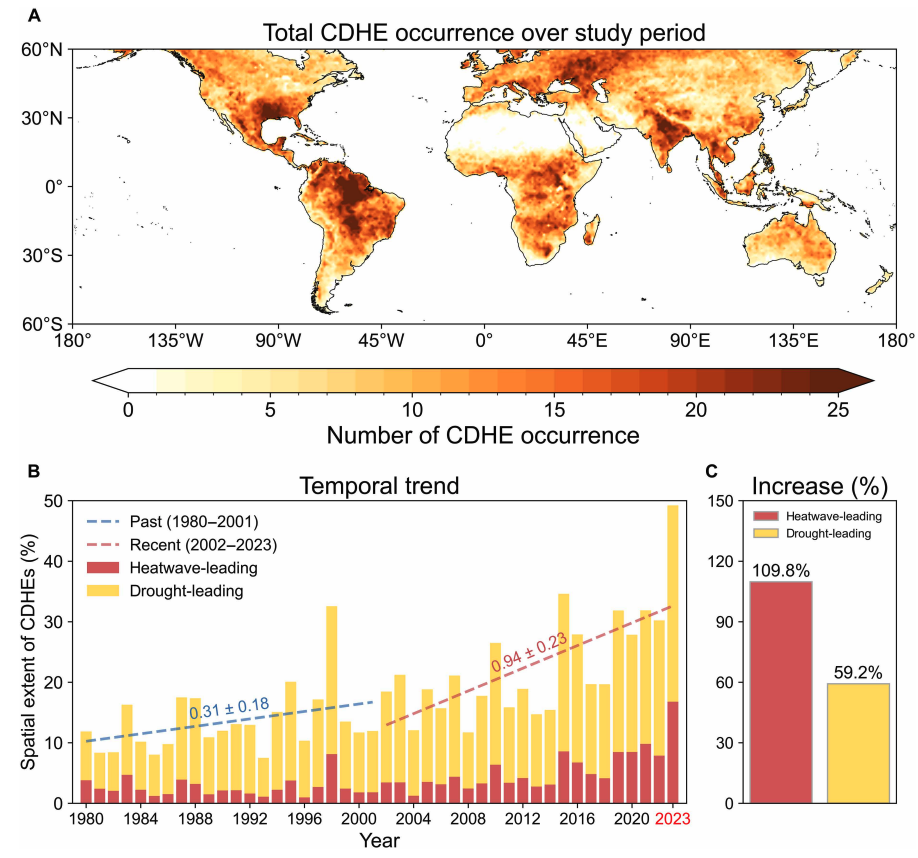
Heatwave-led events have been the main contributor to this increase, the study says, with their spatial extent rising 110% between 1980-2001 and 2002-23, compared to a 59% increase for drought-led events.
The map below shows the global distribution of CDHEs over 1980-2023. The charts show the percentage of the land surface affected by a heatwave-led CDHE (red) or a drought-led CDHE (yellow) in a given year (left) and relative increase in each CDHE type (right).
The study finds that CDHEs have occurred most frequently in northern South America, the southern US, eastern Europe, central Africa and south Asia.
Threshold passed
The authors explain that the increase in heatwave-led CDHEs is related to rising global temperatures, but that this does not tell the whole story.
In the earlier 22-year period of 1980-2001, the study finds that the spatial extent of heatwave-led CDHEs rises by 1.6% per 1C of global temperature rise. For the more-recent period of 2022-23, this increases “nearly eightfold” to 13.1%.
The change suggests that the rapid increase in the heatwave-led CDHEs occurred after the global average temperature “surpasse[d] a certain temperature threshold”, the paper says.
This threshold is an absolute global average temperature of 14.3C, the authors estimate (based on an 11-year average), which the world passed around the year 2000.
Investigating the recent surge in heatwave-leading CDHEs further, the researchers find a “regime shift” in land-atmosphere dynamics “toward a persistently intensified state after the late 1990s”.
In other words, the way that drier soils drive higher surface temperatures, and vice versa, is becoming stronger, resulting in more heatwave-led compound events.
Daily data
The research has some advantages over other previous studies, Yeh says. For instance, the new work uses daily estimations of CDHEs, compared to monthly data used in past research. This is “important for capturing the detailed occurrence” of these events, says Yeh.
He adds that another advantage of their study is that it distinguishes the sequence of droughts and heatwaves, which allows them to “better understand the differences” in the characteristics of CDHEs.
Dr Meryem Tanarhte is a climate scientist at the University Hassan II in Morocco, and Dr Ruth Cerezo Mota is a climatologist and a researcher at the National Autonomous University of Mexico. Both scientists, who were not involved in the study, agree that the daily estimations give a clearer picture of how CDHEs are changing.
Cerezo-Mota adds that another major contribution of the study is its global focus. She tells Carbon Brief that in some regions, such as Mexico and Africa, there is a lack of studies on CDHEs:
“Not because the events do not occur, but perhaps because [these regions] do not have all the data or the expertise to do so.”
However, she notes that the reanalysis data used by the study does have limitations with how it represents rainfall in some parts of the world.
Compound impacts
The study notes that if CDHEs continue to intensify – particularly events where heatwaves are the precursors – they could drive declining crop productivity, increased wildfire frequency and severe public health crises.
These impacts could be “much more rapid and severe as global warming continues”, Yeh tells Carbon Brief.
Tanarhte notes that these events can be forecasted up to 10 days ahead in many regions. Furthermore, she says, the strongest impacts can be prevented “through preparedness and adaptation”, including through “water management for agriculture, heatwave mitigation measures and wildfire mitigation”.
The study recommends reassessing current risk management strategies for these compound events. It also suggests incorporating the sequences of drought and heatwaves into compound event analysis frameworks “to enhance climate risk management”.
Cerezo-Mota says that it is clear that the world needs to be prepared for the increased occurrence of these events. She tells Carbon Brief:
“These [risk assessments and strategies] need to be carried out at the local level to understand the complexities of each region.”



The post Heatwaves driving recent ‘surge’ in compound drought and heat extremes appeared first on Carbon Brief.
Heatwaves driving recent ‘surge’ in compound drought and heat extremes