



- What timeline options were delegates debating?
- How did the timeline discussions unfold?
- What were the main points of disagreement?
- Why is the IPCC in a ‘serious funding crisis’?
- How have scientists reacted?
- What other issues remain unresolved?
- How are the IPCC AR7 reports progressing?
- How might the IPCC use AI and enhance gender inclusivity?

Carbon credit certifiers from the much-criticized voluntary market could be the big winners of a failure to strike a deal on the exchange of offsets between countries at Cop28, experts told Climate Home.
Talks over Article 6.2 of the Paris Agreement – allowing for bilateral deals – collapsed in Dubai following a bitter fight over integrity between the European Union and the United States.
But willing countries can still move ahead with agreements in a vacuum that is increasingly being filled by independent certifiers from the voluntary market. Some observers are raising questions on whether they are fit for purpose.
Transatlantic fight
When the EU led a push at Cop28 for tighter controls over the bilateral exchange of carbon credits, one of its main goals was to restrict the role of operators from the voluntary carbon market.
In the year leading up to the summit, criticism of the market, which sells offsets mainly to corporate emitters, intensified. The climate credentials and the social and environmental integrity of several of its projects were being questioned. The nascent mechanism should draw a blank slate – the EU argued – and rely on a new standard directly supervised by the UN.

US Climate envoy John Kerry is a major proponent of carbon markets. Photo: COP28 / Christophe Viseux
The US went into the talks with a polar opposite vision. It wanted a light-touch approach built on the existing voluntary standards, accepting their requirements and using their infrastructure, according to a leaked EU memo prepared before Cop28 and seen by Climate Home.
The two forces clashed during deeply divisive marathon negotiations in Dubai, failing to find common ground. “Views have become more polarised,” said Pedro Martins Barata, an expert at EDF and a former carbon markets negotiator. “There’s more dissent on an almost philosophical level on what carbon markets should be like.”
After no deal
As the summit drew to a close, the Cop presidency put a ‘take it or leave it’ text on the table. It contained provisions the EU and other groups found unacceptable and was roundly rejected. Negotiators will try again to land a deal at Cop29 next year.
In the meantime, countries can still go ahead with bilateral deals under an initial rulebook agreed two years ago in Glasgow. “Nothing that happened in Dubai prevents countries from moving forward and some will certainly do so,” said Martins Barata.
Switzerland is developing projects with Ghana, Thailand and Vanuatu that will help achieve its climate goals. Singapore inked a similar deal with Papua New Guinea during the summit.
How Russia won a ‘dangerous loophole’ for fossil gas at Cop28
The political stalemate has opened up a big opportunity for players from the voluntary market. They are expected to take a leading role in filling the regulatory gap, experts told Climate Home.
“If a voluntary standard or its projects are given preference by certain countries, it will be a significant stamp of approval and could generate lots of investment,” said Jonathan Crook from Carbon Market Watch.
Voluntary market eyes opportunity
Some are wasting no time. Singapore, a pioneer in bilateral offsets, is partnering up with Verra and Gold Standard, the leading carbon credit registers. Their goal is to create a “playbook” with rules and procedures for countries to use existing carbon credit programs to achieve their climate plans under Article 6.
Hugh Salway, a senior director at Gold Standard, sees an important role for existing operators to speed up the implementation of deals. “A government can create its standard which would take time to develop and would be complicated to maintain,” he told Climate Home. “Or it can use our standard which is already set up with rules, methodologies, and auditors.”
‘Car without wheels’: Adaptation playbook lacks finance target
Another register, the Qatar-based Global Carbon Council (GCC), is also working with a series of credits-producing countries, including Oman and Ghana. They are looking to sell article 6.2 offsets in a first-of-its-kind auction at the beginning of 2024.
“We have been doing this for years, we have the necessary capacity to make it work,” said Kishor Rajhansa, chief operating officer of GCC. Limiting the role of the private sector “would kill off the potential of article 6.2,” he added in an interview at Cop28.
Integrity concerns raised
But some observers are concerned by an outsized influence of existing standards given their chequered record.
Some flagship projects certified by Verra have come under fire for making exaggerated climate claims and for causing alleged environmental and human rights violations. The GCC has been accused of breathing new life into offsets that hardly make any difference to global emissions and would not be accepted anywhere else.
Using voluntary market systems “may simplify things, but it raises many questions about how suitable it is, both for countries and the climate, given all the issues that have been flagged,” said Carbon Market Watch’s Crook.
The post Countries go ahead with carbon deals despite Cop28 standoff appeared first on Climate Home News.
Continue Reading
Three countries have been named by the Paris Agreement’s compliance committee for failing to submit a nationally determined contribution (NDC) and repeatedly snubbing offers of help with their climate plans.
After months of internal debate over whether to identify serial non-responders, the Paris Agreement’s Implementation and Compliance Committee (PAICC) named the three countries which have failed to engage with it over their NDCs on Friday.
It named Democratic Republic of Congo, Senegal and North Korea in a footnote of its annual report, adding that it decided to name them “with a view to facilitating engagement”, adding that representatives of the three nations had been invited to its meeting in early 2027 “with the purpose of identifying any challenges and constraints”.
“The Committee noted the importance of Parties engaging with the Committee in a timely manner, while noting that some delays may be due to the national capabilities and circumstances of the Parties”, the report said.
-
Under US pressure, World Bank says it will back gas “where appropriate”
The US wants the World Bank to expand its gas support while climate campaigners are pushing for it to end – its head spoke this week of limited backing for the fossil fuel -
IPCC scientists vow to press on with climate reports despite political deadlock
After governments again failed to agree a timeline, nearly 120 IPCC authors pledged to complete their assessment on time and with full scientific rigour -
Paris Agreement committee snubbed over missing NDC climate plans
Many governments have still not submitted a nationally determined contribution to the UN, breaching a key requirement of the Paris Agreement
In July, PAICC said 12 countries had ignored its repeated attempts to discuss why they had not published an NDC as required every five years under the 2015 Paris accord.
Members of the committee had been divided over whether to name them, but at a September meeting decided to do so in their annual report to the annual climate COP summit.
By the time the report was published on Friday, only Congo, Senegal and North Korea “had not communicated an NDC or submitted a [Biennial Transparency Report] and had not yet responded to any of the Committee’s notifications, despite several reminders issued by the Committee in this regard”.
Rainforest and renewable energy ambitions
The silence from Congo and Senegal is notable because the former is home to much of the Congo Basin rainforest while the latter has sought billions of dollars in climate finance to support its renewable energy ambitions.
After Brazil, Congo has more rainforest than any country in the world. This forest, and the country’s peatlands, absorb huge amounts of greenhouse gas but are fast being lost to expanding farmland, charcoal production, logging and mining.
Senegal signed a Just Energy Transition Partnership with Canada and wealthy European nations in 2023, to help it meet its renewable energy targets under the-then government of Macky Sall. It was chair of the Least Developed Countries group between January 2022 and December 2023.

Tejas Rao, who is researching the PAICC as part of a doctoral thesis at Cambridge University, said the governments of the three countries should engage with the committee.
“Engagement costs these governments very little and the committee has shown it will listen,” he said.
“Silence leaves the committee with no basis to help, and it leaves the [governments] exposed to the narrative that they are simply disengaged,” he told Climate Home News.
Paris Agreement requirement
The 2015 Paris Agreement requires all parties to publish an NDC every five years outlining their emissions reduction targets, with each plan meant to be more ambitious than the country’s last NDC.
The latest set – the third round of plans, with new targets for 2035 – was due in February 2025. While most countries missed this deadline, all but around 30 – mostly small emitters but including Egypt, Vietnam and Argentina – have now submitted them.
Over the year, the PAICC – which is made up of government climate officials from developed and developing countries – has been communicating with governments that have not submitted NDCs and trying to overcome barriers to them doing so.
Some nations have cited exceptional circumstances as the reason for not submitting an NDC, a process that requires a significant amount of work in tracking emissions and consulting on how to curb them across the economy. For example, a letter from a Sudanese official to the PAICC, seen by Climate Home News, said that the country’s civil war had led to the suspension of its NDC preparation.
-
IPCC scientists vow to press on with climate reports despite political deadlock
After governments again failed to agree a timeline, nearly 120 IPCC authors pledged to complete their assessment on time and with full scientific rigour -
Under US pressure, World Bank says it will back gas “where appropriate”
The US wants the World Bank to expand its gas support while climate campaigners are pushing for it to end – its head spoke this week of limited backing for the fossil fuel -
Who shapes climate science? The equity question facing the IPCC
Early completion of the next global climate science assessment reports risks excluding research from the Global South, which is key to ensuring the findings are fair
The US and Iran are not signed up to the Paris Agreement and so do not have active NDCs, nor does Taiwan, which is not a UN member state.
Rao said that because the PAICC is “facilitative and non-punitive”, naming the countries “is meant to open a door, not close one – the invited consultation is the point”.
“In recent months, governments that explained their constraints, whether capacity, finance or domestic process, have been met with follow-up and support rather than sanction, and the number of silent governments has fallen sharply,” Rao said.
The post Paris Agreement committee names three countries snubbing it over NDCs appeared first on Climate Home News.
Paris Agreement committee names three countries snubbing it over NDCs
Countries have failed – for the sixth time running – to agree on the timeline for publishing the Intergovernmental Panel on Climate Change’s (IPCC) next set of influential reports.
The IPCC’s 65th session (IPCC-65) was seen by many to be the final opportunity for countries to agree on a schedule where its seventh assessment report (AR7) would be published in time for the UN’s second “global stocktake” of climate action.
Before last week’s meeting in Addis Ababa, Ethiopia, IPCC chair Prof Sir Jim Skea had warned that releasing the reports in time for the stocktake in 2028 would depend on a timelines being agreed by the end of 2026.
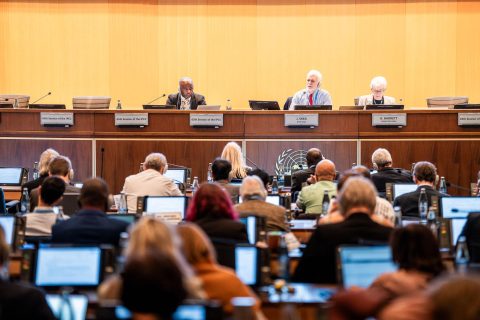
But the week-long meeting descended into fraught disagreements between governments, resulting in Skea “suspending” the talks on Friday evening with no decision made.
Countries were also unable to agree on the IPCC’s budget for the rest of the AR7 cycle, leaving the body with a “serious funding crisis”.
The IPCC has pledged to reconvene the meeting at the “earliest opportunity”; however, it has not yet given an indication of when this will be.
In his concluding remarks, Skea described the Addis Ababa summit as a “profound disappointment” and “among the most difficult IPCC meetings”, according to reporting from the Earth Negotiations Bulletin (ENB).
Some countries have reacted with dismay to the breakdown of negotiations, warning that a failure to have the IPCC’s latest assessments on climate adaptation and mitigation ready for the UN stocktaking exercise would undermine global climate action.
A climate envoy from a Pacific island state said it was a “travesty that a handful of countries continue to delay the IPCC’s reports – the science we need back home to help us save lives and livelihoods”.
Below, Carbon Brief explores the key developments, debates and disagreements at the IPCC meeting.
- What timeline options were delegates debating?
- How did the timeline discussions unfold?
- What were the main points of disagreement?
- Why is the IPCC in a ‘serious funding crisis’?
- How have scientists reacted?
- What other issues remain unresolved?
- How are the IPCC AR7 reports progressing?
- How might the IPCC use AI and enhance gender inclusivity?