

Do you find it hard to reconcile the Sultan Al Jaber the climate champion with Sultan Al Jaber the oil chief? So does he, if an unscripted moment reported by the Guardian is anything to go on.
In a live event with former UN special envoy Mary Robinson in November, Al Jaber momentarily forgot his PR-approved lines and reverted to industry talking points.
“There is no science out there, or no scenario out there, that says that the phase-out of fossil fuel is what’s going to achieve 1.5C,” he said.
He dismissed Robinson’s call for a phase-out as “alarmist” and said it would “take the world back into caves”.
Leading scientists Jean-Pascal van Ypersele and Michael Mann wrote Al Jaber an open letter in response.
Speaking for the climate system, “the most difficult party… which has only red lines and no flexibility,” they said, “humanity needs to phase out fossil fuels by 2050”.
Carbon capture and storage can only mitigate “a very small fraction” of fossil fuel emissions, the letter said.
That last point is critical, as the oil and gas sector cites scenarios that show some residual fossil fuel use with CCS to justify production on a much larger scale.
Laurence Tubiana, one of the architects of the Paris Agreement, unpacks the CCS myth together with Emmanuel Guerin in an article for Climate Home News.
“People in the oil and gas industry know there is zero probability of [a] high-CCS scenario coming true,” they write. “The reality is they are just fooling us one more time, to buy time we can’t afford to waste in dealing with the climate crisis.”
Al Jaber’s slip of the tongue shows why precision matters in negotiations. Phase down can mean something very different to phase out, and “unabated” fossil fuels need further defining.
The latest headlines
- Don’t be fooled: CCS is no solution to oil and gas emissions – Laurence Tubiana and Emmanuel Guerin, European Climate Foundation
- Vietnam charts uncertain coal path as finance falls short
- US tees up Congress battle with $3bn Green Climate Fund pledge
Health at the table
In a Cop first, health ministers took over plenary discussions on Sunday. Over 120 countries have signed a health declaration coordinated by the Cop28 presidency.
The declaration, and most ministerial statements, focused on strengthening healthcare systems as a means of climate adaptation.
It does not mention fossil fuels, or how burning coal, oil and gas releases harmful air pollutants besides greenhouse gases.
Sweden was one country to join the dots. “A decision here at Cop28 to phase out fossil fuels will contribute to [health] outcomes. The health of people and the planet cannot be separated,” said Mattias Frumerie, Swedish head of delegation.
Diarmid Campbell-Lendrum, head of climate and health at the World Health Organization, took the same view in a press conference.
“Talking about action on climate change without talking about fossil fuels is like talking about lung cancer without mentioning tobacco,” he said.
The ministerial plenary is an “important and delayed step”, but health discussions need to start mentioning fossil fuels, said Dr Arvind Kumar, founder of the Lung Care Foundation. Otherwise “the problem will not get solved”.
“Little cosmetic changes here and there are not going to make much of a difference,” he said.
In brief
Bad excuse? – Brazilian president Lula da Silva said in a meeting with NGOs that he is joining OPEC to “convince oil producing countries that they need to prepare for the end of fossil fuels”. Colombia’s president Gustavo Petro argued oil producers already know they have to move past oil.
Big polluters – Electricity generation in China and India, and oil and gas production in the US caused the biggest emissions rises since 2015, analysis published by Climate Trace shows. The figures are based on a database of 352 million emissions sources. Since the signing of the Paris Agreement emissions grew 8.6%.
Slow entrance – Crowds have eased at Cop28 since world leaders left town, yet long queues at the entrance still held up negotiations, Earth News Bulletin reports. More than 100,000 delegates are registered for Cop28, according to UN Climate Change.
The post Cop28 bulletin: Al Jaber goes off script, denies science appeared first on Climate Home News.

Starting on Monday, about 10,000 government negotiators, scientists, journalists and campaigners will gather at a purpose-built venue in a national park in Mongolia’s capital Ulaanbaatar to discuss how to stop land turning into desert as the world warms.
Drought is currently sweeping much of the Northern hemisphere, leaving normally green urban parks looking like dry savannah, causing crops to fail, food prices to rise and billions to be shaved off economic output.
On Wednesday, Britain’s prime minister chaired an emergency meeting of the government’s Cobra committee. These are usually reserved for wars, terrorist attacks, riots and pandemics – but this one was on the extreme heat and drought the UK has been suffering since May.
With many countries facing far worse with fewer resources than the UK, the issues to be discussed at the UN’s COP17 summit in Mongolia – often overlooked – should be nearer the top of policy-makers minds.
But what is COP17? What will be decided and announced there over the next two weeks? How does it relate to climate change and how will it help restore the lands on which we all rely for our food, water and other essential resources? Climate Home News explains all below.
What is COP17?
It is the conference of parties (COP) to the United Nations Convention to Combat Desertification (UNCCD). The parties are 196 governments, which includes all of the countries recognised by the UN.
The convention was conceived at the Rio Earth Summit in 1992, at the same time as the other two larger “Rio trio” conventions on climate and biodiversity.
While the climate convention’s COP takes place every year, the UNCCD COP happens only once every two years. COP17 will be its seventeenth gathering.

What is desertification?
It is the process by which land degrades and becomes more like a desert, making it harder – and sometimes impossible – to grow crops or graze livestock there.
Climate change and other human activities – like excessive irrigation which depletes ground water – are making this process worse, causing poverty, hunger, health problems, forced migration and loss of species.
It’s a widespread problem. The UN estimates that half a billion people live within areas that have experienced desertification since the 1980s and that two-fifths of the world’s land is degraded.
What has it got to do with climate change?
The planet’s climate is heating up, mainly due to humans burning fossil fuels, and drying out its land. This kills plants and exposes the soil which can then be blown away by wind and washed away by water.
Without a top layer of soil, plants struggle to grow again and the land gets closer to being a desert. So combating desertification is a way of adapting to climate change.
It is also a way of lessening the pace of climate change, as land degradation releases carbon dioxide previously stored in healthy soils and plants.
What will be negotiated at COP17?
The main issue is what form a new initiative to tackle drought could take. The last COP saw Africa push hard for this to be a protocol – a kind of binding sub-treaty to the UNCCD.
But the US, Europe, Argentina and others argued that would take too long to set up, cost too much and take money away from what can be spent on the ground. They prefer a legally weaker alternative – a framework instead of a protocol.
Negotiations went late into the last night of talks in Riyadh, with the Saudis hosting informal consultations, but eventually governments had to agree to disagree and pick up talks again in Ulaanbaatar.
As Earth dries out, countries fail to reach drought agreement
Governments will also negotiate a new policy on protecting rangelands and pastoralists from degradation. Rangelands are areas where animals graze. They cover around half the Earth’s land and include almost everything other than forest, deserts, farms, glaciers and cities. Pastoralists are people who herd animals on these rangelands, often moving from place to place to find fresh pasture.
COP17 host country Mongolia has a lot of both – and pushed successfully for the UN to declare 2026 the International Year of Rangelands and Pastoralists. It is keen to agree a decision at COP17 bringing those issues more to the forefront of the UNCCD.
Negotiators will also debate the UNCCD’s post-2030 strategic framework, which they hope to adopt at COP18 in 2028. Campaign groups like the World Wildlife Fund want a stronger focus on biodiversity and nature-positive food systems.
What will happen when?
The COP will formally open with a ceremony on Monday August 17, followed by opening statements by governments and the adoption of the agenda.
Negotiations will begin, mostly behind closed doors for two weeks until the closing plenaries on Friday August 28.
While talks rumble on in the background, the second week will see senior government representatives including ministers get involved, with a “high-level segment” running from August 24-26.

They will discuss issues like drought resilience, finance and pastoralist communities. This is likely to be when any announcements – of new funding, for instance – are made.
On Monday August 24, there will also be an open dialogue between government officials and civil society members. Here, local practitioners are likely to share stories of how they are helping their communities reverse land degradation. UNCCD prides itself on being a bottom-up convention.
Unlike climate COPs, which often end a day or two over time, UNCCD COPs usually finish on the evening of their last day and – while they have gone late into the night – have never run into the next day.
What else should we watch out for?
At the last COP two years ago, host Saudi Arabia led the creation of an initiative called the Riyadh Global Drought Resilience Partnership to help 80 of the poorest nations deal with drought.
It received $12 billion in pledges, mainly from Gulf-based development finance institutions. Saudi Arabia is expected to report back on whether these pledges have been delivered and how the money will reach those in need now.
There are also hopes that governments will announce financial support for Mongolia’s Rangelands Flagship Initiative, which aims to mobilise investment in projects to fight land degradation.
Who will preside over COP17?
While the last five and the next two climate COPs have been or will be presided over by men, COP17 will be woman-led with Mongolia’s foreign minister, Battsetseg Batmunkh, as president.

This will also be the first COP for the UNCCD’s new executive director Yasmin Fouad. Before being appointed environment minister in her native Egypt, Fouad was a scientist and lead author of the Intergovernmental Panel on Climate Change’s special report on desertification. She played a key role at the COP27 climate summit in Egypt in 2022.
Although Saudi Arabia’s UNCCD COP presidency is ending, the Gulf power house will likely continue to be influential. It has supported the COP financially as part of the Riyadh-Ulaanbaatar action agenda and will be following up on initiatives announced two years ago.
While Saudi Arabia is often blamed for obstructing progress at climate talks, as a desert nation it is generally thought to have played a constructive role at UNCCD COPs.
What are the negotiating dynamics?
The UNCCD has six main negotiating groups: Africa, Asia, Latin America and the Caribbean, the Northern Mediterranean, Central and Eastern Europe, and developed donor countries. Governments can also speak in their own capacities.
While divisions between the Global North and Global South do exist at UNCCD COPs, they are not as stark as at climate COPs. The Global South’s umbrella group – the G77 and China – usually only speaks on finance issues, on which developing countries tend to be united.
-
When taps run dry in the Caribbean, it’s not enough to blame El Niño
Climate change means El Niño is heating already hotter land and sea, causing devastation across the region and the world -
“We’ve gone backwards” – new plastics treaty text dims hopes for production curbs
During troubled talks, fossil fuel-producing nations have pushed for a global pact to tackle only plastic waste rather than reducing the size of the problem -
China’s coal power rebounds as record clean energy goes to waste
Long-term contracts guarantee coal plants buyers regardless of demand, crowding out renewables, report finds


Civil society groups are present but not as vocal or as confrontational as at climate COPs. There are generally no protests and campaigners tend to try to hold governments accountable more quietly. There are likely to be far fewer journalists than at climate COPs too.
What role will the US play?
While the US has left the UN’s climate convention, it remains in the UNCCD and is expected to bring a delegation of officials from its departments of agriculture and state. It is likely to resist any renewed push from Africa for a drought protocol.
The post Will the world’s drying lands get relief from COP17 in Mongolia? appeared first on Climate Home News.
Will the world’s drying lands get relief from COP17 in Mongolia?
Helen Phillips’ book, ‘Hum’, is set in a dystopian near future, in a city suffering the effects of climate breakdown and with dire air quality. Robots (the Hums) press advertising messages during conversations, meetings and even as they carry out medical procedures.
The Hums are vehicles for these ad messages, which are often for products like cosmetics, sweets or anything that might be relevant during interactions with humans. This advertising is poorly disguised, and merges with sentiments that lean towards concerns of well-being, convincing people how much better off they’ll be if they make a purchase.
While the novel is futuristic, the insidious way advertising permeates daily life is resonant of how adverts show up in our world today. And these ads are directly contributing to the worsening future climate Phillips describes in her book.
-
As fires burn and temperatures soar, it’s time to imagine a world beyond GDP
Environmental destruction, like clear-cutting a forest, can boost gross domestic product but it reduces a country’s real wealth
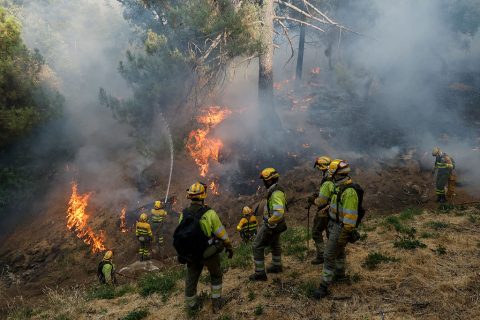
Already by the summer of 2026, Europe had seen a 57% increase in wildfires in just four years with western Europe recording the hottest ever June and July on record. We’re facing droughts and floods, as well as predicted hikes in food costs or even chronic food shortages – and that’s before the expected additional effects of a strong El Niño later this year.
Frequent flying and bigger burgers
A portion of this climate breakdown is fuelled by over-consumption in richer countries, particularly of products that are high carbon – for which advertising can take some of the blame. Research shows that adverts drive citizens to consume about a third more goods and services in general, over and above what they might have purchased.
Yet despite a clear link between promoting high-carbon behaviours and climate breakdown, little advertising regulation exists in the UK. Take frequent flying for instance, one of the most carbon-intensive activities we can partake in.
EasyJet’s latest ad campaign is called “Drop Everything”. It encourages consumers to book cheap flights departing within the next 48 hours for presumably short or weekend getaways. Rather than promoting a specific destination, “Drop Everything” promotes a mindset that encourages indiscriminate consumption of flying. The ads were shown on billboards with clever creative slogans, as well as on digital media and through influencer campaigns.
Overall, flight numbers are increasing. The UK Civil Aviation Authority reported the highest number of UK passengers in the first quarter of 2026 (more than 61 million, breaking previous records for travel between January and March). It seems we’re still not joining the dots between flying and a worsening climate.
And how about meat consumption? Scientists advocate for less meat-eating, especially beef which has the highest carbon footprint of nearly all foods. Yet adverts from McDonald’s proliferate, helping make it one of the highest-volume sellers of fast-food chain beef burgers. In 2024, the outdoor advertising budget for McDonald’s UK rose to £86 million, an increase of 71% on previous years.

Small share for sustainability
While over half of UK ad professionals feel increasingly queasy about their profession and its effects on the climate crisis, the people running the show – the UK trade bodies – prefer to focus on the growth advertising brings.
In the first three months of 2026, they stated that UK advertising spend increased by 9.3%, reaching a total of £11.7 billion for that quarter, fuelling consumption and market growth.
But how many of those adverts actually promote low carbon goods and services? Kantar’s Sustainable Ads Tracker shows the percentage of ads featuring sustainability messaging in 2026 is around 4.3%. That’s woefully low, and much of this is made up of messaging that promotes recycling.
Additionally, the ad industry continues to happily produce adverts for the large oil and gas corporations that are fuelling climate breakdown. These adverts only narrowly pass the Advertising Standards Authorities’ advertising codes, allowing the continued greenwashing of the world’s most polluting brands.
There is essentially no leadership from the UK trade bodies, likely because they are directly funded by the brands and advertisers themselves. They are essentially ‘ad shushing’ – pushing for indiscriminate growth and directing attention to their sustainability awards, while confusingly denying that adverts drive higher consumption overall.
Let’s ‘un-shush’
Where does this leave us as we are subjected to hundreds, if not thousands, of persuasive advertising messages every day that support high-carbon lifestyles? Most ad professionals are unable to push back against this agenda at work, often due to the threat of job loss. The advertising trade bodies won’t take the lead as they work in service to big brands and advertisers.
NGOs urge Brazil to prevent fossil fuel capture of COP30 climate summit
So, who can push for the changes we need? Members of the public.
Through pressuring our city officials and governments, we can force through restrictions, such as the watershed bans on unhealthy foods on TV before 9pm in the UK. Through supporting the efforts of organisations such as Ad Free Cities and others, we can help achieve bans on outdoor advertising for fossil fuels, aviation, meat and even single-use plastics in cities and regions such as Amsterdam, The Hague, Edinburgh, Florence, Uppsala and many more.
If we’re serious about climate change and stopping big global brands pushing their high-carbon products onto us, then advertising restrictions are one of the best ways to achieve this. If we don’t want a world like the one Phillips describes in her book, we need to make our voices heard above the advertising noise.
The post Pushing the climate crisis: How advertising fuels high-carbon lifestyles appeared first on Climate Home News.
Pushing the climate crisis: How advertising fuels high-carbon lifestyles
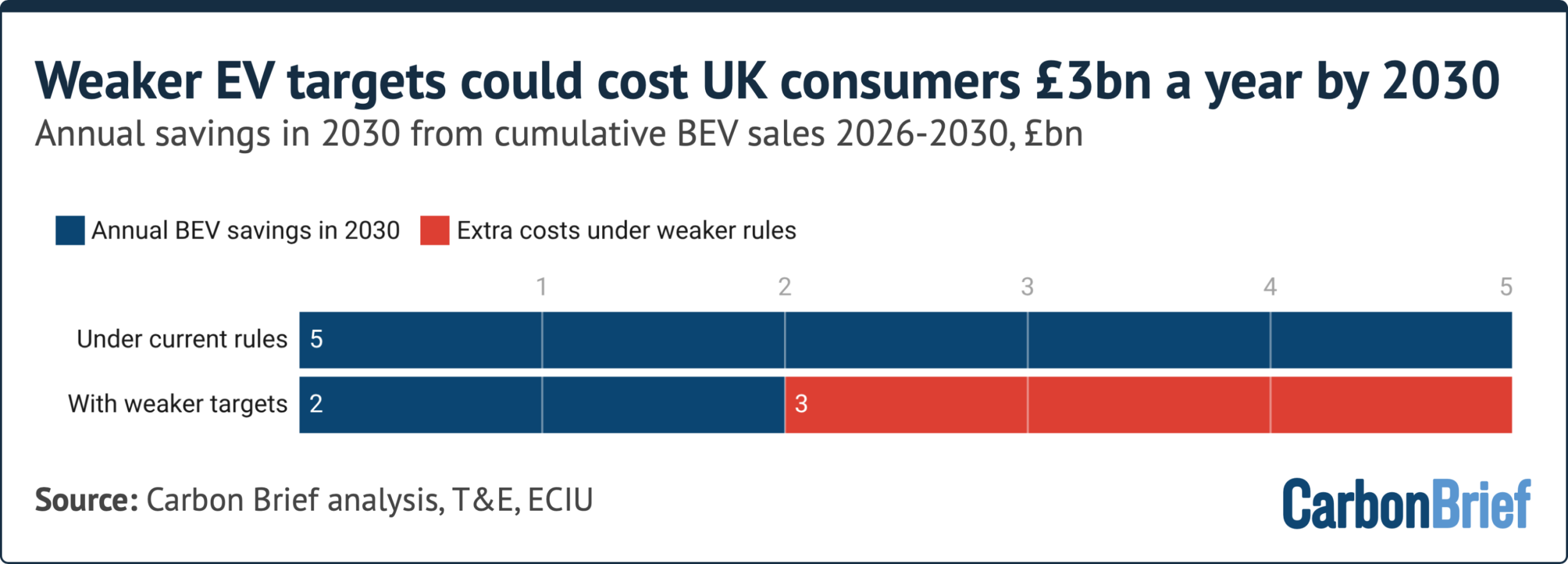
An upcoming UK government consultation on weakening targets for electric vehicles (EVs) could cost consumers as much as £3bn a year by 2030, according to Carbon Brief analysis.
It could require the UK to import an extra 17m barrels of oil in 2030, raising expected net imports by 8%, as well as adding 2.5% to national emissions that year, the analysis shows.
After years of fierce lobbying by parts of the car industry – and despite the significant savings on offer for EV drivers – media reports suggest that EV targets could be “watered down”.
Under current rules, battery EVs – BEVs, those which run only on electricity – must make up a rising share of new car sales in the UK.
This policy, known as the “zero-emission vehicles” (ZEV) mandate, was introduced by the previous Conservative government and sets a goal for 33% BEV sales in 2026, rising to 80% in 2030.
(Carmakers are able to use “flexibilities” to help meet their targets, which reduces the effective target under the ZEV mandate to an estimated 25% of sales in 2026.)
Now, the government under new Labour prime minister Andy Burnham is reported to be considering a cut in the BEV target for 2030 to just 50% of new car sales, alongside options for 60% or 70%.
Carbon Brief understands that a consultation on weakening the ZEV mandate is being reviewed by the prime minister’s office in Number 10, ahead of being formally released.
If the mandate is weakened to 50% by 2030 – and if carmakers make more use of “flexibilities” – there could be up to 3m fewer BEVs on UK roads by 2030, according to the NGO T&E.
Previous Carbon Brief analysis found that BEVs are around £1,100 cheaper to run per year than a petrol car, thanks to far lower fuel costs.
Overall, BEVs are more than £1,000 per year cheaper to own than either petrol cars or plug-in hybrids (PHEVs, which can run on petrol or electricity).
This is according to analysis of the “total cost of ownership” by the Energy and Climate Intelligence Unit (ECIU), including purchase price, fuel costs, insurance and proposed pay-per-mile charges.
In total, Carbon Brief analysis shows that UK drivers could be hit with an extra £3bn in annual ownership costs by 2030, if the ZEV mandate is weakened, as shown below.
A weaker ZEV mandate could “put billions of pounds of committed investments at risk”, reports BusinessGreen, including in the EV charging network and battery supply chains.
Industry group Energy UK says that the mandate is “working in the way it was designed to work” and that it is the “single biggest driver of emissions reductions” in government climate plans.
However, Carbon Brief analysis shows that a weaker ZEV mandate could result in an extra 7.4m tonnes of carbon dioxide emissions (MtCO2) in 2030. This would add the equivalent of 2.5% to national emissions in 2030, under the UK’s international climate goal for that year.
In addition, a weaker ZEV mandate could result in the UK needing to import an extra 17m barrels of oil in 2030, equivalent to 8% of projected net imports that year.
Energy UK says that shifting to EVs will help to reduce household energy bills “for everyone”. This is not only through direct cost-of-ownership savings for EV drivers, but also by spreading the costs of upgrading the electricity system across a wider user base.
Car industry group the Society of Motor Manufacturers and Traders claims that its members are spending “blilions…on discounts, finance incentives and marketing support” and that “natural” EV demand is below the level required to meet the current ZEV mandate. Its claims are disputed.
related
Q&A: Does the world need ‘carbon capture and storage’ to reach net-zero?
UK withdraws millions in funding from world’s second-largest rainforest in Congo
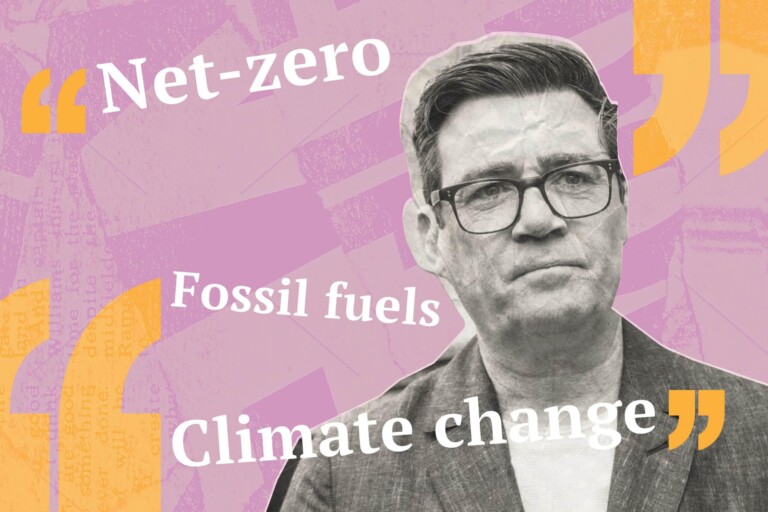
28 quotes from new UK leader Andy Burnham on climate, net-zero and fossil fuels
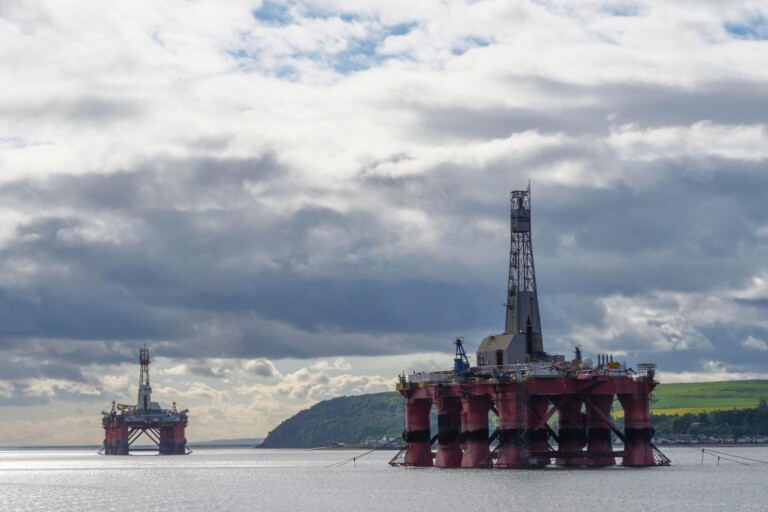
Analysis: UK newspapers have already printed 63 editorials in 2026 backing North Sea drilling
The post Analysis: Weaker EV targets could cost UK consumers £3bn a year by 2030 appeared first on Carbon Brief.
Analysis: Weaker EV targets could cost UK consumers £3bn a year by 2030



-
Climate Change1 year ago
Guest post: Why China is still building new coal – and when it might stop
-
Greenhouse Gases1 year ago
Guest post: Why China is still building new coal – and when it might stop
-

 Greenhouse Gases2 years ago
嘉宾来稿:满足中国增长的用电需求 光伏加储能“比新建煤电更实惠”
-

 Climate Change2 years ago
嘉宾来稿:满足中国增长的用电需求 光伏加储能“比新建煤电更实惠”
-
Climate Change2 years ago
Bill Discounting Climate Change in Florida’s Energy Policy Awaits DeSantis’ Approval
-

 Renewable Energy10 months ago
Sending Progressive Philanthropist George Soros to Prison?
-
Greenhouse Gases1 year ago
嘉宾来稿:探究火山喷发如何影响气候预测
-

 Carbon Footprint2 years ago
US SEC’s Climate Disclosure Rules Spur Renewed Interest in Carbon Credits