

Disruptions to global fuel markets caused by the war in Iran have hit Africa’s efforts to expand clean cooking with gas, prompting the International Energy Agency (IEA) – backed by the US, a major fossil gas exporter – to launch a programme aimed at strengthening security of supply.
Although a fossil fuel, liquefied petroleum gas (LPG) stoves are generally regarded as a cleaner and healthier alternative to using smoky wood or charcoal, which about 1 billion people in sub-Saharan Africa still rely on, according to IEA estimates. Cooking with these inefficient biofuels generates annual carbon emissions comparable to those from the aviation and shipping sectors combined.
Speaking on Thursday at a high-level online event on clean cooking in Africa, Fatih Birol, the IEA’s executive director, said LPG supply had been “disproportionately affected” by the Strait of Hormuz crisis.
“Our numbers show that 3.4 billion people around the world, most of them in Africa, have been negatively affected as a result of the LPG crisis,” Birol said.
-
India looks to untapped graphite riches for slice of critical minerals boom
Clean energy demand for battery-grade graphite is surging, but India faces hurdles as it positions itself to compete with China’s grip on the supply chain -
Ugandan farmers launch UK court case against East African oil pipeline
Crowdfunded lawsuit filed at London’s High Court seeks to enforce Uganda’s laws against EACOP Ltd, the pipeline project’s UK-registered company -
As blue economy gathers pace, communities must benefit from ocean boom, activists say
As governments turn to the ocean for jobs, growth and climate solutions, campaigners at the Our Ocean Conference in Mombasa warned coastal communities must not be left behind

With around 30% of global seaborne trade in LPG passing through the key shipping route off the coast of Iran, supply disruptions and price shocks led to fuel rationing and sharp price hikes in Asia and Africa this year, putting LPG beyond the reach of many households, according to an IEA progress report released at the event.
The report found that most emerging nations have thin fuel reserves to buffer the impacts of the crisis. “Many countries now have less than 15 days of fuel storage,” Birol said, adding that several countries, including Uganda and Bangladesh, had approached the IEA for support to deal with the crisis.
Prioritise LPG security
In response, the agency is developing a new clean cooking security programme aimed at expanding LPG storage, strengthening supply chains, and improving cooperation between producing and consuming countries.
Birol said the IEA’s energy security strategy has spanned oil, natural gas and electricity, “but we think LPG security is also very important”. He added that the agency is working closely with LPG companies around the world to find ways to keep supplies stable.
Speaking at the event, US Energy Secretary Chris Wright highlighted the US’s position as the biggest producer and exporter of LPG, and said that expanding access to clean cooking fuels had become the Trump administration’s top international energy priority.
He called for greater collaboration to build global supply chains, including gas distribution networks, LPG storage capacity and, “most critically”, fuel delivery systems to reduce costs for the 2 billion people worldwide who still lack access to clean cooking.
The loss and damage fund needs far more finance to deliver climate justice
Funding grows but still falls short
Alongside its new fuel security programme, the IEA announced $900 million in new commitments for clean cooking in Africa, adding to the $2.2 billion pledged at the inaugural Africa Clean Cooking Summit in Paris in 2024.
Around $750 million of those earlier commitments have already been deployed across 22 African countries, supporting projects ranging from LPG storage in Tanzania and electric cooking in Kenya to new stove factories in Nigeria and stove distribution in Senegal.
The IEA said clean cooking access in sub-Saharan Africa is now expanding three times faster than in 2010, reaching nearly 12 million people in 2024. But population growth continues to outpace progress, with the number of people still cooking with more polluting fuels rising by around 14 million last year.
Kenyan President William Ruto said financing remains the biggest hurdle, noting that Kenya alone requires around $1 billion to achieve its clean cooking goals.
“Closing the continent’s clean cooking access gap will require scaled-up investment, yet annual financing remains far below what is needed,” he said.
In 2024, the IEA said investments of $4 billion a year would be needed for the rest of this decade to close the clean cooking gap in Africa, but levels remain far below what is needed to provide universal access.
Paris summit unlocks cash for clean cooking in Africa, side-stepping concerns over gas
Norwegian Prime Minister Jonas Gahr Støre described clean cooking as “one of the most underfunded opportunities in global development and climate policy”, despite causing around 850,000 premature deaths across Africa every year, mostly among women and children.
He called on governments, international partners and the private sector to work together to ensure rapid progress on what he described as “one of the most cost-effective climate mitigation strategies available to us”, adding that “carbon finance, climate finance and development finance must align”.
Localising the supply chain
Clean cooking in Africa is not only about energy access, said Lerato Mataboge, the African Union (AU) Commissioner for Infrastructure and Energy, explaining that it has the power to reshape livelihoods and markets across the continent.
But this will only be possible if the clean cooking value chain is localised, she said, adding that the AU aims “to avoid Africa remaining a consumer and not a producer of transformation interventions that are required by our people”.
Mataboge said the recent LPG supply disruptions underscore the need for Africa to build more resilient clean cooking supply chains, warning that the roughly 13 million people who gained access to clean cooking annually in the past five years could revert to traditional fuels if LPG prices continue to surge.
She called for greater investment in manufacturing, distribution and infrastructure, saying Africa must “create local value chains” and strengthen private-sector participation.
Moving the value chain for clean cooking closer to the people that need it most and improving infrastructure, she said, would not only support a just energy transition but also “insulate communities from external shocks, thereby guaranteeing security of supply”.
The post Iran war fuel shocks threaten Africa’s clean cooking push, IEA says appeared first on Climate Home News.
Iran war fuel shocks threaten Africa’s clean cooking push, IEA says

Three countries have been named by the Paris Agreement’s compliance committee for failing to submit a nationally determined contribution (NDC) and repeatedly snubbing offers of help with their climate plans.
After months of internal debate over whether to identify serial non-responders, the Paris Agreement’s Implementation and Compliance Committee (PAICC) named the three countries which have failed to engage with it over their NDCs on Friday.
It named Democratic Republic of Congo, Senegal and North Korea in a footnote of its annual report, adding that it decided to name them “with a view to facilitating engagement”, adding that representatives of the three nations had been invited to its meeting in early 2027 “with the purpose of identifying any challenges and constraints”.
“The Committee noted the importance of Parties engaging with the Committee in a timely manner, while noting that some delays may be due to the national capabilities and circumstances of the Parties”, the report said.
-
Under US pressure, World Bank says it will back gas “where appropriate”
The US wants the World Bank to expand its gas support while climate campaigners are pushing for it to end – its head spoke this week of limited backing for the fossil fuel -
IPCC scientists vow to press on with climate reports despite political deadlock
After governments again failed to agree a timeline, nearly 120 IPCC authors pledged to complete their assessment on time and with full scientific rigour -
Paris Agreement committee snubbed over missing NDC climate plans
Many governments have still not submitted a nationally determined contribution to the UN, breaching a key requirement of the Paris Agreement

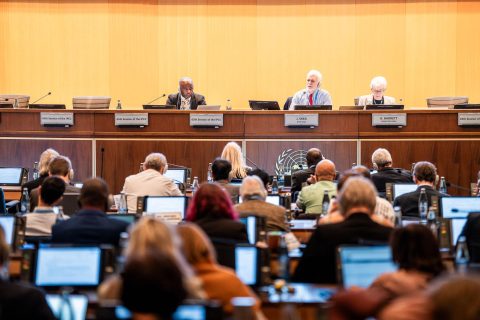

In July, PAICC said 12 countries had ignored its repeated attempts to discuss why they had not published an NDC as required every five years under the 2015 Paris accord.
Members of the committee had been divided over whether to name them, but at a September meeting decided to do so in their annual report to the annual climate COP summit.
By the time the report was published on Friday, only Congo, Senegal and North Korea “had not communicated an NDC or submitted a [Biennial Transparency Report] and had not yet responded to any of the Committee’s notifications, despite several reminders issued by the Committee in this regard”.
Rainforest and renewable energy ambitions
The silence from Congo and Senegal is notable because the former is home to much of the Congo Basin rainforest while the latter has sought billions of dollars in climate finance to support its renewable energy ambitions.
After Brazil, Congo has more rainforest than any country in the world. This forest, and the country’s peatlands, absorb huge amounts of greenhouse gas but are fast being lost to expanding farmland, charcoal production, logging and mining.
Senegal signed a Just Energy Transition Partnership with Canada and wealthy European nations in 2023, to help it meet its renewable energy targets under the-then government of Macky Sall. It was chair of the Least Developed Countries group between January 2022 and December 2023.

Tejas Rao, who is researching the PAICC as part of a doctoral thesis at Cambridge University, said the governments of the three countries should engage with the committee.
“Engagement costs these governments very little and the committee has shown it will listen,” he said.
“Silence leaves the committee with no basis to help, and it leaves the [governments] exposed to the narrative that they are simply disengaged,” he told Climate Home News.
Paris Agreement requirement
The 2015 Paris Agreement requires all parties to publish an NDC every five years outlining their emissions reduction targets, with each plan meant to be more ambitious than the country’s last NDC.
The latest set – the third round of plans, with new targets for 2035 – was due in February 2025. While most countries missed this deadline, all but around 30 – mostly small emitters but including Egypt, Vietnam and Argentina – have now submitted them.
Over the year, the PAICC – which is made up of government climate officials from developed and developing countries – has been communicating with governments that have not submitted NDCs and trying to overcome barriers to them doing so.
Some nations have cited exceptional circumstances as the reason for not submitting an NDC, a process that requires a significant amount of work in tracking emissions and consulting on how to curb them across the economy. For example, a letter from a Sudanese official to the PAICC, seen by Climate Home News, said that the country’s civil war had led to the suspension of its NDC preparation.
-
IPCC scientists vow to press on with climate reports despite political deadlock
After governments again failed to agree a timeline, nearly 120 IPCC authors pledged to complete their assessment on time and with full scientific rigour -
Under US pressure, World Bank says it will back gas “where appropriate”
The US wants the World Bank to expand its gas support while climate campaigners are pushing for it to end – its head spoke this week of limited backing for the fossil fuel -
Who shapes climate science? The equity question facing the IPCC
Early completion of the next global climate science assessment reports risks excluding research from the Global South, which is key to ensuring the findings are fair
The US and Iran are not signed up to the Paris Agreement and so do not have active NDCs, nor does Taiwan, which is not a UN member state.
Rao said that because the PAICC is “facilitative and non-punitive”, naming the countries “is meant to open a door, not close one – the invited consultation is the point”.
“In recent months, governments that explained their constraints, whether capacity, finance or domestic process, have been met with follow-up and support rather than sanction, and the number of silent governments has fallen sharply,” Rao said.
The post Paris Agreement committee names three countries snubbing it over NDCs appeared first on Climate Home News.
Paris Agreement committee names three countries snubbing it over NDCs