Connect with us

Published

on

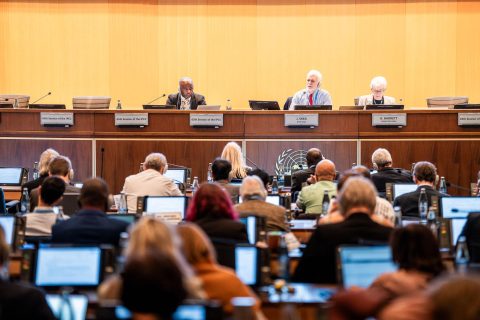
It’s been less than six months since countries struck a historic deal to “transition away from fossil fuels” after bitter fights and sleepless nights at COP28. But, in Bonn right now, discussions on what to do next about the biggest culprit of climate change seem to have largely disappeared from the agenda.

“It’s really jarring to see how quiet the conversation on fossil fuels has gone,” said Tom Evans, a senior policy advisor at E3G, adding that the trouble is this issue “doesn’t have a clear home at the UNFCCC right now”.

Last week negotiators clashed over whether that space should be the newly-created “UAE Dialogue” on implementing the outcomes of the Global Stocktake – the centrepiece of the Dubai climate summit.

Developed countries thought so and argued that talks should consider all elements of the global stocktake, including mitigation. But the Like-Minded Group of Developing Countries (LMDCs), which includes China, Saudi Arabia and India, retorted that the focus should be exclusively on finance and means of implementation. Small island states and the AILAC coalition of Latin American countries took the middle ground, pushing for discussions on all outcomes with a special focus on finance, according to observers and a summary of the discussions by the Earth Negotiations Bulletin.

Pending an agreement on that front, developed countries believe the mitigation work programme – a track set up at COP26 – is the only other natural forum to wrangle over emission-cutting measures.But negotiators there have failed to even agree on what should or should not be discussed.

An EU negotiator told Climate Home attempts to start a conversation on the way forward continue to be blocked by the LMDCs, with China and Saudi Arabia “the most vocal” among them. “The reason is that they fear this would put pressure on them to keep moving away from fossil fuels,” the EU delegate added.

The LMDCs argued that discussions over how to follow up on the COP28 agreement on fossil fuels are outside the mandate of the mitigation work programme. They have also hit back at rich nations accusing them of not doing enough to cut emissions.

Speaking on behalf of the group at a session hosted by the COP29 Presidency, the Bolivian negotiator said developed countries should be required to get to net zero by 2030. “The Annex 1 countries’ pathway to achieve net zero by 2050 does not contribute to solving the climate crisis, it is leading the world to a catastrophe,” he added.

In his intervention, the head of the EU delegation urged the COP28 and COP29 presidencies to “break the deadlock” on mitigation. “What are we waiting for?” he cried.

Shortly before, Yalchin Rafiyev, the lead negotiator for Azerbaijan’s COP29 presidency, had outlined his vision for the summit. The 1,918-word-long speech did not mention fossil fuels once.


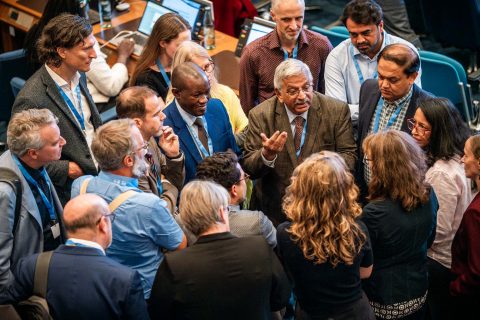
As the negotiations focus on Loss and Damage, members of civil society demonstrate in the corridors calling for polluters to pay up. (Photo: Kiara Worth/IISD ENB)

Go slow on finance 

Monday’s session on finance ended with concerns from both the Arab Group and the US that the current text collating views on the new climate finance goal (known as the NCQG) is “unbalanced” and may not produce an outcome that is “fit for purpose” by the end of the Bonn talks on Thursday. The NCCQ is due to be agreed at COP29 in Baku in November.

The 35-page “informal paper” – from which an actual negotiating text needs to emerge – is a hotch-potch of views on what the post-2025 goal should look like (a single target for public finance from rich nations or a multi-layered target with a range of goals covering various sources and purposes); who should contribute (only developed countries or a wider pool, even mentioning countries with a space programme!); and how much money (no quantified amount, a percentage of gross national income, or about $1 trillion a year). And that’s only a taster of what’s in the document…

One major sticking point for the Arab Group on Monday wasthe lack of negotiations so far on the size – “quantum” – of the NCQG (it wants an annual $1.1 trillion plus arrears from the existing $100 billion goal). Its negotiator expressed disappointment that everything else is being discussed in Bonn apart from that.

As the session came to the end of its allotted two hours, a long list of 23 delegations had yet to take the floor, including the European Union, the UK, China, Japan, Bolivia, South Africa and many African countries. It’s going to be a tough task getting through them in the last slot this afternoon – and with just three days left when will the real horse-trading start?

Iskander Erzini Vernoit, founding director of the Imal Initiative for Climate & Development, a Morocco-based think-tank, told journalists on Tuesday finance talks in Bonn had “not advanced significantly beyond where we started”, with the text going no further in resolving the fundamental debates. The way forward to Baku on the NCQG is “murky”, he warned.


World Bank greenlights role in L&D Fund 

On Monday, the World Bank’s board approved the bank’s role as trustee and host of the secretariat for the new “Fund for Responding to Loss and Damage” for an interim period of four years. This is a procedural step – which had to be taken before a deadline of June 12 – on the road to getting the UN-agreed fund up and running this year.

In a short statement announcing the decision, the bank stressed that the fund’s independent board will determine “key priorities, including financing decisions, eligibility criteria, and risk management policies”. The bank also made clear that it won’t play a role in raising money for the fund or deciding how to spend its so-far meagre resources.

Climate activist and loss and damage expert Harjeet Singh said the next step is to push on with setting up the fund’s secretariat, including appointing an executive director. The World Bank must facilitate the receipt of pledged funds while the fund’s board (which next meets in July) needs to adopt key policy decisions to enable earliest possible disbursement to affected countries, he said.

“It is crucial that the success of the Loss and Damage Fund is measured by how quickly and adequately those facing the harsh realities of the climate emergency receive support for recovery,” he told Climate Home.

At COP28, countries – including the host nation UAE – pledged close to $700 million for the new fund, but substantive discussions about how to mobilise the amounts needed to cover fast-rising losses from extreme weather and rising seas have yet to take place.

In Bonn, climate justice activists are lobbying hard for the L&D Fund to receive finance under the new post-2025 goal. But developed countries are pushing back, saying there is no basis for this under the Paris Agreement, which refers to them providing financial resources only for mitigation (measures to reduce emissions) and adaptation to climate impacts.

The post Bonn bulletin: Fossil fuel transition left homeless appeared first on Climate Home News.

Bonn bulletin: Fossil fuel transition left homeless

Continue Reading

Climate Change

UN head calls for platform for “honest dialogue” on fossil fuel transition

Published

on

The head of the United Nations called on Wednesday for governments to get together for an “honest dialogue” on how to transition away from fossil fuels.

Antonio Guterres told those gathered for the International Energy Agency’s ministerial meeting in Paris that “we must stop treating the transition away from fossil fuels as taboo”.

“Delay will only breed instability,” he said in a video message, “history is littered with the wreckage of failed transitions – broken economies, scarred communities and lost opportunities. We face a choice: design the transition together – or stumble into it through crisis and chaos.”

He called for “a dedicated global platform for honest dialogue on transitioning away from fossil fuels” that includes fossil fuel producers and consumers, developed and developing countries, civil society and public and private financial institutions.

    Guterres’ call contrasted sharply with the position of the United States. Ahead of the conference, US energy secretary Chris Wright threatened to pull Washington out of the IEA if the government-funded think tank continues to promote the energy transition.

    At the event, Wright downplayed the importance of climate change, claiming that while it is a “really physical problem, it just isn’t even remotely close to the world’s biggest problem”. He called on the IEA to focus more on providing clean cooking solutions, which include fossil gas.

    But, while US support wavers, the IEA’s head Fatih Birol celebrated that Brazil, India, Colombia and Vietnam have joined the Paris-based institution. He said this shows that the IEA’s strategy of engaging with the world outside developed countries was paying off. UK energy secretary Ed Milliband said it was a “vote of confidence” in the IEA.

    Roadmap and conference

    Guterres’ words come just over two years since governments agreed at COP28 to transition away from fossil fuels in energy systems and three months after over 80 governments pushed at COP30 for a roadmap away from fossil fuels.

    After the proposal failed to gain consensus at COP30 in the formal negotiations, Brazil’s COP30 presidency promised to deliver a global roadmap through an informal initiative before this year’s COP31 climate summit in Antalya.

    Separately, Australia, which is leading the negotiations at COP31, vowed it would “continue to argue” for a transition away from coal, oil and gas in energy systems during its co-presidency.

    Governments, experts, industry leaders and Indigenous representatives will be gathering this April in the Colombian city of Santa Marta for a highly-awaited first conference on transitioning away from fossil fuels.

    The government of Colombia, which is co-hosting the summit with the Netherlands, said it would seek to launch a permanent platform that would help a “coalition of the willing” accelerate the shift away from planet-heating coal, oil and gas beyond the UN climate process.

    “Although there is growing consensus to gradually eliminate fossil fuels, there were still no specific spaces or meeting places dedicated to comprehending and addressing the pathways needed to overcome economic, fiscal and social dependence on fossil fuels, especially for producing countries,” Maria Fernanda Torres Penagos, director of climate change in Colombia’s Environment Ministry, said last month.

      It is unclear how that platform would cross over with Guterres’ suggestion. But Alex Rafalowicz, the director of the Fossil Fuel Non-Proliferation Treaty Initiative (FFNPTI), which is supporting the conference, praised the UN chief’s “welcome leadership and vision”.

      He said that the development of this platform is already happening through the FFNPTI, in which 18 countries are participating in discussions on a fossil fuel treaty.

      “The Santa Marta conference is the first stop on this journey and all countries that are seriously committed to the 1.5C limit should be there”, he said, “we expect that out of Santa Marta we will have more proposals and commitments that can feed into the [Brazilian] COP Presidency roadmap”.

      Coalitions like the Beyond Oil and Gas Alliance and the Powering Past Coal Alliance already offer platforms to discuss transitioning away from fossil fuels. But major fossil fuel producers have not joined these alliances.

      Guterres said that the platform should deliver a global transition plan which “aligns investment, energy security and climate goals – with concrete milestones and robust finance, particularly for developing countries”.

      Guterres said in 2022 that, in order to be compatible with limiting global warming to 1.5C, wealthy countries should phase out coal by 2030 and other nations by 2040. The IEA said in 2021 that the world should reach net zero by 2050 to meet the 1.5C warming limit.

      The post UN head calls for platform for “honest dialogue” on fossil fuel transition appeared first on Climate Home News.

      UN head calls for platform for “honest dialogue” on fossil fuel transition

      Continue Reading

      Climate Change

      Border Wall Closes in on Big Bend

      Published

      on

      Residents and elected officials are speaking out against a proposed border barrier through Texas’ biggest state park and one of the jewels of the national park system.

      REDFORD, Texas—Plans for a border wall through the Big Bend region of West Texas are raising alarms among residents and elected officials.

      Border Wall Closes in on Big Bend

      Continue Reading

      Climate Change

      Texas Alleges ‘Habitual Non-Compliance’ of Wastewater Rules at Dow Chemical Complex 

      Published

      on

      But the lawsuit, filed Friday by Texas Attorney General Ken Paxton’s office, could shield the petrochemical giant from harsher litigation from a local citizen group.

      The Texas Attorney General’s office filed a lawsuit Friday afternoon against Dow Chemical Co., North America’s largest chemical manufacturer, describing hundreds of water pollution violations from its industrial complex on the rural Gulf Coast in Seadrift.

      Texas Alleges ‘Habitual Non-Compliance’ of Wastewater Rules at Dow Chemical Complex 

      Continue Reading

      Trending

      Copyright © 2022 BreakingClimateChange.com