

Hundreds of scientists gathered in London this week to discuss the role of migration as a way for communities to adapt to climate change.
The impacts of a warming world, such as sea level rise and worsening extremes, are pushing many people around the world to leave their homes.
As a form of climate adaptation, a decision to migrate involves an array of different factors, such as politics, conflict and economic opportunity.
The conference unpacked these topics, as well as the impacts of climate change on livelihoods, relocation and gender norms across Africa and Asia.
The event had a strong focus on urban areas, with one co-convenor stating that “half of the world’s population now lives in the cities…A lot of the battles of climate adaptation will be won and lost in cities.”
Another co-convenor told Carbon Brief that the conference’s “focus really is on the climate change adaptation community, showing that migration is not a failure of adaptation – it is part of adaptation”.
Carbon Brief attended the conference to report on the sessions and speak to world-leading experts on climate-driven migration.
- Migration as adaptation
- Cities and livelihoods
- Immobility and relocation
- Legal pathways
- Changing narratives
Migration as adaptation
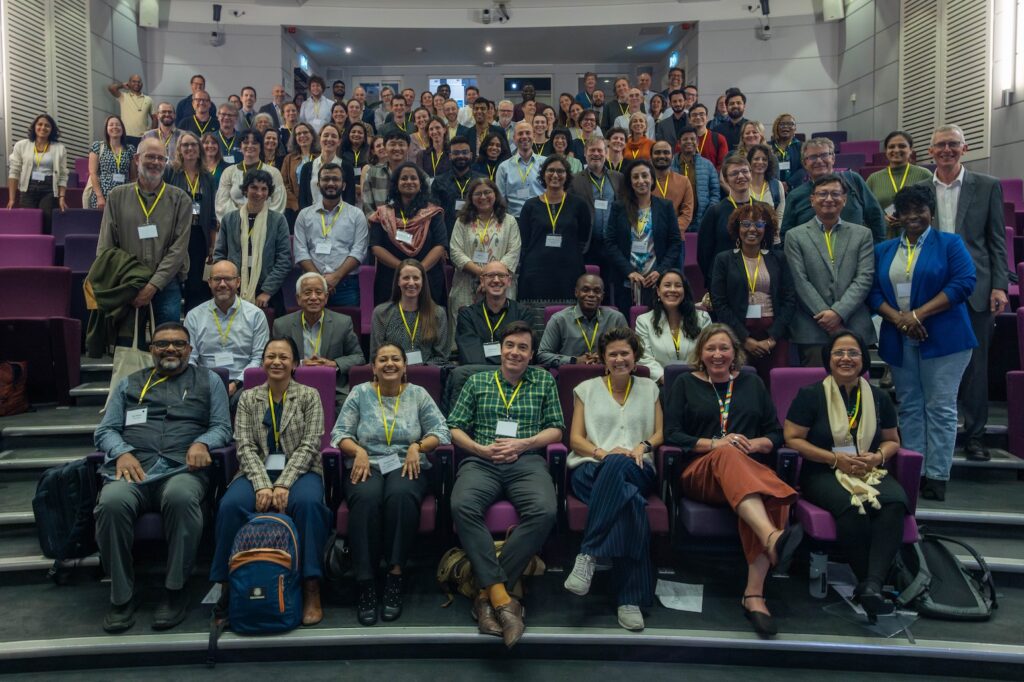
The two-day conference on “mobility in adaptation to climate change” was held at Wellcome’s headquarters in London. It gathered more than 100 leading experts in migration, adaptation and climate change from countries across Europe, Africa and Asia.
On day one of the conference, co-convenor Prof Neil Adger, a professor from the University of Exeter, told Carbon Brief:
“Our focus really is on the climate change adaptation community, showing that migration is not a failure of adaptation – it is part of adaptation.”
In his opening address, Adger highlighted that there were still many unknowns on climate migration – such as how and when it is an appropriate way to adapt to climate change, and who benefits and loses in these situations.
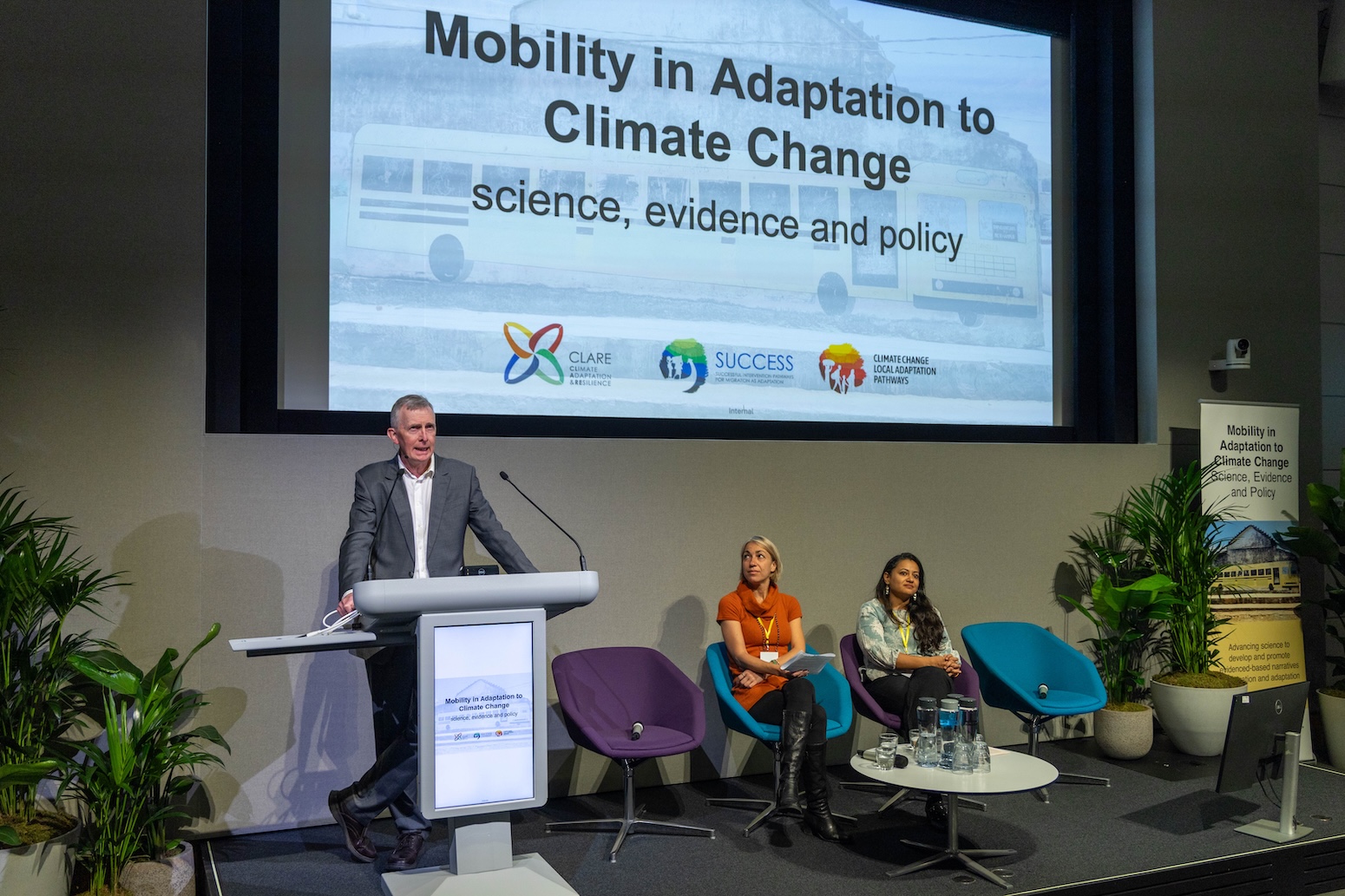
Dr Manuela Di Mauro – the head of climate-adaptation research at the UK Foreign Commonwealth and Development Office – took to the stage next. She told attendees that mobility has always been a part of human life, stating:
“We are all migrants. We are all part of the same history.”
She urged the scientific community to “learn the language and the political perspective” needed to support and engage with policymakers about climate-driven migration.
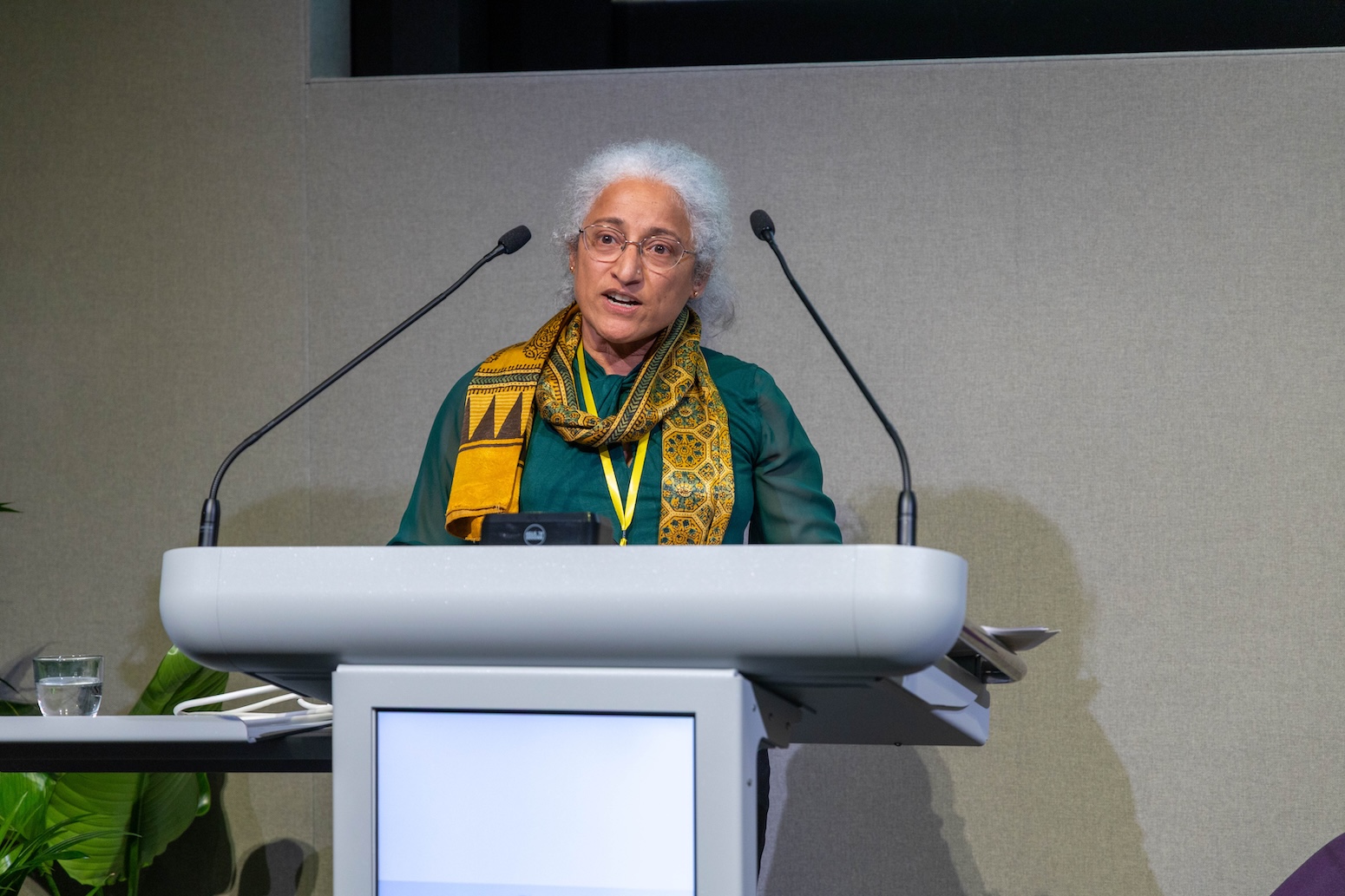
Conference co-convenor Dr Chandni Singh from the Indian Institute for Human Settlements (IIHS) then delivered the first in-depth talk of the conference, outlining the current state of knowledge on climate change and migration.
She explained that cross-border migration is “emotionally and economically arduous” adding “under a changing climate, people choose to move within national borders first”. (Estimates suggest that around three-quarters of total global migration is internal.)
Singh emphasised that “mobility choices are extremely complex and nuanced, based on one’s aspirations and capabilities, social norms and asset bases”. She continued:
“Some [people] are forced to move or are displaced, others are relocated preemptively to move people out of harm’s way and others choose to stay despite escalating risk – or because resilience-building measures allow people to stay.”
She stressed that people need resources to migrate, so the poorest people are often unable to move – leaving them in a state of “immobility”. However, she also noted that most people do not want to leave their homes, stressing the “visceral reality of place attachment”.
Singh explained that many families “live dual lives”, in which family members work in the city to save money for a life back in their village. This dynamic of living across two locations is often referred to as “translocality”.
For example, Singh shared the story of residents from the Indian village of Kolar, who travel more than 100km to and from Bangalore for work every day, or else live there in informal settlements.
These workers send the money they earn back home, where it is often used to dig bore wells to access water. However, Singh warned that climate change and poor water management mean these wells often fail year after year, trapping people in this cycle of travelling to Bangalore to earn more money.
Singh also stressed the prevalence of rural-to-urban migration. She cited UN estimates (that do not explicitly include climate-driven migration), which find that around 2.5 billion people are expected to migrate from rural to urban areas by 2050. It adds that 90% of the change occurring in Africa and Asia.
Singh added:
“Half of the world’s population now lives in the cities…A lot of the battles of climate adaptation will be won and lost in cities.”
She noted that although migration “helps to manage risks”, it also has “significant financial, personal and social costs”.
Singh went on to discuss the global goal on adaptation – a set of 59 indicators to measure global progress on adaptation. Singh said that “migration and mobility are completely invisible…and therefore completely overlooked” in the goals.
She concluded by discussing the importance of new narratives on climate change and migration, saying:
“It’s the narratives and stories we tell of this moment that can help us first acknowledge what is happening, help subvert misinformation and untruths, and really demand accountability.”
Cities and livelihoods
Migration from villages to cities was a central theme of the conference.
On day two of the conference, Dr Aromar Revi, founding director of the IIHS, told delegates that the “root cause of the climate emergency is maldevelopment” and emphasised the importance of pursuing adaptation, mitigation and development goals together.
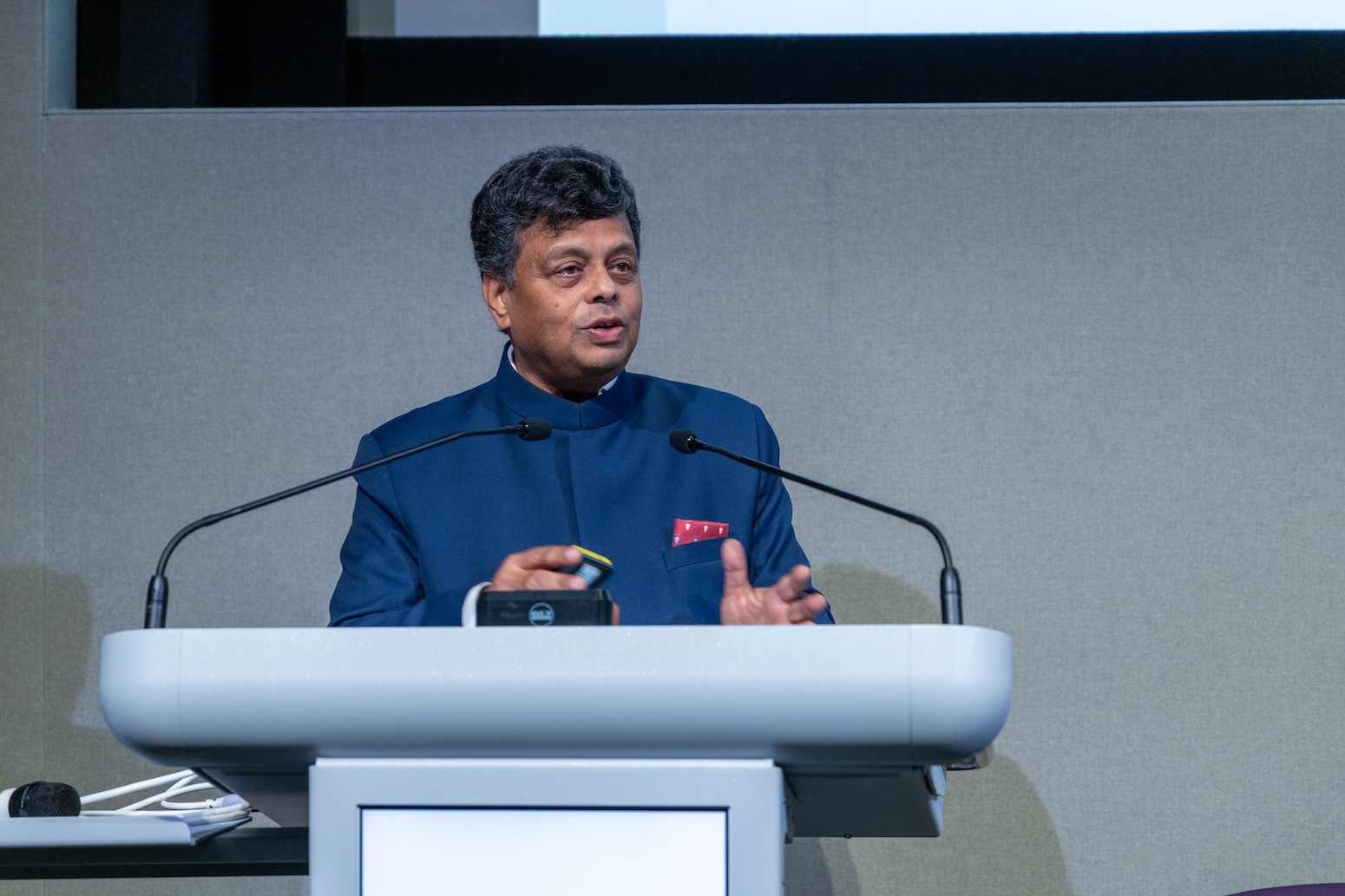
He noted that the Intergovernmental Panel on Climate Change is currently working on a special report on climate change and cities and argued that “cities will play a decisive role in shaping global climate futures”.
He continued:
“Cities concentrate opportunities, but they also concentrate poverty, inequality and risk. And that’s something that we really don’t know how to understand, especially in a changing climate.”
Throughout the conference, many of the delegates presented nuanced stories of rural-to-urban migration from individual communities. These case studies highlighted the complex, interlinking factors that drive a person’s decision to move and the wide range of outcomes.
Dr Aysha Jennath from the IIHS presented the results from her research, which unpacks the experiences of migrants who have moved from rural to urban areas, for a range of reasons including the changing climate and for better livelihoods.
Jennath and her colleagues interviewed thousands of migrants living in informal settlements, or working in informal jobs, in large cities in Bangladesh, Bhutan, India and Nepal. The researchers’ questions aimed to understand the migrants’ “wellbeing, adaptive capacity and precarity”.
Overall, Jennath found that migrants in large cities are vulnerable to poor housing, unsafe working conditions and a lack of basic social services.
Dr Binaya Pasakhala and Dr Sabarnee Tuladhar from the International Centre for Integrated Mountain Development, presented initial results from the Climate Adaptation and Resilience (CLARE) project, in which researchers interviewed households across Bangladesh, Bhutan, India and Nepal about migration patterns.
They conducted hundreds of surveys to identify how households are adapting to the changing climate and grouped responses into a series of “pathways” describing the impacts of rural-to-urban migration on their livelihoods.

For example, Tuladhar noted that in Bhutan, there is a huge emphasis on education, which has “changed the aspirations of the community – especially the youth”. This drives “huge depopulation” from rural areas as young, educated people migrate to urban areas or internationally, she said.
This mass movement into the cities provides opportunities for young people. It also provides money for the families back home – a type of finance known as remittances.
However, it also “weakened resilience” in the villages through “gungtong” – a phrase which translates literally to “empty houses”.
However, they also described the case of Nepal’s Baragon mountain community, where remittances from people who moved to urban centres has allowed communities in the villages to shift livelihoods away from subsidence farming towards commercialised farming and tourism. In this case, “migration has actually strengthened the resilience of the community”, Tuladhar said.
Prof Nitya Rao is a researcher in gender and development at the University of East Anglia (UEA), also presented research funded by CLARE.
She told the conference that when men are forced to leave for work, due to a lack of other options, a lot of their earnings go towards “survival” and less is saved. On the other hand, “mixed migration” – such as the movement of a father and son – is often “aspirational”. It typically yields higher remittances and improves adaptive capacity back home, according to Rao.
Speaking to Carbon Brief, Rao argued that in order to “make migration a case of adaptation and not just survival in the short term”, destination cities need to do more to welcome migrants.
Dr Maria Franco Gavonel, a lecturer at the University of York and Prof Mumuni Abu, a senior lecturer from the University of Ghana, explored the concept of “social tipping points” in migration decision-making.
They suggested that as a drought intensifies, there may be a threshold at which households decide to leave. The authors compared drought indices to immigration patterns across communities in Ghana, Mali, Kenya and Ethiopia, but did not find evidence of a social tipping point.
This could be because households anticipate severe droughts and leave before they hit, the speakers suggested. They also noted that there are many government-led policy responses to drought that could affect a household’s decision to stay or leave.
For example, Kenya has a livestock-insurance policy to help families who lose animals during drought. Similarly the African Union uses satellite data to assess the severity of droughts and provide compensation to affected households.
In the final session of the conference, Dr Kasia Paprocki, an associate professor of environment at the London School of Economics and Political Science, provided a counterpoint to the idea that the vast majority of villagers want to abandon farming and move to the city.
She argued that people are often displaced from rural communities and unable to live farming lifestyles, even if they want to, adding:
“I have found that agrarian dispossession is being intensified through development interventions that are today being referred to as climate change adaptation.”
She argued for the need to “reorganise economies” to enable people to stay “if they would like to”, adding:
“Climate change adaptation and climate migration without meaningful agrarian reform will not produce climate justice.”
Immobility and relocation
Movement from rural to urban areas was not the only migration pattern discussed in the conference. Experts also discussed movement patterns including planned relocation and immobility.
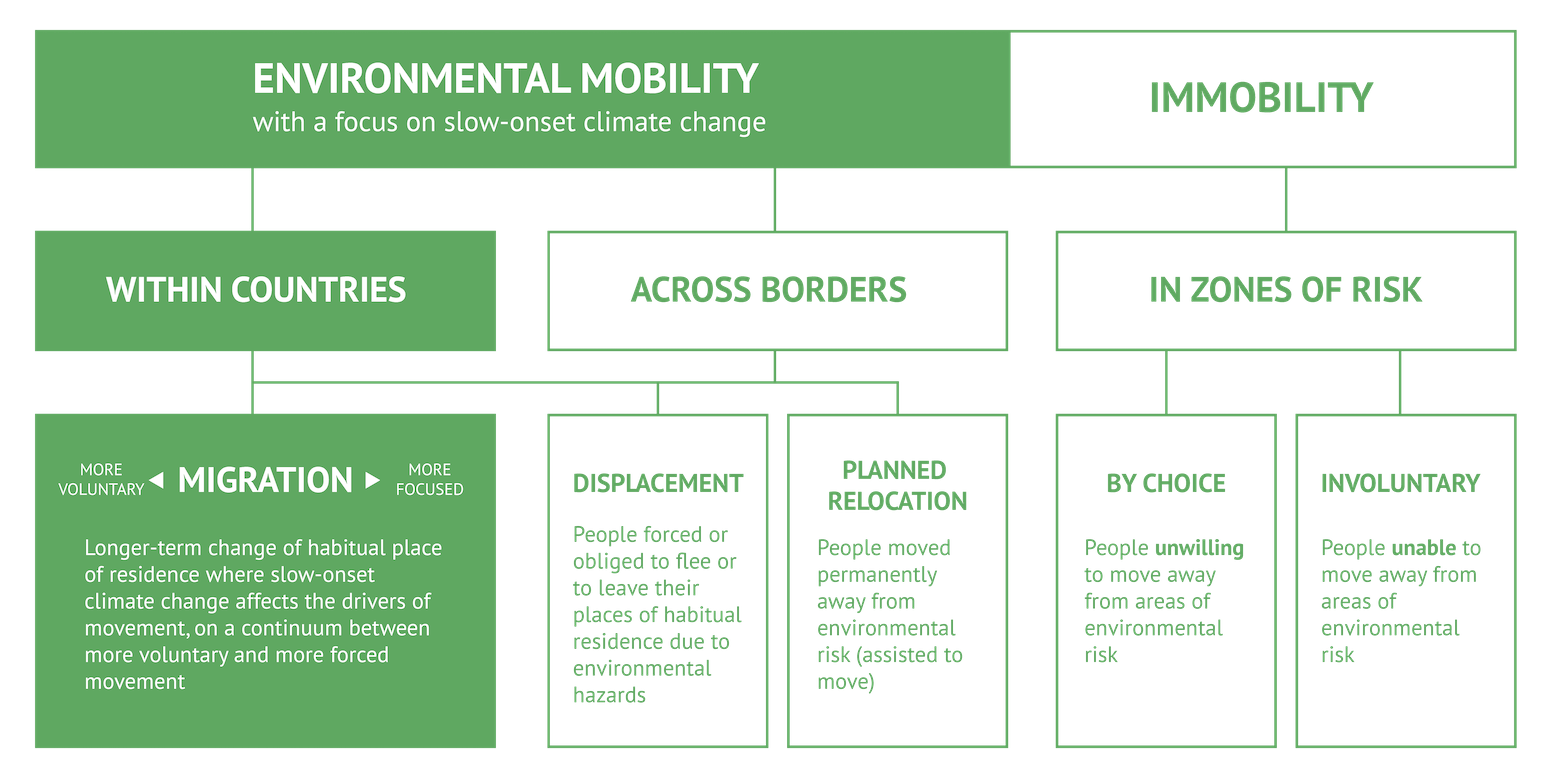
The graphic below – adapted from the 2021 Groundswell report and originally published in Carbon Brief’s 2024 explainer on climate-driven migration – shows different categories of mobility and immobility due to climate change.
Dr Roman Hoffmann from the International Institute for Applied Systems Analysis’s migration and sustainable development research group opened a session on “immobility” by presenting a way of defining and measuring the phenomenon.
He told Carbon Brief that immobility is “basically the absence of movement”, adding:
“The are different types of immobility. We have voluntary and involuntary immobility – and sometimes these different forms are not so clearly distinguishable, but there’s more sort of a continuum. Basically, the question is whether people are able to realise their aspirations to move or to stay.”
In his talk, Hoffman noted that media narratives around migration often focus on large movements of people, while the topic of immobility “falls between the cracks”.
Immobility is often seen as a problem experienced by the poorest and most vulnerable members of society – for example, because people cannot find or afford the resources they need, such as food or transportation, because they are not healthy enough to move or because they do not have the social network they require to make such a big change.
However, Dr Joyce Soo from the Lund University Centre for Sustainability Studies, explained that there are also instances when “wealth enables immobility”.
Soo explained that in coastal regions of Sweden that are exposed to extreme events, many residents there choose to stay, as there is “strong trust in government protection”, such as coastal defences. She explained that in this instance “immobility is linked to identity and status”.
A separate session at the conference focused on planned relocation – the organised movement of a group of people away from a site that is highly vulnerable to climate extremes.
Dr Ricardo Safra de Campos, a senior lecturer in human geography at the University of Exeter, told the delegates that planned relocation is “arguably the most controversial aspect of mobility as a response to climate change” and is usually implemented when “all other forms of in-situ adaptation have failed”.
Safra de Campos and Nihal Ranjit, a senior research associate at IIHS, worked with a team of researchers to interview people who underwent planned relocation programmes in India and Bangladesh.
They told delegates that planned relocation is often implemented when people feel unsafe – for example due to climate extremes – resulting in an “erosion of habitability”.
However, Ranjit explained “safety alone doesn’t make relocation successful”. He argued that the most important aspect of planned relocation is to ensure that migrants do not lose their livelihoods.
He presented the example of Ramayapatnam – a fishing village in India where houses were slowly being lost to coastal erosion. Ranjit explained that a planned relocation programme was set up to move people away from the coast, but that many people refused to move, as doing so would mean losing their only means of earning money.
He also noted the many Indian citizens hold a deep mistrust of the government and question the authorities’ intentions.
Relocation must be “rights-based, participatory, livelihood-centred and attentive to culture, community and long-term wellbeing”, Ranjit said.
Meanwhile, Dr Annah Pigott-McKellar, a human geographer at the Queensland University of Technology, compared two case studies of relocation in Australia.
When devastating flash floods hit Queensland in January 2011, a relocation programme led by the local government was set up to move people. The first houses were built within a year, and people were moved in “extremely fast”, Pigott-McKellar said. She explained that the goal was to keep the town together and “keep some level of social continuity”.
Conversely, when northern New South Wales faced severe flooding in 2022, the response was slow, according to Pigott-McKellar. She explained that different members of the community were offered varying levels of assistance by the state. For example, some households offered buybacks for their lost properties, while others were not.
The result was a “fragmented and dispersed mobility pathway” that saw the community split up and mistrust in the government grow.
Pigott-McKellar emphasised the importance of follow-through and continuity in relocation, stating:
“Relocation isn’t a moment in time. It is a process that unfolds over months or years”.
Legal pathways
Most human migration happens within borders. However, conference delegates also discussed cases in which people move to other countries, with a focus on the possible legal pathways.
Prof Jon Barnett, professor in the school of geography, Earth and atmospheric sciences at the University of Melbourne, explained migration patterns in the south Pacific islands.
He told delegates that climate change is causing “significant social impacts” across the islands, adding:
“While we can’t say that climate change is a major factor in migration decisions…there is a “fingerprint of climate change in [all] migration decisions.”
Barnett outlined legal migration routes for Pacific islanders, such as Fiji’s climate relocation trust fund, which has already had more than 2,000 requests, or seasonal worker schemes to New Zealand, which have already issued 137,000 visas.
However, he noted that there is a “massive burden” for the women who stay on the Pacific islands when their husbands leave. He explained that not only do women substitute for the labour of the men, but climate change can also amplify their workload by making farming more difficult and illnesses more widespread.
He concluded:
“Migration cannot be the only adaptation strategy we offer to the Pacific Islands. It’s got to be one strategy in the portfolio.”
Speaking separately to Carbon Brief, he said:
“As climate change amplifies pressures on people’s livelihoods, we may end up with a whole series of transnational populations that are kind of constantly in churn – where they’re not just living on the island, but also in Australia, New Zealand, the US.
“That’s not necessarily a bad thing, I think, so long as people still have a right to return to their islands and can do so – and are making informed choices…to manage their climate risk.”
Demographer Prof Raya Muttarak, from the University of Bologna, told delegates that Italy is the only EU country with explicit legislation for climate-related protection.
This six-month residence permit was introduced in 2018, for people who are found to have faced a “contingent and exceptional calamity”. However, she noted that there are flaws in the evidence base for making these claims, which can make it difficult for people to obtain the permits.
Changing narratives
Many speakers discussed the framing of climate change and migration in their talks. There was also a workshop on how to develop and promote “new narratives” around migration as an adaptation response to a changing climate on the first day of the conference.
Dr Reetika Subramanian, a senior research associate at UEA who helped to organise the conference, told Carbon Brief that many media narratives around migration are “alarmist” and “crisis-based”, with a focus on people from poorer countries illegally entering wealthier countries.
However, explained that the conference convenors wanted to begin work on developing a new framing for migration – both in response to climate change and more generally – focusing on its “adaptive aspects”.
Dr Benoy Peter, the executive director of the Centre for Migration and Inclusive Development, told Carbon Brief that “far right” media and politics often “leverage” migration to present a negative framing.
However, he said that he sees migration as a “solution”, describing it as the “fastest way for intergenerational upward social mobility for people from socially and economically disadvantaged populations”.
Prof Kerilyn Schewel, assistant professor of sociology at the University of North Carolina at Chapel Hill, told Carbon Brief that the migration community has “moved beyond a ‘push factor’ narrative – that climate change is coming and uprooting communities – to a more nuanced perspective that recognises that people are already moving for all kinds of reasons”.
She said the new “research frontier” is “seeing how environmental factors intersect with these other social or developmental outcomes”, such as education.
Liby Johnson, the executive director of development organisation Gram Vikas, told the conference his reason for hope:
“Communities are figuring this out. They are not rejecting mobility – they are asking for mobility that is safer, fairer and more dignified. Communities affected by climate uncertainty are not simply enduring crises – they are actively using mobility to diversify risk, protect dignity and build better futures.”
Revi, from the IIHS, told Carbon Brief:
“The future of mobility is much more certain than the climate futures are. People have been mobile for a very long time. That’s been an important part of the transformation of societies and economies for centuries…Mobility is part of the solution. It is not the full solution, but it’s part of the solution. People are voting with their feet and with their aspirations to make a change.”


The post Experts: Why migration is ‘not a failure of adaptation’ in a warming world appeared first on Carbon Brief.
Experts: Why migration is ‘not a failure of adaptation’ in a warming world

June Rubis is a steering group committee member for the Cali Fund, from Sarawak in Malaysian Borneo.
At COP16 in Cali, governments made a significant commitment: at least half of the funding from the new Cali Fund should support the self-identified needs of Indigenous Peoples and local communities, including women and youth. It was a watershed moment for multilateral benefit-sharing.
The challenge now is to translate that commitment into access arrangements that recognise the different institutions, priorities and decision-making processes of Indigenous Peoples and local communities.
For generations, biodiversity and traditional Indigenous knowledge have provided significant value to companies who depend on nature’s genetic diversity to discover new drugs that fight diseases, create products that improve health, and grow crops resilient to extreme heat and flooding events. While some compounds are sampled directly from the source country, increasingly the digital blueprints are held in online public databases which are freely accessible to use for innovation and research.
Countries urged to ramp up “insufficient” nature policies at COP17
The Cali Fund was established at COP16 to encourage commercial users of Digital Sequence Information, or DSI, to share benefits arising from its use. Estimates suggest it could generate over $3.5 billion a year – a stark contrast to the modest $10,656 currently committed to the fund from just five SMEs, underlining how much progress must be made at COP17 over the next two weeks.
The COP16 decision that set up the fund offers two routes for money to reach Indigenous Peoples and local communities: through government authorities, and through direct payments to institutions identified by Indigenous Peoples and local communities themselves.
Varied ways of organising
Indigenous Peoples and local communities organise through a wide range of institutions. Some have national or regional organisations experienced in managing international grants. Others work through territorial organisations, customary institutions, community associations, cooperatives or networks. Some have professional finance teams and audited accounts; others have extensive experience governing territories, collective resources or conservation work without having been organised around international funding requirements.
For direct access, some questions are already apparent. Which institutions should be able to receive funds? How should they be identified? What fiduciary standards should apply? How should safeguards and accountability work where institutional capacities differ? What support may be needed where institutions have strong community mandates but less experience with international finance?
Comment: Protecting nature is a public duty, not a Wall Street profit opportunity
If access is designed mainly around institutions that already meet the expectations of large international finance mechanisms, early funding will tend to favour those already familiar to funders. They will gain further experience and become better positioned for future funding, while institutions with less administrative capacity may remain outside the system despite strong community mandates and long histories of stewardship.
These first decisions matter most, because they set the terms for everyone who follows.
The role of intermediaries requires care. Some Indigenous organisations may want a fiscal host to hold and manage funds on their behalf. Communities may choose to work through an NGO they trust. Government-facilitated arrangements may work well in particular national contexts.
What matters is the function an intermediary performs and the authority that comes with it. Providing administrative support is different from deciding which Indigenous organisations qualify, which priorities can receive support, or how success will be assessed. Direct access means communities keep that decision-making authority.
Decision-making power
The COP16 decision refers to institutions that Indigenous Peoples and local communities identify. But authority among Indigenous Peoples does not sit in one kind of body. It may sit with territorial organisations, customary institutions, community associations or combinations of these. Legal recognition and customary authority do not always align neatly.