Connect with us

Published

on

At an event on the sidelines of Wednesday’s talks, the “Troika” of COP presidencies was very clear that the next round of national climate plans (NDCs) must be aligned with a global warming limit of 1.5C. The three countries – the UAE, Azerbaijan and Brazil – have all promised to set an example by publishing “1.5-aligned” plans by early next year.  

What their negotiators were not so clear on, however, was what it means for an NDC to be 1.5-aligned.

Asked by Destination Zero’s Cat Abreu about the risk of “1.5 washing”, Brazil’s head of delegation Liliam Chagas replied that “there is no international multilaterally agreed methodology to define what is an NDC aligned to 1.5”. “It’s up to each one to decide,” she said.

The moderator, WWF’s climate lead Fernanda Carvalho, pointed out that IPCC scientists say 1.5C alignment means cutting emissions globally by 43% by 2030 and 60% by 2035 – but without giving national breakdowns.

She added that Climate Action Tracker does have a methodology. This shows that no major nations so far have climate plans aligned with 1.5C.

E3G expert Alden Meyer followed up, telling the negotiators that “while we may have some disagreements on exactly what an NDC must include to be 1.5-aligned, we know now what it must exclude – it must exclude any plans to expand the production and export of fossil fuels”.

All three Troika nations are oil and gas producers with no plans to stop producing or exporting their fossil fuels and are in fact ramping up production.

Claudio Angelo, international policy coordinator for Brazil’s Climate Observatory, said the onus is on rich countries to move first, but “this is no excuse for doing nothing”. Even yesterday, he noted, President Lula was talking to Saudi investors about opening a new oil frontier on Brazil’s northern shore.

Whether 1.5-aligned or not, no government has used Bonn as an opportunity to release an early NDC. Azerbaijan’s lead on Troika relations Rovshan Mirzayev said “some”, but “no more than 10”, are expected to be published by COP29 in November.

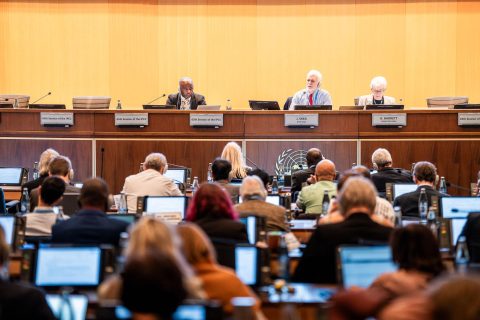
Rovshan Mirzayev (left), Fernanda Carvalho (centre-left), Liliam Chagas (centre-right) and Hana Alhashimi (right) in Bonn yesterday (Photo: Observatorio do Clima/WWF/Fastenaktion/ICS)

Climate commentary

Napping on NAPs or drowning in paperwork?   

As he opened the Bonn conference last week, UN climate head Simon Stiell bemoaned that only 57 governments have so far put together a national adaptation plan (NAP) to adjust to the impacts of climate change.

“By the time we meet in Baku, this number needs to grow substantially. We need every country to have a plan by 2025 and make progress on implementing them by 2030,” he said.

The South American nation of Suriname is one of the 57. Its coast is retreating, leaving the skeletons of homes visible in the sea and bringing salt water into cropland – and its NAP lays out how it wants to minimise that.

Tiffany Van Ravenswaay, an AOSIS adaptation negotiator who used to work for Suriname’s government, told Climate Home how hard it is for small islands and the poorest countries to craft such plans.

“We have one person holding five or seven hats in the same government,” she said. These busy civil servants often don’t have time to compile a 200-page NAP, and then an application to the Green Climate Fund or Adaptation Fund for money to implement it, accompanied by a thesis on why these impacts are definitely caused by climate change.

“It takes a lot of data, it takes a lot of work, and it takes also a lot of human resources,” she said. What’s needed, she added, are funds for capacity-building, to hire and train people.

Cecilia Quaglino moved from Argentina to the Pacific Island nation of Palau to write, along with just one colleague, its NAP. She told Climate Home they are “struggling” to get it ready by next year. “We need expertise, finance and human resources,” she said.

According to three sources in the room, developing countries pushed for the NAP negotiations in Bonn to include the “means of implementation” – the code phrase for cash – to plan and implement adaptation measures, but no agreement was reached.

Talks on the Global Goal on Adaptation are also centred on finance. Developing countries want to track the finance provided towards each target, whereas developed countries want to avoid quantification – and any form of standalone adaptation finance target for the goal.

They are also divided on the extent to which negotiators themselves should run the process for coming up with indicators versus independent experts. Developed countries want more of a role for the Adaptation Committee, a body mainly of government negotiators, whereas developing nations want non-government specialists with a regional balance to run the show.

Bonn bulletin: Fears over "1.5 washing" in NDCs

The island of Pulo Anna in Palau, pictured in 2012, is vulnerable to rising sea levels (Photo: Alex Hofford/Greenpeace)

Just transition trips up on justice definitions 

At COP27 in Sharm el-Sheikh, governments agreed to set up a work programme on just transition. But justice means very different things to different governments and different groups of people.

For some, it’s about justice for workers who will lose their jobs in the shift away from fossil fuels. For others, it’s more about meeting the needs of women or indigenous people affected by climate action.

Many developing countries view it as a question of justice between the Global South and North, and trade barriers that they believe discriminate against them. Or it can be seen as all of the above.

That’s why negotiations in Bonn about how to work out what to even talk about under the Just Transition Work Programme have been so fraught – resulting in “deep exasperation”, according to the Fossil Fuel Non-Proliferation Treaty Initiative’s Amiera Sawas.

While the elements of justice that could be discussed seem infinite, the UNFCCC’s budget is very much not – a fact brought up by some negotiators when trying to limit the scope of the talks.

Ultimately what does make it onto the agenda for discussion matters, because climate justice campaigners hope there will be a package agreed by COP30 in Belem that can help make the clean energy transition fairer and mobilise money for that purpose.

Caroline Brouillette from Climate Action Network Canada has been following the talks. “The transition is already happening,” she told Climate Home. “The question is: will it be just?”

E3G’s Alden Meyer described it as a “very intense space”. Rich countries, he said, don’t want a broader definition of just transition in case that opens the door to yet more calls for them to fund those efforts in developing nations.

Despite these divisions, after a late night and long final day of talks, two observers told Climate Home early on Thursday afternoon that negotiators had reached an agreement to present to the closing plenary session – where it’s likely to be adopted.

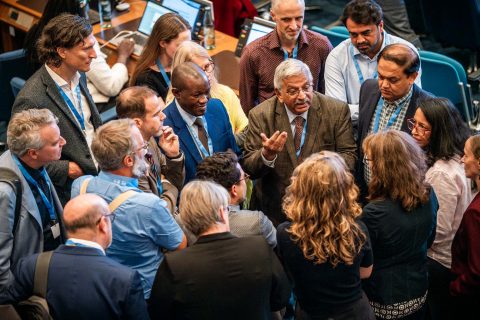
Just Transition Working Group negotiators huddle for informal talks yesterday (Photo: Kiara Worth/IISD ENB)

The post Bonn bulletin: Fears over “1.5 washing” in national climate plans appeared first on Climate Home News.

Bonn bulletin: Fears over “1.5 washing” in national climate plans

Continue Reading

Climate Change

Allegations of harms at China-backed transition minerals projects rise

Published

on

Reports of human rights and environmental abuses linked to Chinese companies’ overseas investments in the mining and refining of minerals needed for the clean energy transition are on the rise, research by a monitoring group has found.

The number of recorded allegations of harm at projects tied to Chinese firms have increased every year since 2021, rising to 148 in 2025, according to the Business and Human Rights Centre (BHRC). On Wednesday it released new data showing that a total of 434 allegations of abuse were made against Chinese-backed projects over the five-year period in projects across the world.

The world’s top cleantech manufacturer, China is also the leading financier of critical minerals projects worldwide. The country has committed more than $120 billion in foreign direct investment into mineral mining and processing since 2023, Australian think-tank Climate Energy Finance recently found.

“China plays a central role in global transition mineral supply chains, and as such has a unique opportunity to raise the bar on human rights and community engagement at every stage of mining,” said Michael Clements, BHRC’s executive director.

“While there have been encouraging developments, from stronger regulations to more company engagement, there remains a gap between human rights commitment and action,” he said.

The report comes as communities affected by Chinese-backed mineral projects have filed the first two cases to a Beijing-based mediation mechanism intended to bring willing Chinese companies to the discussion table with affected communities.

Allegations of harms on the rise

BHRC’s latest analysis – including data for the period 2023-2025 – covered mining, smelting and refining projects for 11 minerals considered key to manufacturing clean energy technologies such as batteries, EVs and solar panels needed to move away from climate-heating fossil fuels.

The highest number of abuses was recorded in Indonesia, the world’s largest producer of nickel, which is used to make EV batteries. After the Indonesian government banned exports of raw nickel, Chinese firms invested billions of dollars to develop a large-scale nickel smelting and processing industry in the Southeast Asian country, largely powered by coal.

Other countries with a high number of recorded harms include the Democratic Republic of Congo, where Chinese firms dominate cobalt and copper production; Myanmar, where unregulated rare earths mining has caused widespread environmental destruction; Serbia, where Chinese-backed mining of some of Europe’s most significant copper and gold deposits is swallowing land and homes, and Zimbabwe, where Chinese investments have turned the nation into Africa’s top lithium producer.

Growing risks for people and nature

Allegations tracked by BHRC included negative impacts on local livelihoods, health and land rights, workers’ health and safety and work-related deaths, as well as water pollution and environmental contamination. In addition, 18 people were attacked for raising concerns about Chinese transition mineral projects between 2023 and 2025.

The report shows that 10 Chinese companies, including Zijin Mining, Tsingshan Group and Zhejiang Huayou Cobalt, accounted for nearly two-thirds of all allegations recorded in the last five years. It found that some Chinese companies “still appear to turn a blind eye to these issues” but noted that several others have been more responsive to allegations of abuse. However, even among companies with human rights policies, implementation remains a challenge, BHRC warned.

    Zijin Mining and Zhejiang Huayou Cobalt repeatedly responded to the allegations of harm by saying they take environmental and social risks seriously and adhere to international standards. Tsingshan Group never responded to BHRC’s requests for comment.

    Platform for dialogue between communities and Chinese firms

    At the same time, Chinese authorities have made “significant progress” on introducing a more specific framework for managing environmental and social risks in overseas investment, BHRC said.

    This includes global consultation on a draft Sustainable Mining Code, adherence to UN guiding principles on business and human rights, and greater emphasis on oversight of companies operating overseas.

    The China Chamber of Commerce of Metals, Minerals & Chemicals Importers & Exporters (CCCMC) set up a mediation and consultation mechanism intended to provide a platform for dialogue between affected communities or civil society groups that have raised concerns and Chinese companies.

    More than three years since its launch, the mechanism has now received its first two complaints from local communities and many more are considering filing a case, Margaux Day, executive director at the nonprofit Accountability Counsel, told an event hosted by Climate Home News last month.

    “This is incredibly exciting in that it fills a governance and accountability gap where often communities who are seeking to protect their rights and the environment can’t reach someone who will respond to them,” she told the panel discussion at London Climate Action Week.

    Climate Home News understands that the complaints were filed by communities in Latin America and Southeast Asia over labour rights and resettlement issues. No information about the cases has yet been made public. The mechanism’s secretariat did not respond to Climate Home News’ questions.

    The mechanism was set up after the Chinese regulator for banks and insurers called on investor-level institutions to establish complaints bodies to hear from communities outside of China. But whether the new initiative will prove effective in tackling grievances remains an open question.

    “Real potential” for better mining practices

    Participation in the mechanism is voluntary for Chinese firms and it doesn’t have a fact-finding function, nor can it impose provisions for compensation or compliance with human rights standards.

    But Day told Climate Home News that, if successful, it could bring companies to negotiate an outcome that is better for people and the planet and leads to more sustainable mining practice.

    Chen Yu, an independent China advisor for campaign group Global Witness, agreed that the mechanism holds “real potential”.

    “There exists nothing else at a similar level to promote dialogue between communities and Chinese mining companies in particular,” she said.

    For companies, the mechanism opens “a channel for problem-solving and dialogue with communities”, she added, as “Chinese companies often remain cautious of approaching affected communities directly, afraid of making the problem bigger”.

    However, Chen said the mechanism remains at an early stage of development, faces resourcing challenges and is not yet sufficiently understood by communities in mining areas or Chinese firms.

    To help it address some of these challenges, the secretariat is currently seeking technical support from a range of organisations, including civil society groups. But, Chen said, “it will take time for the mechanism to show its value”.

    The post Allegations of harms at China-backed transition minerals projects rise appeared first on Climate Home News.

    Allegations of harms at China-backed transition minerals projects rise

    Continue Reading

    Climate Change

    Energy transition policymaking must evolve to fit an age of rupture

    Published

    on

    Andreas Sieber is head of political strategy at 350.0g. Cat Abreu is director of the International Climate Politics Hub.

    From the US abduction of Venezuela’s president at the start of this year to the Iran war which rumbles on, disruption is the new normal for global geopolitics, more often than not linked to conflict over supplies of oil and gas. 

    Events so far in 2026 – driven largely by the desire of the Trump administration to grab control of fossil fuels around the world – show that the climate community’s approach to energy diplomacy will have to evolve if we are to operate effectively and push for climate action in such a volatile landscape.

    Today’s climate and energy governance must be able to cope with trade wars, genocide, fascism, spiralling inequality and challenges to multilateralism. The increasingly dominant paradigms of economic competitiveness, energy security and green industrialisation can help drive the transition but they also challenge our collective mission to deliver an equitable green shift.

    US-China rivalry dominates

    Longer-term geopolitical trends that are seeing power move from West to East and North to South have fuelled a US–China “superpower rivalry”, which is pulling the global economy apart and reining in trade.

    A key question will be how the fracture “lines” are drawn: by the US and China, or also by other countries or blocs? Many governments will try to remain “in the middle” between the two giants to capture economic gains from both sides. Yet despite the language of “strategic autonomy”, Washington and Beijing may be in a position to force choices via market access, export controls and sanctions.

      At first glance, this may not seem particularly relevant for climate and energy politics. But Huawei’s exclusion from 5G operations across the political West and India following the so-called Clean Network Campaign by the US government serves as a warning of what could happen to climate green tech.

      And the recent debate to cut out Chinese inverters from European markets follows the same pattern – US security forces perceive a risk and start encouraging their allies to drop Chinese technology.

      The new drivers: competition and security

      Despite this fracturing geopolitical and economic context, energy transition is still happening. To ensure it is effective and equitable, we need to understand what is driving it and how to adapt climate politics so that it better responds to these drivers.

      Put simply, China is supplying the world with low-cost renewables (roughly 60% of critical wind and 80% of solar components), batteries, EVs and other key elements. Other countries now also want their piece of the green tech pie and are forming industrial policies to get it.

      It is this new competitiveness-driven logic that will shape the quest for decarbonisation, which has shifted from cooperating around the cost of tackling climate change to rivalry for the benefits of climate action.

      Over 90% of new renewables projects are now cheaper than fossil alternatives. Gas-fired power is 3–4 times more expensive than solar and wind. In 2015, most decarbonisation policies were “traditional” emissions-cutting strategies like carbon pricing or net zero dates, whereas green industrial policies now underpin the majority.

      Iran war could boost fossil fuel phase-out push, says Colombian minister

      Meanwhile, security has become a central driver of energy politics. We are living through the second major fossil fuel crisis in just four years. Elevated oil and gas prices will impose up to $1 trillion in additional costs on the global economy by the end of the year if disruption continues in the Strait of Hormuz. Fossil fuel supply chains have exposed countries to conflict, coercion and brutal price shocks.

      Fossil fuel volatility destabilises whole economies – higher fuel costs drive up food prices, increase political instability, and push millions into poverty and hunger. This incentivises governments to shield themselves from global shocks, especially in countries that are net fossil fuel importers and home to roughly three-quarters of the world’s population. 

      Yet security fears can cut both ways. The same instability that makes fossil fuel dependence untenable is also sharpening concern over China’s dominance of critical clean technologies and supply chains.

      Equity, cooperation and the opportunity for change

      Developing countries benefit from the rapid uptake of renewables enabled by low-cost Chinese technologies. But significant fiscal space and public investment is needed for the electricity grids and infrastructure required to fully unleash the energy transition, as well as for green industrialisation to diversify revenue streams.

      Despite this, industrial-scale domestic production and ownership often remain out of reach for too many countries that lack the fiscal space to allow green supply chains to flourish and compete with their traditional industrial base. But more just and diversified green tech supply chains could be achieved with concomitant support.

      Can giant batteries unlock Africa’s green industrial future?

      For the first time in decades, the international order is being substantially reshaped. If within this context, decarbonisation is increasingly driven by green industrial policy, energy security and competitiveness, the climate policy community must better anticipate where these debates are moving. We must speak the same language, and enter the forums where decisions are made, including security, trade and bilateral or trilateral spaces.

      We should build on an enlightened self interest recognising that cooperation remains essential and beneficial. This includes using the UN climate process differently: less as an ever-expanding negotiation machine, and more as a space for norm-setting, political alignment and deal-making. In an age of fragmentation, effective cooperation must not only be framed as necessary but thought of as a strategically compelling source of resilience and shared advantage.

      The post Energy transition policymaking must evolve to fit an age of rupture appeared first on Climate Home News.

      Energy transition policymaking must evolve to fit an age of rupture

      Continue Reading

      Climate Change

      Extreme heat costing India’s poorest workers 2% of GDP, survey finds

      Published

      on

      Low-income Indian workers, many of them migrants from rural areas hit by climate change, are paying for worsening extreme heat through lost working days and health complications, with the cost equivalent to 2% of national GDP per year, new research shows.

      The International Institute of Environment and Development (IIED), a London-based think-tank, worked with local organisations to survey around 540 households of informal workers in three Indian cities: Ajmer, Delhi and Agra. Most had migrated from rural areas to find work in industries such as construction, brick-making, garment manufacturing and food packaging.

      The survey found them struggling through long working days with little access to shade, cooling, rest or water, as well as few toilets for women. And even when they go home, many live in makeshift shelters or airless cramped rooms with barely a single fan, bringing almost no respite.

      Outdoor workers are losing about 24 days of work a year due to heat, costing them nearly a tenth of their annual earnings, while indoor workers sacrifice roughly 15 days. On top of losing income, they are also bearing the cost of health problems like heat exhaustion, psychological stress and kidney damage brought on by repeated dehydration.

      If the survey’s findings are extrapolated to a national level, the IIED researchers estimate that the decline in productivity and effects of kidney disease combined add up to lost wages of $78 billion each year.

        Vishram Meena, 45, from Alwar in Rajasthan, has worked on construction sites in Ajmer for more than a decade, toiling for 10 to 12 hours a day carrying materials and mixing cement in the full sun.

        In May 2024, on one of the hottest days, he collapsed after feeling dizzy and suffering a nosebleed. His wife and colleagues managed to get him to hospital where he was diagnosed with heat stroke. He has since returned to the same building work because the family needs the money.

        “I went back because what else could I do? We are not machines. We are human beings. The heat is killing us slowly,” he was quoted as saying in a report on the survey’s findings.

        “Victorian-era” conditions

        Ritu Bharadwaj, IIED’s director of climate resilience, finance and loss and damage, described some of the stories from workers about their experiences of extreme heat as “genuinely horrifying”.

        Kusum, a tailor at a garment manufacturing and export unit in Kapashera, Delhi, recounted how the machines for ironing finished garments are in the same tiny room where workers are making the clothes, with steam and hot air building up through her shift.

        Fans are too far apart to move the air and nothing has changed in over a decade, she said, adding that “in summer, the unit feels like a furnace”.

        “These are Victorian-era working conditions and they’re completely unacceptable in the 21st century,” said Bharadwaj. She called for stepped-up social protection from the government to pay people for days they are unable work due to heat, as well as micro-insurance schemes with payouts triggered by temperature measurements.   

        This money would help families buy food and pay medical bills when their income dips if they fall ill or cannot work their usual hours due to soaring temperatures.

        Climate change-driven heatwaves hit Delhi’s Red Fort market traders

        The aim of the IIED study, Bharadwaj added, is to get policy-makers’ attention by showing the scale of damage extreme heat is doing to India’s GDP in an economy whose growth relies on service-led industries. “If the workers within them start falling sick, you know it’s the economic growth which is going to get impacted,” she told a webinar to present the research.

        “Whether [policymakers] care about the workers or not, at least they would care about the GDP, and therefore then invest in their care,” she explained.

        Labour code leaves out heat

        However, Bharadwaj noted that a 2026 reform to India’s labour law bringing a range of regulations together in one code does not include heat-related protections for workers and only applies to businesses above a certain size. She urged the government to introduce a temperature threshold above which all workers would be able to stop their activities.

        IIED and its partners have also carried out a similar study in Bangladesh which will be published later this month, showing that extreme heat is costing its workforce the equivalent of nearly 1.4% of GDP.

        Shakirul Islam, chairperson of the Ovibashi Karmi Unnayan Program (OKUP) in Bangladesh, said the government had introduced stricter safety policies for garment-making companies after the Rana Plaza complex collapsed in 2013. But, he said, these rules are rarely followed by manufacturers, especially at the level of smaller subcontractors.

        The workers’ welfare centres that do exist are open mainly during work hours so they are difficult to visit. Some companies also make saline water available for heat stress, which is no good for those with high blood pressure, he noted.

        For Indian women workers, a just transition means surviving climate impacts with dignity

        Archana Shukla Mukherjee, CEO of India’s Change Alliance, which also partnered with IIED on the survey, said it was time to hold both the government and businesses accountable for finding solutions to the intensifying problem of extreme heat’s effects on workers.

        She said that employee state insurance schemes should identify heat stroke as an occupational disease while companies along the whole supply chain should start putting in place heat protection measures, including for informal workers and migrants.

        If the tools and mechanisms available to help workers do not reach the most vulnerable and marginalised people, “then I think we are not doing something right,” she said.

        The post Extreme heat costing India’s poorest workers 2% of GDP, survey finds appeared first on Climate Home News.

        Extreme heat costing India’s poorest workers 2% of GDP, survey finds

        Continue Reading

        Trending

        Copyright © 2022 BreakingClimateChange.com