

Bolivia’s election of centre-right President-elect Rodrigo Paz Pereira could see the country open its vast lithium resources to foreign investors to bolster its faltering economy – a move that could benefit the US after years of hostility toward Washington, analysts say.
Paz, a senator and the son of a former president, won the country’s election earlier this month, ending two decades of left-wing rule, which constrained foreign investment in the South American nation’s mineral wealth.
The change in government may be welcomed by investors in the US, which is seeking to secure access to minerals that are critical for clean technology and military equipment, to counter China’s supply chain dominance, and has previously raised concerns over Chinese investments in the region’s lithium industry.
Lithium is a key material to manufacture rechargeable batteries for electric vehicles and energy storage.
Bolivia makes up less than 1% of global lithium production despite possessing some of the world’s largest reserves, with an estimated 23 million tonnes, or 20% of the global total.
Paz has pledged to seek overseas partnerships to tap these reserves. But he will have to balance engaging the US with maintaining investment from China and Russia initiated by his predecessors.
“Exactly what he does on this issue will determine his relationship with China and Russia,” said Farit Rojas, a professor at the Higher University of San Andrés in La Paz.
At the same time, the political reset could provide Bolivia with a critical opportunity to set clearer and stricter environmental and social standards for developing its burgeoning lithium sector, analysts told Climate Home News.
Bolivia’s lithium dream
Paz’s election comes at a pivotal moment for the country. It is mired in an economic crisis spurred by runaway inflation caused by a foreign currency shortage, leaving people waiting in long lines for fuel and essentials like cooking oil.
Converting lithium reserves into a profitable export industry would bring much needed dollars into the country.
But doing so would require amending Bolivia’s constitution to allow private firms to extract the mineral. That privilege was restricted to Bolivia’s state-owned companies under the 20-year rule of the Movement for Socialism (MAS), the party formerly led by ex-President Evo Morales.
-
COP30 could confront “glaring gap” in clean energy agenda: mining
Energy transition minerals may be tackled at UN climate talks for the first time, as resource-rich developing nations and Indigenous groups call for the industry’s costs and benefits to be fairly shared -
Political backing more important than money for new forest fund at COP30, Brazil says
The Tropical Forest Forever Facility is seeking $25bn in startup capital from donors but doesn’t need to hit this goal before its launch in Belém, Brazil’s finance ministry tells Climate Home event -
Can COP30 mark a turning point for climate adaptation?
Adaptation needs more funding, indicators of progress toward agreed targets and high-level political attention at next month’s UN climate summit in Brazil


Constitutional restrictions and past rejection of foreign investment mean Bolivia’s lithium resources remain largely untapped compared to neighbouring Argentina and Chile, whose deposits are of higher quality.
A significant share of Bolivia’s deposits also lie beneath the Salar de Uyuni salt flats, a major tourist attraction.
Paz, whose party does not have a legislative majority, has yet to say whether and how he will amend Bolivia’s constitution. But he has pledged not to “sell out” Salar de Uyuni.
US, China and Russia: a balancing act
His first months in office will be watched closely by the Trump administration. Following Paz’s election victory, the US Department of State pledged to work with him on “shared goals of regional and global security, economic prosperity, and growth that will benefit our nations”.
For the US, this could be an opportunity to break China and Russia’s grip on Bolivia’s lithium reserves, said Pablo Hamilton, a Chilean mining lawyer connecting foreign investors with energy opportunities in Bolivia.
In 2024, Bolivia’s state-owned Yacimientos de Litio Bolivianos lithium company signed contracts worth a combined $2 billion with Chinese and Russian firms to extract lithium beneath the Salar de Uyuni salt flats. The year prior, it signed a $1.4 billion deal with Chinese battery manufacturing giant CATL to develop its lithium resources.
AI and satellite data help researchers map world’s transition minerals rush
But those contracts – which have yet to be approved by Bolivia’s legislature – have been sharply criticised by scientists, Indigenous peoples and local communities because of a lack of transparency over the consultation process, inconsistencies within the contracts and environmental risks. Paz has pledged to review the contracts.
Cancelling the contracts could cause investors to worry about policy volatility, Hamilton told Climate Home News. But the administration could justify doing so if it can prove allegations of corruption that have swirled around the deals. It could also provide an opportunity to establish stricter mining standards that provide certainty to potential investors.
Investors “don’t know what to expect”
“The rules are not clear enough. It’s very concerning that investors don’t know what to expect,” Hamilton said. “This is a great opportunity to [mandate] a free, prior and informed consultation process and environmental impact assessments – really professional ones, not just to tick the box.”
To attract foreign investment, Paz will likely seek to build public-private partnerships, which will require greater engagement from local actors than in the past, Hamilton said.
In the area surrounding Salar de Uyuni, Indigenous groups have lost trust in the government, citing the shadowy allocation of mining contracts and saying their communities have not benefited from mining.
They also worry that additional extraction would deplete the limited freshwater resources they rely on for farming, said Gonzalo Mondaca of environmental organisation Cedib, which works with communities living in the lithium-rich region.
Efforts to green lithium extraction face scrutiny over water use
The proposed Chinese and Russian extraction plans would use direct lithium extraction (DLE), a group of technologies that proponents say can help extract more lithium with fewer environmental impacts but which still uses large amounts of water.
But existing environmental assessments are not sufficient to understand the impact of the technique on the salt flat’s ecosystem, said Mondaca.
On the campaign trail, Paz also said he would seek to export the magnesium byproducts of lithium extraction to the US and China.
However, that plan requires a high level of technological development and Bolivia currently lacks the necessary infrastructure, said Mondaca.
Even if the new president manages to clear constitutional hurdles to liberalise the country’s lithium sector, “there is still a long way to go,” he added.
The post Bolivia’s shift to the right renews ambition to mine vast lithium reserves appeared first on Climate Home News.
Bolivia’s shift to the right renews ambition to mine vast lithium reserves

Continue Reading
Three countries have been named by the Paris Agreement’s compliance committee for failing to submit a nationally determined contribution (NDC) and repeatedly snubbing offers of help with their climate plans.
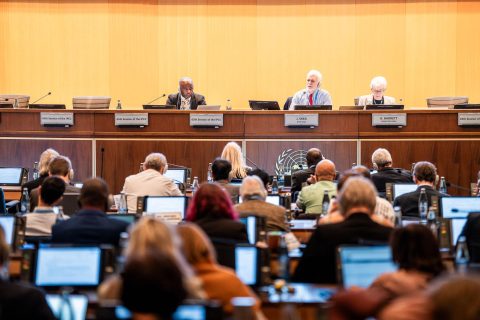
After months of internal debate over whether to identify serial non-responders, the Paris Agreement’s Implementation and Compliance Committee (PAICC) named the three countries which have failed to engage with it over their NDCs on Friday.
It named Democratic Republic of Congo, Senegal and North Korea in a footnote of its annual report, adding that it decided to name them “with a view to facilitating engagement”, adding that representatives of the three nations had been invited to its meeting in early 2027 “with the purpose of identifying any challenges and constraints”.
“The Committee noted the importance of Parties engaging with the Committee in a timely manner, while noting that some delays may be due to the national capabilities and circumstances of the Parties”, the report said.
-
Under US pressure, World Bank says it will back gas “where appropriate”
The US wants the World Bank to expand its gas support while climate campaigners are pushing for it to end – its head spoke this week of limited backing for the fossil fuel -
IPCC scientists vow to press on with climate reports despite political deadlock
After governments again failed to agree a timeline, nearly 120 IPCC authors pledged to complete their assessment on time and with full scientific rigour -
Paris Agreement committee snubbed over missing NDC climate plans
Many governments have still not submitted a nationally determined contribution to the UN, breaching a key requirement of the Paris Agreement


In July, PAICC said 12 countries had ignored its repeated attempts to discuss why they had not published an NDC as required every five years under the 2015 Paris accord.
Members of the committee had been divided over whether to name them, but at a September meeting decided to do so in their annual report to the annual climate COP summit.
By the time the report was published on Friday, only Congo, Senegal and North Korea “had not communicated an NDC or submitted a [Biennial Transparency Report] and had not yet responded to any of the Committee’s notifications, despite several reminders issued by the Committee in this regard”.
Rainforest and renewable energy ambitions
The silence from Congo and Senegal is notable because the former is home to much of the Congo Basin rainforest while the latter has sought billions of dollars in climate finance to support its renewable energy ambitions.
After Brazil, Congo has more rainforest than any country in the world. This forest, and the country’s peatlands, absorb huge amounts of greenhouse gas but are fast being lost to expanding farmland, charcoal production, logging and mining.
Senegal signed a Just Energy Transition Partnership with Canada and wealthy European nations in 2023, to help it meet its renewable energy targets under the-then government of Macky Sall. It was chair of the Least Developed Countries group between January 2022 and December 2023.

Tejas Rao, who is researching the PAICC as part of a doctoral thesis at Cambridge University, said the governments of the three countries should engage with the committee.
“Engagement costs these governments very little and the committee has shown it will listen,” he said.
“Silence leaves the committee with no basis to help, and it leaves the [governments] exposed to the narrative that they are simply disengaged,” he told Climate Home News.
Paris Agreement requirement
The 2015 Paris Agreement requires all parties to publish an NDC every five years outlining their emissions reduction targets, with each plan meant to be more ambitious than the country’s last NDC.
The latest set – the third round of plans, with new targets for 2035 – was due in February 2025. While most countries missed this deadline, all but around 30 – mostly small emitters but including Egypt, Vietnam and Argentina – have now submitted them.
Over the year, the PAICC – which is made up of government climate officials from developed and developing countries – has been communicating with governments that have not submitted NDCs and trying to overcome barriers to them doing so.
Some nations have cited exceptional circumstances as the reason for not submitting an NDC, a process that requires a significant amount of work in tracking emissions and consulting on how to curb them across the economy. For example, a letter from a Sudanese official to the PAICC, seen by Climate Home News, said that the country’s civil war had led to the suspension of its NDC preparation.
-
IPCC scientists vow to press on with climate reports despite political deadlock
After governments again failed to agree a timeline, nearly 120 IPCC authors pledged to complete their assessment on time and with full scientific rigour -
Under US pressure, World Bank says it will back gas “where appropriate”
The US wants the World Bank to expand its gas support while climate campaigners are pushing for it to end – its head spoke this week of limited backing for the fossil fuel -
Who shapes climate science? The equity question facing the IPCC
Early completion of the next global climate science assessment reports risks excluding research from the Global South, which is key to ensuring the findings are fair
The US and Iran are not signed up to the Paris Agreement and so do not have active NDCs, nor does Taiwan, which is not a UN member state.
Rao said that because the PAICC is “facilitative and non-punitive”, naming the countries “is meant to open a door, not close one – the invited consultation is the point”.
“In recent months, governments that explained their constraints, whether capacity, finance or domestic process, have been met with follow-up and support rather than sanction, and the number of silent governments has fallen sharply,” Rao said.
The post Paris Agreement committee names three countries snubbing it over NDCs appeared first on Climate Home News.
Paris Agreement committee names three countries snubbing it over NDCs