Connect with us

Published

on

The past three years have been exceptionally warm globally.

In 2023, global temperatures reached a new high, after they significantly exceeded expectations.

This record was surpassed in 2024 – the first year where average global temperatures were 1.5C above pre-industrial levels.

Now, 2025 is on track to be the second- or third-warmest year on record.

What has caused this apparent acceleration in warming has been subject to a lot of attention in both the media and the scientific community.

Dozens of papers have been published investigating the different factors that could have contributed to these record temperatures.

In 2024, the World Meteorological Organization (WMO) discussed potential drivers for the warmth in a special section of its “state of the global climate” report, while the American Geophysical Union ran a session on the topic at its annual meeting.

In this article, Carbon Brief explores four different factors that have been proposed for the exceptional warmth seen in recent years. These are:

Carbon Brief’s analysis finds that a combination of these factors explains most of the unusual warmth observed in 2024 and half of the difference between observed and expected warming in 2023.

However, natural fluctuations in the Earth’s climate may have also played a role in the exceptional temperatures, alongside signs of declining cloud cover that may have implications for the sensitivity of the climate to human-caused emissions.

An unusually warm three years

Between 1970 and 2014, average surface temperatures rose at a fairly steady rate of around 0.18C per decade.

Set against this long-term trend, temperature increases during the period from 2015 to 2022 were on the upper end of what would be expected.

The increases seen in 2023, 2024 and 2025 were well outside of that range.

The high temperatures of the past three years reflect a broader acceleration in the rate of warming over the past decade.

However, the past three years were unusually warm, even when compared to other years in the 2010s and 2020s.

Record-breaking warmth in 2023 meant that it beat the prior warmest year of 2016 by 0.17C – the largest magnitude of a new record in the past 140 years.

The year 2024 then swiftly broke 2023’s record, becoming the first year where average global temperatures exceeded 1.5C above pre-industrial levels.

The 10 months of data available for 2025 indicates that the year is likely to be slightly cooler than 2023 – though it is possible it may tie or be slightly warmer.

The figure below shows global surface temperatures between 1970 and 2025. (The figures for 2025 include uncertainty based on the remaining three months of the year.)

It includes a smoothed average based on temperature data for 1970-2022 that takes into account some acceleration of warming – and then extrapolates that smoothed average forward to 2023-25 to determine what the expected temperature for those years would have been. (This follows the approach used in the WMO’s “state of the global climate 2024” report.)

Chart showing annual global surface temperatures and the long-term average warming
Global average surface temperature changes between 1970 and 2024 using the WMO average of six groups that report global surface temperature records (dark blue), estimated 2025 temperatures and uncertainties (red) based on the first nine months of the year and a long-term average locally linear smooth (light blue).

This approach calculates how much warmer the past three years were than would be expected given the long-term trend in temperatures.

It shows that 2023 was around 0.18C warmer than expected, 2024 was a massive 0.25C warmer and 2025 is likely to be 0.11C warmer.

Researchers have identified a number of potential drivers of unexpected warmth over 2023-25. Here, Carbon Brief looks at the evidence for each one.

A weirdly behaving El Niño event

El Niño is a climate pattern of unusually warm sea surface temperatures (SSTs) in the tropical Pacific that naturally occurs every two to seven years. Strong El Niño years generally have warmer global temperatures, with the largest effect generally occurring in the months after El Niño conditions peak (when SSTs reach their highest levels in the tropical Pacific).

A relatively strong El Niño event developed in the latter half of 2023, peaking around November before fading in the spring of 2024.

This event was the fourth-strongest El Niño ever recorded, as measured according to SSTs in the Niño 3.4 region in the central tropical Pacific. However, it was notably weaker than the El Niño events in both 1998 and 2016.

This can be seen in the chart below, which shows the strength of El Niño events (red shading) since the 1980s. (The blue shading indicates La Niña events – the opposite part of the cycle to El Niño, which results in cooler SSTs in the tropical Pacific.)
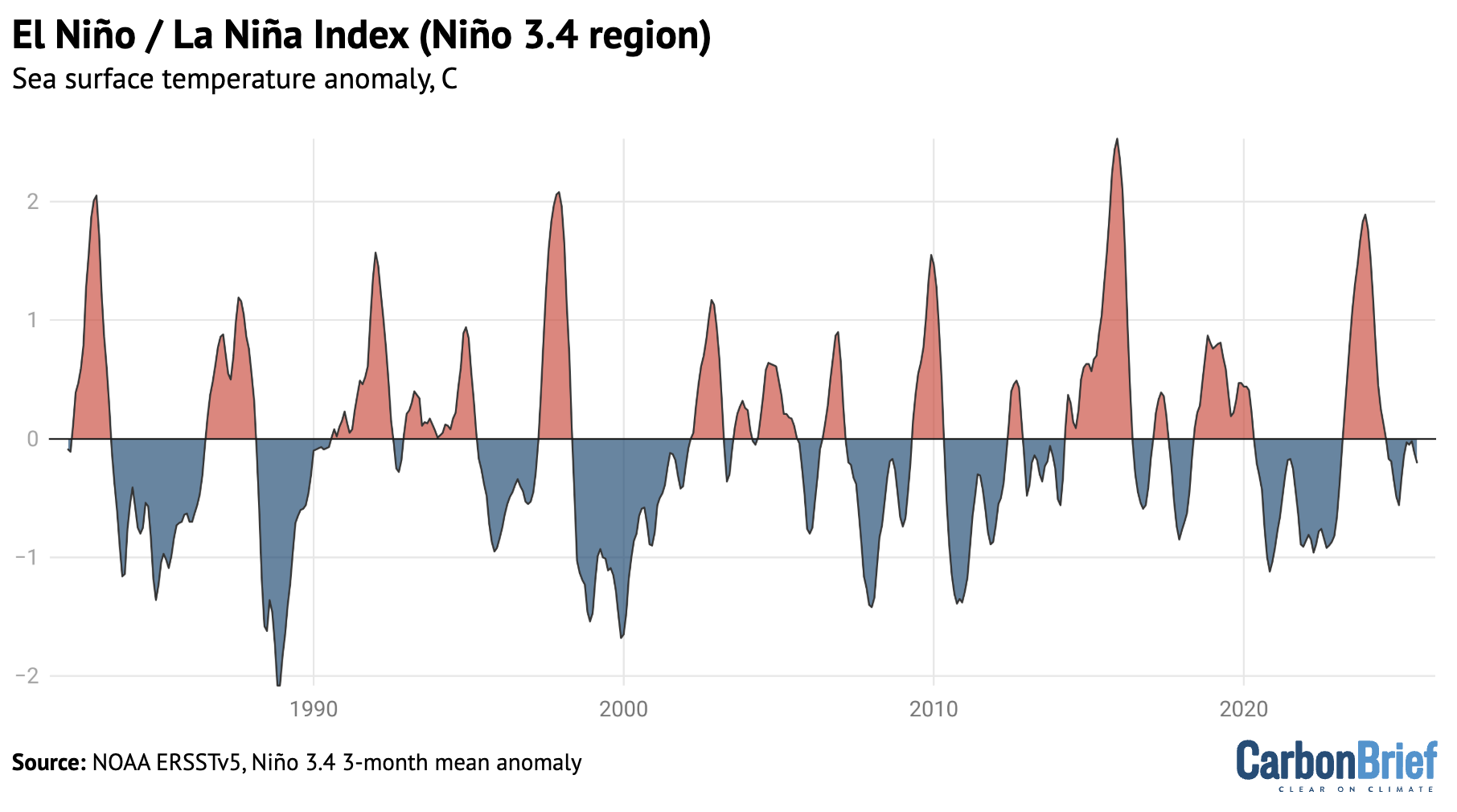
Char showing El Niño and La Niña Index (Niño 3.4 region)
NOAA’s Niño 3.4 region Oceanic Niño Index using detrended data from ERSSTv5.

(It is worth noting that measuring the strength of El Niño events is not entirely straightforward. Other tools used by scientists to monitor changes to El Niño – such as the US National Oceanic and Atmospheric Administration’s (NOAA’s) multivariate ENSO index – show the 2023-24 event was much weaker than indicated in the Niño 3.4 dataset.)

Global surface air temperatures tend to be elevated by around 0.1-0.2C in the six months after the peak of a strong El Niño event – defined here as when SSTs in the Niño 3.4 region reach 1.5C above normal.

The figure below shows the range of global temperature change for the 12 months before and 22 months after the peak of all 10 strong El Niño events since 1950. The light line represents the average of past strong El Niño events, the dark blue line the temperature change observed during the 2023-24 event and the shaded blue area the 5-95th percentile range.
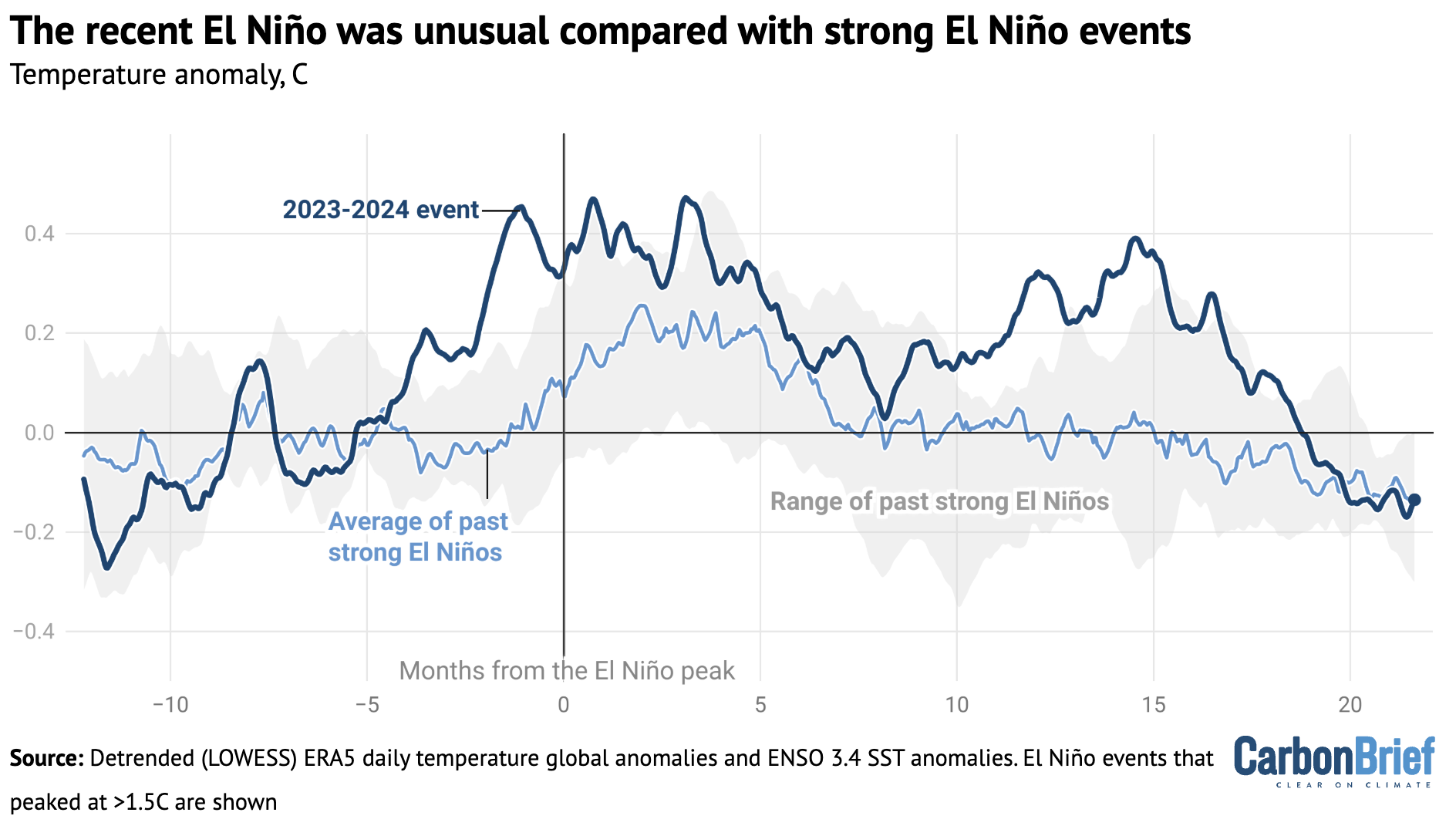
Chart showing that the recent El Niño was unusual compared with strong El Niño events
Global mean surface temperatures for the 12 months prior to peak El Niño conditions and the 22 months following for strong El Niño events. Calculations by Carbon Brief using data from Copernicus/ECMWF’s ERA5 and NOAA’s Oceanic Niño Index.

The figure shows the 2023-24 El Niño was quite unusual compared to other strong El Niño events since 1970. Global temperatures rose to around 0.4C above expected levels – which is on the high side of previous El Niños.

The heat also came early, with high temperatures showing up around four months before the El Niño event peaked. This early heat is unlike any other El Niño event in modern history and is one of the reasons why 2023’s global temperatures were so unexpectedly warm.

Global temperatures remained elevated for a full 18 months after the El Niño peaked, well after conditions in the tropical Pacific shifted into neutral conditions – and even after mild La Niña conditions developed at the end of 2024 and into early 2025.

This figure does not explain how much of this unusual heat was actually caused by El Niño, compared to other factors, but it does suggest that El Niño behaviour alone does not fully explain unusually high temperatures in recent years.

Based on the historical relationship between El Niño and global temperatures, Carbon Brief estimates that El Niño contributed a modest 0.013C to 2023 temperatures and a more substantial 0.128C to 2024 temperatures, albeit with large uncertainties. (See “methodology” section at the end for details.)

However, it is possible that this 2023 estimate is too low. There are some suggestions in the literature that 2023-24 El Niño’s early warmth may have been caused by the rapid transition out of a particularly extended La Niña event. There are indications that temperatures have spiked in similar situations further back in the historical temperature record.

Falling sulphur dioxide emissions

Sulphur dioxide (SO2) is an aerosol that is emitted into the lower atmosphere by the burning of coal and oil. It has a powerful climate cooling effect – Carbon Brief analysis shows that global emissions of SO2 have masked about one-third of historical warming.

Global SO2 emissions have declined around 40% over the past 18 years, as countries have increasingly prioritised reducing air pollution, including through the installation of scrubbers at coal plants.

These declines have been particularly concentrated in China, which has seen a 70% decline in SO2 emissions since 2007. In addition, a rule introduced for international shipping in 2020 by the International Maritime Organization (IMO) has resulted in an 80% decline in the sulphur content of shipping fuel used around the world.

The decline of SO2 emissions is shown in the figure below.
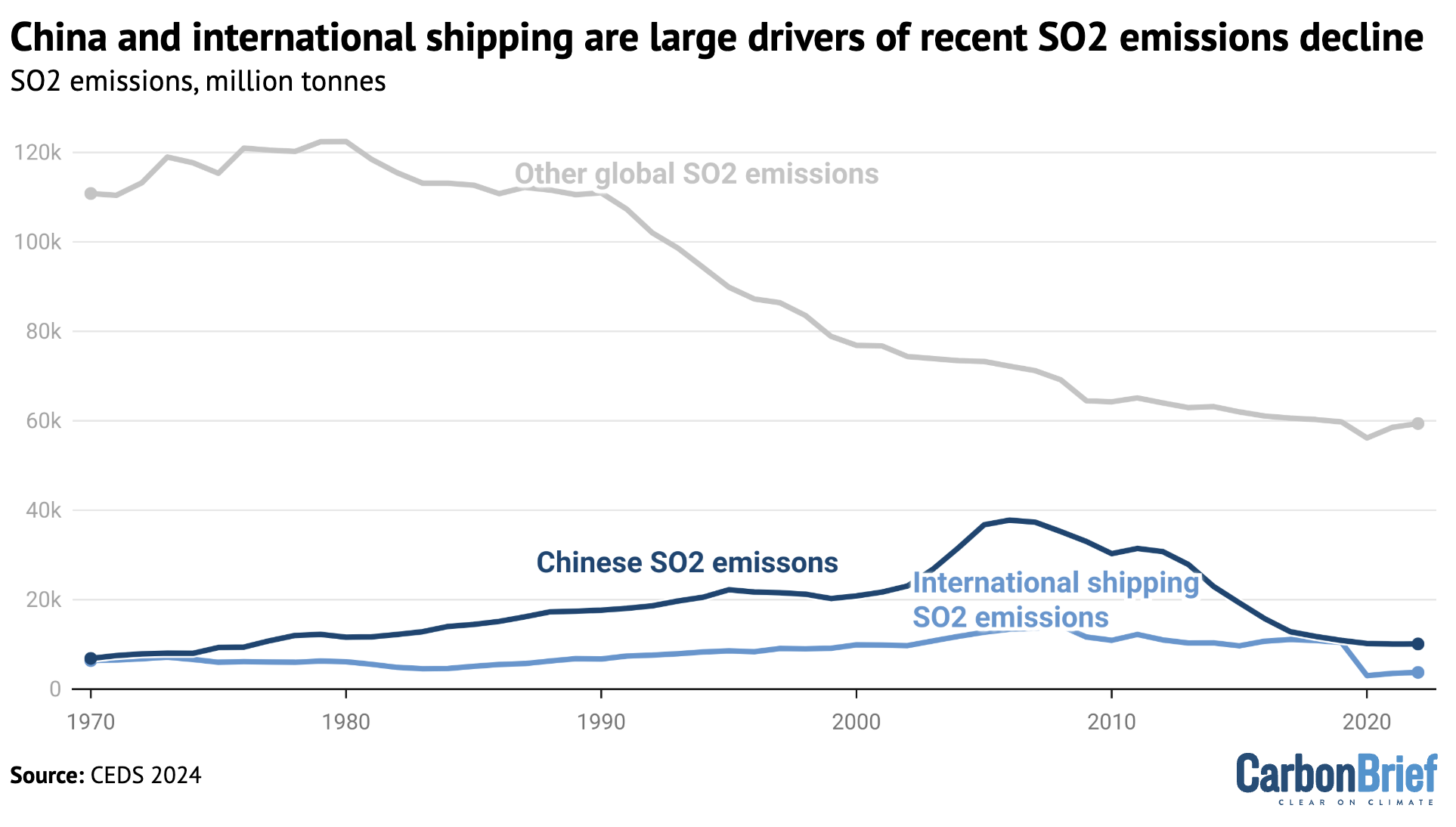
Chart showing that China and international shipping are large drivers of recent SO2 emissions decline
Annual SO2 emissions from China, international shipping and the rest of the world. Data from the Community Earth atmospheric Data System (CEDS).

Shipping in particular has been suggested as a potential culprit for recent temperatures, given that ships emit SO2 over oceans where the air tends to be cleaner and so emissions have a bigger effect.

Seven of the eight studies that have explored the temperature impact of the IMO regulations have suggested a relatively modest effect, in the range of 0.03-0.08C. However, one study – led by former NASA scientist Dr James Hansen – calculated a much stronger effect of 0.2C that would explain virtually all the unusual warmth of recent years.

The figure below shows Carbon Brief’s estimate of the global average surface temperature changes caused by the low-sulphur shipping fuel rules, using the estimates produced by all eight studies. The central estimate (dark blue line) is relatively low, at around 0.05C, but the uncertainty range (light blue shading) across the studies remains large.
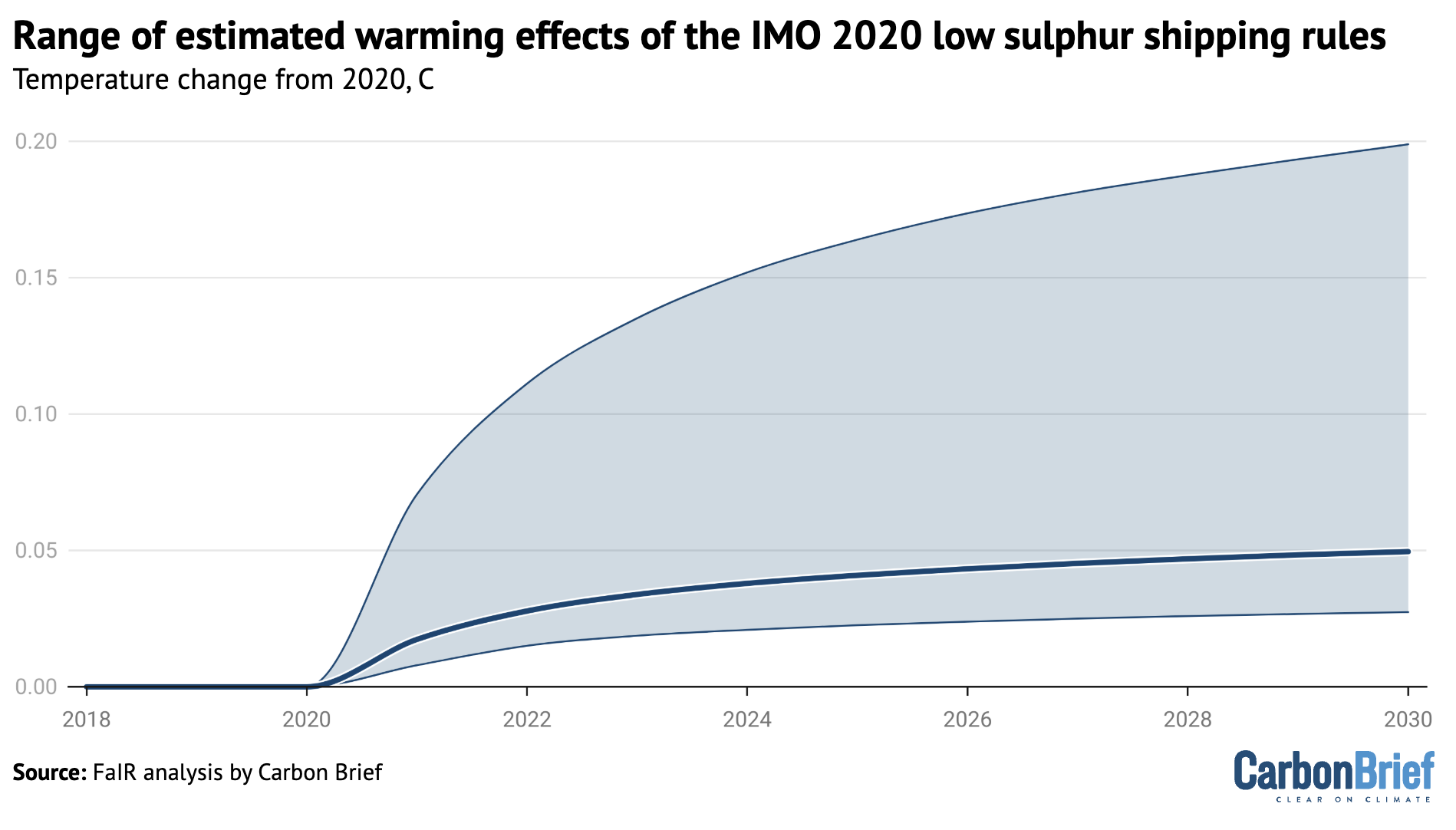
Chart showing the range of estimated warming effects of the IMO 202 low sulphur shipping rules
Range (5th to 95th percentile) and central estimate (50th percentile) of simulated global average surface temperature responses to the IMO 2020 regulations across the radiative forcing estimates in the literature. Analysis by Carbon Brief using the FaIR model.

Overall, Carbon Brief’s analysis finds that around 0.04C of warming over 2020-23 and 0.05C of warming over 2020-24 can be attributed to SO2 declines from shipping and other sources.

However, this approach might slightly overstate the effects of SO2 on the exceptional temperatures of the past three years, as shipping and other SO2 declines would have had some effect on 2021 and 2022 as well.

It is also worth noting that the total effects of SO2 declines on global temperatures have been considerably larger and are estimated to be responsible for around one-quarter of all warming since 2007.

However, these SO2 decreases occurred over a long period of time and do not clearly explain the recent spike in temperatures.

An unusual volcanic eruption in Tonga

In early 2022, the Hunga Tonga-Hunga Ha’apai underwater volcano erupted spectacularly, sending a plume 55km into the atmosphere. This was by far the most explosive volcanic eruption since Mount Pinatubo erupted in 1991.

This was a highly unusual volcanic eruption, which vaporised vast amounts of sea water and lofted it high into the atmosphere. Overall, around 146m metric tonnes of water vapour ended up in the stratosphere, which is the layer of the atmosphere above the troposphere.

Water vapour is a powerful greenhouse gas. While it is short-lived in the lower atmosphere, it can stick around for years in the stratosphere, where it has a significant warming effect on the climate.

The figure below shows the concentration of water vapour in the stratosphere between 2005 and mid-2025. It shows how the 2022 eruption increased atmospheric concentrations of the greenhouse gas by around 15%. More than half the added water vapour has subsequently fallen out of the upper atmosphere.
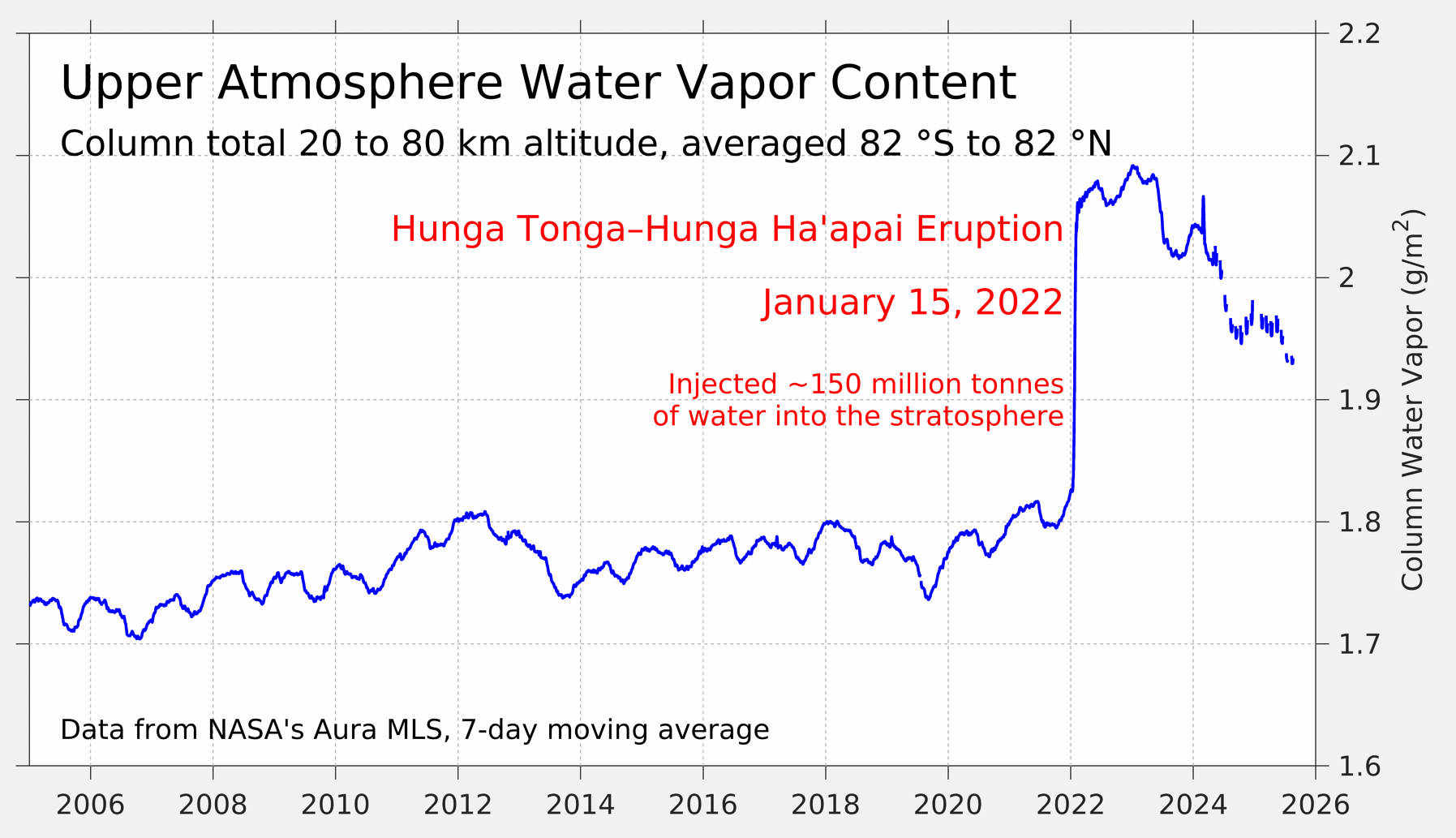
Chart showing upper atmosphere water vapour content
Upper atmosphere water vapor content from NASA’s Aura MLS satellite. Figure from Dr Robert Rohde.

Most early studies of the Hunga Tonga-Hunga Ha’apai volcano focused specifically on the effects of stratospheric water vapour. These tended to show strong warming in the lower stratosphere and cooling in the middle-to-upper stratosphere, but only a slight warming effect on global surface temperatures of around 0.05C.

Hunga Tonga-Hunga Ha’apai had much lower sulphur emissions than prior explosive eruptions, such as Pinatubo and El Chichon. However it put 0.51.5m tonnes of sulphur into the stratosphere – the most from an eruption since Pinatubo.

Studies that included both sulphur and water vapour effects tend to find that the net effect of the eruption on surface temperatures was slight global cooling, concentrated in the southern hemisphere.

By using the estimates published in a 2024 study published in Geophysical Research Letters, which used the FaIR climate emulator model, Carbon Brief estimates that the Hunga Tonga-Hunga Ha’apai eruption cooled global surface temperatures by -0.01C in 2023 and -0.02C in 2024.

This suggests that the eruption was likely only a minor contributor to recent global surface temperatures.

A stronger-than-expected solar cycle

The source of almost all energy on Earth is the sun. Over hundreds of millions of years, variations in solar output have a big impact on the global climate.

Thankfully, over shorter periods of time the sun is remarkably stable, helping keep the Earth’s climate habitable for life. (Big changes – such as ice ages – have more to do with variations in the Earth’s orbit than changes in solar output.)

However, slight changes in solar output do occur – and when they do, they can influence climate change over shorter periods of time. The most important of these is the roughly 11-year solar cycle, which is linked with the sun’s magnetic field and results in changes in the number of sunspots and amount of solar energy reaching Earth.

The figure below shows a best-estimate of changes in total solar irradiance since 1980, based on satellite observations. Total solar irradiance is a measure of the overall amount of solar energy that reaches the top of the Earth’s atmosphere and is measured in watts per metre squared.
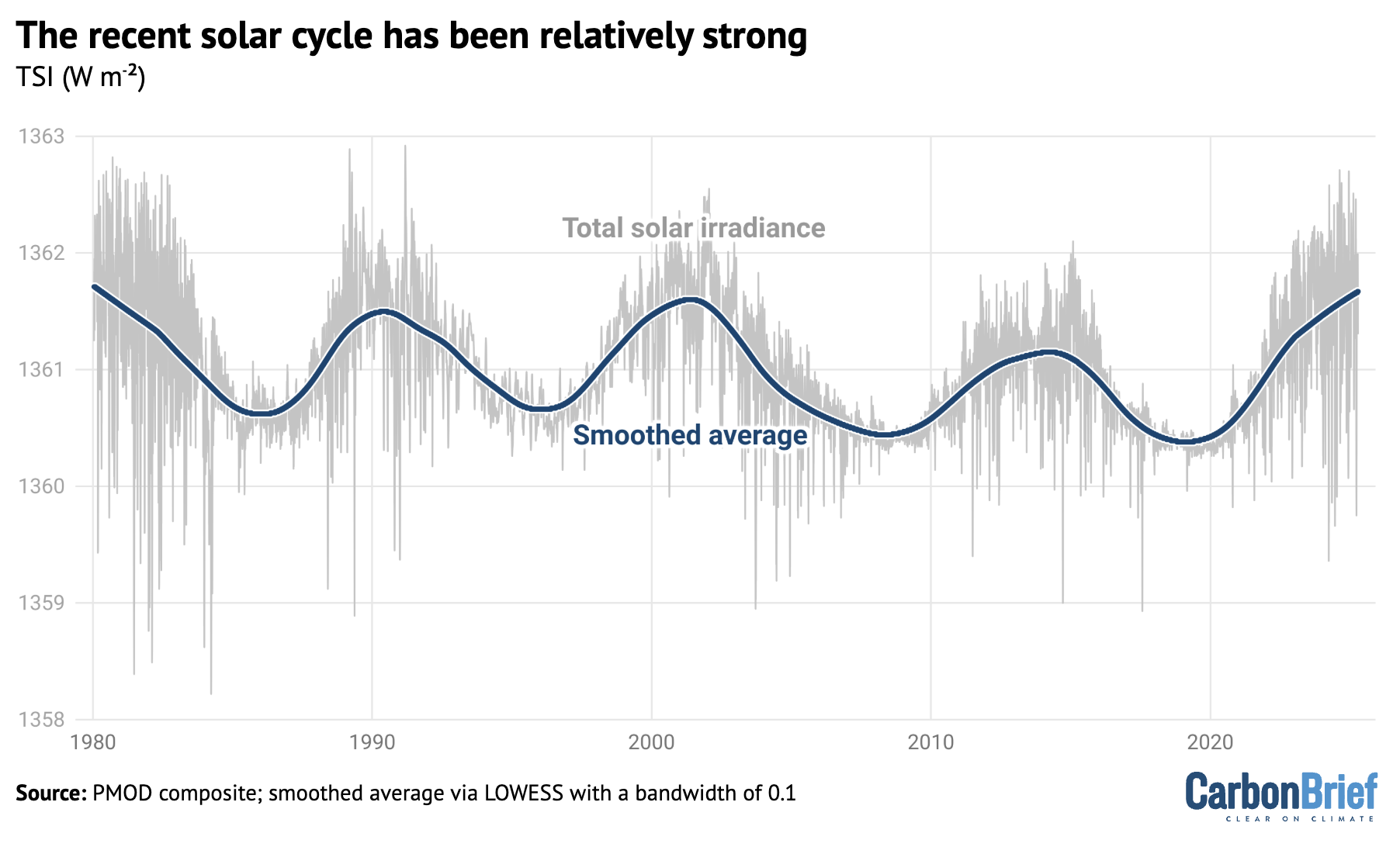
Chart showing the recent solar cycle has been relatively strong
Total solar irradiance from the PMOD composite (blue) along with a smoothed average (red) from 1980 to 2025.

The 11-year solar cycle is relatively modest compared to the sun’s total output, varying only a few watts per metre squared between peak and trough – amounting to around 0.01% of solar output. However, these changes can result in variations of up to 0.1C in global temperatures within a decade.

The most recent solar cycle – solar cycle 25 – began around 2020 and has been the strongest solar cycle measured since 1980. It was stronger than most models had anticipated and likely contributed to around 0.04C global warming in 2023 and 0.07C in 2024.

Putting together the drivers

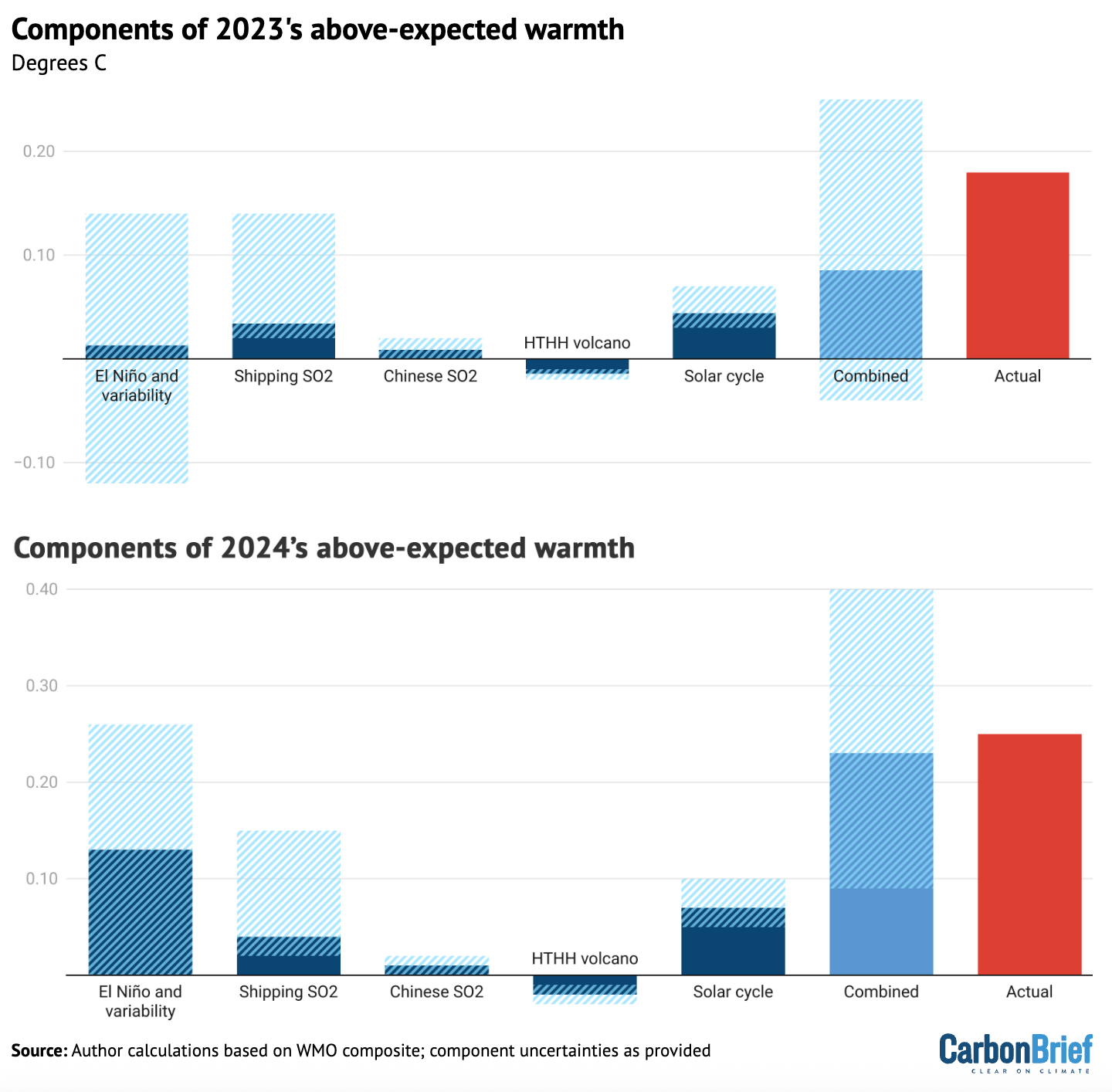
By combining earlier estimates of different factors contributing to 2023 and 2024 global surface temperatures, about half of 2023’s unusual warmth and almost all of 2024’s unusual warmth can be effectively explained.

This is illustrated in the figure below, which shows the five different factors discussed earlier – El Niño, shipping SO2, Chinese SO2, the Hunga Tonga-Hunga Ha’apai volcano and solar cycle changes – along with their respective uncertainties.

The sum of all the factors is shown in the “combined” bar, while the actual warming compared to expectations is shown in red.

The upper chart shows 2023, while the lower one shows 2024.
Charts showing the components of 2023 and 2024's above-expected warmth
Attribution of 2023 and 2024 anomalous warmth. Blue bars show individual factors and their uncertainties, the orange bar shows the combined effects and combination of uncertainties and the green bar shows the actual warming compared with expectations. Adapted from Figure 12 in WMO’s state of the global climate 2024 report.

It is important to note that the first bar includes both El Niño and natural year-to-year variability; the height of the bar reflects the best estimate of El Niño’s effects, while the uncertainty range encompasses year-to-year variability in global temperatures that may be – at least in part – unrelated to El Niño.

The role of natural climate variability

Large natural variability to the Earth’s climate is one of the main reasons why the combined value of the different drivers of expected warmth in 2023 has an uncertainty range that exceeds the observed warming – even though the best-estimate of combined factors only explains half of temperatures.

Or, to put it another way, there is up 0.15C difference in global temperatures year-on-year that cannot be explained solely by El Niño, human-driven global warming, or natural “forcings” – such as volcanoes or variations in solar output.

The figure below shows the difference between actual and expected warming in the global temperature record for every year in the form of a histogram. The vertical zero line represents the expectation given long-term global warming and the other vertical lines indicate the warming seen in 2023, 2024 and 2025.

The height of each blue bar represents the number of years over 1850-2024 when the average global temperature was that far (above or below) the expected level of warming. 
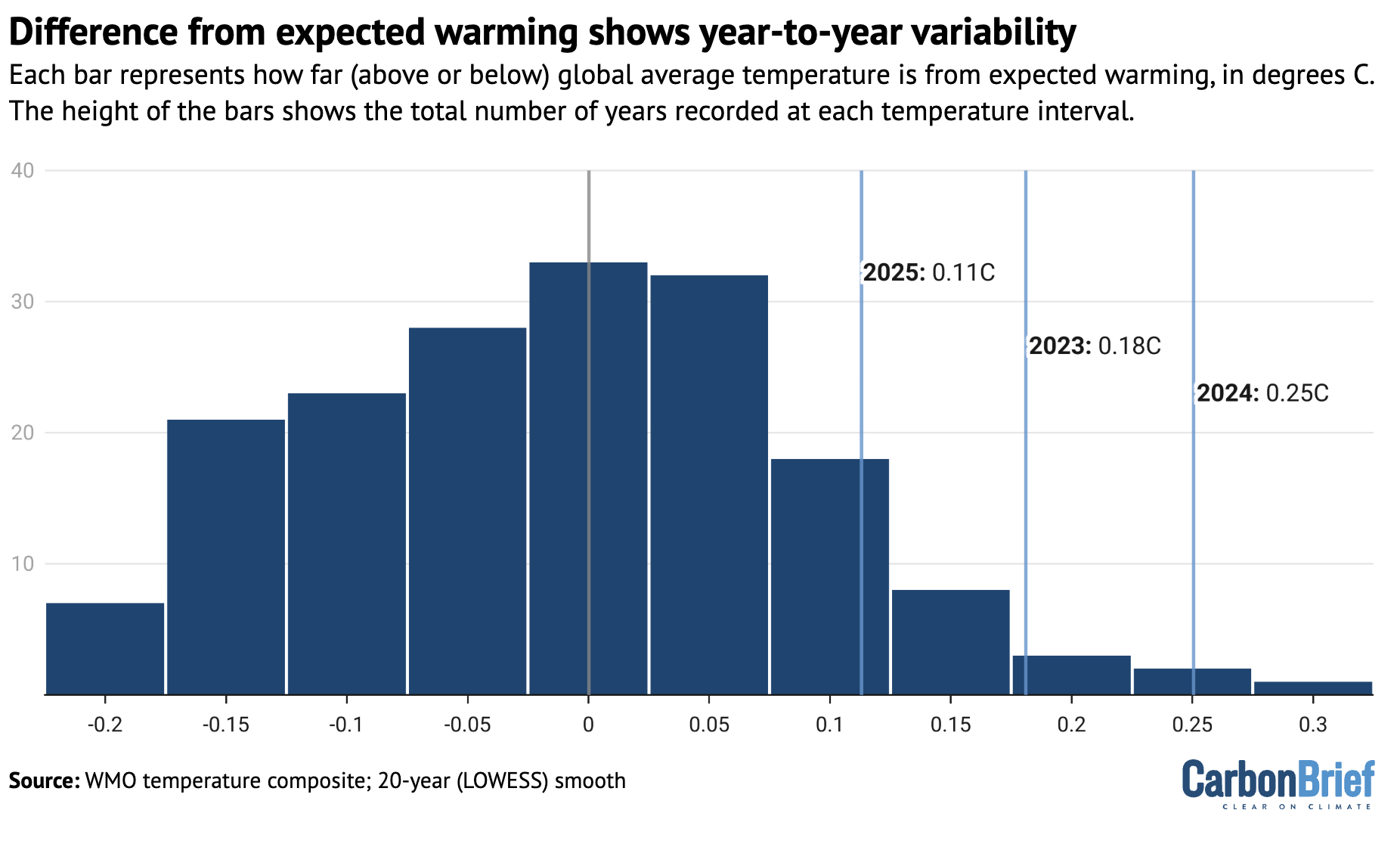
Chart showing that the difference from expected warming shows year-to-year variability
Histogram of residuals between actual and expected warming for all years since 1850, with the values for the past three years highlighted. Expected warming based on a 20-year locally linear smooth of the data.

Based on the range of year-to-year variability, temperatures would be expected to spike as far above the long-term trend as they did in 2023 once every 25 years, on average. The year 2024 would be a one-in-88 year event, whereas 2025 would be a less-unusual, one-in-seven year event.

These likelihoods for the past three years are sensitive to the approach used to determine what the longer-term warming level should be.

In this analysis, Carbon Brief used a local smoothing approach (known as locally estimated scatterplot smoothing) to determine the expected temperatures, following the approach used in the WMO “state of the climate 2024” report.

This approach results in a warming of 1.28C in 2023 and 1.30C in 2024, against which observed temperatures are compared.

Other published estimates put the longer-term warming in 2024 notably higher.

Earlier this year, the scientists behind the “Indicators of Global Climate Change” (IGCC) report estimated that human activity caused 1.36C of recent warming in 2024. They also found a slightly lower overall warming level for 2024 – 1.52C, as opposed to the WMO’s 1.55C – because they looked exclusively at datasets used by IPCC AR6. (This meant estimates from the Copernicus/ECMWF’s ERA5 dataset were not included.)

Based on climate simulations, the IGCC report finds the likelihood of 2024’s warmth to be a one-in-six year event and 2023’s a one-in-four event.

Using the same assumptions as the IGCC, Carbon Brief’s approach calculates that 2024 would be a less-common, one-in-18 year event.

However, the IGCC estimate of current human-induced warming is based on the latest estimates of human and natural factors warming the climate. That means that it already accounts for additional warming from low-sulphur shipping fuel, East Asian aerosols and other factors discussed above.

Therefore, the results from these two analyses are not necessarily inconsistent: natural climate variability (including El Niño) played a key role – but this came in addition to other factors. Natural fluctuations in the Earth’s climate alone would have been unlikely to result in the extreme global temperatures seen in 2023, 2024 and 2025.

A cloudy picture

Even if unusual recent global warmth can be mostly attributed to a combination of El Niño, falling SO2 emissions, the Hunga Tonga-Hunga Ha’apai volcano, solar cycle changes and natural climate variability, there are a number of questions that remain unanswered.

Most important is what the record warmth means for the climate going forward. Is it likely to revert to the long-term average warming level, or does it reflect an acceleration in the underlying rate of warming – and, if so, what might its causes be?

As explained by Carbon Brief in a 2023 article, climate models have suggested that warming will speed up. Some of this acceleration is built into the analysis presented here, which includes a slightly faster rate of warming in recent years than has characterised the period since 1970.

But there are broader questions about what – beyond declining SO2 and other aerosols – is driving this acceleration.

Research recently published in the journal Science offered some potential clues. It found a significant decline in planetary reflectivity – known as albedo – over the past decade, associated with a reduced low-level cloud cover that is unprecedented in the satellite record.

The authors suggest it could be due to a combination of three different factors: natural climate variability, changing SO2 and other aerosol emissions and the effects of global warming on cloud reflectivity.

Natural climate variability seems unlikely to have played a major role in reduced cloud cover, given that it was relatively stable until 2015. However, it is hard to fully rule it out given the relatively short satellite record.

Reductions in SO2 emissions are expected to reduce cloud reflectivity, but the magnitude of the observed cloud reflectivity changes are much larger than models simulate.

Models might be underestimating the impact of aerosols on the climate. But, if this were the case, it would indicate that climate sensitivity might be on the higher end of the range of model estimates, because models that simulate stronger aerosol cooling effects tend to have higher climate sensitivity.

Finally, cloud cover might be changing and becoming less reflective as a result of warming. Cloud responses to climate change are one of the largest drivers of uncertainty in future warming. One of the main reasons that some climate models find a higher climate sensitivity is due to their simulation of less-reflective clouds in a warming world.

The Science study concludes that the 2023 heat “may be here to stay” if the cloud-related albedo decline was not “solely” caused by natural variability. This would also suggest the Earth’s climate sensitivity may be closer to the upper range of current estimates, it notes.

Methodology

Carbon Brief built on work previously published in the IGCC 2024 and WMO state of the global climate 2024 reports that explores the role of different factors in the extreme temperatures in 2023, 2024 and 2025.

The impact of El Niño Southern Oscillation (ENSO) on the temperatures was estimated using a linear regression of the annual mean global temperature anomaly on the Feb/Mar Niño 3.4 index. This resulted in an impact of −0.07C, 0.01C and 0.13C for 2022, 2023 and 2024 respectively (with a 95% confidence interval of ±0.13 ºC).

It is important to note that the uncertainties in the ENSO response estimated here also incorporate other sources of unforced internal (modes of variability in other basins such as AMV), and potentially some forced variability. The bar in the combined figure is labelled “El Niño and variability” to reflect this.

For details on calculations of the temperature impact of shipping and Chinese SO2 declines, see Carbon Brief’s explainer on the climate impact of changing aerosol emissions.

Solar cycle 25 was both slightly earlier and slightly stronger than prior expectations with a total solar irradiance anomaly of 0.97 watts per metre squared in 2023 relative to the mean of the prior 20 years. This resulted in an estimated radiative forcing of approximately 0.17 watts per metre squared and an estimated global surface temperature increase of 0.07C (0.05C to 0.10C) with a one- to two-year lag based on a 2015 study. Thus, the impact on 2023 and 2024 is around 0.04C and 0.07C, respectively (+/- 0.025C). This is a bit higher warming than is given by the FaIR model, as the 2015 study is based on global models that have ozone responses to the UV changes, which amplifies the temperature effects a bit.

The Hunga Tonga-Hunga Haʻapai volcanic eruption added both SO2 and water vapour to the stratosphere (up to 55km in altitude). The rapid oxidation of SO2 to sulphate aerosol dominated the radiative forcing for the first two years after the eruption. As a result, the net radiative forcing at the tropopause was likely negative; −0.04 watts per metre squared and −0.15 watts per metre squared in 2022 and 2023, respectively, implying a temperature impact of -0.02C (-0.01C to -0.03C) calculated using the FaIR model.

The post Analysis: What are the causes of recent record-high global temperatures? appeared first on Carbon Brief.

Analysis: What are the causes of recent record-high global temperatures?

Continue Reading

Greenhouse Gases

Analysis: UK newspaper editorial opposition to climate action overtakes support for first time

Published

on

Nearly 100 UK newspaper editorials opposed climate action in 2025, a record figure that reveals the scale of the backlash against net-zero in the right-leaning press.

Carbon Brief has analysed editorials – articles considered the newspaper’s formal “voice” – since 2011 and this is the first year opposition to climate action has exceeded support.

Criticism of net-zero policies, including renewable-energy expansion, came entirely from right-leaning newspapers, particularly the Sun, the Daily Mail and the Daily Telegraph.

In addition, there were 112 editorials – more than two a week – that included attacks on Ed Miliband, continuing a highly personal campaign by some newspapers against the Labour energy secretary.

These editorials, nearly all of which were in right-leaning titles, typically characterised him as a “zealot”, driving through a “costly” net-zero “agenda”.

Taken together, the newspaper editorials mirror a significant shift on the UK political right in 2025, as the opposition Conservative party mimicked the hard-right populist Reform UK party by definitively rejecting the net-zero target that it had legislated for and the policies that it had previously championed.

Record climate opposition

Nearly 100 UK newspaper editorials voiced opposition to climate action in 2025 – more than double the number of editorials that backed climate action.

As the chart below shows, 2025 marked the fourth record-breaking year in a row for criticism of climate action in newspaper editorials.

This also marks the first time that editorials opposing climate action have overtaken those supporting it, during the 15 years that Carbon Brief has analysed.

Chart showing that for the first time, there were more UK newspaper editorials opposing climate action than supporting it in 2025
Number of UK newspaper editorials arguing for more (blue) and less (red) climate action, 2011-2025. Some editorials also present a “balanced” view, which is categorised as advocating for neither “more” nor “less” climate action. These editorials are not represented in this chart. Source: Carbon Brief analysis.

This trend demonstrates the rapid shift away from a long-standing political consensus on climate change by those on the UK’s political right.

Over the past year, the Conservative party has rejected both the “net-zero by 2050” target that it legislated for in 2019 and the underpinning Climate Change Act that it had a major role in creating. Meanwhile, the Reform UK party has been rising in the polls, while pledging to “ditch net-zero”.

These views are reinforced and reflected in the pages of the UK’s right-leaning newspapers, which tend to support these parties and influence their politics.

All of the 98 editorials opposing climate action were in right-leaning titles, including the Sun, the Daily Mail, the Daily Telegraph, the Times and the Daily Express.

Conversely, nearly all of the 46 editorials pushing for more climate action were in the left-leaning and centrist publications the Guardian and the Financial Times. These newspapers have far lower circulations than some of the right-leaning titles.

In total, 81% of the climate-related editorials published by right-leaning newspapers in 2025 rejected climate action. As the chart below shows, this is a marked difference from just a few years ago, when the same newspapers showed a surge in enthusiasm for climate action.

That trend had coincided with Conservative governments led by Theresa May and Boris Johnson, which introduced the net-zero goal and were broadly supportive of climate policies.

Chart showing nearly every climate-related editorial in the UK's right-leaning newspapers last year opposed climate action
The share of right-leaning, climate-related UK newspaper editorials arguing for more (blue) and less (red) climate action, 2011-2025, %. Some editorials also present a “balanced” view, which is categorised as advocating for neither “more” or “less” climate action. These editorials are not represented in this chart. Source: Carbon Brief analysis.

Notably, none of the editorials opposing climate action in 2025 took a climate-sceptic position by questioning the existence of climate change or the science behind it. Instead, they voiced “response scepticism”, meaning they criticised policies that seek to address climate change.

(The current Conservative leader, Kemi Badenoch, has described herself as “a net-zero sceptic, not a climate change sceptic”. This is illogical as reaching net-zero is, according to scientists, the only way to stop climate change from getting worse.)

In particular, newspapers took aim at “net-zero” as a catch-all term for policies that they deemed harmful. Most editorials that rejected climate action did not even mention the word “climate”, often using “net-zero” instead.

This supports recent analysis by Dr James Painter, a research associate at the University of Oxford, which concluded that UK newspaper coverage has been “decoupling net-zero from climate change”.

This is significant, given strong and broad UK public support for many of the individual climate policies that underpin net-zero. Notably, there is also majority support for the “net-zero by 2050” target itself.

Much of the negative framing by politicians and media outlets paints “net-zero” as something that is too expensive for people in the UK.

In total, 87% of the editorials that opposed climate action cited economic factors as a reason, making this by far the most common justification. Net-zero goals were described as “ruinous” and “costly”, as well as being blamedfalsely – for “driving up energy costs”.

The Sunday Telegraph summarised the view of many politicians and commentators on the right by stating simply that said “net-zero should be scrapped”.

While some criticism of net-zero policies is made in good faith, the notion that climate change can be stopped without reducing emissions to net-zero is incorrect. Alternative policies for tackling climate change are rarely presented by critical editorials.

Moreover, numerous assessments have concluded that the transition to net-zero can be both “affordable” and far cheaper than previously thought.

This transition can also provide significant economic benefits, even before considering the evidence that the cost of unmitigated warming will significantly outweigh the cost of action.

Miliband attacks intensify

Meanwhile, UK newspapers published 112 editorials over the course of 2025 taking personal aim at energy security and net-zero secretary Ed Miliband.

Nearly all of these articles were in right-leaning newspapers, with the Sun alone publishing 51. The Daily Mail, the Daily Telegraph and the Times published most of the remainder.

This trend of relentlessly criticising Miliband personally began last year in the run up to Labour’s election victory. However, it ramped up significantly in 2025, as the chart below shows.

Chart showing UK newspapers published more than 100 editorials criticising Ed Miliband last year – nearly twice as many as in 2024
Cumulative number of UK newspaper editorials criticising energy secretary Ed Miliband in 2024 (light blue) and 2025 (dark blue). Source: Carbon Brief analysis.

Around 58% of the editorials that opposed climate action used criticism of climate advocates as a justification – and nearly all of these articles mentioned Miliband, specifically.

Editorials denounced Miliband as a “loon” and a “zealot”, suffering from “eco insanity” and “quasi-religious delusions”. Nicknames given to him include “His Greenness”, the “high priest of net-zero” and “air miles Miliband”.

Many of these attacks were highly personal. The Daily Mail, for example, called Miliband “pompous and patronising”, with an “air of moral and intellectual superiority”.

Frequently, newspapers refer to “Ed Miliband’s net-zero agenda”, “Ed Miliband’s swivel-eyed targets” and “Mr Miliband’s green taxes”.

These formulations frame climate policies as harmful measures that are being imposed on people by the energy secretary.

In fact, the Labour government decisively won an election in 2024 with a manifesto that prioritised net-zero policies. Often, the “targets” and “taxes” in question are long-standing policies that were introduced by the previous Conservative government, with cross-party support.

Moreover, the government’s climate policy not only continues to rely on many of the same tools created by previous administrations, it is also very much in line with expert evidence and advice. This is to prioritise the expansion of clean power and to fuel an economy that relies on increasing levels of electrification, including through electric cars and heat pumps.

Despite newspaper editorials regularly calling for Miliband to be “sacked”, prime minister Keir Starmer has voiced his support both for the energy secretary and the government’s prioritisation of net-zero.

In an interview with podcast The Rest is Politics last year, Miliband was asked about the previous Carbon Brief analysis that showed the criticism aimed at him by right-leaning newspapers.

Podcast host Alastair Campbell asked if Miliband thought the attacks were the legacy of his strong stance, while Labour leader, during the Leveson inquiry into the practices of the UK press. Miliband replied:

“Some of these institutions don’t like net-zero and some of them don’t like me – and maybe quite a lot of them don’t like either.”

Renewable backlash

As well as editorial attitudes to climate action in general, Carbon Brief analysed newspapers’ views on three energy technologies – renewables, nuclear power and fracking.

There were 42 newspaper editorials criticising renewable energy in 2025. This meant that, for the first time since 2014, there were more anti-renewables editorials than pro-renewables editorials, as the chart below shows.

As with climate action more broadly, this was a highly partisan issue. The Times was the only right-leaning newspaper that published any editorials supporting renewables.

Chart showing newspaper editorials criticising renewables overtook those supporting them for the first time in more than a decade
Number of UK newspaper editorials that were pro- (blue) and anti-renewables (red), 2011-2025. Some editorials also present a “balanced” view, which is categorised as advocating for neither “more” or “less” climate action. These editorials are not represented in this chart. Source: Carbon Brief analysis.

By far the most common stated reason for opposing renewable energy was that it is “expensive”, with 86% of critical editorials using economic arguments as a justification.

The Sun referred to “chucking billions at unreliable renewables” while the Daily Telegraph warned of an “expensive and intermittent renewables grid”.

At the same time, editorials in supportive publications also used economic arguments in favour of renewables. The Guardian, for example, stressed the importance of building an “affordable clean-energy system” that is “built on renewables”.

There was continued support in right-leaning publications for nuclear power, despite the high costs associated with the technology. In total, there were 20 editorials supporting nuclear power in 2025 – nearly all in right-leaning newspapers – and none that opposed it.

Fracking was barely mentioned by newspapers in 2023 and 2024, after a failed push by the Conservatives under prime minister Liz Truss to overturn a ban on the practice in 2022. This attempt had been accompanied by a surge in supportive right-leaning newspaper editorials.

There was a small uptick of 15 editorials supporting fracking in 2025, as right-leaning newspapers once again argued that it would be economically beneficial.

The Sun urged current Conservative leader Badenoch to make room for this “cheap, safe solution” in her future energy policy. The government plans to ban fracking “permanently”.

North Sea oil and gas remained the main fossil-fuel policy focus, with 30 editorials – all in right-leaning newspapers – that mentioned the topic. Most of the editorials arguing for more extraction from the North Sea also argued for less climate action or opposed renewable energy.

None of these editorials noted that the UK is expected to be significantly less reliant on fossil-fuel imports if it pursues net-zero, than if it rolls back on climate action and attempts to squeeze more out of the remaining deposits in the North Sea.

Methodology

This is a 2025 update of previous analysis conducted for the period 2011-2021 by Carbon Brief in association with Dr Sylvia Hayes, a research fellow at the University of Exeter. Previous updates were published in 2022, 2023 and 2024.

The count of editorials criticising Ed Miliband was not conducted in the original analysis.

The full methodology can be found in the original article, including the coding schema used to assess the language and themes used in editorials concerning climate change and energy technologies.

The analysis is based on Carbon Brief’s editorial database, which is regularly updated with leading articles from the UK’s major newspapers.

The post Analysis: UK newspaper editorial opposition to climate action overtakes support for first time appeared first on Carbon Brief.

Analysis: UK newspaper editorial opposition to climate action overtakes support for first time

Continue Reading

Greenhouse Gases

DeBriefed 16 January 2026: Three years of record heat; China and India coal milestone; Beijing’s 2026 climate outlook

Published

on

Welcome to Carbon Brief’s DeBriefed. 
An essential guide to the week’s key developments relating to climate change.

This week

Hottest hat-trick

STATE OF THE CLIMATE: Scientists have announced that 2025 was either the second or third hottest year on record, with close margins between last year and 2023, reported the Associated Press. The newswire noted that “temperature averages for 2025 hovered around – and mostly above – 1.4C of industrial era warming”. Bloomberg said that this happened despite the natural weather phenomenon La Niña, which “suppresses global temperatures”, meaning “heat from greenhouse gases countered that cooling influence”. Carbon Brief’s comprehensive analysis of the data found cumulative global ice loss also “reached a new record high in 2025”.

OVERHEATING OCEANS: Separately, the world’s oceans “absorbed colossal amounts of heat in 2025”, said the Guardian, setting “yet another new record and fuelling more extreme weather”. It added that the “extra heat makes the hurricanes and typhoons…more intense, causes heavier downpours of rain and greater flooding and results in longer marine heatwaves”.

FIRE AND ICE: Wildfires in Australia have destroyed around 500 structures, said the Sydney Morning Herald, with a “dozen major fires” still burning. A wildfire in Argentinian Patagonia has “blazed through nearly 12,000 hectares” of scrubland and forests, according to the Associated Press. Meanwhile, parts of the Himalayas are “snowless” for the first time in nearly four decades, signalling a “climatic anomaly”, reported the Times of India.

Around the world

  • EMISSIONS REBOUND: US emissions rose 2% last year after two years of declines” due to a rise in coal power generation, said Axios, in coverage of research by the Rhodium Group.
  • ‘UNINVESTABLE’ OIL: US president Donald Trump may “sideline” ExxonMobil from Venezuela’s oil market after its comment that Venezuela is “uninvestable”, reported CNBC. TotalEnergies is also “in no rush to return to Venezuela”, said Reuters
  • PRICE WARS: The EU issued guidelines that will allow tariffs on Chinese electric vehicles to be removed in exchange for minimum price commitments, said Reuters
  • ‘RECORD’ AUCTION: The UK government has secured “8.4 gigawatts of new offshore wind power” in a “record” auction, said Sky News. Although the auction saw some price rises, this will likely be “cost neutral” for consumers, Carbon Brief said – contrary to the “simplistic and misleading” narratives promoted by some media outlets.
  • COP STRATEGY: The Guardian reported that Chris Bowen, the Australian minister appointed “president of negotiations” for COP31, plans to use his role to lobby “Saudi Arabia and others” on the need to phase out fossil fuels. 

$2bn

The size of a new climate fund unveiled by the Nigerian government, according to Reuters


Latest climate research

  • Rooftop solar in the EU has the potential to meet 40% of electricity demand in a 100% renewable scenario for 2050 | Nature Energy
  • Natural wildfires, such as those ignited by lightning strikes, have been increasing in frequency and intensity in sub-Saharan Africa, driven by climate change | Global and Planetary Change
  • Engaging diverse citizens groups can lead to “more equitable, actionable climate adaptation” across four pilot regions in Europe | Frontiers in Climate

(For more, see Carbon Brief’s in-depth daily summaries of the top climate news stories on Monday, Tuesday, Wednesday, Thursday and Friday.)

Captured

Chart: Record clean energy growth helped cut coal power in China and India

Both China and India saw coal power generation fall in 2025, in the “first simultaneous drop in half a century”, found new analysis for Carbon Brief, which was widely reported around the world. It noted that, for both countries, the decline in coal was driven by new clean-energy capacity additions, which were “more than sufficient to meet rising demand”.

Spotlight

What are China experts watching for in 2026?

The year 2026 will be pivotal for China’s climate policy. In March, the government will release key climate and energy targets for 2030, the year by which China has pledged to have peaked its emissions.

At the same time, with the US increasingly turning away from climate policy and towards fossil fuel expansionism, China’s role in global climate action is more important than ever.

Carbon Brief asks leading experts what they are watching for from China over the year ahead.

Shuo Li, director of the China Climate Hub, Asia Society Policy Institute

After decades of rapid growth, independent analyses suggest China’s CO2 emissions may have plateaued or even begun to decline in 2025.

The transition from emissions growth to stabilisation and early decline will be the key watch point for 2026 and will be shaped by the forthcoming 15th five-year plan. [This plan will set key economic goals, including energy and climate targets, for 2030.]

However, the precise timing, scale and enforceability of these absolute emissions control measures remain under active debate. Chinese experts broadly agree that if the 2021-2025 period was characterised by continued emissions growth, and 2031-2035 is expected to deliver a clear decline, then 2026-2030 will serve as a critical “bridge” between the two.

Yan Qin, principal analyst, ClearBlue Markets

First, the 15th five-year plan inaugurates the “dual control of carbon” system. This year marks the first time industries and local governments face binding caps on total emissions, not just intensity.

Second, the national carbon market is aggressively tightening. With the inclusion of steel, cement and aluminum this year, regulators are executing a “market reset” – de-weighting older allowances [meaning they cannot be used to contribute to polluters’ obligations for 2026] and enforcing stricter benchmarks to bolster prices ahead of the full rollout of the EU’s carbon border adjustment mechanism.

Cecilia Trasi, senior policy advisor for industry and trade, ECCO

China’s solar manufacturing overcapacity is prompting Beijing’s first serious consolidation efforts. At the same time, its offshore wind technology is advancing rapidly [and there are] signals that Chinese wind companies are pursuing entry into European markets through local production, mirroring strategies adopted by battery manufacturers.

Together, these dynamics suggest that the next phase of cleantech competition will be shaped less by trade defense alone and more by the interaction between Chinese supply-side reforms and global market-absorption capacity.

Tu Le, managing director, Sino Auto Insights

China’s electric vehicle (EV) industry has been the primary force pushing the global passenger vehicle market toward clean energy. That momentum should continue. But a growing headwind has emerged: tariffs. Mexico, Brazil, Europe and the US are just a few of the countries raising barriers, complicating the next phase of global EV expansion.

One new wildcard: the US now effectively controls Venezuelan oil. If that meaningfully impacts global oil prices, it could either slow – or unexpectedly accelerate – the shift toward clean-energy vehicles.

Responses have been edited for length and clarity.

A full-length version of the article is available on the Carbon Brief website.

Watch, read, listen

SHAPING THE LAND: In addition to land use shaping the climate, climate change is now increasingly “changing the land”, according to satellite monitoring by World Resources Institute, creating a “dangerous feedback loop”.

‘POSITIVE TIPPING POINTS’: A commentary co-authored by climate scientist Prof Corinne Le Quéré in Nature argued that several climate trends have locked in “irreversible progress in climate action”.

FROM THE FLAMES: Nick Grimshaw interviewed musician and data analyst Miriam Quick on how she turned the 2023 Canadian wildfires into music on BBC Radio 6. (Skip to 1:41:45 to listen.)

Coming up

Pick of the jobs

DeBriefed is edited by Daisy Dunne. Please send any tips or feedback to debriefed@carbonbrief.org.

This is an online version of Carbon Brief’s weekly DeBriefed email newsletter. Subscribe for free here.

The post DeBriefed 16 January 2026: Three years of record heat; China and India coal milestone; Beijing’s 2026 climate outlook appeared first on Carbon Brief.

DeBriefed 16 January 2026: Three years of record heat; China and India coal milestone; Beijing’s 2026 climate outlook

Continue Reading

Greenhouse Gases

Brazil’s biodiversity pledge: Six key takeaways for nature and climate change

Published

on

The world’s most biodiverse nation, Brazil, has belatedly published its UN plan for halting and reversing nature decline by the end of this decade.

Brazil is home to 10-15% of all known species on Earth, 64% of the Amazon rainforest and it supplies 10% of global food demand, according to official estimates.

It was among around 85% of nations to miss the 2024 deadline for submitting a new UN nature plan, known as a national biodiversity strategy and action plan (NBSAP), according to a joint investigation by Carbon Brief and the Guardian.

On 29 December 2025, Brazil finally published its new NBSAP, following a lengthy consultation process involving hundreds of scientists, Indigenous peoples and civil society members.

The NBSAP details how the country will meet the goals and targets of the Kunming-Montreal Global Biodiversity Framework (GBF), the landmark deal often described as the “Paris Agreement” for nature, agreed in 2022. 

Below, Carbon Brief walks through six key takeaways from Brazil’s belated NBSAP:

  1. The government plans to ‘conserve’ 80% of the Brazilian Amazon by 2030
  2. It plans to ‘eliminate’ deforestation in Brazilian ecosystems by 2030
  3. Brazil has ‘aligned’ its actions on tackling climate change and biodiversity loss
  4. The country seeks to ‘substantially increase’ nature finance from a range of sources
  5. Brazil’s plans for agriculture include ‘sustainable intensification’
  6. Brazil conducted a largest-of-its-kind consultation process before releasing its NBSAP

The government plans to ‘conserve’ 80% of the Brazilian Amazon by 2030

The third target of the GBF sets out the aim that “by 2030 at least 30% of terrestrial, inland water and of coastal and marine areas…are effectively conserved and managed”. This is often referred to as “30 by 30”.  

Previous analysis by Carbon Brief and the Guardian found that more than half of countries’ pledges were not aligned with this aim. (Importantly, all of the GBF’s targets are global ones and do not prescribe the amount of land that each country must protect.)

Brazil’s NBSAP sets a substantially higher goal – it seeks to conserve 80% of the Amazon rainforest within its borders, as well as 30% of the country’s other ecosystems.

Since Brazil is one of the largest countries in the world, in addition to being the most biodiverse, this higher target represents a significant step towards achieving the global target.

For the purposes of its protected areas target, Brazil considers not just nationally designated protected areas, but also the lands of Indigenous peoples, Quilombola territories and other local communities.

As the NBSAP notes, Brazil has already taken several steps towards achieving the “30 by 30” target.

In 2018, the country created or expanded four marine protected areas in its territorial waters, increasing its protected area coverage from around 1.5% to greater than 25%. 

According to Brazil’s sixth national report, submitted to the CBD in 2020, 18% of the country’s “continental area” – that is, its land and inland waters – was part of a protected area. More than 28% of the Amazon received such a designation. 

A further 12% of the country is demarcated as Indigenous lands, which “provide important protection to a large territorial extension of the country, particularly in the Amazon biome”, the report says.

The action plan that accompanies the new NBSAP sets out 15 actions in support of achieving target three, including recognising and titling Indigenous lands, establishing ecological corridors and biosphere reserves and implementing national strategies for mangrove, coral reef and wetlands protection.

It plans to ‘eliminate’ deforestation in Brazilian ecosystems by 2030

As well as committing to the GBF targets of protecting and restoring ecosystems, Brazil’s NBSAP also sets a separate target to “eliminate” deforestation in Brazilian biomes by 2030.

Target 1B of Brazil’s NBSAP says that the country aims to “achieve zero deforestation and conversion of native vegetation by 2030”.

The country hopes to achieve this “through the elimination of illegal deforestation and conversion, compensation for the legal suppression of native vegetation, prevention and control of wildfires, combating desertification and attaining land degradation neutrality”.

This goes above and beyond what is set out in the GBF, which does not mention “deforestation” at all.

Brazilian president Luiz Inácio Lula da Silva was reelected as leader in 2022 on a promise to achieve “zero deforestation”, following a rise in Amazon destruction under his predecessor, Jair Bolsonaro.

Data from Global Forest Watch (GFW), an independent satellite research platform, found that deforestation in the Brazilian Amazon fell by a “dramatic” 36% in 2023 under Lula.

However, Brazil remains the world’s largest deforester. Separate GFW data shows that the country accounted for 42% of all primary forest loss in 2024 – with two-thirds of this driven by wildfires fuelled by a record drought.

Brazil has ‘aligned’ its actions on tackling climate change and biodiversity loss

Brazil’s NBSAP comes shortly after it hosted the COP30 climate summit in the Amazon city of Belém in November.

One of the presidency’s priorities at the talks was to bring about greater coordination between global efforts to tackle climate change and biodiversity loss.

At the Rio Earth summit in 1992, the world decided to address Earth’s most pressing environmental problems under three separate conventions: one on climate change, one on biodiversity and the final one on land desertification.

But, for the past few years, a growing number of scientists, politicians and diplomats have questioned whether tackling these issues separately is the right approach.

And, at the most recent biodiversity and land desertification COPs, countries agreed to new texts calling for closer cooperation between the three Rio conventions. 

At COP30, the Brazilian presidency attempted to negotiate a new text to enhance “synergies” between the conventions. However, several nations, including Saudi Arabia, vocally opposed the progression of a substantive outcome.

Following on from this, Brazil’s NBSAP states that its vision for tackling nature loss is “aligned” with its UN climate plan, known as a nationally determined contribution (NDC).

In addition, the NBSAP states that Brazil is taking a “holistic approach to addressing the existing crises of climate change and biodiversity loss in a synergistic manner”.

It lists several targets that could help to address both environmental problems, including ending deforestation, promoting sustainable agriculture and restoring ecosystems.

Brazil joins a small number of countries, including Panama and the UK, that have taken steps to bring their actions to tackle climate change and biodiversity loss into alignment.

The country seeks to ‘substantially increase’ nature finance from a range of sources

According to target 19 of the NBSAP, the Brazilian government will “develop and initiate” a national strategy to finance the actions laid out in the document by the end of 2026.

This financial plan “should aim to substantially increase…the volume of financial resources” for implementing the NBSAP.

These resources should come in the form of federal, state and municipal funding, international finance, private funding and incentives for preserving biodiversity, the document continues.

The accompanying action plan includes a number of specific mechanisms, which could be used to finance efforts to tackle nature loss. These include biodiversity credits, a regulated carbon market and the Tropical Forest Forever Facility.

Separately, the NBSAP sets out a goal in target 18 of identifying “subsidies and economic and fiscal incentives that are directly harmful to biodiversity” by the end of this year. Those identified subsidies should then be reduced or eliminated by 2030, it adds.

The document notes that the phaseout of harmful subsidies should be accompanied by an increase in incentives for “conservation, restoration and sustainable use of biodiversity”.

The NBSAP does “important work” in translating the targets of the GBF into “ambitious targets” in the national context, says Oscar Soria, co-founder and chief executive of civil-society organisation the Common Initiative

Soria tells Carbon Brief:

“While the document is laudable on many aspects and its implementation would change things for the better, the concrete financial means to make it a reality – funding it and halting the funding of activities going against it – are still lacking. In this regard, this NBSAP is a good example of the GBF’s problem at the global level.

“The hardest part of political negotiations will begin only now: in 2026, the Brazilian government will have to evaluate the cost of implementing the NBSAP and where finance will come from.”

Brazil’s plans for agriculture include ‘sustainable intensification’

Brazil is one of the world’s leading food producers, meeting 10% of global demand, according to its NBSAP.

It is also the world’s largest grower of soya beans and the second-largest cattle producer.

However, agriculture is also a major driver of biodiversity loss in Brazil, largely due to the clearing of rainforest or other lands for soya growing and cattle ranching. Agriculture itself is also affected by biodiversity loss, particularly the loss of pollinators. The NBSAP says:

“Biodiversity loss directly undermines agricultural production and human well-being, demonstrating that agriculture, other productive activities and biodiversity conservation are interdependent rather than antagonistic.”

Brazil’s NBSAP addresses sustainable agriculture in target 10A, which aims to “ensure that, by 2030, areas under agriculture, livestock, aquaculture and forestry are managed sustainably and integrated into the landscape”.

It lists several approaches to achieving sustainable production, including agroecology, regenerative agriculture and sustainable intensification.

Targets seven and 10B also pertain to food systems. Target seven seeks to reduce the impacts of pollution, including nutrient loss and pesticides, on biodiversity, while target 10B commits to the sustainable fishing and harvesting of other aquatic resources.

In 2021, Brazil launched its national low-carbon agriculture strategy, known as the ABC+ plan. The plan promotes sustainability in the agricultural sector through both adaptation and mitigation actions. 

Brazil conducted a largest-of-its-kind consultation process before releasing its NBSAP

Brazil was among the majority of nations to miss the UN deadline to submit a new NBSAP before the COP16 biodiversity summit in Colombia in October 2024.

At the time, a representative from the Brazilian government said that it was unable to meet the deadline because it was embarking on an ambitious consultation process for its NBSAP.

Braulio Dias, director of biodiversity conservation at the Brazilian Ministry of Environment, who is responsible for the NBSAP process, told Carbon Brief and the Guardian in 2024:

“Brazil is a huge country with the largest share of biodiversity [and] a large population with a complex governance. We are a federation with 26 states and 5,570 municipalities. We started the process to update our NBSAP in May last year and have managed to conclude a broad consultation process involving over a thousand people in face-to-face meetings.

“We are in the process of consolidating all proposals received, consulting all the departments of the Brazilian Ministry of the Environment and Climate Change, all the federal ministries and agencies engaged in the biodiversity agenda and the National Biodiversity Committee, before we can have a high-level political endorsement.

“Then we still have to build a monitoring strategy, a finance strategy and a communication strategy. We will only conclude this process toward the end of the year or early next year.”

In its NBSAP, the Brazilian government says it engaged with around 200 scientific and civil society organisations and 110 Indigenous representatives while preparing its NBSAP.

Around one-third of the Amazon is protected by Indigenous territories.

Indigenous peoples in Brazil have continuously called for more inclusion in UN processes to tackle climate change and nature loss, including by holding multiple demonstrations during the COP30 climate summit in November.

Michel Santos, public policy manager at WWF Brazil, says that many in Brazil’s civil society were pleased with the NBSAP’s extensive consultation process, telling Carbon Brief:

“Brazilian civil society is very happy with everything. It was a long process with broad participation. It took a while to be completed, but we consider the result quite satisfactory.”

The post Brazil’s biodiversity pledge: Six key takeaways for nature and climate change appeared first on Carbon Brief.

Brazil’s biodiversity pledge: Six key takeaways for nature and climate change

Continue Reading

Trending

Copyright © 2022 BreakingClimateChange.com