China’s central and local governments, as well as state-owned enterprises, are busy preparing for the next five-year planning period, spanning 2026-30.
The top-level 15th five-year plan, due to be published in March 2026, will shape greenhouse gas emissions in China – and globally – for the rest of this decade and beyond.
The targets set under the plan will determine whether China is able to get back on track for its 2030 climate commitments, which were made personally by President Xi Jinping in 2021.
This would require energy sector carbon dioxide (CO2) emissions to fall by 2-6% by 2030, much more than implied by the 2035 target of a 7-10% cut from “peak levels”.

The next five-year plan will set the timing and the level of this emissions peak, as well as whether emissions will be allowed to rebound in the short term.
The plan will also affect the pace of clean-energy growth, which has repeatedly beaten previous targets and has become a key driver of the nation’s economy.
Some 250-350 gigawatts (GW) of new wind and solar would be needed each year to meet China’s 2030 commitments, far above the 200GW being targeted.
Finally, the plans will shape China’s transition away from fossil fuels, with key sectors now openly discussing peak years for coal and oil demand, but with 330GW of new coal capacity in the works and more than 500 new chemical industry projects due in the next five years.
These issues come together in five key questions for climate and energy that Chinese policymakers will need to answer in the final five-year plan documents next year.
Five-year plans and their role in China
1. Will the plan put China back on track for its 2030 Paris pledge?
2. Will the plan upgrade clean-energy targets or pave the way to exceed them?
3. Will the plan set an absolute cap on coal consumption?
4. Will ‘dual control’ of carbon prevent an emission rebound?
5. Will it limit coal-power and chemical-industry growth?
Five-year plans and their role in China
Five-year plans are an essential part of China’s policymaking, guiding decision-making at government bodies, enterprises and banks. The upcoming 15th five-year plan will cover the years 2026-30, set targets for 2030 and use 2025 as its base year.
The top-level five-year plan will be published in March 2026 and is known as the five-year plan on economic and social development. This overarching document will be followed by dozens of sectoral plans, as well as province- and company-level plans.
The sectoral plans are usually published in the second year of the five-year period, meaning they would be expected in 2027.
There will be five-year plans for the energy sector, the electricity sector, for renewable energy, nuclear, coal and many other sub-sectors, as well as plans for major industrial sectors such as steel, construction materials and chemicals.
It is likely that there will also be a plan for carbon emissions or carbon peaking and a five-year plan for the environment.
During the previous five-year period, the plans of provinces and state-owned enterprises for very large-scale solar and wind projects were particularly important, far exceeding the central government’s targets.
The five-year plans create incentives for provincial governments and ministries by setting quantified targets that they are responsible for meeting. These targets influence the performance evaluations of governors, CEOs and party secretaries.
The plans also designate favoured sectors and projects, directing bank lending, easing permitting and providing an implicit government guarantee for the project developers.
Each plan lists numerous things that should be “promoted”, banned or controlled, leaving the precise implementation to different state organs and state-owned enterprises.
Five-year plans can introduce and coordinate national mega-projects, such as the gigantic clean-energy “bases” and associated electricity transmission infrastructure, which were outlined in the previous five-year plan in 2021.
The plans also function as a policy roadmap, assigning the tasks to develop new policies and providing stakeholders with visibility to expected policy developments.
1. Will the plan put China back on track for its 2030 Paris pledge?
Reducing carbon intensity – the energy-sector carbon dioxide (CO2) emissions per unit of GDP – has been the cornerstone of China’s climate commitments since the 2020 target announced at the 2009 Copenhagen climate conference.
Consequently, the last three five-year plans have included a carbon-intensity target. The next 15th one is highly likely to set a carbon-intensity target too, given that this is the centerpiece of China’s 2030 climate targets.
Moreover, it was president Xi himself who pledged in 2021 that China would reduce its carbon intensity to 65% below 2005 levels by 2030. This was later formalised in China’s 2030 “nationally determined contribution” (NDC) under the Paris Agreement.
Xi also pledged that China would gradually reduce coal consumption during the five-year period up to 2030. However, China is significantly off track to these targets.
China’s CO2 emissions grew more quickly in the early 2020s than they had been before the Coronavirus pandemic, as shown in the figure below. This stems from a surge in energy consumption during and after the “zero-Covid” period, together with a rapid expansion of coal-fired power and the fossil-fuel based chemical industry. as shown in the figure below.
As a result, meeting the 2030 intensity target would require a reduction in CO2 emissions from current levels, with the level of the drop depending on the rate of economic growth.
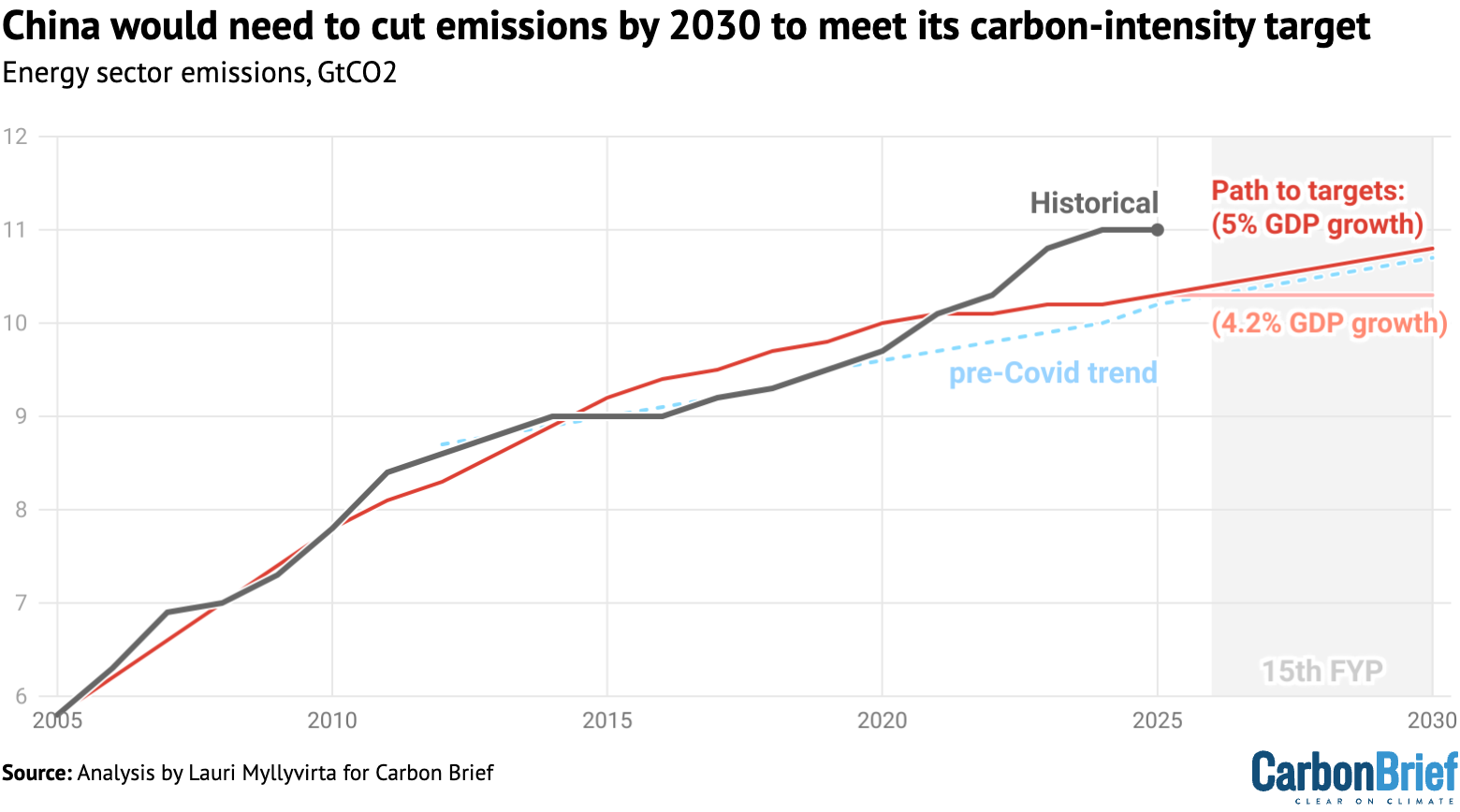
Xi’s personal imprimatur would make missing these 2030 targets awkward for China, particularly given the country’s carefully cultivated reputation for delivery. On the other hand, meeting them would require much stronger action than initially anticipated.
Recent policy documents and statements, in particular the recommendations of the Central Committee of the Communist Party for the next five-year plan, and the government’s work report for 2025, have put the emphasis on China’s target to peak emissions before 2030 and the new 2035 emission target, which would still allow emissions to increase over the next five-year period. The earlier 2030 commitments risk being buried as inconvenient.
Still, the State Council’s plan for controlling carbon emissions, published in 2024, says that carbon intensity will be a “binding indicator” for the next five-year period, meaning that a target will be included in the top-level plan published in March 2026.
China is only set to achieve a reduction of about 12% in carbon intensity from 2020 to 2025 – a marked slowdown relative to previous periods, as shown in the figure below.
(This is based on reductions reported annually by the National Bureau of Statistics until 2024 and a projected small increase in energy-sector CO2 emissions in 2025. Total CO2 emissions could still fall this year, when the fall in process emissions from cement production is factored in.)
A 12% fall would be far less than the 18% reduction targeted under the 14th five-year plan, as well as falling short of what would be needed to stay on track to the 2030 target.
To make up the shortfall and meet the 2030 intensity target, China would need to set a goal of around 23% in the next five-year plan. As such, this target will be a key test of China’s determination to honour its climate commitments.
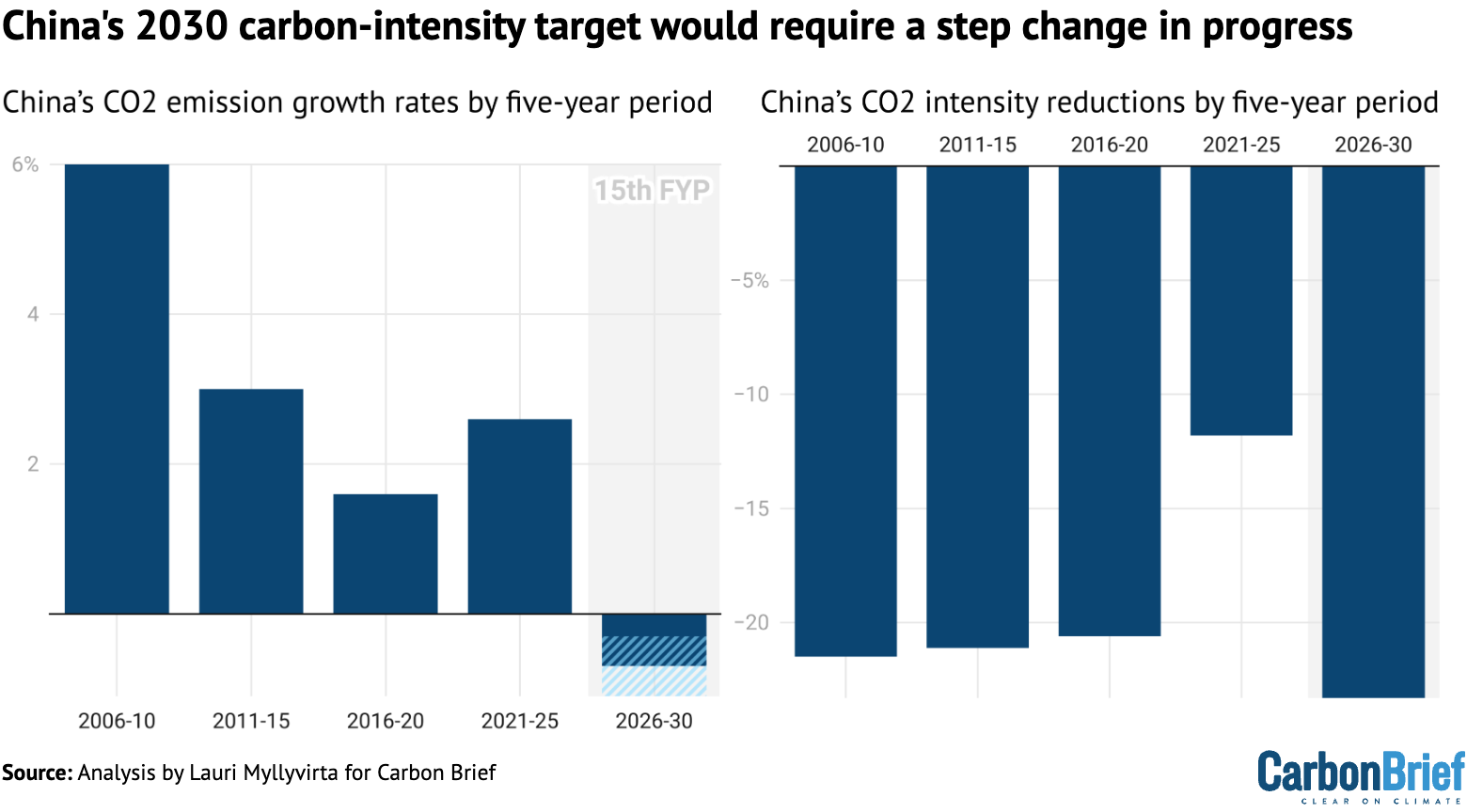
A carbon-intensity target of 23% is likely to receive pushback from some policymakers, as it is much higher than achieved in previous periods. No government or thinktank documents have yet been published with estimates of what the 2030 intensity target would need to be.
In practice, meeting the 2030 carbon intensity target would require reducing CO2 emissions by 2-6% in absolute terms from 2025, assuming a GDP growth rate of 4.2-5.0%.
China needs 4.2% GDP growth over the next decade to achieve Xi’s target of doubling the country’s GDP per capita from 2020 to 2035, a key part of his vision of achieving “socialist modernisation” by 2035, with the target for the next five years likely to be set higher.
Recent high-level policy documents have avoided even mentioning the 2030 intensity target. It is omitted in recommendations of the Central Committee of the Communist Party for the next five-year plan, the foundation on which the plan will be formulated.
Instead, the recommendations emphasised “achieving the carbon peak as scheduled” and “promoting the peaking of coal and oil consumption”, which are less demanding.
The environment ministry, in contrast, continues to pledge efforts to meet the carbon intensity target. However, they are not the ones writing the top-level five-year plan.
The failure to meet the 2025 intensity target has been scarcely mentioned in top-level policy discussions. There was no discernible effort to close the gap to the target, even after the midway review of the five-year plan recognised the shortfall.
The State Council published an action plan to get back on track, including a target for reducing carbon intensity in 2024 – albeit one not sufficient to close the shortfall. Yet this plan, in turn, was not followed up with an annual target for 2025.
The government could also devise ways to narrow the gap to the target on paper, through statistical revisions or tweaks to the definition of carbon intensity, as the term has not been defined in China’s NDCs.
Notably, unlike China’s previous NDC, its latest pledge did not include a progress update for carbon intensity. The latest official update sent to the UN only covers the years to 2020.
This leaves some more leeway for revisions, even though China’s domestic “statistical communiques”, published every year, have included official numbers up to 2024.
Coal consumption growth around 2022 was likely over-reported, so statistical revisions could reduce reported emissions and narrow the gap to the target. Including process emissions from cement, which have been falling rapidly in recent years, and changing how emissions from fossil fuels used as raw materials in the chemicals industry are accounted for, so-called non-energy use, which has been growing rapidly, could make the target easier to meet.
2. Will the plan upgrade clean-energy targets or pave the way to exceed them?
The need to accelerate carbon-intensity reductions also has implications for clean-energy targets.
The current goal is for non-fossil fuels to make up 25% of energy supplies in 2030, up from the 21% expected to be reached this year.
This expansion would be sufficient to achieve the reduction in carbon intensity needed in the next five years, but only if energy consumption growth slows down very sharply. Growth would need to slow to around 1% per year, from 4.1% in the past five years 2019-2024 and from 3.7% in the first three quarters of 2025.
The emphasis on manufacturing in the Central Committee’s recommendations for the next five-year plan is hard to reconcile with such a sharp slowdown, even if electrification will help reduce primary energy demand. During the current five-year period, China abolished the system of controlling total energy consumption and energy intensity, removing the incentive for local governments to curtail energy-intensive projects and industries.
Even if the ratio of total energy demand growth to GDP growth returned to pre-Covid levels, implying total energy demand growth of 2.5% per year, then the share of non-fossil energy would need to reach 31% by 2030 to deliver the required reduction in carbon intensity.
However, China recently set the target for non-fossil energy in 2035 at just 30%. This risks cementing a level of ambition that is likely too low to enable the 2030 carbon-intensity target to be met, whereas meeting it would require non-fossil energy to reach 30% by 2030.
There is ample scope for China to beat its targets for non-fossil energy.
However, given that the construction of new nuclear and hydropower plants generally takes five years or more in China, only those that are already underway have the chance to be completed by 2030. This leaves wind and solar as the quick-to-deploy power generation options that can deliver more non-fossil energy during this five-year period.
Reaching a much higher share of non-fossil energy in 2030, in turn, would therefore require much faster growth in solar and wind than currently targeted. Both the NDRC power-sector plan for 2025-27 and China’s new NDC aim for the addition of about 200 gigawatts (GW) per year of solar and wind capacity, much lower than the 360GW achieved in 2024.
If China continued to add capacity at similar rates, going beyond the government’s targets and instead installing 250-350GW of new solar and wind in each of the next five years, then this would be sufficient to meet the 2030 intensity target, assuming energy demand rising by 2.5-3.0% per year.
All previous wind and solar targets have been exceeded by a wide margin, as shown in the figure below, so there is a good chance that the current one will be, too.
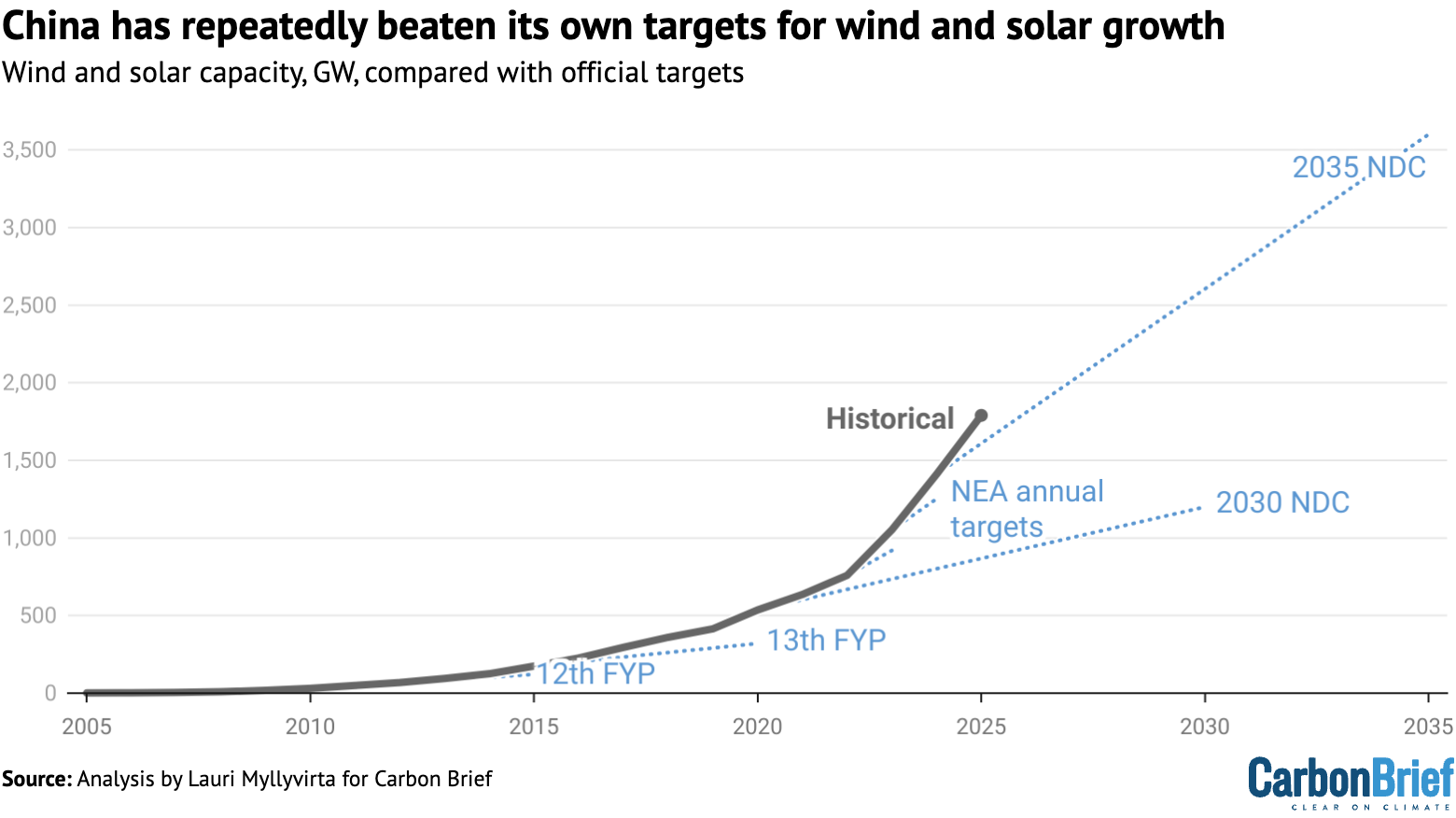
While the new pricing policy for wind and solar has created a much more uncertain and less supportive policy environment for the development of clean energy, provinces have substantial power to create a more supportive environment.
For example, they can include clean-energy projects and downstream projects using clean electricity and green hydrogen in their five-year plans, as well as developing their local electricity markets in a direction that enables new solar and wind projects.
3. Will the plan set an absolute cap on coal consumption?
In 2020, Xi pledged that China would “gradually reduce coal consumption” during the 2026-30 period. The commitment is somewhat ambiguous.
It could be interpreted as requiring a reduction starting in 2026, or a reduction below 2025 levels by 2030, which in practice would mean coal consumption peaking around the midway point of the five-year period, in other words 2027-28.
In either case, if Xi’s pledge were to be cemented in the 15th five-year plan then it would need to include an absolute reduction in coal consumption during 2026-30. An illustration of what this might look like is shown in the figure below.
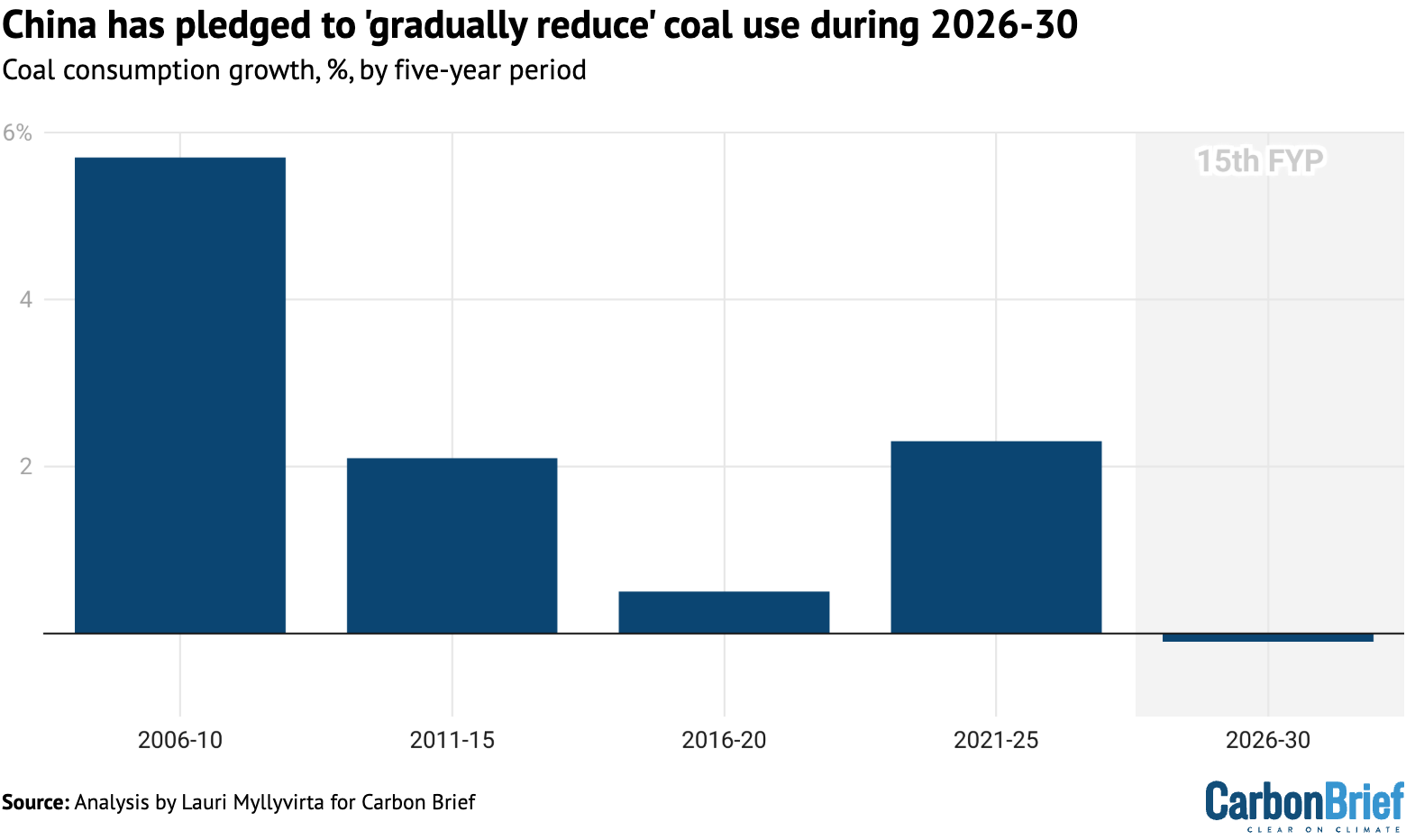
However, the commitment to reduce coal consumption was missing from China’s new NDC for 2035 and from the Central Committee’s recommendations for the next five-year plan.
The Central Committee called for “promoting a peak in coal and oil consumption”, which is a looser goal as it could still allow an increase in consumption during the period, if the growth in the first years towards 2030 exceeds the reduction after the peak.
The difference between “peaking” and “reducing” is even larger because China has not defined what “peaking” means, even though peaking carbon emissions is the central goal of China’s climate policy for this decade.
Peaking could be defined as achieving a certain reduction from peak before the deadline, or having policies in place that constrain emissions or coal use. It could be seen as reaching a plateau or as an absolute reduction.
While the commitment to “gradually reduce” coal consumption has seemed to fade from discussion, there have been several publications discussing the peak years for different fossil fuels, which could pave the way for more specific peaking targets.
State news agency Xinhua published an article – only in English – saying that coal consumption would peak around 2027 and oil consumption around 2026, while also mentioning the pledge to reduce coal consumption.
The energy research arm of the National Development and Reform Council had said earlier that coal and oil consumption would peak halfway through the next five-year period, in other words 2027-28, while the China Coal Association advocated a slightly later target of 2028.
Setting a targeted peak year for coal consumption before the half-way point of the five-year period could be a way to implement the coal reduction commitment.
With the fall in oil use in transportation driven by EVs, railways and other low-carbon transportation, oil consumption is expected to peak soon or to have peaked already.
State-owned oil firm CNPC projects that China’s oil consumption will peak in 2025 at 770m tonnes, while Sinopec thinks that continued demand for petrochemical feedstocks will keep oil consumption growing until 2027 and it will then peak at 790-800m tonnes.
4. Will ‘dual control’ of carbon prevent an emission rebound?
With the focus on realising a peak in emissions before 2030, there could be a strong incentive for provincial governments and industries to increase emissions in the early years of the five-year period to lock in a higher level of baseline emissions.
This approach is known as “storming the peak” (碳冲锋) in Chinese and there have been warnings about it ever since Xi announced the current CO2 peaking target in 2020.
Yet, the emphasis on peaking has only increased, with the recent announcement on promoting peaks in coal consumption and oil consumption, as well as the 2035 emission-reduction target being based on “peak levels”.
The policy answer to this is creating a system to control carbon intensity and total CO2 emissions – known as “dual control of carbon” – building on the earlier system for the “dual control of energy” consumption.
Both the State Council and the Central Committee have set the aim of operationalising the “dual control of carbon” system in the 15th five-year plan period.
However, policy documents speak of building the carbon dual-control system during the five-year period rather than it becoming operational at the start of the period.
For example, an authoritative analysis of the Central Committee’s recommendations by China Daily says that “solid progress” is needed in five areas to actually establish the system, including assessment of carbon targets for local governments as well as carbon management for industries and enterprises.
The government set an annual target for reducing carbon intensity for the first time in 2024, but did not set one for 2025, also signaling that there was no preparedness to begin controlling carbon intensity, let alone total carbon emissions, yet.
If the system is not in place at the start of the five-year period, with firm targets, there could be an opportunity for local governments to push for early increases in emissions – and potentially even an incentive for such emission increases, if they expect strict control later.
Another question is how the “dual” element of controlling both carbon intensity and absolute CO2 emissions is realised. While carbon intensity is meant to be the main focus during the next five years, with the priority shifting to reducing absolute emissions after the peak, having the “dual control” in place requires some kind of absolute cap on CO2 emissions.
The State Council has said that China will begin introducing “absolute emissions caps in some industries for the first time” from 2027 under its national carbon market. It is possible that the control of absolute carbon emissions will only apply to these sectors.
The State Council also said that the market would cover all “major emitting sectors” by 2027, but absolute caps would only apply to sectors where emissions have “stabilised”.
5. Will it limit coal-power and chemical-industry growth?
During the current five-year period, China’s leadership went from pledging to “strictly control” new coal-fired power projects to actively promoting them.
If clean-energy growth continues at the rates achieved in recent years, there will be no more space for coal- and gas-fired power generation to expand, even if new capacity is built. Stable or falling demand for power generation from fossil fuels would mean a sharp decline in the number of hours each plant is able to run, eroding its economic viability.
Showing the scale of the planned expansion, researchers from China Energy Investment Corporation, the second-largest coal-power plant operator in China, project that China’s coal-fired power capacity could expand by 300GW from the end of 2024 to 2030 and then plateau at that level for a decade. The projection relies on continued growth of power generation from coal until 2030 and a very slow decline thereafter.
The completion of the 325GW projects already under construction and permitted at the end of 2024, as well as an additional 42GW permitted in the first three quarters of 2025, could in fact lead to a significantly larger increase, if the retirement of existing capacity remains slow.
In effect, China’s policymakers face a choice between slowing down the clean-energy boom, which has been a major driver of economic growth in recent years, upsetting coal project developers, who expect to operate their coal-fired power plants at a high utilisation, or retiring older coal-power plants en masse.
Their response to these choices may not become clear for some time. The top-level five-year plan that will be published in March 2026 will likely provide general guidelines, but the details of capacity development will be relegated to the sectoral plans for energy.
The other sector where fossil fuel-based capacity is rapidly increasing is the chemical industry, both oil and coal-based. In this sector, capacity growth has led directly to increases in output, making the sector the only major driver of emissions increases after early 2024.
The expansion is bound to continue. There are more than 500 petrochemical projects planned by 2030 in China, of which three quarters are already under construction, according to data provider GlobalData.
As such, the emissions growth in the chemical sector is poised to continue in the next few years, whereas meeting China’s 2030 targets and commitments would require either reining it in and bringing emissions back down before 2030, or achieving emission reductions in other sectors that offset the increases.
The expansion of the coal-to-chemicals industry is largely driven by projects producing gas and liquid fuels from coal, which make up 70% of the capacity under construction and in planning, according to a mapping by Anychem Coalchem.
These projects are a way of reducing reliance on imported oil and gas. In these areas, electrification and clean energy offer another solution that can replace imports.
Conclusions
The five-year plans being prepared now will largely determine the peak year and level of China’s emissions, with a major impact on China’s subsequent emission trajectory and on the global climate effort.
The targets in the plan will also be a key test of the determination of China’s leadership to respect previous commitments, despite setbacks.
The country has cultivated a reputation for reliably implementing its commitments. For example, senior officials have said that China’s policy targets represent a “bottom line”, which the policymakers are “definitely certain” about meeting, while contrasting this with other countries’ loftier approach to target-setting.
Depending on how the key questions outlined in this article are answered in the plans for the next five years, however, there is the possibility of a rebound in emissions.
There are several factors contributing to such a possibility: solar- and wind-power deployment could slow down under the new pricing policy, weak targets and a deluge of new coal- and gas-power capacity coming onto the market.
In addition, unfettered expansion of the chemical industry could drive up emissions. And climate targets that limit emissions only after a peak is reached could create an incentive to increase emissions in the short term, unless counteracted by effective policies.
On the other hand, there is also the possibility of the clean-energy boom continuing so that the sector beats the targets it has been set. Policymakers could also prioritise carbon-intensity reductions early in the period to meet China’s 2030 commitments.
Given the major role that clean-energy industries have played in driving China’s economic growth and meeting GDP targets, local governments have a strong incentive to keep the expansion going, even if the central government plans for a slowdown.
During the current five-year period, provinces and state-owned enterprises have been more ambitious than the central government. Provinces can and already have found ways to support clean-energy development beyond central government targets.
Such an outcome would continue a well-established pattern, given all previous wind and solar targets have been exceeded by a wide margin.
The difference now is that a significant exceedance of clean-energy targets would make a much bigger difference, due to the much larger absolute size of the industry.
To date, China’s approach to peaking emissions and pursuing carbon neutrality has focused on expanding the supply and driving down the cost of clean technology, emphasising economic expansion rather than restrictions on fossil-fuel use and emissions, with curbing overcapacity an afterthought.
This suggests that if China’s 2030 targets are to be met, it is more likely to be through the over-delivery of clean energy than as a result of determined regulatory effort.

The post Q&A: Five key climate questions for China’s next ‘five-year plan’ appeared first on Carbon Brief.
Q&A: Five key climate questions for China’s next ‘five-year plan’
Greenhouse Gases
Analysis: UK newspaper editorial opposition to climate action overtakes support for first time
Nearly 100 UK newspaper editorials opposed climate action in 2025, a record figure that reveals the scale of the backlash against net-zero in the right-leaning press.
Carbon Brief has analysed editorials – articles considered the newspaper’s formal “voice” – since 2011 and this is the first year opposition to climate action has exceeded support.
Criticism of net-zero policies, including renewable-energy expansion, came entirely from right-leaning newspapers, particularly the Sun, the Daily Mail and the Daily Telegraph.
In addition, there were 112 editorials – more than two a week – that included attacks on Ed Miliband, continuing a highly personal campaign by some newspapers against the Labour energy secretary.
These editorials, nearly all of which were in right-leaning titles, typically characterised him as a “zealot”, driving through a “costly” net-zero “agenda”.
Taken together, the newspaper editorials mirror a significant shift on the UK political right in 2025, as the opposition Conservative party mimicked the hard-right populist Reform UK party by definitively rejecting the net-zero target that it had legislated for and the policies that it had previously championed.
Record climate opposition
Nearly 100 UK newspaper editorials voiced opposition to climate action in 2025 – more than double the number of editorials that backed climate action.
As the chart below shows, 2025 marked the fourth record-breaking year in a row for criticism of climate action in newspaper editorials.
This also marks the first time that editorials opposing climate action have overtaken those supporting it, during the 15 years that Carbon Brief has analysed.

This trend demonstrates the rapid shift away from a long-standing political consensus on climate change by those on the UK’s political right.
Over the past year, the Conservative party has rejected both the “net-zero by 2050” target that it legislated for in 2019 and the underpinning Climate Change Act that it had a major role in creating. Meanwhile, the Reform UK party has been rising in the polls, while pledging to “ditch net-zero”.
These views are reinforced and reflected in the pages of the UK’s right-leaning newspapers, which tend to support these parties and influence their politics.
All of the 98 editorials opposing climate action were in right-leaning titles, including the Sun, the Daily Mail, the Daily Telegraph, the Times and the Daily Express.
Conversely, nearly all of the 46 editorials pushing for more climate action were in the left-leaning and centrist publications the Guardian and the Financial Times. These newspapers have far lower circulations than some of the right-leaning titles.
In total, 81% of the climate-related editorials published by right-leaning newspapers in 2025 rejected climate action. As the chart below shows, this is a marked difference from just a few years ago, when the same newspapers showed a surge in enthusiasm for climate action.
That trend had coincided with Conservative governments led by Theresa May and Boris Johnson, which introduced the net-zero goal and were broadly supportive of climate policies.

Notably, none of the editorials opposing climate action in 2025 took a climate-sceptic position by questioning the existence of climate change or the science behind it. Instead, they voiced “response scepticism”, meaning they criticised policies that seek to address climate change.
(The current Conservative leader, Kemi Badenoch, has described herself as “a net-zero sceptic, not a climate change sceptic”. This is illogical as reaching net-zero is, according to scientists, the only way to stop climate change from getting worse.)
In particular, newspapers took aim at “net-zero” as a catch-all term for policies that they deemed harmful. Most editorials that rejected climate action did not even mention the word “climate”, often using “net-zero” instead.
This supports recent analysis by Dr James Painter, a research associate at the University of Oxford, which concluded that UK newspaper coverage has been “decoupling net-zero from climate change”.
This is significant, given strong and broad UK public support for many of the individual climate policies that underpin net-zero. Notably, there is also majority support for the “net-zero by 2050” target itself.
Much of the negative framing by politicians and media outlets paints “net-zero” as something that is too expensive for people in the UK.
In total, 87% of the editorials that opposed climate action cited economic factors as a reason, making this by far the most common justification. Net-zero goals were described as “ruinous” and “costly”, as well as being blamed – falsely – for “driving up energy costs”.
The Sunday Telegraph summarised the view of many politicians and commentators on the right by stating simply that said “net-zero should be scrapped”.
While some criticism of net-zero policies is made in good faith, the notion that climate change can be stopped without reducing emissions to net-zero is incorrect. Alternative policies for tackling climate change are rarely presented by critical editorials.
Moreover, numerous assessments have concluded that the transition to net-zero can be both “affordable” and far cheaper than previously thought.
This transition can also provide significant economic benefits, even before considering the evidence that the cost of unmitigated warming will significantly outweigh the cost of action.
Miliband attacks intensify
Meanwhile, UK newspapers published 112 editorials over the course of 2025 taking personal aim at energy security and net-zero secretary Ed Miliband.
Nearly all of these articles were in right-leaning newspapers, with the Sun alone publishing 51. The Daily Mail, the Daily Telegraph and the Times published most of the remainder.
This trend of relentlessly criticising Miliband personally began last year in the run up to Labour’s election victory. However, it ramped up significantly in 2025, as the chart below shows.

Around 58% of the editorials that opposed climate action used criticism of climate advocates as a justification – and nearly all of these articles mentioned Miliband, specifically.
Editorials denounced Miliband as a “loon” and a “zealot”, suffering from “eco insanity” and “quasi-religious delusions”. Nicknames given to him include “His Greenness”, the “high priest of net-zero” and “air miles Miliband”.
Many of these attacks were highly personal. The Daily Mail, for example, called Miliband “pompous and patronising”, with an “air of moral and intellectual superiority”.
Frequently, newspapers refer to “Ed Miliband’s net-zero agenda”, “Ed Miliband’s swivel-eyed targets” and “Mr Miliband’s green taxes”.
These formulations frame climate policies as harmful measures that are being imposed on people by the energy secretary.
In fact, the Labour government decisively won an election in 2024 with a manifesto that prioritised net-zero policies. Often, the “targets” and “taxes” in question are long-standing policies that were introduced by the previous Conservative government, with cross-party support.
Moreover, the government’s climate policy not only continues to rely on many of the same tools created by previous administrations, it is also very much in line with expert evidence and advice. This is to prioritise the expansion of clean power and to fuel an economy that relies on increasing levels of electrification, including through electric cars and heat pumps.
Despite newspaper editorials regularly calling for Miliband to be “sacked”, prime minister Keir Starmer has voiced his support both for the energy secretary and the government’s prioritisation of net-zero.
In an interview with podcast The Rest is Politics last year, Miliband was asked about the previous Carbon Brief analysis that showed the criticism aimed at him by right-leaning newspapers.
Podcast host Alastair Campbell asked if Miliband thought the attacks were the legacy of his strong stance, while Labour leader, during the Leveson inquiry into the practices of the UK press. Miliband replied:
“Some of these institutions don’t like net-zero and some of them don’t like me – and maybe quite a lot of them don’t like either.”
Renewable backlash
As well as editorial attitudes to climate action in general, Carbon Brief analysed newspapers’ views on three energy technologies – renewables, nuclear power and fracking.
There were 42 newspaper editorials criticising renewable energy in 2025. This meant that, for the first time since 2014, there were more anti-renewables editorials than pro-renewables editorials, as the chart below shows.
As with climate action more broadly, this was a highly partisan issue. The Times was the only right-leaning newspaper that published any editorials supporting renewables.

By far the most common stated reason for opposing renewable energy was that it is “expensive”, with 86% of critical editorials using economic arguments as a justification.
The Sun referred to “chucking billions at unreliable renewables” while the Daily Telegraph warned of an “expensive and intermittent renewables grid”.
At the same time, editorials in supportive publications also used economic arguments in favour of renewables. The Guardian, for example, stressed the importance of building an “affordable clean-energy system” that is “built on renewables”.
There was continued support in right-leaning publications for nuclear power, despite the high costs associated with the technology. In total, there were 20 editorials supporting nuclear power in 2025 – nearly all in right-leaning newspapers – and none that opposed it.
Fracking was barely mentioned by newspapers in 2023 and 2024, after a failed push by the Conservatives under prime minister Liz Truss to overturn a ban on the practice in 2022. This attempt had been accompanied by a surge in supportive right-leaning newspaper editorials.
There was a small uptick of 15 editorials supporting fracking in 2025, as right-leaning newspapers once again argued that it would be economically beneficial.
The Sun urged current Conservative leader Badenoch to make room for this “cheap, safe solution” in her future energy policy. The government plans to ban fracking “permanently”.
North Sea oil and gas remained the main fossil-fuel policy focus, with 30 editorials – all in right-leaning newspapers – that mentioned the topic. Most of the editorials arguing for more extraction from the North Sea also argued for less climate action or opposed renewable energy.
None of these editorials noted that the UK is expected to be significantly less reliant on fossil-fuel imports if it pursues net-zero, than if it rolls back on climate action and attempts to squeeze more out of the remaining deposits in the North Sea.
Methodology
This is a 2025 update of previous analysis conducted for the period 2011-2021 by Carbon Brief in association with Dr Sylvia Hayes, a research fellow at the University of Exeter. Previous updates were published in 2022, 2023 and 2024.
The count of editorials criticising Ed Miliband was not conducted in the original analysis.
The full methodology can be found in the original article, including the coding schema used to assess the language and themes used in editorials concerning climate change and energy technologies.
The analysis is based on Carbon Brief’s editorial database, which is regularly updated with leading articles from the UK’s major newspapers.
The post Analysis: UK newspaper editorial opposition to climate action overtakes support for first time appeared first on Carbon Brief.
Analysis: UK newspaper editorial opposition to climate action overtakes support for first time
Greenhouse Gases
DeBriefed 16 January 2026: Three years of record heat; China and India coal milestone; Beijing’s 2026 climate outlook
Welcome to Carbon Brief’s DeBriefed.
An essential guide to the week’s key developments relating to climate change.
This week
Hottest hat-trick
STATE OF THE CLIMATE: Scientists have announced that 2025 was either the second or third hottest year on record, with close margins between last year and 2023, reported the Associated Press. The newswire noted that “temperature averages for 2025 hovered around – and mostly above – 1.4C of industrial era warming”. Bloomberg said that this happened despite the natural weather phenomenon La Niña, which “suppresses global temperatures”, meaning “heat from greenhouse gases countered that cooling influence”. Carbon Brief’s comprehensive analysis of the data found cumulative global ice loss also “reached a new record high in 2025”.
OVERHEATING OCEANS: Separately, the world’s oceans “absorbed colossal amounts of heat in 2025”, said the Guardian, setting “yet another new record and fuelling more extreme weather”. It added that the “extra heat makes the hurricanes and typhoons…more intense, causes heavier downpours of rain and greater flooding and results in longer marine heatwaves”.
FIRE AND ICE: Wildfires in Australia have destroyed around 500 structures, said the Sydney Morning Herald, with a “dozen major fires” still burning. A wildfire in Argentinian Patagonia has “blazed through nearly 12,000 hectares” of scrubland and forests, according to the Associated Press. Meanwhile, parts of the Himalayas are “snowless” for the first time in nearly four decades, signalling a “climatic anomaly”, reported the Times of India.
Around the world
- EMISSIONS REBOUND: US emissions rose 2% last year after two years of declines” due to a rise in coal power generation, said Axios, in coverage of research by the Rhodium Group.
- ‘UNINVESTABLE’ OIL: US president Donald Trump may “sideline” ExxonMobil from Venezuela’s oil market after its comment that Venezuela is “uninvestable”, reported CNBC. TotalEnergies is also “in no rush to return to Venezuela”, said Reuters.
- PRICE WARS: The EU issued guidelines that will allow tariffs on Chinese electric vehicles to be removed in exchange for minimum price commitments, said Reuters.
- ‘RECORD’ AUCTION: The UK government has secured “8.4 gigawatts of new offshore wind power” in a “record” auction, said Sky News. Although the auction saw some price rises, this will likely be “cost neutral” for consumers, Carbon Brief said – contrary to the “simplistic and misleading” narratives promoted by some media outlets.
- COP STRATEGY: The Guardian reported that Chris Bowen, the Australian minister appointed “president of negotiations” for COP31, plans to use his role to lobby “Saudi Arabia and others” on the need to phase out fossil fuels.
$2bn
The size of a new climate fund unveiled by the Nigerian government, according to Reuters.
Latest climate research
- Rooftop solar in the EU has the potential to meet 40% of electricity demand in a 100% renewable scenario for 2050 | Nature Energy
- Natural wildfires, such as those ignited by lightning strikes, have been increasing in frequency and intensity in sub-Saharan Africa, driven by climate change | Global and Planetary Change
- Engaging diverse citizens groups can lead to “more equitable, actionable climate adaptation” across four pilot regions in Europe | Frontiers in Climate
(For more, see Carbon Brief’s in-depth daily summaries of the top climate news stories on Monday, Tuesday, Wednesday, Thursday and Friday.)
Captured

Both China and India saw coal power generation fall in 2025, in the “first simultaneous drop in half a century”, found new analysis for Carbon Brief, which was widely reported around the world. It noted that, for both countries, the decline in coal was driven by new clean-energy capacity additions, which were “more than sufficient to meet rising demand”.
Spotlight
What are China experts watching for in 2026?
The year 2026 will be pivotal for China’s climate policy. In March, the government will release key climate and energy targets for 2030, the year by which China has pledged to have peaked its emissions.
At the same time, with the US increasingly turning away from climate policy and towards fossil fuel expansionism, China’s role in global climate action is more important than ever.
Carbon Brief asks leading experts what they are watching for from China over the year ahead.
Shuo Li, director of the China Climate Hub, Asia Society Policy Institute
After decades of rapid growth, independent analyses suggest China’s CO2 emissions may have plateaued or even begun to decline in 2025.
The transition from emissions growth to stabilisation and early decline will be the key watch point for 2026 and will be shaped by the forthcoming 15th five-year plan. [This plan will set key economic goals, including energy and climate targets, for 2030.]
However, the precise timing, scale and enforceability of these absolute emissions control measures remain under active debate. Chinese experts broadly agree that if the 2021-2025 period was characterised by continued emissions growth, and 2031-2035 is expected to deliver a clear decline, then 2026-2030 will serve as a critical “bridge” between the two.
Yan Qin, principal analyst, ClearBlue Markets
First, the 15th five-year plan inaugurates the “dual control of carbon” system. This year marks the first time industries and local governments face binding caps on total emissions, not just intensity.
Second, the national carbon market is aggressively tightening. With the inclusion of steel, cement and aluminum this year, regulators are executing a “market reset” – de-weighting older allowances [meaning they cannot be used to contribute to polluters’ obligations for 2026] and enforcing stricter benchmarks to bolster prices ahead of the full rollout of the EU’s carbon border adjustment mechanism.
Cecilia Trasi, senior policy advisor for industry and trade, ECCO
China’s solar manufacturing overcapacity is prompting Beijing’s first serious consolidation efforts. At the same time, its offshore wind technology is advancing rapidly [and there are] signals that Chinese wind companies are pursuing entry into European markets through local production, mirroring strategies adopted by battery manufacturers.
Together, these dynamics suggest that the next phase of cleantech competition will be shaped less by trade defense alone and more by the interaction between Chinese supply-side reforms and global market-absorption capacity.
Tu Le, managing director, Sino Auto Insights
China’s electric vehicle (EV) industry has been the primary force pushing the global passenger vehicle market toward clean energy. That momentum should continue. But a growing headwind has emerged: tariffs. Mexico, Brazil, Europe and the US are just a few of the countries raising barriers, complicating the next phase of global EV expansion.
One new wildcard: the US now effectively controls Venezuelan oil. If that meaningfully impacts global oil prices, it could either slow – or unexpectedly accelerate – the shift toward clean-energy vehicles.
Responses have been edited for length and clarity.
A full-length version of the article is available on the Carbon Brief website.
Watch, read, listen
SHAPING THE LAND: In addition to land use shaping the climate, climate change is now increasingly “changing the land”, according to satellite monitoring by World Resources Institute, creating a “dangerous feedback loop”.
‘POSITIVE TIPPING POINTS’: A commentary co-authored by climate scientist Prof Corinne Le Quéré in Nature argued that several climate trends have locked in “irreversible progress in climate action”.
FROM THE FLAMES: Nick Grimshaw interviewed musician and data analyst Miriam Quick on how she turned the 2023 Canadian wildfires into music on BBC Radio 6. (Skip to 1:41:45 to listen.)
Coming up
- 17 January: High Seas Treaty comes into force, New York
- 19-26 January: World Economic Forum annual meeting, Davos, Switzerland
- 21 January: IEA Q1 Gas Market Report, Paris
Pick of the jobs
- Eurasia Group, analyst, climate transition | Salary: Unknown. Location: Nairobi, Kenya or Mexico City, Mexico
- Heard, climate programme coordinator | Salary: £31,518. Location: London (hybrid)
- Environmental Investigation Agency, climate campaigner | Salary: £36,000- £40,000. Location: London (hybrid)
DeBriefed is edited by Daisy Dunne. Please send any tips or feedback to debriefed@carbonbrief.org.
This is an online version of Carbon Brief’s weekly DeBriefed email newsletter. Subscribe for free here.
The post DeBriefed 16 January 2026: Three years of record heat; China and India coal milestone; Beijing’s 2026 climate outlook appeared first on Carbon Brief.
Greenhouse Gases
Brazil’s biodiversity pledge: Six key takeaways for nature and climate change
The world’s most biodiverse nation, Brazil, has belatedly published its UN plan for halting and reversing nature decline by the end of this decade.
Brazil is home to 10-15% of all known species on Earth, 64% of the Amazon rainforest and it supplies 10% of global food demand, according to official estimates.
It was among around 85% of nations to miss the 2024 deadline for submitting a new UN nature plan, known as a national biodiversity strategy and action plan (NBSAP), according to a joint investigation by Carbon Brief and the Guardian.
On 29 December 2025, Brazil finally published its new NBSAP, following a lengthy consultation process involving hundreds of scientists, Indigenous peoples and civil society members.
The NBSAP details how the country will meet the goals and targets of the Kunming-Montreal Global Biodiversity Framework (GBF), the landmark deal often described as the “Paris Agreement” for nature, agreed in 2022.
Below, Carbon Brief walks through six key takeaways from Brazil’s belated NBSAP:
- The government plans to ‘conserve’ 80% of the Brazilian Amazon by 2030
- It plans to ‘eliminate’ deforestation in Brazilian ecosystems by 2030
- Brazil has ‘aligned’ its actions on tackling climate change and biodiversity loss
- The country seeks to ‘substantially increase’ nature finance from a range of sources
- Brazil’s plans for agriculture include ‘sustainable intensification’
- Brazil conducted a largest-of-its-kind consultation process before releasing its NBSAP
The government plans to ‘conserve’ 80% of the Brazilian Amazon by 2030
The third target of the GBF sets out the aim that “by 2030 at least 30% of terrestrial, inland water and of coastal and marine areas…are effectively conserved and managed”. This is often referred to as “30 by 30”.
Previous analysis by Carbon Brief and the Guardian found that more than half of countries’ pledges were not aligned with this aim. (Importantly, all of the GBF’s targets are global ones and do not prescribe the amount of land that each country must protect.)
Brazil’s NBSAP sets a substantially higher goal – it seeks to conserve 80% of the Amazon rainforest within its borders, as well as 30% of the country’s other ecosystems.
Since Brazil is one of the largest countries in the world, in addition to being the most biodiverse, this higher target represents a significant step towards achieving the global target.
For the purposes of its protected areas target, Brazil considers not just nationally designated protected areas, but also the lands of Indigenous peoples, Quilombola territories and other local communities.
As the NBSAP notes, Brazil has already taken several steps towards achieving the “30 by 30” target.
In 2018, the country created or expanded four marine protected areas in its territorial waters, increasing its protected area coverage from around 1.5% to greater than 25%.
According to Brazil’s sixth national report, submitted to the CBD in 2020, 18% of the country’s “continental area” – that is, its land and inland waters – was part of a protected area. More than 28% of the Amazon received such a designation.
A further 12% of the country is demarcated as Indigenous lands, which “provide important protection to a large territorial extension of the country, particularly in the Amazon biome”, the report says.
The action plan that accompanies the new NBSAP sets out 15 actions in support of achieving target three, including recognising and titling Indigenous lands, establishing ecological corridors and biosphere reserves and implementing national strategies for mangrove, coral reef and wetlands protection.
It plans to ‘eliminate’ deforestation in Brazilian ecosystems by 2030
As well as committing to the GBF targets of protecting and restoring ecosystems, Brazil’s NBSAP also sets a separate target to “eliminate” deforestation in Brazilian biomes by 2030.
Target 1B of Brazil’s NBSAP says that the country aims to “achieve zero deforestation and conversion of native vegetation by 2030”.
The country hopes to achieve this “through the elimination of illegal deforestation and conversion, compensation for the legal suppression of native vegetation, prevention and control of wildfires, combating desertification and attaining land degradation neutrality”.
This goes above and beyond what is set out in the GBF, which does not mention “deforestation” at all.
Brazilian president Luiz Inácio Lula da Silva was reelected as leader in 2022 on a promise to achieve “zero deforestation”, following a rise in Amazon destruction under his predecessor, Jair Bolsonaro.
Data from Global Forest Watch (GFW), an independent satellite research platform, found that deforestation in the Brazilian Amazon fell by a “dramatic” 36% in 2023 under Lula.
However, Brazil remains the world’s largest deforester. Separate GFW data shows that the country accounted for 42% of all primary forest loss in 2024 – with two-thirds of this driven by wildfires fuelled by a record drought.
Brazil has ‘aligned’ its actions on tackling climate change and biodiversity loss
Brazil’s NBSAP comes shortly after it hosted the COP30 climate summit in the Amazon city of Belém in November.
One of the presidency’s priorities at the talks was to bring about greater coordination between global efforts to tackle climate change and biodiversity loss.
At the Rio Earth summit in 1992, the world decided to address Earth’s most pressing environmental problems under three separate conventions: one on climate change, one on biodiversity and the final one on land desertification.
But, for the past few years, a growing number of scientists, politicians and diplomats have questioned whether tackling these issues separately is the right approach.
And, at the most recent biodiversity and land desertification COPs, countries agreed to new texts calling for closer cooperation between the three Rio conventions.
At COP30, the Brazilian presidency attempted to negotiate a new text to enhance “synergies” between the conventions. However, several nations, including Saudi Arabia, vocally opposed the progression of a substantive outcome.
Following on from this, Brazil’s NBSAP states that its vision for tackling nature loss is “aligned” with its UN climate plan, known as a nationally determined contribution (NDC).
In addition, the NBSAP states that Brazil is taking a “holistic approach to addressing the existing crises of climate change and biodiversity loss in a synergistic manner”.
It lists several targets that could help to address both environmental problems, including ending deforestation, promoting sustainable agriculture and restoring ecosystems.
Brazil joins a small number of countries, including Panama and the UK, that have taken steps to bring their actions to tackle climate change and biodiversity loss into alignment.
The country seeks to ‘substantially increase’ nature finance from a range of sources
According to target 19 of the NBSAP, the Brazilian government will “develop and initiate” a national strategy to finance the actions laid out in the document by the end of 2026.
This financial plan “should aim to substantially increase…the volume of financial resources” for implementing the NBSAP.
These resources should come in the form of federal, state and municipal funding, international finance, private funding and incentives for preserving biodiversity, the document continues.
The accompanying action plan includes a number of specific mechanisms, which could be used to finance efforts to tackle nature loss. These include biodiversity credits, a regulated carbon market and the Tropical Forest Forever Facility.
Separately, the NBSAP sets out a goal in target 18 of identifying “subsidies and economic and fiscal incentives that are directly harmful to biodiversity” by the end of this year. Those identified subsidies should then be reduced or eliminated by 2030, it adds.
The document notes that the phaseout of harmful subsidies should be accompanied by an increase in incentives for “conservation, restoration and sustainable use of biodiversity”.
The NBSAP does “important work” in translating the targets of the GBF into “ambitious targets” in the national context, says Oscar Soria, co-founder and chief executive of civil-society organisation the Common Initiative.
Soria tells Carbon Brief:
“While the document is laudable on many aspects and its implementation would change things for the better, the concrete financial means to make it a reality – funding it and halting the funding of activities going against it – are still lacking. In this regard, this NBSAP is a good example of the GBF’s problem at the global level.
“The hardest part of political negotiations will begin only now: in 2026, the Brazilian government will have to evaluate the cost of implementing the NBSAP and where finance will come from.”
Brazil’s plans for agriculture include ‘sustainable intensification’
Brazil is one of the world’s leading food producers, meeting 10% of global demand, according to its NBSAP.
It is also the world’s largest grower of soya beans and the second-largest cattle producer.
However, agriculture is also a major driver of biodiversity loss in Brazil, largely due to the clearing of rainforest or other lands for soya growing and cattle ranching. Agriculture itself is also affected by biodiversity loss, particularly the loss of pollinators. The NBSAP says:
“Biodiversity loss directly undermines agricultural production and human well-being, demonstrating that agriculture, other productive activities and biodiversity conservation are interdependent rather than antagonistic.”
Brazil’s NBSAP addresses sustainable agriculture in target 10A, which aims to “ensure that, by 2030, areas under agriculture, livestock, aquaculture and forestry are managed sustainably and integrated into the landscape”.
It lists several approaches to achieving sustainable production, including agroecology, regenerative agriculture and sustainable intensification.
Targets seven and 10B also pertain to food systems. Target seven seeks to reduce the impacts of pollution, including nutrient loss and pesticides, on biodiversity, while target 10B commits to the sustainable fishing and harvesting of other aquatic resources.
In 2021, Brazil launched its national low-carbon agriculture strategy, known as the ABC+ plan. The plan promotes sustainability in the agricultural sector through both adaptation and mitigation actions.
Brazil conducted a largest-of-its-kind consultation process before releasing its NBSAP
Brazil was among the majority of nations to miss the UN deadline to submit a new NBSAP before the COP16 biodiversity summit in Colombia in October 2024.
At the time, a representative from the Brazilian government said that it was unable to meet the deadline because it was embarking on an ambitious consultation process for its NBSAP.
Braulio Dias, director of biodiversity conservation at the Brazilian Ministry of Environment, who is responsible for the NBSAP process, told Carbon Brief and the Guardian in 2024:
“Brazil is a huge country with the largest share of biodiversity [and] a large population with a complex governance. We are a federation with 26 states and 5,570 municipalities. We started the process to update our NBSAP in May last year and have managed to conclude a broad consultation process involving over a thousand people in face-to-face meetings.
“We are in the process of consolidating all proposals received, consulting all the departments of the Brazilian Ministry of the Environment and Climate Change, all the federal ministries and agencies engaged in the biodiversity agenda and the National Biodiversity Committee, before we can have a high-level political endorsement.
“Then we still have to build a monitoring strategy, a finance strategy and a communication strategy. We will only conclude this process toward the end of the year or early next year.”
In its NBSAP, the Brazilian government says it engaged with around 200 scientific and civil society organisations and 110 Indigenous representatives while preparing its NBSAP.
Around one-third of the Amazon is protected by Indigenous territories.
Indigenous peoples in Brazil have continuously called for more inclusion in UN processes to tackle climate change and nature loss, including by holding multiple demonstrations during the COP30 climate summit in November.
Michel Santos, public policy manager at WWF Brazil, says that many in Brazil’s civil society were pleased with the NBSAP’s extensive consultation process, telling Carbon Brief:
“Brazilian civil society is very happy with everything. It was a long process with broad participation. It took a while to be completed, but we consider the result quite satisfactory.”
The post Brazil’s biodiversity pledge: Six key takeaways for nature and climate change appeared first on Carbon Brief.
Brazil’s biodiversity pledge: Six key takeaways for nature and climate change
-
Greenhouse Gases5 months ago
Guest post: Why China is still building new coal – and when it might stop
-
Climate Change5 months ago
Guest post: Why China is still building new coal – and when it might stop
-
Greenhouse Gases2 years ago嘉宾来稿:满足中国增长的用电需求 光伏加储能“比新建煤电更实惠”
-
Climate Change2 years ago
Spanish-language misinformation on renewable energy spreads online, report shows
-
Climate Change2 years ago
Bill Discounting Climate Change in Florida’s Energy Policy Awaits DeSantis’ Approval
-
Climate Change Videos2 years ago
The toxic gas flares fuelling Nigeria’s climate change – BBC News
-
Climate Change2 years ago嘉宾来稿:满足中国增长的用电需求 光伏加储能“比新建煤电更实惠”
-
Carbon Footprint2 years agoUS SEC’s Climate Disclosure Rules Spur Renewed Interest in Carbon Credits