

Local officials are often viewed as relatively weak actors in China’s governance structure, largely implementing policies issued from the central level.
However, a new book – “Implementing a low-carbon future: climate leadership in Chinese cities” – argues that these officials play an important role in designing innovative and enduring climate policy.
The book follows how four cities – Shenzhen, Zhenjiang, Xiamen and Nanchang – approached developing low-carbon policies over the course of almost a decade.
It identifies “bridge leaders” – mid-level local bureaucrats who have a strong interest in a specific policy area and who are unlikely to move often between different posts – as key to effective local climate policymaking.
Carbon Brief interviews author Weila Gong, non-resident scholar at the UC San Diego School of Global Policy and Strategy’s 21st Century China Center and visiting scholar at UC Davis, on her research.
The interview has been edited for length and clarity.
- Gong on why cities are important: “Over 85% of China’s carbon emissions come from cities. The majority of Chinese people live in cities, so the extent to which cities can become truly low-carbon will also influence China’s climate success.”
- On what motivates local policymakers: “Mid-level bureaucrats need to think about how to create unique, innovative and visible policy actions to help draw attention to their region and their bosses.”
- On cities as a way to test new policies: “Part of the function of local governments in China is to experiment with policy at a local level, thereby helping national-level officials develop responses to emerging policy challenges.”
- On how local policymakers get results: “Even though we tend to think that local officials are very constrained in terms of policy or financial resources, they can often have the leverage and space to build coalitions.”
- On uneven city-level engagement: “To begin with, all regions received political support if they joined the [low-carbon city] pilot programme. But over the years, different regions have engaged very differently.”
- On the need for ‘entrepreneurial bureaucrats’: “China will always need local officials willing to introduce new legislations or try new policy instruments…For that, it needs entrepreneurial bureaucrats who are willing to turn ideas into actions.”
- On international cooperation: “Even with how geopolitics is really complicating things, many cities continue to have common challenges. For example, collaboration between Shanghai and Los Angeles on green shipping corridors is still ongoing”.
- On the effectiveness of mid-level bureaucrats: “They are creative, they know how to convince their boss about the importance of climate action and they know how that can bring opportunities for themselves and their boss. And because of how long they have worked in one area, they understand the local politics, policy processes and the coalitions needed to provide solutions.”
Carbon Brief: You’ve just written a book about climate policy in Chinese cities. Could you explain why subnational governments are important for China’s climate policy in general?
Weila Gong: China is the world’s largest carbon emitter, so the extent to which global efforts to address climate change can actually reach their goal is largely influenced by China’s efforts.
If you look at the structure of China’s carbon emissions, over 85% of China’s carbon emissions come from cities. The majority of Chinese people live in cities, so the extent to which cities can become truly low-carbon will also influence China’s climate success. That’s why I started to look at this research area.
We tend to think of China as a centralised, big system and a unitary state – state-run and top-down – but it actually also has multi-level governance. No climate action or national climate targets can be achieved without local engagement.
We also tend to think subnational level [actors], including the provincial, city and township levels, are barriers for environmental protection, because they are focused on promoting economic growth.
But I observed these actors participating in China’s low-carbon city pilot programme [as part of my fieldwork spanning most of the 2010s]. I was really surprised to see so many cities wanted to participate in the pilot, even though at the time there was no specific evaluation system that would reward their efforts.
We think of local governments just as implementers of central-level policy. When it comes to issues like climate change and also low-carbon development – in 2010 [policymakers found these concepts] very vague…So I was curious why those local officials would want to take on this issue, given that there was no immediate reward, either in terms of career development or in terms of increasing financial support from the central government.
CB: Could you help us understand the mindset of these bureaucrats? How do local-level officials design policies in China?
WG: The role of different local officials in promoting low-carbon policy is not very well understood. We tend to focus on top political figures, such as mayors or [municipal] party secretaries, because we see them as the most important policymakers.
But that is not entirely true. Those top local politicians are very important in supporting efforts to tackle problem areas…but the focus in my book is the mid-level bureaucrats.
Unlike mayors and party secretaries, mid-level officials tend to stay in one locality for their entire career. That helps us to understand why climate policy can become durable in some places and not others.
Mayors and party secretaries are important for [pushing through policy solutions to problem] issues, but they can also be key barriers for ensuring continuation of those policies – particularly when they change positions…as they tend to move to another locality every three to five years.
Therefore, these top-level officials are not the ones implementing low-carbon policies. That’s why I looked at the mid-level bureaucrats instead.
The conventional understanding of these bureaucrats is that they are obedient and only follow their bosses’ guidance. But actually, when low-carbon policies emerged as an important area for the central government in 2010, opportunities appeared for local governments to develop pilot projects.
Mid-level local officials saw this as a way to help their bosses – the mayors and party secretaries – increase their chances of getting promoted, which in turn would help the mid-level bureaucrats to advance their own career.
Impressing central government officials isn’t really a consideration for these officials…but their bosses need visible or more reliable local actions to show their ability to enforce low-carbon development.
As such, mid-level bureaucrats need to think about how to create unique, innovative and visible policy actions to help draw attention to their region and their bosses.
Secondly, mid-level bureaucrats are more interested in climate issues if it is in the interest of their agency or local government.
For example, Zhenjiang [a city in east China] came to be known as a leader in promoting low-carbon development due to a series of early institutional efforts to establish low-carbon development. In particular, in part because of this, it was chosen for a visit by president Xi Jinping in 2014.
As a result, the city created a specialised agency [on low-carbon development]. This made it one of the first regions to have full-time local officials that followed through on low-carbon policy implementation.
This increased their ability to declare their regulatory authority on low-carbon issues, by being able to promote new regulations, standards and so on, as well as enhancing the region’s and the local policymakers’ reputations by building institutions to ensure long-term enforcement.
Another motivation for many local governments is accessing finance through the pilot programmes. If their ideas impress the central-level government, local policymakers could get access to investment or other forms of financial resources from higher levels of government.
In the city of Nanchang, for example, officials were trying to negotiate access to external investment, because the main central government fund for low-carbon initiatives only provided minimal finance.
Nanchang officials tried to partner with the Austrian government on sustainable agriculture, working through China’s National Development and Reform Commission (NDRC).
It didn’t materialise in the end, but they still created a platform to attract international investment, and gathered tens of millions of yuan [millions of dollars] in central-level support because the fact they showed they were innovating allowed them to access more money through China’s institutional channels.
CB: Could you give an example of what drives innovative local climate policies?
WG: National-level policies and pilot programme schemes provide openings for local governments to really think about how and whether they should engage more in addressing climate change.
The national government has participated in international negotiations on climate for decades…but subnational-level cities and provinces only joined national efforts to address climate issues from the 2010s – starting with the low-carbon city programme.
So we can see that local responses to addressing climate change have been shaped by the opportunities provided by the national government, [who in turn] want more local-level participation to give them successful case studies to take to international conferences.
Local carbon emission trading systems (ETSs) are an example of giving local governments opportunities to experiment.
In my book, I look at the case of Shenzhen, which launched China’s first local ETS. [Shenzhen was one of seven regions selected to run a pilot ETS, ahead of the national ETS being established in 2018.]
Part of the function of local governments in China is to experiment with policy at a local level, thereby helping national-level officials develop responses to emerging policy challenges.
I remember a moment during my field research in 2012, when I was with a group of officials from both the national and local government.
The national government officials asked the local officials to come up with some best practices and solutions, to help them envision what could be done at the national level.
Then there are drivers at the international level, which I think is very interesting.
I observed that the officials particularly willing to take on climate issues usually had access to international training.
During the early stages of subnational climate engagement, organisations such as the German Agency for International Cooperation (GIZ) worked with the NDRC and other national-level agencies to train local officials across the country.
This created more opportunities to help local officials understand what climate change and carbon markets were, and how to use policy instruments to support low-carbon development.
In Shenzhen, local bureaucrats also turned to their international partners to help them design policy.
The city created a study group to visit partners working on the EU ETS and learn how it was designed. They learned about price volatility in the EU ETS and pushed legislation through the local people’s congress [to mitigate this in their own system].
One thing that made the Shenzhen ETS so successful is what I call “entrepreneurial bureaucrats” [who have the ability to design, push through and maintain new local-level climate policies].
Shenzhen’s vice mayor worked with the local people’s congress to push the ETS legislation through. This was the first piece of legislation in China to require compulsory participation by more than 600 local industrial actors. It also granted the local government authority to decide the quotas and scope of the ETS.
These 600 entities also included Shenzhen’s public building sector[, a powerful local interest group].
This shows that, even though we tend to think that local officials are very constrained in terms of policy or financial resources, they can often have the leverage and space to build coalitions – even in China’s more centralised political system – and know how to mobilise political support.
CB: You chose to look at the effectiveness of four cities – Shenzhen, Zhenjiang, Xiamen and Nanchang – in climate policymaking. Why did you choose these cities and how representative are they of the rest of China?
WG: We tend to believe that only economically-advanced areas or environmentally-friendly cities will become champions for low-carbon development…But I was surprised, because Zhenjiang and Nanchang are not known for having an advanced economy, but [they nevertheless built impactful climate] institutions – regulations, standards and legislation that shape individual and organisational behaviours in the long term. I thought they were interesting examples of how local regions can really create those institutions.
Then there was Xiamen, which is seen as an environmentally-friendly city and economically is comparable to Shenzhen when you look at GDP per capita. Xiamen actually did not turn its low-carbon policy experimentation into long-term institutions, instead randomly proposing new initiatives [that were not sustained].
I conducted more than 100 interviews, talking with policy-practitioners inside and outside of government about specific policies, their processes and implementation.
I found that, over the course of eight years, these [cities] showed very different levels of engagement.
Some I categorised into substantive engagement, where the local government delivered on their climate goals. [Shenzhen falls into this category.]
Then there is performative engagement – such as in the case of Nanchang – where the local government was more interested in [using climate policies to] attract external investment and access projects from higher levels of government.
But they were not able to enforce the policies, because impressing higher levels of government became the primary motivation.
Zhenjiang was a case of symbolic engagement. It actually created a lot of institutions, such as a specialised agency and a screening system to ensure new [low-carbon] investment. When I was observing Zhenjiang, from 2012 to 2018, officials recognised they needed to be carbon-constrained.
The problem was that Zhenjiang has a very strong power sector – mainly coal power – which supplies the whole eastern coast. That meant, even though the government was very determined to promote low-carbon policies, they faced [opposition from] very strong local actors – meaning the government could only partially implement the targets they set.
Then there is sporadic engagement, as seen in Xiamen. [The city’s approach to climate policy was incremental and cautious] because of a lack of political support [from officials in Xiamen], as well as local coalitions between key actors. So instead, we find random initiatives being promoted.
This explains the uneven policy implementation in China. To begin with, all regions received political support if they joined the pilot programme. But over the years, different regions have engaged very differently, in terms of the regulations, standards and legislation they have introduced, and whether those were paired with enforcement by a group of trained personnel to follow through on those initiatives.
CB: What needs to be done to strengthen sub-national climate policy making?
WG: It’s very important to have groups of personnel trained on climate policy. Since 2010, when I started studying the low-carbon pilot programme, there were no provincial-level people or agencies fully responsible for climate change. Back then, there was only the [central-level] department of climate change under the NDRC.
By the time I finished the book, provincial-level departments of climate change had been created across all provinces. But almost nothing has been established at the city level, so most city-level climate initiatives are being managed under the agencies responsible for air quality.
That means climate change is only one of those local officials’ day-to-day responsibilities. Only a handful of cities have dedicated staff working on climate issues: Beijing, Shanghai, Zhenjiang, Shenzhen and Guiyang.
Nanchang devised some of China’s first legislation to include an annual [financial] budget for low-carbon development. But when I revisited the city, officials were not actually sure about how and whether that budget was being used, because there wasn’t a person responsible for it.
Therefore, even if there are resources available, they can go unused because local officials at the city level are so busy. If climate policy is not prioritised, or written into their job responsibilities, that can be a challenge for sustaining implementation.
In China’s governance structure, the national government comes up with ideas, and the provincial level transfers these ideas down to local-level governments. City-level governments are the ones implementing these ideas.
So we need full-time staff to follow through on policies from the beginning right up to implementation.
Secondly, while almost all cities have now made carbon-peaking plans, one area in which the Chinese government can make further progress is in data.
China has recently emphasised the need to strengthen carbon-emissions data collection and monitoring. But when I was conducting my research, most Chinese cities had not yet established regular carbon-accounting systems.
As such, inadequate energy statistics and insufficient detail remain key barriers to effective climate-policy implementation.
In addition, the relevant data usually is owned by China’s National Bureau of Statistics (NBS), which does not always share it with other agencies. Local agencies can’t always access detailed data.
When I visited Xiamen, officials told me the local government is now improving emissions monitoring systems. But there should be more systematic and rigorous data collection, covering both carbon emissions and non-CO2 greenhouse gases. Also, much of the company-level data is self-reported, which could affect the accuracy of carbon-emissions statistics.
For continued climate action, it’s also important that the central government ensures that local officials have the institutional support needed to experiment and propose new ideas.
…China will always need local officials willing to introduce new legislations or try new policy instruments – like Shenzhen with its ETS, or establishing new carbon-monitoring platforms.
For that, it needs entrepreneurial bureaucrats who are willing to turn ideas into actions. Ensuring that local governments have the right set of conditions to do this is very important.
CB: What did you find most surprising when researching this book?
WG: That international collaboration is still very important. I found that many officials learnt about climate change through international engagement.
In the current situation, I think international engagement is still very important – particularly given how, even with how geopolitics is really complicating things, many cities continue to have common challenges. For example, collaboration between Shanghai and Los Angeles on green shipping corridors is still ongoing.
That can bring opportunities for continuing climate action at the city level in the face of rising international tensions, as long as national governments give them space to be involved in international climate action.
Another surprise was the factors of what exactly made climate action durable. I was really surprised that many of the cities that I revisited were still involved in the pilot programmes, despite the central government restructuring that shifted the climate change portfolio from the NDRC to the Ministry of Ecology and Environment – which created challenges for the local governments who had to navigate this.
I also thought that the change in mayors for all four cities would lead to climate initiatives falling off the agenda.
But actually, Zhenjiang, Xiamen and Nanchang all maintained their low-carbon initiatives, despite these changes. This showed it isn’t only strong mayors that bring success, but rather a group of trained personnel building and enforcing regulations and standards. So the importance of bureaucrats and bureaucracy in making climate action durable was actually way beyond my initial expectations.
I was also surprised that bureaucrats can be entrepreneurial, even though they work in a centralised system. They are creative, they know how to convince their boss about the importance of climate action and they know how that can bring opportunities for themselves and their boss. And because of how long they have worked in one area, they understand the local politics, policy processes and the coalitions needed to provide solutions.
The post Interview: How ‘mid-level bureaucrats’ are helping to shape Chinese climate policy appeared first on Carbon Brief.
Interview: How ‘mid-level bureaucrats’ are helping to shape Chinese climate policy

Drought and heatwaves occurring together – known as “compound” events – have “surged” across the world since the early 2000s, a new study shows.
Compound drought and heat events (CDHEs) can have devastating effects, creating the ideal conditions for intense wildfires, such as Australia’s “Black Summer” of 2019-20 where bushfires burned 24m hectares and killed 33 people.
The research, published in Science Advances, finds that the increase in CDHEs is predominantly being driven by events that start with a heatwave.
The global area affected by such “heatwave-led” compound events has more than doubled between 1980-2001 and 2002-23, the study says.
The rapid increase in these events over the last 23 years cannot be explained solely by global warming, the authors note.
Since the late 1990s, feedbacks between the land and the atmosphere have become stronger, making heatwaves more likely to trigger drought conditions, they explain.
One of the study authors tells Carbon Brief that societies must pay greater attention to compound events, which can “cause severe impacts on ecosystems, agriculture and society”.
Compound events
CDHEs are extreme weather events where drought and heatwave conditions occur simultaneously – or shortly after each other – in the same region.
These events are often triggered by large-scale weather patterns, such as “blocking” highs, which can produce “prolonged” hot and dry conditions, according to the study.
Prof Sang-Wook Yeh is one of the study authors and a professor at the Ewha Womans University in South Korea. He tells Carbon Brief:
“When heatwaves and droughts occur together, the two hazards reinforce each other through land-atmosphere interactions. This amplifies surface heating and soil moisture deficits, making compound events more intense and damaging than single hazards.”
CDHEs can begin with either a heatwave or a drought.
The sequence of these extremes is important, the study says, as they have different drivers and impacts.
For example, in a CDHE where the heatwave was the precursor, increased direct sunshine causes more moisture loss from soils and plants, leading to a drought.
Conversely, in an event where the drought was the precursor, the lack of soil moisture means that less of the sun’s energy goes into evaporation and more goes into warming the Earth’s surface. This produces favourable conditions for heatwaves.
The study shows that the majority of CDHEs globally start out as a drought.
In recent years, there has been increasing focus on these events due to the devastating impact they have on agriculture, ecosystems and public health.
In Russia in the summer of 2010, a compound drought-heatwave event – and the associated wildfires – caused the death of nearly 55,000 people, the study notes.

The record-breaking Pacific north-west “heat dome” in 2021 triggered extreme drought conditions that caused “significant declines” in wheat yields, as well as in barley, canola and fruit production in British Columbia and Alberta, Canada, says the study.
Increasing events
To assess how CDHEs are changing, the researchers use daily reanalysis data to identify droughts and heatwaves events. (Reanalysis data combines past observations with climate models to create a historical climate record.) Then, using an algorithm, they analyse how these events overlap in both time and space.
The study covers the period from 1980 to 2023 and the world’s land surface, excluding polar regions where CDHEs are rare.
The research finds that the area of land affected by CDHEs has “increased substantially” since the early 2000s.
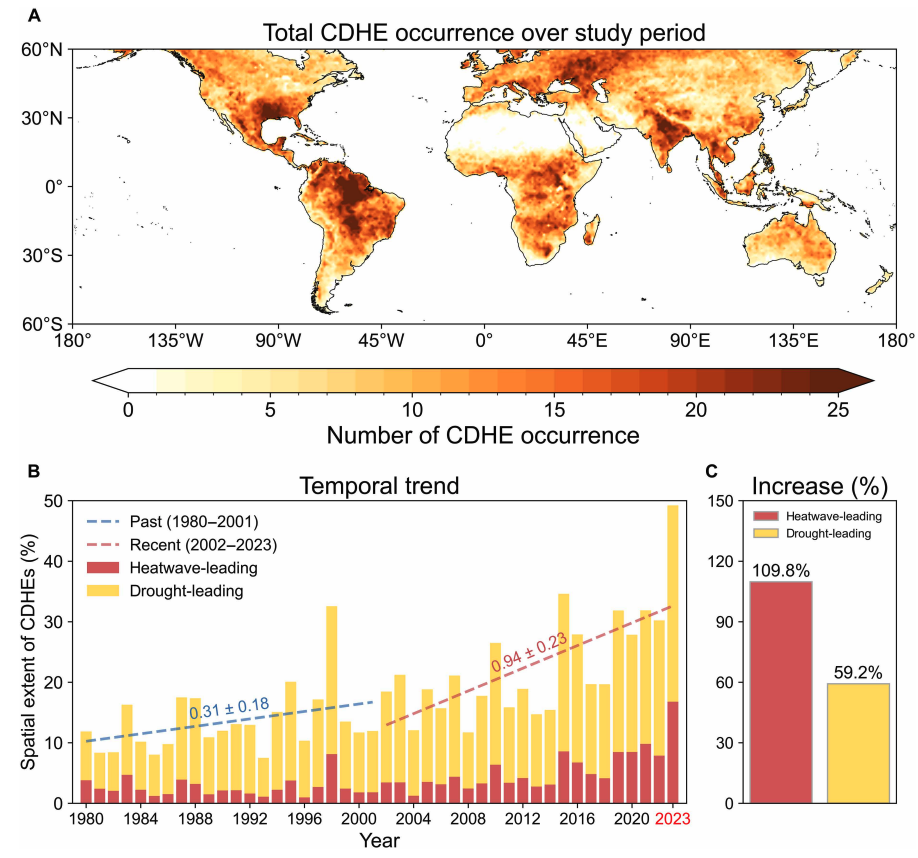
Heatwave-led events have been the main contributor to this increase, the study says, with their spatial extent rising 110% between 1980-2001 and 2002-23, compared to a 59% increase for drought-led events.
The map below shows the global distribution of CDHEs over 1980-2023. The charts show the percentage of the land surface affected by a heatwave-led CDHE (red) or a drought-led CDHE (yellow) in a given year (left) and relative increase in each CDHE type (right).
The study finds that CDHEs have occurred most frequently in northern South America, the southern US, eastern Europe, central Africa and south Asia.
Threshold passed
The authors explain that the increase in heatwave-led CDHEs is related to rising global temperatures, but that this does not tell the whole story.
In the earlier 22-year period of 1980-2001, the study finds that the spatial extent of heatwave-led CDHEs rises by 1.6% per 1C of global temperature rise. For the more-recent period of 2022-23, this increases “nearly eightfold” to 13.1%.
The change suggests that the rapid increase in the heatwave-led CDHEs occurred after the global average temperature “surpasse[d] a certain temperature threshold”, the paper says.
This threshold is an absolute global average temperature of 14.3C, the authors estimate (based on an 11-year average), which the world passed around the year 2000.
Investigating the recent surge in heatwave-leading CDHEs further, the researchers find a “regime shift” in land-atmosphere dynamics “toward a persistently intensified state after the late 1990s”.
In other words, the way that drier soils drive higher surface temperatures, and vice versa, is becoming stronger, resulting in more heatwave-led compound events.
Daily data
The research has some advantages over other previous studies, Yeh says. For instance, the new work uses daily estimations of CDHEs, compared to monthly data used in past research. This is “important for capturing the detailed occurrence” of these events, says Yeh.
He adds that another advantage of their study is that it distinguishes the sequence of droughts and heatwaves, which allows them to “better understand the differences” in the characteristics of CDHEs.
Dr Meryem Tanarhte is a climate scientist at the University Hassan II in Morocco, and Dr Ruth Cerezo Mota is a climatologist and a researcher at the National Autonomous University of Mexico. Both scientists, who were not involved in the study, agree that the daily estimations give a clearer picture of how CDHEs are changing.
Cerezo-Mota adds that another major contribution of the study is its global focus. She tells Carbon Brief that in some regions, such as Mexico and Africa, there is a lack of studies on CDHEs:
“Not because the events do not occur, but perhaps because [these regions] do not have all the data or the expertise to do so.”
However, she notes that the reanalysis data used by the study does have limitations with how it represents rainfall in some parts of the world.
Compound impacts
The study notes that if CDHEs continue to intensify – particularly events where heatwaves are the precursors – they could drive declining crop productivity, increased wildfire frequency and severe public health crises.
These impacts could be “much more rapid and severe as global warming continues”, Yeh tells Carbon Brief.
Tanarhte notes that these events can be forecasted up to 10 days ahead in many regions. Furthermore, she says, the strongest impacts can be prevented “through preparedness and adaptation”, including through “water management for agriculture, heatwave mitigation measures and wildfire mitigation”.
The study recommends reassessing current risk management strategies for these compound events. It also suggests incorporating the sequences of drought and heatwaves into compound event analysis frameworks “to enhance climate risk management”.
Cerezo-Mota says that it is clear that the world needs to be prepared for the increased occurrence of these events. She tells Carbon Brief:
“These [risk assessments and strategies] need to be carried out at the local level to understand the complexities of each region.”



The post Heatwaves driving recent ‘surge’ in compound drought and heat extremes appeared first on Carbon Brief.
Heatwaves driving recent ‘surge’ in compound drought and heat extremes
Greenhouse Gases
DeBriefed 6 March 2026: Iran energy crisis | China climate plan | Bristol’s ‘pioneering’ wind turbine
Welcome to Carbon Brief’s DeBriefed.
An essential guide to the week’s key developments relating to climate change.
This week
Energy crisis
ENERGY SPIKE: US-Israeli attacks on Iran and subsequent counterattacks across the Middle East have sent energy prices “soaring”, according to Reuters. The newswire reported that the region “accounts for just under a third of global oil production and almost a fifth of gas”. The Guardian noted that shipping traffic through the strait of Hormuz, which normally ferries 20% of the world’s oil, “all but ground to a halt”. The Financial Times reported that attacks by Iran on Middle East energy facilities – notably in Qatar – triggered the “biggest rise in gas prices since Russia’s full-scale invasion of Ukraine”.
‘RISK’ AND ‘BENEFITS’: Bloomberg reported on increases in diesel prices in Europe and the US, speculating that rising fuel costs could be “a risk for president Donald Trump”. US gas producers are “poised to benefit from the big disruption in global supply”, according to CNBC. Indian government sources told the Economic Times that Russia is prepared to “fulfil India’s energy demands”. China Daily quoted experts who said “China’s energy security remains fundamentally unshaken”, thanks to “emergency stockpiles and a wide array of import channels”.
‘ESSENTIAL’ RENEWABLES: Energy analysts said governments should cut their fossil-fuel reliance by investing in renewables, “rather than just seeking non-Gulf oil and gas suppliers”, reported Climate Home News. This message was echoed by UK business secretary Peter Kyle, who said “doubling down on renewables” was “essential” amid “regional instability”, according to the Daily Telegraph.
China’s climate plan
PEAK COAL?: China has set out its next “five-year plan” at the annual “two sessions” meeting of the National People’s Congress, including its climate strategy out to 2030, according to the Hong Kong-based