UK newspapers have already launched more editorials attacking Ed Miliband in the first four months of 2025 than they did during the whole of 2024, Carbon Brief analysis reveals.
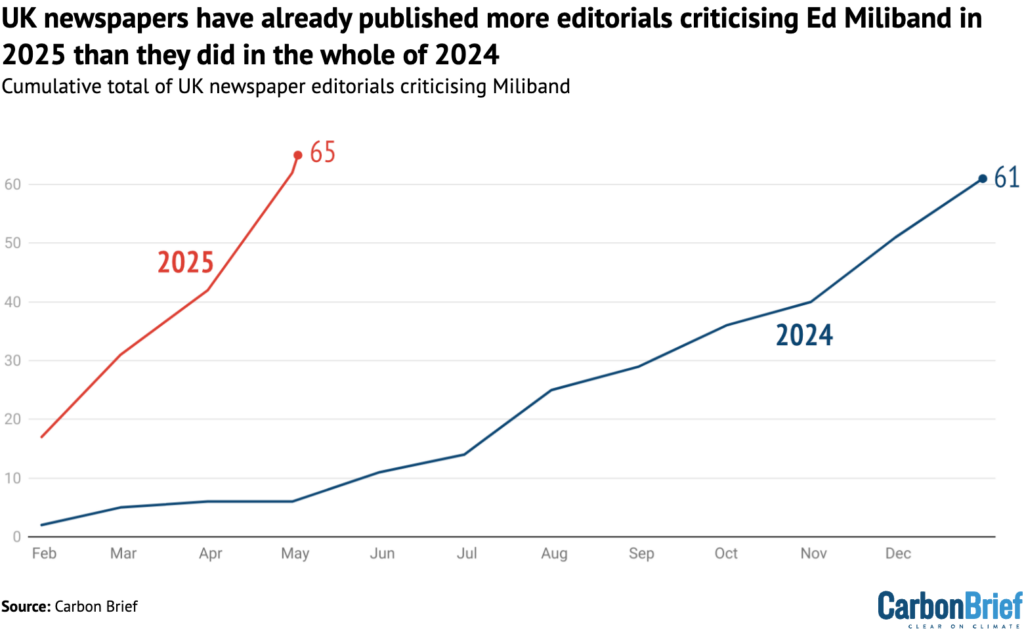
In the year to date, predominantly right-leaning publications have published 65 editorials – articles seen as the newspaper’s formal “voice” – criticising the UK energy secretary, compared with only 61 across the full year of 2024.
Nearly four such editorials have been published every week so far in 2025, roughly three times the rate of the previous year.
This is a significant escalation from a period that had already seen an unprecedented torrent of attacks levelled at the energy secretary.
The articles, which primarily appear in the Sun, the Daily Mail and the Daily Telegraph, frequently seek to label Miliband as a “net-zero zealot” with a “messianic” devotion to climate action.
The newspapers have focused specifically on Miliband’s support for renewables.
They have also tried to blame him for the potential closure of the UK’s remaining steel plant and – most recently – misrepresented the words of former prime minister Sir Tony Blair to falsely present them as a personal rebuke to Miliband.
Many of the articles urge prime minister Keir Starmer to “sack” Miliband due to his supposedly “radical” policy ideas, referring to him as a “liability” for the Labour government.
Despite this near-obsessive stream of criticism and constant speculation about the energy secretary’s job security, the prime minister has said unequivocally that the net-zero agenda is “in my government’s DNA” and that Miliband is “doing a great job”.
Record criticism
The UK’s Labour government won an election last summer, with a large majority, on the back of a manifesto that focused heavily on climate action.
As laid out at the time, one of the government’s “five missions” was to:
“Make Britain a clean-energy superpower to cut bills, create jobs and deliver security with cheaper, zero-carbon electricity by 2030.”
Miliband, the energy security and net-zero secretary, is the minister overseeing this brief and the public face of much of the government’s net-zero strategy.
This position has resulted in a relentless stream of criticism and personal attacks from right-leaning commentators and media organisations, against a backdrop of rising political and press opposition to net-zero.
Carbon Brief analysis in January revealed the scale of the personal attacks levelled at Miliband in newspaper editorials during 2024, both in the lead up to the general election and in the months that followed.
However, the new analysis shows that the 61 critical editorials published last year have already been eclipsed in 2025 after barely four months of intense focus on Miliband.
As of 2 May, predominantly right-leaning newspapers have already published 65 editorials taking aim at the energy secretary this year. The chart below, which shows the cumulative number of such editorials, highlights this rapid escalation.
Specific events, often only vaguely related to the energy secretary, have inflated the criticism of Miliband in the media.
One example was the imminent closure of the UK’s last remaining steel blast furnaces in Scunthorpe, in early April. Right-leaning newspapers blamed Miliband, among other things, for “banning new coal mines” in the UK, which they argued could have provided coking coal to the facility.
(The Scunthorpe site’s owners prior to government control, British Steel, had said that the coal from a planned mine in Cumbria would not have been suitable for their needs.)
More recently, right-leaning newspapers have used the furore around a report published by the Tony Blair Institute for Global Change (TBI) as a further opportunity to criticise Miliband.
Many publications misleadingly interpreted comments by Blair as a criticism of the Starmer government’s net-zero policies and, by association, Miliband himself. They described the energy secretary as an “eco-loon” compared to the “uncontroversial” advice from Blair.
Miliband the ‘fanatic’
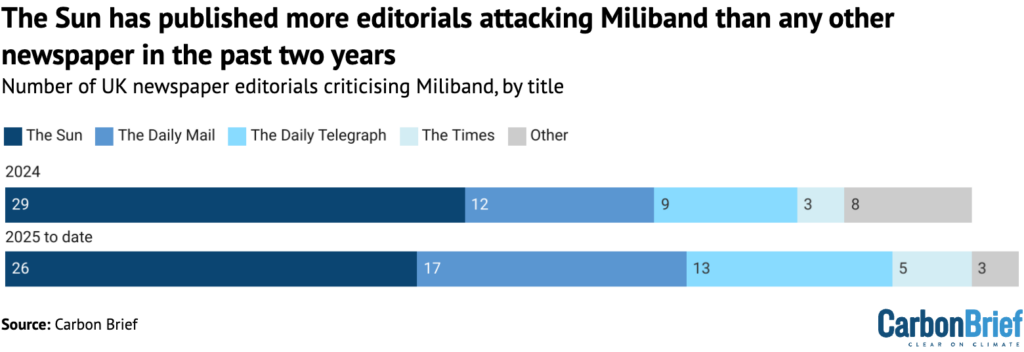
The majority of the criticism of Miliband in newspaper editorials in 2025 has come from the Daily Mail, the Sun and the Daily Telegraph.
The Sun remains the most consistent critic of Miliband, with 26 editorials published in 2025 so far. There have only been 18 weeks in 2025 to date. As the chart below shows, this spate of 26 editorials from the Sun is already approaching last year’s record of 29.
The attacks levelled at Miliband by right-leaning newspapers are often both highly personal and somewhat melodramatic.
They frequently imply that his focus on net-zero policies is a sign of mental instability or quasi-religious devotion, rather than being part of his job title – or acknowledging that reaching net-zero emissions is the only way scientists say climate change can be prevented from getting worse.
The Sun has referred to Miliband’s “uncontrolled fanaticism”. The Sun on Sunday has described the “madness of Ed Miliband’s green crusade” and called him the “fanatical prophet of net-zero”.
Another editorial from the Sun stated that “Miliband is so blinded by eco-ideology that he’s lost touch with reality”, referring to his “eco insanity”.
In an editorial lamenting the state of the UK’s oil-and-gas industry, which shed 10s of 1,000s of jobs under the previous Conservative government, the Daily Mail mentioned:
“Energy secretary Ed Miliband’s messianic desire to sacrifice a multi-billion pound industry on the altar of net-zero.”
The newspapers also suggest that Miliband is unwilling to listen to any criticism. “Miliband has shown himself unprepared to countenance any suggestion that his efforts to decarbonise the grid within five years might be reckless,” the Daily Telegraph claimed.
There have also been frequent calls from newspaper editorials for Starmer to sack the energy secretary. In an article titled “Miliband’s madness”, published at the end of April, the Daily Mail asked:
“Isn’t it time Sir Keir Starmer accepted his colleague’s ideological net-zero fervour is damaging the government – and sacked him?”
Beyond the editorial pages, there has also been a constant stream of comment pieces, many by climate sceptics, which often go even further in their attacks on the energy secretary. “Miliband belongs in a padded cell,” Daily Mail columnist Richard Littlejohn wrote at the start of May.
This has come amid much media speculation from commentators on both the left and right that Starmer is considering firing Miliband.
However, Starmer has not given any indication of doing this.
On the contrary, at the recent energy security conference the UK government hosted in London, Starmer stated that he was fully committed to his government’s net-zero ambitions. “That is in the DNA of my government,” he stated in a widely covered speech.




The post Analysis: Attacks on Ed Miliband in UK newspaper editorials have already exceeded 2024 levels appeared first on Carbon Brief.
Analysis: Attacks on Ed Miliband in UK newspaper editorials have already exceeded 2024 levels

Climate Change
“Sink or swim”: WA Gov hugely underestimating decline in regional gas demand while sleeping on green exports, new report finds
PERTH, Tuesday 13 October 2026 — A new report from Greenpeace Australia Pacific and Springmount Advisory reveals green commodity exports are an untapped economic opportunity for Western Australia in a declining Asian gas market, while offering a genuine solution for decarbonising Asia.
From Gas to Green: Building Western Australia’s Future State is a comprehensive analysis of the declining gas market in Asia, and the untapped economic opportunity for WA to become a global leader in green commodity exports while driving the regional shift away from fossil fuels.
The report offers key recommendations for the WA Government to support regional decarbonisation through an orderly phase out of gas exports in favour of green iron and other green exports. It comes as global climate leaders from across business, politics and advocacy prepare to meet for the Global Citizen Now: Perth event focused on decarbonising WA.
Key findings:
- Gas demand is falling across WA’s core markets in Asia: Gas demand fell in 2025 and is projected to continue to decline, driven by a combination of global geopolitical factors and domestic concerns.
- Policy shifts in key markets since the war on Iran now prioritise renewables and nuclear over gas: Japan, South Korea and China have legislated energy plans that prioritise renewables and nuclear over gas.
- New WA gas would arrive in a saturated, uncertain Asian market filled with cheaper gas: The US is now the world’s largest liquefied gas producer and plans to double its capacity as it also targets Asian markets.
- Green commodities offer a real solution to sustain WA’s economy: WA can lead Australia’s green commodity exports, which by 2060 could be worth almost a trillion dollars.
- Exporting more WA gas is likely to delay or impede Asia decarbonisation: Despite claims by the gas industry, there is no evidence that WA gas is displacing coal in Asia, and in fact diverts resources from genuine decarbonisation options.
Geoff Bice, WA Campaign Lead at Greenpeace Australia Pacific said: “As our export partners in Asia shift away from expensive and polluting gas, the WA Government has a golden opportunity to pivot our economy to green exports, like green iron, which is the most effective way to help our region to decarbonise.
“The writing is on the wall: gas is in decline, renewables are our future. In this context, it makes zero sense for the government to encourage high risk projects like Woodside’s reckless Browse gas proposal at Scott Reef.
“This report clearly shows that the WA Government faces a choice: sink or swim. They can either allow the gas industry to keep ripping off West Australians and continue propping up its decline, or choose the path that will deliver enormous benefits to the state and the world by becoming a leader in the rapidly expanding green economy.”
Tom Quinn, Managing Director of Springmount Advisory: “Western Australia prospers when it looks to the future and builds for future demand. Twenty years from now, what the world needs is green commodities made using WAs abundant renewable resources. Just like it did with iron ore in the 1950s and gas in the 1970s, WA should look to the future and build what the world will need, not sunsetting industries like gas that are already past their peak.”
-ENDS-
Media contact
Kate O’Callaghan on 0406 231 892 or kate.ocallaghan@greenpeace.org
Lucy Keller on 0491 135 308 or lucy.keller@greenpeace.org
A report from Greenpeace Australia Pacific and Springmount Advisory reveals the untapped green economic opportunity for Western Australia in a declining Asian gas market, which also offers a genuine solution for decarbonisation in Asia.
Is Western Australia clinging to a fading gas industry while a thriving green future passes it by? As major Asian trading partners rapidly pivot away from volatile gas imports toward cheap solar and battery storage, this report exposes a high-stakes choice: risk becoming stranded in an oversupplied fossil fuel market, or harness WA’s unmatched sun and wind to lead the global clean energy transition.
Summary
From Gas to Green: Building Western Australia’s Future State reveals that Western Australia (WA) faces a critical juncture as falling Asian gas demand, geopolitical gas supply volatility and accelerating renewable energy deployment undermine the long-term economic viability of gas exports. By harnessing its world-class wind and solar resources, the report demonstrates that WA can execute an orderly phase-out of gas and pioneer a green commodity export economy that could generate $987 billion in economic value by 2060, create 24,000 ongoing jobs, and drive a 9.6% reduction in global greenhouse gas emissions.
Key Findings
- Gas demand is falling in Asia – WA can no longer rely on gas exports: Gas demand in core Asian markets fell in 2025 and is projected to continue to decline in 2026. Legislated energy plans in Japan, South Korea, and China now prioritise renewables and nuclear over gas.
- Asia is increasing renewables, importing gas just gets in the way: Evidence from markets like Thailand suggests that gas imports are increasingly crowding out cheaper renewable energy investments and battery storage rather than displacing coal, locking in more emissions over time.
- Green commodities offer a real solution to decarbonise Asia – this is a major win for WA: With world-class renewables, WA can lead Australia’s green commodity exports, which by 2060 could be worth almost a trillion dollars ($987 billion) and support a genuine 9.6% reduction in global emissions.
Recommendations to WA government
Recommendation 1: Plan an orderly gas phase-out aligned with a trading partner pivot plan
Implement a managed, orderly phase-out of gas exports aligned with trading partners’ decarbonisation pathways, rather than waiting for demand to collapse, by:
- Developing and implementing a staged phase-out of gas facilities aligned with feedstock supply expiry or typical end of facility lifespans.
- Committing to no new gas development for gas expansion, including Browse and Kimberley fields.
- Developing new, reciprocal trade relationships with existing gas trade partners, structured to progressively replace gas exports with green commodities – integrated with recommendation 2.
Recommendation 2: Develop an integrated green commodity export strategy, positioning WA as a global green iron manufacturing hub
Establish an integrated green commodity export strategy that immediately prioritises green iron development, positioning WA as a global green iron manufacturing hub, by:
- Committing to green commodity export targets to give industry and investors a clear demand signal.
- Prioritising green iron as the lead sector within the broader green commodity strategy, given WA’s iron ore endowment and first-mover potential.
Recommendation 3: Reject false solutions such as carbon dumping (CCS) and blue hydrogen
Reject carbon dumping (also described as carbon capture and storage, or CCS) and blue hydrogen as viable decarbonisation technologies, and prioritise green hydrogen and proven renewables for clean energy and fuel production by:
- Excluding blue hydrogen projects (and CCS-dependent projects) from all government support programs.
- Requiring existing hydrogen-based production (including ammonia, methanol, synthetic fuels) to have clear, near-term transition timelines to switch to green hydrogen production.

What you can do
Together, we can push for a prosperous green future.
You can help by:
- Sending an email to Environment Minister Murray Watt and Prime Minister Anthony Albanese, calling on them to reject Browse.
- Sharing this story to help more Australians understand what’s at stake.
- Encouraging your friends and family to take action.
REPORT: “From Gas to Green” Building Western Australia’s Future State
Cleaner cooking projects in the UN carbon market will have to set aside a share of their credits to insure against the risk that the trees they save are lost to fire, drought or logging, after the market’s regulator rejected calls to exempt the sector.
The requirement is part of a new rulebook that the Paris Agreement carbon market regulator – the Article 6.4 Supervisory Body – approved last Friday for programmes that aim to cut emissions by distributing new and cleaner cookstoves in regions that still burn wood or charcoal for cooking.
These are the UN mechanism’s first rulebooks for cookstoves, one of the carbon market’s most popular credit types and also one of its most criticised for overstating climate benefits.
They consist of two methodologies: one for programmes that aim to cut greenhouse gas emissions by distributing more efficient cookstoves that burn less wood or charcoal, and a separate methodology for projects shifting households to lower-emissions cookers running on electricity or liquid petroleum gas (LPG).
Mkhuthazi Steleki, the South African chair of the Supervisory Body, said “this decision gives cleaner cooking projects a new pathway under the UN carbon market, with clear rules to ensure that each credit represents a real and credible emission reduction”.