


Amazon is making its boldest move yet into nuclear energy. The tech giant has teamed up with X-energy Reactor Company, Korea Hydro & Nuclear Power Corporation (KHNP), and Doosan Enerbility in a partnership aimed at deploying Xe-100 small modular reactors (SMRs) and TRISO-X fuel across the United States.
The alliance comes at a pivotal moment. Data centers, driven by artificial intelligence (AI), cloud computing, and the digital economy, are pushing energy demand to record highs. Traditional renewables like wind and solar, while critical, can’t always meet the 24/7 power needs of hyperscale computing. Nuclear, with its steady carbon-free output, is emerging as the missing piece.
Aligned with the recent $350 billion U.S.–Korea trade deal, the collaboration spans reactor engineering, supply chain development, construction planning, long-term operations, and global AI-nuclear deployment opportunities. Together, the partners aim to mobilize up to $50 billion in public and private investment to accelerate advanced nuclear adoption in America.
X-energy’s SMRs: Compact Power for a Digital World
X-energy CEO J. Clay Sell, commented on this partnership,
“This partnership brings together proven nuclear leadership and experience from Korean industry and X-energy’s advanced reactor and fuel technology to meet a historic energy challenge. By combining our expertise, we are ensuring that we are best positioned to accelerate the Xe-100 SMR into the marketplace with the unique knowledge and skills developed throughout the South Korea industrial supply chain. Collaboration between the United States and South Korea in this critical sector is vital to preserving American leadership in the AI race and surpassing China as the leader in nuclear development.”
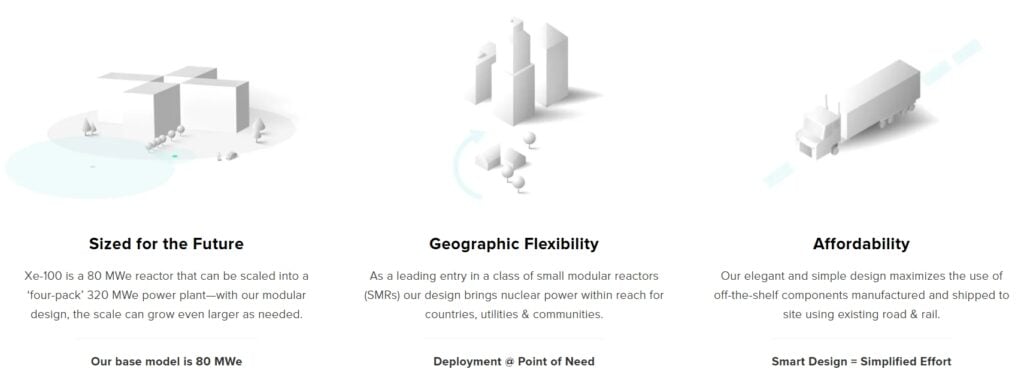
X-energy’s Xe-100, a fourth-generation SMR designed to be modular, cost-effective, and intrinsically safe, is the core of the deal. Unlike traditional reactors, which can take more than a decade to build, the Xe-100’s simplified design shortens construction timelines and reduces upfront capital costs.
Watch the video:
Key advantages of the Xe-100 include:
- Scalability – Modular design allows deployment in stages to match demand growth.
- Enhanced safety – Built with TRISO-X fuel, considered one of the most robust nuclear fuels ever developed.
- Industrial versatility – Can serve high-demand industries like chemicals, steel, and data centers.
By targeting 960 MW of clean energy capacity to the U.S. grid by 2039, X-energy and its partners are aiming for what would be the largest SMR deployment in the industry to date.
Small Modular Nuclear Reactor: Xe-100
Amazon’s Clean Energy Ambitions
For Amazon, nuclear energy is part of a larger strategy to meet its net-zero carbon target by 2040, set through The Climate Pledge, which the company co-founded in 2019. The e-commerce and cloud giant is investing heavily in decarbonizing its global operations through four main levers:
- Driving efficiency – Optimizing transportation routing, improving packaging, and boosting chip efficiency in data centers.
- Deploying low-carbon alternatives – Using lower-carbon concrete and steel, recycled plastics, and greener fuels.
- Investing in carbon-free electricity – Expanding its portfolio of wind, solar, battery storage, and now nuclear projects.
- Scaling sustainable supply chains – Embedding decarbonization across procurement and product development.
By early 2025, Amazon had committed to 621 renewable energy projects worldwide, including 124 new projects in 2024 alone, representing 34 GW of carbon-free capacity. Nuclear will now complement this mix, providing steady baseload power to balance variable renewable output.
Amazon’s Nuclear Playbook
Amazon’s nuclear investments are already taking shape:
- In 2024, the company signed multiple agreements to support new SMR development.
- It partnered with Energy Northwest on a next-gen SMR project.
- It struck a deal to build a data center near Talen Energy’s nuclear plant in Pennsylvania, linking cloud services directly to carbon-free nuclear power.
With the X-energy deal, Amazon is moving beyond one-off projects toward systematic integration of nuclear into its clean energy roadmap.
Furthermore, Vibhu Kaushik, Head of Worldwide Energy, Amazon Web Services (“AWS”), also said,
“Data centers are the critical infrastructure needed to support AI leadership, and their power needs continue to accelerate to meet the growing needs of our customers. “By forming this partnership with KHNP and Doosan along with X-energy, we’re continuing to pursue innovative carbon-free solutions and technology to help meet the increasing energy demand, and we’re excited that this will help us enable over five gigawatts of new nuclear energy in the U.S.”
Why AI Needs Nuclear?
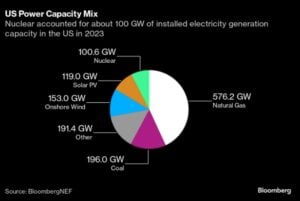
Artificial intelligence is reshaping the global economy—but it comes with an insatiable hunger for electricity. Analysts estimate that data centers could consume up to 10% of global electricity by 2030, with AI workloads contributing a growing share.
Unlike traditional corporate facilities, AI data centers operate around the clock and require constant, reliable power to prevent downtime. While solar and wind are critical for decarbonization, their intermittency means they can’t serve as the sole backbone of data infrastructure. Nuclear energy, by contrast, offers stable, carbon-free power at scale, making it ideal for the digital era.
By linking nuclear deployment directly to AI expansion, Amazon and its partners are signaling a new phase in clean energy investment—where tech and nuclear grow hand in hand.
A Global Supply Chain Push
Doosan Enerbility, a leader in heavy industry, and KHNP, South Korea’s nuclear operator, bring critical expertise in supply chain development and project delivery. Their involvement is central to ensuring the Xe-100 can be built quickly, cost-effectively, and at scale.
This collaboration also reflects shifting geopolitics in energy. By tying nuclear deployment to the U.S.–Korea trade agreement, the partnership reinforces energy security and strengthens transpacific clean energy ties. With supply chain bottlenecks affecting global renewables, nuclear offers an alternative path with deeper industrial integration.
Beyond Amazon: A Model for the Private Sector
Perhaps most importantly, this alliance signals a broader shift in nuclear’s role in the private sector. For decades, nuclear was almost entirely government-led, with utilities as the main operators. Now, tech companies are directly investing in nuclear solutions to meet their own decarbonization needs.
If Amazon’s model succeeds, it could set a precedent for other energy-intensive industries, from semiconductors to steel, to adopt SMRs as part of their decarbonization strategies.
Lastly, deploying SMRs at scale won’t be without challenges. Regulatory approvals, financing structures, and public acceptance all remain hurdles. But with Amazon, X-energy, KHNP, and Doosan pooling expertise and capital, the path looks clearer than ever.
By targeting 960 MW of carbon-free nuclear power by 2039, Amazon and its partners are charting a blueprint for how nuclear can fit into the clean energy transition, balancing the intermittency of renewables while enabling the AI-driven digital economy.
In short, this partnership represents more than a corporate energy deal. It’s a signal that advanced nuclear is stepping out of research labs and into the front lines of the energy transition—and that Big Tech may be the key to scaling it.
The post Amazon, X-energy, KHNP, and Doosan Partner on $50B Nuclear Push for AI Data Centers appeared first on Carbon Credits.

EU carbon credit claims changed on 27 September 2026, the day the Directive (EU) 2024/825 began to apply across the European Union. The change is narrow. It changes how a company can talk about the credits it buys. A product can no longer be called neutral on the strength of compensation alone; however, every specific, evidenced statement about what a company measured, reduced, and funded stays fully available.

The post Promoting Improved Cooking Practices in Nigeria appeared first on Terrapass.



-
Climate Change1 year ago
Guest post: Why China is still building new coal – and when it might stop
-

 Greenhouse Gases2 years ago
嘉宾来稿:满足中国增长的用电需求 光伏加储能“比新建煤电更实惠”
-
Greenhouse Gases1 year ago
Guest post: Why China is still building new coal – and when it might stop
-

 Climate Change2 years ago
嘉宾来稿:满足中国增长的用电需求 光伏加储能“比新建煤电更实惠”
-

 Renewable Energy12 months ago
Sending Progressive Philanthropist George Soros to Prison?
-
Climate Change2 years ago
Bill Discounting Climate Change in Florida’s Energy Policy Awaits DeSantis’ Approval
-
Greenhouse Gases1 year ago
嘉宾来稿:探究火山喷发如何影响气候预测
-

 Climate Change2 years ago
Analysis: China’s CO2 falls 1% in Q2 2024 in first quarterly drop since Covid-19