

Blue carbon markets are gaining momentum, with the latest development marking a significant milestone. According to Platts, the price of blue carbon credits under its DBC-1 benchmark reached a record high in late August 2025. This surge shows strong demand for high-quality carbon credits tied to coastal and marine ecosystems.
Limited supply also plays a role, as project pipelines are still constrained. The event highlights both the potential and the growing challenges in scaling blue carbon as a reliable tool for climate action.
Record High Prices for DBC-1 Credits
Platts assessed its Blue Carbon (DBC-1) current-year carbon price at $29.30/mtCO₂e on Aug. 28, up $1.30/mtCO₂e day over day. Prices hit a 15-month high in early July, then dropped to a five-month low on Aug. 1 before rebounding 14.9% into late August.
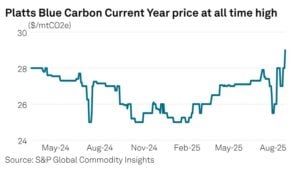
This rebound, fueled by high demand and low supply, has pushed the benchmark close to record levels since its launch in March 2024. The price strength shows how fast demand for blue carbon projects is growing. It is now outpacing the supply of credits.
Blue carbon credits come from activities like restoring mangroves, protecting seagrass, and conserving salt marshes. They differ from traditional forest-based carbon offsets. These ecosystems capture and store carbon quickly.
They also provide key benefits. These include preserving biodiversity, boosting coastal resilience, and helping local communities.
What’s Driving Demand: Climate Targets, Policy, and Trust
Several factors explain why demand for blue carbon is spiking:
- Corporate climate targets: Companies are increasingly seeking high-integrity offsets to complement decarbonization plans. Blue carbon, with its dual climate and ecological benefits, is seen as a premium option.
- Policy support: Governments in Southeast Asia, Africa, and Latin America have started or grown programs to boost investment in coastal ecosystems. This has added momentum to project development.
- Market differentiation: In a scrutinized voluntary carbon market, blue carbon projects shine. They offer verifiable, high-quality credits, making them appealing to buyers worried about greenwashing.
Traders and developers say buyers are now paying more for DBC-1 credits than for other nature-based offsets.
Why Blue Carbon Projects Struggle to Scale
Despite demand growth, the supply of blue carbon credits remains limited. Coastal projects can be tricky. Land tenure issues, regulatory uncertainty, and long verification timelines add to the complexity.
Moreover, countries with big mangrove or seagrass areas often struggle to scale projects. This is due to limited capacity and gaps in funding.
Current blue carbon projects represent only a fraction of the voluntary carbon market. Industry estimates show that fewer than 10 million metric tons of blue carbon credits are issued each year. This is much lower than the hundreds of millions needed to make a real impact on climate change. This structural imbalance between demand and supply is one of the main drivers of the record-high pricing.
Nature’s Superpower: How Coastal Ecosystems Lock Away Carbon
Blue carbon ecosystems, including mangroves, seagrasses, and tidal marshes, are among the most effective natural carbon sinks. The UN Environment Programme says these habitats can capture carbon four times faster than forests. They also store it in sediments for centuries.
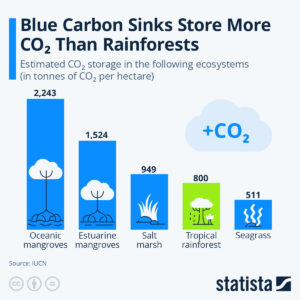
Blue carbon ecosystems worldwide capture about 0.5 to 1.0 gigatonnes of CO₂ each year. However, coastal degradation leaves much of this potential unused. Restoration and conservation projects are growing, especially in Southeast Asia, Africa, and Latin America. Large areas of mangrove forests are at risk.
Forecasts show that if restoration projects grow as planned, blue carbon initiatives could offset up to 3% of global emissions by 2030. This makes them vital in both voluntary and compliance carbon markets.
- SEE MORE: The Importance of Blue Carbon Credits
Broader Trends: Blue Carbon in the Market Landscape
Blue carbon’s rise comes at a time when the broader VCM is evolving. Demand for higher-quality credits has shifted investment from cheaper offsets to premium options, like blue carbon. This fits into a larger effort to ensure carbon markets help real decarbonization. They shouldn’t let companies skip cutting emissions.
Financial institutions are also entering the space, with specialized funds being established to back blue carbon projects. These funds provide upfront money for restoration or conservation projects.
In return, they receive future credit revenues. This trend reflects the growth of the carbon market. Investors see offsets as both environmental assets and financial instruments with good return potential.
In addition, new methodologies and standards are being developed to improve the credibility of blue carbon credits. Verra and Gold Standard are updating accounting rules. This helps capture the complete climate value of coastal ecosystems.
Also, Article 6 of the Paris Agreement could create opportunities for trading blue carbon credits. This would boost demand in compliance markets.
The chart below shows the potential carbon abatement for each type of blue carbon solution by 2050.
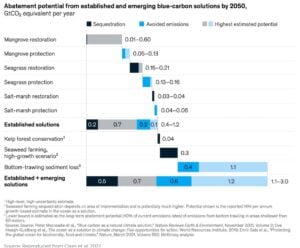
The co-benefits of blue carbon projects also make them uniquely appealing. Mangrove and seagrass restoration offers unique benefits. They can boost fisheries, lower coastal erosion, and shield vulnerable communities from storm surges.
Blue carbon links climate mitigation, adaptation, and biodiversity protection. This makes it appealing for buyers who want to achieve climate and sustainability goals.
Signals for Investors, Companies, and Policymakers
The record-high DBC-1 price signals several important implications for stakeholders:
- For investors:
Blue carbon allows entities to join a fast-growing premium market. However, supply bottlenecks might hold back short-term growth. Early movers could benefit from long-term appreciation in credit values. - For companies:
Buyers should be prepared for higher costs as competition for limited credits intensifies. Securing long-term offtake agreements with project developers may become necessary. - For policymakers:
There is a need to create supportive environments for coastal ecosystem projects. This includes clear rules, land-use plans, and financial incentives.
Blue Carbon’s Defining Moment
Platts’ DBC-1 benchmark shows that blue carbon is shifting from a niche area to a key part of the voluntary carbon market. With prices hitting record highs, the market is sending a strong signal: demand for high-quality, high-impact carbon credits is here to stay.
Without significant supply growth, the imbalance will continue. This will keep prices high and limit access for some buyers.
For now, blue carbon remains a premium and scarce commodity. The sector is set for more growth, thanks to rising interest from governments, investors, and companies. With strong policies and new financing, blue carbon could be key to global climate strategies. It can also provide numerous ecological and social benefits.
The post Blue Carbon Credits Hit Record High as Demand Outpaces Supply appeared first on Carbon Credits.

EU carbon credit claims changed on 27 September 2026, the day the Directive (EU) 2024/825 began to apply across the European Union. The change is narrow. It changes how a company can talk about the credits it buys. A product can no longer be called neutral on the strength of compensation alone; however, every specific, evidenced statement about what a company measured, reduced, and funded stays fully available.

The post Promoting Improved Cooking Practices in Nigeria appeared first on Terrapass.



-
Climate Change1 year ago
Guest post: Why China is still building new coal – and when it might stop
-

 Greenhouse Gases2 years ago
嘉宾来稿:满足中国增长的用电需求 光伏加储能“比新建煤电更实惠”
-
Greenhouse Gases1 year ago
Guest post: Why China is still building new coal – and when it might stop
-

 Climate Change2 years ago
嘉宾来稿:满足中国增长的用电需求 光伏加储能“比新建煤电更实惠”
-

 Renewable Energy12 months ago
Sending Progressive Philanthropist George Soros to Prison?
-
Climate Change2 years ago
Bill Discounting Climate Change in Florida’s Energy Policy Awaits DeSantis’ Approval
-
Greenhouse Gases1 year ago
嘉宾来稿:探究火山喷发如何影响气候预测
-

 Climate Change2 years ago
Analysis: China’s CO2 falls 1% in Q2 2024 in first quarterly drop since Covid-19