A reality without AI is beyond comprehension! AI is a powerful tool that transforms resource-intensive industries, products, and services by offering data-based suggestions and making smart decisions. As clean tech continues to evolve, the integration of artificial intelligence (AI) will be crucial to driving further advancements.
AI and Microchips: Driving the Clean Tech Revolution
AI and microchips are transforming renewable energy. AI makes processes faster and more efficient, boosting clean energy innovation. Microchips, crucial for AI and data centers, are key to this progress.
In clean energy, these chips enable smarter trading, improve forecasts for wind and solar power, and enhance safety and efficiency.
Machine learning has been used in clean tech for years to monitor wind farms and detect faults. However, applying AI in energy trading was slower. Now, advances in generative AI are changing that. They optimize power markets and improve renewable energy management.
Furthermore, top companies are heavily investing in clean technology, using AI to transform the sector. For instance, Google, Microsoft, and Meta are applying AI in clean energy projects to enhance efficiency and sustainability.
Battery makers like CATL and Tesla are also on board. They use AI to boost battery performance, improve energy storage, and streamline operations. Meanwhile, NVIDIA, the leading chipmaker, is focused on creating advanced AI chips for clean tech.
Together, these companies are revolutionizing technology. They are making renewable energy systems smarter, more efficient, and ready for a sustainable future.

AI-Driven Grid Solutions for Clean Energy
Grid Enhancing Technologies (GETs) play a vital role in optimizing power transmission. These systems help improve the integration of clean energy while reducing the need for costly infrastructure expansions. GETs use a mix of hardware, like sensors and data analytics software to make grids more efficient and adaptable.
So why are they important?
- GETs reduce grid congestion by preventing bottlenecks in energy flow.
- They help manage peak loads by handling sudden spikes in energy demand.
- GETs improve planning by enhancing the accuracy of day-ahead energy forecasts.
- They reroute power effectively during outages or maintenance to ensure energy delivery.
How AI Boosts GETs
AI, especially ML is transforming how GETs operate. AI analyzes data in a fraction of time and improves the performance of grid-enhancing technologies.
Real-Time Data
ML uses real-time weather data to adjust transmission line thermal ratings. This improves grid efficiency and capacity to handle more renewable energy without adding new infrastructure. AI also processes different kinds of grid data, like impedance and voltage angles, at high speed. This optimizes power flow, reduces congestion, and boosts efficiency.
Customer Energy Consumption
AI plays a crucial role in understanding customer energy consumption. It accurately predicts energy needs and leverages advanced tools like generative adversarial networks (GANs) to generate synthetic data. These capabilities enhance forecasting accuracy, energy management, and grid reliability.
Supervisory Control and Data Acquisition (SCADA)
Systems like Supervisory Control and Data Acquisition (SCADA) also benefit. AI makes SCADA more accurate and responsive, providing real-time grid performance data that helps operators make better decisions.
As renewable energy grows, smarter grid solutions are essential. In short, GETs, powered by AI, tackle challenges like congestion, peak loads, and clean energy integration.
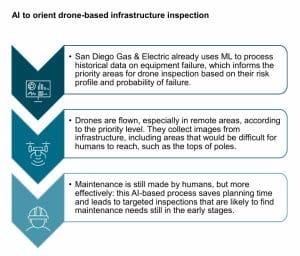
Supporting Smarter Grid Investments
The rise of renewable energy requires stronger grid infrastructure. AI helps identify weak points in the grid and suggests where investments are most needed. This prevents curtailments and ensures a smoother transition to clean energy systems.
By supporting grid flexibility, AI makes infrastructure investments smarter and more effective. It predicts challenges and optimizes resource allocation, ensuring the grid is ready for the growing share of renewables.
Efficient Wind and Solar Energy Management with AI
Wind energy depends on weather- which is an unpredictable force of nature. So the energy output is also inconsistent. AI solves this problem with weather analyzing tools and historical data for accurate energy forecasts. These forecasts help operators plan better and reduce energy waste.
AI also enhances wind farm operations through predictive maintenance. Sensors collect real-time data to identify potential issues early.
- For example, AI detects yaw system misalignments that reduce turbine output or gearbox problems from unusual vibrations.
- It eliminates the need for manual pitch inspections by spotting blade alignment issues automatically.
With AI-driven insights, wind farms run efficiently which further minimizes downtime and maximizes energy production. Here’s a snapshot of it.

Solar energy relies on consistent performance, but challenges like shading, dust, and equipment issues can reduce output. Traditional systems often miss early warning signs, as inverters have limited processing capabilities.
AI-based monitoring offers a better solution. By analyzing vast amounts of data quickly, it detects small performance issues that inverters might overlook. This enables real-time adjustments and faster maintenance.
Subsequently, distributed solar systems connecting to low- or medium-voltage grids also benefit from AI. It optimizes energy flow and establishes a uniform distribution of solar power across decentralized networks. By tackling these challenges, AI helps solar systems deliver reliable, clean energy while reducing operational delays.
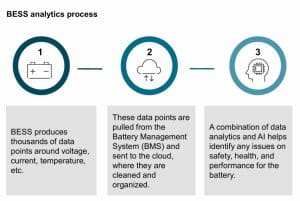
AI’s Role in Battery Management Systems
Measuring the state of charge (SOC) in lithium-iron-phosphate (LFP) battery cells is challenging. These problems and inaccuracies are mostly associated with traditional battery management systems (BMS), that majorly impact battery performance.
But AI provides a better solution to this problem. It uses data analytics and machine learning to spot safety, health, and performance issues. This leads to more accurate SOC predictions. As a result, less downtime is needed for BMS recalibration, thereby maximizing efficiency and revenue.
The process, however, is complex. For instance, AI-based SOC estimation employs the Single Extended Kalman Filter algorithm. This algorithm estimates SOC by calculating the battery’s open-circuit voltage. Machine learning then fine-tunes the Kalman filter for improved accuracy.
Data Complexities in Clean Tech AI
AI offers powerful solutions for clean technology but comes with challenges. Training AI algorithms requires vast amounts of data, which demands advanced data management systems. Therefore, clean tech industries must collect, store, and analyze massive data sets while protecting sensitive information through robust privacy measures.
Similarly, ethical concerns also need much attention. AI systems must prioritize fairness, transparency, and accountability. Clear guidelines are crucial to avoid biases, respect privacy, and ensure clean tech benefits reach all communities equally.
Thus, from this report, we can comprehend how AI is transforming clean energy with smarter tools that improve forecasting, maintenance, and efficiency. As innovations continue to emerge, we can expect AI to crawl more rapidly in clean tech which is driving the future of renewable energy.
The post AI and Clean Tech: A Revolution in Renewable Realms appeared first on Carbon Credits.
Carbon Footprint
McKibben opts for a small-tent climate movement
A few months ago I went to a climate change forum at the Center for Brooklyn History. The panel I attended, “Confronting Climate Change: Understanding Deniers,” featured the prominent climate activist, Bill McKibben.
Bill McKibben. Courtesy https://billmckibben.com/.
I was curious to hear McKibben’s take on climate change deniers. I don’t regard the true deniers as a big problem – they’re only 11-15% of our country, according to most polls. Rather, I wondered if McKibben would label as “climate deniers” people who agree that climate change is a significant problem but disagree with his framing and his proposed solutions. I have worked for decades on energy and climate matters as an energy lawyer. Now, more than ever, I believe that to address climate change we need to build a big tent.
In the Q&A I tested where McKibben is on this by asking if he would label as a climate denier someone who subscribes to the main tenets of climate change science yet holds that natural gas has a role to play as a bridge fuel. (Our exchange starts at 1:12:45 of the video.)
This could have been a chance for McKibben to make clear that such a view isn’t climate denialism, even if he feels it’s misguided. But he punted, saying “I don’t care whether they’re deniers or not.” For good measure, he threw in his long-standing refrain that swapping coal for natural gas makes climate change worse, despite coal’s far higher carbon content per unit of energy.
674-MW methane-powered generating station, Salem, MA.
As you can hear in the recording, McKibben’s claim that gas is worse than coal draws on the work of Cornell scientist Robert Howarth. Yet McKibben didn’t mention that Howarth’s work is controversial and disputed by many scientists. The crux of the dispute is whether methane’s impact on warming should be measured with a 20-year or 100-year time frame.
Methane is a relatively short-lived greenhouse gas, with a lifetime of around 10 years, versus the 100-year life applicable to carbon dioxide. But each ton of methane is far more potent while in the atmosphere, trapping roughly 100 times as much heat as a ton of CO2. These cross-cutting facts about atmospheric methane — shorter life but greater potency than CO2 — have resulted in two opposing camps: one insisting on a 20-year timeframe for greenhouse gas accounting, the other adhering to the established 100-year frame. This matters because with a 20-year timeframe, generating electricity with natural gas (which, chemically speaking, is essentially all methane) is more damaging to climate than coal-fired electricity.
McKibben blew past this dispute. To hear him at the Center for Brooklyn History, one would have no inkling that there’s an active disagreement over which timeframe to use, that there are staunch climate activists who favor the 100-year time frame, and that the Intergovernmental Panel on Climate Change (IPCC) generally uses the 100-year timeframe.
McKibben’s latest (2025) book. Published by W.W. Norton & Company.
McKibben also insisted that a discussion about natural gas’s potential role in mitigating climate change as a replacement for coal is irrelevant because solar “is now our cheapest resource.” McKibben’s claim, of course, suffuses “Here Comes the Sun,” his 2025 book that extols solar power as the cheapest solution for all of our energy needs. But this too is questionable, because it’s based on cost comparisons between solar farms and natural gas power plants (or nuclear power plants) that fail to consider that electricity supply and delivery is a complex system of wires and plants rather than individual power plants. Based on his remarks, McKibben is choosing to ignore studies such as the comprehensive 2025 report from the Clean Air Task Force that concluded that plant-level cost comparison “is a good metric to track historical technology cost evolution [but] is not an appropriate tool to use in the context of long-term planning and policymaking for deep decarbonization.” And the task force is not alone in finding that when electricity is treated as a system, solar loses its place as the cheapest low-carbon resource.
The dogmatism McKibben displayed at the Brooklyn meeting was unfortunate. We’re in a time when efforts to combat climate change are in retreat. A unified front is required to turn the tide. Instead of doubling down on absolutist positions, activists like McKibben who seem convinced that the solution to climate change is all-renewables, end of discussion, should be seeking common ground with others who want climate action but believe that nuclear power and natural gas must also play a role.
NYC Climate March, Sept 17, 2023. Photo: C. Komanoff.
Climate change activists need to build a bigger tent, rather than call anyone who disagrees with their positions a climate change denier. It is striking that McKibben stuck to his guns after saying in the same talk that the most important goal for everyone right now is to help climate change realists win more House and Senate seats in this year’s midterms. As some have noted, an absolutist position on natural gas appears less likely to achieve that win and politicians are following that advice.
Will McKibben evolve? He has demonstrated that he knows how to build a national climate movement centered around issues like divestment. Given the current political situation, he should focus on building an even bigger tent by welcoming all of the 85% who believe that we need to address climate change but do not agree with his ideological positions.
Rich Miller is an energy lawyer who has worked for a variety of stakeholders and now gives walking tours in lower Manhattan on the history of electricity.
Carbon Footprint
Rebranding ‘Balcony Solar’ as ‘Guerrilla Solar’ won’t lift its climate value.
Image generated with Claude. Why have we juxtaposed a bicycle with balcony solar? Read on.
First it was Plug-In Solar. Then it was Balcony Solar. Now it’s Guerrilla Solar, at least according to Inside Climate News, which yesterday proclaimed that The ‘Guerrilla Solar’ Era Has Arrived.
“It,” of course, is Modular solar panels. They’re the hot new photovoltaic solution: cheap enough to buy at Home Depot, easy to hang or prop to catch maximum rays, and small enough to fit on a balcony (if you’ve got one) and plug into your “home grid.” But, alas, too meager a generator of electricity to be more than a bit player in decarbonizing most U.S. homes.
How do I know? I’ve done the math.
A standard, lower-end 220-watt balcony solar array will produce 337 kilowatt-hours a year, or 28 kWh a month averaged over the course of a year. That’s for a 220W unit measuring 3.5 feet by 3.5 feet. (220W x 1/1000 x 17.5% x 8760 hours per year = 337 kWh. Calculation assumes a 17.5% full-year capacity factor, which is arguably generous for New York, where I live. )
Our balcony solar mashup. Top: an install in Germany. Bottom: Home Depot advert.
A typical U.S. home consumes 10,500 kWh a year, or 28 to 29 kWh per day, says Solartech, drawing on U.S. Energy Information Administration data. That puts a home’s daily power needs on par with a balcony solar unit’s monthly output. In effect, once each month the balcony array gifts a homeowner or renter a bit more than day’s full complement of electricity. And earth’s atmosphere gets the same respite: a 3 percent reduction in carbon emissions caused by the home’s electricity usage.
(The 3 percent figure could also be calculated directly by dividing 337 kWh per year of solar production by 10,500 kWh per year to run the home. For bigger or smaller arrays, just prorate your assumed wattage by my 220W; for 440W, say, double my figures.)
Balcony Solar metrics
Why write about balcony solar if it’s so inconsequential? CTC’s mission includes puncturing would-be climate balloons before they ascend too far. In the same vein, we practice quantification to make clear what does and doesn’t move the climate needle. (More on that further below.)
The best way to depict balcony solar’s climate value is to express it in terms of tangible metrics. We’ve selected two. Both assume the basic, lower-end PV array I assumed at the top: a 3.5 foot-square array whose peak output is 220 watts.
1. It would take 50 million 220W balcony solar units (bsu’s) to restore the climate benefit we destroyed in 2020-2021 when we shut the high-performing Indian Point nuclear power plant 32 miles from Midtown Manhattan.
2. A single person cutting back their driving by a mile a day would provide the same climate benefit over the course of a year as a single 220W bsu.
(Calculations in sidebar. Now you know why we led with images of an urban dweller as cyclist and balcony solar user.)
Yes, it’s dense — as befits a sidebar. The numbers tell a story. Follow the color co-ordination.
Ponder that: It would take fifty million smallish bsu’s to level up to the fossil fuel carbon emissions that Indian Point was keeping at bay by supplying the New York City area year in and year out with abundant carbon-free power. Deploying that many balcony solar units would entail 10 bsu’s for each of the 5 million households in the MTA’s service territory. (The Metropolitan Transportation Authority provides subway, bus and commuter rail transit in the five boroughs and seven suburban counties.) Or, if those same households upgraded to 1100-watt bsu’s, collectively they would still make up only half of the lost Indian Point power.
The second comparison, involving driving, is perhaps trickier to grasp but more interesting, since it relates to people’s behavior. Living differently isn’t part of public discourse, at least not in the USA, and especially when what’s being served up is using less. But “reducing,” as we might call it (remember “Reduce, Reuse, Recycle”? or, “Insulate, then Insolate”?) is just as potent for cutting emissions as switching to renewables — even more so when the reducing means driving less, considering the multitude of benefits that accrue from diminishing cars’ imprints on our communities. Still, staying on topic: driving just one fewer mile per day brings about the same shrinkage in carbon emissions as deploying one 220W solar array.
What Balcony Solar boosters are really saying
To be fair, our friends at Inside Climate News and, yes, The New York Times appear to be trying to modulate their balcony solar enthusiasm.
ICN‘s Dan Gearino, whom we cited up front, said he looked to Germany, the birthplace of balcony solar, to see if the units made sense for U.S. households. His takeaway: “It may make more sense financially to spend the cost of plug-in solar on insulation, air sealing or other basic measures to reduce energy use.” Hooray: insulate before you insolate.
Gearino helpfully interviewed renewables guru (and U.S. emigré) Craig Morris, who currently heads Germany’s plug-in solar trade association, Bundesverband Steckersolar. To Morris, balcony solar’s main advantages are that it provides power without taking up land, and that it affords people a way to “become participants in the transition to clean energy.” Behold, guerrilla solar. That, in turn, bolsters “the political consensus that supports the transition.” But Morris also made clear that widespread adoption of plug-in solar would only meet “about 2 percent of Germany’s electricity demand.”
Morris’s “about 2 percent” feels right for Germany. But not for the U.S., where widespread adoption of virtually any individual carbon alternative seems forever out of reach, and where the energy pie is so much larger — think giant fridges, freezers for beer, steroidal homes bursting with piles of powered toys, not to mention industrial and institutional electricity use that Morris correctly excluded from his figure.
Don’t forget to micro-dose. NYT headline + image for David Wallace-Wells’ guest essay (see text). Image by Rui Pu.
Both Gearino and Morris seem more measured than climate journalist Robinson Meyer, founding editor of Heatmap and frequent contributor to The Times, where he wrote about balcony solar in mid-June.
“New zero-carbon power kits will allow Americans to make their own energy choices,” declares the callout to the print version of Meyer’s NYT guest essay, The Tiny Solar Panel That Could Change America. (The even more expansive print headline invites us to “Forget Roofs. Backyard Solar Is the Next Frontier.”)
Wallace-Wells is of two minds. He calls balcony solar “a small way that apartment- and condo-dwelling Americans can take ownership of their energy choices and cut down their pollution on the margins.” No quarrel there, thanks to his qualifiers “small” and “on the margins.” Earlier, though, he opines that balcony solar units “have the potential to change how Americans understand and consume energy,” But read further and you’ll again see Wallace-Wells cautioning that “Balcony solar will play one small role in [the] drama” of transiting to the new world of clean, abundant energy.
Any such caveats are welcome these days, amid widespread solar hoopla. Still, it doesn’t seem to be in Wallace-Wells’ toolkit — or that of Inside Climate News and other mainstream climate journalists — to tutor their audiences as to the true limits of balcony solar and other panaceas. Just like it wasn’t in their field of vision a decade ago to lay out the true stakes of shutting Indian Point as Riverkeeper was singing its siren song.
What’s Next for NY Balcony Solar
Meantime, as Canary Media reported recently (and helpfully), New Yorkers concerned with climate and affordability are waiting for NY Gov. Kathy Hochul to sign the recently passed SUNNY (Solar Up Now New York) Act legalizing balcony and other plug-in solar. It would be head-spinning (and politically suicidal) if she didn’t, given near-universal support ranging from Con Edison to DSA Assembly Member Emily Gallagher, who told Canary Media, “This is the most popular bill I’ve [ever] worked on.”
My guess is that Hochul is waiting for the right moment, and perhaps the right “package,” that can advance and not undercut her push to launch five large new nuclear power plants around the state — one to be built by the public New York Power Authority, the others to be constructed and operated privately. A little bit of math, a la what we offered here a la Indian Point, might help her out.
The governor also must manage the veritable hot potato of her deferred implementation of the landmark 2019 Community Leadership and Climate Protection Act. She might do well to consider jettisoning the act’s unwieldy cap-and-invest centerpiece in favor of a straight-up carbon tax (with the revenues distributed pro rata to the state’s households) in its place. That, far more than balcony (or guerrilla) solar, could blow open the door to the “innovations and technologies we cannot yet imagine” that Wallace-Wells fantasized about in his Times essay.
Carbon Footprint
The new SBTi Corporate Net-Zero Standard: what it means for business
On 11 June 2026, the Science Based Targets initiative (SBTi) published the most substantial revision of its flagship corporate framework since its introduction. The SBTi Corporate Net-Zero Standard Version 2.0 takes effect on 1 February 2027 and reshapes the way companies approach their net-zero targets.
![]()
-
Greenhouse Gases11 months ago
Guest post: Why China is still building new coal – and when it might stop
-
Climate Change11 months ago
Guest post: Why China is still building new coal – and when it might stop
-
Greenhouse Gases2 years ago嘉宾来稿:满足中国增长的用电需求 光伏加储能“比新建煤电更实惠”
-

Climate Change2 years ago嘉宾来稿:满足中国增长的用电需求 光伏加储能“比新建煤电更实惠”
-
Renewable Energy8 months agoSending Progressive Philanthropist George Soros to Prison?
-
Climate Change2 years ago
Bill Discounting Climate Change in Florida’s Energy Policy Awaits DeSantis’ Approval
-
Carbon Footprint2 years agoUS SEC’s Climate Disclosure Rules Spur Renewed Interest in Carbon Credits
-
Greenhouse Gases12 months ago
嘉宾来稿:探究火山喷发如何影响气候预测

