Connect with us

Published

on

The following article was written by Inside Climate News reporter Lisa Sorg and was originally published by Inside Climate News on November 10th. It is the third installment in Gaslighting, a series from Inside Climate News about opposition to a wave of new natural gas pipelines, power plants and storage facilities on the drawing board in North Carolina.

Shelley Robbins, the senior decarbonization manager for the Southern Alliance for Clean Energy, stands next to the Dan River in Rockingham County. Credit: Lisa Sorg/Inside Climate News

Shelley Robbins, the senior decarbonization manager for the Southern Alliance for Clean Energy, stands next to the Dan River in Rockingham County. Credit: Lisa Sorg/Inside Climate News

A man sat in a white unmarked truck, which had backed into a small parking lot near a natural gas pipeline at the Dan River. A similar truck, a similar man, had been there a month before.

Shelley Robbins, the senior decarbonization manager for the Southern Alliance for Clean Energy, looked past him and ambled down a gravel driveway toward Draper Landing, a public boat launch to the river and a popular tourist destination.

It was October, and the leaves had turned from a deep summer green to shades of russet and saffron. A blue jay squawked to defend its territory. Into the long grass someone had pounded wooden survey stakes, topped with an orange flag and the word “wetlands” printed in black marker. The air reeked of a dead animal. A vortex of vultures circled overhead.

This was the same river that had been inundated with toxic coal ash in February 2014 when, about four miles east of Draper Landing, a coal ash pit at Duke Energy’s Dan River Steam Plant breached. The U.S. Environmental Protection Agency estimated at least 39,000 tons of toxic coal ash and 27 million gallons of ash pond water were released into the river. Even after the cleanup, some of that material settled to the bottom, where it remains.

Wetlands have been marked near the Transco, T15 and planned MVP Southgate pipelines in Rockingham County. Credit: Lisa Sorg/Inside Climate News

Wetlands have been marked near the Transco, T15 and planned MVP Southgate pipelines in Rockingham County. Credit: Lisa Sorg/Inside Climate News

The Transco pipeline runs beneath the Dan River in Rockingham County. Credit: Lisa Sorg/Inside Climate News

The Transco pipeline runs beneath the Dan River in Rockingham County. Credit: Lisa Sorg/Inside Climate News

Now fossil fuels again figured in the river’s future. Robbins had studied the pipeline maps and their arcane legends—metering stations, rights of ways, interconnections. And here it was: Near the river, a cornfield and a copse of trees was the nexus of an immense natural gas buildout planned for North Carolina.

All of the projects—pipelines, compressor stations and liquified natural gas plants—would emit tons of methane, a potent greenhouse gas and driver of climate change, as well as other pollutants into the atmosphere. These projects raise local concerns over permitting loopholes, safety and public health.

A segment of Transco’s 10,000-mile pipeline already runs under the Dan River at Draper Landing; the company plans to add more pipeline in four counties in North Carolina.

The planned Southgate extension of the Mountain Valley Pipeline would also be built here, and would feed gas to a third pipeline on the property: the T15 Reliability Project.

The T15 is a complicated undertaking. The existing T15 is a 63-year-old pipeline that runs 37 miles through Rockingham and Caswell counties; it includes a small compressor station near Ruffin.

But because of its age, the T15 needs to be upgraded. A new pipeline would be laid near the existing one, with an additional eight new miles of line coursing through Person County, where Duke Energy plans to build two natural gas plants that would use the fuel to generate electricity.

To accommodate the larger pipeline and higher transmission pressure, a new, larger compressor station would be built, Ruffin II, near the Rockingham-Caswell county line.

Until recently, Public Service Co. of North Carolina, a small subsidiary of Dominion, owned the T15. Now it’s owned by a Canadian energy giant. In October, with approval from the N.C. Utilities Commission, Enbridge announced it had purchased the T15 project as part of a $4 billion deal for all of Public Service Co. of North Carolina’s natural gas business.

The natural gas for these projects would come from fracking operations in Appalachia or gas plants along the Gulf Coast. The gas would then be transmitted to any number of destinations: homes and businesses, Duke’s proposed new plants in Person and Catawba counties, data centers in North Carolina and beyond. Utilities like Duke could even resell the gas to other companies, which in turn could export it.

Even seasoned utilities experts like Robbins are perplexed by the complexity and speed of the buildout. It’s like assembling a jigsaw puzzle without a picture, with a timer about to ring.

Each part of the expansion is fragmented and operates under different rules, depending on whether it crosses state lines. Unlike the proposed Transco and MVP Southgate projects, the T15 runs solely within North Carolina. As a result, it falls outside of several federal environmental and safety oversight requirements.

“It’s disheartening,” Robbins said. “I feel like we’re at an inflection point here where there is so much that we are about to lock in.”

Robbins is 56, with shoulder-length dark blonde hair and bangs, and an affinity for large hoop earrings. She wore slate blue fingernail polish and a letter bead bracelet that spelled out “Harris Walz” and “Smash the Patriarchy”—a gift from her adult daughter, a medical student. Her son is a filmmaker who documents the demise of glaciers.

Robbins lives in Durham but grew up in Thomasville, North Carolina, a small city south of Winston-Salem that lies just east of the Transco pipeline. In college, she didn’t envision forging a career in energy. Her father was a banker; Robbins was an economics major at Duke University. Then she discovered some aspects of macroeconomics—complex systems that interact and influence one another—also applied to ecology and the natural world.

Slowly, the pieces of her calling began to come together, and she’s spent much of the last 20 years fighting fossil fuels.

Sixteen years ago, Robbins was living in South Carolina. A colleague recommended she read the book With Speed and Violence by Fred Pearce. It details the tipping points caused by climate change—melting permafrost, stalling ocean currents—that will propel the planet past the point of no return.

The book permanently changed Robbins’ thinking. Even so, she thought such global upheavals were far in the future. Now, she said, “the 2008 me could not fathom what 2024 me is seeing.”

At Draper Landing, Robbins was getting her bearings as she set out to travel the pipeline’s route. The day trip allowed Robbins to get outdoors, to give her a break from stuffy hotel conference rooms, where she often gives presentations on energy issues.

She strode back toward the car. From afar, she stopped to look at the large Transco metering station, a system of valves and pipes that regulates pipeline pressure. Most people driving by had no idea what they were seeing, she thought.

Transco operates a natural gas metering station near the Dan River in Rockingham County. The company's pipeline runs 10,000 miles from the Gulf of Mexico to New York, and cuts through North Carolina, including beneath the Dan River. Credit: Lisa Sorg/Inside Climate News

Transco operates a natural gas metering station near the Dan River in Rockingham County. The company’s pipeline runs 10,000 miles from the Gulf of Mexico to New York, and cuts through North Carolina, including beneath the Dan River. Credit: Lisa Sorg/Inside Climate News

Robbins took in the picturesque field and forest by the river, but to her eye, the massive pipeline infrastructure, the poles and warning signs were hard to ignore.

She checked that she was standing on the public right-of-way.

She took a picture.

Then she headed off down Fieldcrest Road, past the man in the white truck.

July’s Hearing on the Enbridge Sale

Three months earlier, in July, about 20 people gathered in a windowless, beige hearing room at the N.C. Utilities Commission in Raleigh. Half of them came to testify about Dominion’s plan to sell its natural gas subsidiary, Public Service Co. of North Carolina, to Enbridge.

For the deal to go through, the seven-member Utilities Commission—five appointed by the governor and two by the legislature—had to approve it. And if they did, Enbridge would be North America’s largest natural gas utility by volume transmitted. The company, which has an uneven safety record, would add the Moriah Energy Center, a 50-million-gallon liquified natural gas plant in southeastern Person County, the Ruffin compressor station and the T15 to its massive portfolio.

This event was a do-over: Dominion had failed to provide enough advance public notice for a June hearing. No one showed up.

The Utilities Commission ordered a second hearing, but even now, there were snags in the proceedings. The notice, which arrived to Dominion customers by postal mail, contained a word salad of technical terms. One man thought he’d been summoned to court. The downstairs doors to the building were locked, and at least one person had to wait 10 minutes before a security guard passed by to let her in.

Several people testified they were concerned about Enbridge’s safety record.

“We’re concerned about Enbridge’s motives,” testified Juhi Modi, North Carolina field coordinator for the nonprofit Appalachian Voices. “How can we allow a company with this safety record to do business in North Carolina? We can’t afford more methane pipelines that will lock us into natural gas for decades.”


Appalachian Voices was working to defeat or delay the T15 pipeline and has advocated for neighbors, including Andrea Childers, who were trying to stop the Moriah Energy Center. Childers lives in Person County, where Dominion is building the huge liquified natural gas plant a half mile from her home. She routinely appeared before government officials about the natural gas buildout. Tonight, she testified again: “I’m pleading with you to do the right thing.”

On its website, the company noted it had only six reportable spills totaling 4,620 gallons of crude oil and liquid fuels last year.

But the company has accumulated 100 environmental violations since the year 2000, according to Good Jobs First, totalling $283 million in federal penalties. The bulk of those fines stem from a 2010 oil spill that saturated 40 miles of the Kalamazoo River watershed in Michigan. Enbridge employees did not detect a 6-foot break in Line 6B, which gushed oil for 17 hours before the company reported it.

Company spokesperson Persida Montanez told Inside Climate News that after the Michigan incident, the company invested $14.5 billion “on maintenance, inspection and leak detection across our cross-continent pipeline network—keeping our pipes healthy and fit for service. … It transformed the way we think about safety, and how we operate at Enbridge.”

The Rev. Keith Sexton, a minister with the United Methodist Church, asked the commissioners to deny the transaction on the basis of climate change. “Natural gas is not clean energy,” Sexton said. “That’s a marketing lie.”

Two months later, the Utilities Commission quietly approved the transaction. Enbridge now owns all of Dominion’s natural gas infrastructure in North Carolina.

The Ruffin Compressor Station

As Shelley Robbins traveled east along the pipeline route, she noted the presence of several solar farms along the way. One was equipped with panels that automatically tilted to follow the sun. She envisions a future where solar energy and battery storage replace the polluting smokestacks, pipelines and compressor stations. A future when utilities can manage energy demand, paying customers more money to reduce their usage at peak times.

“When you fight something, you need to have an alternative,” Robbins said. “You can’t just say, ‘No, don’t do that.’ You need to be able to say, ‘What are we going to do instead?’”

About 15 miles east of Draper Landing, she passed the abandoned Ruffin school, a hulking brick building with boarded-up windows and holes in the roof. She marveled at a corner lot where a large brown cow and a black-and-white goat were grazing. Then she arrived at the Ruffin compressor station. Compressor stations increase the pressure of gas to send it down a pipeline; they usually have to be built every 75 miles or so to keep the gas moving.

The Ruffin station is a white square building about the size of a small church about 150 feet off the road and surrounded by a metal security fence. Valves and pipes jut from the ground. It connects to the existing T15, but because the new pipeline would be larger—42 inches in diameter, about the size of a large patio table—the existing Ruffin facility would be torn down and a new compressor station must be built about two miles away.

The Ruffin compressor station near the Rockingham-Caswell county line pushes natural gas through the T15 pipeline. When the T15 is expanded, the company will build a new and larger Ruffin compressor station that is projected to emit significantly more air pollution. Credit: Lisa Sorg/Inside Climate News

The Ruffin compressor station near the Rockingham-Caswell county line pushes natural gas through the T15 pipeline. When the T15 is expanded, the company will build a new and larger Ruffin compressor station that is projected to emit significantly more air pollution. Credit: Lisa Sorg/Inside Climate News

Ruffin II will be larger, with greater horsepower, its four turbines fueled by natural gas. It will emit significantly more pollution than the original compressor station, according to its state air permit, approved last month: 81 times more carbon monoxide, 636 times the levels of volatile organic compounds, 265 times greater emissions of particulate matter, and 131 times more nitrogen oxide, an indirect greenhouse gas that produces ozone.

High levels of ozone can damage the respiratory system and cause or worsen asthma as well as other lung disorders, according to federal health officials. It would also emit smaller amounts of benzene and formaldehyde, classified by the EPA as known carcinogens.

Add another 307,670 tons of greenhouse gases, and, if not for additional emissions controls, Ruffin II would be classified as a major pollution source, subject to stricter federal and state regulations.

Robbins thought the Ruffin station looked small and quiet, seemingly harmless, tucked in a pocket out of the way. But she knew what was coming and that it would be disruptive, ugly and dangerous.

She stood on Ruffin Road and took a picture.

Robbins had been tracking T15 developments from her home office back in Durham. There, bookshelves are arranged with photos of her children, a rock collection and a vintage camera. On the wall hangs a watercolor of Robbins and her daughter, painted by Robbins’ mother.

A standing desk is outfitted with two computer screens, where she analyzes spreadsheets and arcane utilities commission and environmental documents, then writes blog posts for her organization.

As part of her research she found state and federal documents that showed two existing T15 segments in Rockingham County, just north of the Ruffin compressor station, had become exposed at the surface.

Before the sale to Enbridge, Dominion had been publicly underscoring the safety of its proposed pipeline project. Meanwhile, an engineering firm hired by the energy company wrote to state and federal regulators that by June one of the exposed segments “has become much more severe.”


The work required water quality permits, state and federal documents show. Had those pipeline segments been outside a waterway, it’s possible the public would have never known there was a problem, which an Enbridge spokesperson now says has been repaired.

Robbins had seen issues with Dominion pipelines before. In the early 2000s, when she worked in South Carolina, a segment had also popped out of a creekbed. The pipeline had been like that since it was installed in the 1960s, Robbins said.

Robbins wondered how long the T15 had been exposed. Like so many questions about natural gas companies, she doubted she’d ever get an answer.

At the End, the T15’s Eight-Mile Dogleg

The final leg of Robbins’ winding excursion along the proposed route of the T15 took her through Caswell County, where the pipeline would run through rolling hills and pine-studded hunting and fishing lands owned by the N.C. Wildlife Resources Commission. On Murray Road, a dead end, the T15 would graze the Dan River Work Farm, a minimum-security state prison.

If there were an emergency, the only way out is through the woods and across the North Fork of Rattlesnake Creek.

The prison has an emergency evacuation plan, but it is not public.

Eventually, the T15 arrives in Person County, where for eight miles, an all-new segment of pipeline would dogleg north to send natural gas to Duke Energy’s proposed new plants at Hyco Lake.

Duke Energy operates two coal-fired power plants at Hyco Lake in northern Person County. The utility plans to retire the plants and replace them with two that burn natural gas, a source of a potent greenhouse gas, methane. Credit: Lisa Sorg/Inside Climate News

Duke Energy operates two coal-fired power plants at Hyco Lake in northern Person County. The utility plans to retire the plants and replace them with two that burn natural gas, a source of a potent greenhouse gas, methane. Credit: Lisa Sorg/Inside Climate News

Here, Robbins saw the gentle ridges and glens of Semora Road that sway like a hammock. About five miles from the lake, the tree line breaks and two smokestacks pierce the horizon. They look like white pencils with black erasers topped by a blinking white light to warn low-flying planes.

These are Duke Energy’s coal-fired Roxboro plants, perched on the shore. With the state Utilities Commission’s blessing, Duke plans to replace them with two new natural gas-powered plants on adjoining land it owns. The T15 will deliver the gas to Duke, sourced from MVP Southgate or possibly Transco. And here, Duke can burn it or resell it to other utilities and energy companies.

The T15 would run directly in front of Woodland Elementary School, a one-story brick building built in 1950. The Duke power plants are about a quarter mile away.

Robbins was shocked. She had seen the plants and Woodland Elementary on Google Earth maps, but to stand at the edge of the school’s driveway, to see the smokestacks looming right there, she felt stunned, then furious.

She envisioned the kids who spend eight hours a day, nine months a year, for six years of their lives here. The proposed gas plants will be even closer to the school, she thought, spewing emissions at them.

She thought of the regulators, ensconced in offices and meeting rooms far away.

Our system of environmental protection has failed these children. Regulators will defer to the emissions rules and pretend these children aren’t here.

She wanted to ask every regulator and decision-maker at every step of the process: Would you send your child here?

Those are the airborne hazards. Below ground, the diameter of the pipeline and its maximum allowable operating pressure determine what the industry calls the “potential impact radius.”

Within these areas, there are different classifications of risk: Prisons, like the Dan River Work Farm, and schools, like Woodland Elementary, are especially vulnerable because they’re difficult to quickly evacuate.

The T15 pipeline would run in front of Woodland Elementary School in northern Person County. The school is a quarter mile from Duke Energy's coal-fired power plants, which will be replaced with two that burn natural gas. The 222 students will still be exposed to more than 1,000 tons of air pollution each year. Credit: Lisa Sorg/Inside Climate News

The T15 pipeline would run in front of Woodland Elementary School in northern Person County. The school is a quarter mile from Duke Energy’s coal-fired power plants, which will be replaced with two that burn natural gas. The 222 students will still be exposed to more than 1,000 tons of air pollution each year. Credit: Lisa Sorg/Inside Climate News

Montanez, the Enbridge spokesperson, said the maximum allowable operating pressure is still being determined as the T15 is designed, but will be at transmission strength. That is generally from 200 to 1,500 pounds per square inch, also known as psi. By comparison, a typical car tire is inflated at 28 to 36 psi.

Montanez said the information about the operating pressure isn’t public for security reasons.

However, State Utilities Commission records from 2024 show that segments of a pipeline, then owned by Dominion, had an operating pressure of 628 psi at the time of the inspection. The pipeline served the Durham region.

At that pressure, with a 42-inch diameter pipeline like the one planned for the T15, people could be injured or even killed within 700 feet of the line in case of an explosion, not accounting for wind, topography or walls, according to the Pipeline Safety Trust.

In a worst-case situation, the staff and 222 students in kindergarten through fifth grade would have one primary route to safety: Semora Road, which is two lanes and parallels the pipeline. A secondary route scurries through a maze of cul-de-sacs near Hyco Lake before reaching another main road.

The Person County School District did not respond to questions about evacuation plans for Woodland Elementary.

“The myriad terrible things those pollutants do to the human body, especially over time. That is why this Roxboro plant sitting next to the elementary school is, in my mind, unconscionable.” — Shelley Robbins, Southern Alliance for Clean Energy

Until the federal Clean Air Act became law in 1970, the students of Woodland Elementary breathed air heavily polluted by emissions from the Roxboro plants. Even now, with stricter regulations, state records show students and staff are still exposed to more than 3,000 tons of nitrogen oxide, more than 2,500 tons of sulfur dioxide, and 570-plus tons of carbon monoxide each year.

Switching from one fossil fuel to another doesn’t solve all of the air pollution problems. The new gas-fired Roxboro plants would still emit methane, a potent greenhouse gas. Although emission levels of some pollutants would be sharply reduced, according to Duke Energy’s own modeling, they won’t be eliminated. More than 1,100 tons of nitrogen oxide, 51 tons of very fine particulate matter and 258 tons of sulfur dioxide would still come from the plant each year.

And levels of carbon monoxide and volatile organic compounds would increase, state records show, by 15 percent and 50 percent, respectively.

“The myriad terrible things those pollutants do to the human body, especially over time,” Robbins said. “That is why this Roxboro plant sitting next to the elementary school is, in my mind, unconscionable.”

Epilogue

Five miles east of Woodland Elementary lies the 1,350-acre Person County mega park, an area designated to attract industry. For nearly a decade, county officials have been courting hundreds of companies to locate there, but found no takers—until this year.

Fewer than a half dozen people in Person County knew the identity of the buyer. All of them were silenced by non-disclosure agreements with the company, public meeting minutes show. There were no job numbers, no tax revenue estimates. Just a map showing the location of the mega park in relation to Duke Energy’s planned new natural gas plants, a high-voltage transmission line and a “proposed natural gas line”—the T15.

Many residents felt uneasy about the secrecy. “We don’t know what it is,” said Andrea Childers, who lives in Person County. “Nothing good is going to come of this.”

In late October, the county and Microsoft announced the company had purchased the mega park, although neither would disclose what will be built there.

Microsoft had already reported it would invest more than $1 billion in four data centers in Catawba County, near Duke Energy’s other two proposed natural gas plants.

Since there would be so much energy available to the mega park, Robbins suspected Microsoft could construct a new data center there. These are large server farms where computers hum 24 hours a day, consuming voracious quantities of planet-warming energy.

She had hoped Microsoft would choose to power its operations with solar power and battery storage. But given the supply of natural gas, that seemed unlikely.

Then, in early November, Robbins received troubling news: The N.C. Utilities Commission approved Duke Energy’s much-anticipated carbon plan, which directs the utility to bring more than 3,600 megawatts of new natural gas online within the next seven years. That includes enormous amounts coming in on the T15, Transco and MVP Southgate lines.

The plan also delays the date Duke is required to reduce its carbon dioxide emissions by five years: 2035 instead of the original 2030.

The Utilities Commission made its ruling just six weeks after Tropical Storm Helene destroyed towns and livelihoods in western North Carolina. The storm, revved up by climate change, killed 101 people.
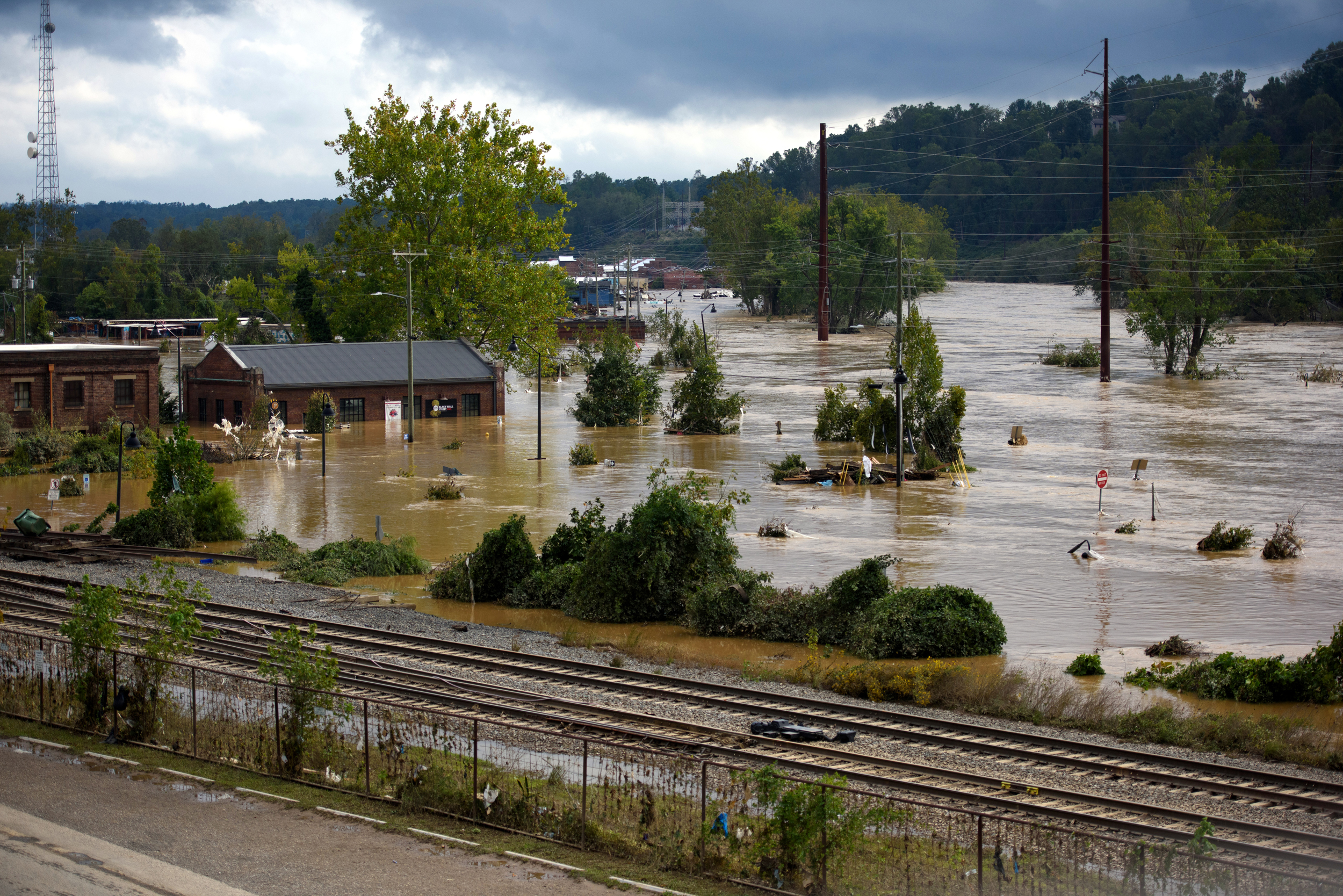
Heavy rains from Hurricane Helene caused record flooding and damage on Sept. 28 in Asheville, N.C. Credit: Melissa Sue Gerrits/Getty Images

Heavy rains from Hurricane Helene caused record flooding and damage on Sept. 28 in Asheville, N.C. Credit: Melissa Sue Gerrits/Getty Images

Robbins had read the decision. Although it ran 183 pages, it mentioned climate change just eight times, seven of them quoting public commenters. She thought the ruling showed a lack of concern for the effect climate change was having on the state, in real time.

Several days later, after the polls had closed on a warm Election Day, environmental advocates like Robbins struggled to comprehend the fallout from Donald Trump’s sweeping victory in the nation’s nasty, deeply partisan presidential race.

Trump has promised to expedite the approval of natural gas pipelines, roll back air emissions rules and withdraw from the Paris Agreement, all of it now endangering the progress the U.S. has made in combating climate change. In an earnings call two days after the election, Duke Energy’s chief financial officer said the utility could revert to burning more coal as a result of the Trump administration’s proposed energy policies.

Robbins felt crestfallen. The Biden administration had allocated billions of dollars in clean energy investments. Now the Trump administration could counter those advances by incentivizing fossil fuels.

Robbins needed to get away. She headed to the coast for a few days where she could stare at the sea. She took her computer with her. There was more work to do.

The post A Pipeline Runs Through It appeared first on SACE | Southern Alliance for Clean Energy.

A Pipeline Runs Through It

Continue Reading

Renewable Energy

How the VEU Program Works: Step by Step for Homeowners 

Published

on

Are you a homeowner in Victoria?

Working on how to make your home more energy-efficient while saving on bills, reducing your carbon footprint, and even getting discounts via government-supported programs?

If so, this blog is for you!

We’re going to take you on a walkthrough on how the Victorian Energy Upgrades (VEU) Program works, explain the key players involved, and break down essential terms like VEECs (Victorian Energy Efficiency Certificates) and accredited providers.

You’ll also find a step-by-step guide for homeowners from the application process, getting quotes and installation, to certification and savings.

At Cyanergy Australia, we specialise in residential installations under the VEU scheme, so we’ll draw on our experience and share practical insights to help you make the most of this program.

Let’s get into the details!

What is the VEU Program?

The VEU (Victorian Energy Upgrades) program is a flagship energy-efficiency initiative run in the state of Victoria.
Supported by the state government, this scheme enables households to replace outdated, inefficient appliances
and systems with energy-efficient alternatives.

This is often offered at little or no cost. From LED lighting and efficient hot water systems to smart thermostats
and insulation, each upgrade slashes your energy use and reduces your carbon footprint.

And the best part? The process is simple, transparent, and designed to make energy efficiency effortless.

In just a few easy steps, you can enjoy lower bills, a more comfortable home, and the satisfaction of contributing to
a cleaner, greener Victoria.

Some Key Outlines of the VEU Program

  • The scheme was developed under the Victorian Energy Efficiency Target Act 2007, which sets a commitment for
    large energy retailers to reduce greenhouse gas emissions through energy efficiency programs.
  • However, the VEU
    airconditioning Rebate Program
    , which was previously set to end much sooner, has now been
    officially extended until 2045

  • This ensures long-term support for Victorian homeowners seeking to enhance energy efficiency during heating
    and
    cooling.

  • The program is regulated by the Essential Services Commission (ESC) in Victoria. To become eligible, the
    program requires installations only from accredited providers with approved products or services listed
    in the Public Product Registry.

  • The legal mechanics essentially require energy retailers to meet annual targets for greenhouse gas
    reduction.

  • They do this by acquiring certificates called VEECs, which
    we’ll discuss in the next section.

Why the VEU Rebate Matters for Victorian Homeowners?

Upgrading to more efficient appliances or insulation often has high upfront costs and several other complexities. This can be burdensome for low-income households, so the government introduced the VEU program in order to remove financial barriers.

For example, by enabling discounts and rebates through a market-based certificate system, the program helps make it more financially appealing for homeowners.

What Does it Mean for Homeowners?

In Australia, many people often ask: Is the VEU Rebate Worth It? Well, here’s why the answer is ‘Yes’ for homeowners:

In practical terms, if you live in Victoria and upgrade your home via an accredited provider, you can get access to discounted or even no-cost energy-efficient products and services. Also,

  • The VEU Rebate directly reduces the cost of energy-efficient upgrades,
  • This makes improvements such as better insulation, solar hot water systems, and efficient heating and cooling widely accessible.
  • It not only lowers upfront expenses but also helps households save on ongoing energy bills.
  • The rebate helps to increase the comfort and value of their home and contributes to long-term environmental benefits.
  • It’s a practical way to invest in your home while easing financial pressure.

From our experience at Cyanergy Australia, many homeowners are pleasantly surprised by how accessible the program is when you choose a provider who understands it.

The Role of VEECs in Victoria’s Energy Future

So, what is a VEEC?

VEEC stands for Victorian Energy Efficiency Certificate. Each certificate represents one tonne of greenhouse gas emissions prevented or reduced through an eligible upgrade, such as installing LED lighting, upgrading heating and cooling systems, or improving insulation.

How do VEECs work?

  • A homeowner does an eligible upgrade via an accredited provider.
  • That upgrade yields a certain number of VEECs, based on the greenhouse‐gas savings of that item.
  • The accredited provider then sells those VEECs to large energy retailers who are required to surrender them to meet their legal obligations.
  • The income from selling VEECs enables the provider to offer you the discounted price for the upgrade. That’s how you get the benefit.

Now you might be wondering what an Accredited Providers (AP) mean.

An accredited provider is a business that’s authorised under the VEU scheme to conduct eligible upgrade activities, create VEECs, liaise with homeowners, and ensure agreement with the program’s rules.

Behind Every Upgrade: VEECs and Accredited Providers in Action!

Understanding VEECs and accredited providers helps you recognise how the discount or rebate works. Keep in mind you’re not getting a random free upgrade; you’re getting access to a government-backed scheme run through certified channels.

So, you should be clear about all these questions before upgrading

  1. Is this provider accredited under VEU?
  2. Which VEEC activity does this upgrade qualify for?
  3. Which model or product is being installed, and is it on the approved list?

Step-by-Step: Claiming Your Energy Upgrade Benefits with VEU

The process of how the VEU Program works is straightforward and simple. It includes a few stepwise processes, from application to installation, certification, and monitoring.

Let’s explore each step together in the following section:

Step 1: Background Research & Eligibility Check

  • Initially, you have to contact an accredited provider in your area. However, before contacting, conduct some background research on their previous experiences and running projects.
  • The provider checks whether your home is eligible under the VEU program, taking into account your location, type of dwelling, desired upgrade, and the eligible products.
  • They will offer you a quote outlining: the product to be installed, the discount amount under VEU, and the amount you have to contribute.

Step 2: Quote Approval & Scheduling

  • After reviewing the quote, ensure you understand the product brand or model, the installation cost, and what items are included (such as labour and the decommissioning of the old unit).
  • Also, check the warranty and any additional or extra-cost items.
  • Once you sign off, the installation is scheduled to proceed. Accredited providers will provide you with a specific timeframe and keep you updated.

Step 3: Installation of the System

  • The system provider arranges qualified, licensed installers to carry out the work. The installed products must meet eligibility criteria and installation standards under the VEU scheme.
  • On installation day, it’s best if you are present so the installer can access the areas, remove old units if relevant, test the new product, take photos if needed, and ensure everything is working correctly.
  • After installation, ensure you receive the necessary documentation, including the invoice, product model details, and, if applicable, a decommissioning certificate for the old equipment, as well as proof of installation.

Step 4: Certification and VEEC Creation

  • Once the upgrade is complete, the accredited provider submits the activity under the VEU program, creating the corresponding number of VEECs based on the product, activity type, and the greenhouse gas savings achieved.
  • These VEECs are then sold to energy retailers who deliver them to the ESC (via the VEU Registry).
  • After this is all finalised, you begin to enjoy lower energy bills and improved energy performance.

Step 5: Monitor your System Regularly

  • It’s now just a matter of using your upgraded system, enjoying the improved efficiency, and monitoring your energy bills. Many upgrades (especially lighting, insulation, and efficient hot water) will deliver noticeable savings.
  • If anything goes wrong, such as product failure or installation fault, please contact your provider under warranty.
  • It’s wise to keep all documentation in a safe place, as you will need it during any official audits or future upgrades.

Here’s What You Can Upgrade Under VEU!

  1. Hot Water Systems
  2. Upgrade to an energy-efficient heat
    pump

    or solar hot water system for reliable hot water and lower energy use.

  3. Heating & Cooling Units
  4. Switch to high-efficiency reverse-cycle
    air
    conditioners or split systems
    to stay comfortable while cutting your power bills.

  5. LED Lighting
  6. Replace old halogen or incandescent bulbs with
    energy-saving
    LEDs
    and reduce lighting costs by up to 80%!

  7. In-Home Displays (IHDs)
  8. Track your energy usage in real-time and take control of your electricity bills with smart in-home displays.

  9. Weather Sealing
  10. Improve insulation to keep your home cool in summer and warm in winter, saving energy year-round.

  11. Refrigerators & Freezers
  12. Replace old, power-hungry appliances with modern, energy-efficient models to lower your electricity costs.

What are the Common Pitfalls of VEU & How to Avoid Them?

Did you know that even a minor mistake could result in your VEU
rebate being disqualified
?

Yes, it happens more often than you’d think in VIC! But don’t worry! We’ve got your back.

Here’s a quick and easy checklist that helps you avoid any common mistakes and make sure your rebate works
smoothly

  • Don’t fall for fake, flashy rebate offers. If a provider arrives unannounced, offers a “free upgrade”
    without a proper quote, or adds huge extra costs after you’ve agreed, this is a red flag.
  • Some businesses may claim to be part of VEU but aren’t properly accredited. Always check and avoid
    non-accredited providers.
  • Even when the subsidy is real, if you want a product that’s reliable and suitable for your home, then don’t
    install low-quality products.
  • Lack of transparency about upgrade scope: Understand exactly what you are paying, what’s included, and if
    old equipment removal is included.
  • Find whether additional wiring or structural work is required in any place.
  • Never think the upgrade is “totally free” cause there may still be a homeowner or tenant’s
    contribution
    .
  • Many upgrades are heavily subsidised, but some of them require your contribution, for example, when you
    choose a
    higher-end product than the subsidy covers.

Why Cyanergy Is the Smart Choice for Your VEU Upgrades?

At Cyanergy Australia, when we work with homeowners under the VEU program, we take care of all the paperwork and ensure you use eligible, high-quality products every step of the way.

Not only that, we clearly explain any additional costs upfront, so there are no surprises later. Once everything’s confirmed, we schedule your installation with our licensed professionals, ensuring everything meets VEU standards.

With years of experience in residential installations, we know what works and what homeowners truly value.

So, if you’re looking for expertise, transparency, and genuine savings, Cyanergy ticks all the boxes.

For more information, reach out to our experts and win a free solar quote today!

Glossary of Terms

Terms Abbreviation
Accredited Provider (AP) A business authorised under the VEU program to conduct eligible upgrades, create VEECs, and manage the process with homeowners.
Decommissioning The removal or disposal of the old, inefficient appliance or system. It’s often required as part of eligibility to generate VEECs.
Public Product Registry An official database maintained by the ESC, listing all approved and eligible products that can be installed under the VEU program.
VEU Victorian Energy Upgrades program, the state government scheme in Victoria that supports energy-efficient upgrades for homes & businesses.
VEEC Victorian Energy Efficiency Certificate: one certificate equals one tonne of greenhouse gas emissions prevented. This is created via upgrade activities and traded by accredited providers to energy retailers.
Victorian Energy Efficiency Target Act 2007 The legislation that established the VEU program. It mandates energy retailers to achieve specific greenhouse gas reduction targets by supporting energy-efficient upgrades across Victoria.

Your Solution Is Just a Click Away

The post How the VEU Program Works: Step by Step for Homeowners  appeared first on Cyanergy.

How the VEU Program Works: Step by Step for Homeowners 

Continue Reading

Renewable Energy

LM Wind Power Cuts 60% of Denmark Staff

Published

on

Weather Guard Lightning Tech

LM Wind Power Cuts 60% of Denmark Staff

The crew discusses LM Wind Power’s dramatic layoff of 60% of remaining Danish staff, dropping from 90 to just 31 workers. What does this mean for thousands of wind farms with LM blades? Is government intervention possible? Who might acquire the struggling blade manufacturer? Plus, a preview of the Wind Energy O&M Australia 2026 conference in Melbourne this February.

Learn more about CICNDT!
Register for ORE Catapult’s UK Offshore Wind Supply Chain Spotlight!

Sign up now for Uptime Tech News, our weekly email update on all things wind technology. This episode is sponsored by Weather Guard Lightning Tech. Learn more about Weather Guard’s StrikeTape Wind Turbine LPS retrofit. Follow the show on Facebook, YouTube, Twitter, Linkedin and visit Weather Guard on the web. And subscribe to Rosemary Barnes’ YouTube channel here. Have a question we can answer on the show? Email us!

If you haven’t downloaded your latest edition of PES Wind Magazine, now’s the time issue four for 2025. It’s the last issue for 2025 is out and I just received mine in the Royal Mail. I had a brief time to review some of the articles inside of this issue. Tremendous content, uh, for the end of the year.

Uh, you wanna sit down and take a good long read. There’s plenty of articles that affect what you’re doing in your wind business, so it’s been a few moments. Go to peswind.com Download your free copy and read it today. You’re listening to the Uptime Wind Energy Podcast, brought to you by build turbines.com.

Learn, train, and be a part of the Clean Energy Revolution. Visit build turbines.com today. Now here’s your hosts, Alan Hall, Joel Saxon, Phil Totaro, and Rosemary Barnes. Welcome to the Uptime Wind Energy [00:01:00]Podcast. I’m your host, Alan Hall in the Queen city of Charlotte, North Carolina. I’ve got Yolanda Padron in Texas.

Joel Saxon up in Wisconsin and Rosemary Barnes down under in Australia, and it has been a, a really odd Newsweek. There is a slow down happening in wind. Latest news from Ella Wind Power is they’re gonna lay off about 60% of their staff in Denmark. They’ve only have about 90 employees there at the moment.

Which is a dramatic reduction of what that company once was. Uh, so they’re planning to lay off about 59 of the 90 workers that are still there. Uh, the Danish media is reporting. There’s a lot of Danish media reporting on this at the moment. Uh, there’s a letter that was put out by Ellen Windpower and it discusses that customers have canceled orders and are moving, uh, their blade production to internal factories.

And I, I assume. That’s a [00:02:00] GE slash Siemens effort that is happening, uh, that’s affecting lm and customers are willing to pay prices that make it possible to run the LM business profitably. Uh, the company has also abandoned all efforts on large blades because I, I assume just because they don’t see a future in it for the time being now, everybody is wondering.

How GE Renova is involved in this because they still do own LM wind power. It does seem like there’s two pieces to LM at the minute. One that serves GE Renova and then the another portion of the company that’s just serving outside customers. Uh, so far, if, if you look at what GE Renova paid for the company and what revenue has been brought in, GE Renova has lost about 8.3 billion croner, which is a little over a billion dollars since buying the company in 2017.

So it’s never really been. Hugely profitable over that time. And remember a few months ago, maybe a month ago now, or two months ago, the CEO of LM [00:03:00] Windpower left the company. Uh, and I now everyone, I’m not sure what the future is for LM Windpower, uh, because it’s, it has really dramatically shrunk. It’s down to what, like 3000 total employees?

I think they were up at one point to a little over when Rosie was there, about 14,000 employees. What has happened? Maybe Rosemary, you should start since you were working there at one point.

Rosemary Barnes: Yeah, I dunno. It always makes me really sad and there’s still a few people that I used to work with that were there when I went to Denmark in May and caught up with a bunch of, um, my old colleagues and most of them had moved on because a lot of firing had already happened by that point.

But there were still a few there, but the mood was pretty despondent and I think that they guessed that this was coming. But I just find it really hard to see how with the number, just the pure number of people that are left there. I, I find it really hard to see how they can even support what they’ve still [00:04:00] got in the field.

Um. Let alone like obviously they cut way back on manufacturing. Okay. Cut Way back on developing new products. Okay. But you still do need some capabilities to work through warranty claims and um, you know, and any kind of serial issues. Yeah, I would be worried about things like, um, you know, from time to time you need a new, a new blade or a new set of blades produced.

Maybe a lot of them, you know, if you discover an issue, there’s a serial defect that doesn’t, um, become obvious until 10 years into the turbine’s lifetime. You might need to replace a whole bunch of blades and are you gonna be able to, like, what’s, what is gonna happen to this huge number of assets that are out there with LM blades on there?

Uh, I, yeah, I, I would really like to see some announcements about what they’re keeping, you know, what functionality they’re planning to keep and what they’re planning to excise.

Joel Saxum: But I mean, at the end of the day, if it’s, if [00:05:00] the business is not profitable to run that they have no. Legal standing to have to stay open?

Rosemary Barnes: No, no, of course not. We all know that there, there’s, you know, especially like you go through California, there’s all sorts of coast turbines there that nobody knows how to maintain them anymore. Right. And, um, yeah, and, and around there was one in, um, in Texas as well with some weird kind of gearbox. I can’t remember what exactly, but yeah, like the company went bankrupt, no one knew what to do with them, so they just, you know, like fell into disrepair and couldn’t be used anymore.

’cause if you can’t. Operate them safely, then you can’t let no one, the government is not gonna let you just, you know, just. Try your luck, operate them until rotors start flying off. You know, like that’s not really how it works. So yeah, I do think that like you, you can’t just stay silent about, um, what you expect to happen because you know, like maybe I have just done some, a bit of catastrophizing and, you know, finding worst case scenarios, but that is where your mind naturally goes.

And the absence of information about what you can expect, [00:06:00] then that’s what. People are naturally gonna do what I’ve just done and just think through, oh, you know, what, what could this mean for me? It might be really bad. So, um, yeah, it is a little bit, a little bit interesting.

Allen Hall: Delamination and bottom line, failures and blades are difficult problems to detect early.

These hidden issues can cost you millions in repairs and lost energy production. C-I-C-N-D-T are specialists to detect these critical flaws before they become expensive burdens. Their non-destructive test technology penetrates deep to blade materials to find voids and cracks. Traditional inspections, completely.

Miss C-I-C-N-D-T Maps. Every critical defect delivers actionable reports and provides support to get your blades. Back in service, so visit cic ndt.com because catching blade problems early will save you millions. Yolanda, what are asset managers [00:07:00] thinking about the LM changes as they proceed with orders and think about managing their LM Blade fleet over the next couple of years, knowing that LM is getting much smaller Quicker?

Yolanda Padron: Yeah, and this all comes at a time when. A lot of projects are reaching the end of the full service agreements that they had with some of these OEMs, right? So you already know that your risk profile is increasing. You already know. I mean, like Rosie, you said worst case scenario, you have a few years left before you don’t know what to do with some of the issues that are being presented.

Uh, because you don’t count with that first line of support that you typically would in this industry. It’s really important to be able to get a good mix of the technical and the commercial. Right? We’ve all seen it, and of course, we’re all a little bit biased because we’re all engineers, right? So we, to us it makes a lot of sense to go over the engineering route.

But the pendulum swung, swung so [00:08:00] far towards the commercial for Ella, the ge, that it just, it. They were always thinking about, or it seemed from an outsider’s point of view, right, that they were always thinking about, how can I get the easiest dollar today without really thinking about, okay, five 10 steps in the future, what’s going to happen to my business model?

Like, will this be sustainable? It did Just, I don’t know, it seems to me like just letting go of so many engineers and just going, I know Rosie, you mentioned a couple of podcasts ago about how they just kept on going from like Gen A to Gen B, to Gen C, D, and then it just, without really solving any problems initially.

Like, it, it, it was just. It’s difficult for me to think that nobody in those leadership positions thought about what was gonna happen in the [00:09:00]future.

Rosemary Barnes: Yeah. I think it was about day-to-day survival. ’cause I was definitely there like saying, you know, there’s too many, um, technical problems that Yeah. When I was saying that a hundred, a hundred of versions of me were all saying that, a lot of us were saying it.

Just in the cafeteria amongst ourselves. And a lot of us, uh, you know, a bit more outspoken Danish people don’t really believe a lot in a strict hierarchy. So certainly people were saying it to directors and VPs and CEOs, but, um, yeah, it was, uh, I think it was more about like the commercial reality of today is that there won’t be a commercial.

Tomorrow to experience these engineering problems if we don’t make these, um, decisions. Now, if, if that makes sense. As a really complicated way of saying we need to be able to sell this product, otherwise we’re not gonna sell anything. And then no one will be, no one will have a job in 10 years regardless.

So. We’ll solve, you know, whatever quality problems that arise from doing too many new technologies at once, at [00:10:00] least we’ll be, the company will still exist to be able to have a go at solving them if we, you know, make these sales. Um, which it won’t if we don’t. So I think that that would be the, like the other point of view, like it’s really easy to say now, oh yeah, we should have, um, we shouldn’t have done that, but yeah, I, I’m pretty sure management’s gonna tell you why they did it is for the sales.

Joel Saxum: This is an odd case being lm an ex Danish company now owned by GE Renova, which is a US based company.

Allen Hall: Global.

Joel Saxum: Global really. But yeah, but when we get into this, too big to fail type thing, right? So like Siemens cesa, having the German government back them up with a note, um, when they were having troubles a year and a half ago.

Uh. Is there a award like the too big to fail in the United States where the government bailed out the auto worker or the auto manufacturers and stuff like that. I don’t see that happening here because the company’s too small. But at what level do governments [00:11:00] intervene? Right? So it’s, I know every government’s gonna be different and every, but there’s have their own criteria and there’s not a hard set, probably line or metric of like, oh, you have this much impact on society, so we must support you to make sure you survive.

Well, when Rosemary, when you say like in, when you were there, you were there five years ago, 2020, right before COVID. Right. At that point in time, 20% of the world’s blades were LM blades of the global fleet. Well, if that’s was true still, that would be a hundred thousand plus turbines in the global fleet.

That would be LM blades. And if we have. Issues with them and we can’t solve them. I think one, one of the, one of the things that we’re, that we’re probably thankful for is there is that many, so there has been a lot of independent engineering expertise that’s been able to fix some of them. A lot of independent ISPs, you know, out there, service companies, blade repair companies that have been able to figure out how to make these things even, you know, regardless of getting the layup pattern or layup designs or any kind of engineering information from, from Malam [00:12:00] or from the OEMs.

Um, we have been able to maintain them, so that’s good. But is there a level where, I know Alan, you were shaking your head, but is there a level where anybody steps in from a government standpoint to save lm?

Allen Hall: I would almost bet that Renova has talked to the Danish government. Somebody at LM has, I would have to think that they have already.

And has been, at least in the press, no response. And with this latest announcement, it doesn’t seem like the Danish government wants to be involved. So my, my take on it is they have an American stamp on ’em right now, and Denmark and the United States are not playing nice to one another. So why would I help ge?

Why would I do that? And that’s not a bad response.

Rosemary Barnes: Potentially it wouldn’t even have to be necessarily the US or the Danish government that might have to get involved, because I know in Australia, and I’m, I can’t believe it’s different anywhere else. You have to be able to safely operate, uh, an asset like a, a wind turbine.

And that’s, um, some, [00:13:00] a responsibility of both the asset owner and the operator, but also the manufacturer and so they can compel to provide the information that you need to operate safely. I’ve always wondered how, um, ’cause you know, all the OEMs not talking, uh, LM or GE specifically here, they, they don’t really give away enough information to, um, operate assets safely, in my opinion.

So that is the key thing that you just, you can’t lose otherwise. You’re going to end up with blades that have to be scrapped or that you have to, you know, guess that it’s probably okay and then see how it goes. And, you know, that’s. Good a lot of the time, but it’s, it’s gonna make things less safe into the future.

You would expect to see more blade failures if you saw that happening a lot. So, you know, I would at least wanna make sure that you’re keeping, keeping people, keeping those models and keeping the people that know how to run them. Enough of them around. [00:14:00] Or making them publicly available.

Allen Hall: Don’t miss the UK Offshore Wind Supply Chain Spotlight 2025 in Edinburg on December 11th.

Over 550 delegates and 100 exhibitors will be at this game changing event. Connect with decision makers, explore market ready innovations and secure the partnerships to accelerate your growth. Register now and take your place at the center of the UK’s offshore Wind future. Just visit supply chain spotlight.co.uk and register today.

How soon before ING Yang puts in an offer to buy LM and or TPI? That’s gonna happen in the next six months. It has to.

Joel Saxum: What about instead of buying the factory, what if someone rises from the ashes and just buys the molds?

Allen Hall: I think you have to eat the workers. I think that’s gonna be the trouble,

Joel Saxum: but I don’t think you want them.

Allen Hall: Wow. That’s a hot take.

Joel Saxum: But honestly, like the quality coming out now, and I’ll, and I will caveat this as well, the [00:15:00] quality is not their, the quality is not all their fault. The quality of some respects is the way it was designed for manufacturing. But there is issues that we have seen and has been, have been uncovered that have been in the news, in the, in the free press that show that stuff happening in factories that shouldn’t be happening.

So do you actually want that or do you, this is why I say someone rises from the ashes and, and or, and creates something with a bunch of inco, you know, like knowing the pitfalls and the, the, the things that have happened that are bad, the things that can go well that are good. You know, when we talk to some of the people in the industry that have been around blade manufacturing, and they, and they have told us, man, we’ve seen.

Quality, uh, control mechanisms thrown on the shelves, even though we know they work just because people, defactor didn’t wanna use them for whatever reason. I don’t, you know, you don’t know, um, whether it’s inspection, whether it’s, you know, robotics this, or whether it’s [00:16:00] this solution here. Like there’s a possibility that we could do this way better.

Maybe there’s this case right now where someone is like, you know what, robotics, let’s do this. Let’s try to make it happen. Let’s get rid of this incumbent knowledge of automated blades and start fresh from a. Scratch

Allen Hall: my other hot take was GE sells their wind business,

Joel Saxum: the entire wind business.

Allen Hall: Yeah.

Joel Saxum: To who

Allen Hall: Ing Yang or somebody?

Anybody,

Rosemary Barnes: if they wanna do that, I’d recommend doing it in the, um, current administration would probably be the most likely to allow that to happen because I would imagine that, uh, another time that people might not be so happy that, uh, the US has therefore no wind turbine manufacturer.

Allen Hall: Does anybody else not think so that that’s a possibility.

They’re not listening to offers right now.

Joel Saxum: I would say Mitsubishi maybe. I don’t think Ming Yang. I don’t think some, I don’t think a Chinese, no, but I do think a Korea and a Japanese, a German

Allen Hall: could do it.

Joel Saxum: Yeah. Well, that would entertain the offer. [00:17:00]

Rosemary Barnes: What about one of the large ISPs buying, you know, the ability to, you know.

Properly, properly service blades for, you know, many, many, many manufacturers. There’s a lot of knowledge that you’d get there. Um, the ability to replace blades, maybe it splits into two and there’s, you know, one company takes it for manufacturing into the future, and which case they’re probably just buying factories and not really worried about much else.

And then somebody else buys molds and, um, knowledge. Models, those sorts of things

Joel Saxum: as a pitch for what exactly what you’re saying. So now let’s go back to, um, was it Larry Fink who said that they’re in investing in infrastructure, big time in the future, energy infrastructure is the future, da, da, da. And they, or like BlackRock’s been throwing money at everything, right?

They’ve been just buying, buying, buying, buying, buying. If some, someone came to them with the right [00:18:00] plan, there’s where your capital could come from. Who is it? Right? You know, that there’s players out there that may not be in the ISP world, I think is, p is interesting, Rosemary, but like a, a next era that’s like this with GEs,

Allen Hall: Adani,

Joel Saxum: a Donny’s in too much hot water to to, to make a deal with that, to let the SEC allow that.

Rosemary Barnes: Here’s my hot take. So LM started at the lm, it stands for lco Mills Fabric, which means, um, furniture manufacturer, right? So they started out making furniture, then they were making, um, caravans, I believe, and then there were, so that was all wood. Then they started making caravans outta fiberglass. Then they started making boats because those are also fiberglass and wood kind of things.

Then they moved into wind turbine blades and became LM glass fiber. So now they’re only doing fiberglass things. And then it was LM wind power. They only were doing wind power. Maybe, you know, [00:19:00] are they gonna go into, I don’t know, making airplanes next, or, or rockets, or are they gonna take a step backwards and, you know, go back into furniture?

Allen Hall: How do you put a value on a company that’s losing money?

Joel Saxum: That’s where I was going, Mr. Hall, October of 2016 when GE bought them, they paid one point. Six, 5 billion US dollars. I don’t think that that’s was probably a too wild of a price back then, but there’s no way that they’re worth that much now with what has has happened.

That being said, say they’re worth, I don’t know, I’m just gonna throw a number out there. Say they’re worth 800 million, half of that. I don’t see that as like a crazy amount for someone else, like Rosemary said, that may be crossing industry silos to pick up. Some factories, some, some composites knowledge, some other things as well, as long as they get, get into it.

With the understanding that this is a fire sale and [00:20:00] things need to be fixed,

Rosemary Barnes: isn’t, um, ozempic Danish? So there must be some, build, some Danish billionaires. Maybe there’s gonna be some national pride that that kicks in and makes somebody want to, you know, like Denmark is quite known for wind power. Um, if you combine, you know, the demise of LM with vest also.

Announcing a whole lot of job cuts. I, it’s not such a fast stretch to think that some Danish billionaire is gonna be like, you know what, Denmark should still have wind industry and I’m gonna make sure it happens.

Allen Hall: No shot. I don’t see it. I, it would be awesome if they did

Joel Saxum: Maersk, lm,

Allen Hall: but Meers doesn’t wanna lose money.

Why you, why would you invest in something that’s going to lose money for the next five years? Who’s doing that today?

Joel Saxum: Let’s just do a little comparison. So TPI claiming bankruptcy the other day when we looked at the Val, the market cap of them, they’re publicly traded. They were a hundred million, weren’t they?

Like a couple, six months ago,

Allen Hall: [00:21:00] $1.5 million.

Joel Saxum: Oh my God. It’s 1.5 million. Do you mean you could buy TPI over 1.5 million?

Allen Hall: I can get a second mortgage and have a pretty good take of that business. It has no value because it’s not making money. You, you’ve, it’s EBITDA times X.

Yolanda Padron: It’d be really interesting to see like an is like them turning into an ISB.

Like I will fix everything that I manufactured, gear, the molds, or like I will replace the parts.

Rosemary Barnes: It’s hard as well. I just make a few blades here or there. Um, because they only get cheap when you make thousands of them. But that said like sometimes people have to pay, at least in Australia, like it’s not uncommon that you need a new blade.

You have to pay a million dollars for it. So in that case, you know, like that’s apparently, you know, TPI, you buy TPI for one and a half and you make two blades in your first year. Then you know,

Yolanda Padron: you make a blade set, you’re done.

Joel Saxum: Yeah. So they were worth a hundred million in market cap a year ago today. [00:22:00] So it’s like a 99.6% decrease since last year.

Allen Hall: When you file bankruptcy, stuff like that happens. Here’s gonna be the rub. Whoever decides to do whatever with it, they’re gonna have to have a lot of cash because I guarantee you vendors have not been paid or. Or vendors are asking for money upfront before they make a delivery, and that’s not the way that GE likes to operate.

GE likes to operate. I buy this thing and then six months later I pay you half and another six months later, I may pay the remaining half. They don’t like to pay things upfront and. It’s gonna be a problem.

Joel Saxum: Net 180, and then on day 179, they’re gonna find a magic error in your invoice and it resets the clock.

Allen Hall: Australia’s wind farms are growing fast, but are your operations keeping up? Join us February 17th and 18th at Melbourne’s Poolman on the park for Wind Energy o and m Australia 2026, where you’ll connect with the [00:23:00] experts solving real problems in maintenance asset management and OEM relations. Walk away with practical strategies to cut costs and boost uptime that you can use the moment you’re back on site.

Register now at WM a 2020 six.com. Wind Energy o and m Australia is created by Wind professionals for wind professionals because this industry needs solutions, not speeches. So looking for something to do in February while America is in the middle of a winter snowstorm. You wanna go to Australia for?

Wind O and M Australia 2026 and it is going to be February, what, Joel?

Joel Saxum: 17th and 18th at the Pullman on the park in sunny. Melbourne

Allen Hall: and Rosemary, what’s on the schedule for the event in Sunny Australia?

Rosemary Barnes: Well, it’s, uh, agenda just full of the topics that Australian operators are talking about at the moment.

Um, there’s, you are gonna be [00:24:00] topics on compliance. Um, also training is a, a big thing. Training and resources to get workforce up to speed. Um, also some on big data and ai, they’re catchy. Uh, yeah, hyped up terms. But can you actually do something useful with it? I mean, you definitely can, but how do you, um, and then just heaps of stuff about just specific asset management problems that people are having be a lot of talking about problems.

And there’s also gonna be a lot of talking about solutions. So that’s kind of the point. It’s the, it’s the place where you can get. Both sides. ’cause I think, yeah, both sides are very important.

Joel Saxum: I think one, one of the things that is was good about the event last year and we’re excited about this year as well, is we tried to fit in as many networking opportunities as we could.

We’ve got a lot of coffee breaks. We’ve got breakfast, we’ve got a cocktail hour, we’ve got lunches, we’ve got all these things, and it’s kind of designed around keeping the whole crew together in one spot. So we’re able to share information, have those conversations. Oh, you have this asset. Oh, I [00:25:00] know this one.

Um, operators, speaking to operators, speaking to ISPs about specialties fixes. What are you doing? Could we implement that in our fleet? Those kind of things, right? And that’s about the, we, we talk on the podcast and in our daily lives regularly. Everybody here in the podcast is about collaboration and sharing information and sharing knowledge, and that’s the way that we’re gonna forward the, uh, industry.

So we’re really excited. Again, again, this is round two. We’re bringing this event down to Australia. Last year was great. I think we had basically every major operator represented, uh, at the event. And we’re gonna repeat that again this year.

Rosemary Barnes: I really like the size of it. Last year, I think we were about 170 or 180, which was our limit for that, that event, we did sell out this year.

We, uh, increased that a little bit to 250. Um, but it’s a good size. It’s not like, I don’t know if there’s any other, um, introverts out there, but usually when I go to an event, I get so exhausted from just. Uh, I don’t know the, the pressure of if there’s [00:26:00] an exhibition hole that you’re supposed to wander around and, you know, like the last conference I went to had like probably 20 parallel streams and it’s just like, what am I supposed to see?

Oh, these sessions all sound similar, which is gonna be the good one. Um, and then you’re trying to meet up with people as well. This event, it’s targeted enough. It’s one session. You’re gonna find probably at least 95% of the sessions interesting if you are working in wind energy, o and m in Australia. So you just go there, you sit down, you watch the interesting information, and every single person that you run into when you at lunch or coffee or whatever, every every single person is gonna be someone you can have an interesting conversation with.

So it’s just. It’s a lot, uh, it’s a lot easier for someone who, I mean, you, Americans, you’re all, uh, it’s like national law, right? That you have to be extroverted. It’s not allowed to be any kind of other personality type in America. But in Australia, there’s a lot of, uh, a lot of introverts. And, uh, I would say that this is a much, much more introvert friendly event than [00:27:00] your typical big, big, broad conference.

Allen Hall: Well, you won’t want to miss Wilma 2026. In order to get, what are those 250 seats, you need to register and you need to register now. So visit wma w om a 2020 six.com and. Get signed in, get registered, and we’ll see you in Australia in February. That wraps up another episode of the Uptime Wind Energy Podcast.

Thanks for joining us as we explore the latest in wind energy technology and industry insights. If today’s discussion sparked any questions or ideas, we’d love to hear from you. Just reach out to us on LinkedIn and don’t forget to subscribe so you never miss an episode. And if you found value in today’s conversation.

Please leave us a review. It really helps other wind energy professionals discover the show and we’ll catch you here next week on the Uptime Wind Energy [00:28:00] Podcast.

https://weatherguardwind.com/lm-wind-denmark/

Continue Reading

Renewable Energy

Saving Electricity

Published

on

My father was big on turning off lights because he was frugal.

Another reason, of course, that affects those of us tied to the grid, is to do one’s part in lowering the consumption of fossil fuels.

Saving Electricity

Continue Reading

Trending

Copyright © 2022 BreakingClimateChange.com