

Wall Street investors have earned billions financing activities linked to deforestation in the tropics, with forest loss reaching record highs last year. But a major proposal by Brazil’s COP30 presidency wants to turn financial markets into allies of the rainforest.
The Tropical Forest Forever Facility (TFFF), a proposed new fund seeking to raise cash for conservation efforts in tropical countries, is set to be launched at the COP30 climate summit in Belém later this year.
Brazilian President Luiz Inácio Lula da Silva has rallied behind the initiative and secured key endorsements from the eight South American nations home to the entire Amazon Basin. Private banks and countries in the BRICS group of large emerging economies have voiced support.
COP30 president André Corrêa do Lago has said “the TFFF is the right answer for forest conservation”.
The initiative comes as developing countries have complained about being unable to access existing forest funds at the Global Environment Facility (GEF), while foreign aid budgets which have funded forest conservation shrink in the US and Europe.
Yet finance needs in developing countries are large and growing, with estimates ranging between $20 billion and $72 billion every year to protect forests. In contrast, in 2022, the total finance destined for forests was just $2.3 billion.
-
Amazon nations pledge support for Brazil’s COP30 rainforest fund
In a joint declaration issued at the Amazon summit, eight South American nations pledged to support Brazil’s Tropical Forest Forever Facility (TFFF) -
The Amazon rainforest emerges as the new global oil frontier
Half a century of oil drilling has left the world’s largest rainforest scarred by deforestation and pollution. Now it is bracing for a new wave of fossil fuel extraction -
COP30 PR firm found to be “uniquely reliant” on fossil fuel clients
Edelman relies on work with oil and gas firms like Shell and Chevron for a higher percentage of its income than any other PR agency, a new report found


What is the Tropical Forest Forever Facility (TFFF)?
The TFFF is being proposed as a blended finance instrument, with funding from both public and private sources. It would seek to directly pay tropical countries that can show effective forest protection.
On paper, the TFFF will get its money similarly to an investment fund. Donor countries and private investors put their money in the fund, which then invests the capital in financial markets. A part of the returns is used to pay back investors and what remains is allocated to forest protection in tropical countries.
“Think of a bank that runs normal market operations but that directs its profits not to shareholders but to forests,” said João Paulo de Resende, undersecretary for economic and fiscal affairs at Brazil’s Ministry of Finance.
In its most recent version, Brazilian officials propose that the fund starts with $125 billion in capital, of which $25 billion would come from donor countries and $100 billion from private investors.
The payments to forest countries would depend on the returns of the fund, but an 8% yield would allow the fund to pay at a rate of about $4 per hectare of protected forest — which in total could raise an estimated $2.8 billion for rainforests every year.
The Brazilian government has said donor countries could include the United Kingdom, Norway and the United Arab Emirates, while private investors endorsing the fund include investment managers PIMCO, Bank of America and Barclays.
Recipients would include tropical countries in major rainforest basins such as Colombia, the Democratic Republic of Congo (DRC) and Indonesia, among others.

How is the TFFF different from other climate funds?
Other UN funds like the Green Climate Fund (GCF) or the GEF mostly give out one-time grants to countries that reduce emissions through projects and programmes to protect or restore forests (an approach known as REDD+). The TFFF would instead aim to reward countries that have kept their forests standing and can show results.
This “results-based payments” system is not new – the GCF, for example, gave out more than $500 million between 2015 and 2020 in this way. However, a fund solely for countries that can show success in preventing deforestation is a new way to target large intact rainforests, which struggle to receive REDD+ funding, said Torbjørn Gjefsen, international forest finance advisor at the Rainforest Foundation Norway.
“There is complementarity. It’s not competing with REDD+,” said Gjefsen. “If fully operational, it will substantially increase the amount of funding available for this kind of results-based payments.”
Amid a context of tighter foreign aid spending, another key difference is that the TFFF would seek to attract investments rather than depending on donations from public budgets.
The fund’s concept note claims that, if fully operational, the one-time investment from donor countries would allow payments to forest nations for as much as 40 years in the future.
Finally, unlike the other UN environmental funds, the TFFF is being proposed as a mechanism hosted by the World Bank outside of UN environmental conventions.
Sandra Guzman, founder of the Climate Finance Group for Latin America and the Caribbean (GFLAC), said this could potentially help convince large developing countries like China to contribute funds without having to assume donor-country responsibilities at the UN negotiations. Chinese officials have welcomed the TFFF and said they “hope it plays a positive role”.
Colombia announces fossil fuel phase-out summit to be held in 2026
How will the TFFF make money from financial markets?
In tapping financial markets, the TFFF will have to also deal with risk. If investments don’t generate the expected yields, payments to forest countries would need to be paused and paid out later, de Resende said.
The Brazilian government’s estimates show that if the TFFF had been operating in the last 20 years, it would have been under financial stress on two occasions: during the 2008 financial crisis and during the COVID-19 pandemic. The TFFF’s models project a 60% chance that payments to forest countries would need to be slightly reduced at some point in the fund’s lifespan.
The Brazilian authorities remain optimistic, as most value fluctuations are likely to be small, they say. Resende said that “over the long run, this risk is minimal.”
The TFFF’s main strategy is to get cheap money from investors and lend money to emerging economies at much higher interest rates. Emerging market bonds would account for as much as 80% of its investments.
Critics say this could be a risky strategy, which is precisely why these emerging countries pay higher interest rates. “The risk of Egypt’s state bond is just not the same as the risk of US treasury bonds,” said Max Alexander Matthey, co-founder of Climate Impact Auctions.
Another key point is that, for the fund to achieve the promised payments, it would need to borrow money at a very low cost, so it would need a top-category AAA rating from credit rating agencies. Brazilian authorities have been in discussion with agencies on this and have said they aim to receive a “shadow rating” for the TFFF before COP30.
As part of the strategy, the fund will also exclude any investments in polluting industries such as coal, oil and gas.
Can COP30 turn adaptation talks into real-world investments?
Who is allowed to receive payments from the TFFF?
According to the fund’s concept note, the 74 countries that are home to rainforests could be eligible to apply for TFFF payments if they meet the required criteria.
To access funds, tropical countries must demonstrate that they are reducing deforestation in a defined area, have a robust forest measurement system and a set of forest policies, and demonstrate that the payments will not replace national resources.
Countries would also have to commit to reserve at least 20% of payments for Indigenous people. While an important step, Guzman said this could be tricky in practice because of the challenges of directly transferring funds to these communities.
“Indigenous communities do not always have formal legal structures or administrative capacity,” she said. “It’s not easy, but it is desirable that communities start building these legal mechanisms.”
Currently not many forest countries meet the minimum requirements to be eligible for TFFF payments.

Online platform TFFF Watch, built by NGO Plant for the Planet, estimates that major countries like the DRC and Indonesia would not qualify for payments due to high deforestation rates, and would be missing on annual deals worth $400 million and $450 million respectively.
On the other hand, Papua New Guinea would be greatly benefitted if the TFFF went into operation exactly as laid out in its concept note, according to TFFF Watch. The country is already eligible for around $120 million in annual rewards, the platform estimates.
As shown by recent wildfires in the Amazon, some countries could end up losing or seeing some of their forests degraded even with robust protections. In these cases, countries would get their payments cut by the same ratio as they lose forests.
Yet once they do access TFFF funding, forest countries will have full authority over how to use the funds.
Brazilian government authorities have sent a letter of intent to the World Bank, which will have to decide by October whether it will host the TFFF. By COP30, Brazil plans to sign a declaration of intent with donor countries.
The post Explainer: Brazil’s “right answer” to forest finance turns to financial markets to keep rainforests standing appeared first on Climate Home News.
https://www.climatechangenews.com/2025/09/23/explainer-brazil-forest-finance-financial-markets-tfff-cop30/

Three countries have been named by the Paris Agreement’s compliance committee for failing to submit a nationally determined contribution (NDC) and repeatedly snubbing offers of help with their climate plans.
After months of internal debate over whether to identify serial non-responders, the Paris Agreement’s Implementation and Compliance Committee (PAICC) named the three countries which have failed to engage with it over their NDCs on Friday.
It named Democratic Republic of Congo, Senegal and North Korea in a footnote of its annual report, adding that it decided to name them “with a view to facilitating engagement”, adding that representatives of the three nations had been invited to its meeting in early 2027 “with the purpose of identifying any challenges and constraints”.
“The Committee noted the importance of Parties engaging with the Committee in a timely manner, while noting that some delays may be due to the national capabilities and circumstances of the Parties”, the report said.
-
Under US pressure, World Bank says it will back gas “where appropriate”
The US wants the World Bank to expand its gas support while climate campaigners are pushing for it to end – its head spoke this week of limited backing for the fossil fuel -
IPCC scientists vow to press on with climate reports despite political deadlock
After governments again failed to agree a timeline, nearly 120 IPCC authors pledged to complete their assessment on time and with full scientific rigour -
Paris Agreement committee snubbed over missing NDC climate plans
Many governments have still not submitted a nationally determined contribution to the UN, breaching a key requirement of the Paris Agreement

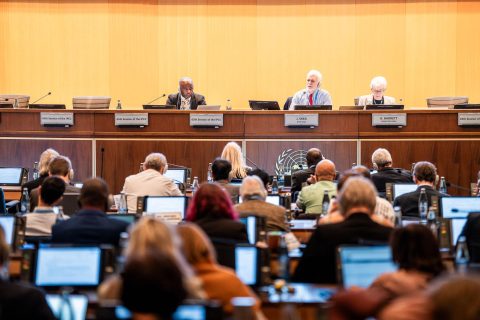

In July, PAICC said 12 countries had ignored its repeated attempts to discuss why they had not published an NDC as required every five years under the 2015 Paris accord.
Members of the committee had been divided over whether to name them, but at a September meeting decided to do so in their annual report to the annual climate COP summit.
By the time the report was published on Friday, only Congo, Senegal and North Korea “had not communicated an NDC or submitted a [Biennial Transparency Report] and had not yet responded to any of the Committee’s notifications, despite several reminders issued by the Committee in this regard”.
Rainforest and renewable energy ambitions
The silence from Congo and Senegal is notable because the former is home to much of the Congo Basin rainforest while the latter has sought billions of dollars in climate finance to support its renewable energy ambitions.
After Brazil, Congo has more rainforest than any country in the world. This forest, and the country’s peatlands, absorb huge amounts of greenhouse gas but are fast being lost to expanding farmland, charcoal production, logging and mining.
Senegal signed a Just Energy Transition Partnership with Canada and wealthy European nations in 2023, to help it meet its renewable energy targets under the-then government of Macky Sall. It was chair of the Least Developed Countries group between January 2022 and December 2023.

Tejas Rao, who is researching the PAICC as part of a doctoral thesis at Cambridge University, said the governments of the three countries should engage with the committee.
“Engagement costs these governments very little and the committee has shown it will listen,” he said.
“Silence leaves the committee with no basis to help, and it leaves the [governments] exposed to the narrative that they are simply disengaged,” he told Climate Home News.
Paris Agreement requirement
The 2015 Paris Agreement requires all parties to publish an NDC every five years outlining their emissions reduction targets, with each plan meant to be more ambitious than the country’s last NDC.
The latest set – the third round of plans, with new targets for 2035 – was due in February 2025. While most countries missed this deadline, all but around 30 – mostly small emitters but including Egypt, Vietnam and Argentina – have now submitted them.
Over the year, the PAICC – which is made up of government climate officials from developed and developing countries – has been communicating with governments that have not submitted NDCs and trying to overcome barriers to them doing so.
Some nations have cited exceptional circumstances as the reason for not submitting an NDC, a process that requires a significant amount of work in tracking emissions and consulting on how to curb them across the economy. For example, a letter from a Sudanese official to the PAICC, seen by Climate Home News, said that the country’s civil war had led to the suspension of its NDC preparation.
-
IPCC scientists vow to press on with climate reports despite political deadlock
After governments again failed to agree a timeline, nearly 120 IPCC authors pledged to complete their assessment on time and with full scientific rigour -
Under US pressure, World Bank says it will back gas “where appropriate”
The US wants the World Bank to expand its gas support while climate campaigners are pushing for it to end – its head spoke this week of limited backing for the fossil fuel -
Who shapes climate science? The equity question facing the IPCC
Early completion of the next global climate science assessment reports risks excluding research from the Global South, which is key to ensuring the findings are fair
The US and Iran are not signed up to the Paris Agreement and so do not have active NDCs, nor does Taiwan, which is not a UN member state.
Rao said that because the PAICC is “facilitative and non-punitive”, naming the countries “is meant to open a door, not close one – the invited consultation is the point”.
“In recent months, governments that explained their constraints, whether capacity, finance or domestic process, have been met with follow-up and support rather than sanction, and the number of silent governments has fallen sharply,” Rao said.
The post Paris Agreement committee names three countries snubbing it over NDCs appeared first on Climate Home News.
Paris Agreement committee names three countries snubbing it over NDCs