

Brazil’s COP30 president has called for governments to set up a new forum to discuss trade issues, following a series of disagreements at recent COPs over whether trade-related measures belong on the agenda of global climate negotiations.
Speaking during a World Trade Organization (WTO) event in Geneva last week, André Aranha Corrêa do Lago proposed the creation of an “integrated forum on climate change and trade” and hailed it as a “flagship initiative from our COP30 action agenda”.
He said climate and trade “have been discussed in silos for too long”, saying a new forum would foster trust and ideas to deal with trade issues, which include the harmful effects of climate-related trade measures, such as tariffs on high-emissions goods, carbon pricing, or export curbs that could hamper the green transition.
-
Threat of EU carbon tax prompts dubious “green aluminium” claims in Mozambique
Mozambique’s biggest industry claims its aluminium is green, which would help it avoid European taxes – but those claims have been questioned -
Emerging economies set up COP29 agenda fight over trade measures
The BASIC group led by China wants “unilateral restrictive trade measures” on the COP29 agenda -
Brazil seeks European trade advantages in return for Amazon protection
The EU wants environmental guarantees in case a future Brazilian government stops trying to protect the Amazon


At the last two COPs – and at mid-year talks in Bonn – emerging economies have tried unsuccessfully to push what they call “unilateral trade measures” onto the agenda, saying policies such as the European Union’s carbon border tax are protectionist and harm their economies. The EU and other developed countries have opposed a dedicated agenda item.
In May, before the Bonn talks, Brazil’s COP presidency urged governments not to introduce “potentially contentious new agenda items that could further burden the process or detract from agreed priorities”. Despite that call, emerging economies proposed an agenda item on “trade-restrictive unilateral measures” and the ensuing debate delayed the start of the talks.
Avoiding a fight?
But Corrêa do Lago’s proposal, which Brazil will ask governments to support at COP30 in Belém in November, received a lukewarm response from governments on both sides of the debate.
“It remains unclear how creating this additional forum would add value to the existing processes,” a European Union source told Climate Home News, speaking on condition of anonymity.
“[The bloc] already regularly engages with global partners on the links between trade, climate and environmental policies — bilaterally, plurilaterally and multilaterally,” the source added, saying that took place already under the U.N. Framework Convention on Climate Change (UNFCCC) and the WTO.
A climate negotiator from an African country said they did not understand what the proposal sought to achieve.
“[Perhaps Brazil is] trying to avoid an agenda fight by establishing this forum”, the negotiator said, asking not to be identified, adding that it was unclear how the new body would be funded.
“Source of fresh thinking”
Corrêa do Lago said in Geneva the proposed forum would be insulated “from the calculus of concessions and gains so we can focus entirely on the calculus of what is possible and necessary”, saying it would be distinct from both the WTO and the U.N. Framework Convention on Climate Change.
“Think of it as an upstream tributary, the source of fresh thinking that feeds into the two main streams of our multilateral system,” he said. “Its role will be to explore ideas and gather critical mass behind mutually empowering solutions, free from the constraints of formal proceedings.”
Climate experts said that while trade issues were not being properly discussed as part of climate negotiations, it was unclear how a new forum might help.
-
Colombia announces fossil fuel phase-out summit to be held in 2026
While a new report warns governments are significantly expanding fossil fuels, Colombia launches a call for the Global South to lead on ending their use -
COP30 PR firm found to be “uniquely reliant” on fossil fuel clients
Edelman relies on work with oil and gas firms like Shell and Chevron for a higher percentage of its income than any other PR agency, a new report found -
Vanuatu pursues new UN resolution to turn ICJ climate opinion into action
The Pacific island nation, which led a campaign for the International Court of Justice (ICJ) to clarify states’ climate duties, said the legal opinion must not be “left on paper”


“A forum focused on climate and trade is a timely intervention, as this discussion currently is not happening at the WTO, and the EU is preventing discussions on trade at the UNFCCC,” said Avantika Goswami, climate lead at the India-based Centre for Science and Environment, a nonprofit research organisation.
But she said “there is a lot of baggage with the intertwining issues of trade and climate, and it is unclear if a new forum will resolve old tensions.”
Developing countries must “have a buy-in” on any new forums “to ensure that the harmful impacts of climate-related trade measures do not further entrench existing inequalities”, she added.
Li Shuo, director of the China Climate Hub at the Asia Society nonprofit group, said the Brazilian proposal could serve as a way to “help the rest of the COP get underway more smoothly”.
He said any new forum should not focus solely on carbon pricing and border taxes. Instead, he said, governments should discuss the “elephant in the room”, which is “do you buy Chinese solar panels, wind turbines, batteries, and electric vehicles? If not, what is the credible, convincing strategy for decarbonisation?”
Colette van der Van, head of Tulip Consulting which focuses on the trade-environment-development nexus, said the proposed forum could be “the fresh start needed to overcome the existing stalemate”, especially as it is being proposed by a developing country in Brazil. But, she added, the initiative could be just “yet another initiative” if it is not backed by a diverse group of countries.
The post Brazil’s call for COP trade forum gets lukewarm response appeared first on Climate Home News.

Three countries have been named by the Paris Agreement’s compliance committee for failing to submit a nationally determined contribution (NDC) and repeatedly snubbing offers of help with their climate plans.
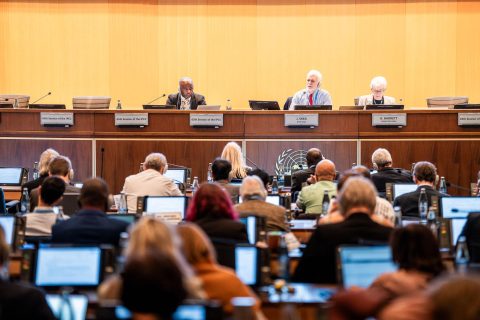
After months of internal debate over whether to identify serial non-responders, the Paris Agreement’s Implementation and Compliance Committee (PAICC) named the three countries which have failed to engage with it over their NDCs on Friday.
It named Democratic Republic of Congo, Senegal and North Korea in a footnote of its annual report, adding that it decided to name them “with a view to facilitating engagement”, adding that representatives of the three nations had been invited to its meeting in early 2027 “with the purpose of identifying any challenges and constraints”.
“The Committee noted the importance of Parties engaging with the Committee in a timely manner, while noting that some delays may be due to the national capabilities and circumstances of the Parties”, the report said.
-
Under US pressure, World Bank says it will back gas “where appropriate”
The US wants the World Bank to expand its gas support while climate campaigners are pushing for it to end – its head spoke this week of limited backing for the fossil fuel -
IPCC scientists vow to press on with climate reports despite political deadlock
After governments again failed to agree a timeline, nearly 120 IPCC authors pledged to complete their assessment on time and with full scientific rigour -
Paris Agreement committee snubbed over missing NDC climate plans
Many governments have still not submitted a nationally determined contribution to the UN, breaching a key requirement of the Paris Agreement


In July, PAICC said 12 countries had ignored its repeated attempts to discuss why they had not published an NDC as required every five years under the 2015 Paris accord.
Members of the committee had been divided over whether to name them, but at a September meeting decided to do so in their annual report to the annual climate COP summit.
By the time the report was published on Friday, only Congo, Senegal and North Korea “had not communicated an NDC or submitted a [Biennial Transparency Report] and had not yet responded to any of the Committee’s notifications, despite several reminders issued by the Committee in this regard”.
Rainforest and renewable energy ambitions
The silence from Congo and Senegal is notable because the former is home to much of the Congo Basin rainforest while the latter has sought billions of dollars in climate finance to support its renewable energy ambitions.
After Brazil, Congo has more rainforest than any country in the world. This forest, and the country’s peatlands, absorb huge amounts of greenhouse gas but are fast being lost to expanding farmland, charcoal production, logging and mining.
Senegal signed a Just Energy Transition Partnership with Canada and wealthy European nations in 2023, to help it meet its renewable energy targets under the-then government of Macky Sall. It was chair of the Least Developed Countries group between January 2022 and December 2023.

Tejas Rao, who is researching the PAICC as part of a doctoral thesis at Cambridge University, said the governments of the three countries should engage with the committee.
“Engagement costs these governments very little and the committee has shown it will listen,” he said.
“Silence leaves the committee with no basis to help, and it leaves the [governments] exposed to the narrative that they are simply disengaged,” he told Climate Home News.
Paris Agreement requirement
The 2015 Paris Agreement requires all parties to publish an NDC every five years outlining their emissions reduction targets, with each plan meant to be more ambitious than the country’s last NDC.
The latest set – the third round of plans, with new targets for 2035 – was due in February 2025. While most countries missed this deadline, all but around 30 – mostly small emitters but including Egypt, Vietnam and Argentina – have now submitted them.
Over the year, the PAICC – which is made up of government climate officials from developed and developing countries – has been communicating with governments that have not submitted NDCs and trying to overcome barriers to them doing so.
Some nations have cited exceptional circumstances as the reason for not submitting an NDC, a process that requires a significant amount of work in tracking emissions and consulting on how to curb them across the economy. For example, a letter from a Sudanese official to the PAICC, seen by Climate Home News, said that the country’s civil war had led to the suspension of its NDC preparation.
-
IPCC scientists vow to press on with climate reports despite political deadlock
After governments again failed to agree a timeline, nearly 120 IPCC authors pledged to complete their assessment on time and with full scientific rigour -
Under US pressure, World Bank says it will back gas “where appropriate”
The US wants the World Bank to expand its gas support while climate campaigners are pushing for it to end – its head spoke this week of limited backing for the fossil fuel -
Who shapes climate science? The equity question facing the IPCC
Early completion of the next global climate science assessment reports risks excluding research from the Global South, which is key to ensuring the findings are fair
The US and Iran are not signed up to the Paris Agreement and so do not have active NDCs, nor does Taiwan, which is not a UN member state.
Rao said that because the PAICC is “facilitative and non-punitive”, naming the countries “is meant to open a door, not close one – the invited consultation is the point”.
“In recent months, governments that explained their constraints, whether capacity, finance or domestic process, have been met with follow-up and support rather than sanction, and the number of silent governments has fallen sharply,” Rao said.
The post Paris Agreement committee names three countries snubbing it over NDCs appeared first on Climate Home News.
Paris Agreement committee names three countries snubbing it over NDCs