

Rachel Rose Jackson is a climate researcher and international policy expert whose work involves monitoring polluter interference at the UNFCCC and advancing pathways to protect against it.
Next week, dozens of governments will gather in the Colombian city of Santa Marta for a conference on transitioning away from fossil fuels.
The conference is a first of its kind, in name and in practice. It’s a welcome change to see a platform for global climate action actually acknowledge the primary cause of the climate crisis – fossil fuels. This sends a clear message about what needs to be done to avoid tumbling off the climate cliff edge we are precariously balancing on.
The agenda set for governments to hash out goes further than any other multilateral space has managed to date. Over the week, participants will discuss how to overcome the economic dependence on fossil fuels, transform supply and demand, and advance international cooperation to transition away from fossil fuels.
Alongside the conference, academics, civil society, movements and others are convening to put forward their visions of a just and forever fossil fuel phase out. The conference can help shape pathways and tools governments can use to achieve a fossil-fuel-free future, particularly if the dialogue begins with an honest assessment of “fair shares.”
-
Santa Marta: fossil fuel transition in an unstable world
Transitioning away from fossil fuels in an unstable world: how can Santa Marta deliver? -
Major oil producers among 46 nations joining fossil fuel phase-out summit
Canada, Australia, Brazil and Norway are set to attend the Santa Marta summit, but the world’s biggest fossil fuel producers are missing from the list -
Iran war could boost fossil fuel phase-out push, says Colombian minister
Colombia’s environment minister Irene Vélez Torres said she hopes that a new fossil fuel phase out summit in Santa Marta can cement a coalition of countries


This means assessing who is most responsible for emissions and exploring truer means of international collaboration that can unlock the technology, resources and finances necessary for a just transition.
Fossil fuel-driven violence is spiraling in places like Palestine, Iran, and Venezuela. Climate disasters are causing billions and billions of dollars in damage annually with no climate reparations in sight. All of this remains recklessly unaddressed on account of corporate-funded fascism.
We know the world’s addiction to fossil fuels must end. Is it surprising that a global governmental convening chooses now to try to tackle fossil fuels? It shouldn’t be, but it is.
COP failures
By contrast, meetings of governments signed up to the longest-standing multilateral forum for climate action—the United Nations Framework Convention on Climate Change (UNFCCC) – took nearly three decades before it officially responded to the power built by movements and acknowledged the need to address fossil fuel use at COP28 in 2023.
Even then, this recognition came riddled with loopholes. It may seem illogical that a forum established by governments in 1992 to coordinate a response to climate change should take decades to acknowledge the root of the problem. Yet there are clear reasons why arenas like the UNFCCC have consistently failed to curb fossil fuels decade after decade.
What would the outcome be when a fossil fuel executive literally oversaw COP28 and when Coca-Cola was one of the sponsors for COP27?
How can strong action take hold when, year after year, the UNFCCC’s COPs are inundated with thousands of fossil fuel lobbyists?
And how can justice be achieved when there are zero safeguards in place to protect against the conflicts of interest these polluters have?
Colombia pledges to exit investment protection system after fossil fuel lawsuits
Justly transitioning off fossil fuels cannot be charted when the very actors that have knowingly caused the climate crisis are at the helm—the same actors that consistently spend billions to spread denial and delay.
Unless platforms like the UNFCCC take concerted action to protect climate policymaking from the profit-at-all-costs agenda of polluters, the world will not deliver the climate action people and the planet deserve.
The impacts of climate action failure are now endured on a daily basis in some way by each of us – and especially by frontline communities, Indigenous Peoples, youth, women, and communities in the Global South. We must be closing gaps and unlocking pathways for advancing the strongest, fairest and fastest action possible.
Learn from mistakes
Yet, as we chase a fossil-fuel-free horizon, it’s essential that we learn from the mistakes of the past. We do not have the luxury or time to repeat them. History shows us we must protect against the polluting interests that want the world addicted to fossil fuels for as long as humanly possible.
We must also reject their schemes that undermine a just transition—dangerous distractions like carbon markets and Carbon Capture Utilisation and Storage (CCUS) that are highly risky and spur vast harm, all while allowing for polluters to continue polluting.
Fossil Free Zones can be on-ramps to the clean energy transition
We get to a fossil-fuel-free future by following the leadership of the movements, communities and independent experts who hold the knowledge and lived experience to guide us there.
We succeed by protecting against those who have a track record of prioritising greed over the sacredness of life.
And we arrive at a world liberated from fossil fuels by doing all of these things from day one, before the toxicity of the fossil fuel industry’s poison takes hold.
If this gathering in Santa Marta can do this, then it can help set a new precedent for what people-centered and planet-saving climate action looks like. When everything hangs in the balance, there can be no if’s, and’s, or but’s. There’s only here and now, what history shows us must be done, and what we know is lost if we do not.
The post To avoid COP mistakes, Santa Marta conference must be shielded from fossil fuel influence appeared first on Climate Home News.
To avoid COP mistakes, Santa Marta conference must be shielded from fossil fuel influence

For the first time, new-energy vehicles (NEVs) made up 67% of new car sales in China in September, according to the latest data from the China Passenger Car Association (CPCA).
The figures show that NEVs, which include battery electric cars and plug-in hybrids, captured a record share of sales, even though fewer were sold than last year.
This is because sales of combustion-engine cars are falling steeply, a trend that the CPCA has attributed to rising petrol prices following the start of the Hormuz crisis.
Indeed, sales of fuel-only cars were down 31% year-on-year in the first nine months of 2026, with plug-in hybrid sales down 26% – whereas battery EV sales were only down 4%.
One analyst tells Carbon Brief that China’s rapidly growing EV fleet has offset demand for 143m barrels of oil since the start of the Hormuz crisis.
Another says that the crisis is “reinforcing China’s electrification of road transport”.
Meanwhile, amid slowing domestic sales, Chinese carmakers’ exports of NEVs more than doubled [in 2026 to date / in September] from a year earlier.
NEV record
A record two out of every three cars sold in September in China were NEVs, according to CPCA data, as shown in the figure below.
(NEVs predominantly include battery electric vehicles – BEVs – and plug-in hybrids – PHEVs. BEVs only run on electricity, whereas PHEVs also have a combustion engine.)
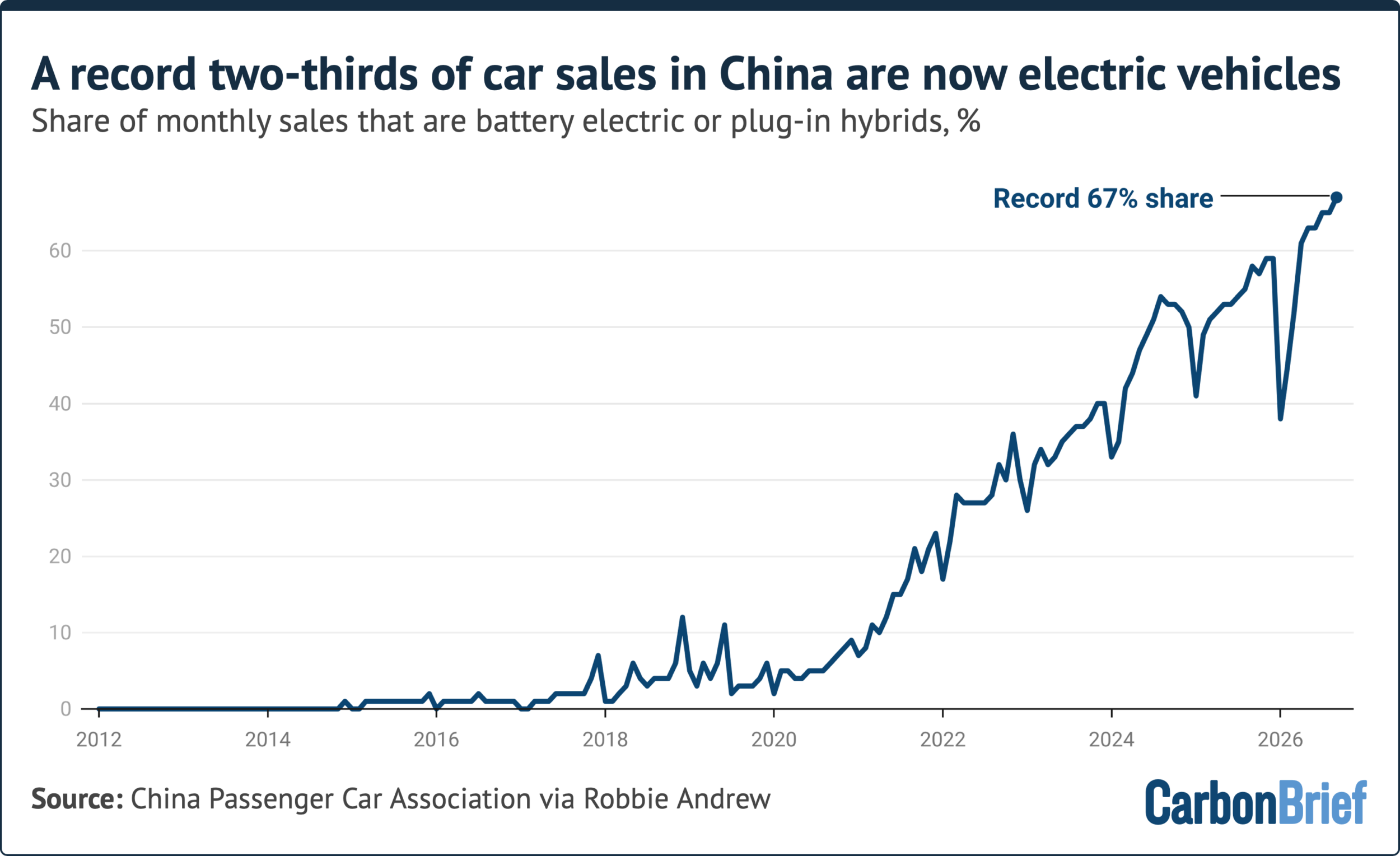
This marks a rapid rise for NEVs from just 6% of new car sales in 2020 up to 58% in 2026 to date – and a record 67% in the month of September.
This year, NEVs’ share of sales has also bounced back from a low of 39% in January, after the full purchase tax exemption that had been in place for more than a decade came to an end in December 2025.
The gain in NEV share in 2026 has come amid a slowdown across the wider domestic passenger-car market, which has hit sales of combustion-engine vehicles particularly hard.
This September, passenger-car retail sales across all categories declined, with overall sales volumes falling 28% year-on-year.
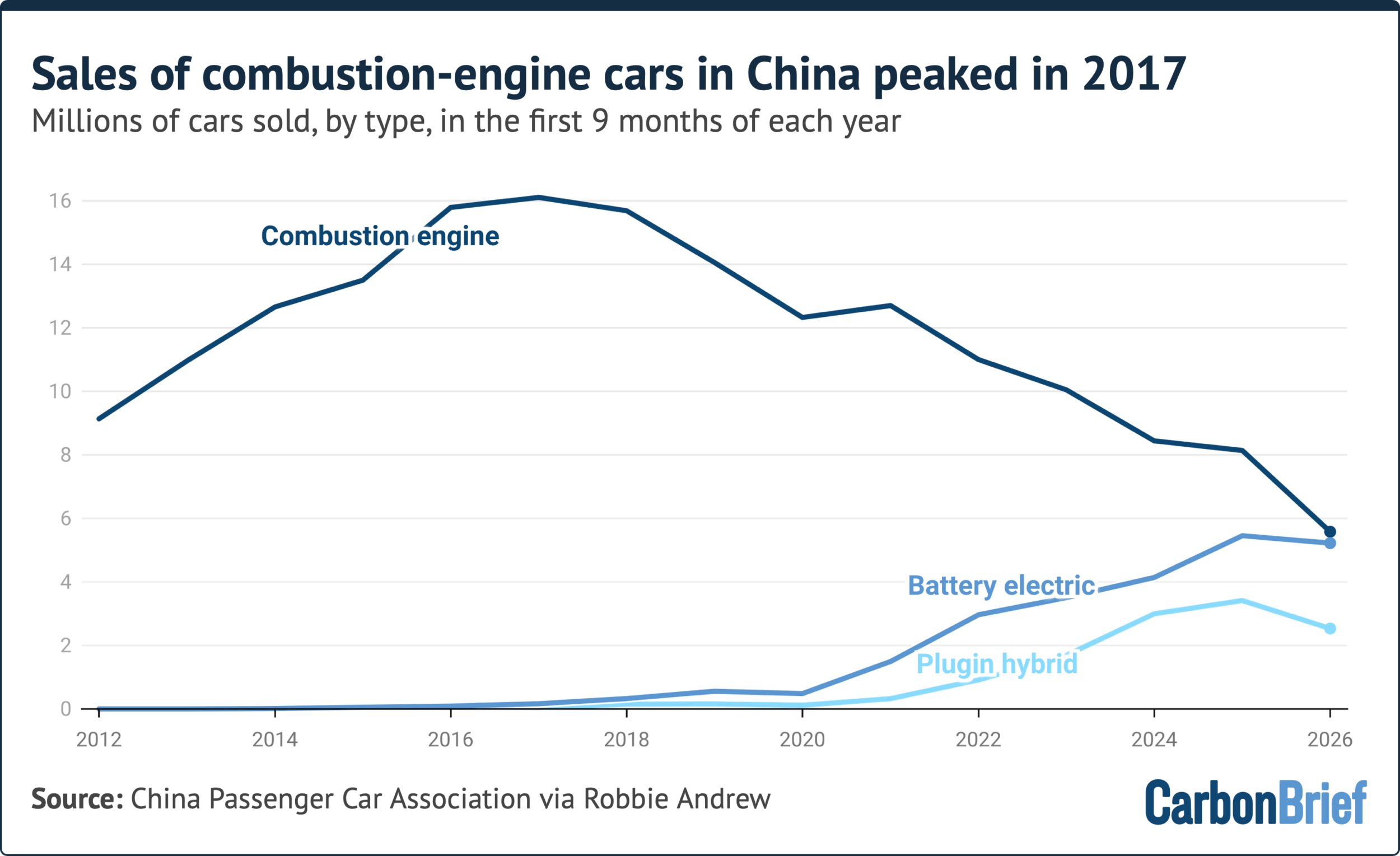
The contraction was led by combustion-engine vehicles, which saw sales fall 43% year-on-year in September and 31% in 2026 to date.
However, sales of PHEVs also fell by 36% year-on-year in September and by 26% in 2026 to date. By comparison, BEVs performed better, although sales still declined 8.5% from a year earlier in September and 4% in 2026 to date.
As a result, NEV sales overall fell by 17% in September and 13% in 2026 to date.
While the market changes in 2026 to date were particularly dramatic, they reflect a broad continuation of trends seen over the past decade.
Indeed, sales of combustion-engine cars in China peaked in 2017 and they have been declining ever since, shown in the figure below.
Impact of Hormuz
Part of the reason for the advance of NEVs in 2026, said Chinese technology news outlet OFweek, was petrol cars “giving up market share” as they were outperformed by electric alternatives.
Cui Dongshu, secretary-general of the CPCA, cited higher petrol prices as an explanation for September’s weak combustion-car sales, in comments to financial news outlet National Business Daily.
Imports of oil into China in January-September have fallen 15% compared to 2025, equivalent to 470m barrels, as ongoing conflict tightened supply and drove up prices.
China’s passenger-car NEV fleet has displaced 143m barrels of oil so far during the strait of Hormuz crisis, Euan Graham, senior energy analyst at thinktank Ember, tells Carbon Brief.
EVs “accounted for 12% of the decrease in China’s oil use post-Hormuz”, according to an estimate provided to thinktank the Brookings Institute by an unnamed analyst.