

Mads Christensen is the Executive Director of Greenpeace International.
In a year that marks the UN’s 80th anniversary and 30 years since the first UN climate summit, the global multilateral system tasked with preventing disaster remains incapable of delivering the speed and scale of change we need — even as the available carbon budget shrinks and tipping points loom.
At the heart of this paralysis lies the broken consensus model of the United Nations Framework Convention on Climate Change (UNFCCC). Every decision must be agreed to by all 198 Parties. In practice, this means even one country can block the rest of the world from acting — and a number often do.
We’ve seen this play out repeatedly: oil-saturated nations derailing fossil fuel phase-out language, rich nations delaying climate finance, and authoritarian regimes using geopolitics as leverage to stall negotiations. But it’s not just fossil fuel exporters or autocracies causing the deadlock.
The result is a ‘race to the bottom’ that rewards inaction, dilutes ambition, and sidelines the world’s most vulnerable. It’s time to end this cycle. It’s time for majority voting at UN climate summits and to reform what are now outdated governance structures.
System is failing vulnerable nations
The Paris Agreement, adopted in 2015, was a diplomatic breakthrough — but it lacks enforcement mechanisms. Implementation has stalled. Emissions are still rising. Fossil fuel production is expanding, and we are hurtling toward 3.1°C of warming by the end of the century.
In short: the system is not delivering and the world cannot afford another lost decade of incrementalism.
This isn’t just a technical problem — it’s a moral one. The communities most affected by the climate crisis are also those least responsible for causing it. From small island states facing existential sea level rise to millions across Africa and South Asia suffering crop failure, water stress, and energy poverty, the injustice is staggering.
-
UN raises COP30 allowance to help with Belém accommodation crisis
But funding shortfalls risk reducing the number of government negotiators who can receive the payment unless more money is put on the table -
Treaty to protect deep ocean reaches key threshold for entry into force
The High Seas Treaty, now signed into law by 60 countries, is seen as crucial to achieving a global goal of protecting 30% of land and sea ecosystems by 2030


These nations have consistently called for stronger action. But under consensus rules, they are routinely overruled or ignored. Instead, decisions are held hostage by the interests of the few: fossil fuel-producing states, authoritarian governments, and wealthy nations with regressive leadership, like the US under President Trump.
Consensus has become a tool of obstruction. We need a model that actually gives climate justice a chance to prevail — one where the majority can act, and the vulnerable are empowered.
Momentum for reform is growing
The case for majority voting is not just practical — in the light of recent judicial developments, the legal and political implications are being magnified.
In July, the International Court of Justice issued an advisory opinion stating that fossil fuel licensing, consumption, and subsidization could amount to violations of international law and basic human rights. This raises the legal stakes for governments that continue to expand fossil fuel production while obstructing climate negotiations.

Simultaneously, political momentum for UN reform is growing. In a speech this month, Chinese President Xi Jinping proposed a more “just and equitable global governance system” in a pointed critique of institutions dominated by outdated rules and powerful interests.
The UN Secretary-General’s own flagship initiative for global reform, the UN80 process, underscores just how overdue these governance changes are.
The company tracking energy transition minerals back to the mines
Although key reform proposals have been delayed beyond this year’s UN General Assembly, the Secretary-General’s mandate implementation review paints a picture of systemic dysfunction: overburdened mandates, siloed agencies, and an avalanche of reporting with little impact or accountability.
If the broader UN system is struggling to deliver on its own instructions, climate governance must not remain stuck in the same bureaucratic inertia. Majority voting could be the first real test of whether the UN can shift from fragmentation to function.
Brazil’s leadership needed
We must ensure that this momentum is used to strengthen — not weaken — international climate governance and majority voting is a clear and immediate step that can deliver results. The UNFCCC’s draft rules of procedure — pending since COP1 in 1995 — already contain provisions for majority decision-making. Their adoption has been blocked for three decades by countries benefiting from the status quo.
Brazil, as host of COP30 in 2025, has already taken a leadership role by proposing innovations in climate cooperation. In a letter to Parties in May, it floated the idea of an “alignment” of actors and efforts— signals that the country is open to innovations in cooperation that go beyond the consensus trap.
That opening must be seized with the courage to act and this year’s UN General Assembly offers governments an opportunity to push for procedural reform and test majority-backed decisions.
As governments bet on carbon trading, Japan’s early scheme spotlights pitfalls
Brazil’s leadership, and support from a wide coalition of countries in Africa, Asia, Latin America, the Pacific, and progressive EU members, can tip the balance. Multilateralism that cannot function — that enables the few to obstruct the many — is no longer credible and must evolve.
While consensus can remain our preferred approach, where there are a few blockers to the majority, we must instead push ahead with science, justice and majority voting to ensure progress.
This is not unprecedented. Other international bodies, from the World Health Assembly to the International Labour Organization, use majority voting when needed. It’s time the UNFCCC caught up. The climate crisis is the defining challenge of our time.
The world’s people are demanding action, and a majority of nations are ready to respond. But a system where one or two countries — whether fossil fuel powers or political saboteurs like Trump’s America — can block the entire planet from acting is not just undemocratic, it’s deadly.
Let consensus be the starting point. But when the majority are ready, and the stakes are existential, let the majority act. Let the majority decide.
The post It’s time for majority voting at UN climate summits appeared first on Climate Home News.

Three countries have been named by the Paris Agreement’s compliance committee for failing to submit a nationally determined contribution (NDC) and repeatedly snubbing offers of help with their climate plans.
After months of internal debate over whether to identify serial non-responders, the Paris Agreement’s Implementation and Compliance Committee (PAICC) named the three countries which have failed to engage with it over their NDCs on Friday.
It named Democratic Republic of Congo, Senegal and North Korea in a footnote of its annual report, adding that it decided to name them “with a view to facilitating engagement”, adding that representatives of the three nations had been invited to its meeting in early 2027 “with the purpose of identifying any challenges and constraints”.
“The Committee noted the importance of Parties engaging with the Committee in a timely manner, while noting that some delays may be due to the national capabilities and circumstances of the Parties”, the report said.
-
Under US pressure, World Bank says it will back gas “where appropriate”
The US wants the World Bank to expand its gas support while climate campaigners are pushing for it to end – its head spoke this week of limited backing for the fossil fuel -
IPCC scientists vow to press on with climate reports despite political deadlock
After governments again failed to agree a timeline, nearly 120 IPCC authors pledged to complete their assessment on time and with full scientific rigour -
Paris Agreement committee snubbed over missing NDC climate plans
Many governments have still not submitted a nationally determined contribution to the UN, breaching a key requirement of the Paris Agreement

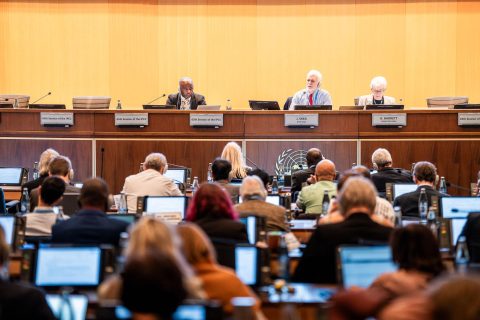

In July, PAICC said 12 countries had ignored its repeated attempts to discuss why they had not published an NDC as required every five years under the 2015 Paris accord.
Members of the committee had been divided over whether to name them, but at a September meeting decided to do so in their annual report to the annual climate COP summit.
By the time the report was published on Friday, only Congo, Senegal and North Korea “had not communicated an NDC or submitted a [Biennial Transparency Report] and had not yet responded to any of the Committee’s notifications, despite several reminders issued by the Committee in this regard”.
Rainforest and renewable energy ambitions
The silence from Congo and Senegal is notable because the former is home to much of the Congo Basin rainforest while the latter has sought billions of dollars in climate finance to support its renewable energy ambitions.
After Brazil, Congo has more rainforest than any country in the world. This forest, and the country’s peatlands, absorb huge amounts of greenhouse gas but are fast being lost to expanding farmland, charcoal production, logging and mining.
Senegal signed a Just Energy Transition Partnership with Canada and wealthy European nations in 2023, to help it meet its renewable energy targets under the-then government of Macky Sall. It was chair of the Least Developed Countries group between January 2022 and December 2023.

Tejas Rao, who is researching the PAICC as part of a doctoral thesis at Cambridge University, said the governments of the three countries should engage with the committee.
“Engagement costs these governments very little and the committee has shown it will listen,” he said.
“Silence leaves the committee with no basis to help, and it leaves the [governments] exposed to the narrative that they are simply disengaged,” he told Climate Home News.
Paris Agreement requirement
The 2015 Paris Agreement requires all parties to publish an NDC every five years outlining their emissions reduction targets, with each plan meant to be more ambitious than the country’s last NDC.
The latest set – the third round of plans, with new targets for 2035 – was due in February 2025. While most countries missed this deadline, all but around 30 – mostly small emitters but including Egypt, Vietnam and Argentina – have now submitted them.
Over the year, the PAICC – which is made up of government climate officials from developed and developing countries – has been communicating with governments that have not submitted NDCs and trying to overcome barriers to them doing so.
Some nations have cited exceptional circumstances as the reason for not submitting an NDC, a process that requires a significant amount of work in tracking emissions and consulting on how to curb them across the economy. For example, a letter from a Sudanese official to the PAICC, seen by Climate Home News, said that the country’s civil war had led to the suspension of its NDC preparation.
-
IPCC scientists vow to press on with climate reports despite political deadlock
After governments again failed to agree a timeline, nearly 120 IPCC authors pledged to complete their assessment on time and with full scientific rigour -
Under US pressure, World Bank says it will back gas “where appropriate”
The US wants the World Bank to expand its gas support while climate campaigners are pushing for it to end – its head spoke this week of limited backing for the fossil fuel -
Who shapes climate science? The equity question facing the IPCC
Early completion of the next global climate science assessment reports risks excluding research from the Global South, which is key to ensuring the findings are fair
The US and Iran are not signed up to the Paris Agreement and so do not have active NDCs, nor does Taiwan, which is not a UN member state.
Rao said that because the PAICC is “facilitative and non-punitive”, naming the countries “is meant to open a door, not close one – the invited consultation is the point”.
“In recent months, governments that explained their constraints, whether capacity, finance or domestic process, have been met with follow-up and support rather than sanction, and the number of silent governments has fallen sharply,” Rao said.
The post Paris Agreement committee names three countries snubbing it over NDCs appeared first on Climate Home News.
Paris Agreement committee names three countries snubbing it over NDCs