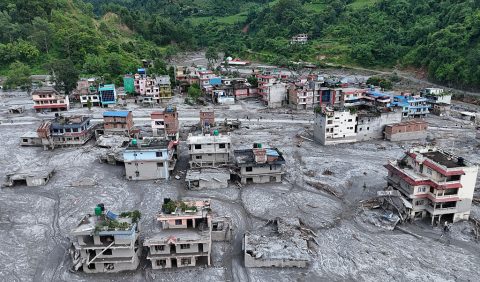
Property insurance premiums are skyrocketing in the face of climate shocks like the fires raging through greater Los Angeles.
As firefighters make some progress containing the unprecedented blazes still tearing through the Los Angeles area, a clearer picture of the true extent of damage is emerging.
Climate Change
CCC: Investing in ‘urgent’ UK adaptation action ‘cheaper than climate damages’
Investing in flood defences, air conditioning and other measures to protect the UK from climate change will provide “long-term savings” for the country, according to the Climate Change Committee (CCC).
The government’s climate advisors have proposed a set of climate-adaptation actions that would require at least an extra £11bn per year in spending, largely from the private sector.
Most of this investment would go towards keeping buildings cool and protecting them from floods, as well as building reservoirs and supporting water-efficiency measures.
The committee says this is a “manageable level of investment” that will shave billions of pounds off climate change-driven damages that the UK will experience in the coming years.
Crucially, the CCC stresses that this approach would be “cheaper than facing the damages”.
This analysis comes from the CCC’s new “well-adapted UK” report, which sets out more than 100 actions that the committee says could help the UK prepare for global warming up to 2C above pre-industrial levels by 2050.
The CCC highlights 20 overarching objectives and a set of measurable targets that it says should be prioritised in the coming years, such as curbing deaths related to extreme heat.
This first-of-its-kind “solutions-focused” report will feed into the UK government’s upcoming fourth climate-change risk assessment, due in 2027, and inform its approach to climate adaptation.
Here, Carbon Brief provides an overview of the key messages in the 554-page report, including the actions highlighted by the CCC and the policy levers required to implement them.
- What is the ‘well-adapted UK’ report?
- What are the climate risks facing the UK?
- How much will it cost to prepare the UK for climate change?
- What measures does the CCC recommend?
What is the ‘well-adapted UK’ report?
The CCC’s new report on how to create a “well-adapted UK” sits alongside a legal process designed to ensure the country is prepared for the impacts of climate change.
It warns that the UK has not yet done enough to adapt to climate change and sets out priorities – as well as potential solutions – for the challenges ahead.
The CCC’s work stems from the Climate Change Act 2008, under which the UK government must publish a Climate Change Risk Assessment (CCRA) every five years. This must set out the risks and opportunities the nation is facing due to climate change.
A key pillar of the act is the creation of the CCC, an independent body that provides advice on the climate-related risks facing the UK and how it should adapt.
The CCC has previously produced three technical reports to advise the government on adaptation. Today sees the publication of the fourth set of advice, officially known as the CCRA4-IA technical report. The “well-adapted UK” report sits alongside this.
(The CCC also makes more frequent assessments of adaptation strategies produced by England, Scotland, Wales and Northern Ireland individually.)
This is the first time the CCC has produced “well-adapted UK”, which it describes as a “solution-focused report” providing suggested government actions to address adaptation needs.
Speaking during a press briefing ahead of the report launch, Baroness Brown, chair of the CCC’s adaptation committee, said:
“It’s a first for us, the first time we’ve produced a report of this sort.It forms part of our independent assessment for the fourth climate-change risk assessment and it contains our advice to government.
“It’s now nearly 20 years since the Climate Change Act was passed and, despite making very strong progress on reducing emissions since 2008, I think we all agree that we have done nothing like enough to address the increasing risk from the impacts of climate change to the UK today.”
The CCC report offers evidence to support action by individual UK governments, as well as other organisations focused on adaptation.
It highlights three priority areas as the UK prepares for 2C of warming by 2050: providing cooling to protect from heat; increasing flood preparedness; and improving water management.
The report says that deploying adaptation at scale around these priorities will help avoid loss of life, as well as disruption to people and the economy.
It also sets out climate risks, actions and enablers across 14 key systems, breaking the analysis down into sectors to allow for clear recommendations on what needs to be done and accountability for delivering progress.
However, the report notes that “climate risks do not simply sit in single systems. Many of the most dangerous risks will cascade across them.”
The CCC states that “adaptation cannot wait”, adding that the duty of the state to keep people safe and secure is being compromised by climate change. As such, it says adaptation needs the same level of focus and commitment as geopolitical and other threats.
The report says:
“Damage is already happening, which can be avoided. Taking action today is cheaper than taking action tomorrow. The main challenge is leadership, getting adaptation underway at sufficient scale and speed.”
Finally, the CCC states that adaptation cannot replace efforts to limit warming, but is instead an “essential complement” to cutting greenhouse gas emissions. It describes adaptation action as “both necessary and achievable, but also urgent”.
What are the climate risks facing the UK?
The UK is already facing increased threats of heatwaves, extreme rainfall and sea level rise due to human-driven burning of fossil fuels and changes in land use, says the report.
Since 2000, the UK has experienced all 10 of its hottest years on record and temperatures passed 40C for the first time in 2022. There is a 50% likelihood of reaching those temperatures again in the next 12 years, says the CCC.
Warmer air can hold more moisture than colder air, with the result that these warmer temperatures have been accompanied by heavier and more intense rainfall in all seasons of the year across the UK.
Additionally, the UK has experienced about 200 millimetres of sea level rise since 1901, with this occurring at an accelerating rate over the last three decades, notes the CCC. The largest increases in sea levels have occurred on the country’s southern coast.
The level of risk facing the country in the future will be determined largely by the level of global emissions, states the report.
Under current emissions pathways, the world will reach around 2C of warming above pre-industrial temperatures by 2050, climbing to nearly 3C by the end of the century.
Lower warming levels are still possible, if countries strengthen their current climate policies and accelerate global emissions reductions. At the same time, scenarios involving even higher levels of warming “should be considered in long-term planning”, says the report.
The table below summarises potential changes to the UK’s climate hazards at 2C of global warming in 2050 and at 4C of global warming in 2100.
In addition to direct impacts on the UK, says the report, the country “cannot be isolated” from global climate risks, such as destructive extreme-weather events.
The report notes that risk is based on three components: hazard; exposure; and vulnerability.
Hazard refers to the physical event that can cause damage. Exposure refers to the presence of people or assets in the area that may be affected by a hazard. Vulnerability is how susceptible something or someone is to experiencing damage if it is exposed to a hazard, accounting for the ability to take adaptation measures.
Current vulnerability and exposure are both highly variable across the country, with marginalised groups likely to be disproportionately impacted by climate change. How these will change in the future is highly uncertain, it says.
How much will it cost to prepare the UK for climate change?
The CCC estimates that delivering its package of adaptation actions will require additional investment of at least £11bn per year, shared between public and private sectors.
(The report notes that, given limits in available information, this is “likely to be an underestimate, but it gives a sense of the scale of investment needed”.)
Roughly a third of this investment will likely be needed for air conditioning and passive cooling measures, according to the committee. Another third will be required for flood defences and water conservation.
Overall, the CCC says around 36% of the expected investment is in areas “that have tended to be funded by the public sector”, while 41% will likely fall to the private sector. The remaining costs are “undetermined”.
The committee stresses that “acting now is cheaper than acting later” and that investing in adaptation is “cheaper than facing the damages” caused by climate change.
Climate-related damages are already costing the UK economy and could grow to around 1-5% of GDP by 2050 – roughly £60-260bn per year – under scenarios of around 2C global warming, according to the CCC.
(The CCC has previously suggested that cutting emissions to net-zero would require investments of £20-40bn per year, yielding savings of a similar magnitude.)
In this context, the £11bn a year “is a manageable level of investment for the UK economy” that will deliver “long-term savings for both public and private actors”, states the report.
CCC analysis of a new adaptation package covering heat and health, urban heat and water scarcity suggests that these measures alone could save up to £12bn a year in climate-damage costs by the 2050s. This can be seen in the chart below.

The CCC stresses that many adaptation actions are “low-cost or low-regret”, highlighting numerous examples that show very favourable benefit-cost ratios. For example, flood resilience measures tend to produce benefits five-times greater than their costs.
In addition, 53 of the 120 adaptation actions for which costs were assessed provided additional “co-benefits”, such as the energy and water bill savings that can result from water-efficiency improvements.
While the CCC does not provide a comprehensive estimate of the financial impact of such co-benefits, it says they “strengthen the case for action”.
The report also emphasises that it makes financial sense to target adaptation measures at people or assets that are particularly vulnerable to and at-risk from climate impacts.
What measures does the CCC recommend?
The CCC’s report sets out a range of climate risks and required adaptation actions across 14 “key systems”, including health, land and the economy as a whole.
As well as proposing more than 100 “actions”, the committee lays out the kind of policies that could be implemented to achieve them. For example, actions in the building sector might require changes to planning policy.
The report also sets out key “enablers” for adaptation in each of these key systems. Common enablers are adequate financial resources, better monitoring processes and improved public awareness of adaptation issues.
The CCC sets out 20 overarching objectives and 39 proposed targets to guide the UK’s adaptation progress out to 2050, which “set out a clear and measurable ambition for a well-adapted UK”. These objectives and targets can be seen in the table below.
The committee says its goals are “clearly measurable and time-bound” and will rely on actions being implemented – often cutting across different systems. For example, curbing deaths linked to extreme heat will rely on the construction of cooler buildings.
For each of the 14 key systems identified, the CCC says it has applied “10 principles for effective adaptation” in order to “inform meaningful recommendations to national government departments”.
Among other things, these principles include preparing for 2C of warming by 2050 and “considering” 4C of warming by 2100.
The following headings break down the key threats facing each of the key systems identified by the CCC – and the actions needed to prepare them for climate change.
Health
Climate change poses a direct threat to population health, with extreme heat linked to everything from increased threat of heart attacks to the spread of climate-sensitive infectious diseases.
At the same time, heatwaves and flooding can disrupt the normal functioning of the UK’s health and social-care system, which can also harm people’s health.
The CCC identifies the following “priority adaptation actions” to protect people from climate change, with a particular focus on minimising excess heat-related mortality and morbidity:
- Behavioural changes – supported by information services – to avoid health risks during hot weather;
- Public cooling spaces to protect vulnerable people during heat events;
- Visits by healthcare or community workers to high-risk people;
- Mental health treatment for people exposed to flooding;
- Surveillance and monitoring of climate hazards and climate-sensitive diseases;
- Early warning systems, including the expansion of heat alerts beyond England;
- Expanding natural areas that can provide shade and reduce the urban heat island effect;
- Maintaining “safe” water bodies that reduce breeding of endemic mosquitoes and harmful algal blooms.
The CCC also identifies priority actions to protect health and social-care facilities from extreme weather:
- Cooling measures in healthcare facilities, including retrofitting buildings with “passive cooling” measures and installing air conditioning;
- Flood defences and other protective measures, such as waterproofed electricals, at hospitals and care homes;
- Training for health professionals that focuses on climate-related health risks;
- Business continuity planning to manage staff absences during extreme-weather events;
- Occupational support to protect healthcare staff during extreme weather;
- Emergency scenario planning for climate-related emergencies.
Many of the required actions would fall to devolved governments and rely on public funding.
The CCC says the UK government could ensure facilities are built to cope with climate extremes by embedding adaptation in statutory health, building and environmental standards. It adds that there is also a need for education programmes to encourage behavioural change.
Crucially, the committee also highlights the need for sustained government funding for adaptation-specific measures. In total, the CCC says the known investment required to deliver adaptation in the health system could be around £0.7-1.7bn per year.
Built environment and communities
Climate change presents numerous risks to the UK’s settlements, buildings and communities, according to the CCC.
The report notes that already, more than half of UK homes are at risk of overheating, 6.3m properties are located in flood-risk areas and extreme weather is causing millions of pounds of damage to properties every year.
Without additional adaptation measures by 2050, it says that the risk of overheating is projected to be 4.2 times higher and that 27% more homes are projected to be at risk of flooding and coastal erosion in England. In addition, the risk of subsidence in Great Britain will increase, with 11% of properties affected by the 2070s, as well as other impacts.
As such, the CCC has set out a series of recommended actions to ensure settlements, buildings and communities are fit-for-purpose and durable places to live and work:
- Building out catchment-scale flood defences, including a mix of engineering “hard” defences and natural defences;
- Expanding urban green infrastructure, for example, street trees, parks and waterways, to provide natural cooling and shade;
- Introducing more “sustainable drainage systems”, such as green roofs, permeable paving, rain gardens and others;
- Helping communities prepare for extreme-weather events;
- Build out nature-based solutions to manage changes from sea level rise and coastal erosion;
- Introducing cooling measures in buildings, including both active cooling – such as air conditioning – and passive cooling measures;
- Utilising government schemes, such as Flood Re, to help ensure all households can access insurance and that it is affordable.
The CCC highlights engagement with communities, ensuring that they are well informed about the future climate risks they face from extreme-weather events, as a key enabler of the above actions.

It notes that a number of policies are already in place to address flooding and overheating, as well as funding for large-scale flood-defence projects. However, it says more can be brought in to support the adaptation of the existing and planned building stock.
Public services
The CCC’s assessment of public services covers the facilities and operation of services outside of health and social care, such as education, justice and emergency services.
It highlights that hazards such as heatwaves and flooding can cause closure and disruption to the operation of services, as well as impact things such as children’s ability to concentrate. Even in the current climate, it says an estimated 4.3% of cumulative learning time is lost in England due to high temperatures.
Emergency workers are increasingly facing challenges created by climate change. For example, wildfires increase demand for fire and rescue, police and environmental-incident response services.
The CCC calls for the creation of new targets to help protect people from the impacts of increased temperatures and flood risk, including: internal temperatures in learning environments should be kept between 16-25C by 2050; and internal temperatures at prisons and justice facilities should be kept between 16-26C.
By 2030, all emergency services and incident responders should be equipped to meet all weather events, adds the committee.
The CCC sets out suggested actions the government could take to ensure that services operate during extreme weather at levels at least as good as today:
- Introducing outdoor shading, such as trees and canopies, at sites such as playgrounds and outside school gates;
- Rolling out passive cooling strategies;
- Introducing active cooling, such as air conditioning, where necessary to reduce indoor temperatures;
- Rolling out surface-water flood alleviation measures;
- Ensuring key assets are adapted, such as backup generators and response vehicles, so that climate change does not impact the delivery of public services;
- Rostering and timetabling should take into account climate-related travel and health issues, bolstered by flexible capacity within services and staff training;
- Introducing surveillance and early warning systems.
The CCC adds that retrofitting buildings to allow them to adapt to climate change will require both up-front funding and long-term revenue budgets, as will expansions of personnel.
It says policy should be used to ensure that building regulations and design standards for public buildings are suitable for future climate conditions. Additionally, the government should look to provide public funding, accessible and reliable climate information and help to improve joint working between different departments, delivery bodies and responders.
Cultural heritage
The CCC considers four aspects of cultural heritage in its report: cultural and archaeological sites and landscapes; buildings that are listed or otherwise significant; fixed assets, such as statues, monuments and shipwrecks; and moveable assets, such as art and historic documents.
Without adaptation, flooding, storms and coastal erosion may reduce access to these sites and assets, or even destroy them entirely. However, due to their varied nature, any adaptation plans need to be highly context-specific, it says.

The report notes that many of the CCC’s priority adaptation actions are broadly applicable across the four classes of cultural-heritage assets, such as:
- Increasing the frequency of inspections and repairs for built assets;
- Creating or strengthening flood barriers and coastal defences;
- Improving drainage around cultural-heritage sites;
- Adjusting opening times and access to help protect visitors and staff, such as temporary closures during extreme weather or installing raised walkways;
- Incorporating technology and digital solutions, such as early-warning systems, digitising collections and creating virtual tours;
- Managing loss, such as by relocating assets and transforming the use of historic buildings.
Adapting the UK’s cultural-heritage assets will require an unknown amount of funding, along with training to increase adaptation-planning capabilities, says the report. These plans must be developed for each context, it says, incorporating local risks, costs and the “potential acceptable future states” of these assets.
The report calls for heritage organisations to “plan for future climate conditions and share these plans for others to learn from”. It also recommends that such considerations should be required for projects receiving public funds in the future.
Water and wastewater
The report groups together the UK’s water supply – both public and private – and wastewater infrastructure.
It notes that these systems are “not fit for the current, let alone future, climate”, with risks of both drought and floods expected to increase across the UK under future warming.
Droughts are the “most significant climate hazard” facing the water system, while heavy rainfall and flooding can damage both water and wastewater infrastructure and overwhelm the capacity of wastewater-transport systems.
The CCC proposes several priority adaptation actions for the water subsystem:
- Installing water-efficient products, such as low-flow fixtures on taps and toilets;
- Reusing non-potable water in specific instances, such as using rainwater to cool data centres;
- Encouraging behavioural changes, including through smart metering and water-efficiency labelling;
- Improving water-use efficiency in private use;
- Repairing leaks quickly – particularly the largest and most damaging ones;
- Installing protections against flooding and erosion;
- Increasing the use of reservoirs to store excess winter rainfall for summer usage;
- Improving pollution-management systems to protect existing water sources;
- Increasing water-treatment capacity and efficiency.
The committee also proposes actions to address adaptation in the wastewater subsystem:
- Separating the systems that carry rainwater from those that carry wastewater;
- Reducing the area of impermeable surfaces to decrease runoff;
- Encouraging behavioural changes to avoid blockages and flooding;
- Increasing the volume that the wastewater system can treat at a given time;
- Improving and decentralising water-treatment processes.
To adapt the water system to future climate change, the committee suggests creating minimum water-efficiency standards for appliances, as well as for new water users, such as data centres.
It also calls for increased planning and regulation between the water and wastewater sectors, as well as across other sectors that contribute heavily to water usage or wastewater generation.

Energy
The CCC warns that climate change is already impacting the energy sector. This includes electricity generation, storage and transport, as well as fuel production, storage and transport of gas, oil, bioenergy and sustainable aviation fuels.
It says that electricity networks are vulnerable to damage from flooding, high winds and increased heat, while heat and drought can reduce efficiency and capacity across the electricity grid and at power plants.
For example, the CCC says that in England, 22% of the electricity infrastructure is currently at risk of flooding, but this is expected to increase to 26% by 2040 due to climate change.
Flooding and water scarcity are the areas of most concern for the fuel-supply system.
The CCC adds that there are interdependencies between fuel and electricity systems.
The committee identifies the following adaptation actions to reduce the climate risk facing the energy system and to allow the current level of resilience to be maintained:
- Siting energy assets to reduce their exposure to climate hazards;
- Building redundancy into the energy system design to avoid single points of failure;
- Reinforcing existing energy assets and designing new ones with appropriate; protections;
- Ensuring that regular inspections of energy assets are undertaken and preventative maintenance is taken where possible;
- Managing vegetation around electricity and gas networks;
- Preparing ways to anticipate, respond to and recover from extreme events, such as early warning systems;
- Provide alternative sources of backup power.
The CCC identifies resources and funding as key enablers for undertaking these actions. It recognises the significant build-out of new equipment that is planned in the next five to 10 years in the energy sector, stating that it is “easier and more cost-effective to build resilience into infrastructure projects at the design stage rather than retrofitting later”.
Other enablers include clear plans, roles and responsibilities being set early and the use of technology and innovation.
The CCC notes that governance of the energy system is “complex”, with some elements centralised and others devolved, as well as splits across the public and private sectors. However, it says policy levers can be used to drive and monitor adaptation across segments, such as regulation, strategic planning and innovation provision.
The committee calls for continued UK government focus on timely and appropriate targets for investments, clarity on the future of the gas grid, wider mandatory adaptation reporting and other measures.
Transport
The committee’s transport-system assessment includes roads, rail and public transportation systems, as well as maritime and aviation infrastructure and operations.
The report notes that the interconnected nature of the UK’s transport system “offers some built-in redundancy”, but also increases the risk of cascading climate impacts.
The biggest climate hazard facing the UK’s transport system is flooding. However, it is also at risk from subsidence, erosion, high winds and extreme heat, according to the report.

The CCC recommends the following measures as priorities for physically adapting the transport sector:
- Improving drainage systems across roadways, tunnels and urban rail systems;
- Installing coastal flood defences, such as seawalls and “rock armour”, near infrastructure located in floodplains;
- Reinforcing embankments, installing retaining structures and strengthening earthworks to protect against erosion;
- Using materials that are durable at higher temperatures, as well as integrating other temperature-reducing measures, such as shading and airflow;
- Reinforcing tall structures against high winds.
It also recommends several operational adaptations for the sector:
- Increasing preventative maintenance, including by clearing drains, dredging waterways, patching tarmac and painting rails;
- Using technology to optimise schedule, route and speed-limit adjustments;
- Implementing contingency plans to protect system-critical assets during severe disruptions.
To implement these adaptation measures, the CCC recommends improving the available guidance and reporting for planners and operators. It notes that planning policies and design codes should embed an “appropriate consideration of climate risk”, such as exposure to hazards.
It also calls for improved resilience standards and engagement with the public to determine the level of service expected in the future and the level of investment required to achieve that.
Waste
The waste sector is facing climate risks predominantly relating to mine tailings and historic landfill sites, with heavier rainfall increasing the risk of landslides that can threaten communities, according to the CCC.
For example, 368 out of 2,590 coal-mine tips in Wales are currently categorised as posing a potential risk to public safety. Increased rainfall and storms under a 2C of global warming in 2050 will increase the potential for landslides at these sites, as well as the number of sites that require adaptation.
The report says that government action is needed to reduce these risks. It adds that better data and monitoring should be used to prioritise the sites that pose the greatest risk.
The CCC sets out actions to ensure these waste sites are managed safely and do not harm people or the environment around them:
- Improving drainage at waste sites and stabilising their slopes stabilised;
- Installing coastal and flood defences at waste sites where needed;
- Treating waste to stabilise or remove hazardous materials;
- Permanently removing or relocating waste from vulnerable sites.
The biggest enabler for these changes will be resources and funding, according to the CCC.
Local authorities have some regulatory power to manage historic waste sites, which it says they should use to ensure adaptation actions are taken.
Digital and telecoms
The digital and telecommunications sector is made up of both public and private networks, as well as infrastructure such as data centres, wired connections and other assets.
Climate change threatens the sector directly, by damaging or otherwise challenging this telecommunications infrastructure, according to the CCC. However, says the report, the “main climate risk” facing the telecoms sector is its “fundamental dependency on the power system”.
The report notes that storms and flooding can damage infrastructure and cause power failures, while high temperatures can overwhelm cooling systems and force systems to overheat.
The CCC calls for several physical adaptation measures to protect digital and telecoms assets:
- Choosing infrastructure sites to reduce vulnerabilities to flooding and wind;
- Installing physical protection measures, such as flood defences and underground cables, for existing infrastructure;
- Completing the changeover to fibre-based digital systems, which are more water-resistant than existing networks;
- Adopting cooling systems and upgrading existing ones to withstand projected future temperatures;
- Adopting more water-efficient cooling systems to reduce vulnerability to water shortages.
Resilience can also be achieved through redundancy measures, it says:
- Installing backup generators, on-site batteries and other redundancies for the power supply;
- Providing backup batteries to consumers to ensure access to emergency services in case of power outages;
- Creating redundancy in cooling systems and network connections;
- Encouraging consumers to store key data in multiple locations to reduce the impact of data-centre outages.
Some of these actions are already underway, notes the report. For example, the changeover to fibre-based systems is expected to be completed by January 2027.
It says resilience will also require regulatory clarity, such as confirming that the UK’s Office of Communications (Ofcom) has a mandate to cover data centres, as well as climate resilience. It notes that this oversight is “expected to be confirmed” by the pending Cyber Security and Resilience Bill.
The CCC also calls for mandatory reporting of climate risks and resilience plans for companies that provide critical telecoms services.
Land
Even if adaptation measures are taken, the land sector – including not just the UK’s terrestrial ecosystems, but also land-related commercial industries, such as farming and forestry – will “not all be able to stay the same as today”, says the report.
Changing temperatures and rainfall patterns are some of the most pressing challenges facing the land sector, with the hot-and-dry summer of 2025 causing more than £800m in revenue loss for England’s farmers.
Climate change is also increasing the frequency of threats, such as wildfires, pests and pathogens, as well as the spread of invasive alien species.

The CCC identifies several priority actions for adaptation in the land sector, with different types of terrestrial ecosystems requiring different measures:
- Increasing the diversity and connectivity of habitats for both wild lands and land-based commercial activities;
- Rewetting peatlands and allowing other ecosystems to naturally regenerate;
- Managing the spread of invasive species, pests, pathogens and diseases;
- Preparing for wildfires, as well as reducing their occurrence and spread through managing fuel loads and maintaining fire breaks;
- Encouraging the use of resilient soil- and water-management practices and improving on-farm biodiversity;
- Adjusting farm planning in response to the changing climate, such as by shifting to different crops or adjusting the timing of planting and harvesting;
- Planting shade trees near riverbanks;
- Creating new coastal habitats;
- Manually moving vulnerable species to locations where they may be able to thrive under a changed climate.
It adds that achieving resilience in the land sector can also be aided by reducing the non-climate pressures that threaten habitats, such as pollution.
The committee notes that delivering on these actions will require both the support of government agencies and private landowners. It says that doing so will require public funding for adaptation, cultural awareness and acceptance of change, as well as flexible regulation and coherent frameworks on land use.
Sea
Similar to the land sector, the CCC’s suggestions for sea-system adaptation measures cut across multiple other sectors, including human health, international trade and food security.
The UK’s seas are already both warming and acidifying in response to human-caused fossil-fuel emissions, with impacts up and down the marine food chain.
By 2050, without adaptation measures, the UK could experience seabird population declines of more than 70%, fisheries employment losses of up to 20% and a rise in disease outbreaks, says the report.
The CCC identifies the following priority adaptation actions focused on both marine habitats and on human activities related to the sea sector:
- Creating larger, better-connected marine protected areas;
- Improving international cooperation around marine protection;
- Diversifying the species targeted by fisheries – moving away from cold-water species, such as cod and haddock, towards warmer-water ones, such as tuna;
- Increasing the genetic diversity of farmed species to increase resilience to disease;
- Sustainably managing wild fish populations, even if this means reducing fishing in the short term;
- Investing in more resilient equipment to withstand stronger storms;
- Relocating aquaculture away from the migration pathways of wild species;
- Preventing the spread of invasive species, diseases, pests and pathogens.
Similar to the land system, the committee says that reducing external pressures – including pollution and harmful fishing practices – can support achieving resilience in the sea system.
The report notes several existing policies that can aid in adaptation for the sea system, including the UK Marine Strategy and the 2020 Fisheries Act. However, it notes that “many actions to adapt [the sector] sit within the industry itself”.
Specific government actions that can support adaptation include changing the licensing and quotas for the fishing industry to reduce the pressure of overfishing, it adds.
Food security
The report considers the “food security” system to include food and agricultural inputs imported from abroad, separate from the country’s own farming and fisheries.
It notes that in 2023, 40% of the UK’s food was imported.
A number of extreme weather events pose hazards to food production and transport, potentially impacting food security both in the UK and globally. These events can also drive up food prices, while warming trends can lower average crop yields and drive changes in the suitability of growing regions.
While agricultural productivity is projected to continue to increase in the future due to improved technological efficiency, it is “unclear how these trends will interact with climate change and extreme weather shocks”, says the report.

Adapting the UK’s food-security system will require undertaking a number of priority actions, says the CCC:
- Shifting working hours for agricultural labourers, providing shading and taking other measures to protect workers from heat stress;
- Investing in capacity-building, skills and technology to improve sustainability and efficiency for local producers;
- Diversifying the supply chains of both imported foods and inputs to UK agriculture, such as fertilisers, animal feed and fuel;
- Reducing food waste (edible food that is discarded at the retail level or by consumers);
- Investing in resilient cold-chain infrastructure for transporting and storing temperature-sensitive food products;
- Stress-testing the global commodity markets and preparing for potential shocks, such as export bans;
- Considering centralised stockpiling of critical food supplies.
Many of these actions are “expected to be delivered by market forces and industry”, says the report, although doing so will require engagement with and improved information for these actors. It suggests that requiring food-related businesses to disclose their climate risks could facilitate adaptation decisions.
The report also suggests strengthening international collaboration, such as through food-trade agreements, as well as providing support to vulnerable groups to alleviate potential food-price inflation due to climate shocks.
Economy and finance
The CCC divides the economy and finance sector into three subsystems: businesses, which provide goods and services; finance, which provides banking, investment and insurance services; and the macroeconomy, which accounts for the country’s overall economic strength through GDP, employment, inflation and other indicators.
All three of these subsystems are impacted by climate change, says the report.
Climate hazards, such as heatwaves, storms and flooding, can disrupt supply chains and daily operations in the business sector.
Climate-related damages can threaten financial assets and increase insurance costs, which can “reduce capacity to recover from climate events and create risks to financial stability and economic growth”, it says.
Meanwhile, macroeconomic indicators such as GDP and inflation can be “negatively affected by all climate-related impacts across sectors”, adds the report.
For the business subsystem, the CCC recommends the following priority adaptation actions:
- Identifying and managing climate-related risks to commercial assets, such as by installing flood defences and air-conditioning systems;
- Protecting workers from climate hazards, such as by adjusting working hours or providing shade and water;
- Reducing supply-chain exposure to climate hazards by diversifying suppliers, stockpiling resources and making procurement decisions with climate risk in mind;
- Identifying opportunities for businesses to provide adaptation innovations, goods and services.
For the finance subsystem, the committee outlines the following priorities:
- Collecting company-level data on climate risks and adaptation;
- Incorporating climate risks and adaptation costs into financial decisions;
- Reducing financial risks by accounting for the climate risks posed to financial institutions’ capital assets;
- Integrating adaptation into insurance products, pooling risk and issuing climate-responsive products, such as resilience bonds, which fund adaptation projects.
The CCC also details several priority actions for the macroeconomy:
- Creating a fiscal framework for the UK government that incorporates adaptation costs and potential future climate-related spending;
- Effectively responding to climate-related inflationary pressures;
- Reducing the climate risks associated with critical supply chains, such as energy, food and pharmaceuticals.
Carrying out these actions will require resources and capacity-building for businesses and financial institutions, as well as clearly defined roles and responsibilities for all involved actors, says the report.
National security and international engagement
The final sectoral section in the CCC’s “well-adapted UK” report looks at how international climate change poses risks to national security, foreign policy and development interests.
The committee says a key message is that the UK is interconnected with the rest of the world, meaning that no matter how well-adapted the country is domestically, it will be threatened by international climate risks.
The CCC says that national security ”cannot be ensured without climate resilience”. Moreover, it says that the UK has an obligation to help other countries adapt and build resilience – and that it will benefit from such aid.
This comes just days after the UK announced its intention to cut funding to the UN’s flagship Green Climate Fund, which provides climate financing for developing countries.
The CCC highlights that “climate-change impacts, weak economic development and inequality exacerbate each other”, as well as noting that climate hazards are a growing driver of involuntary migration.
It recommends the following measures to help maintain UK national security and fulfil international commitments in the face of global climate risks:
- Adapting the defence sector, including training and equipping forces to operate in more extreme weather conditions;
- Embedding climate considerations within decision-making processes;
- Providing direct adaptation assistance to support other countries and territories;
- Mobilising international private adaptation finance;
- Sharing and exporting the UK’s capabilities internationally, both in climate science and financial services.
Financial resources are one of the most important enablers for these actions, alongside a clear division of roles and responsibilities and effective use of data and monitoring.
The CCC also calls for sustained diplomacy and engagement on climate adaptation.
The post CCC: Investing in ‘urgent’ UK adaptation action ‘cheaper than climate damages’ appeared first on Carbon Brief.
CCC: Investing in ‘urgent’ UK adaptation action ‘cheaper than climate damages’
Climate Change
Alabama Coal Ash Lawsuit Can Continue, Appeals Court Rules
The lawsuit challenges Alabama Power’s plans to leave more than 21 million tons of coal ash in an unlined pond at the head of the Mobile-Tensaw Delta, an area sometimes called “America’s Amazon” for its rich biodiversity.
A yearslong court battle over the 21.7 million tons of coal ash sitting in one of Alabama’s most ecologically sensitive areas will continue after an appeals court ruling handed down Monday.
Climate Change
Factcheck: Trump’s false claims about the IPCC and ‘RCP8.5’ climate scenario
Among a flurry of posts on social media last weekend, US president Donald Trump declared “good riddance” to a specific emissions scenario used in global climate projections.
The “RCP8.5” scenario, which envisages a future of very high carbon emissions, was “wrong, wrong, wrong”, the president wrote in block capitals.
This was “just admitted” by the UN’s “top climate committee”, he falsely claimed, referring to the Intergovernmental Panel on Climate Change (IPCC).
The post was quickly picked up by right-leaning media, amplifying Trump’s misrepresentation of emissions scenarios and the role of the IPCC.
His claim follows the publication of a new set of emissions scenarios that will feed into the next IPCC reports.
While the new scenarios no longer include such high emissions as in RCP8.5, they also show it is “not possible” to limit global warming to 1.5C above pre-industrial levels without significant “overshoot”, one of the authors tells Carbon Brief.
Moreover, projections suggest that the world is still on course for between 2.5C and 3C of warming, another author says.
This level of warming was previously described as “catastrophic” by the UN.
In this factcheck, Carbon Brief looks at Trump’s comments, the debate around RCP8.5 and the “good” and “bad” news within the latest scenarios.
- What did Trump say?
- What is RCP8.5?
- Why is RCP8.5 so hotly debated?
- How has RCP8.5 been replaced?
- How is the IPCC involved?
What did Trump say?
In the late evening of Saturday 16 May, Trump posted the following message on his Truth Social social-media platform:
“Dumocrats” is a derogatory nickname for Democrat politicians, debuted by the president in a televised Fox News interview on Thursday 14 May, according to the Independent.
By “top climate committee”, the president was presumably referring to the IPCC, the UN body responsible for assessing science about human-caused climate change.
However, the IPCC does not develop, control or own climate scenarios. Moreover, it has not published anything stating that any climate scenario is “wrong”. (For more, see: How is the IPCC involved?)
Nevertheless, right-leaning media outlets have reported on Trump’s comments, in many instances repeating his false assertion that the RCP8.5 climate scenario had been developed by the IPCC.
The New York Post misleadingly claimed that the IPCC “had quietly adjusted” its framework of emission scenarios. The Daily Caller, a pro-Trump conspiratorial US outlet, adds its own falsehoods stating that “IPCC researchers revised their modelling approach last month, swapping the extreme pathway for seven alternative scenarios”. The climate-sceptic Australian claimed that scientists had “quietly scrapped the apocalyptic forecasts that have terrified policymakers and the public”.
With Fox News also covering Trump’s comments, along with an earlier article by the Times, much of the reporting around RCP8.5 in recent days has been driven by media controlled by the climate-sceptic mogul Rupert Murdoch.
It is not the first time the Trump administration has attacked RCP8.5. In an executive order issued in May 2025 – entitled, “Restoring gold-standard science” – the White House included the climate scenario in a list of examples of how the previous government had “used or promoted scientific information in a highly misleading manner”.

Federal agencies, it claimed, had been using RCP8.5 to “assess the potential effects of climate change in a higher warming scenario”, despite scientists warning that “presenting RCP8.5 as a likely outcome is misleading”.
The executive order came after Project 2025 – a policy wishlist for Trump’s second term published in 2023 by the Heritage Foundation, an influential rightwing, climate-sceptic thinktank in the US – criticised the climate scenario.
The manifesto said a “day-one” priority for the new government should be to “eliminate” the US Environmental Protection Agency’s “use of unauthorised regulatory inputs”, such as “unrealistic climate scenarios, including those based on RCP8.5”.
What is RCP8.5?
Scientists use emissions scenarios to explore potential future climates, based on how global energy and land use could change in the decades to come.
These scenarios are not predictions or forecasts of what will happen in the future. Therefore, Trump’s declaration that projections under RCP8.5 were “wrong, wrong, wrong” misrepresents the purpose of emissions scenarios.
Different modelling groups have produced thousands of different scenarios over the years. RCP8.5 was developed by scientists back in the early 2010s as one of a set of four consistent “representative concentration pathways”, or RCPs, for climate modellers to use.
As their name suggests, the RCPs were representative of the vast array of scenarios in the scientific literature.
Their corresponding numbers – 2.6, 4.5, 6.0 and 8.5 – do not describe temperature rise (as some mistakenly assume), but the level of “radiative forcing” that each pathway reaches by 2100. This forcing level is a measure of the change in the Earth’s “energy balance” (in watts per square metre) caused by human-caused greenhouse gas emissions.
As the highest forcing of the set, RCP8.5 was a scenario of very high emissions and extensive global warming.
When it was originally published in 2011, RCP8.5 was intended to reflect the high end – roughly the 90th percentile – of the baseline scenarios available in the scientific literature at the time.
A “baseline” scenario is one that assumes no climate mitigation, explains Dr Chris Smith, senior research scholar at the International Institute for Applied Systems Analysis (IIASA) in Austria. He tells Carbon Brief:
“RCP8.5 was developed as a no-climate-policy scenario, often called ‘reference’ or ‘baseline’ scenarios. These are used to benchmark the actions of climate policy.”
Under RCP8.5, the IPCC’s fifth assessment report (AR5) in 2013 projected a best estimate of 4.3C of temperature rise by 2081-2100, compared to the pre-industrial period, with a “likely” range of 3.2C to 5.4C.
The RCPs were succeeded in 2017 by the “shared socioeconomic pathways”, or SSPs. The SSPs included a set of five socioeconomic “narratives”, which described factors such as population change, economic growth and the rate of technological development.
The SSPs were then used in the IPCC’s sixth assessment (AR6) cycle, which ran over 2015-23. The upper end of the AR6 temperature projections was provided by the successor to RCP8.5, known as SSP5-8.5, which indicated warming of 4.4C by 2081-2100, with a “very likely” range of 3.3C to 5.7C.
Why is RCP8.5 so hotly debated?
Prof Detlef van Vuuren from Utrecht University, a leading figure in the development of emissions scenarios for many years, tells Carbon Brief that RCP8.5 is a “low-probability, high-risk scenario and it was always meant like that”.
The scenario assumed a world without climate policy and was designed to explore the consequences of high levels of greenhouse gases and global warming. It was not, van Vueren says, a “best-guess scenario” of what the future held in store.
However, in some research papers, RCP8.5 was characterised as “business as usual”, suggesting that it was the likely outcome if society did not pursue climate action.
This was “incorrect”, says van Vuuren, noting that RCP8.5 “is not a likely outcome”. He adds: “It’s never been a likely outcome.”
Over time, RCP8.5 became hotly debated in academic circles, with some scientists arguing that such high emissions were becoming increasingly unlikely and others claiming that RCP8.5 was still consistent with historical cumulative carbon dioxide (CO2) emissions.
Carbon Brief unpacked the arguments in this debate in a detailed explainer in 2019.
The charts below, originally included in a 2012 Nature commentary and then updated each year by the authors, shows how projected CO2 emissions under RCP8.5 (red line) compares with the other RCPs (bold coloured lines) and observations (black line).
The left-hand chart shows total CO2 emissions, including land-use change, while the right-hand chart shows CO2 emissions from burning fossil fuels and producing cement – the dominant drivers of 21st century emissions.

While emission trends up to the early 2010s approximately tracked RCP8.5, a flattening of emissions growth in the years since has meant they have not kept pace with the sustained rises that were assumed in the scenario.
Over the past decade, global emissions have more closely tracked RCP4.5, one of the two “medium stabilisation scenarios” of the original four RCPs.
The debate around RCP8.5 has not just focused on current emissions, but also on the scenarios underlying assumptions for the future.
When it was published in 2011, the world had just seen unprecedented growth in global CO2 emissions, which had increased by 30% over the previous decade. Global coal use had increased by nearly 50% over the same period. Cleaner alternatives remained expensive in most countries and the idea of continued rapid growth in coal use seemed realistic.
Critics of RCP8.5 point to its assumptions for a dramatic expansion of coal use in the future, as well as high growth in global population.
For example, in a 2017 paper, two scientists argued that the “return to coal” envisaged in RCP8.5 would require an unprecedented five-fold increase in global coal use by the end of the century. Such an outcome was “exceptionally unlikely”, the authors wrote.
However, others have argued that while high-emissions scenarios are becoming increasingly unlikely, they still have an important role to play. For example, they highlight risks that only emerge under higher levels of warming.
In addition, research has shown that feedbacks in the climate system – where warming triggers the release of more CO2 and methane, which warms the planet further – could mean that human-caused emissions lead to a higher radiative forcing and have a greater climate impact than initially assumed.
How has RCP8.5 been replaced?
As the IPCC heads into its seventh assessment cycle (AR7), scientists have been developing the emissions scenarios and climate model projections that will – eventually – feed into its reports.
For the emissions scenarios, that process – known as ScenarioMIP – started back in 2023 at a meeting in Reading, UK. This involved scientists representing “different climate research communities”, explains van Vuuren.
This “brainstorming” session devised the outlines for the new scenarios, he says. After more meetings, these were subsequently developed into a proposal that was – after review – translated into a journal paper. After review from scientists and the public, the final paper was published in April.
The paper sets out seven all-new emissions scenarios, replacing the SSPs (and its predecessors, the RCPs). For simplicity, the new scenarios are named according to their levels of greenhouse gas emissions.
The figures below show the emissions (left) and the estimated global temperature changes (right) under the proposed scenarios, from the “low-to-negative” emissions scenario (turquoise) up to a “high-emissions” scenario (brown).

(It should be noted that, while the ScenarioMIP paper has been published, there remains an embargo on using the scenario data produced by integrated assessment models – often referred to as IAMs – to publish academic papers, analysis or even social media posts until 1 September this year. Carbon Brief will publish a detailed explainer on the new scenarios once the embargo lifts.)
When compared to the SSPs that came before, the range in future emissions in the new scenarios “will be smaller”, the authors say in the paper:
“On the high-end of the range, the…high emission levels (quantified by SSP5-8.5) have become implausible, based on trends in the costs of renewables, the emergence of climate policy and recent emission trends…At the low end, many…emission trajectories have become inconsistent with observed trends during the 2020-30 period.”
In other words, the combination of technological progress and action on climate change that, to date, remains insufficient, means that scenarios of very high or very low emissions are now not considered plausible.
Another way of looking at it is that the “range of potential futures has narrowed”, explains Smith, one of the authors on the paper.
If you “draw a fan or plume of potential future emissions that start in 2025”, it lies entirely within the spread of scenarios from a decade ago, he says:
“So you’ve ruled out futures at the high end. You’ve also ruled out futures at the low end – so it’s now not possible to limit warming to 1.5C, at least in the short term or the medium term.
This is a mix of “good” and “bad” news, Smith adds.
“In the latest set of scenarios, the lowest [scenario sees] peaking at about 1.7C, so we’ve also lost that low end, but the good news is we’ve lost the high end…Back in 2010, RCP8.5 wasn’t an implausible future, we’ve now made it an implausible future, because we’ve actually bent the curve [on emissions] enough to eliminate that possibility.”
The new “high” scenario projects warming in 2100 of closer to 3.2C (with a range of 2.5C to 4.3C).
To be clear, this “high” scenario would still come with catastrophic climate impacts, even if the level of warming would remain slightly below what was set out in RCP8.5.
Van Vuuren adds that the world is “now on a trajectory to 2.5-3C of warming”. As a result, “we don’t have any scenario anymore that can reach 1.5C with limited overshoot – we will have a significant overshoot”.
How is the IPCC involved?
Contrary to Trump’s claims, the common set of future emissions scenarios used by climate scientists are not developed by the IPCC, the UN climate-science body that produces landmark reports about climate change.
Instead, the development process described above is driven by a group of Earth system modelling experts convened by the Coupled Model Intercomparison Project (CMIP).
CMIP – an initiative of another UN body, the World Climate Research Programme – coordinates the work of dozens of climate modelling centres around the world.
Working in six-to-eight year cycles, CMIP asks modelling centres around the world to run a common set of climate-model experiments – simulations that use the same inputs and conditions – that allows for results to be collected together and more easily compared.
For experiments that explore how the climate might change in the future, modelling centres are instructed to run simulations against a fixed set of future climate scenarios, each with different levels of concentrations of greenhouse gases, aerosols and other drivers of climate change.
These future emissions scenarios are revisited each time CMIP embarks on a new “phase” of climate-modelling coordination, to reflect advances in scientific understanding and the pace of real-world climate action.
The group tasked with producing the design of future scenarios, as well as the “input files” for climate models, is the “scenario model intercomparison project”, or ScenarioMIP.
CMIP aligns its work with the schedule of the IPCC, coordinating a new set of model runs for each IPCC assessment cycle.
For example, the IPCC’s AR5 in 2013 featured climate models from the fifth phase of CMIP (CMIP5), whereas AR6 in 2021 used climate models from CMIP’s sixth phase (CMIP6).
AR7 will feature models from CMIP’s ongoing seventh phase (CMIP7). The first results from CMIP7 model runs are expected later this year.
The IPCC is consulted during the CMIP process, van Vuuren tells Carbon Brief, but their input is “no different from any other review comment” that the ScenarioMIP team received.
Thus, while the IPCC relies on model runs coordinated by CMIP in its landmark reports, it does not play a role in designing future emissions scenarios, nor in deciding when they should be retired.
Dr Robert Vautard, co-chair of IPCC AR7 Working Group I, tells Carbon Brief that the IPCC does not “do or coordinate research”. Its role, he says, is to “synthesise existing knowledge” and produce “regular” reviews of climate-science literature.
He adds that ScenarioMIP is just one set of scenarios the climate-science body assesses in its reports:
“IPCC assesses all scenarios, or sets of scenarios, that the scientific community produces. IPCC does not produce scenarios. CMIP7 will be [one] set of scenarios assessed by IPCC [for AR7] – but there will be many others.”
The post Factcheck: Trump’s false claims about the IPCC and ‘RCP8.5’ climate scenario appeared first on Carbon Brief.
Factcheck: Trump’s false claims about the IPCC and ‘RCP8.5’ climate scenario
-
Climate Change9 months ago
Guest post: Why China is still building new coal – and when it might stop
-
Greenhouse Gases9 months ago
Guest post: Why China is still building new coal – and when it might stop
-
Greenhouse Gases2 years ago嘉宾来稿:满足中国增长的用电需求 光伏加储能“比新建煤电更实惠”
-

Climate Change2 years ago嘉宾来稿:满足中国增长的用电需求 光伏加储能“比新建煤电更实惠”
-
Climate Change2 years ago
Bill Discounting Climate Change in Florida’s Energy Policy Awaits DeSantis’ Approval
-
Renewable Energy7 months agoSending Progressive Philanthropist George Soros to Prison?
-
Carbon Footprint2 years agoUS SEC’s Climate Disclosure Rules Spur Renewed Interest in Carbon Credits
-
Greenhouse Gases10 months ago
嘉宾来稿:探究火山喷发如何影响气候预测