Connect with us

Published

on

Top 4 Carbon Projects in 2025: The Game-Changers in Climate Action You Need to Know

In the fight against climate change, companies big and small face mounting pressure to take responsibility for their carbon footprint. Despite rigorous efforts to reduce greenhouse gas (GHG) emissions, certain hard-to-abate emissions persist—those that cannot be entirely avoided due to technological or operational constraints. Carbon offsetting offers an effective solution for addressing these residual emissions.

Why Do Carbon Offset Projects Matter? 

Carbon offset projects are verified initiatives designed to reduce, avoid, or remove GHG emissions from the atmosphere. These projects span various activities, such as protecting natural ecosystems, reforestation, afforestation, and deploying clean energy technologies. 

Each tonne of reduced emissions generates a carbon credit, which individuals and companies can purchase to offset their footprints. Notably, removal credits have reached their largest share of retirement activity, signaling a growing shift toward projects that directly eliminate CO₂ from the atmosphere.

For businesses facing the urgency of reducing their environmental impact, carbon offsetting provides a tangible, immediate action. By investing in offset projects, companies can achieve carbon neutrality as well as contribute to sustainable development goals. Below are the top ten carbon credit buyers in 2024, according to the Allied Offsets report.
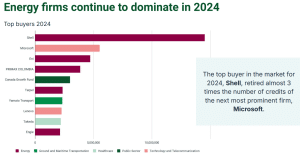
top carbon credit buyers in 2024
Chart from Allied Offsets report

However, the success of carbon offsetting depends on proper implementation. When done right, these projects can significantly benefit the climate while ensuring meaningful impacts on-site. If done improperly, they risk being seen as a shortcut rather than a complement to essential internal emission reductions.

Given the growing need for corporate accountability, the decision to invest in top-tier carbon offset projects is both strategic and impactful. Here are the top four carbon projects that are worth considering in 2025. 

TerraPass: Driving Measurable Impact in Carbon Offsets

TerraPass has been a pioneer in carbon offsets, making sustainability accessible for individuals and businesses since its founding in 2004. To date, TerraPass has offset over 43 million metric tons of CO₂, equivalent to removing more than 9.3 million cars from the road for a year.

The organization supports a wide range of verified projects that directly reduce greenhouse gas emissions, with over 200,000 customers across the globe. One notable initiative is landfill gas capture, which prevents harmful methane emissions from entering the atmosphere. Methane is 25 times more potent than CO₂, and TerraPass’s efforts in this area have a significant climate impact. 
Terrapass carbon offset project

TerraPass’s key projects include:

  • Ideal Family Farms Methane Capture Project (Wisconsin): This project reduces methane emissions by converting agricultural waste into renewable energy, preventing harmful gases from entering the atmosphere.
  • New Bedford Landfill Gas-to-Energy Project (Massachusetts): This initiative captures landfill gas and converts it into energy, reducing emissions while providing a sustainable energy source.
  • Waymart Wind Energy Project (Pennsylvania): A wind farm that generates renewable energy, displacing fossil fuel-based electricity generation.

For individuals, TerraPass offers carbon offset packages starting at just $5.99 per month, covering emissions from everyday activities like driving, flying, and household energy use. Their simple carbon calculator helps users identify their footprint and take immediate action.

Businesses can integrate TerraPass into their sustainability strategies with tailored solutions for events, supply chains, or entire operations. Companies like Subaru and Amtrak have partnered with TerraPass to meet corporate social responsibility (CSR) goals, demonstrating its credibility among industry leaders.

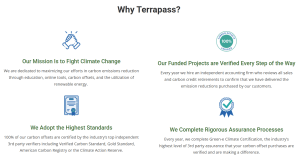
The carbon offset provider is transparent about its impact, providing third-party verification for all projects under standards like the Verified Carbon Standard (VCS) and Climate Action Reserve (CAR). This ensures contributions make a measurable difference.

Whether it’s reducing methane, generating clean energy, or offsetting daily activities, TerraPass transforms complex sustainability challenges into actionable steps toward a greener planet.

So, why TerraPass? 

  • Backed by Green-e Climate certification to ensure quality and credibility.
  • Offers user-friendly tools, such as an advanced carbon calculator, to educate and engage individuals and businesses.
  • Supports multiple verified projects, ensuring transparent and impactful results.

3Degrees: Advancing Global Sustainability Through Innovative Solutions

3Degrees is a trailblazer in climate solutions, empowering organizations worldwide to achieve renewable energy and carbon reduction goals. Founded in 2007, the company has facilitated over 10 million metric tons of CO₂ reductions, equivalent to the annual energy use of about 1.2 million homes.

The company specializes in renewable energy certificates (RECs), carbon offsets, and consulting services. 3Degrees has helped over 4,000 organizations transition to sustainable energy practices, including industry leaders like Google, Microsoft, and LinkedIn. 3Degrees ensures impactful and lasting contributions to global climate goals by enabling these companies to meet their sustainability commitments.

One of the standout achievements of 3Degrees is its work in renewable energy procurement. It has facilitated over 10 gigawatts of renewable energy transactions globally, supporting solar, wind, and other clean energy projects. These efforts have significantly reduced dependency on fossil fuels and accelerated the transition to a low-carbon economy.
3degrees carbon offset project

The key projects supported by 3Degrees are:

  • Cookstove Project in Uganda: This initiative provides energy-efficient cookstoves to communities, significantly reducing deforestation and indoor air pollution. The project improves public health while lowering greenhouse gas emissions.
  • Kootznoowoo Forestry Project (Alaska): A forest management program led by Indigenous communities that preserves old-growth forests, enhances biodiversity, and sequesters carbon.
  • Solar Water Heater Initiative in India: By installing solar water heaters in rural households, this project promotes renewable energy use and reduces dependency on fossil fuels, cutting emissions while supporting sustainable development.

3Degrees is also a champion of equity-focused climate solutions. Through projects like forest conservation in the Amazon and clean cookstove initiatives in sub-Saharan Africa, the company mitigates emissions while supporting local communities. These initiatives often deliver secondary benefits, such as improved air quality and job creation, amplifying their positive impact.

For businesses seeking net-zero goals, 3Degrees offers strategic consulting services. Their expertise ensures companies align with frameworks like the Science-Based Targets initiative (SBTi) and adhere to global reporting standards.

With recognition as a certified B Corporation, 3Degrees combines profit with purpose. Its mission to “connect people with solutions needed to combat climate change” reflects its dedication to building a sustainable future.

From large corporations to local governments, 3Degrees delivers actionable, measurable, and transformative climate solutions that make a global impact.

Why pick 3Degrees?

  • Custom climate solutions for corporations aiming to meet their sustainability goals.
  • Proven expertise in renewable energy procurement and supply chain decarbonization.
  • Facilitates broader access to clean energy for businesses and consumers alike.

Rimba Raya Biodiversity Reserve: Protecting Nature, Empowering Communities

The Rimba Raya Biodiversity Reserve stands as one of the largest REDD+ (Reducing Emissions from Deforestation and Forest Degradation) projects in the world, spanning over 64,000 hectares of tropical peat swamp forest in Central Kalimantan, Indonesia. 

The project has a dual mission: combating deforestation and preserving biodiversity while uplifting local communities.

Since its establishment, Rimba Raya has prevented the emission of over 130 million metric tons of CO₂. That equals taking about 28 million cars off the road for a year. Its efforts focus on protecting critical ecosystems that act as carbon sinks, particularly peatlands, which store up to 10 times more carbon than other forest types.

The reserve is home to more than 300 species, including endangered animals like the Bornean orangutan. The project supports rehabilitation programs and has partnered with the Orangutan Foundation International to create habitats for over 350 rescued orangutans.
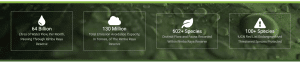
Rimba Raya in numbers

Rimba Raya’s impact extends beyond environmental preservation. It works closely with 14 villages surrounding the reserve, positively affecting over 10,000 people. 

Initiatives include access to clean water, educational programs, and alternative livelihood opportunities, such as sustainable farming and aquaculture. These programs aim to reduce dependency on forest exploitation while improving the well-being of local communities.

The project operates under rigorous certification standards, including the Verified Carbon Standard (VCS) and Climate, Community, and Biodiversity Standards (CCBS). These certifications ensure transparency, accountability, and measurable results.

Rimba Raya’s holistic approach showcases how conservation can balance environmental, social, and economic goals. As a model for REDD+ projects worldwide, it demonstrates that protecting nature and empowering people go hand in hand in addressing climate change.

What makes Rimba Raya noteworthy?

  • Directly combats deforestation linked to palm oil plantations.
  • Focuses on biodiversity conservation and sustainable development for local communities.
  • Aligned with all 17 UN Sustainable Development Goals (SDGs).

MyClimate: Shaping a Sustainable Future

MyClimate is a globally renowned organization offering high-quality carbon offset solutions and climate education programs. Headquartered in Switzerland, MyClimate has been at the forefront of climate action since 2002. To date, it has offset over 19 million metric tons of CO₂ through more than 174 projects worldwide.

The organization focuses on projects that deliver measurable environmental, social, and economic benefits. These include the following initiatives:

  • Efficient Cookstove Program (Kenya): This initiative distributes energy-efficient cookstoves to rural households, reducing wood consumption by up to 50%. It helps mitigate deforestation, lowers CO₂ emissions, and improves indoor air quality, benefiting families’ health and the environment.
  • Reforestation in Nicaragua: MyClimate partners with local farmers to restore degraded land through reforestation. This project sequesters carbon, enhances biodiversity, and provides economic benefits to local communities.
  • Solar Energy for Schools (Tanzania): By installing solar panels in off-grid schools, this project provides renewable energy, enabling better lighting and access to educational resources. It also reduces dependency on fossil fuels, cutting emissions and operational costs.
  • Biogas Systems in India: This program supports rural families by providing biogas digesters that convert organic waste into clean cooking gas. The project reduces greenhouse gas emissions and reliance on firewood while improving living conditions.

MyClimate’s approach combines innovation with accountability. All projects adhere to rigorous international standards, such as Gold Standard and Plan Vivo, ensuring they deliver real and lasting impact. 

MyClimate also partners with companies to create customized sustainability strategies. Brands like Lufthansa and Hilton Worldwide have leveraged MyClimate’s expertise to align their operations with global climate goals. These collaborations highlight the project’s role as a trusted partner in achieving net-zero targets.

One of its remarkable programs, “Cause We Care” empowers companies and customers to support sustainable tourism. Businesses commit to climate action, and customer contributions fund climate projects and local sustainability efforts. This innovative initiative combines emissions reductions with meaningful environmental and social impacts, fostering responsible travel and eco-conscious development worldwide.

What makes MyClimate stand out?

  • Combines high-quality carbon offset projects with impactful education programs.
  • Over 74,000 climate pioneers trained and supported globally.
  • Tailored solutions and tools for individuals and businesses simplify climate action.

Taking Action for a Sustainable Future

Investing in carbon offset projects is a powerful step toward combating climate change while addressing hard-to-abate emissions. With the voluntary carbon market evolving and more companies prioritizing quality and transparency, initiatives like TerraPass, 3Degrees, Rimba Raya, and MyClimate stand out as impactful solutions.

These projects reduce greenhouse gas emissions while promoting biodiversity, create jobs, and improve living conditions in local communities. Keep an eye on these impactful initiatives as they continue to lead the charge in 2025 and beyond. Together, we can take meaningful action today for a greener, more sustainable tomorrow.

The post Top 4 Carbon Projects in 2025: The Game-Changers in Climate Action You Need to Know appeared first on Carbon Credits.

Continue Reading

Carbon Footprint

Navigating Nature Based Solutions – The 2026 Forecast

Published

on

“…Human subtlety… will never devise an invention more beautiful, more simple or more direct than does nature, because in her inventions nothing is lacking, and nothing is superfluous…”

The voluntary carbon market (VCM) has passed its inflection point. The volatility that characterized 2023 and 2024 has settled into a stark, data-driven reality: the market has bifurcated. As we look toward 2026, corporate leaders face two distinct markets. One is a liquid, low-price market of legacy credits facing increasing obsolescence. The other is a constrained, high-value market of high-quality assets. Specifically within Nature-Based Solutions (NBS), where demand is beginning to structurally outstrip supply.

For the capital-intensive, risk-averse organization, the strategy for 2026 cannot rely on the spot market procurement tactics of the past decade. The data from 2025 indicates that securing access to high-quality NBS is no longer just a corporate social responsibility objective; it is a balance sheet imperative driven by regulatory convergence and the tangible risk of stranded assets.


The End of Uniformity: The Quality Premium Widens

The most critical signal for your 2026 strategy is the decoupling of credit prices based on integrity.

In 2025, while total credit retirements marginally declined by 4.5% to 168 million tonnes, the primary market value actually grew by over 6% to $1.04 billion. This counter-intuitive dynamic—lower volume, higher value—proves that buyers are actively discarding low-quality inventory in favor of fewer, higher-quality assets.

This “flight to quality” has created a substantial price premium. In previous years, the spread between high and low-rated credits was negligible. By mid-2025, MSCI reported that credits rated ‘BBB’ and above were trading at a premium of approximately 360% over lower-rated credits. Specifically within NBS, Afforestation, Reforestation, and Revegetation (ARR) projects rated ‘BBB+’ averaged $26.10 per tonne, while their lower-rated counterparts (‘BB-‘ and below) languished at $14.50.

For the CFO, this presents a clear heuristic: the “cheap” option carries a hidden cost. Low-quality credits now face a high probability of becoming stranded assets. Credits that are technically issued but unusable for credible net-zero claims or compliance obligations due to reputational toxicity or regulatory exclusion.


The Supply Crunch in High-Quality NBS

As your organization forecasts its procurement needs for 2026, you must account for a deepening supply deficit in the specific assets you likely desire. While the overall market holds a surplus of legacy credits, the inventory of high-quality credits is shrinking.

For the third consecutive year, highly-rated credits (BBB+) experienced a market deficit in 2025, meaning retirements (consumption) exceeded new issuances. This scarcity is acute in Nature-Based Solutions. While forestry and land use, accounting for 68 million tonnes in 2024, remain the most frequently retired project category, the composition of that supply is changing.

Buyers are aggressively shifting away from legacy REDD+ (avoided deforestation) projects toward removal-based NBS, such as ARR and Improved Forest Management (IFM). In 2025, transaction volumes for IFM projects grew over 300%, while legacy REDD+ volumes fell by 52%.

The implication for your 2026 planning is scarcity. The lead time for new high-quality NBS projects to come online is significant. Consequently, we are witnessing a surge in early-stage offtake agreements. In 2025, the value of announced offtake deals totaled $12.25 billion… a massive leap from $3.95 billion in 2024. Sophisticated buyers, including major energy and technology firms, are locking in future supply at weighted average prices of $160 per credit for durable removals, effectively bypassing the spot market entirely.


Regulatory Convergence: The Compliance Floor

The distinction between “voluntary” and “compliance” markets is eroding, and this convergence will be a primary price driver in 2026. Regulatory bodies are increasingly creating a floor for credit quality that impacts voluntary buyers.

Two mechanisms are driving this shift:

1. CORSIA Phase 1

The Carbon Offsetting and Reduction Scheme for International Aviation (CORSIA) has entered its first mandatory compliance phase (2024–2026). The International Civil Aviation Organization (ICAO) has tightened eligibility, creating a “compliance-grade” stamp of approval. Sylvera modeling suggests that compliance demand could exceed voluntary demand as early as 2027, largely driven by the approaching CORSIA Phase 1 deadline. This will create direct competition for high-integrity credits between voluntary corporate buyers and regulated aviation entities, inevitably driving up price floors for eligible NBS credits.

2. Article 6 and Corresponding Adjustments

The operationalization of Article 6 of the Paris Agreement is accelerating. As of late 2025, 176 bilateral agreements were in place under Article 6.2. This mechanism allows countries to transfer carbon credits (Internationally Transferred Mitigation Outcomes, or ITMOs) to one another.

For corporate buyers, the critical development for 2026 is the “Corresponding Adjustment” (CA). A CA ensures that when a credit is sold abroad, the host country deducts it from its own national inventory, preventing double-counting. We project that credits with a CA will command a distinct premium and may become a requirement for companies making specific claims under the Paris Agreement framework. With countries like Singapore and Japan already executing trades, the infrastructure for this high-compliance market is solidifying.

3. The Role of Independent Assurance

In an environment of rising prices and regulatory complexity, “trust” is a risk management tool. Reliance on project developer marketing materials is insufficient for audit committees and risk officers.

The rise of independent rating agencies such as MSCI, Sylvera, Calyx Global, and BeZero, has fundamentally altered the due diligence landscape. These agencies now cover the majority of the market; Calyx Global’s ratings alone cover 70% of all retirements from 2021 to 2024.

Data indicates that utilizing these ratings is becoming a prerequisite for transaction security. Buyers are increasingly writing clauses into offtake agreements that allow them to exit the contract if a project’s third-party rating drops below a certain threshold (e.g., ‘BBB’). For 2026, we advise integrating independent ratings data directly into your procurement workflows to mitigate delivery and reputational risk.


Strategic Outlook for 2026

Based on the current trajectory, the role of Nature-Based Solutions in 2026 will be defined by three core realities:

  1. NBS as a Removal Mechanism: The market will continue to prize “removals” (sequestering carbon) over “avoidance” (preventing emissions). In 2024, removal credits commanded a 381% price premium over reduction credits, up from 245% the previous year. Corporations with net-zero targets must prioritize ARR and IFM projects to align with the Science Based Targets initiative (SBTi) guidance on residual emissions.
  2. Co-Benefits as Value Drivers: Buyers are no longer paying solely for the carbon molecule. They are paying for the verified impact on biodiversity and local communities. Projects with quantifiable co-benefits are achieving measurable price uplifts. In 2026, expect biodiversity monitoring to become a standard component of high-quality NBS due diligence.
  3. The Necessity of Long-Term Positions: The spot market for high-integrity NBS is thinning. If your organization waits to purchase 2026 vintage credits in 2026, you will likely face a restricted supply of “leftover” inventory at inflated prices. The $12 billion surge in offtakes signals that your peers are moving upstream to finance project development directly.
 

Recommendations for the C-Suite

To navigate the 2026 carbon market landscape effectively, we recommend the following actions:

  • Audit Your Inventory: Assess your current holdings against independent ratings. Identify assets at risk of becoming “stranded” due to low integrity scores or lack of alignment with Core Carbon Principles (CCPs).
  • Pivot to Offtakes: Move from spot purchasing to multi-year offtake agreements for high-quality ARR and IFM projects. This hedges against future price spikes and secures supply.
  • Integrate Compliance Standards: Even if your purchasing is voluntary, align your quality thresholds with CORSIA Phase 1 or Article 6 requirements to future-proof your investments against regulatory creep.
  • Demand Data: Require independent ratings and granular monitoring data (MRV) for all prospective NBS investments. Do not rely on issuer claims alone.

The era of cheap, opaque carbon credits is effectively over. The market of 2026 offers clarity and impact, but only for those willing to invest in integrity.


About Carbon Credit Capital

For over 20 years, Carbon Credit Capital has guided global organizations through the complexities of sustainability strategy and carbon finance. To discuss how these 2026 forecasts impact your specific net-zero roadmap, or to analyze the integrity of your current portfolio, connect with our sustainability experts.

Continue Reading

Carbon Footprint

Surge Battery Metals Strengthens Nevada North With High-Grade Expansion and Infill Success

Published

on

Surge Battery Metals (TSX-V: NILI | OTCQX: NILIF | FRA: DJ5C) delivered two strong updates from its Nevada North Lithium Project (NNLP) in February 2026. Together, these results confirm expansion potential, reinforce high-grade continuity, and advance technical work needed for the upcoming Pre-Feasibility Study (PFS).

On February 17, Surge reported a major step-out success. The company drilled a 31-meter intercept grading 4,196 ppm lithium from surface in a hole located 640 meters southeast of the existing resource boundary. This intercept sits well above the current resource average grade of 3,010 ppm lithium. The wide step-out confirms that high-grade mineralization extends significantly beyond the defined resource footprint.

Just one week later, on February 25, Surge released the final batch of results from its 2025 core drilling program. These infill holes focused on upgrading inferred resources to higher confidence categories and collecting technical data for the PFS. The results returned some of the strongest intercepts drilled to date.

Together, these two updates strengthen the project’s scale, quality, and development readiness. 

Infill Drilling Confirms a Thick, High-Grade Core

The February 25 news highlighted Hole NNL-030 as a standout result. The hole intersected 116 meters, averaging 3,752 ppm lithium. Within that interval, a 32.1-meter zone graded 4,521 ppm lithium. These grades exceed the project’s current average and confirm the presence of a thick, ultra-high-grade core.

Hole NNL-032 also delivered strong results, returning 82.29 meters, averaging 3,664 ppm lithium. Hole NNL-036 intersected 78.63 meters, averaging 3,141 ppm lithium, including a deep 9.4-meter zone grading 4,580 ppm lithium.

Surge Battery Metals North Nevada drilling results
Source: Surge Battery Metals

These intercepts show both lateral and vertical continuity. They show that high-grade lithium persists across wide widths and at depth. Importantly, most of these zones occur near the surface. Near-surface mineralization reduces stripping requirements and can improve early-year mine economics.

The infill drilling supports resource upgrading efforts. It helps convert Inferred resources into Indicated and Measured categories. Higher confidence categories are critical for mine planning, financing, and permitting.

The results confirm that Nevada North’s high-grade core is consistent, thick, and scalable.

Mr. Greg Reimer, President & Chief Executive Officer and Director of Surge, stated, 

“This infill drilling is doing exactly what it was designed to do: upgrade the resource, confirm continuity of some of our best lithium intercepts, and de-risk the early years of a potential mine plan at Nevada North. Coupled with a robust PEA economic profile, we believe Nevada North is strongly positioned as we move forward with the development of our PFS. We look forward to updating the Mineral Resource Estimate as our next key milestone.”

Expansion Beyond the Current Resource Boundary

The February 17 step-out result adds a new dimension to the project story. The 31-meter intercept grading 4,196 ppm lithium occurred 640 meters beyond the existing resource area. This large extension demonstrates strong mineral continuity outside the current pit-constrained model.

Step-out drilling is important because it tests the limits of a deposit. A successful 640-meter extension suggests the deposit remains open and may support future resource growth.

Nevada North already hosts a pit-constrained Inferred Resource of 11.24 million tonnes of lithium carbonate equivalent (LCE) grading 3,010 ppm lithium at a 1,250 ppm cutoff. High-grade step-out intercepts increase confidence that future resource updates may expand both tonnage and overall contained lithium.

Surge Nevada lithium clay comparison

Highly anomalous soil values and geophysical surveys also suggest the clay horizons could extend even further. The mineralized zone currently spans more than 4,300 meters in strike length and over 1,500 meters in width. Continued drilling could increase the overall scale of the project.

This combination of strong infill and wide step-out success strengthens Nevada North’s long-term growth profile.

Advancing Toward Pre-Feasibility and Permitting

The 2025 drilling program did more than confirm grade. It also collected critical technical data required for the upcoming PFS and environmental permitting.

Hole NNL-035 was strategically positioned near Texas Spring to gather hydrogeological data. The hole successfully installed the Vibrating Wire Piezometers (VWPs) to monitor groundwater conditions. This data will help model basin hydrology and support environmental approvals.

The company also completed detailed geotechnical logging across all holes. High-resolution televiewer surveys mapped fault structures. Representative samples from each rock unit are now undergoing rock strength testing. These tests will help determine safe pit wall angles for future mine planning.

Remarkably, quality control procedures were rigorous. Of the 806 total samples analyzed, 134 were QA/QC samples. Certified reference standards, blanks, and duplicates were systematically inserted.

Standards are performed within acceptable limits. Duplicate samples fell within 10% tolerance. These results confirm strong analytical accuracy and reproducibility.

This technical work reduces development risk. This, in turn, ensures that the PFS is built on high-quality geological and engineering data.

Strategic Upside: By-Products and Strong Economics

In addition to lithium, the infill drilling consistently returned elevated cesium and rubidium values. Cesium reached up to 163 ppm and rubidium up to 349 ppm in association with the lithium core. Surge is evaluating the deportment of these elements in ongoing metallurgical studies.

If recoverable, these critical minerals could add value to the project economics. By-product potential can improve revenue streams and enhance overall project returns.

Nevada North already shows strong economic metrics from its Preliminary Economic Assessment. The PEA reports an after-tax NPV (8%) of approximately US$9.17 billion and an after-tax IRR of 22.8% at a lithium price of US$24,000 per tonne LCE. Operating costs are estimated at roughly US$5,243 per tonne LCE.

Surge - NNLP Preliminary Economic Assessment (PEA)

High grades play a central role in these economics. Thick intervals averaging 3,500–4,500 ppm lithium reduce the tonnage required to produce each unit of lithium. This supports lower operating costs and stronger early cash flow potential.

The joint venture with Evolution Mining also strengthens the project’s development pathway. Evolution is a globally recognized mining company with operational expertise. This partnership adds technical depth and financial strength to the Nevada North project.

A Strengthened Position in the U.S. Lithium Landscape

The United States is working to strengthen its domestic lithium supply chain. Federal incentives and policy measures emphasize secure, locally sourced battery materials. Projects that combine high grade, large scale, and technical readiness are well-positioned in this environment.

Nevada North now demonstrates three key strengths at once:

  1. Proven high-grade core through infill drilling,
  2. Expansion potential through 640-meter step-out success, and
  3. Advancing technical data for PFS and permitting.

These updates reinforce Nevada North as one of the highest-grade lithium clay projects in the United States. They show both growth and de-risking in the same drilling campaign.

As global demand for lithium continues to rise, supply sources with strong grade, scale, and development momentum will stand out. Surge Battery Metals’ recent results highlight meaningful progress on all three fronts.

The company’s Nevada North Lithium Project is not only expanding. It is advancing toward higher confidence resources, improved technical definition, and future development milestones. These combined achievements strengthen Surge’s position within the evolving North American lithium supply chain.

DISCLAIMER 

New Era Publishing Inc. and/or CarbonCredits.com (“We” or “Us”) are not securities dealers or brokers, investment advisers, or financial advisers, and you should not rely on the information herein as investment advice. Surge Battery Metals Inc. (“Company”) made a one-time payment of $50,000 to provide marketing services for a term of two months. None of the owners, members, directors, or employees of New Era Publishing Inc. and/or CarbonCredits.com currently hold, or have any beneficial ownership in, any shares, stocks, or options of the companies mentioned.

This article is informational only and is solely for use by prospective investors in determining whether to seek additional information. It does not constitute an offer to sell or a solicitation of an offer to buy any securities. Examples that we provide of share price increases pertaining to a particular issuer from one referenced date to another represent arbitrarily chosen time periods and are no indication whatsoever of future stock prices for that issuer and are of no predictive value.

Our stock profiles are intended to highlight certain companies for your further investigation; they are not stock recommendations or an offer or sale of the referenced securities. The securities issued by the companies we profile should be considered high-risk; if you do invest despite these warnings, you may lose your entire investment. Please do your own research before investing, including reviewing the companies’ SEDAR+ and SEC filings, press releases, and risk disclosures.

It is our policy that information contained in this profile was provided by the company, extracted from SEDAR+ and SEC filings, company websites, and other publicly available sources. We believe the sources and information are accurate and reliable but we cannot guarantee them.

CAUTIONARY STATEMENT AND FORWARD-LOOKING INFORMATION

Certain statements contained in this news release may constitute “forward-looking information” within the meaning of applicable securities laws. Forward-looking information generally can be identified by words such as “anticipate,” “expect,” “estimate,” “forecast,” “plan,” and similar expressions suggesting future outcomes or events. Forward-looking information is based on current expectations of management; however, it is subject to known and unknown risks, uncertainties, and other factors that may cause actual results to differ materially from those anticipated.

These factors include, without limitation, statements relating to the Company’s exploration and development plans, the potential of its mineral projects, financing activities, regulatory approvals, market conditions, and future objectives. Forward-looking information involves numerous risks and uncertainties and actual results might differ materially from results suggested in any forward-looking information. These risks and uncertainties include, among other things, market volatility, the state of financial markets for the Company’s securities, fluctuations in commodity prices, operational challenges, and changes in business plans.

Forward-looking information is based on several key expectations and assumptions, including, without limitation, that the Company will continue with its stated business objectives and will be able to raise additional capital as required. Although management of the Company has attempted to identify important factors that could cause actual results to differ materially, there may be other factors that cause results not to be as anticipated, estimated, or intended.

There can be no assurance that such forward-looking information will prove to be accurate, as actual results and future events could differ materially. Accordingly, readers should not place undue reliance on forward-looking information. Additional information about risks and uncertainties is contained in the Company’s management’s discussion and analysis and annual information form for the year ended December 31, 2024, copies of which are available on SEDAR+ at www.sedarplus.ca.

The forward-looking information contained herein is expressly qualified in its entirety by this cautionary statement. Forward-looking information reflects management’s current beliefs and is based on information currently available to the Company. The forward-looking information is made as of the date of this news release, and the Company assumes no obligation to update or revise such information to reflect new events or circumstances except as may be required by applicable law.

Carboncredits.com receives compensation for this publication and has a business relationship with any company whose stock(s) is/are mentioned in this article.

Additional disclosure: This communication serves the sole purpose of adding value to the research process and is for information only. Please do your own due diligence. Every investment in securities mentioned in publications of carboncredits.com involves risks that could lead to a total loss of the invested capital.

Please read our Full RISKS and DISCLOSURE here.

The post Surge Battery Metals Strengthens Nevada North With High-Grade Expansion and Infill Success appeared first on Carbon Credits.

Continue Reading

Carbon Footprint

Canada Approves First Uranium Mine in 20 Years as Tech Giants Eye Nuclear Fuel for AI Power

Published

on

Canada Approves First Uranium Mine in 20 Years as Tech Giants Eye Nuclear Fuel for AI Power

Canada has taken a major step in its mining history. The country recently approved the first large-scale uranium mine in more than 20 years. This new project is part of Canada’s effort to support clean energy and nuclear power production.

The federal and provincial governments approved the Phoenix In Situ Recovery (ISR) uranium mine. This mine is part of Denison Mines’ Wheeler River Project in Saskatchewan. This approval allows the construction of both the mine and its processing mill.

Phoenix will use ISR mining, a method seen as more environmentally friendly than traditional open-pit or underground mining. The technique uses liquid to dissolve uranium underground. It then brings the uranium to the surface for processing. This method reduces land disturbance compared to traditional methods.

With its license now issued and environmental reviews completed, construction is expected to take about two years. The project remains on track for its first production by mid-2028.

The approval is a milestone for Canada’s nuclear fuel sector. It signals renewed interest in uranium mining at a time when nuclear power is gaining traction as a low-carbon energy source.

A New Era for Canada’s Uranium Sector

Uranium is the key fuel for nuclear power plants. Nuclear power provides large amounts of low-carbon electricity around the world. As countries seek to reduce greenhouse gas emissions, nuclear energy is playing a growing role in clean energy strategies.

Canada is one of the world’s top uranium producers. Mines like Cigar Lake, McClean Lake, and Rabbit Lake in Saskatchewan have been supplying uranium for decades.

Canada uranium production
Source: Government of Canada

However, no new large mining projects had been approved at the federal level in over two decades before Phoenix. Canada can now boost uranium production. This will help support nuclear fuel supply chains at home and abroad.

The Phoenix mine will create economic benefits. This includes jobs during both construction and operations in northern Saskatchewan. It will also contribute to local tax revenue and community development.

Rising Power Needs Put Nuclear Back in Focus

Nuclear power accounts for a significant share of clean electricity globally. Nuclear reactors produce constant, reliable power that does not depend on weather like wind or solar. Many countries view nuclear energy as critical to meeting climate goals while maintaining grid stability.

As electric grids transition to cleaner energy sources, the demand for uranium — the core fuel for nuclear plants — is rising.

According to the International Energy Agency (IEA), global electricity demand grew by 3 % in 2025, following a 4.4 % increase in 2024. The agency expects demand to rise by about 3.6% each year from 2026 to 2030. This growth will come from industrial use, electrification, electric vehicles, cooling needs, and more data centers.

global electricity demand 2030 IEA
Source: IEA

This growth underscores the need for reliable, low-carbon generation capacity. Nuclear energy is a strong candidate because it supplies large volumes of consistent electricity with low emissions.

Tech Sector Turns to Nuclear for 24/7 Power

As electricity demand grows, especially from data centers, tech companies are focusing on long-term power solutions.

Executives at NexGen Energy, developing Canada’s largest uranium project in Saskatchewan, say they’ve talked with data center providers. They discussed financing uranium mining projects and securing a long-term uranium supply. These talks aim to ensure stable fuel for nuclear plants that could help power future data infrastructure.

CEO Leigh Curyer said,

“It’s coming. You’ve seen it with automakers. These tech companies, they’re under an obligation to ensure the hundreds of billions that they are investing in the data centres are going to be powered.”

NexGen is working on the Rook I uranium project in Saskatchewan’s Athabasca Basin. This area is one of the richest for uranium and hosts Canada’s largest development-stage uranium project.

Canada nuclear power generation
Source: Government of Canada

The company anticipates full government approval soon, and it aims for production around 2030. NexGen executives say the mine could supply more than 20 % of global uranium demand once operational.

NexGen’s discussions with data center operators focus on financing and long-term supply agreements. The idea is like car makers investing in battery material mines. They do this to secure vital supplies for electric vehicles.

These talks do not involve giving tech firms any control of NexGen. Instead, they focus on ways to help ensure uranium supply and potentially support early project development.

Why Tech Firms Are Interested in Nuclear Fuel

Modern data centers need a lot of electricity. This is especially true for those supporting AI, cloud computing, and large digital services. Power demand from data centers is a key driver of rising global electricity use, according to the IEA.

Unlike intermittent renewables, nuclear power provides 24/7 electricity that is not affected by weather. This reliability makes it attractive for companies that need stable energy for critical infrastructure.

Some technology firms have already signaled interest in long-term arrangements with nuclear energy providers. These supply arrangements might involve financing for mining, long-term fuel contracts, or offtake agreements when projects start production.

Long-term contracts for uranium can help companies lock in fuel supply for decades. This can reduce risks related to supply shortages or price volatility in commodity markets.The discussions show how energy security and climate goals are intersecting with corporate planning in the tech sector.

Tight Supply and Rising Prices Reshape the Market

The uranium market has tightened in recent years. Uranium prices have gone up. This rise shows supply issues and increasing interest in nuclear energy. Recent trading values put uranium at almost US$89 per pound, after briefly exceeding US$100 per pound in end of January.

uranium prices

Projections suggest that global nuclear capacity will need more fuel in coming decades as new reactors come online and existing ones are extended. Countries like China and India are expanding nuclear power to meet their growing electricity needs.

In Canada, new mines such as Phoenix and big projects like Rook I can fill global supply gaps. They also support national energy plans.

Global Supply Strain: U.S. and China Reshape the Uranium Market

The scramble for uranium supply is accelerating beyond Canada.

In the United States, a ban on Russian enriched uranium imports will take full effect in January 2028. Russia holds around 44% of the world’s uranium enrichment capacity. In 2023, it provided 27% of U.S. utility enrichment purchases, according to S&P Global Commodity Insights.

To reduce this dependence, the U.S. Department of Energy announced $2.7 billion in task orders to expand domestic enrichment capacity. The funding supports Centrus Energy, General Matter, and Orano Federal Services.

  • Orano got $900 million to build a new enrichment facility in Oak Ridge, Tennessee. They expect to submit a license application in the first half of 2026.

Conversion capacity is also expanding. Solstice Advanced Materials plans to increase uranium conversion output by 20% at its Metropolis Works plant in Illinois. The facility is expected to exceed 10 kilotonnes of UF₆ production in 2026, and it is reportedly sold out through 2030.

At the same time, China’s nuclear buildout is adding pressure to global supply. China operates 58 reactors, with 34 more under construction. Citi Research estimates China’s uranium needs will rise from 35 million pounds in 2025 to 58 million pounds by 2030, equal to about 27% of global demand. Yet, China produces only around 4 million pounds domestically.

Global uranium demand could reach 400 million pounds by 2040, more than double today’s levels. Meanwhile, about 70% of post-2027 uranium requirements remain uncontracted, highlighting the growing supply gap.

uranium production forecast S&P Global

S&P Global expects a uranium market upcycle until 2028, fueled by rising nuclear demand, especially from AI data centers. Global capacity is set to double, reaching 561-992 GW by 2050. Production jumps 141% to 141.2 million pounds by 2033, generating $14.9 billion revenue at $98.7/lb—65% above current prices.

Kazatomprom and Cameco will lead in 2025, generating $5.4 billion in revenue. This accounts for 86% of the group’s output. After 2028, NexGen and Denison will drive the supply wave, peaking at $1.6 billion in capex. Big Tech (Meta, AWS, Google, Microsoft) signs PPAs and equity deals.

uranium production 2030 S&P Global forecast

Nuclear Fuel Security Becomes a Climate Strategy

The approval of a new mine after more than 20 years shows that uranium is regaining importance in global energy planning. The Phoenix ISR project and other potential mines reflect renewed confidence in nuclear fuel production.

Early interest from tech companies in securing uranium supply shows a shift in energy planning. As power demand increases, companies are exploring new clean energy options. They want stable, low-carbon electricity.

For countries pushing decarbonization, nuclear power — supported by a stable uranium supply — offers a path to reduce emissions while meeting baseload electricity demand.

In this context, the Canadian uranium sector is poised for growth. New mines and potential private sector involvement may strengthen nuclear fuel security, supporting both national and global energy transitions.

The post Canada Approves First Uranium Mine in 20 Years as Tech Giants Eye Nuclear Fuel for AI Power appeared first on Carbon Credits.

Continue Reading

Trending

Copyright © 2022 BreakingClimateChange.com

