


Battery storage systems play a crucial role in maintaining grid stability by balancing electricity supply and demand. They store energy from renewable sources like wind and solar, releasing it when needed, which helps to save power during low-demand periods. In this rapidly growing sector, lithium-ion batteries are taking the lead, driving the energy transition with their high efficiency and flexibility.
Utility-scale battery energy storage is booming across the United States. According to the latest report from the U.S. Energy Information Administration (EIA), till July 2024, operators added 5 gigawatts (GW) of new capacity to the U.S. power grid, making a total available battery storage capacity more than 20.7 GW. Notably, developers plan to add 15 GW in 2024 and another 9 GW in 2025.

Source: EIA
A MESSAGE FROM Li-FT POWER LTD.
Lithium Deposits That Can Be Seen From The Sky

Who is Li-FT Power? They are one of the fastest developing North American lithium juniors with a flagship Yellowknife Lithium project located in the Northwest Territories.
Three reasons to consider Li-FT Power:
RESOURCE POTENTIAL | EXPEDITED STRATEGY | INFRASTRUCTURE
Li-FT is advancing five key projects; all located in the extremely safe and friendly mining jurisdiction of Canada.
TXSV: LIFT | OTCQX: LIFFF | FRA: WS0
*** This content was reviewed and approved by Li-FT Power Ltd. and is being disseminated on behalf of Li-FT Power Ltd. by CarbonCredits.com. ***
Lithium-ion batteries Lead the Charge
The U.S. power sector has overwhelmingly adopted lithium-ion batteries for energy storage. These batteries now account for over 90% of the global demand, outpacing their use in personal electronics. As the world transitions from fossil fuels, battery storage is crucial to improving energy efficiency and supporting clean energy adoption.
Energy storage, while not a primary electricity source, provides crucial backup power. It stores electricity generated from the grid or renewable sources, making it a key player in the renewable energy ecosystem. Batteries allow electricity produced during peak generation times to be stored and later supplied during peak demand periods, enhancing grid reliability and reducing energy losses.
Despite impressive growth, the battery storage sector faces several challenges. Supply chain disruptions, inflation, and delays in grid interconnection are slowing the pace of new projects. However, experts like energy analysts and battery enthusiasts expect these issues to improve by the end of this year, leading to an even faster deployment.
Michael Craig, a professor at the University of Michigan, emphasizes the need for rapid technological advancement to meet ambitious carbon-reduction goals. The EIA predicts that utility-scale battery storage will almost double by the end of 2024, a sign that the industry is moving in the right direction.
Battery Storage Set to Drive 60% of CO2 Reductions by 2030: IEA
Battery storage is becoming increasingly attractive as costs continue to fall. Companies like Tesla and Enphase are scaling their battery storage offerings to meet growing demand, driven by the rise of AI and data centers, which are expected to increase energy consumption dramatically.
According to industry projections, the global battery storage market will grow in leaps and bounds with the push for renewable energy adoption. By 2030, electric vehicles are expected to displace millions of barrels of oil daily, further boosting the need for large-scale energy storage solutions in the power sector.
As battery storage continues to expand, it is clear that this technology is a cornerstone of the energy transition, enabling the shift away from fossil fuels and toward a more sustainable, electrified future.
According to the IEA, to triple global renewable energy capacity by 2030, while ensuring electricity security, energy storage must grow six-fold. In the Net Zero Emissions (NZE) Scenario, storage capacity needs to reach 1,500 GW by 2030. Batteries will drive 90% of this expansion, growing 14-fold to 1,200 GW, supported by technologies like pumped storage and compressed air.
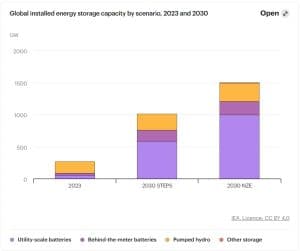
Source: IEA
This rapid growth requires battery deployment to rise 25% annually. Batteries are key, as they account for 60% of CO2 reductions in 2030, directly in EVs and solar PV, and indirectly through electrification and renewables.
Low-Cost Cathode Could Slash Lithium Battery Costs
A team led by Hailong Chen at Georgia Tech has developed a low-cost iron chloride (FeCl3) cathode for lithium-ion batteries (LIBs). This breakthrough could reduce electric vehicle (EV) costs, where batteries make nearly half the price. FeCl3 costs just 1-2% of traditional cathode materials like nickel and cobalt while delivering the same energy capacity, making it a game-changer for EVs and energy storage.
The FeCl3 cathode is not only cheaper but also provides higher voltage than popular alternatives like lithium iron phosphate (LiFePO4). Chen’s team aims to push for all-solid-state LIBs, which could improve safety and efficiency. This could also enhance large-scale energy storage and strengthen the power grid.
Chen’s research, which began in 2019, shows FeCl3 as a scalable and eco-friendly option. The team expects the technology to be commercially available within five years, promising to reshape EVs and renewable energy storage with lower costs and greater sustainability.
Source: Hailong Chen and research team, Georgia Tech
BESS Market Poised for Explosive Growth by 2030, A McKinsey Report
The Battery Energy Storage System (BESS) market is rapidly growing, creating a huge opportunity for investors and companies. In 2022, over $5 billion was invested in BESS, nearly tripling from the previous year.
- According to McKinsey, the global BESS market is projected to grow significantly, reaching between $120 billion and $150 billion by 2030—more than 2x its current size.
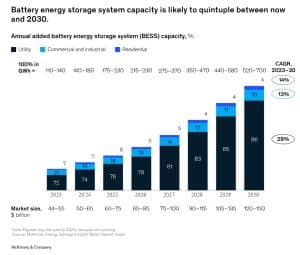 Source: McKinsey
Although the BESS market is expanding, it remains fragmented, leaving many companies uncertain about their next move. Now is the time for businesses to pinpoint the best opportunities and secure their position. With rising competition and increasing demand for renewable energy, companies must act swiftly to carve out their share of this booming market.
Key Strategies to Succeed in the BESS Market
McKinsey has come up with innovative solutions for companies to succeed in the dynamic BESS market:
They should focus on filling gaps in the value chain and prioritizing software development. System integrators can explore new opportunities by partnering with battery manufacturers, while battery makers can add integration services to target specific sectors. Additionally, investing in software that optimizes BESS performance will unlock larger markets and drive higher margins.
Strengthening supply chains and staying agile are also crucial. Companies need strategic partnerships and multi-sourcing options to manage supply disruptions. Smaller firms should act quickly, leverage their intellectual property, and take risks to stay competitive against larger players.
With global investments in BESS surging, reaching between $120 billion and $150 billion by 2030, companies need to identify the best opportunities and act decisively.

Source: McKinsey
Can the U.S. Dominate the Battery Energy Storage Market?
EIA has also estimated that U.S. battery storage capacity could increase by 89% by the end of 2024. This growth depends on developers bringing planned energy storage systems online by their intended commercial operation dates.
- Currently, developers aim to expand U.S. battery capacity to over 30 gigawatts (GW) by the end of 2024. This would surpass the capacity of petroleum liquids, geothermal, wood and wood waste, and landfill gas.
California and Texas dominate the battery storage market. California leads with 7.3 GW of installed battery storage, followed by Texas with 3.2 GW. Significantly, Vistra’s facility in Moss Landing, California, is currently the largest, with 750 megawatts (MW).
By 2025, developers expect to complete over 300 utility-scale battery storage projects across the U.S., with Texas accounting for about 50% of the planned capacity. The five largest battery storage projects set to come online in 2024 or 2025 include:
- Lunis Creek BESS SLF (Texas, 621 MW)
- Clear Fork Creek BESS SLF (Texas, 600 MW)
- Hecate Energy Ramsey Storage (Texas, 500 MW)
- Bellefield Solar and Energy Storage Farm (California, 500 MW)
- Dogwood Creek Solar and BESS (Texas, 443 MW)
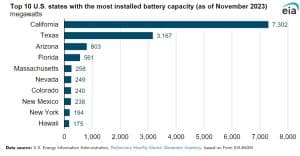 Source: EIA
With ambitious battery storage plans and declining costs, the U.S. is poised to achieve a cleaner, more reliable energy future, rapidly closing the gap with China.
- FURTHER READING: EV Wars and Breakthroughs: BYD to Overtake Tesla, CATL’s New Battery With 1.5M KM Range
The post EIA Expects Explosive Growth in U.S. Battery Storage—Can America Ascend to Dominance? appeared first on Carbon Credits.


Most businesses that decide to act on their net-zero targets reach the same point of friction. Buying carbon credits has meant tracking down brokers, sitting through sales calls, and requesting a quote just to learn a price, sometimes with limited proof of what you are buying.

The earnings calls that quietly reframed climate from sustainability question to operating risk.
Three earnings calls in the last 18 months tell the story without any help from a press release.
Hershey, May 2024: cocoa price exposure compresses margin, and the company attributes part of the cost shock to West African weather. Olam, July 2024: coffee climate exposure quantified in the annual report. JBS, January 2025: supply chain climate disclosures expanded materially in response to investor pressure and regulatory expectation. None of these companies issued the announcement as climate news. They issued it as financial news. The climate-linked supply chain risk did not arrive with a sustainability framing; it arrived as a P&L line.
You are probably reading this article because you suspect the same thing is happening to your business. This piece walks through what is showing up on which earnings calls, how procurement and finance leaders are quantifying the exposure, and what serious corporates are doing about it before the regulator asks.
Where climate risk has already appeared in earnings
The pattern is consistent across resource-intensive sectors. A weather event compresses supply, the price spikes, the cost flows through the income statement, and the analyst on the call asks whether the event is anomalous or structural. Increasingly, the honest answer is the second one.
Cocoa is the cleanest example. The 2023 to 2024 West African harvest fell sharply on the back of erratic rainfall and disease. Cocoa futures more than tripled. Companies with concentrated West African sourcing absorbed the cost; companies with diversified sourcing absorbed less. The exposure was not climate as ESG topic. It was climate as cost of goods.
Coffee follows the same pattern. Brazilian and Vietnamese harvests have moved on weather more sharply across the last several seasons. Roasters with long-tenor supplier relationships and origin diversification have managed the volatility; roasters with spot-market exposure have not. Wheat, sugar, palm oil, beef: the same dynamic in different commodities, a pattern the IPCC AR6 Working Group II report projects will intensify across agricultural systems through mid-century.
What this means: climate risk is no longer a footnote in the 10-K. It is a line item the CFO has to explain on the call.
The three commodity exposures that hit margin first
For most companies with material Scope 3 exposure, three exposures dominate the near-term P&L risk.
- Concentrated single-origin sourcing in a climate-vulnerable region. If your tier-one supply for any material commodity sits in one geography, you have a concentration risk that climate amplifies. Diversification across origins is the obvious hedge, but it takes years to build and requires relationships you cannot acquire by tender.
- Supplier financial fragility under climate stress. Smallholder farmers, who supply a large share of the global cocoa, coffee, and palm oil market, do not carry the balance sheets to absorb yield shocks. When yields collapse, they exit. When they exit, your supply base shrinks, and the surviving suppliers raise prices. The risk is structural, not cyclical.
- Logistics and storage exposure to extreme weather. Hurricane disruptions to Gulf shipping, drought-driven Panama Canal restrictions, flooding in European inland waterways: each of these has moved input costs in the last three years, a pattern documented in Munich Re’s natural catastrophe data. The exposure shows up as a one-quarter event in the financial press but accumulates over time on the cost line.
TCFD and ISSB disclosure changes
The disclosure architecture has now caught up with the risk. The Task Force on Climate-related Financial Disclosures, whose recommendations are now embedded in the ISSB’s IFRS S2 climate standard, requires companies to disclose climate-related risks across physical and transition categories, with quantification where possible.
For physical risk specifically (the climate-linked supply chain risk you are reading about), the disclosure must address both acute exposures (extreme weather events) and chronic exposures (gradual changes in temperature, precipitation, and growing seasons). The disclosure must address the time horizon over which the risk is material, the parts of the value chain exposed, and the financial impact under different scenarios.
The CSRD imposes similar requirements under European law, with double materiality (both financial and impact materiality) embedded in the assessment. The practical effect: your auditors and your investor relations team now need a defensible answer to the climate-linked supply chain risk question, and the answer needs to be quantified.
What procurement and finance can do now
Three actions matter near-term.
Map your exposure. Most companies do not have a clear view of which tier-one and tier-two suppliers sit in which climate-vulnerable geographies. Without the map, you cannot quantify the risk, and without the quantification, you cannot disclose it credibly. The map is the foundation, and World Resources Institute climate risk research provides useful public tooling to start.
Diversify and deepen, in that order. Diversification across origins reduces concentration risk, but the deeper move is to invest in the resilience of the suppliers you already have. Regenerative practices, agroforestry, soil health interventions: these reduce yield volatility under climate stress and protect your input cost trajectory.
Embed the climate spend inside procurement, not outside it. Treating climate risk as a sustainability cost line subordinates it to the ESG budget. Treating it as a procurement and resilience investment puts it in the budget that matters, which is the cost-of-goods budget that the CFO defends quarterly.
Nature-based supply chain investments are the asset class designed for exactly this purpose. They sit inside the value chain, they reduce climate-linked supply risk, they generate verifiable Scope 3 reductions, and they produce the documentation an auditor and a regulator can both test.
If you are quantifying climate-linked supply chain risk in advance of the next earnings cycle or the next disclosure period, the carbon and sustainability experts at Carbon Credit Capital can help you map your exposure and structure a Dual-Value Model response that addresses reduction, resilience, and disclosure-readiness in a single program. Schedule a consultation.

More and more small and medium-sized businesses are hearing the same question from their larger customers: What is your carbon footprint? That question now travels down entire supply chains, and it arrives next to tender requirements, certification criteria, and rising customer expectations.




-
Climate Change1 year ago
Guest post: Why China is still building new coal – and when it might stop
-

 Greenhouse Gases2 years ago
嘉宾来稿:满足中国增长的用电需求 光伏加储能“比新建煤电更实惠”
-
Greenhouse Gases1 year ago
Guest post: Why China is still building new coal – and when it might stop
-

 Climate Change2 years ago
嘉宾来稿:满足中国增长的用电需求 光伏加储能“比新建煤电更实惠”
-

 Renewable Energy11 months ago
Sending Progressive Philanthropist George Soros to Prison?
-
Climate Change2 years ago
Bill Discounting Climate Change in Florida’s Energy Policy Awaits DeSantis’ Approval
-
Greenhouse Gases1 year ago
嘉宾来稿:探究火山喷发如何影响气候预测
-

 Carbon Footprint2 years ago
US SEC’s Climate Disclosure Rules Spur Renewed Interest in Carbon Credits