Connect with us

Published

on

What do you get when you cross kids with paintbrushes and a passion for environmental change? You get ‘artivism’ – a powerful blend of art and activism that can transform hearts and minds.

At Greenpeace, we are always inspired by the power of art to drive change and make a difference. We are thrilled to showcase the incredible ‘artivism’ from the students of Living School Lismore. These young artists have not only embraced the challenge of advocating for nature but have done so with creativity and passion that truly embodies the spirit of environmental stewardship.

Living School strives to offer educational opportunities that fosters and nourishes responsible citizens who make positive contributions to our world. The Middle School students engaged in Project Based Learning Units, exploring Sustainable Development Goals, real world application and a focus on halving our impact across six terms. After the second term, where all students in the school have an in-depth focus on ‘Nature’, they hosed a Nature Symposium – this year marks the second year of Middle School and their second symposium.

Last year, students developed innovations to halve environmental crimes occurring in schools. This year, they worked through the Catalyst Design Thinking Framework to respond to the evocation, ‘How can we advocate for nature through art-ivism?’. These artworks and artist statements were created over just two days, in a hack-a-thon style event, supported by a local artist, staff and cross stage groupings.

Inspiring Artworks by Students from Living School Lismore

“The students’ energy throughout the event was palpable, they are so confident in their determination to call out unsustainable practices which translated powerfully to the variety of artworks created.”

Emma Wilson – Year 8 Guardian Teacher, Living School Lismore


Evermore - Indigo and Jordy © Living School Lismore
Evermore – Indigo and Jordy © Living School Lismore

Evermore

Indigo and Jordy

This art piece is about SDG14: Life Below Water. It is about the environment and the future that is deserved. Not for humans, but for the nature and animals surrounding us. In this painting, you will see the animals clawing at the globe of a future that they not only want, but deserve. The globe is cracking and breaking to show that it could be close. And that the animals really need this. We are hoping this sends a message to the viewers, that society’s consumption is a big role in the prevention of the future for nature that has been tainted to something humans want.


We Choose - Stella and Marli
We Choose – Stella and Marli © Living School Lismore

We Choose

Stella and Marli

Pollution is slowly consuming our oceans and after a while, we will have nothing left. When we disrespect, we get left with less than we had before. ‘We Choose’ is our art piece that represents pollution and beauty. We see the ocean and think of it as an amazing place. But will it be in the future? This is what is happening to our world. We used brown to represent dirty liquid in the water, we used green to represent toxic fluids and pink because it represents the blood that will be on our hands if this continues.

We also used dots to represent the lives that will be lost. If this continues, this will be the path to humanity’s extinction. But if this stops, we will see the true beauty of this world. For the beauty, we used the sea creatures to represent how much marine life will be saved. We used the seaweed to show how much the plants under water will thrive. Be caring, love the planet.


Oil Spill - Strummer © Living School Lismore
Oil Spill – Strummer © Living School Lismore

Oil Spill

Strummer

This artwork, titled ‘Oil Spill’, addresses Sustainable Development Goal 14 and 15 which focuses on land and water. The artists chose to advocate for halving our impact to stop pollution.

This artwork highlights the critical role of art in raising awareness about environmental decline, resulting in the loss of animal, earth and plant life.

Through the use of various elements of art, the artist conveys the message of environmental awareness and stewardship. Contrasting colours are used to highlight the beauty of nature and its rapid demise.


Plastic Ocean - Kai © Living School Lismore
Plastic Ocean – Kai © Living School Lismore

Plastic Ocean

Kai

This artwork, titled ‘Plastic Ocean’, addresses Sustainable Development Goal 15 which focuses on marine life. The artist chose to advocate for halving our impact on the pollution of the environment. This highlights the critical role of art in raising awareness about environmental decline resulting in the loss of animal homes and lives. Contrasting colours are used to highlight the beauty of nature and draw the audience’s eye.


Eye to Eye -Marlon
Eye to Eye – Marlon © Living School Lismore

Eye to Eye

Marlon

This artwork, titled ‘Eye to Eye’, addresses Sustainable Development Goal 14 which focuses on cleaning plastics from the ocean and making the coral not bleached anymore. The artist chose to advocate for halving pollution. ‘Eye to Eye’ highlights the critical role of art in showing people the effects of pollution on our ocean and what we can do about it. By drawing the audience’s eye to the fish, the artist invites them to consider the importance of marine life. By positioning the contrasting elements of life and death around the outside of the eye, the audience is invited to consider our impact.
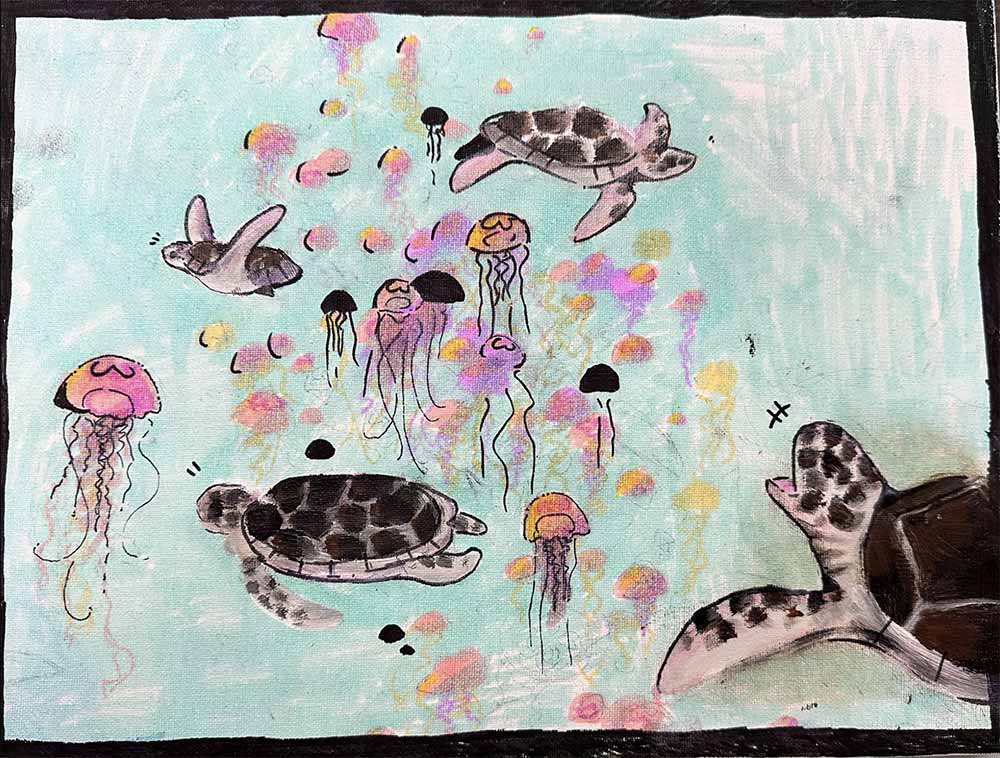

Wild Sea Turtles Consuming Jellyfish
Koco
Wild Sea Turtles Consuming Jellyfish – Koco © Living School Lismore

Wild Sea Turtles Consuming Jellyfish

Koco

My artwork depicts wild sea turtles consuming jellyfish but sadly, due to human impact, they end up ingesting plastic bags. The scene serves as a powerful reminder of humanity’s effects of pollution on marine life. It highlights the urgent need for sustainable practices to protect our oceans and the creators that inhabit them. By raising awareness through art, we can inspire others to take action and make a positive impact on SDG 14.


I Want In My World - Destin © Living School Lismore
I Want In My World – Destin © Living School Lismore

I Want In My World

Destin

The painting, ‘I Want In My World’ was created by a Living School student in Year 7 named Destin Pacanowski. The artwork addresses Sustainable Development Goal 14, which focuses on healthy creeks, lakes, oceans and rivers. Not only focusing on them being healthy but being full of life as well. The artist identifies halving pollution as a crucial step to mitigating the impact on ocean pollution.

This artwork underscores the critical role of art and raising awareness about climate change. Art-ivism has a unique ability to evoke emotions and provoke through in ways that words alone cannot. By visually depicting the effects of pollution and the major importance of sustainable practices, artists can engage viewers on a much deeper level, fostering empathy and understanding.

Through the use of various elements of arts, the artist conveys a message of environmental stewardship. Light and dark colours are embraced to show both sides of the situation in this artwork. The depth is used to show a dark night sky.

By promoting the message of reducing pollution, the artwork strives to inspire viewers to take immediate actions towards sustainability. Overall, this artwork shows a visual call to action. Embracing individuals to make continuous choices that will positively impact the environment and support those most affected by pollution all around the world.


Evacuations - Annika © Living School Lismore
Evacuations – Annika © Living School Lismore

Evacuations

Annika

This piece of artwork is called, ‘Evacuation’. It is named after what is bound to happen if we don’t change our ways. ‘Evacuation’ was carefully crafted by a proud Year 8 student of Living School. It was painted to represent the pollution Halve It goal and to evoke the 13th SDG, Climate Action.

This piece shows what we will do to nature, our home planet, it we continue down this path. The earth cannot combat our advanced machinery and corrupt wats, Nature has no weapon to fight. We pillage and plunder the very thing that gives us life. This picture is showing our fate. There is NO Planet B!

Through this art, with all its many dark shades, I wish to evoke something within the viewer, whether it is anger, sadness, pain or power, something to push them. Push them to speak for the speechless, stand for the sat, empower the powerless, because now is when our earth needs us most. If we don’t answer her call, all our fates will be sealed.


Mining Monsters - (Year 5 Student), (Year 6 Student), Lucy © Living School Lismore
Mining Monsters – (Year 5 Student), (Year 6 Student), Lucy © Living School Lismore

Mining Monsters

(Year 5 Student), (Year 6 Student), Lucy

This wonderful painting was created by three of the Living School’s amazing artists, (Year 5 Student), (Year 6 Student) and Lucy. Our SDG goal is number 14 – Life Below Water. Out artwork was inspired by the wonderful work that Greenpeace has done in relation to preventing deep sea mining.

The artwork explores the problem of deep sea mining where humans are wanting to extract the valuable natural resources that are found on the deep sea floor, which would destroy ecosystems that we don’t know much about yet. We are unsure of the impact this will have but prediction from the past example would suggest that this would have a negative effect.

We have used the element of shape to show that the machine is a monster to be feared of destroying sealife’s home. The element of colour has been used to show the bright life of the deep sea, even though you imagine it to be dark and frightening.

We hope our art-ivism helps the ecosystem of the deep sea to continue to thrive.


Burning Sunset - Year 5 Students
Burning Sunset -Year 5 Students © Living School Lismore

Burning Sunset

Year 5 Students

SDG 13: Climate Change/Stop burning fossil fuels
Halve It: Environment

This artwork show trees being burnt down. It shows birds dying and falling from smoke. It shows the forest turning into a desert under the setting sun.

The artist used red, orange and pink to show dryness and heat. Purple and green to show life that cannot be replaced. Black to show sadness.

The message of the artists: ‘This life can’t be replaced.’


One Day - (Year 8 Student), Allie © Living School Lismore
One Day – (Year 8 Student), Allie © Living School Lismore

One Day

(Year 8 Student), Allie

This work of art is called, ‘One Day’. It was made by a group of talented Australian students who attend Living School in Lismore, NSW. This art is based on SDG 12, Responsible Consumption and Production.

This art piece is about the pollution that could happen in the future and global warming. The rough state of the paint encapsulates this art piece, this distinct style showing how this matter is real. Using palette knives and plastic with acrylic paint is a match that many ised ut it hard to get right.

The elements of this art is the hape language and the depth of the deep ocean and the ice using shapes and depth, this art piece truly comes to life.

This art piece was made in protest of pollution that happens in the arctic, with grand glaciers and icebergs alike starting to melt, many may write about the diverse wildlife or the arctic circles. We hope that people realise how greedy and horrible some companies are.


The Weeping Orca - Eve, Pearl, Ashley © Living School Lismore
The Weeping Orca – Eve, Pearl, Ashley © Living School Lismore

The Weeping Orca

Eve, Pearl, Ashley

Three intelligent students from Living School, Eve, Pearl and Ashley, currently in Year 5 and 6, are the creators of this awesome art work. We chose SDG 14, Life Below Water. Our artwork is inspired by the National Wildlife Federation. Our Halve It focus relates to the environment.

Our artwork is intended to help the healthy orcas in captivity. Orcas are being removed from the natural environments and placed in captivity for the purpose of human entertainment. This is extremely distressing for the animals and it also affects the vital food chain. Humans need to stop taking healthy orcas out of nature and into captive homes.

We have experienced with dark contrast colours, different strategy of shade, intense levels of depth, layering different types of textures and elements that draws in the viewer and uts the viewer in the experience of the orcas in need. This is intended to make them sad.

We hope our art-ivism will make people step into action and stop people from captivating safe and healthy orcas from their natural habitats.

If we help the orcas, we save the orcas. Start acting now.


Beauty and the Barrel - Ari and Theo © Living School Lismore
Beauty and the Barrel – Ari and Theo © Living School Lismore

Beauty and the Barrel

Ari and Theo

This artwork, ‘Beauty and the Barrel’, was created by Ari and Theo at Living School who are in Year 5 and 8. The artwork addresses Sustainable Development Goal 14, which focuses on Life Below Water. The artist chose to advocate for halving water, which is a critical step towards minimising human impacts on water ecosystems. Oil spills and dumping oil can kill beautiful creatures in our sea, We are trying to look after our environment. We have strong feelings and are passionate for the ocean’s future.

We like fishing and snorkelling and observe amazing sea creatures. Now we see less fish, we are disappointed. Through the use of various elements of art, the artists convey a message of environmental compassion. Ocean colours make us feel calm and emphasis the beauty of the sea, the need to look after sea creatures in our hearts. Textures and a variety of colours emphasise the complexity of the ocean and its ecosystem. We have promoted awareness of keeping the ocean clean and pristine. Overall, this artwork serves as a visual recall for the urgency of rewilding and cleaning up the oceans and our planet.


Choose Your Fate - Teo, Stella and Siân © Living School Lismore
Choose Your Fate – Teo, Stella and Siân © Living School Lismore

Choose Your Fate

Teo, Stella and Siân

This artwork, ‘Choose Your Fate’ is by Teo, Stella and Siân of Living School Year 8 and Year 7. The artwork addresses Sustainable Development Goal 15 which is about Life on Land and Halve It Goal of environment. The artists chose to bring attention to deforestation and protecting animals.

This artwork conveys the importance of raising awareness about climate change through art. Art has a way to provoke thoughts that words alone can not do. By depicting the effects of climate change visually, you can give viewers a deeper level of understanding and empathy.

The amazing artists used line, shape, colours, texture and space to bring their painting to life. The artists focus on animal protection is shown through two extremely contrasting perspectives of a positive and negative environment.

The artwork hopes to inspire viewers to take action and protect life on our planet and minimise climate change. Due to the extreme and confronting views of the environment, the artists believe that this artwork can make a change.

Overall, this artwork encourages individuals to take action and make a positive impact on the environment to help save our home.


Our Touch - Jali and (Year 5 Student) © Living School Lismore
Our Touch – Jali and (Year 5 Student) © Living School Lismore

Our Touch

Jali and (Year 5 Student)

Do we choose rising oceans or rising actions?

‘Our Touch’ was created by two students at the Living School in Year 5 and Year 8. With the challenges of climate change becoming more apparent and the number of climate refugees increasing, this artwork advocates for Sustainable Development Goal 13, Climate Action. This artwork highlights the effects of rising sea levels caused by pollution, halving pollution is a vital step towards minimising climate change impacts.

The most visible meaning in this artwork is to raise awareness around rising sea levels. However, the underlying goal is to show people that one person can make big differences, especially in a time of crisis. The artists hope that ‘Our Touch’ brings the viewers emotions of empowerment through the uniqueness of art.

Elements of art are regularly used in this artwork. The vivid colour of the nail art draws attention to the disaster depicted. The dark sharp lines of the skyline give perspective and contrast against the vibrant but fading sun.

Promoting the message of halving pollution to reduce global warming and rising sea levels, this artwork is a form of art-ivism. With the hand decorated as the earth, the artwork hopes to show that climate change doesn’t just hurt one person, it hurts the whole world, and inspires everyone to take action.

In all, ‘Our Touch’, provides a visual call to action and empowerment. As the world continues on this negative downward spiral, we must come together to create an impact.


Earth Away- (Year 5 Student) and Sage © Living School Lismore

Earth Away

(Year 5 Student) and Sage

This artwork, ‘Earth Away’, was created by two students at Living School in Year 5 and Year 8. They address Sustainable Development Goal 13 which focuses on Climate Action. The artist chose to advocate for halving pollution which is a crucial step towards sustainability and a healthy environment.

The artwork, ‘Earth Away’, aims to promote awareness around climate action. Art has the unique ability to evoke emotions and inspire other artists. Through the use of various elements of art, blending lines, colour and texture, we promote the message of climate action. We tried to use the same colours as how they look in real life. We feel passionate about the future of our earth.

Overall, this artwork serves as a visual call to action, urging individuals to make conscious choices that will eventually help the earth if we all start now. We want to have a positive impact on our future.


Not a Perfect World - Rose, Lui, Vaan, Scarlet, Banksia © Living School Lismore
Not a Perfect World – Rose, Lui, Vaan, Scarlet, Banksia © Living School Lismore

Not a Perfect World

Rose, Lui, Vaan, Scarlet, Banksia

This artwork, ‘Not a Perfect World’, was created by five students at Living School in Year 5, Year 6 and Year 7. The artwork addresses Sustainable Development Goal 14, which focuses on Life Below Water. The artists chose to advocate for halving pollution, which is a crucial step towards the earth.

This artwork underscores the critical role of art raising awareness about climate change. Art has a unique ability to evoke emotions and make viewers feel passion about the painting. Through the use of various elements of art, blending the paint together and adding texture to our painting.

By promoting the message of the knowledge that there is too much pollution in the water and turtles are dying. Overall, this artwork serves as a visual call to action, uring individuals to make conscious choices that will help the environment to build a sustainable life.


Don’t Blame, Make Change - Archie and Max © Living School Lismore
Don’t Blame, Make Change – Archie and Max © Living School Lismore

Don’t Blame, Make Change

Archie and Max

The artwork, ‘Don’t Blame, Make Change’, was created by two students at Living School in Year 6. The artwork addresses Sustainable Development Goal 13, which focuses on Climate Action. The artists chose to advocate for halving pollution and waste which is a crucial step towards a healthy and sustainable ecosystems here on earth.

This artwork aims to provide awareness around critical concepts surrounding climate change and the health of our environment. Evoking emotion can be a difficult take to achieve but art can empower emotions.

Through the use of various elements of art, such as line, colour, shape and collage, we promoted the message of climate action and to stop pollution which will lead to a healthy and sustainable earth.

Overall, this artwork serves as a visual call to action, urging individuals to make conscious choices that will save the world.


Stop Being A Tosser - Linny © Living School Lismore
Stop Being A Tosser – Linny © Living School Lismore

Stop Being A Tosser

Linny

I created ‘Stop Being A Tosser’ with my own hand power alone. The artwork addresses SDG 6 which focuses on Clean Water and SDG 14, Life Below Water.

I chose water as my Halve It focus because I love the ocean and fishing. We will destroy the environment if we do not care for our oceans.

I have used colour to show depth and to draw attention to the issue of water pollution.

I aim to inspire viewers to save the waterways and stop being a tosser.


Wasted - Floyd and Sally © Living School Lismore
Wasted – Floyd and Sally © Living School Lismore

Wasted

Floyd and Sally

This artwork, ‘Wasted’, was created by Floyd and Sally, Year 7 and Year 8 students from Living School. We chose the SDGs 11, 13, 14 and 15 – Sustainable Cities and Communities, Climate Action, Life Below Water and Life on land. We chose to focus on pollution and environment in regards to Halve It.

We tried to evoke emotion through overwhelming the viewer with as many climate problems as we could.

Our clouds, oil and leaves are full of texture and the strong lines of the boat and buildings were designed to stand out.

Our aim was to inspire viewers to start being aware of themselves and to stop polluting and destroying the planet.


Fish Plastic Cycle - Toto and Theo © Living School Lismore
Fish Plastic Cycle – Toto and Theo © Living School Lismore

Fish Plastic Cycle

Toto and Theo

This artwork, ‘Fish Plastic Cycle’, was created by Theo and Toto, two smart Year 5 students from Living School.

The artwork focuses on SDG 13 and 14, which are Climate Action and Life Below Water. The Halve It focus is pollution and water.

We painted the cycle of throwing plastic in the water, the fish eat it, then we eat the fish.

We used elements of art to make the viewers feel emotions. We used bright colours for the plastic so it stands out. We also used big, simple shapes to create attention.
Through our artwork, we hope to inspire people to buy reusable products and not throw rubbish in the ocean.

Overall, this artwork aims to bring awareness to plastic pollution and how our actions always impact us.


More Rubbish, Less Life - Alexa and Kotomi © Living School Lismore
More Rubbish, Less Life – Alexa and Kotomi © Living School Lismore

More Rubbish, Less Life

Alexa and Kotomi

This artwork, ‘More Rubbish, Less Life’, was created by Alexa and Kotomi, two Year 5 students from Living School. The work addresses SDG 14 – Life Below Water and we chose to focus on Halve It – Environment.

We chose to paint a turtle half happy, half sad and what the ocean could be and what it is now.

We used colour, shade and hue to show the bright side and the dark side of this story.

Through our artwork, we hope viewers will know what the world could be if we actually tried.


I Scream, You Scream, We All Scream For Action! - Minnie and (Year 6 Student) © Living School Lismore
I Scream, You Scream, We All Scream For Action! – Minnie and (Year 6 Student) © Living School Lismore

I Scream, You Scream, We All Scream For Action!

Minnie and (Year 6 Student)

This artwork was created by Minnie and (Year 6 Student), a Year 8 and Year 6 students. We chose two Sustainable Development Goals, 13 – Climate Action and 4 – Quality Education. 13 was chosen to represent the melting ice caps killing polar bears. This is why we added the melting ice-cream, making a reflection for the earth and polar bear. 4 was chosen because it is crucial to teach everyone, especially our future generations, what is really happening to the world so that we can SCREAM for action. For Halve It, we chose environment because of our heating planet and melting ice cape.

The elements of art that we used were texture for the polar bear’s fur and rippling water. Colour to show shade and hues. All of this makes you stop and stare, inspiring the viewers to try and do something. Overall, this artwork aims to make you feel wonder and urgency to do something about our melting planet.


The Last Penguins - Loretta, (Year 8 Student) and Indi © Living School Lismore
The Last Penguins – Loretta, (Year 8 Student) and Indi © Living School Lismore

The Last Penguins

Loretta, (Year 8 Student) and Indi

The people involved in this creation are, Loretta, Lorien and Indi. We are addressing SDG 14, Life Below Water in this painting. Our Halve It focus is a cross between pollution and environment.

We have tried to evoke emotions in this painting by showing that the ocean is getting filled with things like oil spills, which in turn, is killing the penguins and sea life.

In the sky and the top of the wave, we have used texture, tone and colour to blend it and make it seem more real. We used very well defined shapes for penguins.

We aim to inspire viewers to donate to foundations like Sea Shepherd and Greenpeace and also to reflect on their own impact on the ocean ecosystem, which they don’t usually see in everyday life.

All in all, we aim to raise awareness of the oceans fate with this painting.


Deadfish Dominoes - Piper, Miles, Kasper, Wolfie © Living School Lismore
Deadfish Dominoes – Piper, Miles, Kasper, Wolfie © Living School Lismore

Deadfish Dominoes

Piper, Miles, Kasper, Wolfie

This piece of art titled, ‘Deadfish Dominoes’, was created by four Year 7 students, Piper, Miles, Kasper and Wolfie. This artwork was created to highlight the importance of SDGs 6 and 14. These foals focus on the health of water. 6 being Clean Water and Sanitation and 14 being Life Below Water.

This artwork showcases the disaster that took place in the Murray-Darling river, where thousands of Murray Cod floated up to the surface, dead due to the lack of oxygen. This piece also shows the steps that have been taken to get to this point. And the steps that may well be taken if we don’t change our course. Black water events, such as these, cause detrimental effects to the river, causing many plant and animal life populations to rapidly deplete, causing negative effects to the environment and sanitation of the water system.


Unstable Reality - (Year 8 Student) © Living School Lismore
Unstable Reality – (Year 8 Student) © Living School Lismore

Unstable Reality

(Year 8 Student)

This piece, ‘Unstable Reality’, was designed by a Year 8 students of Gudji. It is focused on SDG 13 Climate Action.

It shows how the world is majority industries and factories, even though we are working towards sustainability and renewables, it shows how the industry need to set fire to fossil fuels and eliminate greenhouse gasses for a greener, better world.


The Plale - (Year 8 Student) © Living School Lismore
The Plale – (Year 8 Student) © Living School Lismore

The Plale

(Year 8 Student)

This wonder of art was designed by a Year 8 students of Gudji at Living School. This follows a work of art-ivism of Sustainable Development Goal 14. Goal 14 is a goal dedicated to protecting and conserving our wildlife in the ocean. Many companies dedicated to work and volunteer to help them.

This texture of this artwork features a bumpy, raised body, showing that the body of the whale is made out of plastic. The background shows the polluted water because of our litter and machines. Leaving rubbish on our floor drains into our oceans and hurts our wildlife underwater.

This artwork has been through decent layers to create a shaping effect of the crumbling plastics qualities.


Ocean In A Bottle - (Year 8 Student) © Living School Lismore
Ocean In A Bottle – (Year 8 Student) © Living School Lismore

Ocean In A Bottle

(Year 8 Student)

This design was created by a Year 8 member of Gidji from Living School. This work of art is a work of art-ivism of SDG 14. Sustainable Development Goal 14 focuses on Life Below Water. Helping save animals and protect them from rubbish and our pollution.

This design shows our animals being trapped within our bad creations and fast fashion. Plastics like the plastic bottle the whale and jellyfish are stuck in is rubbish that has blown into our drains and washed into our oceans.

This shows materials from on land and the sea. To design this masterpiece, there were uses of paint brush strokes intricately placed to change the colours and placement of shape.


Gudji Fruit Farms - Flo © Living School Lismore
Gudji Fruit Farms – Flo © Living School Lismore

Gudji Fruit Farms

Flo

This artworks focuses on bees being killed by pesticides which is a huge problem. Bees are a huge part of life. They pollinate flowers which can bloom into fruit and vegetables. 1 in every 3 bites we get from bees. When people use pesticides and a bee lands on the flower, the pesticide infects the bee.

When the bee goes back to the hive, the entire hive can become infected, causing the bee keeper to burn the hive and all the bees inside to stop infection from spreading to other hives. Every bee who lands on a flower infected with pesticide is another life lost. You may think, so what if bees are dying? Well, as hive after hive dies, we, along with bees, creep closer to extinction.


Koala - Willow, Marley, Ryder, Banjo © Living School Lismore
Koala – Willow, Marley, Ryder, Banjo © Living School Lismore

Koala

Willow, Marley, Ryder, Banjo

We have made this artwork to show the impacts of climate change on species like koalas, mainly in southern and eastern Australia. Global warming can make bushfires that burn down koala habitats and more.

We are chopping too many trees.

Feral cats and dogs can kill native wildlife. There are unsustainable practices of forestry all around Australia.

If koala’s homes are burned or chopped down, it will force it to move to another home but what if there isn’t another home to go to and trying to get to another home means crossing roads so it could get run over?

Forestry corp has a history of doing some illegal forestry. They used to cut down habitats and trees! Why do these companies do this? We can have a house but by giving us a house you give native animals from Australia no house.


Split Rivers - Javier, Araluen, (Year 6 Student), (Year 5 Student) © Living School Lismore
Split Rivers – Javier, Araluen, (Year 6 Student), (Year 5 Student) © Living School Lismore

Split Rivers

Javier, Araluen, (Year 6 Student), (Year 5 Student)

This diptych artwork was made by four students from Living School in Years 5 and 6. We had two students working on each painting. We decided to split the image across two canvases to show the polarity between how the earth could be, and the way we are currently going.

Our art addresses both sustainable development goal 14 and 15, Life Below Water and Life on Land. They are linked because the health of the land impacts the water and the health of the water impacts the land. We wanted our audience to realise that our beautiful country can become a wasteland if we don’t take charge.

Overproduction of oil, chemical and rubbish pollution, land clearing and other unsustainable practices are destroying the health of our rivers. We want our artwork to inspire people to consider the effect of their choices on the land. If we don’t, we will all face the consequences.


The Silver River - Cooper © Living School Lismore
The Silver River – Cooper © Living School Lismore

The Silver River

Cooper

‘The Silver River’, by Year 5 student Cooper, addresses issues around waterway protection.

This artwork highlights the importance of SDG 14, Life Below Water because there is pollution and goodness.

This artwork uses glitter to add texture but also represents the glittery nail polish that impacts our waterways. It shows the oil pollution that coats animals in toxic oil forever. It also bleaches things and kills trees.

It also places importance on the Halve It goal of water, which we need to protect.
The use of lines show the flow of water.

We MUST stop the use of oil and production of cars, unless they are hybrid.

STOP WATER POLLUTION NOW!!


Fish-dom - (Year 8 Student) and Zai © Living School Lismore
Fish-dom – (Year 8 Student) and Zai © Living School Lismore

Fish-dom

(Year 8 Student) and Zai

This artwork was illustrated by to young 13 and 12 year old boys at Living School. The painting named ‘Fish-dom’ outlines the tench Sustainable Development Goal which focuses on Life Below Water, as in fish, crustaceans and other species of water animals and plants.

(Year 8 Student) and Zai decided to end up on Life Below Water because of the overfishing problems in Australian rivers and oceans.

Through the various elements of art and details of the painting, the illustrators centered the focus on the differences of sides, which is sustainable and unsustainable.


You Are Here - Molly and Indie © Living School Lismore
You Are Here – Molly and Indie © Living School Lismore

You Are Here

Molly and Indie

This artwork was created by Molly M in Year 5 and Indie H in Year 6. We created this artwork of a statue in Lismore in the floods. We chose it because we are sick of our community going through the same terror every year and seeing people lose so much while the government does so little. The floods of 2022 left hundreds of people homeless and some people lost family members and pets.

We want our community to understand how much rubbish we are dumping in our river and how climate change will make natural disasters words. We are commenting on SDG 13, Climate Action. We want to Singapore our leaders to realise how important it is to make change and make sure we don’t leave anyone behind.


Enclosed - Mia, (Year 7 Student) and Eavie © Living School Lismore
Enclosed – Mia, (Year 7 Student) and Eavie © Living School Lismore

Enclosed

Mia, (Year 7 Student) and Eavie

This artwork was created by Mia in year 7, (Year 7 Student) and Eavie in Year 8 from Living School. We are addressing waterways health and Sustainable Development Goal 14: Life Below Water. We created this artwork to show that keeping animals captive is not ok.

Removing them from ecosystems has a real negative impact on the planet, The real question is, why DO we keep animals captive? The answer is simple, for our own entertainment and greed. How would you feel is someone took you from your home where you were free to roam and put you in a tiny little box?

You aren’t just stripping the animals of a good life, you are disrupting the environment they were in. This artwork was designed to spread awareness about how the animals must feel, and make a statement about the impact of humanity’s greed.

I Scream, You Scream, We All Scream For Action!

Continue Reading

Climate Change

The UN climate process was built for negotiation – now it must support implementation

Published

on

By Paul Watkinson, Stefan Ruchti-Crowley, Anju Sharma, Ovais Sarmad and Benito Müller.

In the corridors of the World Conference Centre in Bonn, where the June Climate Meetings (SB64) will conclude on Thursday, the need for change is palpable.

Delegates are grappling once again with overcrowded agendas, growing demands on limited negotiating time, external geopolitical pressures that reverberate internally to test the limits of a consensus-based process, and concerns over its future financial sustainability.

Bonn Bulletin: Finance row threatens to scupper work on adaptation goal

There is growing frustration with a process that consumes vast amounts of time to produce outcomes that are often too incremental to match the accelerating reality of the climate crisis.

The climate regime has delivered. But it is in danger of not delivering enough.

More effective multilateralism

There is no denying the successes of the UN climate process. Over three decades, the UN Framework Convention on Climate Change (UNFCCC), the Kyoto Protocol and the Paris Agreement established a universal framework for climate action, created transparency and accountability mechanisms, and sent powerful signals to governments, businesses and investors.

Thanks in large part to this framework, the world is no longer on a trajectory of more than 4°C of warming, clean technology costs have fallen dramatically, and participation in the global climate effort remains nearly universal.

Yet, global temperatures continue to break records. Climate impacts are intensifying across every region. The world remains far off track to achieve the goals of the Paris Agreement. As warming approaches – and may exceed – 1.5°C, every additional fraction of a degree brings greater losses of lives, livelihoods and ecosystems, with the greatest burdens falling on the most vulnerable countries and communities.

    We remain convinced that the answer to the climate crisis is not less multilateralism, but more effective multilateralism.

    The hard truth is that the UNFCCC remains largely organised around the logic of treaty-making, while the central challenge of climate action has shifted to implementation. A process designed to negotiate agreements and deliver decision text as the outcome is now required to support implementation on the ground—and it is struggling.

    There is a structural mismatch between what the climate process was designed to do, and what it needs to do now.

    Consultations on reforms

    Discussions on the urgency of reform are widespread and no longer confined to the margins. Formally, the Arrangements for Intergovernmental Meetings (AIM) process is exploring ways of improving the efficiency and effectiveness of the process.

    The UNFCCC Executive Secretary has also convened a High-Level Informal Consultative Roundtable for strategic reflection on how to strengthen the complementarity between the intergovernmental process and action in the real economy.

    Defending multilateralism today requires adapting it.

    The good news is that meaningful reform does not require reopening treaties, renegotiating the Paris Agreement, or indeed even resolving long-standing differences on the Rules of Procedure to change the consensus rule. Stefan Ruchti-Crowley and Paul Watkinson’s recent paper for ecbi (European Capacity Building Initiative), Quo Vadis COP? Reforming UNFCCC Sessions to Improve Negotiations and Support Implementation, outlines a practical toolbox of four reforms that can be pursued within the existing institutional framework.

    First, the process must improve its agendas.

    The formal process is burdened by crowded agendas and overlapping workstreams. Consolidating agenda items under broader thematic pillars (such as mitigation, adaptation, finance and transparency); developing good practices for agenda adoption; removing legacy “ghost” items; and concluding outstanding business on the Kyoto Protocol will create more space for substantive discussions and implementation.

    Second, the process must organise its work more strategically.

    The climate process currently attempts to address nearly every issue at every session. A more strategic approach would use thematic multi-year programmes of work; better align review cycles and timelines; improve coherence across the many bodies and processes that have accumulated over time, often to the extent that even insiders have lost oversight; and also make better use of inter-sessional and pre-sessional meetings.

    Third, the process must focus more deliberately on implementation.

    Critically, not every challenge requires a negotiated outcome. Negotiations should focus on issues that genuinely require collective decision-making. Other discussions should prioritise learning, cooperation and practical problem-solving.

    Existing formats such as Talanoa Dialogues, roundtables and other facilitative approaches should be expanded. Likewise, the Enhanced Transparency Framework should become a stronger mechanism for mutual learning and accountability rather than a largely procedural reporting and “box-ticking” exercise.

    Fourth, the process must make structural changes and broaden participation.

    National delegations should include a broader range of practitioners and policymakers, including a Head of Implementation. The process should strengthen engagement with sectoral ministers, investors, technology providers, scientists, local authorities and non-Party stakeholders.

    Stronger links are necessary between science policy and implementation, and with international institutions that shape the enabling conditions for climate action, particularly finance and development. Platforms to address systemic barriers along with AI-enabled learning by doing will equally support strengthened action.

    Delivering commitments with limited resources

    The case for reform is becoming even stronger as financial pressures intensify.

    Improving efficiency is not simply desirable; it has become unavoidable. The UNFCCC faces growing budgetary constraints arising from delayed contributions, uncertainty surrounding major donors, and broader reductions across the UN system.

    A process that is better organised, more implementation-focused and less encumbered by procedural overload will be far better equipped to navigate a future of tighter resources.

    Leadership will be crucial.

    Panama environment minister backs calls for reform of UN climate process

    COP presidencies have an important role to play, as do the Chairs of the Subsidiary Bodies. The UNFCCC Executive Secretary and Secretariat must take a bold approach to work in coordination with the COP Bureau to implement urgent changes.

    Careful diplomacy will, of course, be essential. Parties must be reassured that reform is intended to strengthen the effectiveness of the regime, not weaken its governance. The objective is not to replace mandates, but to ensure that mandates can be fulfilled more effectively. It is to ensure that negotiation is used where negotiation is needed, while other forms of cooperation are used where they can deliver better results.

    The UNFCCC remains the cornerstone of international climate cooperation. No other forum combines its legitimacy, universality and legal authority. But the multilateral climate process must evolve from a system primarily designed to negotiate commitments into one that is equally capable of supporting their delivery.

    The post The UN climate process was built for negotiation – now it must support implementation appeared first on Climate Home News.

    The UN climate process was built for negotiation – now it must support implementation

    Continue Reading

    Climate Change

    The vote that stopped a data center: US communities query resource-hungry AI

    Published

    on

    On quiet streets across the Californian city of Monterey Park, green-and-white “YES on Measure NDC” signs stood on front-yard lawns as volunteers walked door-to-door, drumming up support among residents to vote in favor of a ban on new data centers in their area.

    They clarified the ballot wording in English, Spanish and Chinese, while distributing multilingual flyers warning about the rise in electricity demand, industrial infrastructure and environmental impacts associated with AI-related data center development.

    Less than a month later, on June 2, Monterey Park voters overwhelmingly approved the ban in the San Gabriel Valley east of Los Angeles, with 86.4% voting in favor and 13.6% opposed, according to county election results.

    Social opposition to data centers is on the rise, especially in the US, as artificial intelligence (AI) and the technology hubs needed to support it stoke competition for electricity, water and land in communities where they are based. Industry advocates say data centers bring economic benefits and do not always result in higher power prices for households.

    A front-yard sign encourages Monterey Park residents to vote “YES on Measure NDC” (No Data Centers) in the San Gabriel Valley, LA County on May 9, 2026 (Photo: Kristen Mayol)

    A front-yard sign encourages Monterey Park residents to vote “YES on Measure NDC” (No Data Centers) in the San Gabriel Valley, LA County on May 9, 2026 (Photo: Kristen Mayol)

    The result in Monterey Park made it the first city in the United States to enact a citywide prohibition on data centers through a voter-approved ballot measure.

    “This week our city has been celebrating the landslide results from Measure NDC,” Monterey Park Mayor Elizabeth Yang said in a phone interview.

    On social media, Yang described the city’s response as the result of sustained resident organizing and civic engagement. “We want to fulfill our duty of listening to residents,” Yang told Climate Home News.

    A community campaign takes shape

    The vote came after months of public testimony, neighborhood outreach and organizing surrounding a proposed data center project on Saturn Street in Monterey Park. Here, developers planned to replace an existing commercial office building with a nearly 50-megawatt data center intended to serve growing demand for AI computing.

    Supporters of Measure NDC (Measure No Data Centers) argued that keeping this, and other such centers, out of their community would help protect air quality, drinking water resources, public health and local infrastructure.

    According to CoStar News, a real estate information platform, the backers of the Saturn Street project – Digico Infrastructure REIT and HMC Capital’s StratCap – had already withdrawn their planning application on April 3 amid growing local opposition and regulatory uncertainty, including the city’s decision to place a data center ban before voters.

    Subsequently, on April 20, the Monterey Park City Council adopted an ordinance prohibiting all data centers within the city limits.

    Explainer: Will AI data centres make or break the energy transition?

    Company representatives later said they would explore future “productive land uses … supported by the broader community”. Potential alternatives discussed publicly have included housing, although no formal proposal has been submitted.

    Reuters reported in May that DigiCo Infrastructure, an Australian company, was exploring “monetisation options” for its two Los Angeles sites after rowing back on the Monterey Park proposal. DigiCo is also selling its Chicago data center for $750 million to pay down debt and fund the development of another site in Sydney.

    DigiCo and HMC Capital did not respond to requests for comment for this article.

    Potential local benefits of data centers

    Industry lobby groups argue that data centers can provide economic benefits to host communities. According to the US-based Data Center Coalition, which represents major operators and developers, data centers generate tax revenue, support construction and technical jobs, and provide infrastructure needed for cloud computing, scientific research and AI development.

    The industry has also challenged claims that data centers necessarily raise electricity costs for households. A recent report by energy consulting firm Energy + Environmental Economics (E3), commissioned by the coalition, found no historical evidence that data centers had driven up residential electricity rates under existing utility pricing structures. It argued that factors including inflation, grid modernization costs, natural gas price volatility and investments in wildfire resilience have played a bigger role in rising electricity bills.

    According to E3, large users can, under certain regulatory frameworks, reduce prices for other customers by contributing more revenue to utilities than they cost to serve. In a previous analysis of Amazon data centers, the consultancy found that payments from the facilities exceeded the incremental costs incurred by utilities. The report also noted that regulators across the US have increasingly adopted specialized pricing structures as data center demand has expanded.

    An aerial photo shows the Alibaba Zhejiang Cloud Computing Renhe Data Center in Hangzhou, China, on April 11, 2024. (Photo by Costfoto/NurPhoto)

    An aerial photo shows the Alibaba Zhejiang Cloud Computing Renhe Data Center in Hangzhou, China, on April 11, 2024. (Photo by Costfoto/NurPhoto)

    Hefty carbon, water and land footprints

    The concerns raised in Monterey Park mirror debates over the environmental and infrastructure demands of AI being heard in many countries around the world, from Europe to North America and Asia.

    This month, a UN report estimated that the data centers required for AI globally could consume 945 terawatt-hours of electricity annually by 2030 – roughly twice France’s 2025 power consumption.

    This, it calculated, would have a carbon footprint needing some 6.7 billion trees grown over 10 years to offset, a water footprint equal to the annual domestic needs of 1.3 billion people in Sub-Saharan Africa, and a land footprint of more than 14,500 square kilometers, roughly twice the Jakarta metropolitan area. 

    In a 2026 report, Key Questions on Energy and AI, the International Energy Agency (IEA) found that electricity consumption from AI-focused data centers grew by approximately 50% in 2025 alone.

    It warned that “social acceptability is also a growing issue, as communities push back against data center projects”, citing concerns about environmental sustainability, electricity affordability, infrastructure strain and democratic participation in land-use decisions.

    Global data center electricity consumption by sensitivity case, 2020-2035

    Left axis shows terawatt hours. (IEA: Licence CC BY 4.0)

    Left axis shows terawatt hours. (IEA: Licence CC BY 4.0)

    AI-focused facilities consume substantially more electricity than traditional data centers and often require extensive supporting infrastructure, including cooling systems, industrial electrical equipment, backup generators running on diesel and large-scale energy storage systems.

    The IEA also noted that operators are increasingly exploring onsite natural gas generation and battery infrastructure to maintain electrical reliability as AI workloads intensify.

    Local concern over industrial infrastructure

    Samuel Brown Vazquez, an East San Gabriel Valley community organizer, said doubts about the proposed data center in Monterey Park were informed by broader debates over industrial development in the area.

    Brown cited community opposition to proposals that could bring battery energy storage facilities – and potentially data centers – to the former Puente Hills Mall site  in the City of Industry, where residents have raised concerns about pollution, fire risks, and the impacts of new industrial infrastructure on nearby residential neighborhoods and schools.

    Many viewed the campaign as part of a larger conversation about how communities should respond to the rapid expansion of AI-related infrastructure across Southern California.

    Power-hungry AI data centres seen driving demand for fossil fuels

    According to nonprofit Data Center Watch, around $64 billion-worth of data center projects nationwide were delayed or blocked between May 2024 and March 2025 amid increasing local opposition.

    Mayor Yang wants Monterey Park’s experience to encourage other communities to take a more active role in decisions about AI-related infrastructure. “We’re hoping other cities can follow similarly in banning data centers with proposed ballot measures,” she said, adding that whether such efforts succeed elsewhere will depend in part on how local officials respond to residents’ concerns.

    Materials for the “Yes on Measure NDC” campaign, May, 2026 (Photos: Kristen Mayol)

    Materials for the “Yes on Measure NDC” campaign, May, 2026 (Photos: Kristen Mayol)

    The new UN report this month called on governments and companies to address AI’s environmental impacts proactively to ensure that the technology develops sustainably and its benefits are shared fairly.

    Kaveh Madani, director of the United Nations University Institute for Water, Environment and Health, who led the investigation team for the report, said AI “is a technological transformation that is improving the lives of billions of people around the world”. But, he added, it must be used “responsibly”.   

    “We have a narrow window to ensure that the backbone of the technological revolution of our era develops within planetary limits, and that the communities who provide the critical minerals for advancing AI and the ones that host its infrastructure and e-waste are also among those who benefit from it,” he said.

    This story was developed, reported and produced under the Covering Climate Now (CCNow) Climate Journalism Student Mentorship, which connects USC student journalists with professional newsrooms in CCNow’s global network. Participants receive training, editorial mentorship, and the opportunity to report and publish original climate stories with partner outlets while being paid professional freelance rates.

    The post The vote that stopped a data center: US communities query resource-hungry AI appeared first on Climate Home News.

    The vote that stopped a data center: US communities query resource-hungry AI

    Continue Reading

    Climate Change

    Warning against ‘consumer club’ as G7 forms critical minerals alliance

    Published

    on

    Wealthy nations in the G7 have agreed to work more closely together to secure the minerals they need for the energy transition, AI and defence, and to diversify supply chains away from China, calling for more cooperation with “like-minded partners”.

    But the agreement adopted at this week’s G7 leaders’ summit in France is vague on what co-operation with resource-rich developing countries could look like, with critics warning against creating a consumer club of powerful nations that excludes others from shaping standards and building green supply chains.

    “The G7 communiqué reaffirms our suspicion that, for the G7, it is all about resource security, not just energy transition,” Claude Kabemba, executive director of Southern Africa Resource Watch, told Climate Home News.

      In a joint communique, the leaders of some of the world’s largest economies said they would step up coordination within the group and with partner countries to establish mineral processing and industrial capacity, support local value addition, promote innovation, develop standards, improve mineral traceability and share information on stockpiling systems.

      They agreed to create a joint crisis-prevention mechanism with the support of the International Energy Agency to monitor mineral supply and demand disruptions, as well as establish harmonised platforms to provide information about the origin of minerals, starting with lithium and nickel.

      The statement was endorsed by France, the UK, Canada, Germany, Italy, Japan, the US and the European Union at the end of the three-day summit in Evian, on the French shores of Lake Geneva. Australia, which isn’t a G7 member, also supported the declaration.

      Breaking dependency on China

      Western governments have been scrambling to secure the minerals they need to produce clean energy technologies such as batteries, electric vehicles and wind turbines, as well as hardware for artificial intelligence and military equipment while breaking their dependence on China.

      China controls most supply chains for the strategic minerals they need, dominating the processing of 19 out of 20 critical minerals. The only exception is nickel, where Indonesia leads on supply and processing. Last year, Beijing spooked governments in Europe and the US when it imposed restrictions on rare earths exports, signalling its willingness to use its industrial clout to achieve its geopolitical objectives.

      “We are all faced with risks of over-dependence and therefore vulnerability in our value chains,” French President Emmanuel Macron told a press conference, citing the “risks of divisions” among the group on how to respond to China’s control over strategic resources. “We have decided to move forward together,” he said.

      Leaders agreed to aggregate demand to support the development of minerals projects and set targets for reducing dependencies on any single country outside the G7 by the end of the year.

      A US proposal to regulate mineral prices and a French push to establish a permanent secretariat to track G7 initiatives on minerals failed to reach consensus among the group, according to Reuters.

      Who has a seat at the table?

      The declaration recognises the need for “mutually beneficial partnerships” and “plurilateral trade agreements” between G7 countries and “like-minded” and “trusted” partners to build diversified supply chains. Other parts of the text refer to “developing countries” and “emerging economies”.

      A separate G7 statement on “mutually beneficial international partnerships” mentions the need for international cooperation along the whole of mineral supply chains.

      “Who is going to be part of this conversation is unclear,” said Sébastien Treyer, executive director of France think-tank IDDRI, citing the ambiguity of the language and calling for developing countries to be part of the conversation.

      Trade agreements that support green industrialisation can be “an entry point” for investment into value-addition projects in developing countries, said Treyer, but “how this is going to be operationalised is the key question”.

      Moving beyond a ‘consumer club’

      Resource-rich developing countries, particularly in Africa, have called for investment to build their industrial capacity to turn raw materials into high-value components for clean energy technologies such as batteries, capturing more domestic value and creating jobs.

      But Kabemba, whose organisation is based in South Africa, said the declaration says “nothing about transferring industrial capacity to previously exploited regions such Africa”.

      “Africa needs to react with its own coalition of the willing to put Africa’s interests first, otherwise, Africa risks being locked into a role as a raw material supplier in a new economic order it is not helping to build,” he said.

        Patrick Schröder, a resource governance expert at Chatham House, agreed that the G7 remains overwhelmingly focused on securing minerals supplies and reducing its dependence on China. “The benefits for developing country producers are only marginal in the G7 discussions,” he said.

        Brazil, which is rich in rare earths, graphite and copper, was invited to attend the G7 meeting but did not endorse the minerals declaration – highlighting the need for future minerals framework to be more inclusive and responsive to producer-country concerns, said Schröder.

        For Luc Tezenas, head of policy and advocacy at the Resource Justice Network, “the answer to rising geopolitical fragmentation cannot be to shrink multilateralism into a smaller club of ‘like-minded’ consumer economies”.

        Instead, a non-binding minerals framework put forward by South Africa during its presidency of the G20 last year “shows more promise as a pathway forward because it attempts to link supply resilience with regional value chains and economic justice,” he said. The UK, which is presiding over the G20 next year, has the opportunity to build a more inclusive way forward, he added.

        Circularity: another way to capture value

        G7 nations also described the circular economy and the substitution of minerals in designing technologies as “key” to meet growing demand and secure sufficient supplies.

        This, they said, includes increasing recycling capacity by setting targets, combatting the illegal transfer of used products and components, and promoting the recovery of minerals from secondary sources such as mining waste.

        “We also recognise the opportunity for emerging market and developing economies to benefit from capturing added value through the recycling and secondary processing of their mining waste, as well as from circular economy innovations,” they said.

        Schröder, of Chatham House, said the challenge now lies in demonstrating that intentions can be turned into creating a circular economy for minerals through investments, business support and a favourable policy environment.

        The post Warning against ‘consumer club’ as G7 forms critical minerals alliance appeared first on Climate Home News.

        Warning against ‘consumer club’ as G7 forms critical minerals alliance

        Continue Reading

        Trending

        Copyright © 2022 BreakingClimateChange.com