继中国的二氧化碳(CO2)排放量在2024年第二季度出现下降后,第三季度碳排放量与去年同期持平或略低。
Carbon Brief基于官方和商业数据进行的最新分析显示,三季度的数字意味着今年中国全年碳排放量仍有可能下降。

然而,最近创纪录的高温导致九月份的排放量上升,加之新的经济刺激措施出台,使得中国的排放轨迹现在面临更大的不确定性。
在今年八月和九月的大部分时间里,肆虐的热浪导致空调用电需求大幅上升,再加上水电出力不足,导致第三季度燃煤发电量增长2%,燃气发电量增长13%,尽管风电和太阳能发电量的增长继续打破纪录。
电力部门的排放量增加被钢铁、水泥和石油使用产生的排放量减少、以及电力部门以外的天然气需求停滞所抵消。因此,中国第三季度的碳排放量较去年同期基本持平或略有下降。
该分析的其他关键调研结果包括:
- 第三季度太阳能发电量同比增长44%,风电增长24%,两者的新增装机容量继续创纪录。
- 与去年受干旱影响的数据相比,水力发电量增长了11%,但仍未达到预期水平。核电增长了4%。
- 由于建筑活动减少、电动汽车和天然气卡车的增加以及消费疲软,石油需求下降了约2%。
- 第三季度,钢铁和水泥行业的排放量分别下降了3%和12%,这两个行业都继续受到建筑活动下降的影响。
- 煤化工行业获得了新的政策支持,导致该行业的煤炭消费量年初至今增长近五分之一。
若要使中国2024年总排放量低于2023年水平,第四季度三个月的碳排放量需至少下降2%。工业用电需求增长放缓以及空调季的结束将助力实现这一目标。
然而,北京在九月底宣布的新经济刺激计划并未明显强调碳排放问题,这给排放量下降的前景增加了不确定性。
无论如何,中国仍将偏离其2025年“碳强度”目标,该目标要求该国在2020至2023年碳排放快速增长之后,在2024年和2025年排放量都需减少至少2%。
就未来而言,决策者最近透露了中国在碳达峰和减排方面的新计划,表明该国将采取渐进而谨慎的方式,这与实现《巴黎协定》目标所需要的水平有差距。
但是,如果中国清洁能源的快速增长能够持续,它有可能更快地实现减排。
清洁能源扩张满足夏季全部电力需求增长
尽管此前有预测显示中国的电力需求增速将放缓,但2024年第三季度实际电力需求同比增长了7.2%,高于第二季度的6.9%。
然而,电力需求增长的构成有所变化,大约60%的需求增长来自住宅和服务行业,其中家庭需求猛增了15%。
工业电力需求增长继续放缓,七月至九月增长了4.6%,低于第二季度的5.9%。
与此同时,太阳能发电量同比增长44%,风电增长了24%。尽管水电利用率不足,但仍同比增长了11%。核电的增长仅为4%,主要是由于新建核电机组较少。
电力需求的迅速增长超过了低碳能源供应的增长。为填补供需之间的缺口,燃煤发电量增长了2%、燃气发电量增长了13%,如下图所示。
这导致该季度电力部门的碳排放量增加了3%。

然而,纵观整个夏季,无论是从五月到九月,还是从六月到八月,清洁能源的扩张都足以覆盖电力需求的全部增长。
今年八月和九月比去年更热,导致空调用电需求迅速增长。相比之下,去年六月和七月气温更高。
尽管住宅用电需求快速上升,但夏季燃煤和燃气发电量总体上有所减少,六月下降了7%,七月下降了5%,八月上升了4%,九月上升了9%。单月的增长率受极端高温出现时间的影响显著。
就新增发电装机容量而言,太阳能持续打破去年纪录,2024年初至九月新增装机容量达163GW,相当于德国、西班牙、意大利和法国四个拥有最多太阳能装机容量的欧盟国家的总和。第三季度中国太阳能装机同比增长22%。
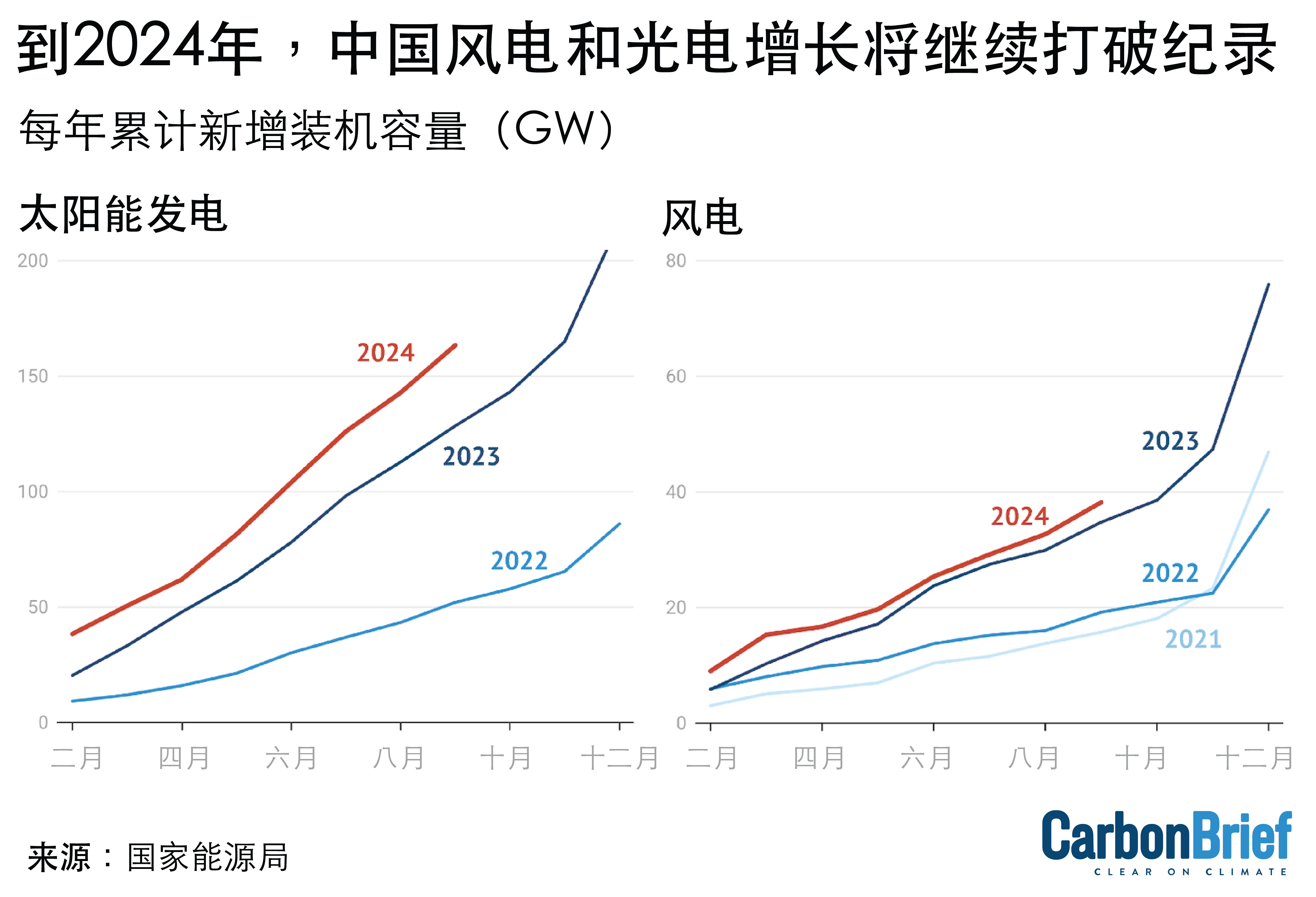
根据今年前九个月的增速,仅今年中国太阳能发电量的增长就可能相当于澳大利亚或越南在2023年的总发电量。
风电装机也加速增长,截至九月新增了38GW,同比增长10%,超过英国的总风电装机容量(30GW)。
今年八月,国务院一次性核准了11台新核电机组,获批项目的总发电装机容量约13GW。继2022年和2023年各核准10台核电机组后,2024年迄今批准的11台机组标志着中国下一批核电产能正在启动,将助力清洁能源增长。
在第三季度,水电装机仅同比增长2%,意味着11%的发电量增长主要源自利用率的恢复。由于严重干旱,水电利用率在2022年跌至十年来最低,2023年仅部分恢复,今年的反弹已接近预期平均水平。
2024年上半年,中国新核准的煤电项目骤降了80%,仅批准9GW,相比去年同期的52GW大幅下降。然而,根据能源资讯提供商Polaris Network的数据,第三季度有八个大型煤电项目获批,显示核准量可能在下半年有所增加。
建筑和石油需求放缓继续拉低总排放
虽然电力行业的碳排放在2024年第三季度出现了小幅增长,但工程量的持续萎缩拉低了总排放量。
因此,第三季度中国的碳排放量保持平稳,与去年同期水平持平或略低,如下图所示。
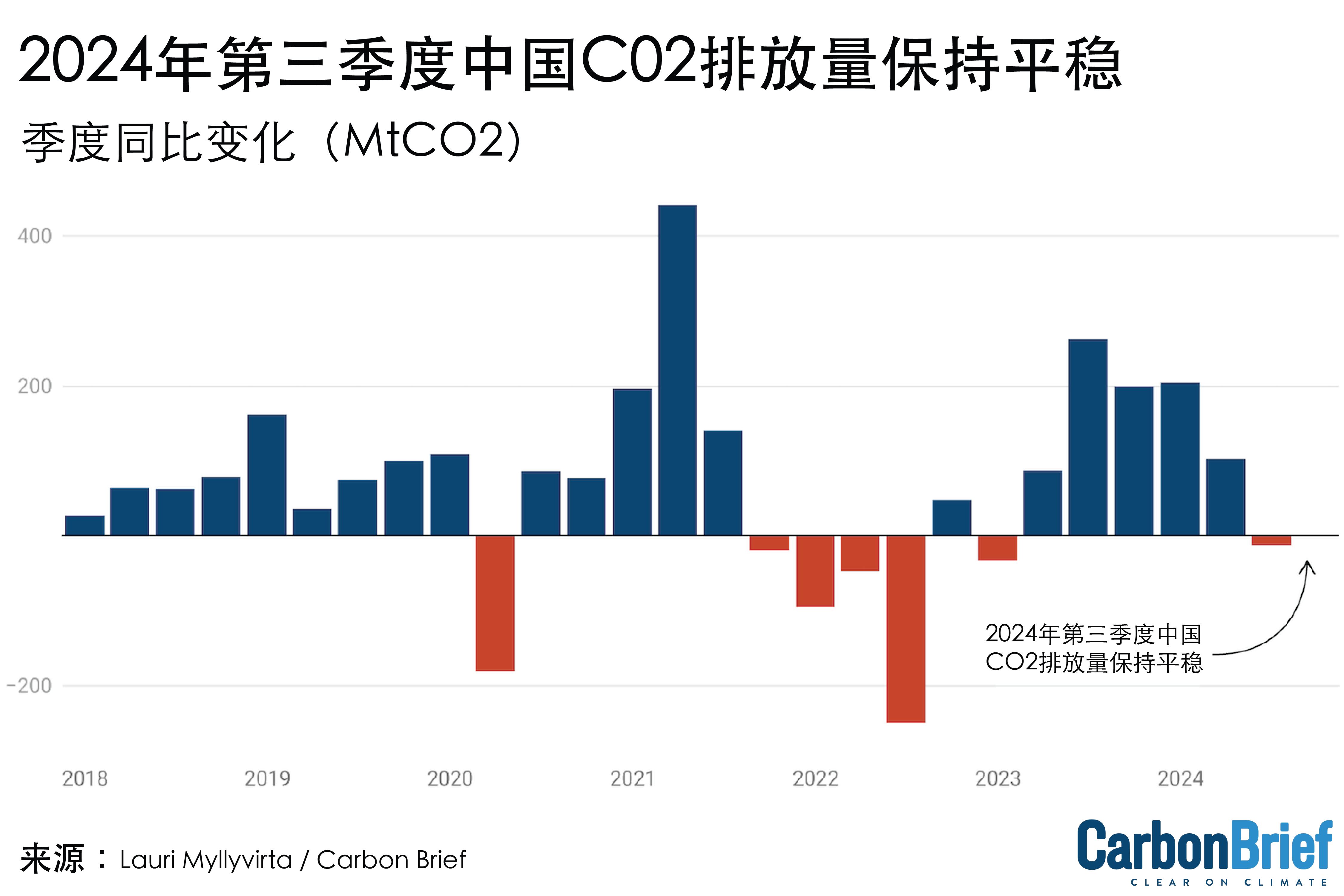
如果剖析建筑业导致的除电力行业以外的排放下降会发现,第三季度钢铁产量下降9%,水泥产量下降12%,房地产投资萎缩10%,与上半年持平。
这导致与2023年同期相比,水泥相关碳排放量减少了11%(24MtCO2),如下图所示。
尽管钢铁产量下降了9%,但钢铁相关排放量仅下降了3%(13MtCO2),原因在于需求下降的冲击主要由电弧炉炼钢厂承担,而不是排放强度高得多的燃煤高炉炼钢厂。
中国钢铁行业缺乏优先发展电弧炉的激励机制。电弧炉使用回收废钢,排放量较低。理论上,将钢铁纳入中国的碳排放权交易市场可能会促进转型。
然而,如果对该行业采取与电力行业相同的方式,对燃煤高炉炼钢和电炉炼钢设定不同的基准,则难以激励电力转型。
为推动钢铁行业结构性变革,中国工信部颁布政策,暂停所有新增钢铁产能的核准,将年初以来的实际停止审批变成正式禁令。直至去年,该行业仍在大规模投资煤基炼钢产能。

另一个排放下降的主要领域是石油消费,第三季度石油相关碳排放下降了2%(13MtCO2),如上图所示。该数据来自国家统计局。
石油需求和相关二氧化碳排放量的减少可能更多。石油产品供应量(以炼油厂扣除进出口后的产量计算)降幅更大。该指标显示,第三季度燃烧石油产生的碳排放下降了10%(63MtCO2),表明中国的二氧化碳总排放量或下降2%。
统计局报告的降幅要温和得多,这可能反映了中国统计数据趋于平缓化的特点。另一种可能的解释是,炼油厂以前的产量超出了消费需求,现在不得不削减产量以减少库存。
无论石油消费量下降的幅度如何,其下降原因已显而易见。工程量减少是重要因素,因为很大一部分柴油用于建筑工地和运输建筑材料。
电动车份额的增加也侵蚀了汽油需求量。家庭消费支出疲软也推动了需求减少,直到十月政府刺激政策出台后才出现回升迹象。
使用液化天然气的卡车的普及也对柴油需求形成抑制。2024年初至九月,液化天然气卡车销量占卡车总销量的20%,但天然气整体需求增长缓慢,表明这一影响有限。
天然气消费量增速从今年上半年的10%放缓至第三季度的3%。增量集中在电力行业,其他行业需求停滞,可能是由于工业需求疲软。
在经历了一二月排放量上升、三月至八月下降、九月再次增加后,年末三个月排放量需要至少下降2%,方能使中国的年度总排放量低于2023年水平。
由于工业电力需求增长的持续放缓和空调季的结束,这种情况很有可能发生。但即便如此,中国仍将偏离2025年的碳强度目标。该目标要求,在2020年至2023年中国排放量快速增长之后,在2024年和2025年都需至少下降2%。
排放量没有更快下降——甚至可能在第三季度根本没有下降——的根本原因是:今年能源消费量增速继续远超历史趋势。
第三季度,能源消费总量(包括但不限于电力消费量)增长了5.0%,快于GDP增长4.6%。
在疫情前,中国的能源需求增长一直低于GDP增速,这意味着经济的能源强度在下降。
然而,疫情后以制造业为重点的经济政策似乎扭转了这一趋势。
煤化工行业获得新的政策支持
中国碳排放前景中新增的一个变数是煤化工行业。该行业将国内煤炭转化为进口石油和天然气的替代品,尽管碳足迹要高得多。
国家发改委最近出台的政策要求“加快”煤化工行业的发展,包括“加快煤制油气战略基地建设”。
政策发布后数周,山西一个大型煤制油项目和陕西一个煤化工园区已开工建设,新疆也有类似项目获得核准。
据咨询公司中信建投期货称,2024年,煤化工行业的煤炭消费量预计将占中国煤炭总消费量的7%以上。
万得金融终端(Wind Financial Terminal)的数据表明,2024年前八个月煤化工行业的煤炭消费量增长了18%,2023年增长了9%。在今年一至八月期间,煤化工行业煤炭消费量增长所带来的排放占化石燃料碳排放总量增长的三分之二(总增幅为0.9%)。
然而,该行业的煤炭消费量增速在七月至八月放缓至5%,九月化工产品产量也继续放缓。上图(“化工”)显示了这个对碳排放量增长的较小推动因素。
近期油气价格上涨、加上中国增加国内煤炭产量和压低国内煤炭价格的努力,共同提振了对油价和煤价敏感的煤化工行业。
煤化工行业体现了中国是将能源安全,还是减排置于优先事项的直接矛盾。
经济刺激计划为排放前景增添不确定性
今年夏季的经济数据显示中国经济持续放缓、GDP增长未达目标,因此市场对当局出台刺激计划的预期随之增强。
政府在九月下旬宣布了一系列刺激措施,其主要针对金融市场,但也承诺要“稳定”房地产市场。
尽管该刺激计划的规模对于中国而言并不算大,进一步的细节也让那些希望政策出现更激烈转向的人感到失望,但该方案显然是经过深思熟虑后协调进行的,让外界得以一窥中国最高决策者正计划如何应对经济下行。
近年来广受关注的直接向家庭转移政府资金的措施,如今也将开始尝试。
这些措施旨在提振家庭消费,而非此前刺激政策重点的高能耗制造业和建筑业,若得以实施将让中国在更低能耗、低碳排的方式下实现增长。
然而,与整个一揽子计划的规模相比,直接转移资金的规模较小,且大部分资金用于汽车和家电补贴。这些补贴释放了家庭现金流,但同时也引导了家庭支出向最高耗能的领域集中。
大部分刺激资金仍通过地方政府借贷和银行贷款等传统渠道进行,这些资金通常用于工业和基础设施项目。
该刺激计划并没有明确着墨于气候。尽管相当一部分资金可能会流向与清洁能源相关的领域,但这只是因为这些投资最近在中国的投资流中占据主导地位,但该计划并未有额外政策推动此类投资。
决策者不认为碳排放会“提前”达峰
尽管清洁能源的快速增长似乎表明中国可能很快实现碳达峰,但决策者仍然预期碳排放量将在2030年之前继续增长,然后趋于平稳或逐渐下降。
今年八月,国家能源局在回应记者就有分析显示中国可能已实现碳达峰的问题时,淡化了这一可能性。
国家能源局相关部门负责人在回答这一问题时强调,国家领导层已确定“2030年前”为实现碳达峰的时间点,暗示该机构并无授权改变这一目标。
中共中央也在一份《意见》中重申,该国的目标是到2035年前让碳排放进入“下降趋势”。
国务院此前的一项计划表明,中国将在碳达峰后重点控制二氧化碳排放总量,而非排放强度,并表示这不会在2026至2030年期间发生。
根据中国目前在《巴黎协定》中的承诺,其允许采取一种非常渐进的方法来实现碳达峰并在达峰后减少排放,将更大幅度的减排留到未来几十年。
然而,这种路径将消耗全球1.5°C温控目标下90%的碳预算。若要限制全球气温上升至比工业化前高1.5°C以内,中国的排放量需在2035年之前至少比2023年水平下降30%。
国际能源署(IEA)最新分析指出,到2035年,中国等新兴市场需要将排放量减少到比2022年水平低35至65%的水平,以实现在COP28气候大会上做出的全球承诺或国家净零目标。
与中国决策者所传递的谨慎态度相反,若中国能保持当前的清洁能源扩展速度并推进电气化,到2035年,化石燃料的二氧化碳排放量将在2023年的水平上减少30%。
同样,国际能源署最新发布的《世界能源展望》(World Energy Outlook)发现,根据目前的政策方案,清洁能源的增长将有助于到2035年将中国的二氧化碳排放量减少到比2023年水平低24%。国际能源署表示,如果中国实现其宣布的雄心和目标,到2035年,碳排放量的削减将增加到45%。
根据《巴黎协定》,中国将于2025年2月前向联合国提交国家自主贡献(NDC)承诺,预计其将更清楚地说明决策者正在追求的减排途径。
关于数据
分析数据汇编自中国国家统计局、国家能源局、中国电力企业联合会和中国海关的官方数据发布,以及行业数据提供商万得资讯(WIND Information)的数据。
风能和太阳能发电量,以及按燃料划分的火电发电量系通过将每月末的发电装机乘月利用率计算得出,数据来自万得金融终端提供的中电联报告数据。
火电总发电量以及水电、核电发电量来自国家统计局月度发布数据。
由于没有生物质的月利用率数据,因此采用了2023年52%的年平均值。电力部门的煤炭消费量估算基于燃煤发电量和每月燃煤电厂的平均热耗率,以避免有争议的官方煤炭消费数据对近期其他产量数据的影响。
当数据来自多个来源时,本文对不同来源的数据交叉引用,并尽可能使用官方来源,调整总消费量以匹配国家统计局报告的第一季度、上半年和前三季度的消费增长和能源结构变化。数据调整对所有能源的影响不到1%。未经调整的数据显示,第三季度的排放量减少了1%。
二氧化碳排放量的估算基于国家统计局的默认燃料热值和中国最新的2018年国家温室气体排放清单中的排放因子。水泥的二氧化碳排放因子基于截至2023年的年度估算。
对于石油消费,表观消费量是根据炼油加工量计算的,并减去石油产品的净出口量。
The post 分析:尽管煤电反弹,但中国2024年三季度碳排放未增长 appeared first on Carbon Brief.
Greenhouse Gases
Analysis: Constituency of Reform’s climate-sceptic Richard Tice gets £55m flood funding
The Lincolnshire constituency held by Richard Tice, the climate-sceptic deputy leader of the hard-right Reform party, has been pledged at least £55m in government funding for flood defences since 2024.
This investment in Boston and Skegness is the second-largest sum for a single constituency from a £1.4bn flood-defence fund for England, Carbon Brief analysis shows.
Flooding is becoming more likely and more extreme in the UK due to climate change.
Yet, for years, governments have failed to spend enough on flood defences to protect people, properties and infrastructure.
The £1.4bn fund is part of the current Labour government’s wider pledge to invest a “record” £7.9bn over a decade on protecting hundreds of thousands of homes and businesses from flooding.
As MP for one of England’s most flood-prone regions, Tice has called for more investment in flood defences, stating that “we cannot afford to ‘surrender the fens’ to the sea”.
He is also one of Reform’s most vocal opponents of climate action and what he calls “net stupid zero”. He denies the scientific consensus on climate change and has claimed, falsely and without evidence, that scientists are “lying”.
Flood defences
Last year, the government said it would invest £2.65bn on flood and coastal erosion risk management (FCERM) schemes in England between April 2024 and March 2026.
This money was intended to protect 66,500 properties from flooding. It is part of a decade-long Labour government plan to spend more than £7.9bn on flood defences.
There has been a consistent shortfall in maintaining England’s flood defences, with the Environment Agency expecting to protect fewer properties by 2027 than it had initially planned.
The Climate Change Committee (CCC) has attributed this to rising costs, backlogs from previous governments and a lack of capacity. It also points to the strain from “more frequent and severe” weather events, such as storms in recent years that have been amplified by climate change.
However, the CCC also said last year that, if the 2024-26 spending programme is delivered, it would be “slightly closer to the track” of the Environment Agency targets out to 2027.
The government has released constituency-level data on which schemes in England it plans to fund, covering £1.4bn of the 2024-26 investment. The other half of the FCERM spending covers additional measures, from repairing existing defences to advising local authorities.
The map below shows the distribution of spending on FCERM schemes in England over the past two years, highlighting the constituency of Richard Tice.

By far the largest sum of money – £85.6m in total – has been committed to a tidal barrier and various other defences in the Somerset constituency of Bridgwater, the seat of Conservative MP Ashley Fox.
Over the first months of 2026, the south-west region has faced significant flooding and Fox has called for more support from the government, citing “climate patterns shifting and rainfall intensifying”.
He has also backed his party’s position that “the 2050 net-zero target is impossible” and called for more fossil-fuel extraction in the North Sea.
Tice’s east-coast constituency of Boston and Skegness, which is highly vulnerable to flooding from both rivers and the sea, is set to receive £55m. Among the supported projects are beach defences from Saltfleet to Gibraltar Point and upgrades to pumping stations.
Overall, Boston and Skegness has the second-largest portion of flood-defence funding, as the chart below shows. Constituencies with Conservative and Liberal Democrat MPs occupied the other top positions.

Overall, despite Labour MPs occupying 347 out of England’s 543 constituencies – nearly two-thirds of the total – more than half of the flood-defence funding was distributed to constituencies with non-Labour MPs. This reflects the flood risk in coastal and rural areas that are not traditional Labour strongholds.
Reform funding
While Reform has just eight MPs, representing 1% of the population, its constituencies have been assigned 4% of the flood-defence funding for England.
Nearly all of this money was for Tice’s constituency, although party leader Nigel Farage’s coastal Clacton seat in Kent received £2m.
Reform UK is committed to “scrapping net-zero” and its leadership has expressed firmly climate-sceptic views.
Much has been made of the disconnect between the party’s climate policies and the threat climate change poses to its voters. Various analyses have shown the flood risk in Reform-dominated areas, particularly Lincolnshire.
Tice has rejected climate science, advocated for fossil-fuel production and criticised Environment Agency flood-defence activities. Yet, he has also called for more investment in flood defences, stating that “we cannot afford to ‘surrender the fens’ to the sea”.
This may reflect Tice’s broader approach to climate change. In a 2024 interview with LBC, he said:
“Where you’ve got concerns about sea level defences and sea level rise, guess what? A bit of steel, a bit of cement, some aggregate…and you build some concrete sea level defences. That’s how you deal with rising sea levels.”
While climate adaptation is viewed as vital in a warming world, there are limits on how much societies can adapt and adaptation costs will continue to increase as emissions rise.
The post Analysis: Constituency of Reform’s climate-sceptic Richard Tice gets £55m flood funding appeared first on Carbon Brief.
Analysis: Constituency of Reform’s climate-sceptic Richard Tice gets £55m flood funding
Greenhouse Gases
Cropped 25 February 2026: Food inflation strikes | El Niño looms | Biodiversity talks stagnate
We handpick and explain the most important stories at the intersection of climate, land, food and nature over the past fortnight.
This is an online version of Carbon Brief’s fortnightly Cropped email newsletter.
Subscribe for free here.
Key developments
Food inflation on the rise
DELUGE STRIKES FOOD: Extreme rainfall and flooding across the Mediterranean and north Africa has “battered the winter growing regions that feed Europe…threatening food price rises”, reported the Financial Times. Western France has “endured more than 36 days of continuous rain”, while farmers’ associations in Spain’s Andalusia estimate that “20% of all production has been lost”, it added. Policy expert David Barmes told the paper that the “latest storms were part of a wider pattern of climate shocks feeding into food price inflation”.
-
Sign up to Carbon Brief’s free “Cropped” email newsletter. A fortnightly digest of food, land and nature news and views. Sent to your inbox every other Wednesday.
NO BEEF: The UK’s beef farmers, meanwhile, “face a double blow” from climate change as “relentless rain forces them to keep cows indoors”, while last summer’s drought hit hay supplies, said another Financial Times article. At the same time, indoor growers in south England described a 60% increase in electricity standing charges as a “ticking timebomb” that could “force them to raise their prices or stop production, which will further fuel food price inflation”, wrote the Guardian.
‘TINDERBOX’ AND TARIFFS: A study, covered by the Guardian, warned that major extreme weather and other “shocks” could “spark social unrest and even food riots in the UK”. Experts cited “chronic” vulnerabilities, including climate change, low incomes, poor farming policy and “fragile” supply chains that have made the UK’s food system a “tinderbox”. A New York Times explainer noted that while trade could once guard against food supply shocks, barriers such as tariffs and export controls – which are being “increasingly” used by politicians – “can shut off that safety valve”.
El Niño looms
NEW ENSO INDEX: Researchers have developed a new index for calculating El Niño, the large-scale climate pattern that influences global weather and causes “billions in damages by bringing floods to some regions and drought to others”, reported CNN. It added that climate change is making it more difficult for scientists to observe El Niño patterns by warming up the entire ocean. The outlet said that with the new metric, “scientists can now see it earlier and our long-range weather forecasts will be improved for it.”
WARMING WARNING: Meanwhile, the US Climate Prediction Center announced that there is a 60% chance of the current La Niña conditions shifting towards a neutral state over the next few months, with an El Niño likely to follow in late spring, according to Reuters. The Vibes, a Malaysian news outlet, quoted a climate scientist saying: “If the El Niño does materialise, it could possibly push 2026 or 2027 as the warmest year on record, replacing 2024.”
CROP IMPACTS: Reuters noted that neutral conditions lead to “more stable weather and potentially better crop yields”. However, the newswire added, an El Niño state would mean “worsening drought conditions and issues for the next growing season” to Australia. El Niño also “typically brings a poor south-west monsoon to India, including droughts”, reported the Hindu’s Business Line. A 2024 guest post for Carbon Brief explained that El Niño is linked to crop failure in south-eastern Africa and south-east Asia.
News and views
- DAM-AG-ES: Several South Korean farmers filed a lawsuit against the country’s state-owned utility company, “seek[ing] financial compensation for climate-related agricultural damages”, reported United Press International. Meanwhile, a national climate change assessment for the Philippines found that the country “lost up to $219bn in agricultural damages from typhoons, floods and droughts” over 2000-10, according to Eco-Business.
- SCORCHED GRASS: South Africa’s Western Cape province is experiencing “one of the worst droughts in living memory”, which is “scorching grass and killing livestock”, said Reuters. The newswire wrote: “In 2015, a drought almost dried up the taps in the city; farmers say this one has been even more brutal than a decade ago.”
- NOUVELLE VEG: New guidelines published under France’s national food, nutrition and climate strategy “urged” citizens to “limit” their meat consumption, reported Euronews. The delayed strategy comes a month after the US government “upended decades of recommendations by touting consumption of red meat and full-fat dairy”, it noted.
- COURTING DISASTER: India’s top green court accepted the findings of a committee that “found no flaws” in greenlighting the Great Nicobar project that “will lead to the felling of a million trees” and translocating corals, reported Mongabay. The court found “no good ground to interfere”, despite “threats to a globally unique biodiversity hotspot” and Indigenous tribes at risk of displacement by the project, wrote Frontline.
- FISH FALLING: A new study found that fish biomass is “falling by 7.2% from as little as 0.1C of warming per decade”, noted the Guardian. While experts also pointed to the role of overfishing in marine life loss, marine ecologist and study lead author Dr Shahar Chaikin told the outlet: “Our research proves exactly what that biological cost [of warming] looks like underwater.”
- TOO HOT FOR COFFEE: According to new analysis by Climate Central, countries where coffee beans are grown “are becoming too hot to cultivate them”, reported the Guardian. The world’s top five coffee-growing countries faced “57 additional days of coffee-harming heat” annually because of climate change, it added.
Spotlight
Nature talks inch forward
This week, Carbon Brief covers the latest round of negotiations under the UN Convention on Biological Diversity (CBD), which occurred in Rome over 16-19 February.
The penultimate set of biodiversity negotiations before October’s Conference of the Parties ended in Rome last week, leaving plenty of unfinished business.
The CBD’s subsidiary body on implementation (SBI) met in the Italian capital for four days to discuss a range of issues, including biodiversity finance and reviewing progress towards the nature targets agreed under the Kunming-Montreal Global Biodiversity Framework (GBF).
However, many of the major sticking points – particularly around finance – will have to wait until later this summer, leaving some observers worried about the capacity for delegates to get through a packed agenda at COP17.
The SBI, along with the subsidiary body on scientific, technical and technological advice (SBSTTA) will both meet in Nairobi, Kenya, later this summer for a final round of talks before COP17 kicks off in Yerevan, Armenia, on 19 October.
Money talks
Finance for nature has long been a sticking point at negotiations under the CBD.
Discussions on a new fund for biodiversity derailed biodiversity talks in Cali, Colombia, in autumn 2024, requiring resumed talks a few months later.
Despite this, finance was barely on the agenda at the SBI meetings in Rome. Delegates discussed three studies on the relationship between debt sustainability and implementation of nature plans, but the more substantive talks are set to take place at the next SBI meeting in Nairobi.
Several parties “highlighted concerns with the imbalance of work” on finance between these SBI talks and the next ones, reported Earth Negotiations Bulletin (ENB).
Lim Li Ching, senior researcher at Third World Network, noted that tensions around finance permeated every aspect of the talks. She told Carbon Brief:
“If you’re talking about the gender plan of action – if there’s little or no financial resources provided to actually put it into practice and implement it, then it’s [just] paper, right? Same with the reporting requirements and obligations.”
Monitoring and reporting
Closely linked to the issue of finance is the obligations of parties to report on their progress towards the goals and targets of the GBF.
Parties do so through the submission of national reports.
Several parties at the talks pointed to a lack of timely funding for driving delays in their reporting, according to ENB.
A note released by the CBD Secretariat in December said that no parties had submitted their national reports yet; by the time of the SBI meetings, only the EU had. It further noted that just 58 parties had submitted their national biodiversity plans, which were initially meant to be published by COP16, in October 2024.
Linda Krueger, director of biodiversity and infrastructure policy at the environmental not-for-profit Nature Conservancy, told Carbon Brief that despite the sparse submissions, parties are “very focused on the national report preparation”. She added:
“Everybody wants to be able to show that we’re on the path and that there still is a pathway to getting to 2030 that’s positive and largely in the right direction.”
Watch, read, listen
NET LOSS: Nigeria’s marine life is being “threatened” by “ghost gear” – nets and other fishing equipment discarded in the ocean – said Dialogue Earth.
COMEBACK CAUSALITY: A Vox long-read looked at whether Costa Rica’s “payments for ecosystem services” programme helped the country turn a corner on deforestation.
HOMEGROWN GOALS: A Straits Times podcast discussed whether import-dependent Singapore can afford to shelve its goal to produce 30% of its food locally by 2030.
‘RUSTING’ RIVERS: The Financial Times took a closer look at a “strange new force blighting the [Arctic] landscape”: rivers turning rust-orange due to global warming.
New science
- Lakes in the Congo Basin’s peatlands are releasing carbon that is thousands of years old | Nature Geoscience
- Natural non-forest ecosystems – such as grasslands and marshlands – were converted for agriculture at four times the rate of land with tree cover between 2005 and 2020 | Proceedings of the National Academy of Sciences
- Around one-quarter of global tree-cover loss over 2001-22 was driven by cropland expansion, pastures and forest plantations for commodity production | Nature Food
In the diary
- 2-6 March: UN Food and Agriculture Organization regional conference for Latin America and Caribbean | Brasília
- 5 March: Nepal general elections
- 9-20 March: First part of the thirty-first session of the International Seabed Authority (ISA) | Kingston, Jamaica
Cropped is researched and written by Dr Giuliana Viglione, Aruna Chandrasekhar, Daisy Dunne, Orla Dwyer and Yanine Quiroz.
Please send tips and feedback to cropped@carbonbrief.org
The post Cropped 25 February 2026: Food inflation strikes | El Niño looms | Biodiversity talks stagnate appeared first on Carbon Brief.
Cropped 25 February 2026: Food inflation strikes | El Niño looms | Biodiversity talks stagnate
Greenhouse Gases
Dangerous heat for Tour de France riders only a ‘question of time’
Rising temperatures across France since the mid-1970s is putting Tour de France competitors at “high risk”, according to new research.
The study, published in Scientific Reports, uses 50 years of climate data to calculate the potential heat stress that athletes have been exposed to across a dozen different locations during the world-famous cycling race.
The researchers find that both the severity and frequency of high-heat-stress events have increased across France over recent decades.
But, despite record-setting heatwaves in France, the heat-stress threshold for safe competition has rarely been breached in any particular city on the day the Tour passed through.
(This threshold was set out by cycling’s international governing body in 2024.)
However, the researchers add it is “only a question of time” until this occurs as average temperatures in France continue to rise.
The lead author of the study tells Carbon Brief that, while the race organisers have been fortunate to avoid major heat stress on race days so far, it will be “harder and harder to be lucky” as extreme heat becomes more common.
‘Iconic’
The Tour de France is one of the world’s most storied cycling races and the oldest of Europe’s three major multi-week cycling competitions, or Grand Tours.
Riders cover around 3,500 kilometres (km) of distance and gain up to nearly 55km of altitude over 21 stages, with only two or three rest days throughout the gruelling race.
The researchers selected the Tour de France because it is the “iconic bike race. It is the bike race of bike races,” says Dr Ivana Cvijanovic, a climate scientist at the French National Research Institute for Sustainable Development, who led the new work.
Heat has become a growing problem for the competition in recent years.
In 2022, Alexis Vuillermoz, a French competitor, collapsed at the finish line of the Tour’s ninth stage, leaving in an ambulance and subsequently pulling out of the race entirely.
Two years later, British cyclist Sir Mark Cavendish vomited on his bike during the first stage of the race after struggling with the 36C heat.
The Tour also makes a good case study because it is almost entirely held during the month of July and, while the route itself changes, there are many cities and stages that are repeated from year to year, Cvijanovic adds.
‘Have to be lucky’
The study focuses on the 50-year span between 1974 and 2023.
The researchers select six locations across the country that have commonly hosted the Tour, from the mountain pass of Col du Tourmalet, in the French Pyrenees, to the city of Paris – where the race finishes, along the Champs-Élysées.
These sites represent a broad range of climatic zones: Alpe d’ Huez, Bourdeaux, Col du Tourmalet, Nîmes, Paris and Toulouse.
For each location, they use meteorological reanalysis data from ERA5 and radiant temperature data from ERA5-HEAT to calculate the “wet-bulb globe temperature” (WBGT) for multiple times of day across the month of July each year.
WBGT is a heat-stress index that takes into account temperature, humidity, wind speed and direct sunlight.
Although there is “no exact scientific consensus” on the best heat-stress index to use, WBGT is “one of the rare indicators that has been originally developed based on the actual human response to heat”, Cvijanovic explains.
It is also the one that the International Cycling Union (UCI) – the world governing body for sport cycling – uses to assess risk. A WBGT of 28C or higher is classified as “high risk” by the group.
WBGT is the “gold standard” for assessing heat stress, says Dr Jessica Murfree, director of the ACCESS Research Laboratory and assistant professor at the University of North Carolina at Chapel Hill.
Murfree, who was not involved in the new study, adds that the researchers are “doing the right things by conducting their science in alignment with the business practices that are already happening”.
The researchers find that across the 50-year time period, WBGT has been increasing across the entire country – albeit, at different rates. In the north-west of the country, WBGT has increased at an average rate of 0.1C per decade, while in the southern and eastern parts of the country, it has increased by more than 0.5C per decade.
The maps below show the maximum July WBGT for each decade of the analysis (rows) and for hourly increments of the late afternoon (columns). Lower temperatures are shown in lighter greens and yellows, while higher temperatures are shown in darker reds and purples.
Six Tour de France locations analysed in the study are shown as triangles on the maps (clockwise from top): Paris, Alpe d’ Huez, Nîmes, Toulouse, Col du Tourmalet and Bordeaux.
The maps show that the maximum WBGT temperature in the afternoon has surpassed 28C over almost the entire country in the last decade. The notable exceptions to this are the mountainous regions of the Alps and the Pyrenees.
The researchers also find that most of the country has crossed the 28C WBGT threshold – which they describe as “dangerous heat levels” – on at least one July day over the past decade. However, by looking at the WBGT on the day the Tour passed through any of these six locations, they find that the threshold has rarely been breached during the race itself.
For example, the research notes that, since 1974, Paris has seen a WBGT of 28C five times at 3pm in July – but that these events have “so far” not coincided with the cycling race.
The study states that it is “fortunate” that the Tour has so far avoided the worst of the heat-stress.
Cvijanovic says the organisers and competitors have been “lucky” to date. She adds:
“It has worked really well for them so far. But as the frequency of these [extreme heat] events is increasing, it will be harder and harder to be lucky.”
Dr Madeleine Orr, an assistant professor of sport ecology at the University of Toronto who was not involved in the study, tells Carbon Brief that the paper was “really well done”, noting that its “methods are good [and its] approach was sound”. She adds:
“[The Tour has] had athletes complain about [the heat]. They’ve had athletes collapse – and still those aren’t the worst conditions. I think that that says a lot about what we consider safe. They’ve still been lucky to not see what unsafe looks like, despite [the heat] having already had impacts.”
Heat safety protocols
In 2024, the UCI set out its first-ever high temperature protocol – a set of guidelines for race organisers to assess athletes’ risk of heat stress.
The assessment places the potential risk into one of five categories based on the WBGT, ranging from very low to high risk.
The protocol then sets out suggested actions to take in the event of extreme heat, ranging from having athletes complete their warm-ups using ice vests and cold towels to increasing the number of support vehicles providing water and ice.
If the WBGT climbs above the 28C mark, the protocol suggests that organisers modify the start time of the stage, adapt the course to remove particularly hazardous sections – or even cancel the race entirely.
However, Orr notes that many other parts of the race, such as spectator comfort and equipment functioning, may have lower temperatures thresholds that are not accounted for in the protocol, but should also be considered.
Murfree points out that the study’s findings – and the heat protocol itself – are “really focused on adaptation, rather than mitigation”. While this is “to be expected”, she tells Carbon Brief:
“Moving to earlier start times or adjusting the route specifically to avoid these locations that score higher in heat stress doesn’t stop the heat stress. These aren’t climate preventative measures. That, I think, would be a much more difficult conversation to have in the research because of the Tour de France’s intimate relationship with fossil-fuel companies.”
The post Dangerous heat for Tour de France riders only a ‘question of time’ appeared first on Carbon Brief.
Dangerous heat for Tour de France riders only a ‘question of time’
-
Greenhouse Gases7 months ago
Guest post: Why China is still building new coal – and when it might stop
-
Climate Change7 months ago
Guest post: Why China is still building new coal – and when it might stop
-
Greenhouse Gases2 years ago嘉宾来稿:满足中国增长的用电需求 光伏加储能“比新建煤电更实惠”
-
Climate Change2 years ago
Bill Discounting Climate Change in Florida’s Energy Policy Awaits DeSantis’ Approval
-
Climate Change2 years ago
Spanish-language misinformation on renewable energy spreads online, report shows
-
Climate Change2 years ago嘉宾来稿:满足中国增长的用电需求 光伏加储能“比新建煤电更实惠”
-
Climate Change Videos2 years ago
The toxic gas flares fuelling Nigeria’s climate change – BBC News
-
Carbon Footprint2 years agoUS SEC’s Climate Disclosure Rules Spur Renewed Interest in Carbon Credits