

More than half of the 27 million carbon credits produced by one of the world’s largest offsetting projects did not correspond to actual emission reductions, leading carbon registry Verra has said following a two-year review of Zimbabwe’s Kariba forest protection initiative.
Verra is now seeking compensation for the millions of “excess” credits from Carbon Green Investments (CGI) – the project’s developer – after the registry’s technical analysis found the threat to the forest had been overstated in the project’s original forecast.
The Kariba REDD+ project, which aims to protect an area 10 times the size of New York City, has long faced accusations by several media outlets and carbon market analysts of exaggerating its climate credentials through flawed carbon accounting and of failing to provide promised benefits to local communities.
The conservation project stretches across national parks, forest reserves and wildlife corridors along the southern shore of Lake Kariba in the Zambezi River basin in northern Zimbabwe.
Dozens of big companies, including Gucci, Volkswagen, Nestlé and Dutch electricity firm Greenchoice, bought millions of Kariba’s credits and used them to offset part of their own emissions and back up various green assertions.
Overstated deforestation risk
According to a report by Bloomberg, the project generated more than $100 million in revenue after being set up over a decade ago by South Pole, a major Swiss carbon credits broker, and CGI, which is run by a Zimbabwean businessman. South Pole walked away from Kariba in late 2023 when Verra suspended the project and began an internal review following an investigation by The New Yorker magazine.
Nearly two years later, Verra announced last week that its review had found 57% of Kariba’s nearly 27 million credits were issued “in excess”. That is because the actual deforestation observed in a reference area chosen by Kariba’s project developers to predict how much CO2 the scheme would conserve was “significantly lower” than initially estimated, Verra said.
-
As governments bet on carbon trading, Japan’s early scheme spotlights pitfalls
Analysis by Climate Home News of Japan’s current projects under Article 6.2 – from forest protection to energy-saving lights in Uniqlo stores – raises questions over the climate benefits of some of the offsets -
Brazil pledges $1bn in first contribution to COP30 rainforest fund
Brazil, which will launch the new investment-driven fund for forest protection at the Belém climate summit, calls on other governments to put in seed capital


This calculation is known as the baseline against which a project’s performance is assessed. Critics have repeatedly questioned the accounting method and said flawed methodologies compromise the integrity of carbon offsets. Previous studies by independent rating agencies suggested Kariba may have produced as many as 30 times more credits than it should have done by exaggerating the threat to forests that were never really at risk.
Compensation process
Verra said last week that, despite finding them worthless, the millions of “excess” credits already used by buyers would remain valid. But, at the same time, the carbon registry has requested CGI to compensate for them by buying and cancelling an equivalent number of credits from other projects.
Verra “received a positive response related to this process” from CGI, a spokesperson subsequently told Climate Home News, without giving further details.
CGI’s founder, Zimbabwean tycoon Steve Wentzel, did not reply to a request for comment. In an online statement, CGI said it remains dedicated to Kariba’s “mission of forest conservation” and “committed to continue working toward resolutions that uphold the highest standards”.
The company also said it had asked Verra for a “moratorium” on the compensation process until it reviews the registry’s carbon assessment.
Will pricing emissions from flying affect tourism? Not if it’s done right
Separately, Verra also invited the holders of nearly 5 million Kariba credits that have been purchased but not yet used for offsetting to “voluntarily” eliminate those credits, which in that case would be counted towards the compensation.
South Pole, CGI’s former partner in the scheme, said last week it had asked Verra to cancel 2.5 million credits it still held “to help address the discrepancies in issued credits and uphold the environmental integrity of the project”.
‘Big concerns’ remain
But Jonathan Crook, at the nonprofit Carbon Market Watch (CMW), said Verra’s handling of the Kariba case leaves many questions unanswered and raises big concerns.
“It is not clear what, if anything concrete, will happen if CGI refuses this request [for compensation], thereby raising real questions over whether anyone will actually be held liable, which would be a shockingly inappropriate outcome to this scandal,” he added.
Verra has a patchy track record in obtaining compensation from discredited projects. Nearly 2 million phantom credits linked to failed methane-cutting rice cultivation projects in China have yet to be paid back more than a year since Verra shut down the schemes and sought recompense from their developers.
-
How Shell greenwashed gas with sham Chinese carbon credits
Exclusive: Shell used rice-farming offsets for “carbon neutral” LNG campaign – but farmers and local authorities said no project activities took place -
Shell dodges paying compensation for sham carbon credits in China
The energy giant exited the failed projects after Verra asked for redress, but a legal expert says Shell should be held responsible -
Carbon credit auditors suspended for failures in sham rice-farming offsets
Verra has taken unprecedented action against four certification bodies that overlooked integrity problems with the projects. But the worthless credits still need to be compensated


As Climate Home revealed last year, energy giant Shell was directly involved in the projects and used the majority of the credits to offset – on paper – real greenhouse gas emissions created by its vast fossil fuel operations.
Climate Home understands that Verra is still pursuing compensation for the excess credits from the companies involved in the rice cultivation projects, but there is no fixed timeline for the process to be completed.
Questions over permanence
CMW’s Crook also raised concerns over the future integrity of the remaining 11.6 million Kariba credits deemed by Verra’s review to be of good quality. An underlying principle of REDD+ projects is that carbon stored in forests must be maintained over a long period of time – up to a century – to reliably offset the release of fossil carbon.
But, with the Kariba project no longer registered with Verra, any carbon supposedly conserved through the scheme now “faces a significant risk of being re-released into the atmosphere over the coming years and decades without any clear solution to remedy the situation”, Crook added.
More than 5 million credits from the Kariba project had been kept in a so-called buffer pool, an insurance fund with credits set aside for unexpected losses in stored carbon.
Verra said it had decided to “take pre-emptive action” and cancel all those credits. Additionally, a monitoring system will track deforestation in the project area in the years ahead and extra credits will be cancelled if observed forest loss goes beyond Kariba’s contributions to the buffer pool, the registry said.
“We are following our processes to ensure integrity and deliver what is right for the climate and communities,” the Verra spokesperson added.
The post Zimbabwe forest carbon megaproject generated millions of junk credits appeared first on Climate Home News.
Zimbabwe forest carbon megaproject generated millions of junk credits

Three countries have been named by the Paris Agreement’s compliance committee for failing to submit a nationally determined contribution (NDC) and repeatedly snubbing offers of help with their climate plans.
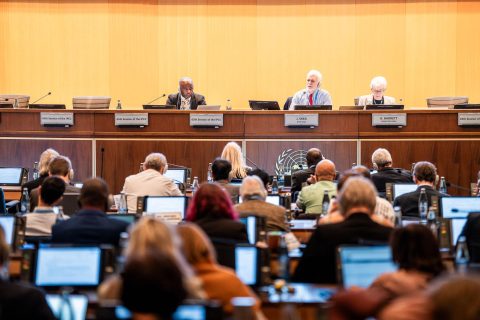
After months of internal debate over whether to identify serial non-responders, the Paris Agreement’s Implementation and Compliance Committee (PAICC) named the three countries which have failed to engage with it over their NDCs on Friday.
It named Democratic Republic of Congo, Senegal and North Korea in a footnote of its annual report, adding that it decided to name them “with a view to facilitating engagement”, adding that representatives of the three nations had been invited to its meeting in early 2027 “with the purpose of identifying any challenges and constraints”.
“The Committee noted the importance of Parties engaging with the Committee in a timely manner, while noting that some delays may be due to the national capabilities and circumstances of the Parties”, the report said.
-
Under US pressure, World Bank says it will back gas “where appropriate”
The US wants the World Bank to expand its gas support while climate campaigners are pushing for it to end – its head spoke this week of limited backing for the fossil fuel -
IPCC scientists vow to press on with climate reports despite political deadlock
After governments again failed to agree a timeline, nearly 120 IPCC authors pledged to complete their assessment on time and with full scientific rigour -
Paris Agreement committee snubbed over missing NDC climate plans
Many governments have still not submitted a nationally determined contribution to the UN, breaching a key requirement of the Paris Agreement


In July, PAICC said 12 countries had ignored its repeated attempts to discuss why they had not published an NDC as required every five years under the 2015 Paris accord.
Members of the committee had been divided over whether to name them, but at a September meeting decided to do so in their annual report to the annual climate COP summit.
By the time the report was published on Friday, only Congo, Senegal and North Korea “had not communicated an NDC or submitted a [Biennial Transparency Report] and had not yet responded to any of the Committee’s notifications, despite several reminders issued by the Committee in this regard”.
Rainforest and renewable energy ambitions
The silence from Congo and Senegal is notable because the former is home to much of the Congo Basin rainforest while the latter has sought billions of dollars in climate finance to support its renewable energy ambitions.
After Brazil, Congo has more rainforest than any country in the world. This forest, and the country’s peatlands, absorb huge amounts of greenhouse gas but are fast being lost to expanding farmland, charcoal production, logging and mining.
Senegal signed a Just Energy Transition Partnership with Canada and wealthy European nations in 2023, to help it meet its renewable energy targets under the-then government of Macky Sall. It was chair of the Least Developed Countries group between January 2022 and December 2023.

Tejas Rao, who is researching the PAICC as part of a doctoral thesis at Cambridge University, said the governments of the three countries should engage with the committee.
“Engagement costs these governments very little and the committee has shown it will listen,” he said.
“Silence leaves the committee with no basis to help, and it leaves the [governments] exposed to the narrative that they are simply disengaged,” he told Climate Home News.
Paris Agreement requirement
The 2015 Paris Agreement requires all parties to publish an NDC every five years outlining their emissions reduction targets, with each plan meant to be more ambitious than the country’s last NDC.
The latest set – the third round of plans, with new targets for 2035 – was due in February 2025. While most countries missed this deadline, all but around 30 – mostly small emitters but including Egypt, Vietnam and Argentina – have now submitted them.
Over the year, the PAICC – which is made up of government climate officials from developed and developing countries – has been communicating with governments that have not submitted NDCs and trying to overcome barriers to them doing so.
Some nations have cited exceptional circumstances as the reason for not submitting an NDC, a process that requires a significant amount of work in tracking emissions and consulting on how to curb them across the economy. For example, a letter from a Sudanese official to the PAICC, seen by Climate Home News, said that the country’s civil war had led to the suspension of its NDC preparation.
-
IPCC scientists vow to press on with climate reports despite political deadlock
After governments again failed to agree a timeline, nearly 120 IPCC authors pledged to complete their assessment on time and with full scientific rigour -
Under US pressure, World Bank says it will back gas “where appropriate”
The US wants the World Bank to expand its gas support while climate campaigners are pushing for it to end – its head spoke this week of limited backing for the fossil fuel -
Who shapes climate science? The equity question facing the IPCC
Early completion of the next global climate science assessment reports risks excluding research from the Global South, which is key to ensuring the findings are fair
The US and Iran are not signed up to the Paris Agreement and so do not have active NDCs, nor does Taiwan, which is not a UN member state.
Rao said that because the PAICC is “facilitative and non-punitive”, naming the countries “is meant to open a door, not close one – the invited consultation is the point”.
“In recent months, governments that explained their constraints, whether capacity, finance or domestic process, have been met with follow-up and support rather than sanction, and the number of silent governments has fallen sharply,” Rao said.
The post Paris Agreement committee names three countries snubbing it over NDCs appeared first on Climate Home News.
Paris Agreement committee names three countries snubbing it over NDCs