

The Zambian government’s cuts to fossil fuel subsidies may be helping reduce the use of planet-heating oil – but they are causing hardship among groups that rely disproportionately on fossil fuels to make a living, including taxi drivers.
The green policy aims to boost both climate action and the heavily-indebted Zambian economy, but taxi drivers in Lusaka, the southern African country’s capital, told Climate Home they are suffering from rising prices for driving and food.
“We have been hit hard,” said 29-year old Masuzyo Kampamba, as he motored down a two-lane highway towards past crowds of children celebrating national youth day last month.
Kampamba doesn’t feel able to get married and start a family as he would not be able to provide for them due to the high cost of living.
Waiting outside the upmarket East Park Mall, driver Stephen Musanda said he is struggling too.
Filling up his regular Toyota taxi used to cost 17 kwacha ($0.70) a litre – for which he now pays 31 kwacha ($1.30). “It’s hard for a common driver like me to survive,” he said.

A Total petrol station near Lusaka’s Central Business District on March 10, 2024 (Photo: Joe Lo)
IMF’s global push
In debt-strapped developing countries like Zambia, the International Monetary Fund (IMF) is using its financial power to push for the removal of fossil fuel subsidies. Similar IMF-backed policies in Haiti and Ecuador have led to mass protests in the last few years.
At the Cop28 UN climate summit last December, governments agreed to contribute to a global effort to transition away from fossil fuels “in a just, orderly and equitable manner”. What that means in practice is still being worked out.
In Zambia and other places like Nigeria, many ordinary citizens feel the shift away from fossil fuel subsidies has not been done fairly so far, with the burden falling on those who cannot afford it. Even supporters of the reforms in Zambia admit they are “painful”.
On a global level, the IMF argues that subsidies incentivise the use of fossil fuels like oil and gas, making climate change worse, while also being expensive, wasteful and skewed towards helping the rich more than the poor.
My message at today’s @wef session on climate and nature: pull back on harmful fossil fuel subsidies and use those resources for climate action. With action, we can leave a heathy planet to our children and grandchildren. #wef24 pic.twitter.com/Uh7TcyafHI
— Kristalina Georgieva (@KGeorgieva) January 17, 2024
In a bid to boost sustainable development, the Washington-based lender has encouraged governments to spend the savings from reducing their support for fossil fuels on climate action, healthcare or education. Zambia has used the money it has freed up for paying down the national debt and making public schools free.
Richard Bridle, a subsidies expert at the International Institute for Sustainable Development (IISD), generally supports such reforms, but said proper analysis must be carried out to identify those most affected and compensate them.
“Generally, the poor don’t have cars,” he said, but there are “particularly affected groups” whose business costs are exposed to fuel prices – like taxi drivers – and they require special attention.
“You’ve got to have steps being taken to understand the impact, particularly on the most vulnerable groups, and – where possible – mitigate that impact,” Bridle said.
Education not petrol
When Zambian President Hakainde Hichilema was elected in August 2021, he inherited $800 million a year of spending on fossil fuel subsidies – 4% of gross domestic product (GDP) – and debt of almost $1 billion which the government was failing even to pay interest on.
He turned to the IMF for another loan – and in December 2021, Zambia was granted a $1.4-billion extended credit facility.
Announcing this credit, the IMF’s then mission chief for Zambia, Allison Holland, said the conditions were that Zambia should cut what the IMF sees as “inefficient” subsidies, reduce its debt level, and increase spending on education and health.
ZAMBIA’S #IMF PROGRAMME: Message from the IMF Mission Chief for Zambia, Ms. ALLISON HOLLAND.@S_Musokotwane @KGeorgieva @IMFAfrica pic.twitter.com/j17kCKck8t
— Ministry of Finance & National Planning – Zambia (@mofnpzambia) September 4, 2022
The IMF sees subsidies as “inefficient” if they hinder economic growth, exacerbate air pollution and climate change, and benefit those with high incomes. Holland said fuel subsidies were an example of spending that is “wasteful” and “doesn’t help the poor”.
In response, the government completely removed direct fossil fuel subsidies for 2022 and, in October that year, it restored taxes on petrol and diesel which the previous government had cut.
Hichilema also announced that public school education would be made free from January 2022. “When we removed fuel subsidies, this is what we intended for our people,” he said in a post on X, formerly known as Twitter.
Ever imagined that you’d be entering January without worrying about school fees? Jan 2022, if you have a child in public school, you won’t pay anything.
This is what we promised & have delivered. When we removed fuel subsidies, this is what we intended for our people. #Zambia pic.twitter.com/b49D9CTigV— Hakainde Hichilema (@HHichilema) December 29, 2021
The government is planning to boost spending on social protection too. In 2020, it spent just 0.7% of GDP on welfare programmes like giving money and food to poor people, but by 2025 it plans to raise this to 1.6%, bringing it in line with the African average.
“Overall, for low-income households, the benefits from increased social spending should outweigh the impact from the removal of fuel and electricity subsidies,” a 2022 IMF analysis said.
Painful but necessary
During a reporting trip this March, Climate Home asked Zambia’s environment minister, a farmer and a rural teacher about the fuel subsidy cuts. All said the measures had been painful, making driving, farming and eating more expensive – but they saw them as necessary.
Green economy and environment minister Collins Nzovu said “there is going to be pain” from removing subsidies, but asked “were we going to keep accumulating debt or we’re going to say this is where we end?”
In the village of Katoba in Lusaka province, secondary school teacher Constancy Mbwenya said spending on subsidies had previously diverted money from health and education.
The subsidy cuts are “a good policy”, he said, but required a period of adjustment. “People need to acclimatise to the new situation,” he explained. “That’s where the hassle is a bit, but then eventually people will understand the importance of removing the subsidies.”
Is water provision in drought-hit Zambia climate ‘loss and damage’ or adaptation?
At the steering wheel, Musanda and Kampamba welcomed free education – although they questioned whether there are enough teachers per pupil, and whether the children can afford to eat at home because of food inflation.
“It’s right because those who were not going to school… are now going to school,” said Musanda. But, he added, “it is difficult for us who used to survive on subsidies”.
IISD’s Bridle compared the situation to France’s “gilets jaunes” (yellow vest) protests, sparked in late 2018 when the French government tried to hike taxes on petrol and diesel and spend the money on climate action.
The rural working class felt the costs of green policies were falling unfairly on them, while they failed to see direct benefits, Bridle said. The large-scale opposition to the policy forced the government into a U-turn and hurt the popularity of French President Emmanuel Macron.
Taxi driver Musanda said similar social unrest was unlikely in Zambia: “We are not used to doing protests.” Instead, many voters might look to bring in a new government at the country’s next elections in 2026, he noted.
According to Bridle, that risk is why governments often rush through reforms well ahead of the next election.
In Zambia, less than one in 20 people own a vehicle, so the vast majority are less affected by the subsidy increase than Musanda.

Corn and peanut farmer Benson Chipungu poses in his field on March 7, 2024 (Photo: Joe Lo)
Benson Chipungu, who spoke to Climate Home on his maize and peanut farm in Chongwe village, 50 km east of Lusaka, said it now costs him more to fill up his tractor with diesel – but he is willing to accept the change nonetheless.
“I think it’s fine because [the government] has made that decision knowing that maybe the subsidies were being a burden on the economy,” he said. “It can be painful – but if… they think it’s going to come out right, then it’s fine – you can try to hang in there.”
The post Zambia’s fossil-fuel subsidy cuts help climate and kids – but taxi drivers suffer appeared first on Climate Home News.
Zambia’s fossil-fuel subsidy cuts help climate and kids – but taxi drivers suffer

Three countries have been named by the Paris Agreement’s compliance committee for failing to submit a nationally determined contribution (NDC) and repeatedly snubbing offers of help with their climate plans.
After months of internal debate over whether to identify serial non-responders, the Paris Agreement’s Implementation and Compliance Committee (PAICC) named the three countries which have failed to engage with it over their NDCs on Friday.
It named Democratic Republic of Congo, Senegal and North Korea in a footnote of its annual report, adding that it decided to name them “with a view to facilitating engagement”, adding that representatives of the three nations had been invited to its meeting in early 2027 “with the purpose of identifying any challenges and constraints”.
“The Committee noted the importance of Parties engaging with the Committee in a timely manner, while noting that some delays may be due to the national capabilities and circumstances of the Parties”, the report said.
-
Under US pressure, World Bank says it will back gas “where appropriate”
The US wants the World Bank to expand its gas support while climate campaigners are pushing for it to end – its head spoke this week of limited backing for the fossil fuel -
IPCC scientists vow to press on with climate reports despite political deadlock
After governments again failed to agree a timeline, nearly 120 IPCC authors pledged to complete their assessment on time and with full scientific rigour -
Paris Agreement committee snubbed over missing NDC climate plans
Many governments have still not submitted a nationally determined contribution to the UN, breaching a key requirement of the Paris Agreement

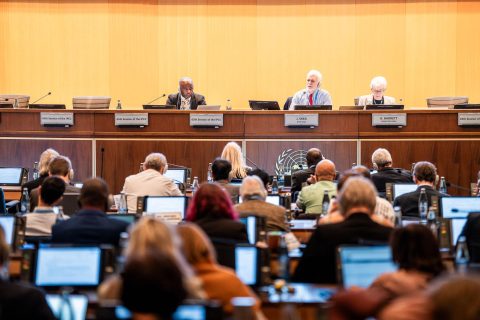

In July, PAICC said 12 countries had ignored its repeated attempts to discuss why they had not published an NDC as required every five years under the 2015 Paris accord.
Members of the committee had been divided over whether to name them, but at a September meeting decided to do so in their annual report to the annual climate COP summit.
By the time the report was published on Friday, only Congo, Senegal and North Korea “had not communicated an NDC or submitted a [Biennial Transparency Report] and had not yet responded to any of the Committee’s notifications, despite several reminders issued by the Committee in this regard”.
Rainforest and renewable energy ambitions
The silence from Congo and Senegal is notable because the former is home to much of the Congo Basin rainforest while the latter has sought billions of dollars in climate finance to support its renewable energy ambitions.
After Brazil, Congo has more rainforest than any country in the world. This forest, and the country’s peatlands, absorb huge amounts of greenhouse gas but are fast being lost to expanding farmland, charcoal production, logging and mining.
Senegal signed a Just Energy Transition Partnership with Canada and wealthy European nations in 2023, to help it meet its renewable energy targets under the-then government of Macky Sall. It was chair of the Least Developed Countries group between January 2022 and December 2023.

Tejas Rao, who is researching the PAICC as part of a doctoral thesis at Cambridge University, said the governments of the three countries should engage with the committee.
“Engagement costs these governments very little and the committee has shown it will listen,” he said.
“Silence leaves the committee with no basis to help, and it leaves the [governments] exposed to the narrative that they are simply disengaged,” he told Climate Home News.
Paris Agreement requirement
The 2015 Paris Agreement requires all parties to publish an NDC every five years outlining their emissions reduction targets, with each plan meant to be more ambitious than the country’s last NDC.
The latest set – the third round of plans, with new targets for 2035 – was due in February 2025. While most countries missed this deadline, all but around 30 – mostly small emitters but including Egypt, Vietnam and Argentina – have now submitted them.
Over the year, the PAICC – which is made up of government climate officials from developed and developing countries – has been communicating with governments that have not submitted NDCs and trying to overcome barriers to them doing so.
Some nations have cited exceptional circumstances as the reason for not submitting an NDC, a process that requires a significant amount of work in tracking emissions and consulting on how to curb them across the economy. For example, a letter from a Sudanese official to the PAICC, seen by Climate Home News, said that the country’s civil war had led to the suspension of its NDC preparation.
-
IPCC scientists vow to press on with climate reports despite political deadlock
After governments again failed to agree a timeline, nearly 120 IPCC authors pledged to complete their assessment on time and with full scientific rigour -
Under US pressure, World Bank says it will back gas “where appropriate”
The US wants the World Bank to expand its gas support while climate campaigners are pushing for it to end – its head spoke this week of limited backing for the fossil fuel -
Who shapes climate science? The equity question facing the IPCC
Early completion of the next global climate science assessment reports risks excluding research from the Global South, which is key to ensuring the findings are fair
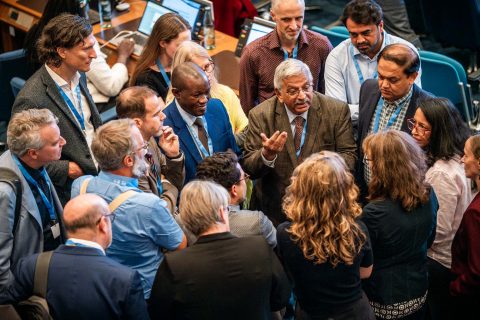
The US and Iran are not signed up to the Paris Agreement and so do not have active NDCs, nor does Taiwan, which is not a UN member state.
Rao said that because the PAICC is “facilitative and non-punitive”, naming the countries “is meant to open a door, not close one – the invited consultation is the point”.
“In recent months, governments that explained their constraints, whether capacity, finance or domestic process, have been met with follow-up and support rather than sanction, and the number of silent governments has fallen sharply,” Rao said.
The post Paris Agreement committee names three countries snubbing it over NDCs appeared first on Climate Home News.
Paris Agreement committee names three countries snubbing it over NDCs