

Carbon dioxide (CO2) emissions from the global power sector grew just 0.2% in the first six months of 2023, with rapidly rising wind and solar outpacing sluggish demand growth.
Emissions from electricity generation would have fallen, but droughts forced countries to increase fossil fuel use to cover declines in hydropower.
The findings come from a new report by thinktank Ember, covering 78 countries and 92% of global electricity demand in the first half of 2023.
The report shows that global electricity demand growth and the expansion of low-carbon supplies remain delicately balanced, with ongoing droughts putting a question mark over Ember’s earlier prediction of a decline in fossil-fueled power in 2023.
While expanded wind and solar capacity met a record 14.3% of global electricity demand in the first half of this year, up from 12.8% a year earlier, hydro generation fell by 8.5%.
With a small rise in fossil-fueled power helping to make up for the drop from hydro, emissions from the sector plateaued rather than declining, despite weak electricity demand growth.
The expansion of low-carbon electricity supplies overall remains insufficient to put the world on track for limiting warming to 1.5C, according to Ember’s report.
Solar topples records
Global wind and solar generation continued to increase across the first six months of 2023, according to Ember.
The amount of electricity generated by solar and wind rose to 1,930 terawatt hours (TWh), up 12% from 1,717TWh during the first half of 2022. This accounted for 14.3% of global electricity generation overall, of which 5.5% came from solar and 8.8% came from wind.
In percentage terms, both sources grew more slowly than in the same period last year. For example, wind output grew 10% in the first half of 2023 compared to 16% in the same period last year. Solar grew 16%, compared to 26% in the first half of 2022.
Such levels of growth are below what is needed to limit warming to 1.5C under the International Energy Agency’s (IEA) net-zero emissions by 2050 scenario, which requires a yearly average growth of 17% for wind and 24% for solar up to 2050, Ember notes.
Similarly, in absolute terms, the growth in wind and solar generation was below the levels seen in 2022. Solar grew by 104TWh, down from 132TWh in the same period last year. Wind increased by 109TWh, compared to 147TWh in the same period last year.
Some 50 countries set new monthly records for solar generation in the first half of 2023, Ember says. This includes 24 of the EU’s 27 members seeing new solar highs as of June.
China, meanwhile, generated 50TWh (6.4% of its electricity) from solar in June 2023, up by 9.7TWh (+25%) on the previous June. This means China’s solar generation in one month would be enough to power New Zealand, Qatar or Hungary for a whole year.
Records were also broken in the US, Mexico, Brazil and Chile, among many others in the Americas, Ember says. As shown in the below chart, where the light green line shows solar trending above 2022 generation levels (dark green line) across a range of countries worldwide.

Having peaked in 2020, wind capacity additions have trended downwards over the past few years, according to Ember. In 2020, 111 gigawatts (GW) of capacity were installed worldwide, in 2021 it was 92GW and in 2022 it was 73GW.
Wind generation growth has similarly slowed, with the largest increase in history (+268TWh) in 2021. This then decreased to +251TWh in 2022, and 109TWh in the first half of 2023.
As with solar, China is surging ahead on wind, being responsible for 91% of global growth in generation in the first half of this year, according to Ember.
China saw a 26% growth in wind generation in the first half of 2023 compared to the same period in 2022. In contrast, wind generation in the EU grew by just 4.8% and in Japan by 2.4%, from an already low baseline, the report notes.
Together, wind and solar generation increased by 213TWh in the first six months of 2023. This increase was much larger than the growth in global electricity demand of 59TWh. However, with hydro output falling dramatically due to drought (see below), there was still a small increase in fossil fuel use and emissions..
Without the increase from wind and solar, global power sector emissions would have risen by 154m tonnes of CO2 (MtCO2, 2.6%), instead of the 12MtCO2 (0.2%) actually seen, according to Ember.
Hydropower drops by record amount
In the first six months of 2023, global hydropower generation fell by 8.5% (-177TWh), according to Ember. Hydro generated 1,898TWh of electricity, some 14% of the global total in the first half of the year, in comparison with 2,074TWh (15%) in the same period of 2022.
The decrease in hydropower generation was caused by droughts, which Ember says were likely exacerbated by climate change. The fall in the six months to June (dark blue) was larger than any decline recorded across a full year in the last two decades, as shown in the chart below.

This was most notable in China, which accounted for around three-quarters of the fall.
China is home to nearly a third of the world’s hydropower generation (30% in 2022).
This year, the country’s hydropower sector was hit by summer droughts for the third consecutive year, as reported by Carbon Brief’s China Briefing.
In July, China’s National Bureau of Statistics announced that hydropower output fell by nearly 23% in the first half of 2023 – the largest drop among all electricity sources.
Similarly, the Centre for Research on Energy and Clean Air recorded a “collapse” in output in the month of June, down 34% year-on-year. It attributed this to “drought and pressure to save water for generation during peak demand season in July–August”.

Ember’s analysis found that China’s hydropower “capacity factor” fell to 30.5% in the first six half of 2023, ten percentage points below the first half of 2022 and the lowest value since at least 2015.
Beyond China, the global capacity factor for hydropower generation fell to 35.6%, nearly four percentage points lower than in the first half of 2022. Across the last decade, the average global hydropower capacity factor was 40.9%, notes Ember.

According to the IEA’s electricity market report, the capacity factor of global hydropower has been a declining trend over the last decade. It has fallen from an average of 38% in 1990-2016, to about 36% in 2020-2022.
This 2% difference means installed hydropower is producing about 240TWh less electricity than it would have produced had the capacity factor stayed the same as it was a decade ago, the IEA report notes.
It adds:
“As a result, an amount of energy as large as Spain’s annual electricity consumption needs to be produced by other dispatchable sources of power, which is currently supplied mainly by fossil-fired generation.”
Currently, 2023 is likely to set a record for the lowest global hydropower capacity factor in recorded history, if conditions fail to substantially improve, Ember adds.
Fossil fuel generation increased to meet the shortfall created by low hydropower rates. If hydropower generation had matched its rate in 2022, power sector emissions would have fallen by 2.9%, Ember says.
Ember suggests that the way hydropower capacity has been hit in the first six months of 2023 is a “warning shot” about how the technology could negatively affect the speed of the electricity transition, given its susceptibility to climate change.
In a statement, Malgorzata Wiatros-Motyka, senior electricity analyst at Ember, says:
“It’s still hanging in the balance if 2023 will see a fall in power sector emissions. While it is encouraging to see the remarkable growth of wind and solar energy, we can’t ignore the stark reality of adverse hydro conditions intensified by climate change. The world is teetering at the peak of power sector emissions, and we now need to unleash the momentum for a rapid decline in fossil fuels by securing a global agreement to triple renewables capacity this decade.”
The Intergovernmental Panel on Climate Change (IPCC) sixth assessment report states that by 2080, climate conditions could affect hydropower generation by between +5% and -5%, under a high emissions scenario. However, it said the expected impact varies significantly depending on the region.
Demand drops in major economies
Across the first six months of 2023, global demand for electricity grew by just 0.4%, according to Ember.
This is much lower than the average annual growth rate between 2012 and 2022, which sat at 2.6%.
Major economies saw falls in demand, including Japan (-5.6%), the EU (-4.6%), the US (-3.4%) and South Korea (-1.4%), leading to a decline in their fossil fuel use for electricity.
This fall in demand in high income economies was due to a number of reasons, according to Ember. In the EU, for example, this continued a trend that began in March 2022, when Russia invaded Ukraine.
Policy measures designed to reduce demand amid the wider energy crisis and concerns over the security of gas, falling output from energy intensive industries, mild winter weather, and reduced personal use due to the cost of living crisis, all contributed.
Mild weather and slower economic activity also drove electricity demand reductions in the US and Japan, Ember says.
Meanwhile, India saw lower-than-expected demand growth in the first six months of 2023, according to the report, rising 3.1% compared to 10.7% in the same period last year. This was lower than the average growth seen from 2012-22 (5.4%).
In China, electricity demand increased by 6%, which is in line with the China Electricity Council’s national estimates, Ember notes, and the historic average for 2012-22 (+5.9%). This reflects China’s rebound from Covid lockdowns in 2022 as well as heatwaves during May and June.
Demand growth is unlikely to continue at such a slow level globally in the future, especially in mature economies that are looking to electrify key sectors such as transport and heating to decarbonise, the report notes.
Electricity demand is set to continue increasing in rapidly-growing economies, including China and India, as they continue to advance their economies and boost electricity access.
Emissions plateau
Thanks to the increase in solar and wind power generation – and despite the drop in hydro output – global power sector emissions plateaued over the first half of 2023, according to Ember. It says the increase from wind and solar avoided 142MtCO2 of emissions.
Globally, the power sector emitted 5,795MtCO2 in the six months of 2023, up just 12MtCO2 (0.2%) from the same period in 2022. This continued a downwards trend that had been seen in the power sector prior to 2021, as seen in the chart below.

Falls in power-sector emissions were seen in the EU (-17%), Japan (-12%), US (-8.6%) and South Korea (-3%), largely as a result of falls in coal generation.
Emissions growth slowed in India, Ember says, where there was a 3.7% increase in the first half of 2023, down from 9.7% a year earlier.
However, Ember’s report notes that current progress falls short of what would be needed to keep warming below 1.5C, stating:
“Power-sector emissions need to be falling fast this decade, not just plateauing. Moreover, having falling emissions when demand is exceptionally low is not enough; emissions must be falling even when global demand is increasing as the world consumes more electricity and moves towards electrifying the entire economy.”
In economies where emissions rose, this was due to an increase in fossil fuel generation.
Globally, fossil-fueled power reached 8,100TWh in the first half of 2023, accounting for 59.9% of global generation overall. This was an increase of 9TWh (0.1%) from a year earlier..
Coal generation increased by 1% (47TWh) and gas generation by 0.5% (14TWh), however other fossil fuel (mainly oil) generation fell 15% (-52TWh).
The changes varied significantly at regional and country level. For example, in China, coal generation increased by 203TWh (8%) in the first half of 2023. This was largely due to the hydropower deficit (129TWh) and contributed to China’s emissions for its power sector rising by 7.9% (173MtCO2).
Without the need to meet the hydropower deficit, China’s coal generation would only have risen by 74TWh (2.9%), according to Ember. This would have been enough to turn the observed 47TWh rise in global coal generation into a fall of 82TWh.
Meanwhile, in the EU, fossil generation fell to its lowest since at least 2000 in the first half of 2023, at 410TWh.
The fall was Europe-wide, with 11 countries seeing a decline of at least 20% and five a decline of more than 30% (Portugal, Austria, Bulgaria, Estonia and Finland), as detailed in an earlier report from Ember, covered by Carbon Brief.
Coal generation in the bloc fell 23% (-49TWh), in contrast to the global rise of 1%.


The post World’s electricity supply close to ‘peak emissions’ due to growth of wind and solar appeared first on Carbon Brief.
World’s electricity supply close to ‘peak emissions’ due to growth of wind and solar

A temporary breach of the 1.5C global-warming limit is now “inevitable” following “decades of insufficient climate action”, says the UN Environment Programme (UNEP).
In its “sobering” annual assessment of the global “emissions gap”, UNEP says that exceeding the Paris Agreement’s 1.5C limit is “imminent and unavoidable”.
This year’s report, titled “The point of return”, says the “task now” is to minimise the size and scale of a temperature “overshoot” and to “establish a credible return path to 1.5C by the end of the century”.
Even the “lowest possible” overshoot scenario for 1.5C would first see global warming peak at around 1.7-1.8C in the middle of the century before declining, says the report.
This scenario – which is “still aligned with the long-term temperature goal of the Paris Agreement” – would require global emissions cuts of 18% by 2030 and 45% by 2035, while ramping up “removals” of carbon dioxide (CO2) from the atmosphere, says UNEP.
In contrast, it notes that the current climate pledges by countries around the world – even if fully implemented – would only reduce emissions by 5-8% by 2030 and 11-15 % by 2035, relative to 2025 levels.
Nonetheless, the report identifies “ample opportunity to accelerate action”, concluding that “countries can still limit peak warming, shorten the duration of overshoot and keep the goals of the Paris Agreement within reach”.
(See Carbon Brief’s detailed coverage of previous reports in 2014, 2015, 2016, 2017, 2018, 2019, 2020, 2021, 2022, 2023, 2024 and 2025.)
Emissions ‘comparable’ between 2024 and 2025
The report says that emissions in 2025 were “comparable” to those of 2024.
Global greenhouse gas emissions in 2025 totalled 58.4bn tonnes of CO2 equivalent (GtCO2e), according to the report. This is around 0.16GtCO2e lower than 2024 levels – albeit, with high levels of uncertainty around the numbers.
In addition, because the figures presented in the 2025 report are “provisional”, the report says, it is “not possible to conclude on the overall direction of emissions in 2025”.
The emissions growth rate has been slowing down in recent decades: the growth rate over 1990-2015 was, on average, 1.7% per year, while emissions have increased by an average of 0.8% per year since 2016.
The chart below shows the total human-driven emissions between 1990 and 2025, separated by greenhouse gas: CO2 from fossil-fuel combustion (dark grey), methane (light grey), nitrous oxide (blue), fluorinated gases (orange) and CO2 from land-use change (green).
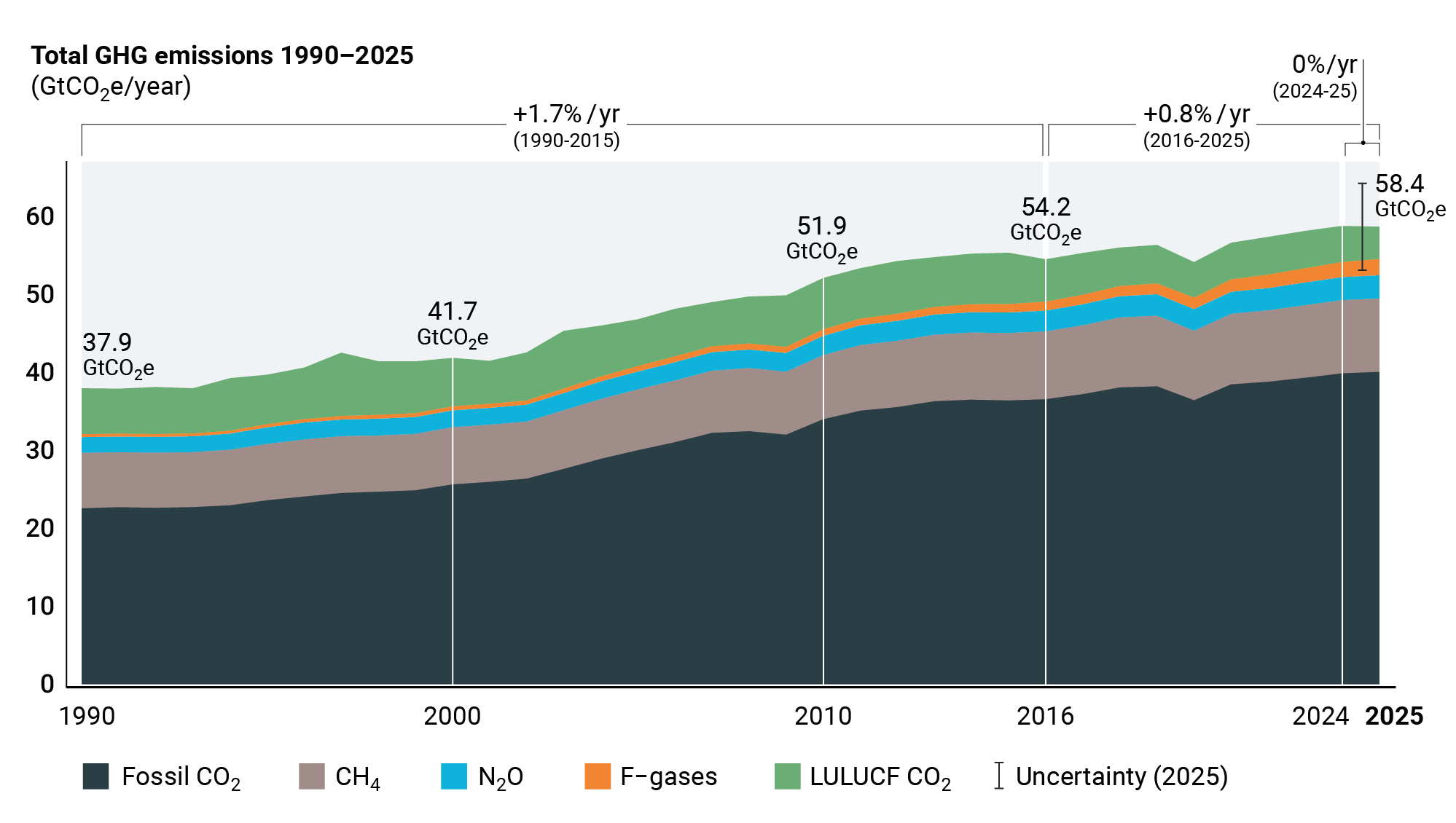
Compared to 2024, emissions from fossil fuels increased slightly, by between 0.4-1.1%, says the report. Emissions of both nitrous oxide and fluorinated gases increased by even higher rates, but since these comprise such a small part of total greenhouse gas emissions, “their contribution to the overall trend is relatively less significant”, it adds. Methane emissions remained steady over that time.
A reduction in the CO2 emissions from land use, land-use change and forestry (LULUCF) “slightly overcompensates” for the rise in emissions of fossil-fuel CO2 and other gases, according to the report. (For more on falling land-use emissions, see Carbon Brief’s explainer.)
The decrease in LULUCF emissions was “partially driven” by a decline in global wildfire emissions, particularly in Africa, South America and parts of south-east Asia. The report notes that these decreases were “likely connected to the ceasing of El Niño conditions”. The ongoing “super” El Niño is likely to cause LULUCF emissions to increase in 2026.
The report also examines countries’ contributions to the increase in greenhouse gas emissions – although here, it excludes LULUCF due to a lag in national-level emissions inventories for the sector.
Among the top six emitters, only the US saw a notable increase in 2025, says the report, whereas emissions in China, the EU, India, Russia and Indonesia were relatively flat. Emissions in the US grew by 133m tonnes of CO2e (MtCO2e) in 2025, due to increased electricity demand and a “rebound” of coal power. This growth in US emissions is likely due to a combination of market factors, including increased heating demand due to a colder winter, higher gas prices and overall increased electricity demand.
The changes for the six largest emitters, the rest of the G20 countries, international transport and the rest of the world can be seen in the chart below.
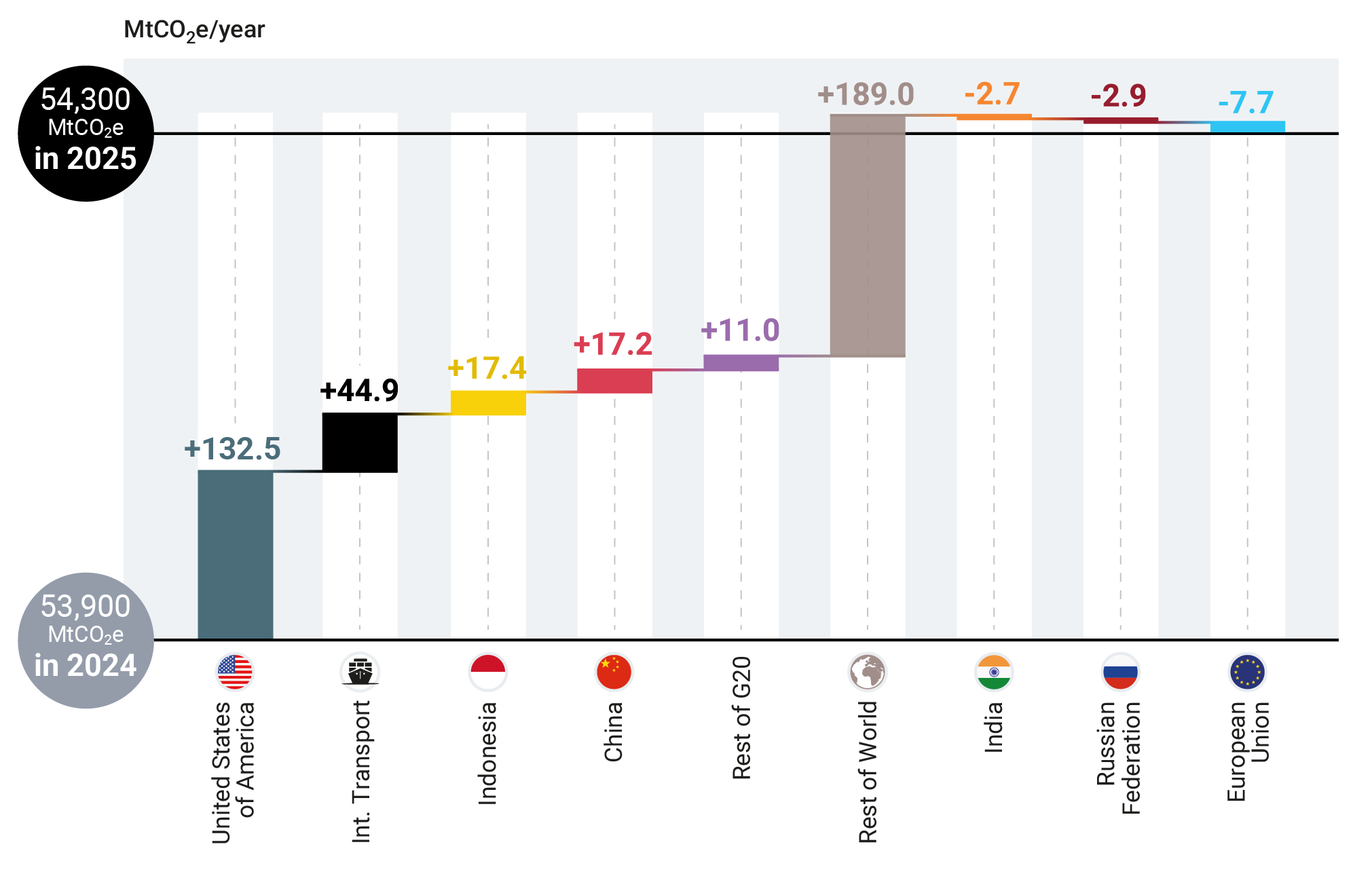
Across most sectors, progress towards decarbonisation has been “modest”, says the report. The most notable decreases have occurred in the power sector and the transport sector, due to the growth of solar power and electric vehicles. The report notes:
“There are emerging signs of transport sector electrification and decarbonisation, but at rates and levels that are not yet sufficient to drive emissions reductions at the global level.”
However, emissions from the transport sector have continued to grow, due to increased demand for international aviation and shipping.
The report notes that while electricity demand from data centres is “projected to double” by 2030, data centres at present account for less than 1% of total emissions.
New NDCs would reduce emissions ‘far from what is needed’
All countries were meant to submit new UN climate pledges for 2035, known as the third nationally determined contributions (NDCs) to the Paris Agreement, by February 2025. However, 95% of nations missed this deadline.
Many countries came forward with their third NDCs at a UN climate summit in New York in September 2025 and at the COP30 climate summit in Brazil in November 2025.
By the end of COP30, 122 – or 63% – of countries had produced their third NDCs.
The report says that figure had risen to 124 by 1 September 2026, with pledges now covering 75% of global emissions.
This is more than double the number of third NDCs available at the time of the 2025 emissions gap report – allowing a “more robust basis for assessing collective progress and ambition toward 2035”, says the report.
Although the first global stocktake of action towards the goals of the Paris Agreement called for countries to submit targets “covering all greenhouse gases”, there has only been a “modest” increase in the number of nations to do so, according to the report.
It says that eight countries included greenhouse gas targets for the first time in their third NDCs, bringing the total number parties with such targets up to 155.
The third NDCs “increasingly use more robust and verifiable target formulations”, such as standardised baselines, says the report.
However, they have not “meaningfully broadened the scope of sectors and gases covered by the targets”, it adds.
If the third NDCs were implemented in full, it would lower global emissions in 2035 by 3.5GtCO2e, compared to 2030 targets, says the report.
It says this is “far from the global reductions needed to get on track to achieving the long-term temperature goal of the Paris Agreement”.
Compared to the 2025 report, the projections for global emissions in 2035 as a result the third NDCs are about 3GtCO2e higher.
This is down to the formal withdrawal of the US from the Paris Agreement, as well as from “harmonising” the projections with the latest historical emissions data, says the report.
The global “implementation gap” for 2030 – defined as the difference between countries’ projected emissions under current policies and the emissions expected if they implemented their NDCs in full – has narrowed compared to last year, says the report.
However, this is mainly due to the withdrawal of the US from the Paris Agreement. In other words, the narrowing of the gap is due to “policy changes, not policy progress”.
The implementation gap for both 2030 and 2035 are of a similar size – suggesting “enhanced collective ambition of 2035 NDCs is weak”, continues the report.
Some 14 of the 17 G20 nations, counting the EU as one, have submitted new NDCs with emissions targets for 2035, says the report.
However, the emissions trajectories of the majority of G20 nations remain “misaligned” with their net-zero targets, says the report.
The chart below shows the gap between nations’ current emission tr