

Storytelling is one of our oldest human behaviors. Across every culture and continent, people have used stories to share values, pass down knowledge and make sense of the world around them. The tales that survive, retold across generations, kept alive through memory and ceremony, aren’t arbitrary. These coastal legends carry essential wisdom.
For countless coastal communities, that wisdom is related to the ocean.
Here are five coastal stories that are important parts of different oral traditions and teach us about our ocean.
Scotland: Selkie Stories
Early written records from the coast of Scotland describe seal-people who shed their aquatic skins to walk among humans on land.
These are the selkie. Their stories follow a familiar arc. One is discovered on shore, their sealskin is stolen and they are bound to a human life. They marry, raise children, but remain melancholy, always watching the water. When the skin is finally found, they return to the sea without hesitation.
It’s not difficult to see where the concept took root. Gray and harbor seals have strikingly humanesque features like expressive eyes, complex vocalizations, mothers who nurse their pups. Early coastal communities observed those qualities, and the selkie story began to spread. It produced a cultural taboo against the excessive hunting of seals.
Today, the selkie is one of Scotland’s most recognized figures. Conservation organizations have adopted the selkie as a bridge symbol of cultural identity and ocean protection. Gray seal populations in Scottish waters continue to face pressure from abandoned fishing gear and historical culling practices, behaviors the selkie taboo was designed to prevent.
Get Ocean Updates in Your Inbox
Sign up with your email and never miss an update.
Pasifika: Wayfinding
Pasifika is a collective term for the Indigenous Peoples of the Pacific Islands. For more than 3,000 years, they’ve managed to pass along extremely complex knowledge on how to navigate the vast expanse of the Pacific Ocean.
Their secret weapon? Storytelling.
They shared stories of the demigod Māui and his canoe, Waka-a-Māui, then navigated by their corresponding constellations in the sky. Tāwhirimātea was the god of wind and storms. When his eyes appeared in the sky (as the Pleiades cluster), it meant that it was a good time to start a long voyage. Stories like these gave navigators a framework for planning their journeys and navigating the distances.
Wayfinding is a science. The people of Pasifika developed their knowledge system through thousands of years of empirical observation, experimentation at sea and rigorous knowledge transmission. The names and stories were a medium of storing and sharing this knowledge, and an effective one at that.
Mexico: Chalchiuhtlicue
Chalchiuhtlicue is the Aztec goddess of rivers, lakes, seas and the ocean, as well as the protector of fishermen and navigators. In Aztec cosmology, she was one of the most actively worshiped deities.
In different stories, she is portrayed as both a creator and destroyer, as surges of water can result in abundant harvests or devastating floods. Today, Mexico’s Pacific and Gulf coasts are among the world’s most biologically rich but storm-exposed marine environments.
Chalchiuhtlicue’s tradition reflects an understanding of how water has the potential to be life-giving or destructive depending on amount and location. Mexico’s Indigenous cultures understood water as the foundational substance of existence, from the ocean to the hydrological routes that fed agricultural soil.
Vietnam: Grandfather Whales
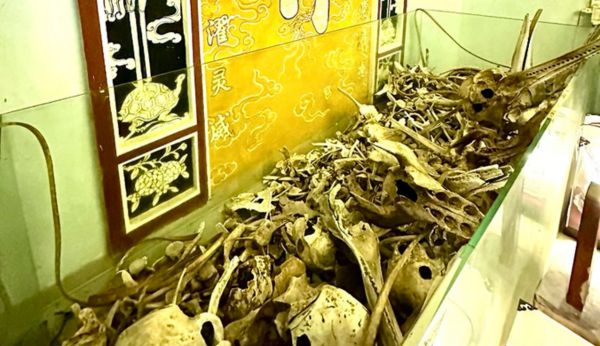
The coastal communities of Vietnam have long shared stories of whales as divine protectors, often referring to them as Cá Ông or “Grandfather Whales.”
It is believed that when fishing boats are lost in a storm, whales physically rescue the crew by sending them toward shore. Several fishing villages in Vietnam still celebrate the Whale Prayer Festival twice a year. Because the whales are so revered, fishermen report whale encounters. Whales received sacred funerals whenever they are beached.
These coastal villages demonstrate a relationship with whale species marked by reciprocity. Sperm whales, humpbacks and gray whales, in fact, show behaviors that are consistent with the stories about rescue. They may approach distressed swimmers, encircle capsized vessels or even support injured kin. When a whale dies, gratitude and grief are expressed. The practice of providing a proper Confucian funeral to beached whales reflects the way that a whale carcass can still sustain hundreds of species after death.

Caribbean: Mami Wata
Many cultures in the Caribbean have carried a belief in Mami Wata. She is an ocean deity, often depicted as a mermaid, who goes by several names: La Siréne in Haiti, River Mumma in Jamaica, and Yemonja in Brazil. Her reinterpretation across several cultures maps how her oral tradition was carried across the Atlantic by enslaved Africans and adapted in different Caribbean settings. Mami Wata is depicted as a beautiful woman, skilled at music, who can be both generous and dangerous. This dual nature is parallel to the Caribbean. It is one of the world’s most biodiverse marine environments, supporting coral reef ecosystems of extraordinary productivity, but it is also a region of violent tropical storms, dangerous currents and unpredictable weather.
Sightings of Mami Wata are thought by some scholars to be related to sightings of manatees. The large, slow marine mammals with humanlike eyes and nursing behavior may match the characterizations of the deity. When the belief in Mami Wata began to decline, so did manatee populations. This reflects a phenomenon researchers call the “sacred species” effect. When a creature holds deep spiritual significance in a culture, harming it carries social and moral consequences that can be more powerful than legal ones. This provides an element of protection that is sometimes more effective than law.
Long before satellites tracked ocean temperatures, people who lived alongside the water were paying close attention. They noticed which creatures signaled safe weather and which behaviors led to abundant catches. They encoded those observations into the stories they told—deities, creatures, warnings and rituals that traveled across centuries intact.
These aren’t relics. Many are living traditions, still practiced and still relevant. And when held up alongside what marine science has since confirmed, the parallels are striking.
The stories contain lessons
What connects a fisherman’s reverence for seals in Scotland to a Vietnamese community’s funeral rites for a beached whale? Around the world, people understand that the ocean is not only a resource for extraction but also offers a relationship to be maintained.
Ocean Conservancy operates on the same understanding. This drives our work today, from protecting marine ecosystems and rebuilding fish populations to fighting the pollution and policy decisions that put our ocean at risk. Right now, aging offshore oil and gas infrastructure is corroding on the seafloor, threatening many of the species that cultures around the world hold dear. The companies that build this infrastructure exploit loopholes to avoid cleaning it up. But we can change that. The proposed Offshore Leasing Standards and Accountability Act before Congress now would require oil and gas companies to take responsibility for their operations before, during and after they drill.
The ocean has always been worth protecting. Add your name and help us pass the Offshore Leasing Standards and Accountability Act now.
The post Lessons from Coastal Legends appeared first on Ocean Conservancy.

If you’ve ever joined a beach cleanup, you’ve almost certainly picked up a plastic bottle. During Ocean Conservancy’s 2025 International Coastal Cleanup® (ICC), plastic beverage bottles were the top item collected by volunteers around the world. Plastic bottles have been among the top 10 items collected throughout the ICC’s entire 41-year history.
But where do those bottles really come from? We know rivers carry plastics of all shapes and sizes from inland communities to coasts and the ocean. What we know far less about is what makes plastic bottles move within rivers, what speeds them up or slows them down and how likely they are to reach the coast and become ocean pollution. Research on river plastics is growing worldwide, but studies in North America lag behind other regions.
Ocean Conservancy scientists, alongside a team of collaborators from 10 research institutions around the United States and Canada, set out to help close some of these pressing knowledge gaps.
How do you track a plastic bottle?
… with a little help from GPS! We modeled our research after a 2021 project in the Toronto Harbor conducted by our University of Toronto colleagues. Like the Toronto project, our research team outfitted floating plastic bottles with GPS tags that reported each bottle’s location at regular intervals. That let us calculate how far and how fast every bottle traveled. Over a two-year period, we released about 300 GPS-tagged bottles into 30 stretches of river in Los Angeles, California; California’s San Francisco Bay Area; Chicago, Illinois; Washington, D.C.; Miami, Florida; Boston, Massachusetts; and Toronto, Canada.
We chose each of these places on purpose.
The locations were selected to represent varied watershed types (ranging from temperate to subtropical climates and mountainous to flat terrain) and development intensity (suburban to densely urban). We followed the bottles for about three months each, through changing seasons, storms and rainfall before locating and retrieving them. And while the plan was always to recover the bottles at the end of the experiment, we also conducted cleanups in each watershed beforehand to make sure we were leaving things a little cleaner than we started.
What did we find?
Our bottles went on quite a journey! On average, each bottle traveled 3.8 miles, but distance traveled actually spanned a huge range depending on the bottle and location. For example, one of our bottles barely budged, moving just 240 feet over the deployment period. Another made it further than the length of a marathon, clocking in at 33 miles traveled.
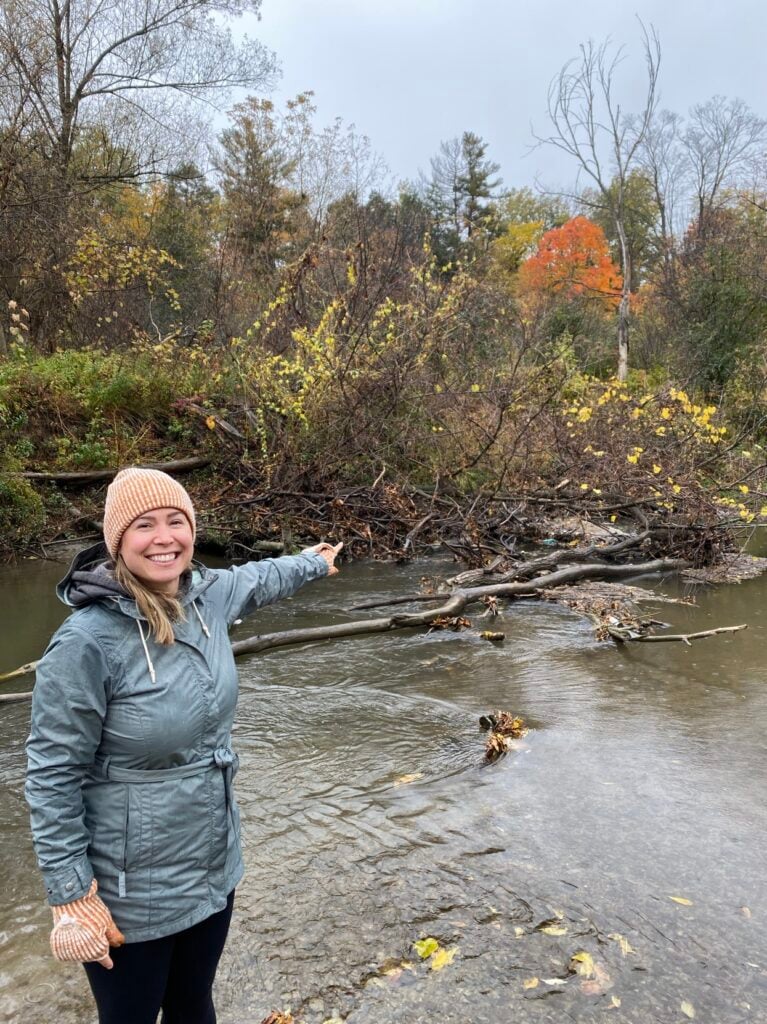
We found river flow was a major driver of how far bottles went, but it wasn’t the only factor—the landscape around each river mattered too. Patterns in bottle movement revealed:
- Forest and vegetation in rivers slowed bottles down. The more forest cover upstream, the less likely a bottle was to reach the coast, because it got snagged in brush, branches and other natural obstructions.
- More urbanized stretches sped them up. Bottles moved farther and faster in more urbanized stretches of river, where there was typically less vegetation to catch them.
Using thousands of GPS points, as well as data about the river systems and watersheds we studied, we built a model to estimate where bottles reaching the coast or the Great Lakes may be coming from. It showed that within a one-year period, about half originate quite close to shore (within seven miles). The other half come from much farther inland, up to 120 miles away!
Why does this matter for our ocean?
Plastic bottles aren’t just unsightly. Ocean Conservancy’s recent, award-winning research found they can be deadly to marine life—either as whole items or after they break up into sharp fragments. There have been documented instances of seabirds like albatross dying after swallowing a plastic bottle whole.
Plastic bottles are among the most prolific plastic pollutants we see out there, and now we understand that many of those we find on beaches or in the ocean may be coming from far upstream.
That has big implications for how we tackle the problem. If half of the bottles reaching the ocean around North America or Great Lakes can start their trip more than 100 miles inland, prevention must happen upstream. Pollution-prevention models, like laws that incentivize the collection and recycling of plastic bottles before they end up in the environment, should be implemented more broadly to prevent plastic from becoming pollution in the first place. Cleanups and other efforts in coastal communities also remain critical. If we want to capture floating plastics like bottles before they reach the coast and eventually our ocean, communities within 120 miles from the ocean or Great Lakes should plan to do those cleanups on an annual basis, or even more frequently.
How can I help keep plastic bottles out of rivers and the ocean?
No matter where you live, the choices you make can help keep plastic out of the ocean:
- Support policies, like those Ocean Conservancy advocates, to stop plastic pollution at the source.
- Join a cleanup along your local river, creek or lakeshore. Every bottle picked up inland is one less that can wash out to sea.
- Choose reusables instead of single-use plastic bottles whenever you can.
We want to extend a huge thank-you to our amazing collaborators on this project at the University of New Hampshire, University of Toronto, Loyola University of Chicago, Smithsonian Environmental Research Center, Florida International University, Moore Institute for Plastic Pollution Research, San Francisco Estuary Institute, University of Waterloo, University of Southern California and University of New Mexico.
Our study, “GPS-Tracked Bottles in North American Rivers Show Marine Plastic Pollution Can Originate from Far Upstream,” was published in the November 13 issue of the scientific journal Environmental Science & Technology-Water. Read the full paper here.
This blog was co-written with Hannah De Frond. Hannah works with Ocean Conservancy and the University of Toronto Trash Team to manage the International Trash Trap Network (ITTN), a global network of local groups using trash traps to increase cleanup efforts, engage communities and inform upstream solutions.