

The World Bank has scrapped its headline climate finance target under pressure from the Trump administration, but experts believe the survival of its wider climate programme should preserve support for clean energy and resilience in developing nations.
Following tense negotiations between its government shareholders, the global lender announced this week it would extend its Climate Change Action Plan (CCAP) while “retiring” its commitment to direct 45% of its financing to projects with climate benefits – a target it has already met.
“It could have been a lot worse,” said Danny Scull, a senior policy advisor at think-tank E3G. “I would have loved to see the most ambitious outcome possible, but it is far less likely we’ll see a scenario where the bank all of a sudden reverses its current trajectory and starts delivering less on climate,” he added.
-
Climate adaptation in Africa needs investment, not imported solutions
Across Africa, communities have implemented vital climate adaptation measures – but these need investment to scale -
With extreme heat now a public health crisis, local data can save lives
The impacts of extreme heat vary widely across countries and cities, and approaches tailored using data can target solutions at vulnerable groups


Introduced in 2021, the CCAP has been credited with overhauling the World Bank’s approach to climate finance after years of criticism over the development finance institution’s lukewarm support for cutting planet-heating emissions and building resilience to extreme weather and rising seas.
Since the CCAP began, the World Bank’s climate finance nearly doubled to $39.2 billion in 2025, with 48% of its financing showing climate “co-benefits” and exceeding the target first set at COP28.
US attack partially rebuffed
With the CCAP due to lapse at the end of June, the US – the World Bank’s largest shareholder – mounted a campaign for the lender to axe the programme entirely. Last April, US Treasury Secretary Scott Bessent publicly welcomed the plan’s upcoming expiration, urging the bank to “shift its myopic focus on climate” and abandon its “distortionary” 45% climate finance target.
But Washington was left increasingly isolated during protracted negotiations in recent months as both European governments and a wide-ranging coalition of developing countries held firm on the plan’s extension, sources with knowledge of the discussions told Climate Home News.
In May, executive directors representing a bloc of nearly 100 countries, including China, Brazil, Saudi Arabia and Russia, sent a letter to the World Bank’s board requesting the CCAP be extended and calling for an independent review of the programme.
While the US had previously seemed unwilling to compromise with its European counterparts, that intervention got it to “back off from its most extreme positions”, E3G’s Scull said.
Focus on “outcomes”
In its statement on Monday, the World Bank Group said it would place less weight on the amount of money flowing into projects with climate benefits and shift its focus to “outcomes”, including indicators such as greenhouse gas emissions avoided and the number of people better shielded from climate risks.
The UK’s international development minister, Jenny Chapman, said in a post on LinkedIn this week that the extension of the CCAP is “a critical step forward”, adding that the stronger emphasis on results “is essential to ensure maximum impact, and the UK will hold the Bank to account to ensure delivery”.
Despite ditching its headline goal, the international lender is still expected to keep counting the volumes of climate finance for the vast majority of its activities. That’s because the individual entities belonging to the group continue to have their own climate targets embedded in their current mandates.
World Bank climate funding greens African hotels while fishermen sink
For example, the International Development Association (IDA), which supports the world’s poorest nations, has committed to providing 45% of its funding to climate-related activities until 2028. And its larger lending arm, the International Bank for Reconstruction and Development (IBRD), should keep aiming for 30% of its financing to have climate benefits.
Joe Thwaites, a climate finance expert at the Natural Resources Defense Council (NRDC), said these targets “can be a backstop against the bottom falling out”. “Client countries are emphasising that they want to see more investments in clean energy and resilience,” he added.
No major change expected
The World Bank’s provision of climate finance is also crucial for wealthy countries’ efforts to meet a commitment to provide $300 billion a year for developing countries by 2035 under the new UN climate goal agreed at COP29 in 2024.
That year, multilateral development banks (MDBs) accounted for around half of all climate finance provided by developed countries under the previous $100-billion-a-year goal, according to calculations by the Organisation for Economic Co-operation and Development.
UK development minister Chapman said this week that the bank “must continue to meet the expectations of the wider international community, including those set out at COP29”. There, MDBs said that by 2030, their annual joint climate financing for low- and middle-income countries would reach an estimated $120 billion.
Fractious COP29 lands $300bn climate finance goal, dashing hopes of the poorest
Rajneesh Bhuee, just transition lead at campaign group Recourse, said it was a “blow” that the World Bank’s headline target had been dropped, but she doesn’t expect to see climate financing reducing – at least in the short term.
“This is the [bank] management’s way of alleviating pressure from the US and ensuring they can have some sort of calm internally,” she told Climate Home News.
Thwaites said shareholder countries should hold the bank’s leadership accountable for delivering what countries have “agreed and need” on climate action.
“If World Bank climate finance does start to fall, donors should focus their support on other international financial institutions that continue to prioritise climate,” he added.
IMF also steps back from climate focus
Regional development banks outside of the Americas may be under less pressure to water down their climate mission. But the World Bank’s sister institution – the International Monetary Fund (IMF) – has seen its enthusiasm for climate action ebb, according to a report released in June by its official watchdog, the Independent Evaluation Office.
The report said that in 2021, the fund placed great emphasis on tackling climate change, as shown by its flagship climate strategy published that year and the establishment of the Resilience and Security Trust in 2022.
But in the last year or so, it found “decreasing emphasis on climate-related issues” which coincided with IMF cost-cutting, “emerging geopolitical challenges” and reduced support for climate action from some unnamed IMF member countries.
Last year, US finance minister Bessent accused the IMF of “mission creep”, accusing it of spending too much time on climate action, gender and social issues.
The evaluation report found that the focus on climate change among the IMF’s management and executive board has weakened, and its flagship reports have not included any climate-related chapters since 2023. IMF head Kristalina Georgieva and other managers mentioned climate-related terms in speeches and statements to the board far less in 2025 than the preceding years, it noted.
While most of the nearly 700 IMF’s staff surveyed welcomed the swing away from climate work, others bemoaned it and felt “self censored” when working to promote awareness of the risks of climate change to the global economy – which the IMF is tasked with protecting.
The post World Bank’s climate work can endure without finance target, experts say appeared first on Climate Home News.
World Bank’s climate work can endure without finance target, experts say

Continue Reading
Three countries have been named by the Paris Agreement’s compliance committee for failing to submit a nationally determined contribution (NDC) and repeatedly snubbing offers of help with their climate plans.
After months of internal debate over whether to identify serial non-responders, the Paris Agreement’s Implementation and Compliance Committee (PAICC) named the three countries which have failed to engage with it over their NDCs on Friday.
It named Democratic Republic of Congo, Senegal and North Korea in a footnote of its annual report, adding that it decided to name them “with a view to facilitating engagement”, adding that representatives of the three nations had been invited to its meeting in early 2027 “with the purpose of identifying any challenges and constraints”.
“The Committee noted the importance of Parties engaging with the Committee in a timely manner, while noting that some delays may be due to the national capabilities and circumstances of the Parties”, the report said.
-
Under US pressure, World Bank says it will back gas “where appropriate”
The US wants the World Bank to expand its gas support while climate campaigners are pushing for it to end – its head spoke this week of limited backing for the fossil fuel -
IPCC scientists vow to press on with climate reports despite political deadlock
After governments again failed to agree a timeline, nearly 120 IPCC authors pledged to complete their assessment on time and with full scientific rigour -
Paris Agreement committee snubbed over missing NDC climate plans
Many governments have still not submitted a nationally determined contribution to the UN, breaching a key requirement of the Paris Agreement

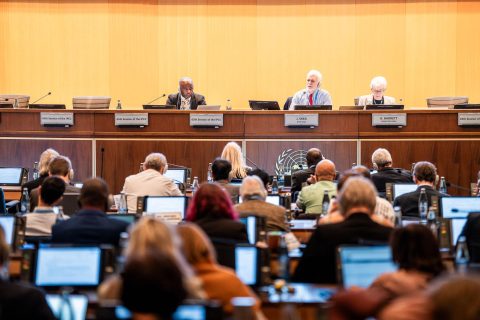

In July, PAICC said 12 countries had ignored its repeated attempts to discuss why they had not published an NDC as required every five years under the 2015 Paris accord.
Members of the committee had been divided over whether to name them, but at a September meeting decided to do so in their annual report to the annual climate COP summit.
By the time the report was published on Friday, only Congo, Senegal and North Korea “had not communicated an NDC or submitted a [Biennial Transparency Report] and had not yet responded to any of the Committee’s notifications, despite several reminders issued by the Committee in this regard”.
Rainforest and renewable energy ambitions
The silence from Congo and Senegal is notable because the former is home to much of the Congo Basin rainforest while the latter has sought billions of dollars in climate finance to support its renewable energy ambitions.
After Brazil, Congo has more rainforest than any country in the world. This forest, and the country’s peatlands, absorb huge amounts of greenhouse gas but are fast being lost to expanding farmland, charcoal production, logging and mining.
Senegal signed a Just Energy Transition Partnership with Canada and wealthy European nations in 2023, to help it meet its renewable energy targets under the-then government of Macky Sall. It was chair of the Least Developed Countries group between January 2022 and December 2023.

Tejas Rao, who is researching the PAICC as part of a doctoral thesis at Cambridge University, said the governments of the three countries should engage with the committee.
“Engagement costs these governments very little and the committee has shown it will listen,” he said.
“Silence leaves the committee with no basis to help, and it leaves the [governments] exposed to the narrative that they are simply disengaged,” he told Climate Home News.
Paris Agreement requirement
The 2015 Paris Agreement requires all parties to publish an NDC every five years outlining their emissions reduction targets, with each plan meant to be more ambitious than the country’s last NDC.
The latest set – the third round of plans, with new targets for 2035 – was due in February 2025. While most countries missed this deadline, all but around 30 – mostly small emitters but including Egypt, Vietnam and Argentina – have now submitted them.
Over the year, the PAICC – which is made up of government climate officials from developed and developing countries – has been communicating with governments that have not submitted NDCs and trying to overcome barriers to them doing so.
Some nations have cited exceptional circumstances as the reason for not submitting an NDC, a process that requires a significant amount of work in tracking emissions and consulting on how to curb them across the economy. For example, a letter from a Sudanese official to the PAICC, seen by Climate Home News, said that the country’s civil war had led to the suspension of its NDC preparation.
-
IPCC scientists vow to press on with climate reports despite political deadlock
After governments again failed to agree a timeline, nearly 120 IPCC authors pledged to complete their assessment on time and with full scientific rigour -
Under US pressure, World Bank says it will back gas “where appropriate”
The US wants the World Bank to expand its gas support while climate campaigners are pushing for it to end – its head spoke this week of limited backing for the fossil fuel -
Who shapes climate science? The equity question facing the IPCC
Early completion of the next global climate science assessment reports risks excluding research from the Global South, which is key to ensuring the findings are fair
The US and Iran are not signed up to the Paris Agreement and so do not have active NDCs, nor does Taiwan, which is not a UN member state.
Rao said that because the PAICC is “facilitative and non-punitive”, naming the countries “is meant to open a door, not close one – the invited consultation is the point”.
“In recent months, governments that explained their constraints, whether capacity, finance or domestic process, have been met with follow-up and support rather than sanction, and the number of silent governments has fallen sharply,” Rao said.
The post Paris Agreement committee names three countries snubbing it over NDCs appeared first on Climate Home News.
Paris Agreement committee names three countries snubbing it over NDCs