Weather Guard Lightning Tech

Wind Turbine Technician Jobs — The 2025–2026 Industry Outlook
Wind turbine technicians literally provide the foundation of the industry, playing a critical role in the global transition to renewable energy. As the wind sector expands, so does the need for skilled talent to install, maintain, and operate wind turbines safely and reliably.
While Weather Guard Lightning Tech does not hire wind turbine technicians, we are often in contact with techs in the field. We update this article every year as a resource for others in the industry and for those who are interested in working as a wind turbine technician. Sources are cited in the article body for easy reference.
The Role of the Wind Technician in 2026
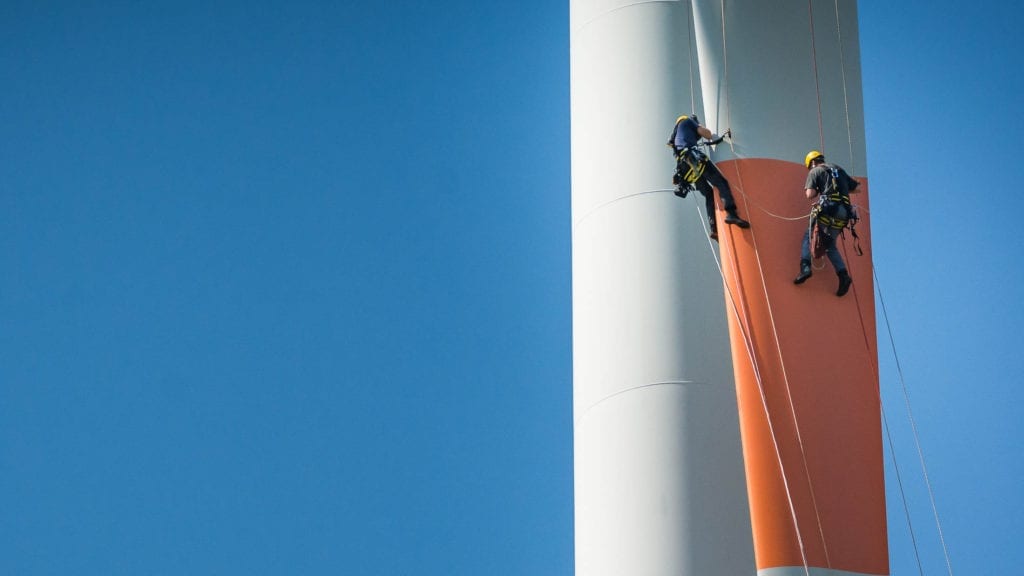
Wind turbine technicians (commonly called wind technicians, or wind service technicians) are responsible for the installation, inspection, maintenance, and repair of wind turbines and related infrastructure. Working as a wind tech typically requires comfort at heights, mechanical and electrical aptitude, and strict adherence to safety procedures. Common duties include:
- Climbing turbine towers for inspection and servicing
- Troubleshooting electrical, hydraulic, and mechanical systems
- Performing routine and predictive maintenance
- Reporting and documenting repair and performance data (see The Department of Energy’s Energy.gov)
Entry into the field typically requires a high school diploma or equivalent, plus specialized post-secondary training.* Technical schools and community colleges increasingly offer wind energy or renewable energy technician programs — often coupled with hands-on experience. (The Department of Energy’s Energy.gov)
Wind Tech Employment: U.S. and Global Demand
In the United States, wind turbine technician jobs are among the fastest-growing occupations:
- Employment growth for wind turbine service technicians is projected to increase ~50% from 2024 to 2034 — much faster than average — adding roughly 6,800 new jobs by 2034. (Bureau of Labor Statistics)
- The occupation is expected to have about 2,300 openings per year on average over that decade, largely driven by new turbine installations and the replacement of existing personnel. (Bureau of Labor Statistics)
These projections underline the sustained demand for technicians, particularly as older turbines age and require more maintenance work.
Wind energy growth is stronger in most countries than that seen in the U.S. A number of factors are driving strong demand worldwide.
- According to the Global Wind Workforce Outlook 2025–2030, the industry will need approximately 628,000 wind technicians by 2030 to support both onshore and offshore wind fleet deployment and operations. (Global Wind Organisation)
- Earlier forecasts estimated that ~569,000 technicians will be required by 2026 to build and maintain the global wind fleet. (Windfair)
This global demand highlights opportunities beyond the U.S., concentrated in major markets such as China, the United States, India, Brazil, Japan, Vietnam, and South Korea. (Global Wind Organisation)
For an overview of wind technician training programs in the U.S., visit BuildTurbines.com
Wind Tech Compensation and Career Path
According to the Bureau of Labor Statistics, in May 2024, the median annual wage for wind turbine technicians in the U.S. was about $62,580 in May 2024 (approximately $30.09/hr).
As with most skilled professions, pay varies by employer and region; experienced technicians and those with advanced certifications can earn much more. Employers may also offer benefits like health insurance, 401(k) matching, and signing bonuses.
Internationally, salaries vary significantly by country, local labor markets, and employer — especially between developed and emerging wind markets.
Because the wind industry is growing quickly, available career advancement and growth opportunities are better than in many other fields. A typical career path might include:
- Entry-level Wind Technician: Perform basic maintenance and inspections.
- Senior Technician / Lead Technician: Higher responsibility for complex troubleshooting and mentorship.
- Operations & Maintenance (O&M) Supervisor or Manager: Oversee teams and maintenance strategies.
- Specialty Roles: Instrumentation, electrical systems, offshore wind technician, and technical training instructor.
Certifications like those from the Global Wind Organisation (GWO) are increasingly standard and help technicians demonstrate safety and technical competence.
And, many wind technicians find other opportunities, growing into sales or consulting roles, and others with entrepreneurial interests establish businesses of their own in the industry, often as a response to what they learn in a few years in the field.
Skills and Training Requirements for Wind Techs
Wind turbine technician roles require a blend of technical training and physical skills:
- Technical Skills Mechanical systems, electrical circuits, hydraulics, PLC systems, and SCADA monitoring.
- Physical and Safety Skills: Comfort working at heights, use of fall protection equipment, confined-space procedures.
- Certifications: GWO Basic Safety Training (BST), rescue and fall-protection standards, and employer-specific or manufacturer-specific credentials are common.
On-the-job training typically supplements formal education and is a key part of career development. Partnerships between training schools and employers enhance placement opportunities. (The Department of Energy’s Energy.gov)
For those looking for their first job as a wind technician, it’s important to note that on-the-job training should never replace formal job training.
Key Industry Trends Affecting Technicians
Expansion of Offshore Wind
Offshore wind projects are expanding in Europe, the U.S., and Asia, creating specialized technician roles with higher travel and safety requirements. These roles often pay premiums due to the increased risk and logistical complexity.
Advanced Maintenance Technologies
Technicians with skills in digital tools and SCADA analytics are increasingly valuable.
Predictive maintenance technologies, including data analytics, drones, and machine-learning-based condition monitoring, are reshaping the work scope and roles available to wind technicians. Service teams increasingly use sensors and analytics to predict failures and schedule maintenance more efficiently, which enhances uptime and reduces reactive repairs (arXiv) – and ultimately reduces serious safety risks.
Workforce Development Challenges
While demand is high, the industry faces training bottlenecks – particularly in the U.S. A skills gap exists between the number of trained technicians and the workforce needed to meet forecast installation and O&M demand, particularly in emerging wind markets. Investments in standardized training and apprenticeship programs are helping close these gaps. (Global Wind Organisation)
What’s happening in the Wind Energy Industry?
More than a million people subscribe to the Uptime Wind Energy Podcast! Maybe you should, too.
Hiring Practices and Opportunities
Entry-Level Positions
Many wind companies regularly hire entry-level technicians, especially those with GWO or equivalent certifications and technical training. Opportunities include onshore installation and maintenance work with employers like Vestas, Siemens Gamesa, GE Vernova, NextEra Energy, and Ørsted. (Jobs are listed in industry job boards and sites like Indeed)
Some roles in the U.S. wind industry explicitly list zero to minimal prior wind experience as acceptable, emphasizing a willingness to train motivated candidates. (NextEra Energy Resources)
Because there are inherent safety risks in any job that requires working at heights, those new to the industry need to remember that on the job training should never replace formal training.
Regional Hiring Overview, 2025-2026
- U.S.: Strong demand exists in wind-rich states like Texas, Iowa, and the Midwest.
- Europe and UK: Offshore wind growth supports technician demand, especially in the North Sea and offshore clusters.
- Asia: China and India continue to expand both onshore and offshore wind capacity, creating wide regional demand.
Online job boards show hundreds of local wind technician openings in regions like Ohio, where employers routinely seek technicians for both onshore and travel roles. (Indeed)
Challenges and Considerations for Wind Technicians and Managers
Market shifts, including political maneuvering, as well as seasonal and weather impacts, are constantly affecting the industry.
While long-term demand is strong, some major developers have recently announced workforce restructuring, particularly as project pipelines shift and financial pressures mount in offshore sectors. For example, Ørsted — one of the world’s largest offshore wind developers — plans workforce reductions amid strategic refocusing. (Reuters) Some of the biggest impacts to the company’s business came about in 2025, almost entirely due to U.S. tariffs and energy policy changes.
To remain competitive, wind operations managers need to plan for talent retention and strategic training investments and creating clear growth plans for employees.
While wind hiring can be seasonal – many sites see hiring slowdowns in winter months and resume when field conditions improve – larger companies maintain a full workforce year round, sometimes shifting workers to other countries to maximize their workforce productivity.
Recognizing the Increasing Value of Wind Turbine Technicians
Technicians are essential to delivering reliable, high-uptime renewable energy. As installations grow and technologies evolve, technician demand is projected to remain robust through 2030 and beyond.
For entry-level candidates, strong technical training and safety certifications unlock opportunities across onshore and offshore wind. For wind managers, strategic workforce development and adoption of advanced maintenance tools are key to scaling operations effectively.
While continued technological advances have changed the role of wind technicians over the years, it is extremely unlikely that any technology will replace the people who truly keep the turbines turning. For the foreseeable future, wind turbine technicians remain a foundation of the global wind industry’s growth, and career prospects are expected to remain strong.
For regular news and perspective on the wind energy industry, including technical innovations and spotlights on the companies moving the wind industry forward, subscribe to the Uptime Tech News newsletter and the Uptime Wind Energy podcast!
Wind Turbine Technician Jobs — The 2025–2026 Industry Outlook
Renewable Energy
Technical Training Academy Expands Across Renewables
Weather Guard Lightning Tech

Technical Training Academy Expands Across Renewables
Nick Martocci, founder of Technical Training Academy in Las Vegas, joins to discuss expanding from wind technician training to other energy technologies and career pathways for veterans in energy.
Sign up now for Uptime Tech News, our weekly newsletter on all things wind technology. This episode is sponsored by Weather Guard Lightning Tech. Learn more about Weather Guard’s StrikeTape Wind Turbine LPS retrofit. Follow the show on YouTube, Linkedin and visit Weather Guard on the web. And subscribe to Rosemary’s “Engineering with Rosie” YouTube channel here. Have a question we can answer on the show? Email us!
Welcome to Uptime Spotlight, shining Light on Wind. Energy’s brightest innovators. This is the Progress Powering tomorrow.
Allen Hall: Nick, welcome back to the program. We’re Tower Trading Academy. Now your technical trading Academy since we last spoke and we last spoke at OM and S in Nashville. Yep. Now we’re here in Orlando. A lot’s changed over the last year.
Nick Martocci: We went through a lot of growth and changes, if you will, to the point where, because I added the program from just wind turbine technician to battery energy storage technician as well.
And obviously like always I’ve got something brewing behind the green curtain. Right, right. Uh, we’re, we’re always doing something and adding and changing training. And what we really did is get to a place where we’re getting really technical with some of the things that we’re doing. And what I did want to [00:01:00] do is rebrand, go through all of the, you know, uh, marketing and pieces again, and try to change things.
And so I tried to find what was the most simplistic, easy pivot, but also kept us out in the people’s eye. Yeah. And we went to Technical Training Academy. So we really didn’t have to do a whole heavy rebrand. We didn’t have to change a lot, but those that are already working with us, it was just letting them know, Hey, we are still Legally Tower Training Academy.
Even the Department of Labor recognizes that, uh, we just have a DBA in place and the DBA doing business as, uh, allows us to now really open that up as far as what are we capable of doing when it comes to. Deliverables for, you know, people in energy and those types of security places.
Allen Hall: Well, I’ve been watching your shorts.
I, they’re on YouTube or on LinkedIn. They’re really good. The little clips about what you [00:02:00] guys are up to, they’re excellent. And the, what I follow, because I, I met you several times, it was just kind of cool to follow the progression there. The state of Nevada has recognized you. There’s a lot of, uh, congratulatory, uh, events that are happening and like, all right, Hey, Nick’s making this thing happen because it’s so hard to be in that training business.
Mm-hmm. To get to where you have brought that whole company. Two is all right. This, this is a, this is a good spot.
Nick Martocci: Yeah. Uh, you’re
Allen Hall: making some progress
Nick Martocci: there. We had Susie Lee’s office last year help us announce the Battery Energy Storage Program, so there was a congressional recognition there as well. Uh, we’ve also been working with other local politicians and things of that nature to be able to showcase some of the things that not just TTA is doing, but veterans and energy.
Because of my partnership with Project Vanguard, I am a state, uh, representative [00:03:00] for Project Vanguard in the state of Nevada. So it’s another piece of also being able to showcase, hey, this is not just what TTA is doing, but what are veterans doing in energy? And I want to be able to not only highlight, you know, obviously TTA, but those pieces as well.
And whatever you state, you know, the veteran pieces, obviously legislators will listen, if that makes sense. That when you start saying, Hey, a veteran is speaking legislation. We’ll quiet down for a second to see, hey, what is this rumble that you guys are creating? And they start to see what we’re doing and they wanna be a part of that.
Allen Hall: Well, I think that’s wonderful. And all the effort and time that you put towards veterans and veteran efforts. Mm-hmm. Thank you so much for doing that. You’re a veteran, you’re a helicopter pilot, you served Yep. Uh, for a number of years. That’s a difficult job. I, you know, obviously the US is involved in some activity at the moment, but.
You know, shout out to all the veterans out there, [00:04:00] obviously. And, and there’s a lot of ’em in renewable energy right now.
Nick Martocci: Well, I mean, not just renewables, but energy, period. ’cause I, I speak to a lot of veterans throughout my downtime, if you’ll say I have that. And you know, the, there’s people that are PMs, program project managers, there are folks that are doing logistics, warehouse hr, and seeing that movement migration.
Of transitioning individuals from active duty, even some folks that are in my program that are in the guard and now getting into a position where, hey, you know, I’m a technician. I’m in energy. Whether they’re a wind turbine tech, they’re in battery, solar, hydro, what have you. Uh, there are quite a number of veterans in the energy market and industry.
Allen Hall: So if you’re a veteran right now or just exiting, uh, the military. I, I think a lot of opportunity is there. They may not [00:05:00] realize. Mm-hmm. Uh, so getting trained up is a lot easier than it used to be. I remember years ago, I think I, we knew people that came outta the military and, and they were just sort of tossed out the door and had to go find things for themselves.
There’s a lot more resources now I would Right. I it feel like than there were even a couple of years ago. And it’s people like you that are kind of bridging that gap for the military to, to get people onboard, to get people trained, to get ’em out in. And doing work in the civilian world, that’s huge.
Nick Martocci: Yeah.
There’s so many leadership traits and skills that veterans already bring to the table. It’s a matter of taking some of those skills that maybe they, you know, worked in motor T and uh, and the motor pools, and they were turning wrenches and fixing, you know, Humvees and other, you know, mechanical vehicles, or they were.
Um, A and p, so airframe and power plant for, uh, aviation and things of that nature. Sure. So now they understand these different types of systems. Already it’s a matter of, oh, how, [00:06:00] how do I transition this over to wind? How do I transition this over to solar? How do I transition this to battery and such? And then be able to pick that up?
It, it, it makes it easier for them because of the familiarity, if you will. To be able to say, Hey, this is very similar to that. All I gotta do is change this information here and now I’m good to go.
Allen Hall: Right. And Project Vanguard’s helping with that a a great deal.
Nick Martocci: Oh yeah. You talked about Project Vanguard, if you don’t know what that is, so Project Vanguard is an initiative to help veterans get into renewable energy careers, utilizing the network that we already have because.
Um, America’s energy is our security as well, and so who better to help take care of the nation’s security of energy than veterans who have already been doing it. And so being able to help individuals, like I said, not always be a technician. Maybe they wanna be able to get into, uh, program or project management.
Maybe they want to get into hr. And by utilizing the [00:07:00] vast network that Project Vanguard has, it, it gives them that ease of entrance and access that maybe they didn’t have before.
Allen Hall: Well, that’s the key. Finding out where those opportunities lie, and it’s hard to do that on your own. Right. Reaching out for some help is the right answer, I think all the time.
And every, especially now, uh, there’s a lot of, uh, military focused companies that, like technical training Academy that are bridging that gap and, and absolutely. That’s fantastic. Now, the amount of training you’re doing on site is impressive and you’re, you’re growing. You’re into Best now, and you’re into more, more and more training, doing some OSHA training.
So there’s a lot of resources available and the website’s been updated. Right. And I think a lot of people are, go to the website, just Google it. You can get there. But the offerings are getting more expansive. The, the technical details are getting deeper into the aspects of all parts of the industry,
Nick Martocci: right?
We’ve worked with, uh, a few entities, uh, to name Drop Ner [00:08:00] and um, destructible. They’ve donated quite a bit of different pieces for our training programs, for blades, for brake systems and things of that nature. For us to be able to take our program to that next level and actually put what technicians are going to be putting their hands on in our training places rather than something as simple as a, uh, like an theory plate piece and actually putting something that a manufacturer is building for these entities.
And saying, Hey, here, this is the exact same thing you’re gonna see, uh, they donated a, a unit that goes to a GE one X, but you know, if you go out to a four X, it’s gonna be the same thing, just a little bigger.
Allen Hall: Bigger. Right,
Nick Martocci: right. And, and so it, it makes it so that it goes from serious hands-on theory to, oh, I’ve seen something just like this, but it was a little smaller.
This is just bigger. I get it. Same thing. And so with destructible being able to make those donations for blades and other pieces. Uh, we’re putting together a LPS program, lightning [00:09:00] Protection Systems. Oh,
Allen Hall: good.
Nick Martocci: And so that’s something That’s awesome. Yeah, it’s something that, it’s a
Allen Hall: lightning protection company.
That’s fantastic.
Nick Martocci: You know, uh, there’s a lot of stuff coming down the pipe for all of those additional pieces. We, we even revamped our whole website when we did the name change back in July, and it allows people to be able to go in and see all those pieces that we’re doing. One of the things is we became a Sprat facility, so being able to do rope access, especially when it comes to those offshore technicians and things of that nature.
So we’re gonna be able to. Help out the wind industry with a lot more of those pieces that they’re looking for. Uh, like I said, the rope access, they’re definitely gonna need, uh, for offshore and things of that nature. Uh, being able to do LPS training, there’s so many other pieces. I’m gonna try not to reveal that we’re working on that are in addition to just the apprenticeship program, but okay.
Somebody went out to the field, I want to get a certification in. Become better SME in this piece and start putting building blocks into people’s [00:10:00]careers.
Allen Hall: Well, that’s the key, right? It it’s the industry’s grown to be more SMEs being on site.
Nick Martocci: Yep.
Allen Hall: And there you have your gearbox people, you have your electrical, diagnosing, debugging people that are out there.
And I think as the industry evolves, we’re gonna have more subject matter experts on sites. Mm-hmm. Doing LPS systems, doing gear boxes, handling some of the electrical things that are happening, even in blades and blade repair. They’re becoming more of subject matter experts. ’cause you have people that, that’s what they do.
They are the expert in fixing this particular kind of blade problem. And they make a great living doing that.
Nick Martocci: And uh, one of the other things that we’re doing is the complimentary training. Right. And what I mean by that is I’ve partnered with, uh, CSN
Allen Hall: Oh Good
Nick Martocci: College of Southern Nevada. Uh, I’m also partnering with some other universities and working on those pieces because I understand that technicians, as they grow in this industry, they want to be able to do other [00:11:00] things, whether that be be a pm, be an engineer.
They want to be able to go and get that piece. And so if I can help refer through our partnerships. Hey, if you want to go get your construction management at CSN, we’re a preferred partner, go talk to. This individual and we can actually, rather than say, Hey, go forth and do great things, we can actually say, Hey, you need to speak to this person, and you know what?
Better yet, let me do an email intro. Making it easier for the end user to actually now say, Hey, you know what? That was so much easier when you create that holistic program similar to what I’ve done, which doesn’t just say, Hey, here, you’re a technician. Bye. Um, you’re actually a part of their career. That, that’s one of the major big things that just really stuck out as far as a different difference maker from me to everybody else.
I don’t just say, Hey, here you go. I, I create a program [00:12:00] with you and your career in mind. You can call back to either TTA or my other business, IFC, infinite Fidelis Consulting, and that is exactly what they do. They, it’s a nonprofit that does workforce development. That is exactly what they do, and they will help.
And so through those partnerships, you now have access immediately to those resources. And I think some of the misnomers and steps that I’ve seen before me is, is exactly that of, hey, you know, we’re finished, right? We’ve taken care of your certs, we’ve taken care of your basic training. Bye-bye. And there there is no un until you see ’em in two years and you do their recertification.
Then you don’t really get to interact with them. And so there’s two years of just what I call dead space. There’s just two, two years of I’ve never seen this person again. And that’s, if they come back to me, they might work for company A, B, or C. And that company might have an internal recertification program where now I’m not [00:13:00] able to still help them and they’re just on a maybe.
Well, that’s where Technical Training Academy
Allen Hall: is doing something different. I, I think you’re right about. The, some of the training schools that exist today are very focused on getting technicians out on a site, and then that’s where it ends. The, the problem is those people tend to grow, especially if they’re from the military.
They tend to go up and rank as they get out in the field a little bit because they do, are doing the right things and every, the, the management realizes I’ve got these people out there that know what they’re doing. I’m gonna promote them, I’m gonna make them the lead, I’m gonna make them the project manager, I’m gonna expand their role.
But you have to also learn that skillset, right? And I think that’s where you’re thinking ahead and trying to help those people grow as they get more experience.
Nick Martocci: And I’m probably repeating myself from two years ago, but this is why I built it. I built it off of the similar frame of leadership style and progression piece that is familiar to us as veterans in the military.
When you’re an E [00:14:00] one, you’re being groomed to be an E two. E two to be groomed to be an E three in, in the civilian world, there really is no grooming process to help you do that ladder climbing piece. And what I wanted to do was help bridge that gap,
Allen Hall: right?
Nick Martocci: And help put those support structures and pieces in place so that somebody could say, Hey, I want to do this.
Who can help me? Well, you can come over to TTA or IFC and we’ll give you a hand. No problem.
Allen Hall: Well, that’s a part about TTA and I think if I was coming outta the military. I, and I wanted to get into renewables. I wouldn’t necessarily necessarily think Las Vegas. I would think Texas, Oklahoma, maybe Indiana, where there’s wind turbines and there’s solar and there’s batteries.
But the reality is, is that the resources that Nevada is putting into veterans and into supporting you make your facility much more powerful than a lot of other places.
Nick Martocci: Well, and and I kind of remember this conversation we had last year about. [00:15:00] The negative connotation of a two mile square space in Las Vegas.
Right. Right. And, and when people immediately think of Las Vegas, that two mile strip is what they immediately think of.
Allen Hall: Sure.
Nick Martocci: Without understanding. And they’re doing a little homework. And that’s why even, you know, tell people, Hey, come out for a tour, check this out and see where we are. Because we’re right across from Nellis Air Force Base right next to the speedway.
One more exit from my, uh, my training center and you’re out of Las Vegas.
Allen Hall: A lot of people coming up in the industry just don’t think about outside that Midwest, that Texas spot. Mm-hmm. And they need to have their horizons open a little bit and realize that there are other places to get training that are high quality, that are gonna be caring about you as a person and the growth of you.
Think about that when you’re applying to school, Joe. Absolutely. Just take whatever’s the closest. And head toward it.
Nick Martocci: We, we don’t play, and we’re going to treat this just like a career. That’s why [00:16:00] training at our school is a 12 hour training day. It’s not an eight hour day, it’s a 12 hour day.
Allen Hall: Right.
Nick Martocci: And that gets them acclimated to a 12 hour work day.
Allen Hall: But that’s
Nick Martocci: what it’s gonna be. Exactly. So that way when you hit the field and some supervisor says, Hey, it’s gonna be a long day. We’re doing 10 hours today. Ah, part-time job. Got it. You know?
Allen Hall: Right. Right. That’s it. So I, I think there, uh, a lot of people have choices if they’re trying to get into renewables.
Mm-hmm. And they need to be thinking about the choices they make. Technical training Academy should be high up on the list.
Nick Martocci: Absolutely
Allen Hall: high up on the list now, especially with veterans. I mean, that, that’s, that’s a no brainer that Do people get ahold of you? How do they contact you? Where should they start that process?
Should they reach out to you on LinkedIn? Should they go to the website? What’s the best way?
Nick Martocci: Best way is really just to go to the website and, uh. O one of the misnomers I made was the Technical Training Academy, and there, there are so many in the United States, I did not realize that. But if you do Technical Training Academy Las Vegas, it narrows it down to four and [00:17:00] we’re the ones on top.
And it makes it easier. And so if you do, uh, technical Training Academy in the Google Bar and just say, Hey, technical Training Academy, Las Vegas will pop up. Otherwise, on LinkedIn, you’ll find us under Technical Training Academy. Uh, Facebook and Instagram. Were still Tower Training Academy. I’m working on getting that changed over, uh, and then from there, yeah, the, I, I think that’s, oh no, we have a YouTube channel.
Tower Training Academy. We’re also on YouTube. Yeah, YouTube. But as far as reaching us, go on our website. Hit enroll now. Uh, also on our website is our phone number, (725) 272-9495.
Allen Hall: There you go.
Nick Martocci: And so you can just ping that or you can even. Hit up my head of administration at admin1@towertrainingacademy.com.
Allen Hall: Great. So everybody reach out, connect up with Nick, get started, figure out what your future looks like because Nick’s here to help and uh, it’s great to connect with you [00:18:00] again because year it’s something more exciting. Like, alright, this is, this is great. It’s expanding. You’re doing training, you got technicians out in the world, you’re going to the best.
That’s fantastic. I’m always cooking. Congratulations because it’s hard. Your business is hard. Yep. And And that is amazing. It’s amazing.
Nick Martocci: I’ve always got something brewing behind the green curtain.
Allen Hall: Yes.
Nick Martocci: Always got something brewing back there.
Allen Hall: Thank you so much for being on the podcast.
Renewable Energy
Countries Without God
A couple of months ago, I happened to ask a friend who had emigrated from Sweden if she was religious. “No!” she exclaimed. “Almost no one in Sweden is religious.”
As we see at left, there seems to be a huge correlation between atheism and the national level of happiness. But what causes that?
Are believers unhappy people for some reason? That doesn’t make sense.
Here’s my two-fold theory. Atheists believe:
a) That we only live once, so we try to enjoy it while we can.
And, more importantly,
b) That we need to take care of one another (since there is no God). We’re willing to make sacrifices if that means things like great education, universal healthcare, environmental responsibility, tolerable working conditions, and near-zero poverty.
Renewable Energy
From the Independent: “Trump Administration to Pay Two More Companies to Walk Away from U.S. Offshore Wind Leases”
From this article in The Independent:
The Trump administration announced two more payouts Monday for energy companies to walk away from U.S. offshore wind projects under development.
Bluepoint Wind and Golden State Wind have agreed to end their offshore wind leases in exchange for reimbursements totaling nearly $900 million. Both companies have decided not to pursue any new offshore wind projects in the United States, the Interior Department announced Monday.
Bluepoint Wind is an offshore wind project in the early stages of development off the coasts of New Jersey and New York, while Golden State Wind is a floating offshore wind project proposed off California’s central coast.
Trump is hellbent on destroying the renewable energy industry so as to benefit his billionaire friends in fossil fuels.
He’s on course to be remembered as the most destructive person in world history, with the possible exception of Adolph Hitler.
-
Greenhouse Gases9 months ago
Guest post: Why China is still building new coal – and when it might stop
-
Climate Change9 months ago
Guest post: Why China is still building new coal – and when it might stop
-
Greenhouse Gases2 years ago嘉宾来稿:满足中国增长的用电需求 光伏加储能“比新建煤电更实惠”
-

Climate Change2 years ago
Bill Discounting Climate Change in Florida’s Energy Policy Awaits DeSantis’ Approval
-
Climate Change2 years ago嘉宾来稿:满足中国增长的用电需求 光伏加储能“比新建煤电更实惠”
-
Renewable Energy6 months agoSending Progressive Philanthropist George Soros to Prison?
-
Climate Change Videos2 years ago
The toxic gas flares fuelling Nigeria’s climate change – BBC News
-
Carbon Footprint2 years agoUS SEC’s Climate Disclosure Rules Spur Renewed Interest in Carbon Credits