


Stellantis, one of Europe’s largest car manufacturers, has announced plans to continue purchasing carbon dioxide (CO₂) emission credits from Tesla in 2025. This decision comes after new EU rules: Starting in 2025, automakers can average their emissions over three years, until 2027.
This policy change gives automakers more flexibility to meet emission targets. However, Stellantis is still committed to using Tesla’s carbon credits to meet environmental standards.
The decision shows the challenges of moving to electric vehicles (EVs) and highlights the need to balance rules with business plans.
Understanding Carbon Emission Credits
CO₂ emission credits are an essential part of emissions reduction policies. Governments limit how much CO₂ companies can release. This is especially important in transportation, where emissions are a big worry.

A company that emits less than its limit earns carbon credits. These credits can be sold to companies that exceed their allowances.
For automakers, this system encourages investment in cleaner technologies. Slow-moving companies must either pay fines for high emissions or buy credits from automakers with extra.
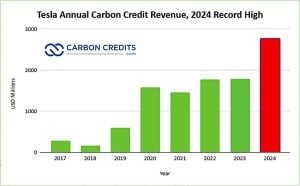
Tesla, which produces only electric vehicles and has low emissions, generates excess credits that it sells to other automakers, including Stellantis.
Since 2019, Tesla has made about $10 billion by selling carbon credits, which has become a major source of income. This financial benefit lets Tesla invest in new technology, research, and production and helps strengthen its position in the EV market.
Stellantis’ Strategy: A Temporary Fix or Long-Term Dependence?
Stellantis depends on emission credits. This shows the challenges it has in meeting EU emission standards. In 2025, Stellantis’ EV sales in Europe accounted for just 14% of its total sales—well below the EU’s target of 21% for that year.
The company is investing in EV production. However, it hasn’t met the EU regulations yet. To comply, it will need to buy credits.
Jean-Philippe Imparato, head of European operations at Stellantis, said, “I’ll use everything.” This shows that the company is fully committed to meeting emission rules.
Stellantis is working hard to boost its EV production. However, it still needs Tesla’s credits to keep going. Imparato further added:
“The 2027 extension ‘gives us some breathing space, but does not provide a solution.”
The automaker has announced plans to ramp up hybrid and electric vehicle production. A new hybrid version of the Fiat 500 will begin production at Stellantis’ Mirafiori plant in Turin, Italy, in November 2025.
The company aims to produce 130,000 units per year, including both hybrid and fully electric versions. This move is part of a two-part strategy. It aims to ensure quick regulatory compliance and invest in EV technology for the future.
Stellantis’ Long-Term Plans
While Stellantis is purchasing carbon credits in 2025, it is also taking steps to strengthen its EV strategy. The company announced investments in battery production and EV infrastructure. These will help reduce its reliance on emission credits in the future.
One of Stellantis’ key initiatives is its plan to expand its electric vehicle lineup. The company is focusing on developing new battery technologies to improve efficiency and lower costs.
Stellantis Roll Out of Battery Electric Vehicles (BEVs)

The European carmaker is also looking for partnerships with battery makers and energy firms. This will help improve its EV supply chain. All these are part of the automaker’s goal to reach net-zero emissions by 2038.
- RELATED: Stellantis Secures $7.5B Loan from U.S. Gov’t for EV Battery Plants: A Push For Its Net Zero Drive
In the next few years, Stellantis plans to boost its EV sales. This will help cut down on buying carbon credits from other companies. The company is focusing on hybrid and fully electric models. This way, it can gradually transition to meet market demand and follow regulatory rules.
European Union’s Emission Regulations
The European Union has strict emissions regulations. These rules aim to encourage automakers to reduce carbon emissions. Automakers must meet specific fleet-wide CO₂ emission targets, which become stricter over time.
Initially, car manufacturers were required to meet individual targets by 2025. In response to industry concerns, the EU extended the compliance period. Now, automakers can meet targets by averaging their emissions from 2025 to 2027.
This change gives automakers more flexibility. It also allows them time to adjust their production plans. However, it does not remove the requirement to meet strict emission targets in the long term.
Stellantis will keep buying Tesla’s carbon credits, even with the compliance extension. This shows the company views these credits as a needed short-term fix while it aims for a more sustainable future.
Industry Perspectives on Compliance and Credit Purchases
The EU’s extension of the compliance period has sparked debate within the auto industry. Some automakers view it as a necessary adjustment that allows them time to scale up EV production without facing immediate financial penalties. Others argue that it could slow the transition to EVs by reducing the pressure on automakers to meet strict deadlines.
Environmental organizations have also raised concerns about the impact of the extension. They say that giving automakers more time to follow regulations might slow down the move to lower emissions. This could hurt efforts to reduce climate change effects.
However, automakers like Stellantis see the extension as a way to balance business sustainability with regulatory requirements.
The company’s decision to continue buying CO₂ credits from Tesla in 2025 highlights the challenges automakers face in meeting stringent emissions targets. The EU’s compliance extension gives temporary relief.
- READ MORE: EU’s 2025 Emission Rules Led Tesla and Mercedes to Pool Carbon Credits to Avoid $15.6 Billion Fine
The post Why Stellantis Still Needs Tesla’s Carbon Credits in 2025 appeared first on Carbon Credits.

EU carbon credit claims changed on 27 September 2026, the day the Directive (EU) 2024/825 began to apply across the European Union. The change is narrow. It changes how a company can talk about the credits it buys. A product can no longer be called neutral on the strength of compensation alone; however, every specific, evidenced statement about what a company measured, reduced, and funded stays fully available.

The post Promoting Improved Cooking Practices in Nigeria appeared first on Terrapass.


-
Climate Change1 year ago
Guest post: Why China is still building new coal – and when it might stop
-

 Greenhouse Gases2 years ago
嘉宾来稿:满足中国增长的用电需求 光伏加储能“比新建煤电更实惠”
-
Greenhouse Gases1 year ago
Guest post: Why China is still building new coal – and when it might stop
-

 Climate Change2 years ago
嘉宾来稿:满足中国增长的用电需求 光伏加储能“比新建煤电更实惠”
-

 Renewable Energy12 months ago
Sending Progressive Philanthropist George Soros to Prison?
-
Climate Change2 years ago
Bill Discounting Climate Change in Florida’s Energy Policy Awaits DeSantis’ Approval
-
Greenhouse Gases1 year ago
嘉宾来稿:探究火山喷发如何影响气候预测
-

 Climate Change2 years ago
Analysis: China’s CO2 falls 1% in Q2 2024 in first quarterly drop since Covid-19