After a five-year long legal battle, the Constitutional Court of South Africa has blocked Shell and local partner Impact Africa’s permit to explore for oil and gas off the country’s East Coast, in a landmark victory for local communities and civil society.
“Today’s judgment makes me feel very happy and proud that the ocean is not for profit for mining companies,” said East Coast resident and environmental campaigner Siyabonga Ndovela.
The verdict culminates a years-long process in which non-profits Sustaining the Wild Coast, Natural Justice, Greenpeace Africa, and others took legal action against Shell, Impact Africa and the South African government for failing to consult affected communities – a legal requirement in the country.
The Constitutional Court ruled that Shell and Impact Africa had not complied with resource governance law, had failed to meaningfully conduct public consultation and had failed to consider the impact on climate change, cultural rights, livelihoods and ecological harm.
The ruling references last year’s landmark advisory opinion by the International Court of Justice, which states that countries have a legal duty to prevent and repair damage to the climate system. The South African judges argued climate change “transcends borders” and that states’ obligations “must be understood within the broader framework of international law.”
“This case must also be understood against the backdrop of well-documented struggles by coastal communities to protect their land, marine resources and ways of life in the face of extractive activities that they believe threaten their very existence,” wrote Justice Narandran Kollapen.
The Constitutional Court found that the exploration right had been unlawfully granted by the Department of Mineral and Petroleum Resources.The ruling upholds a 2022 regional court decision against Shell and overturns a 2024 appeal that allowed the company to conduct fresh public consultations under the original exploration right. Today’s decision means the right, initially granted in 2014, must be set aside.
Celebrating the decision, Sherelee Odyar, oil and gas campaigner at Greenpeace Africa, told Climate Home News that the court confirmed “serious failures” in the awarding of exploration rights to Shell and Impact Africa, which “can not simply be corrected later”.
The Wild Coast is a biodiversity hotspot which has been conserved over generations by coastal communities who rely on the ocean and land. “Our land and sea are central to our livelihoods and our way of life. Over generations we have conserved them, and they have conserved us,” reads the founding statement in the case.
A Shell spokesperson said it noted the ruling, responding that “we are committed to responsible offshore exploration, meaningful stakeholder engagement and environmental stewardship.”
The Department of Mineral and Petroleum Resources did not respond to requests for comment at the time of publication.
“Renewed strength” for communities
The ruling adds to a series of legal challenges brought by civil society groups against oil companies and the government as South Africa has expanded oil and gas development since 2014 under Operation Phakisa, a plan aimed at “unlocking the economic potential of the oceans”.
On the West Coast, Walter Steenkamp, Chair of Aukotowa Fisheries Cooperative, which is involved in a separate ongoing legal action against TotalEnergies, said that “today’s court case gave me renewed strength.”
The case could also set a precedent for future oil developments, said Alessandro Mazzi, legal governance researcher at the University of Wageningen. He added that the verdict “sends a strong signal to investors that where projects affect people’s land, livelihoods and environment, meaningful consultation and genuine ecological assessment are an integral part of responsible investment”.
Janet Solomon, coordinator of advocacy group Oceans not Oil, said that the Court’s emphasis on democratic participation, culture, livelihoods and the health of future generations in handing down the verdict signals a shift in jurisprudence on environmental governance, saying that this focus “may prove to be the judgment’s most enduring legacy.”
The post South Africa’s top court blocks Shell’s offshore oil exploration right appeared first on Climate Home News.
South Africa’s top court blocks Shell’s offshore oil exploration right

For the first time, new-energy vehicles (NEVs) made up 67% of new car sales in China in September, according to the latest data from the China Passenger Car Association (CPCA).
The figures show that NEVs, which include battery electric cars and plug-in hybrids, captured a record share of sales, even though fewer were sold than last year.
This is because sales of combustion-engine cars are falling steeply, a trend that the CPCA has attributed to rising petrol prices following the start of the Hormuz crisis.
Indeed, sales of fuel-only cars were down 31% year-on-year in the first nine months of 2026, with plug-in hybrid sales down 26% – whereas battery EV sales were only down 4%.
One analyst tells Carbon Brief that China’s rapidly growing EV fleet has offset demand for 143m barrels of oil since the start of the Hormuz crisis.
Another says that the crisis is “reinforcing China’s electrification of road transport”.
Meanwhile, amid slowing domestic sales, Chinese carmakers’ exports of NEVs more than doubled [in 2026 to date / in September] from a year earlier.
NEV record
A record two out of every three cars sold in September in China were NEVs, according to CPCA data, as shown in the figure below.
(NEVs predominantly include battery electric vehicles – BEVs – and plug-in hybrids – PHEVs. BEVs only run on electricity, whereas PHEVs also have a combustion engine.)
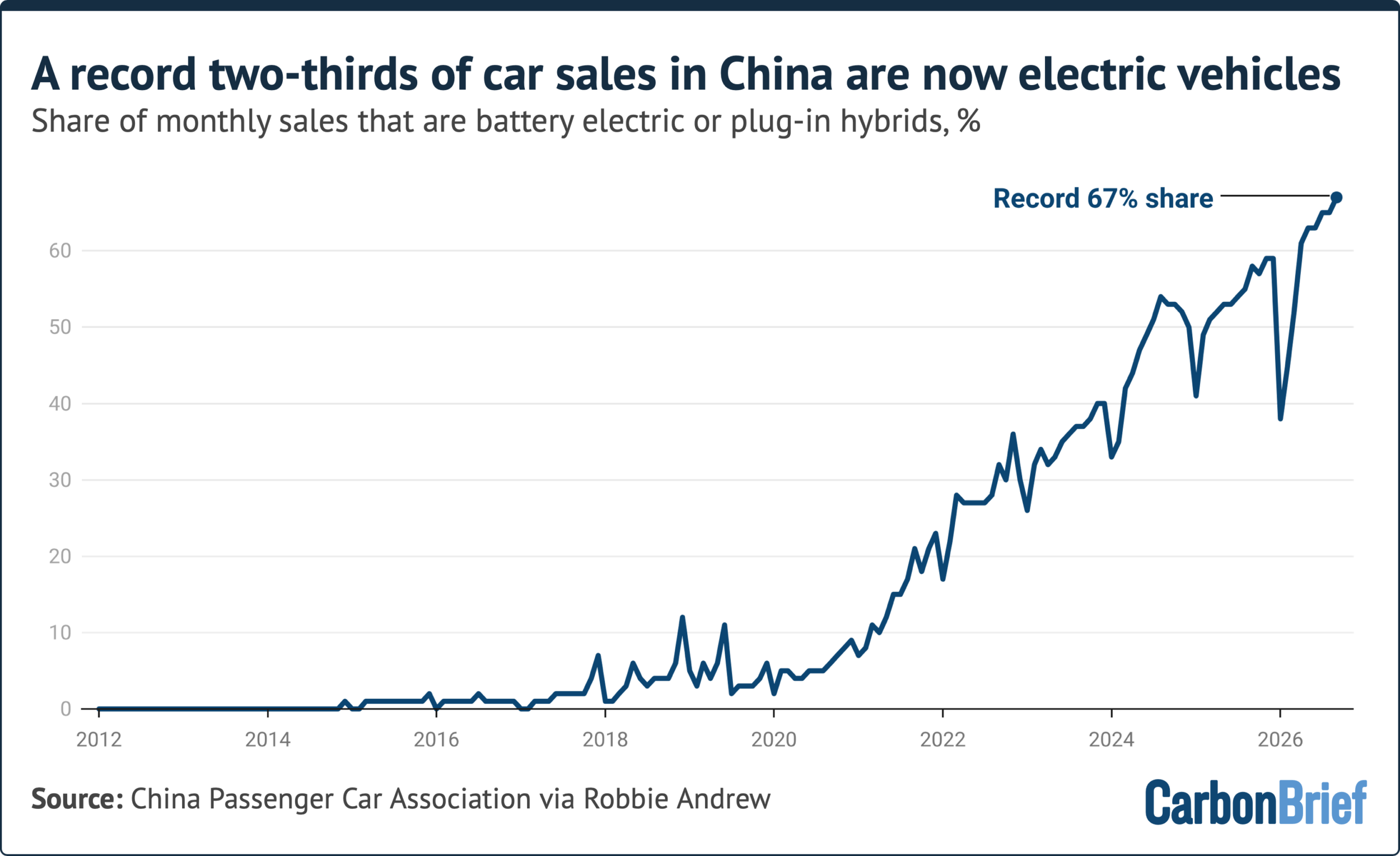
This marks a rapid rise for NEVs from just 6% of new car sales in 2020 up to 58% in 2026 to date – and a record 67% in the month of September.
This year, NEVs’ share of sales has also bounced back from a low of 39% in January, after the full purchase tax exemption that had been in place for more than a decade came to an end in December 2025.
The gain in NEV share in 2026 has come amid a slowdown across the wider domestic passenger-car market, which has hit sales of combustion-engine vehicles particularly hard.
This September, passenger-car retail sales across all categories declined, with overall sales volumes falling 28% year-on-year.
The contraction was led by combustion-engine vehicles, which saw sales fall 43% year-on-year in September and 31% in 2026 to date.
However, sales of PHEVs also fell by 36% year-on-year in September and by 26% in 2026 to date. By comparison, BEVs performed better, although sales still declined 8.5% from a year earlier in September and 4% in 2026 to date.
As a result, NEV sales overall fell by 17% in September and 13% in 2026 to date.
While the market changes in 2026 to date were particularly dramatic, they reflect a broad continuation of trends seen over the past decade.
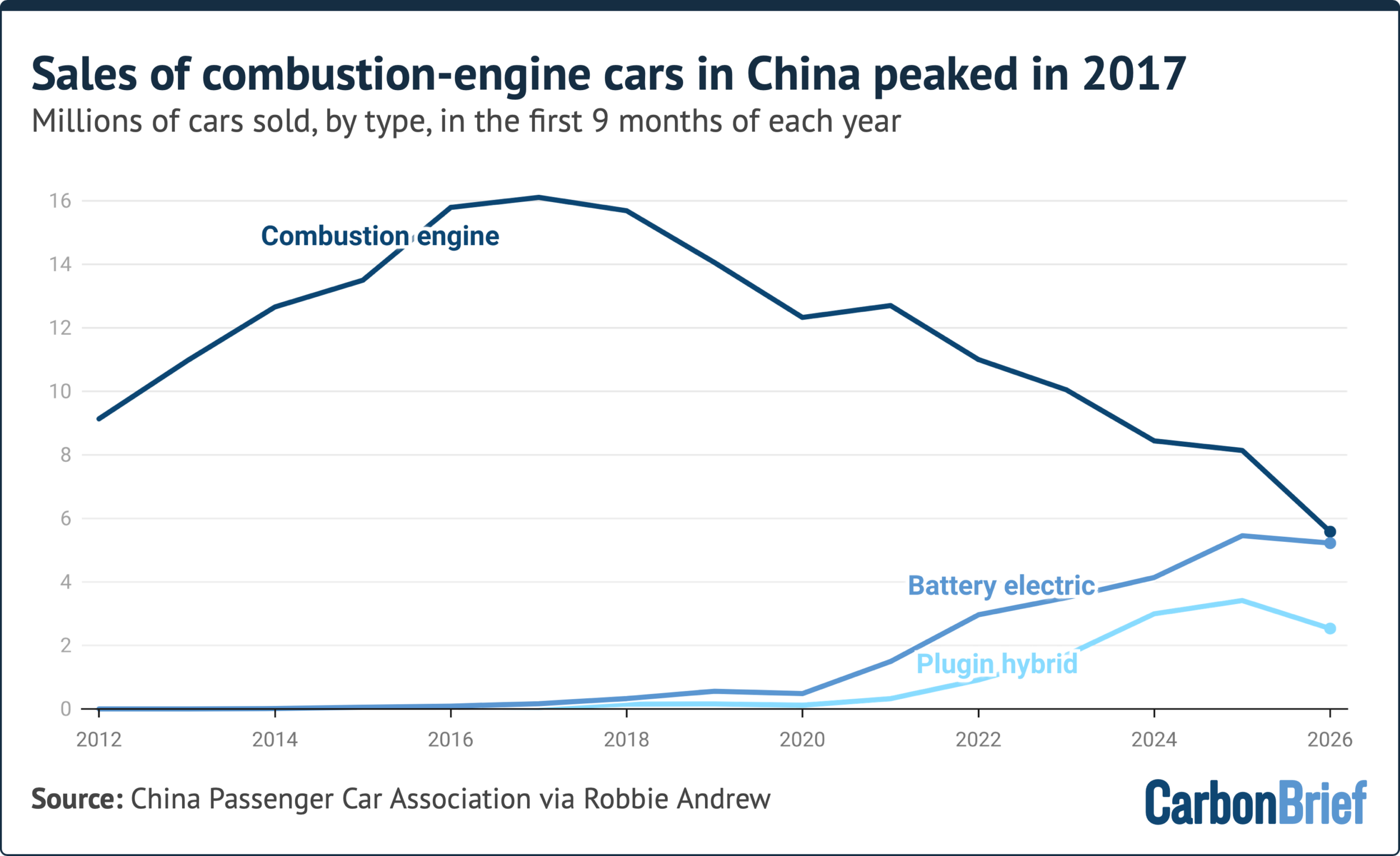
Indeed, sales of combustion-engine cars in China peaked in 2017 and they have been declining ever since, shown in the figure below.
Impact of Hormuz
Part of the reason for the advance of NEVs in 2026, said Chinese technology news outlet OFweek, was petrol cars “giving up market share” as they were outperformed by electric alternatives.
Cui Dongshu, secretary-general of the CPCA, cited higher petrol prices as an explanation for September’s weak combustion-car sales, in comments to financial news outlet National Business Daily.
Imports of oil into China in January-September have fallen 15% compared to 2025, equivalent to 470m barrels, as ongoing conflict tightened supply and drove up prices.
China’s passenger-car NEV fleet has displaced 143m barrels of oil so far during the strait of Hormuz crisis, Euan Graham, senior energy analyst at thinktank Ember, tells Carbon Brief.
EVs “accounted for 12% of the decrease in China’s oil use post-Hormuz”, according to an estimate provided to thinktank the Brookings Institute by an unnamed analyst.
Erica Downs, a senior research scholar at Columbia University’s Center on Global Energy Policy, tells Carbon Brief that the strait of Hormuz crisis and higher oil prices are “reinforcing China’s electrification of road transport”.
She says the “world’s largest oil supply disruption” vindicates China’s early bet on EVs, which was partly driven by concerns about oil-supply security.
NEV demand down
Nevertheless, NEV sales have fallen year-on-year, albeit at a slower rate than overall car sales. The growth in NEV market share has also been decelerating.
Zhang Yichao, a partner at consulting firm AlixPartners, tells Carbon Brief that NEVs benefit from government trade-in policies and a “strong pipeline” of new models, particularly those involving innovation.
He says these factors help explain why NEVs sales have fallen at a slower rate to their combustion-car counterparts.
Cui told the state-run China National Radio that the fall for NEVs and for cars overall in September 2026, is also due to a high baseline of sales from the same month in 2025, as well as changes to trade-in policies and disruptions from the holiday period.
Other factors, says consulting firm Wood Mackenzie, are the weakened demand due to “demand pull-forward” in 2025 caused by the end of subsidies, as well as “tighter financing conditions”.
Zhang tells Carbon Brief he does not “see much more room ahead” for further growth in NEVs’ market share.
He adds that, in his view, their share in China is unlikely to exceed 80%, as some premium-market segments and specific use cases will continue to require combustion-engine vehicles.
Exports surge
Meanwhile, while domestic NEV retail sales fell 17% in September 2026, exports more than doubled, increasing 164% year-on-year, according to the CPCA.
This extends the decline in domestic sales and very strong growth in exports seen across 2026 to date, as shown in the figure below.
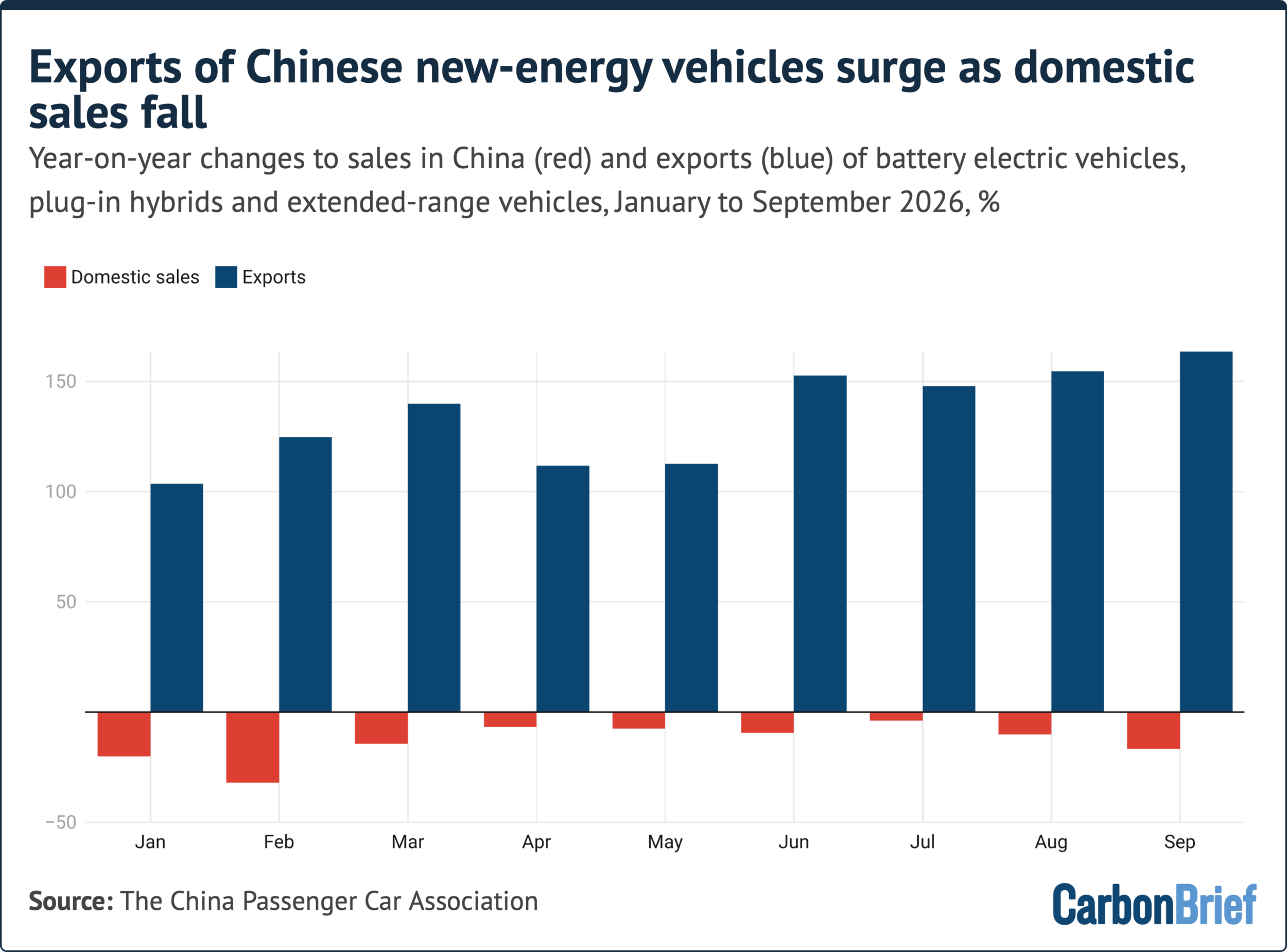
In September, 1,084,000 NEVs were sold domestically in China, while 558,000 NEVs were exported.
Exports are becoming increasingly important to Chinese carmakers, in the face of weaker domestic demand and cut-throat industrial competition.
The CPCA says exports have become “a core priority” for some carmakers.
However, the surge in exports from China has created concern in the EU, which has placed tariffs on imports of EVs from China and recently agreed plans to cut imports of hybrids.
Countries including Mexico and Turkey have also placed tariffs on Chinese EV imports.
At the same time, the Chinese government is putting policies in place that might be expected to disincentivise exports, such as cutting VAT export rebates.
Analysts differ on what impact this policy shift will have, with some saying it will be limited, while others believe it could cause the price of exported cars to rise.