Manuel Pulgar-Vidal is WWF’s Global Climate and Energy Lead and a former Peruvian environment minister and President of COP20 in Lima in 2014
In 2015, the world celebrated the Paris Agreement as a landmark in the global fight against climate change. The principle of “leave no one behind,” carried over from the Sustainable Development Goals, was recognised as a core ethical foundation of the agreement. It represented values of equity, inclusiveness, and justice—ideas essential to tackling both the causes and consequences of climate change.
Yet, in the years that followed, these values drifted into the background. Ethical discussions became marginal, often confined to faith-based initiatives such as Pope Francis’ Laudato Si and Laudate Deum.
Now, in 2025, there are signs of change. On the road to COP30, Brazil has introduced the Global Ethical Stocktake, putting ethics squarely back at the centre of the climate negotiations. It acknowledges what has long been missing from the process and challenges us to rebuild climate action on the foundations of justice, responsibility, and solidarity.

Building the Climate Narrative on Ethical Values
The climate crisis is not just a scientific or political problem—it is also a deeply moral one. Rising emissions and warming temperatures are tied to inequitable development, unchecked consumption, and a reliance on fossil fuels, even when their dangers are well known.
Embedding ethics into climate talks means recognizing the values that should guide us: respect, responsibility, justice, integrity, solidarity, freedom, tolerance, empathy, and equity. These are not abstract ideals. They are the compass we need to navigate the crisis and ensure the planet remains liveable for current and future generations.
If we ignore this ethical dimension, the goals of the Paris Agreement and the UN climate process risk becoming hollow commitments—fine words without meaningful action.
The Role of Courts in Advancing an Ethical Climate Narrative
In recent months, two international courts have issued landmark opinions that reshape the conversation about responsibility and justice in the climate crisis.
-The Inter-American Court of Human Rights recognized that the right to a healthy environment is inseparable from the right to a healthy climate. It laid out three obligations for states: to respect rights, to guarantee rights with reinforced due diligence, and to embed these responsibilities in domestic law.
-The International Court of Justice reaffirmed that climate treaties are built on the principles of equity and intergenerational justice.
These decisions bring ethics and law closer together. They highlight that access to food, water, housing, and a safe climate are fundamental human rights—and that governments cannot ignore their obligations without consequence.
Restoring Credibility Through Ethics
One of the biggest criticisms of global climate negotiations is the gap between promises and delivery. Emissions are not falling fast enough. Adaptation is underfunded. Finance for vulnerable countries lags commitments. The result is widespread frustration and a loss of credibility in the process.
Restoring credibility is not just a technical matter—it is a moral imperative. Countries must not only increase the ambition of their NDCs but also fully implement them. Accountability rules are essential to identify those who delay or fail to act.
The same applies to the private sector. Many corporations make bold claims about being “carbon neutral” or “net zero,” yet their pathways often lack scientific rigor and independent monitoring. When such claims amount to greenwashing, they erode trust.
Ethics provides the framework to rebuild credibility—by linking obligations with accountability and connecting responsibilities directly to citizens and consumers.
Ethics as a Guide for Negotiators
As we approach COP30—more than three decades after the creation of the UNFCCC—negotiators continue to face slow and politicized processes. Too often, meetings are delayed by disputes over agendas, while the climate emergency worsens in real time.
Negotiators may represent their states, but they must also reckon with the moral consequences of inaction. Every year of delay brings more lives lost, more ecosystems destroyed, and more communities displaced.
The Global Ethical Stocktake should serve as a constant reminder of these consequences, awakening the moral conscience that must guide climate diplomacy.
Just as the Global Stocktake in 2023 (COP28) assessed progress and recommended next steps, the ethical debate must reach the heart of negotiations to unlock what political posturing has left unresolved.
Centring Adaptation, Resilience, and Loss and Damage
Since the early 1990s, countries have committed to both decarbonization and building resilience. Yet adaptation lags far behind. Communities most exposed to climate impacts—particularly in the Global South—still lack the resources to protect themselves.
This failure is not only practical but ethical. Without adaptation, vulnerable populations lose the material conditions for survival: food, water, housing, and livelihoods.
The ethical debate must focus strongly on adaptation, loss and damage, and just transition policies. It must highlight the values of solidarity, justice, empathy, and equity in building resilience.
Respecting Indigenous Peoples and Local Communities
Any ethical climate debate must put inclusion at its core. Indigenous peoples and local communities, who have often borne the brunt of exclusion and rights violations, must be central actors in climate solutions.
Their traditional knowledge is not a relic of the past but a living resource. It complements scientific expertise and offers proven pathways for adaptation and ecosystem stewardship. Recognizing and respecting these contributions is both an ethical obligation and a practical necessity.
Making the Global Ethical Debate Permanent
If the Global Ethical Stocktake remains a one-off event, its potential will be wasted. It must become a permanent feature of the climate process.
Brazil should present the results of the Global Ethical Debate at COP30 and propose that future ethical stocktakes align with the Global Stocktake cycle. Champions could be appointed to ensure follow-up, and mechanisms should be created to embed ethics into national planning processes, from NDCs to adaptation plans.
Such steps would make ethics not just a side conversation but a structural element of climate governance.
A Call to Conscience
The climate crisis is a test not only of our science and technology but of our values and humanity. Denialism, polarization, and geopolitical rivalries continue to stall progress. Re-centring ethics offers a bridge between governments and citizens, between technical negotiations and lived realities.
As we look toward COP30 and beyond, the message is clear: ethics is not an optional extra. It is the foundation on which meaningful climate action must be built. If we embrace this truth, guided by both intergenerational and intergenerational responsibility, we can turn commitments into action and leave behind a liveable planet for all.
The post Why ethics must be at the heart of global climate action appeared first on Climate Home News.

For the first time, new-energy vehicles (NEVs) made up 67% of new car sales in China in September, according to the latest data from the China Passenger Car Association (CPCA).
The figures show that NEVs, which include battery electric cars and plug-in hybrids, captured a record share of sales, even though fewer were sold than last year.
This is because sales of combustion-engine cars are falling steeply, a trend that the CPCA has attributed to rising petrol prices following the start of the Hormuz crisis.
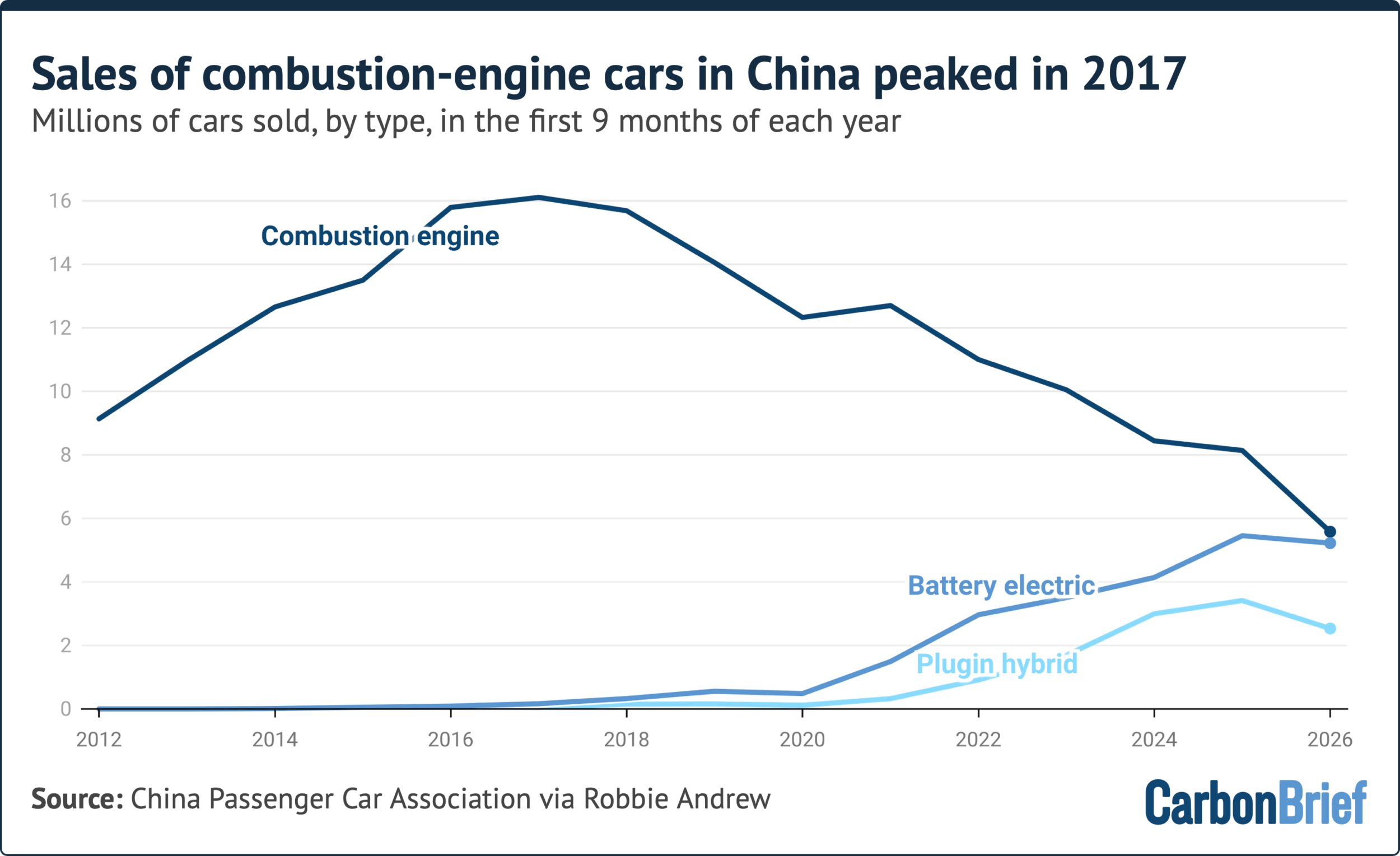
Indeed, sales of fuel-only cars were down 31% year-on-year in the first nine months of 2026, with plug-in hybrid sales down 26% – whereas battery EV sales were only down 4%.
One analyst tells Carbon Brief that China’s rapidly growing EV fleet has offset demand for 143m barrels of oil since the start of the Hormuz crisis.
Another says that the crisis is “reinforcing China’s electrification of road transport”.
Meanwhile, amid slowing domestic sales, Chinese carmakers’ exports of NEVs more than doubled [in 2026 to date / in September] from a year earlier.
NEV record
A record two out of every three cars sold in September in China were NEVs, according to CPCA data, as shown in the figure below.
(NEVs predominantly include battery electric vehicles – BEVs – and plug-in hybrids – PHEVs. BEVs only run on electricity, whereas PHEVs also have a combustion engine.)
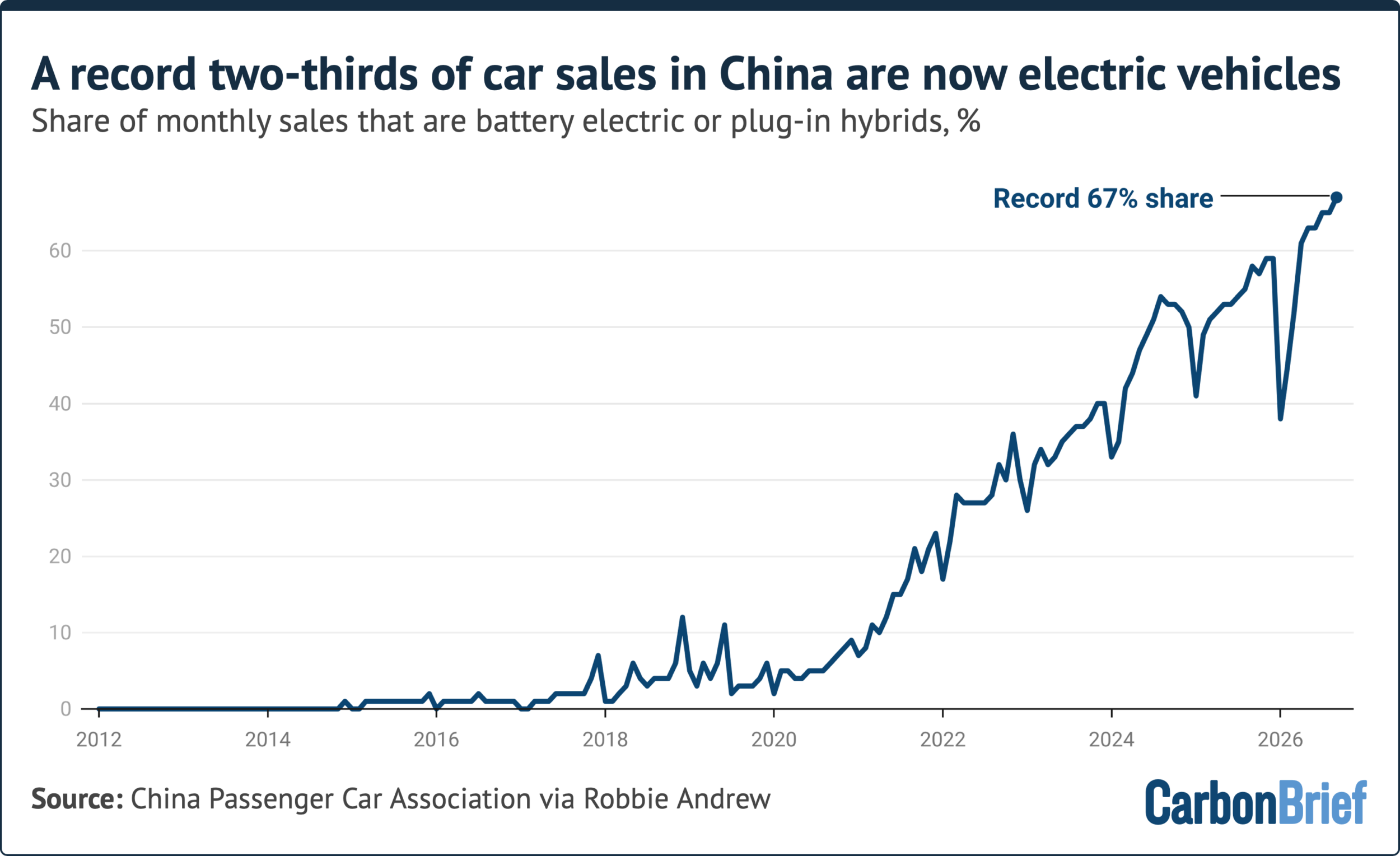
This marks a rapid rise for NEVs from just 6% of new car sales in 2020 up to 58% in 2026 to date – and a record 67% in the month of September.
This year, NEVs’ share of sales has also bounced back from a low of 39% in January, after the full purchase tax exemption that had been in place for more than a decade came to an end in December 2025.
The gain in NEV share in 2026 has come amid a slowdown across the wider domestic passenger-car market, which has hit sales of combustion-engine vehicles particularly hard.
This September, passenger-car retail sales across all categories declined, with overall sales volumes falling 28% year-on-year.
The contraction was led by combustion-engine vehicles, which saw sales fall 43% year-on-year in September and 31% in 2026 to date.
However, sales of PHEVs also fell by 36% year-on-year in September and by 26% in 2026 to date. By comparison, BEVs performed better, although sales still declined 8.5% from a year earlier in September and 4% in 2026 to date.
As a result, NEV sales overall fell by 17% in September and 13% in 2026 to date.
While the market changes in 2026 to date were particularly dramatic, they reflect a broad continuation of trends seen over the past decade.
Indeed, sales of combustion-engine cars in China peaked in 2017 and they have been declining ever since, shown in the figure below.
Impact of Hormuz
Part of the reason for the advance of NEVs in 2026, said Chinese technology news outlet OFweek, was petrol cars “giving up market share” as they were outperformed by electric alternatives.
Cui Dongshu, secretary-general of the CPCA, cited higher petrol prices as an explanation for September’s weak combustion-car sales, in comments to financial news outlet National Business Daily.
Imports of oil into China in January-September have fallen 15% compared to 2025, equivalent to 470m barrels, as ongoing conflict tightened supply and drove up prices.
China’s passenger-car NEV fleet has displaced 143m barrels of oil so far during the strait of Hormuz crisis, Euan Graham, senior energy analyst at thinktank Ember, tells Carbon Brief.
EVs “accounted for 12% of the decrease in China’s oil use post-Hormuz”, according to an estimate provided to thinktank the Brookings Institute by an unnamed analyst.
Erica Downs, a senior research scholar at Columbia University’s Center on Global Energy Policy, tells Carbon Brief that the strait of Hormuz crisis and higher oil prices are “reinforcing China’s electrification of road transport”.
She says the “world’s largest oil supply disruption” vindicates China’s early bet on EVs, which was partly driven by concerns about oil-supply security.
NEV demand down
Nevertheless, NEV sales have fallen year-on-year, albeit at a slower rate than overall car sales. The growth in NEV market share has also been decelerating.
Zhang Yichao, a partner at consulting firm AlixPartners, tells Carbon Brief that NEVs benefit from government trade-in policies and a “strong pipeline” of new models, particularly those involving innovation.
He says these factors help explain why NEVs sales have fallen at a slower rate to their combustion-car counterparts.
Cui told the state-run China National Radio that the fall for NEVs and for cars overall in September 2026, is also due to a high baseline of sales from the same month in 2025, as well as changes to trade-in policies and disruptions from the holiday period.
Other factors, says consulting firm Wood Mackenzie, are the weakened demand due to “demand pull-forward” in 2025 caused by the end of subsidies, as well as “tighter financing conditions”.
Zhang tells Carbon Brief he does not “see much more room ahead” for further growth in NEVs’ market share.
He adds that, in his view, their share in China is unlikely to exceed 80%, as some premium-market segments and specific use cases will continue to require combustion-engine vehicles.
Exports surge
Meanwhile, while domestic NEV retail sales fell 17% in September 2026, exports more than doubled, increasing 164% year-on-year, according to the CPCA.
This extends the decline in domestic sales and very strong growth in exports seen across 2026 to date, as shown in the figure below.
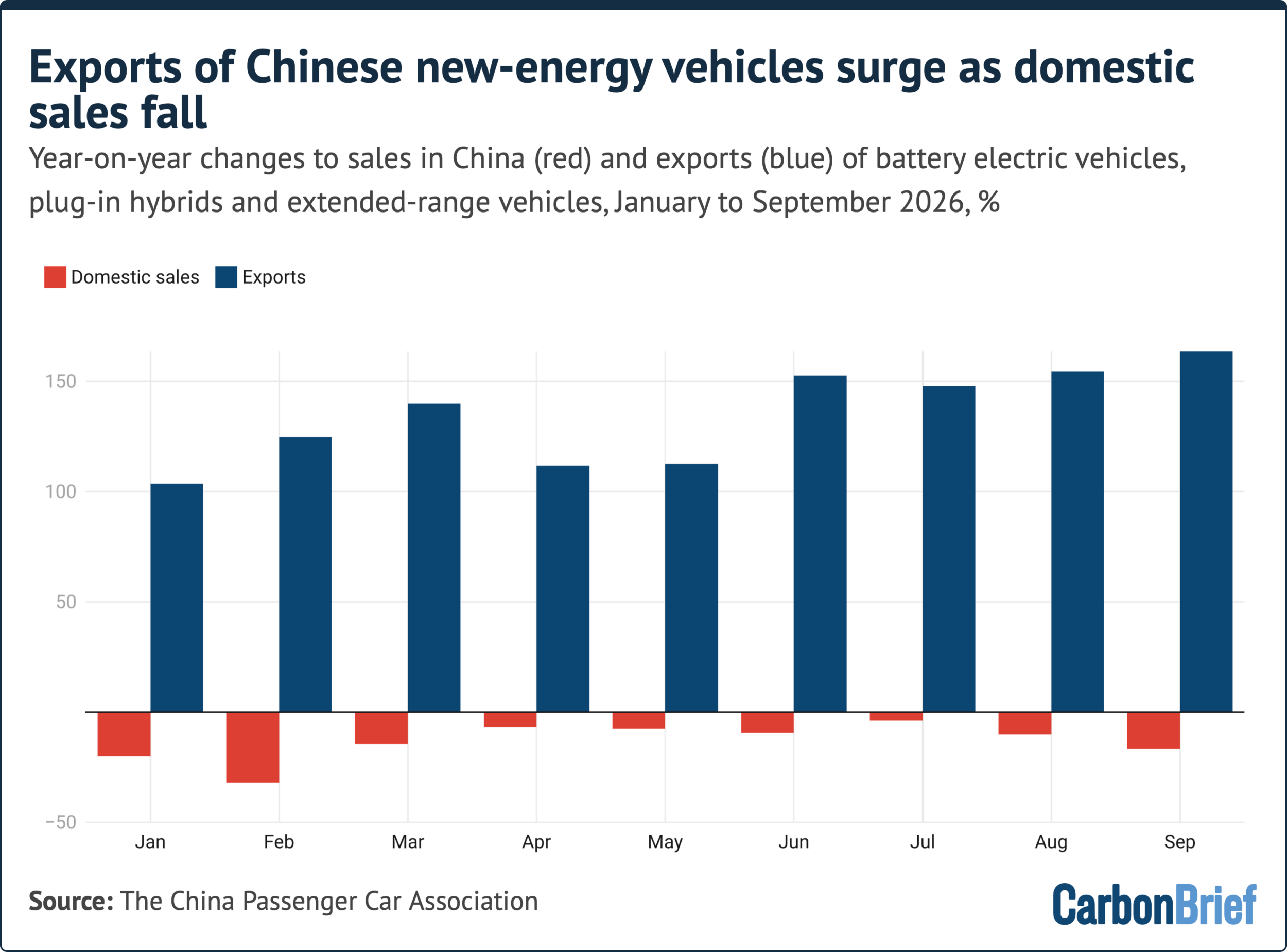
In September, 1,084,000 NEVs were sold domestically in China, while 558,000 NEVs were exported.
Exports are becoming increasingly important to Chinese carmakers, in the face of weaker domestic demand and cut-throat industrial competition.
The CPCA says exports have become “a core priority” for some carmakers.
However, the surge in exports from China has created concern in the EU, which has placed tariffs on imports of EVs from China and recently agreed plans to cut imports of hybrids.
Countries including Mexico and Turkey have also placed tariffs on Chinese EV imports.
At the same time, the Chinese government is putting policies in place that might be expected to disincentivise exports, such as cutting VAT export rebates.
Analysts differ on what impact this policy shift will have, with some saying it will be limited, while others believe it could cause the price of exported cars to rise.
Related