

Colombia wants countries to discuss options for a global agreement to ensure that the extraction, processing and recycling of minerals – including those needed for the clean energy transition – don’t harm the environment and human wellbeing.
The mineral-rich nation is proposing to create an expert group to “identify options for international instruments, including global and legally-binding instruments, for coordinated global action on the environmentally sound management of minerals and metals through [their] full lifecyle”.
Colombia hopes this will eventually lead to an agreement on the need for an international treaty to define mandatory rules and standards that would make mineral value chains more transparent and accountable.
The proposal was set out in a draft resolution submitted to the UN Environment Assembly (UNEA) earlier this week and seen by Climate Home News. UNEA, which is constituted of all UN member states, is the world’s top decision-making body for matters relating to the environment. The assembly’s seventh session will meet in Kenya in December to vote on countries’ proposals.
-
Migrant workers building Saudi Arabia’s green future face exploitation, report finds
Heat stroke, long hours and punishment for taking breaks – low-paid foreign workers compare jobs on Saudi renewable energy projects to a prison sentence -
Milei’s budget cuts fuel deforestation fears in Argentina’s Chaco
President Javier Milei has slashed environmental spending since his 2023 election, putting forest defenders on alert in Gran Chaco, South America’s second-largest forest biome -
Why ethics must be at the heart of global climate action
If science shows us the urgency for climate action, then ethics must show us the way to rebuild momentum writes WWF climate & energy lead Manuel Pulgar-Vidal


Soaring demand for the minerals used to manufacture clean energy technologies and electric vehicles, as well as in the digital, construction and defence industries have led to growing environmental destruction, human rights violations and social conflict.
Colombia argues there is an “urgent need” to strengthen global cooperation and governance to reduce the risks to people and the planet.
Options for a global minerals agreement
The proposal is among a flurry of initiatives to strength global mineral governance at a time when booming demand is putting pressure on new mining projects.
Colombia, which produces emeralds, gold, platinum and silver for exports, first proposed the idea for a binding international agreement on minerals traceability and accountability on the sidelines of the UN biodiversity talks it hosted in October 2024.
Since then, the South American nation has been quietly trying to drum up support for the idea, especially among African and European nations.
Its draft resolution to UNEA7 contains very few details, leaving it open for countries to discuss what kind of global instrument would be best suited to make mineral supply chains more transparent and sustainable.
Does the world need a global treaty on energy transition minerals?
Colombia says it wants the expert group to build on other UN initiatives, including a UN Panel on Critical Energy Transition Minerals, which set out seven principles to ensure the mining, processing and recycling of energy transition mineral is done responsibly and benefits everyone.
The group would include technical experts and representatives from international and regional conventions, major country groupings as well as relevant stakeholders.
It would examine the feasibility and effectiveness of different options for a global agreement, consider their costs and identify measures to support countries to implement what is agreed.
The resolution also calls for one or two meetings for member states to discuss the idea before the UNEA 8 session planned in late 2027, when countries would decide on a way forward.
No time to lose for treaty negotiations
Colombia’s efforts to advance global talks on mineral supply chains have been welcomed by resource experts and campaigners. But not everyone agrees on the best strategy to move the discussion forward at a time when multilateralism is coming under attack.
Johanna Sydow, a resource policy expert who heads the international environmental policy division of the Heinrich-Böll Foundation, said she had hoped that the resolution would explicitly call for negotiations to begin on an international minerals treaty.
“Treaty negotiations take a long time. If you don’t even start with it now, it will take even longer. I don’t see how in two or three years it will be easier to come to an agreement,” she told Climate Home.
-
The company tracking energy transition minerals back to the mines
Australian firm Source Certain traces minerals back to the exact point where they were extracted from the Earth – a technique that could help make cleantech supply chains more accountable -
The ICJ climate ruling has major implications for the loss and damage fund
As the fund struggles with lack of money and bureaucratic barriers, its board must align its actions with the landmark court decision -
Major financiers neglect energy transition risks from mining as demand booms
Financial institutions are lacking safeguards to prevent harms caused by mining the resources needed for the energy transition, analysis of the sector’s financing finds


Despite the geopolitical challenges, “we need joint rules to prevent a huge race to the bottom for [mineral] standards”. That could start with a group of countries coming together and starting to enforce joint standards for mining, processing and recycling minerals, she said.
But any meaningful global agreement on mineral supply chains would require backing from China, the world’s largest processor of minerals, which dominates most of the supply chains. And with Colombia heading for an election in May, it will need all the support it can get to move its proposal forward.
‘Voluntary initiative won’t cut it’
Juliana Peña Niño, Colombia country manager at the Natural Resource Governance Institute, is more optimistic. “Colombia’s leadership towards fairer mineral value chains is a welcome step,” she told Climate Home News.
“At UNEA7, we need an ambitious debate that gives the proposed expert group a clear mandate to advance concrete next steps — not delay decisions — and that puts the voices of those most affected at the centre. One thing is clear: the path forward must ultimately deliver a binding instrument, as yet another voluntary initiative simply won’t cut it,” she said.
More than 50 civil society groups spanning Latin America, Africa and Europe previously described Colombia’s work on the issue as “a chance to build a new global paradigm rooted in environmental integrity, human rights, Indigenous Peoples’ rights, justice and equity”.
“As the energy transition and digitalisation drive demand for minerals, we cannot afford to repeat old extractive models built on asymmetry – we must redefine them,” they wrote in a statement.
Main image: The UN Environment Assembly is hosted in Nairobi, Kenya. (Natalia Mroz/ UN Environment)
The post Colombia proposes expert group to examine options for minerals agreement appeared first on Climate Home News.
Colombia proposes expert group to examine options for minerals agreement

For the first time, new-energy vehicles (NEVs) made up 67% of new car sales in China in September, according to the latest data from the China Passenger Car Association (CPCA).
The figures show that NEVs, which include battery electric cars and plug-in hybrids, captured a record share of sales, even though fewer were sold than last year.
This is because sales of combustion-engine cars are falling steeply, a trend that the CPCA has attributed to rising petrol prices following the start of the Hormuz crisis.
Indeed, sales of fuel-only cars were down 31% year-on-year in the first nine months of 2026, with plug-in hybrid sales down 26% – whereas battery EV sales were only down 4%.
One analyst tells Carbon Brief that China’s rapidly growing EV fleet has offset demand for 143m barrels of oil since the start of the Hormuz crisis.
Another says that the crisis is “reinforcing China’s electrification of road transport”.
Meanwhile, amid slowing domestic sales, Chinese carmakers’ exports of NEVs more than doubled [in 2026 to date / in September] from a year earlier.
NEV record
A record two out of every three cars sold in September in China were NEVs, according to CPCA data, as shown in the figure below.
(NEVs predominantly include battery electric vehicles – BEVs – and plug-in hybrids – PHEVs. BEVs only run on electricity, whereas PHEVs also have a combustion engine.)
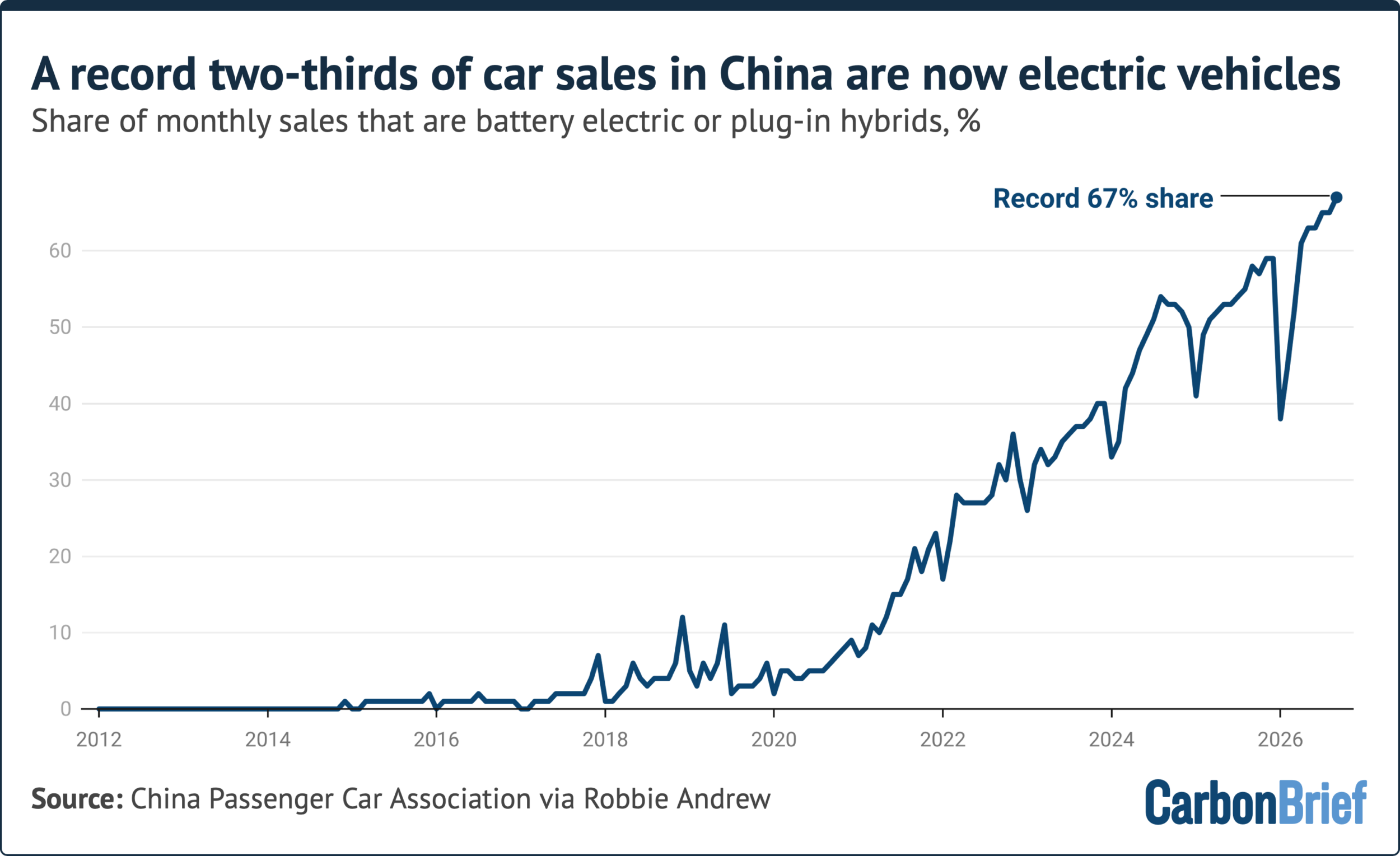
This marks a rapid rise for NEVs from just 6% of new car sales in 2020 up to 58% in 2026 to date – and a record 67% in the month of September.
This year, NEVs’ share of sales has also bounced back from a low of 39% in January, after the full purchase tax exemption that had been in place for more than a decade came to an end in December 2025.
The gain in NEV share in 2026 has come amid a slowdown across the wider domestic passenger-car market, which has hit sales of combustion-engine vehicles particularly hard.
This September, passenger-car retail sales across all categories declined, with overall sales volumes falling 28% year-on-year.
The contraction was led by combustion-engine vehicles, which saw sales fall 43% year-on-year in September and 31% in 2026 to date.
However, sales of PHEVs also fell by 36% year-on-year in September and by 26% in 2026 to date. By comparison, BEVs performed better, although sales still declined 8.5% from a year earlier in September and 4% in 2026 to date.
As a result, NEV sales overall fell by 17% in September and 13% in 2026 to date.
While the market changes in 2026 to date were particularly dramatic, they reflect a broad continuation of trends seen over the past decade.
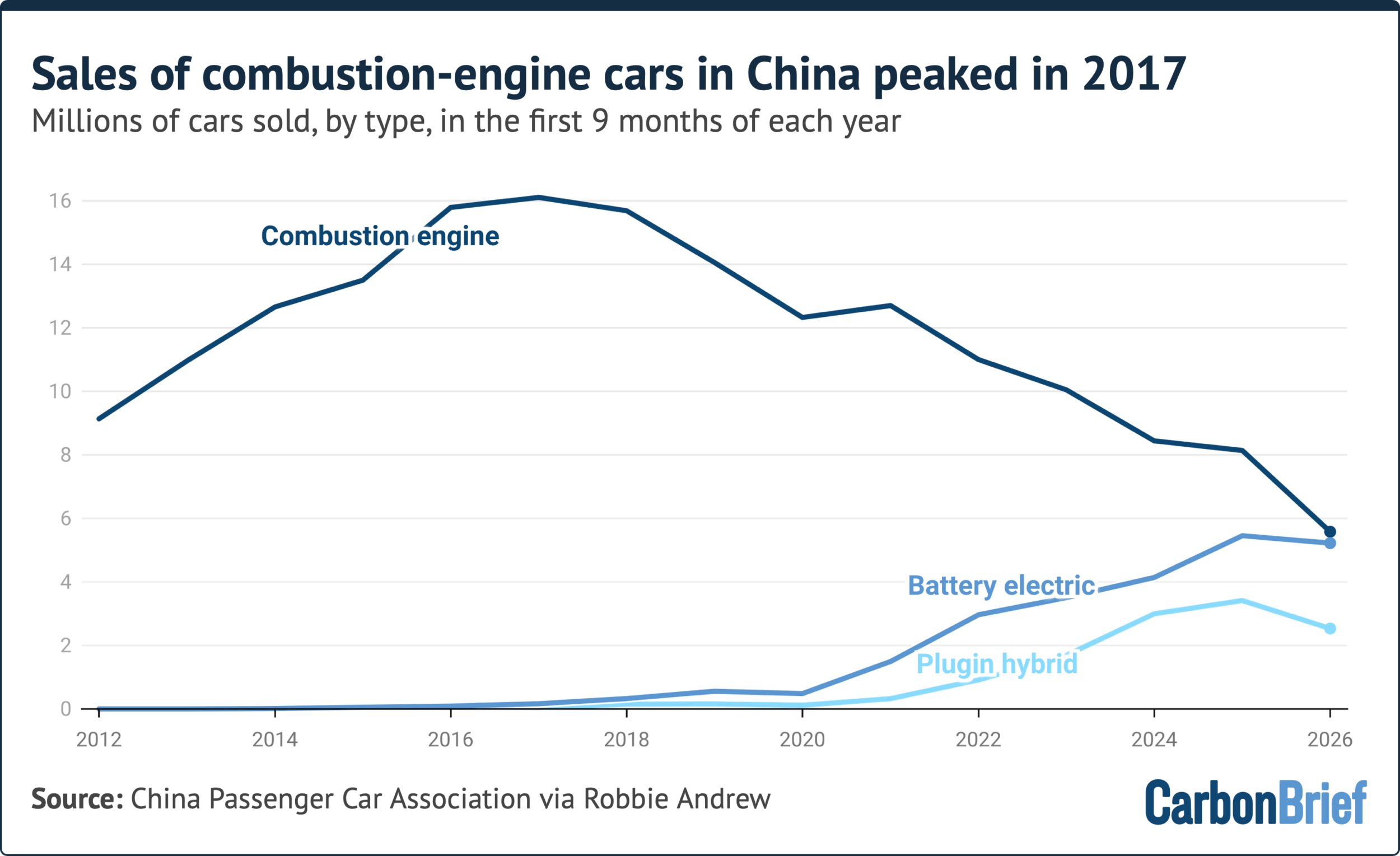
Indeed, sales of combustion-engine cars in China peaked in 2017 and they have been declining ever since, shown in the figure below.
Impact of Hormuz
Part of the reason for the advance of NEVs in 2026, said Chinese technology news outlet OFweek, was petrol cars “giving up market share” as they were outperformed by electric alternatives.
Cui Dongshu, secretary-general of the CPCA, cited higher petrol prices as an explanation for September’s weak combustion-car sales, in comments to financial news outlet National Business Daily.
Imports of oil into China in January-September have fallen 15% compared to 2025, equivalent to 470m barrels, as ongoing conflict tightened supply and drove up prices.
China’s passenger-car NEV fleet has displaced 143m barrels of oil so far during the strait of Hormuz crisis, Euan Graham, senior energy analyst at thinktank Ember, tells Carbon Brief.
EVs “accounted for 12% of the decrease in China’s oil use post-Hormuz”, according to an estimate provided to thinktank the Brookings Institute by an unnamed analyst.