

A Vietnamese climate activist has been jailed for tax fraud as the country’s authoritarian government cracks down on environmentalists while developing a multi-billion dollar clean energy transition plan with rich nations.
A court in Ho Chi Minh City sentenced Hoang Thi Minh Hong on Thursday to three years in prison for dodging $275,000 in taxes related to her climate campaign group CHANGE, her lawyer said. In addition to the jail term, she was fined 100 million Vietnamese dong ($4,100).
The 50-year-old is at least the fifth climate and environmental campaigner to be jailed on tax evasion charges in the last two years in Vietnam. The trial only lasted half a day after Hong pled guilty to charges of dodging tax payments during the 2012-2022 period.
“This conviction is a total fraud, nobody should be fooled by it,” Ben Swanton, co-director of The 88 Project charity told Reuters. “This is yet another example of the law being weaponised to persecute climate activists who are fighting to save the planet”.
String of arrests
Hong’s imprisonment comes two weeks after the arrest of Ngo Thi To Nhien, director of the Vietnam Initiative for Energy Transition, an independent energy policy think-tank.
Nhien worked for the EU, the UN, and the World Bank and was reportedly providing technical advice for the development of the Just Energy Transition Partnership (Jetp) – a $15.5 billion clean energy financing deal made between Vietnam and G7 nations plus the EU, Norway and Denmark.
Vietnam’s energy transition deal is a ‘black box’, partner warns
The continued crackdown on climate experts and activists poses serious questions to the group of rich nations and investors partnering with the Vietnamese government on a coal-to-clean energy transition.
‘Just’ transition?
Announced in December 2022, the agreement stated the need for the media and NGOs to be included in the process “so as to ensure a broad social consensus” and ensure the transition to be “just and equitable”. Campaign group Global Witness has criticised the language as “weak”.
The treatment of civil society and energy experts had been a sticking point in negotiations. A spokesperson for the German government, which is also funding the Jetp, told Climate Home in November 2022 it had raised human rights concerns with the Vietnamese government. A separate source with knowledge of those discussions said the Germans “received significant pushback”.
But the spokesperson also hoped that the deal could help activists. “With the agreement on the JETP, we also hope to be able to send a positive signal to climate activists,” the spokesperson said at the time.
Concerns over deal
Vietnam is a one-party state run by the Communist party without democratic elections. It ranks low on human rights indexes.
When Hoang Thi Minh Hong was first detained in June, the German government said it was concerned by the arrest and viewed it “critically” in regards to the implementation of the Jetp.
Norly Mercado is the Asia Regional Director of 350.org, a partner organization of CHANGE. She said the “unjust imprisonment of fearless changemakers like Hong not only imperils initiatives within Vietnam such as its JETP deal, but also undermines the country’s vital role in shaping a fair and equitable response to the urgent climate crisis”.
Climate Home News has reached out to the German and UK governments and the European Commission for comment.
The post Vietnamese climate activist jailed in ‘unjust’ government crackdown appeared first on Climate Home News.
https://www.climatechangenews.com/2023/09/28/vietnamese-climate-activist-jailed-in-unjust-government-crackdown/

The launch of the Africa Energy Bank (AEB) has been put back yet again, raising doubts about the institution’s future ability to finance fossil fuel projects – its main objective – as global lenders retreat from such investments over climate concerns, experts told Climate Home News.
The bank, which had been billed to launch in September after a series of delays, is now scheduled to begin operations in November, according to the head of the African Energy Chamber, an advocacy body for the continent’s oil and gas sector.
Even as the world aims to transition away from fossil fuels, many African leaders have made clear they want to continue exploring and extracting the continent’s large oil and gas deposits – estimated at around 125 billion barrels of crude and over 600 trillion cubic feet of gas – to boost economic development.
As a group, Africa sided with a number of powerful oil-and-gas producing nations in blocking progress on negotiations to craft a global roadmap to transition away from fossil fuels at last year’s UN COP30 climate talks, although some countries did individually support the proposal.
-
Campaigners oppose Dangote’s planned Kenya refinery over climate and ecological risks
Plans to build Africa’s second largest oil refinery in ecologically sensitive region criticised as “environmental recklessness” -
Tanzania pushed African nations to oppose fossil fuel transition at COP30
While chairing the African group at the summit, the gas-dependent nation advised the continent’s ministers to block language on transitioning away from fossil fuels


Meanwhile, major projects under development across the continent – including the 1,443-km East African Crude Oil Pipeline (EACOP) and Dangote’s 700,000-barrel-per-day Kenyan refinery – show that African governments see oil and gas as playing a significant role in meeting their energy and economic needs for many years to come.
In 2022, at a gathering of the African Petroleum Producers’ Organization (APPO) in oil-rich Angola, ministers from its member states adopted a resolution to create the Africa Energy Bank to finance projects for the production, use and trade of oil, gas and broader energy sources.
African control over energy resources
An article on the APPO website explains that the bank was conceived as a way to overcome “disenchantment” with fossil fuels among “the international community” which it said had crystallised around the “energy transition” concept.
“If Western countries, after having long taken advantage of the energy sources they now revile to develop, can afford the luxury of abandoning them, this is not the case in Africa,” it adds, noting that many of the continent’s economies are still largely dependent on oil and gas revenues.
A separate web page about the bank, also hosted on APPO’s website, says its objectives include financing the exploration, production and refining of oil and gas, as well as supporting member states in transitioning from fossil fuels to cleaner energy sources “while ensuring energy security”.
Said Addi, a former executive with Shell and energy commodities trading house Gunvor, said the new bank was judged necessary because financing for hydrocarbons from many traditional international lenders has become constrained.
In trying to fill this financing gap, Africa is not simply setting up another fund to support oil and gas, he added. “It is also an attempt to give African countries greater control over how their energy resources and infrastructure are financed,” he explained.
Nigeria to host the AEB
The energy bank – a joint initiative of APPO and the African Export–Import Bank (Afreximbank) – has so far suffered several delays and is almost two years behind schedule. The initial plan was to start operations in January 2025, with Nigeria as the host country, but the bank’s opening was delayed to June of that year to allow Nigeria time to finalise the construction of the bank’s headquarters in Abuja.
After the government announced the completion of the offices in late November 2025, a new launch date was set for January 2026, which was moved back to April, June and then September. Now it has shifted again to November, raising concerns that the institution may be losing momentum.
Former Shell executive Addi said that if the capital is eventually paid in, the bank becomes operational and its first projects are commercially credible, then the delays will be regarded as normal teething troubles in setting up a multilateral institution. But, he added, scepticism will be justified if it continues to stall.
Uganda may see lower oil revenues than expected as costs rise and demand falls
Baron Lamarré, an oil and gas expert and former Petronas oil trader, said that missing “three deadlines in a row is not normal”, and warned that if the timeline slips again, “the story flips from ‘ambitious institution finding its footing’ to ‘good idea that lost momentum before it found any’.”
The Nigerian government, APPO and Afreximbank did not respond to requests for comment by the time of publication.
The funding challenge
The Africa Energy Bank is targeting base capital of $5 billion, with plans to scale up to $120 billion within five years by mobilising private-sector funds. However, it is expected to start operations with initial seed capital of $500 million.
The funding plan is to have the 18 member countries of the APPO contribute $83 million each to the bank as equity for a combined $1.5 billion. Afreximbank, other non-APPO African countries and investors outside the continent are expected to provide the remaining $3.5 billion.
But even the initial $500 million has not been easy to mobilise. In May, APPO Secretary-General Farid Ghezali called on members to deliver on their pledges towards the startup goal before the end of June. But the delays suggest this may not have been met, with experts saying Africa may be finding it difficult to self-fund its oil and gas projects in the absence of international capital.
Lamarré said every extension of the deadline points to the fact that “raising fossil fuel capital in Africa without the majors and their financing networks is brutally hard”.
Why the global electrification agenda misses the point on Africa’s energy crisis
Since 2020, Western lenders, export credit agencies and insurers have been in steady retreat from African hydrocarbons, he said, while oil majors are divesting their African assets, handing over fields to smaller local operators whose credit ratings are not high enough to borrow cheaply.
Even capital from China and the Gulf, which has partially filled the gap, cannot match the volume, tenor or pricing that Western investors once offered, Lamarré argued.
“If mobilising the first $500 million of seed capital [for the AEB] has taken this long, that’s the clearest signal yet of how steep the climb to $120 billion looks,” he said, noting that the continent’s energy financing gap is as large as $30 billion-$45 billion per year.
Africa’s investment landscape, meanwhile, has been shifting. While foreign direct investment dropped from a 2024 peak, inflows remained roughly one-third above the continent’s long-term average in 2025, according to the 2026 World Investment Report from UN Trade and Development (UNCTAD). They are concentrated in a few sectors including critical minerals needed for renewable energy technologies, battery manufacturing and advanced industrial production.
At the same time, data on global energy investment from the International Energy Agency (IEA) shows that fossil fuel investment in Africa has declined over the last decade.

“Trojan horse” for fossil fuels
While the Africa Energy Bank struggles to get off the ground, climate campaigners have criticised its primary aim of financing oil and gas on the continent at a time when the world is starting to move away from high-carbon fuels to cleaner alternatives.
Bhekumuzi Dean Bhebhe, founder of Africa Change Lab, described the bank as a “Trojan horse”, arguing that its focus on fossil fuel financing runs counter to the global energy transition and the African Union’s Agenda 2063 goals of sustainable development and inclusive growth.
The energy bank, he warned, “risks locking Africa into a new cycle of debt, dependency and fossil fuel entrenchment”, adding that its financing blueprint does not pave the way for a climate-resilient future. “In truth, it is to deepen the same extractive, carbon-heavy pathways that the continent should be moving away from,” he added.
Ugandan farmers use British court to try to stop East Africa oil pipeline
Kenya-based climate and energy expert Joab Okanda said the AEB’s plan to finance oil and gas is “a misplaced priority” and it should instead back clean energy in line with the policies of some of Africa’s major export markets like Europe.
In addition, the new bank could struggle to mobilise enough resources to advance large-scale oil and gas projects, he added, noting that its proposed $5-billion initial capital is equivalent to the cost of the East African Crude Oil Pipeline alone.
The AEB’s aim of backing more fossil fuels should be flipped “to support countries that are oil-dependent to start working on their transition plans”, Okanda said.
The post Launch of Africa Energy Bank delayed again in blow to oil and gas hopes appeared first on Climate Home News.
Launch of Africa Energy Bank delayed again in blow to oil and gas hopes
A booklet published by the UK’s opposition Conservative party includes a “cost of net-zero” that appears to have been doubled by a spreadsheet error.
The “common sense” policy document argues that “what people ultimately want is a government competent enough to solve the problems for which it takes responsibility”.
In a section that says “sophisticat[ed]…modelling” should not be a substitute for “political judgement”, the “Right Way” document disparages various estimates of the cost of net-zero.
The Conservative document then claims – incorrectly – that the government’s official adviser, the Climate Change Committee (CCC), had put the cost of net-zero at close to £1tn. It says:
“In 2020, the CCC estimated that its route to net-zero would cost £957bn.”
In fact, the CCC’s 2020 estimate was exactly half this amount – £478bn – and last year it published a revised figure of £108bn, largely as a result of the falling cost of electric vehicles (EVs).
Spreadsheet error
The Conservative party’s erroneous claim appears to stem from another report that had accidentally added up numbers twice, using a spreadsheet published by the CCC in 2020.
The 2020 spreadsheet contains a table listing the additional investments that would be needed to build a net-zero economy, from low-carbon electricity generation through to heat pumps and EVs.
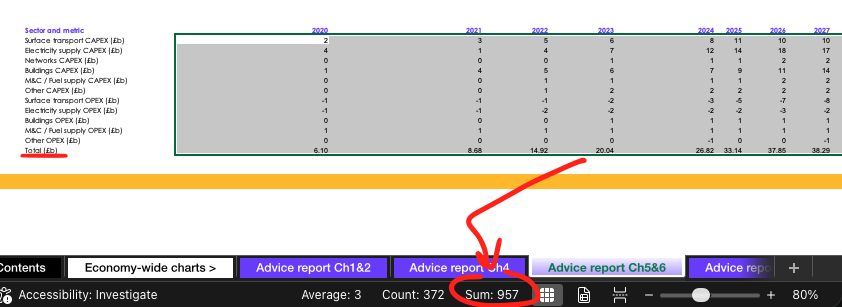
These extra capital expenditures, listed as “CAPEX”, add up to a total of £1.38tn over the 30 years of 2020-50. They are set against operational savings, listed as “OPEX”, of £0.90tn.
Added up over 2020-50, the combined CAPEX and OPEX figures come to a total of £478bn.
In addition to the annual sectoral CAPEX and OPEX figures, the CCC’s 2020 spreadsheet also has a line giving combined totals for each year. It appears that someone has added all of these numbers together, resulting in the savings and costs being counted twice.
This double-counted total for the cost of net-zero amounts to £957bn – as shown in the image below – and it appears to be the source of the claim in the Conservative booklet.
At the time of publication in 2020, the CCC said that the £478bn net cost of net-zero amounted to less than 1% of GDP over 30 years – and that the large investment needed would not only result in savings due to lower fossil-fuel imports, but that it would boost GDP overall, by around 2%.
In 2025, the CCC revised its estimates for investment costs and operating savings to £670bn and £562bn respectively, giving a net total of £108bn over 2025-50, or less than 0.2% of GDP.
Earlier this year, the committee said that cutting emissions to net-zero would cost less than a single fossil-fuel price shock and that doing so would have benefits worth £110bn per year.
Paper trail
The erroneous claim in the Conservative document is referenced to the CCC’s 2020 advice on the UK’s sixth “carbon budget”, which, as explained, does not contain the £957bn figure.
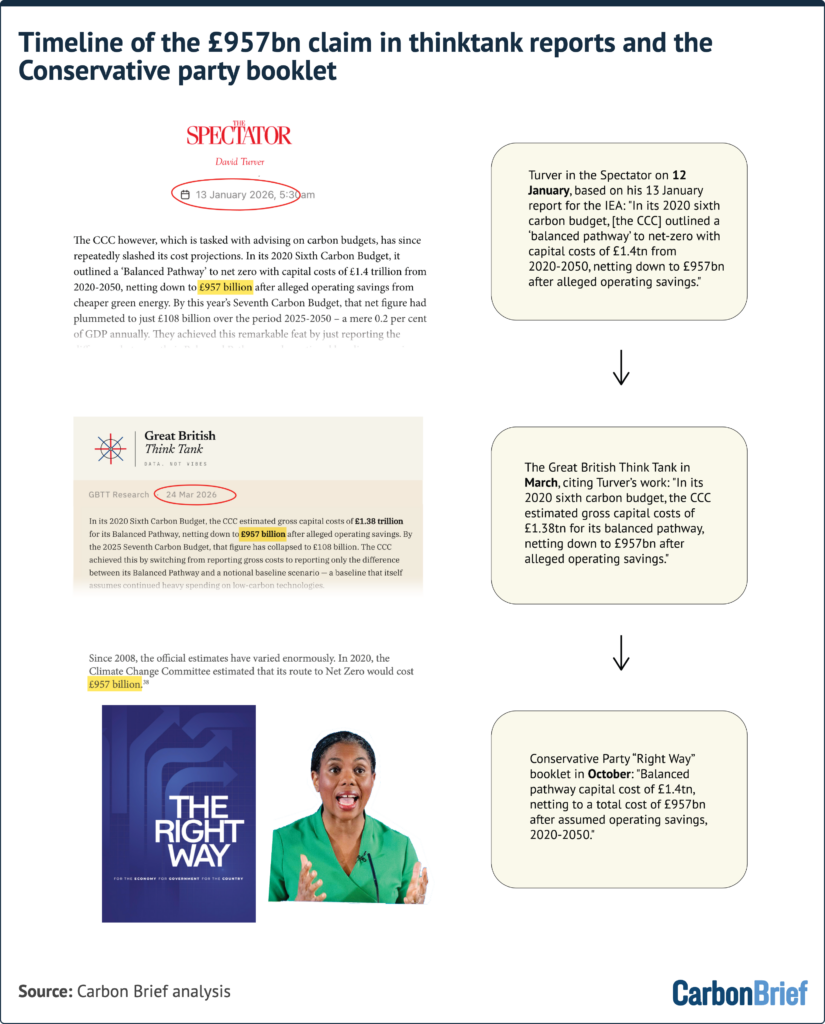
The earliest online use of the £957bn figure found by Carbon Brief is a 12 January 2026 article in the Spectator, by retired engineer and self-described “accidental energy analyst” David Turver.
A day later, Turver repeated the mistaken number in a report for the free-market Institute of Economic Affairs. His report cites figure 5.3 of the CCC’s 2020 advice.
However, as set out above, the CCC spreadsheet containing the data for figure 5.3 only adds up to £478bn, half the figure claimed by Turver.
It appears that Turver accidentally added up all of the numbers in the CCC spreadsheet, without noting that it already included a line for the annual total. This results in double-counting the cost.
(Turver’s report also triggered a slew of inaccurate headlines stating that net-zero would cost £7.6tn – or even £9tn. These figures, which came from Turver’s report, were based, among other things, on the implicit assumption that fossil fuels and the cars, boilers and power plants that use them are all free.)
After Turver’s report and article in January 2026, the erroneous £957bn figure was repeated in March by the Great British Think Tank. The organisation has the tagline “data, not vibes” and says of its work: “Every figure [is] sourced from official public bodies.”
The £957bn figure then appeared in the Conservative “Right Way” document in October 2026.
related
Analysis: EVs are now nine times cheaper than petrol or diesel to drive in the UK

CCC: Heathrow expansion could push flights to ‘80% of UK emissions by 2050’

Revealed: England’s June 2026 heatwave sparked record demand for ambulances

Factcheck: Reform UK’s 45 false or misleading claims about climate and energy
The post Factcheck: UK Conservatives double the ‘cost of net-zero’ after spreadsheet blunder appeared first on Carbon Brief.
https://www.carbonbrief.org/factcheck-uk-conservatives-double-the-cost-of-net-zero-after-spreadsheet-blunder
SYDNEY, Friday 9 October 2026 — In response to the Environment Protection Order issued by the National EPA to stop deforestation at a cattle station in North Queensland, the following comments can be attributed to Adele Chasson, Nature Policy Lead at Greenpeace Australia Pacific:
“Greenpeace welcomes the Environment Protection Order to stop deforestation operations at Wombinoo Station in North Queensland. This order is good news for koalas, wildlife and the Great Barrier Reef. Without intervention, this bulldozing operation could have led to more than 1,000 tonnes of toxic sediment runoff flowing into the Great Barrier Reef every year. This is the first such order under the reformed national nature laws, and shows the potential for genuine environment protection provided strong action continues.
“But this is just one station in one state, and now we need rapid action. Rampant deforestation in Australia continues to destroy precious forests, pushing threatened animals like the koala to the brink of extinction, and poisoning the Great Barrier Reef with muddy runoff. Every minute, the equivalent of a dump truck of sediment enters the Reef, smothering coral and threatening our global icon.
“This first stop order is a great start, but the Albanese government must stop widespread deforestation threatening the Great Barrier Reef and endangered wildlife using the new nature laws. We need a no-go zone plan for the Great Barrier Reef to reign in the bulldozing of forests in the catchment area, and for the National EPA to use the full extent of its powers to catch bulldozers in real time and crack down on deforestation with strong sanctions.
-ENDS-
‘Good news for wildlife’ as EPA puts stop order on Qld cattle station deforestation

