Connect with us

Published

on

US Aims to Add 200 GW of Nuclear Power by 2050 Amid Rising Demand and Policy Hurdles

With rising energy demands, nuclear power is gaining attention as a key component of the US’s carbon-free energy strategy. The US Energy Department (DOE) aims to triple nuclear capacity by 2050, adding 200 gigawatts (GW) to meet net zero emissions goals. 

Michael Goff, acting assistant secretary of the DOE’s Office of Nuclear Energy, emphasizes the urgency of this expansion, noting that:

“We are serious. We need to start deploying now.”

Meeting Rising Energy Demands with Nuclear Power

Large-load customers like data centers and manufacturing are driving increased demand for carbon-free power, potentially steering utilities toward nuclear energy, per S&P Global report. 

Matt Crozat from the Nuclear Energy Institute (NEI) notes a significant rise in utility interest, particularly among those with existing nuclear fleets. 

Last month, the largest nuclear power operator in the country, Constellation Energy Corporation, revealed plans to explore the construction of new nuclear capacity at its reactor sites to address the rising energy demand of its data center clients.

However, despite growing interest, the initial investment risk for new nuclear projects remains a significant hurdle. Lynn Good, CEO of Duke Energy Corp., stresses the need for federal incentives to mitigate construction risks. 

Currently, federal support largely comes in the form of post-construction tax credits, which require operational plants to benefit. Good advocates for more robust support during the construction phase to balance the benefits and risks for consumers.
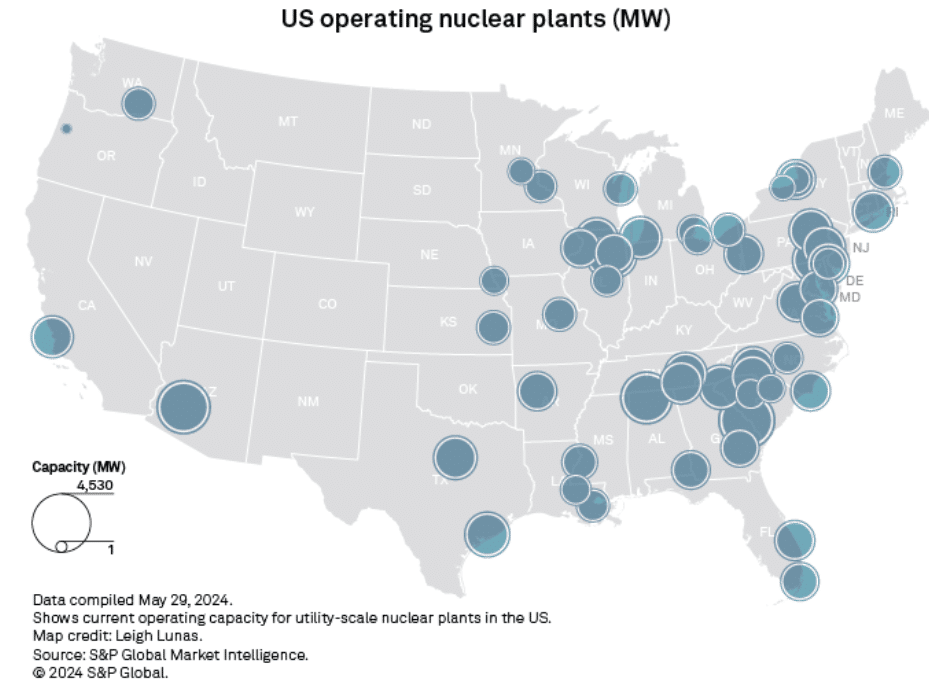
US operating nuclear plants MW

The completion of two new reactors at Georgia’s Vogtle Nuclear Plant, adding over 2,000 megawatts (MW), has sparked optimism. Georgia Gov. Brian Kemp and other officials argue that this project proves new nuclear construction is feasible in the US.

Energy Secretary Jennifer Granholm supports expanding the nuclear industry, suggesting more reactors should be planned, while also noting that:

“We are determined to build a world-class nuclear industry in the United States, and we’re putting our money where our mouth is.”

Balancing Investment Risks and Federal Incentives

However, Southern Company, which oversaw the Vogtle expansion, has no immediate plans for further reactors. Georgia Public Service Commission member Tim Echols underscores the need for federal backstops against cost overruns before approving additional units. 

He believes that current incentives, including tax credits and loan guarantees, are insufficient, referencing the bankruptcy of Vogtle’s contractor, Westinghouse, which caused significant industry concern.
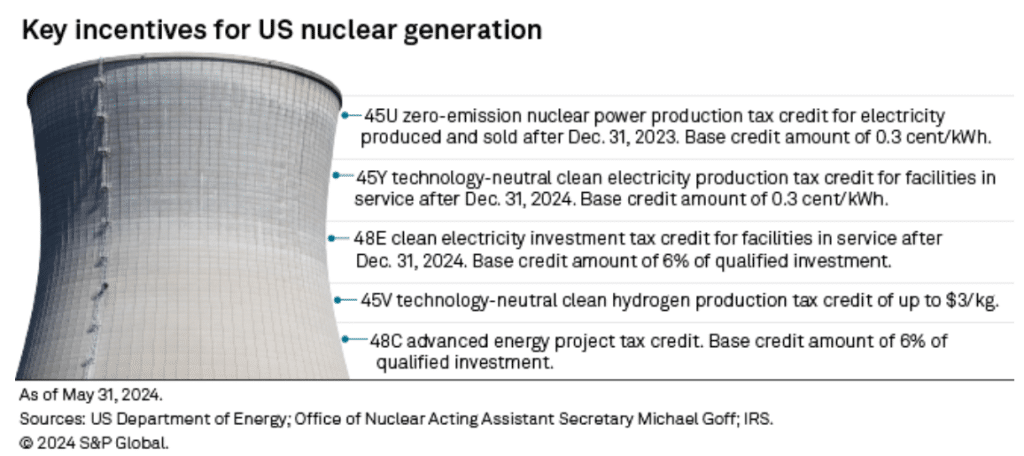
US nuclear generation incentives

The DOE’s Goff acknowledges the challenge of increasing incentives further, noting the substantial existing support under the 2022 Inflation Reduction Act (IRA). This legislation offers multiple credits for new nuclear projects, including options to layer or sell credits and additional credits targeted at clean energy. These incentives have already helped secure lifetime extensions for existing nuclear plants.

Existing nuclear plants are eligible for a production tax credit (PTC) of up to $15 per megawatt-hour (MWh). For new nuclear capacity, operators can choose between a PTC of $30/MWh or an investment tax credit (ITC) of 30%. This ITC can increase to as much as 50% if the nuclear projects use sufficient domestic content and are constructed in former coal plant communities.

Constellation Energy plans to renew operating licenses for all 23 of its reactors, with potential capacity increases qualifying for new capacity credits. This could lead to an additional 2.5 GW of nuclear capacity through uprates, according to NEI President Maria Korsnick.

The federal government is also promoting nuclear energy through public-private partnerships, cost-share projects, loan guarantees, licensing assistance, and research initiatives. The Biden-Harris administration has issued a $1.52 billion loan guarantee to restart an 800-MW nuclear plant in Michigan.

Nuclear Energy for the Nation’s Carbon-Free Power 

The surge in AI applications is significantly increasing electricity demand for data centers, presenting a lucrative opportunity for developers of small nuclear reactors (SMRs) and advanced battery technologies.

According to a Goldman Sachs report, AI applications could boost data center power needs by 160%, with AI queries like those from ChatGPT requiring nearly ten times more electricity than typical Google searches.

data center power demand 2030

Clayton Scott, chief commercial officer for NuScale Power, sees this as a perfect match for their small-scale nuclear systems. Scott believes the nuclear company can provide a solution with its SMRs, each generating 77 megawatts of carbon-free electricity. 

However, these reactors won’t be deployed until late in the decade, pending regulatory approval. The company reported minimal revenue and significant losses as it gears up for commercial operations.

Microsoft, led by Bill Gates’ TerraPower, is also exploring SMRs for powering AI data centers. Other startups, such as Oklo and Helion, are developing innovative nuclear technologies, including fission reactors and nuclear fusion. 

While much of the industry’s focus is on SMRs, none are yet commercially available for utility-scale power generation. Industry experts anticipate several applications for advanced reactors to be filed with the US Nuclear Regulatory Commission soon. 

  • However, the recent cancellation of the first modular project in Idaho and Vogtle’s completion may shift financial risk assessments back toward larger reactors. 

Large light-water reactors could become more prevalent in utility planning. Goff believes that there will still be demand for large-scale reactors. 

Overall, the completion of Vogtle’s reactors and the supportive policy landscape indicate a growing openness to nuclear energy. As demand for carbon-free power continues to rise, nuclear power may play a crucial role in the US’s energy future, provided that policy adjustments and incentives keep pace with industry needs.

The post US Targets 200 GW Nuclear Expansion to Meet Soaring Energy Demand appeared first on Carbon Credits.

Continue Reading

Carbon Footprint

Insetting vs Offsetting: Which Actually Counts Toward Your Scope 3 Targets

Published

on

The accounting differences that decide whether your nature investment shows up in inventory, in BVCM, or nowhere at all.

The question reaches a procurement team about three weeks before the next sustainability committee meeting. Someone has read about insetting. Someone else has just signed off on an offset purchase. The CSO wants to know if the two are interchangeable. The answer is no, and the GHG Protocol Land Sector and Removals Standard is the reason why.

This article walks through what each term means at audit-grade specificity, what the standards actually say about how each gets counted, and how to decide which tool fits which target. The insetting vs offsetting question is one of the most-searched in corporate climate strategy, and one of the most poorly answered. By the end of this piece, you should be able to brief a committee on the difference without notes.

The two definitions, in plain English

Offsetting means buying carbon credits generated outside your value chain and retiring them against your residual emissions. The reduction happens somewhere else, financed by you, and the credit is the receipt.

Insetting means investing in emission reductions or removals inside your own value chain, typically with suppliers, where the reduction is directly linked to the products and services you buy. The reduction happens inside the boundary of your Scope 3 inventory, and the accounting treatment is fundamentally different.

The shorthand from the University of Oxford’s Nature-based Insetting Initiative is useful: insetting is what you do with the supply chain you have; offsetting is what you do with the supply chain you do not have.

What the GHG Protocol Land Sector Standard actually says

The GHG Protocol Land Sector and Removals Standard, finalised in 2024 after a multi-year pilot, sets the rules for how land-based emission reductions and removals enter corporate inventories. The Standard distinguishes between inventory accounting (Scope 1, 2, and 3) and project or intervention accounting (a separate methodology for crediting).

For insetting, the practical implication is that supplier-level interventions, when properly measured and attributed, can reduce your Scope 3 category 1 (purchased goods and services) emissions in your inventory. The reduction is not a credit retired against the inventory; it is a lower inventory number, period.

For offsetting, the credit is retired separately. It can be reported as a contribution toward a net-zero claim under the SBTi Beyond Value Chain Mitigation framework or as part of a VCMI Carbon Integrity claim, but it does not lower the inventory number.

A practical consequence: if your Science Based Target requires a 50% absolute reduction in Scope 3 emissions by 2030, insetting moves you toward the target. Offsetting does not. This single point of difference reshapes the procurement decision.

When insetting counts toward Scope 3 (and when it does not)

Insetting counts toward Scope 3 only when several conditions are met:

  • The intervention must occur with an entity in your value chain.
  • The emissions reduction or removal must be measured against a defensible baseline.
  • The reduction must be attributed to your share of that supplier’s output, not double-counted with other buyers.
  • It must follow the inventory accounting rules in the GHG Protocol Land Sector Standard, not the project accounting rules used to generate credits.

The most common failure mode is double counting. If your supplier sells the same reduction as a credit on the voluntary market and also reports it to you as a Scope 3 reduction, the math breaks. The Standard requires you to address this risk, typically by purchasing and retiring the supplier-issued credit as part of your inventory or by contractual provisions that prevent the supplier from selling the reduction twice.

When insetting does not count toward Scope 3: when the intervention sits with a supplier you do not buy from, when the baseline is not defensible, when the attribution is unclear, or when the documentation does not survive audit. Those cases default to Beyond Value Chain Mitigation, which is still useful but operates on a different ledger.

The procurement and supplier engagement question

Insetting is harder than offsetting. That is the unfashionable truth most buyers eventually confront. Offsetting is a transaction; insetting is a relationship.

To run an insetting program, you need supplier mapping precise enough to know which farms or facilities sit at which Scope 3 boundary. You need an engagement model that gets suppliers to participate, which usually requires multi-year commitments and shared economics. You need an MRV architecture that measures the right things and produces audit-ready documentation. And you need a contractual structure that prevents double counting and protects both sides.

The trade-off you receive in return is significant. Reductions count against your inventory rather than your residual. Supplier relationships deepen, which protects sourcing continuity. Yield and quality improvements often follow regenerative interventions, which reduces your input cost over time. And the regulatory file, under CSRD, CSDDD, EUDR, and the SBTi FLAG Guidance, is materially stronger.

Choosing the right tool for the right target

A practical decision rule. If your target is a science-based Scope 3 reduction and you operate in a FLAG sector or source FLAG commodities, insetting is the structurally correct tool. If your target is a net-zero claim that includes neutralising hard-to-abate residual emissions outside your value chain, BVCM via high-integrity offsets is the structurally correct tool. Most companies with material Scope 3 exposure need both, in different proportions, sequenced over time.

The sequencing matters. Insetting takes longer to stand up but produces a permanent reduction in the inventory. Offsetting can be transacted faster but does not change the inventory and now sits under tighter claim restrictions. Treat them as complementary tools with different jobs, not as substitutes. The Accountability Framework Initiative and the IUCN Global Standard for Nature-based Solutions both provide useful guardrails for the insetting side, with biodiversity, human rights, and benefit-sharing requirements that go beyond carbon math.

If you are mapping a Scope 3 reduction roadmap and need to scope which interventions count toward your inventory versus which sit in Beyond Value Chain Mitigation, the carbon and sustainability experts at Carbon Credit Capital can help you structure a nature-based supply chain investment program that fits your FLAG exposure, your target architecture, and your audit horizon. Schedule a consultation.

Continue Reading

Carbon Footprint

Net zero needs nature: a carbon credit guide

Published

on

Net zero is often described as a balancing act: cut what you can, account for the rest, and reach zero on the ledger. That framing is useful, but it leaves something out. It treats every tonne of carbon as interchangeable and every route to zero as equally sound, while the science tells a more specific story.

Continue Reading

Carbon Footprint

Deforestation in Malawi: causes and solutions

Published

on

Malawi has lost a striking share of its forests over the past three decades. Woodlands that once covered well over a third of the country now cover less than a quarter, and the pressure on what remains is increasing. Behind those figures sit two practical questions: what is driving the loss, and what reverses it?

Continue Reading

Trending

Copyright © 2022 BreakingClimateChange.com

