

A landmark deal to clean up the global shipping industry’s emissions has been postponed for at least a year, after a successful campaign by the US and Saudi Arabia to delay its adoption.
In April 2025, governments provisionally agreed the International Maritime Organization’s (IMO) Net-Zero Framework (NZF), which would penalise high-emitting ships around the world and use the money to fund the transition to cleaner vessels and fuels.
An extraordinary set of talks was called in London this week where the plan was for the new system to be formally adopted. But, after a bad-tempered four days of discussions, governments voted narrowly for a Saudi Arabian proposal to postpone the decision for a year.
The NZF was scheduled to set emissions reduction targets for ships starting in 2028. But this – and the rest of the framework’s timeline – have now been plunged into doubt. Although some technical work can continue, political progress will have to wait until October 2026 when delegates will next take up the issue of whether to adopt the NZF.
-
Countries must confront fossil fuels head-on in their NDCs
Other nations should follow the rare example set by Colombia and Vanuatu, whose climate plans contain explicit goals for cutting back on oil, gas and coal -
COP30 president hints Brazil may be open to a cover decision in Belém
André Corrêa do Lago tells Climate Home News the COP30 talks could conclude with an additional text on key outcomes if countries want it – something Brazil has so far resisted -
Paris Agreement helping to avert dozens of hot days each year, scientists say
Emissions cuts under the 2015 climate accord are stemming the number of hot days globally, highlighting the treaty’s role in tackling global warming, according to new study


‘Catastrophic’ for confidence
Ralph Regenvanu, minister of climate change for the Pacific island nation of Vanuatu, said the decision to delay the NZF is “unacceptable” given the urgency of accelerating climate change. He added that, according to a recent ruling by the International Court of Justice (ICJ), climate action is not optional under international law.
“The IMO’s failure to adopt the framework this week marks a failure of this United Nations agency to act decisively on climate change. This makes the road to Bélem and beyond more difficult. But we know that we have international law on our side and will continue to fight for our people and the planet,” said Regenvanu.
Climate campaigners and researchers also lamented the delay. University College London shipping professor Tristan Smith said the decision was “catastrophic for confidence, and therefore also for the equitable and ambitious decarbonisation we need”.
“Those with the means must step up and lead more than ever, until this multilateral process can regain its composure,” he added. The European Union, for example, is implementing its own regulations similar to the NZF, called Fuel EU.
John Maggs, the Clean Shipping Coalition’s representative at the IMO, said that “governments serious about climate action must spend the next 12 months rallying every nation that supports the framework, convincing those who are on the fence, or opposing, that its adoption is the only sane way forward.”
The World Shipping Council, an international trade association, emphasised the importance of using the year ahead to clarify and develop the IMO Net-Zero Framework, adding that the IMO’s greenhouse gas strategy and the industry’s investment trajectory “remain aligned toward net-zero by 2050”.
“A globally agreed framework is needed to provide a level playing field to get there,” it added in a statement. “The liner industry is committed to the goal of net-zero by 2050 and has invested $150 billion in ships designed to run on green fuels.”
Trump’s threats
Ahead of the meeting, the US government had threatened a series of measures targeting government officials who supported the NZF and threatening to make it difficult and expensive for those countries’ ships to call at US ports.
A joint statement by the US transport and foreign ministers said: “We will fight hard to protect our economic interests by imposing costs on countries if they support the NZF. Our fellow IMO members should be on notice.”
And on Thursday, President Donald Trump tried to intervene directly in the IMO process, urging countries to vote against what he called “this Global Green New Scam Tax on Shipping” and “a Green New Scam Bureaucracy”. In a post on his Truth Social platform, he suggested that the NZF would lead to higher prices for American consumers, adding that the US “will not adhere to it in any way, shape, or form”.
After the vote was postponed, Bob Ward from the Grantham Institute on Climate Change criticised “the bullying by the United States government” which he said “proves that the Trump administration is a threat to the well-being and prosperity of people across the globe.”
A week of procedural politics
Back in April, governments voted 63 to 16 in favour of the NZF – with several Pacific countries abstaining as they said it lacked ambition. But many of the nations that backed the NZF in April supported the postponement of talks this week.
They included major economies like China, India, Colombia and Kenya, but also many small nations reliant on their shipping registries such as Liberia, Bahamas, Panama and Saint Kitts and Nevis. Others – like New Zealand, South Korea, Japan, Cyprus and Greece – abstained.
Those opposing the postponement were mainly European and Pacific countries as well as pro-climate action Latin American nations like Chile, Brazil and Mexico.
The four days of talks were marked by procedural wrangling, with the US and Saudi alliance trying to block the adoption of the agenda on the first day, and then attempting to amend the procedure for adopting the NZF on the second and third.
At the start of Friday – the last day of talks – Brazil’s negotiator proposed a vote on the NZF itself. Singapore then raised the prospect of voting for an adjournment of talks, before Saudi Arabia called for a vote on that plan.
The two sides debated for hours – first in the open meeting and then privately with the head of the IMO Arsenio Dominguez at the front of the room – which vote should be taken first.
After a break for lunch, the IMO decided to hold the postponement vote first. While 49 nations voted against, 57 voted to postpone the decision for a year, giving them the majority. Twenty-one countries abstained and eight were not present.
2030 target to cut emissions still in place
Brazil’s proposed vote on the NZF never took place and their lead negotiator politely declined to be interviewed by Climate Home News as he left the venue, after consolations from negotiators on his side of the debate.
While its adoption has been delayed, technical work on the NZF will continue, starting next week. Issues to be discussed include how the emissions intensities of different fuels should be judged and how the money raised by the levies on fuels should be spent and governed.
Speaking to journalists after the adjournment, IMO head Arsenio Dominguez remained upbeat. “The framework is still there and the member states are still talking,” he said, adding that the target agreed in 2023 to reduce global shipping’s emissions by 20% – while striving for 30% – on 2022 levels by 2030 remains in effect.
The post US-led alliance wins a year’s delay in adoption of green shipping deal appeared first on Climate Home News.
US-led alliance wins a year’s delay in adoption of green shipping deal

Continue Reading
Three countries have been named by the Paris Agreement’s compliance committee for failing to submit a nationally determined contribution (NDC) and repeatedly snubbing offers of help with their climate plans.
After months of internal debate over whether to identify serial non-responders, the Paris Agreement’s Implementation and Compliance Committee (PAICC) named the three countries which have failed to engage with it over their NDCs on Friday.
It named Democratic Republic of Congo, Senegal and North Korea in a footnote of its annual report, adding that it decided to name them “with a view to facilitating engagement”, adding that representatives of the three nations had been invited to its meeting in early 2027 “with the purpose of identifying any challenges and constraints”.
“The Committee noted the importance of Parties engaging with the Committee in a timely manner, while noting that some delays may be due to the national capabilities and circumstances of the Parties”, the report said.
-
Under US pressure, World Bank says it will back gas “where appropriate”
The US wants the World Bank to expand its gas support while climate campaigners are pushing for it to end – its head spoke this week of limited backing for the fossil fuel -
IPCC scientists vow to press on with climate reports despite political deadlock
After governments again failed to agree a timeline, nearly 120 IPCC authors pledged to complete their assessment on time and with full scientific rigour -
Paris Agreement committee snubbed over missing NDC climate plans
Many governments have still not submitted a nationally determined contribution to the UN, breaching a key requirement of the Paris Agreement

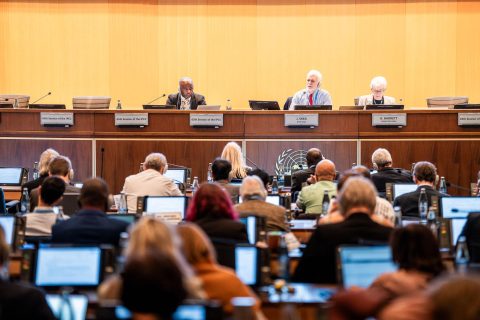

In July, PAICC said 12 countries had ignored its repeated attempts to discuss why they had not published an NDC as required every five years under the 2015 Paris accord.
Members of the committee had been divided over whether to name them, but at a September meeting decided to do so in their annual report to the annual climate COP summit.
By the time the report was published on Friday, only Congo, Senegal and North Korea “had not communicated an NDC or submitted a [Biennial Transparency Report] and had not yet responded to any of the Committee’s notifications, despite several reminders issued by the Committee in this regard”.
Rainforest and renewable energy ambitions
The silence from Congo and Senegal is notable because the former is home to much of the Congo Basin rainforest while the latter has sought billions of dollars in climate finance to support its renewable energy ambitions.
After Brazil, Congo has more rainforest than any country in the world. This forest, and the country’s peatlands, absorb huge amounts of greenhouse gas but are fast being lost to expanding farmland, charcoal production, logging and mining.
Senegal signed a Just Energy Transition Partnership with Canada and wealthy European nations in 2023, to help it meet its renewable energy targets under the-then government of Macky Sall. It was chair of the Least Developed Countries group between January 2022 and December 2023.

Tejas Rao, who is researching the PAICC as part of a doctoral thesis at Cambridge University, said the governments of the three countries should engage with the committee.
“Engagement costs these governments very little and the committee has shown it will listen,” he said.
“Silence leaves the committee with no basis to help, and it leaves the [governments] exposed to the narrative that they are simply disengaged,” he told Climate Home News.
Paris Agreement requirement
The 2015 Paris Agreement requires all parties to publish an NDC every five years outlining their emissions reduction targets, with each plan meant to be more ambitious than the country’s last NDC.
The latest set – the third round of plans, with new targets for 2035 – was due in February 2025. While most countries missed this deadline, all but around 30 – mostly small emitters but including Egypt, Vietnam and Argentina – have now submitted them.
Over the year, the PAICC – which is made up of government climate officials from developed and developing countries – has been communicating with governments that have not submitted NDCs and trying to overcome barriers to them doing so.
Some nations have cited exceptional circumstances as the reason for not submitting an NDC, a process that requires a significant amount of work in tracking emissions and consulting on how to curb them across the economy. For example, a letter from a Sudanese official to the PAICC, seen by Climate Home News, said that the country’s civil war had led to the suspension of its NDC preparation.
-
IPCC scientists vow to press on with climate reports despite political deadlock
After governments again failed to agree a timeline, nearly 120 IPCC authors pledged to complete their assessment on time and with full scientific rigour -
Under US pressure, World Bank says it will back gas “where appropriate”
The US wants the World Bank to expand its gas support while climate campaigners are pushing for it to end – its head spoke this week of limited backing for the fossil fuel -
Who shapes climate science? The equity question facing the IPCC
Early completion of the next global climate science assessment reports risks excluding research from the Global South, which is key to ensuring the findings are fair
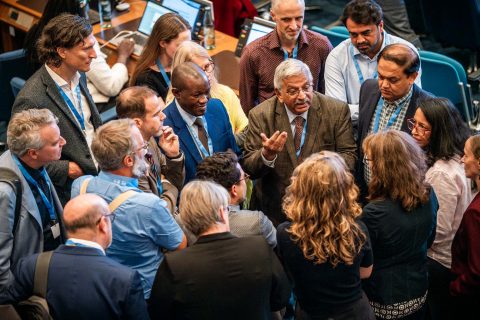
The US and Iran are not signed up to the Paris Agreement and so do not have active NDCs, nor does Taiwan, which is not a UN member state.
Rao said that because the PAICC is “facilitative and non-punitive”, naming the countries “is meant to open a door, not close one – the invited consultation is the point”.
“In recent months, governments that explained their constraints, whether capacity, finance or domestic process, have been met with follow-up and support rather than sanction, and the number of silent governments has fallen sharply,” Rao said.
The post Paris Agreement committee names three countries snubbing it over NDCs appeared first on Climate Home News.
Paris Agreement committee names three countries snubbing it over NDCs