

The head of the United Nations called on Wednesday for governments to get together for an “honest dialogue” on how to transition away from fossil fuels.
Antonio Guterres told those gathered for the International Energy Agency’s ministerial meeting in Paris that “we must stop treating the transition away from fossil fuels as taboo”.
“Delay will only breed instability,” he said in a video message, “history is littered with the wreckage of failed transitions – broken economies, scarred communities and lost opportunities. We face a choice: design the transition together – or stumble into it through crisis and chaos.”
He called for “a dedicated global platform for honest dialogue on transitioning away from fossil fuels” that includes fossil fuel producers and consumers, developed and developing countries, civil society and public and private financial institutions.
-
Türkiye prioritises cleaning up garbage emissions in COP31 ‘action agenda’
‘Zero Waste’ is the personal project of Turkish First Lady Emine Erdogan and aims to cut emissions from landfills and waste disposal -
Argentina’s pioneering glacier law on the line as Milei bets on copper rush
President Javier Milei wants Congress to relax groundbreaking glacier protection legislation to boost mining, but opponents say the environmental risks are too great -
As Louisiana bets big on ‘blue ammonia’, communities brace for air pollution
Carbon capture hasn’t delivered major climate benefits — and the plants would still emit thousands of tons of pollution.


Guterres’ call contrasted sharply with the position of the United States. Ahead of the conference, US energy secretary Chris Wright threatened to pull Washington out of the IEA if the government-funded think tank continues to promote the energy transition.
At the event, Wright downplayed the importance of climate change, claiming that while it is a “really physical problem, it just isn’t even remotely close to the world’s biggest problem”. He called on the IEA to focus more on providing clean cooking solutions, which include fossil gas.
But, while US support wavers, the IEA’s head Fatih Birol celebrated that Brazil, India, Colombia and Vietnam have joined the Paris-based institution. He said this shows that the IEA’s strategy of engaging with the world outside developed countries was paying off. UK energy secretary Ed Milliband said it was a “vote of confidence” in the IEA.
Roadmap and conference
Guterres’ words come just over two years since governments agreed at COP28 to transition away from fossil fuels in energy systems and three months after over 80 governments pushed at COP30 for a roadmap away from fossil fuels.
After the proposal failed to gain consensus at COP30 in the formal negotiations, Brazil’s COP30 presidency promised to deliver a global roadmap through an informal initiative before this year’s COP31 climate summit in Antalya.
Separately, Australia, which is leading the negotiations at COP31, vowed it would “continue to argue” for a transition away from coal, oil and gas in energy systems during its co-presidency.
Governments, experts, industry leaders and Indigenous representatives will be gathering this April in the Colombian city of Santa Marta for a highly-awaited first conference on transitioning away from fossil fuels.
The government of Colombia, which is co-hosting the summit with the Netherlands, said it would seek to launch a permanent platform that would help a “coalition of the willing” accelerate the shift away from planet-heating coal, oil and gas beyond the UN climate process.
“Although there is growing consensus to gradually eliminate fossil fuels, there were still no specific spaces or meeting places dedicated to comprehending and addressing the pathways needed to overcome economic, fiscal and social dependence on fossil fuels, especially for producing countries,” Maria Fernanda Torres Penagos, director of climate change in Colombia’s Environment Ministry, said last month.
-
After disappointing COP30, EU mulls “less naive” strategy for climate talks
EU environment ministers are discussing how to show more “realism” and “pragmatism” in international climate negotiations -
COP31 chief slams climate backsliding, but rejects priority focus on fossil fuels
After a first COP31 strategy meeting, Türkiye’s environment minister says he will “safeguard the development priorities” of developing countries


It is unclear how that platform would cross over with Guterres’ suggestion. But Alex Rafalowicz, the director of the Fossil Fuel Non-Proliferation Treaty Initiative (FFNPTI), which is supporting the conference, praised the UN chief’s “welcome leadership and vision”.
He said that the development of this platform is already happening through the FFNPTI, in which 18 countries are participating in discussions on a fossil fuel treaty.
“The Santa Marta conference is the first stop on this journey and all countries that are seriously committed to the 1.5C limit should be there”, he said, “we expect that out of Santa Marta we will have more proposals and commitments that can feed into the [Brazilian] COP Presidency roadmap”.
Coalitions like the Beyond Oil and Gas Alliance and the Powering Past Coal Alliance already offer platforms to discuss transitioning away from fossil fuels. But major fossil fuel producers have not joined these alliances.
Guterres said that the platform should deliver a global transition plan which “aligns investment, energy security and climate goals – with concrete milestones and robust finance, particularly for developing countries”.
Guterres said in 2022 that, in order to be compatible with limiting global warming to 1.5C, wealthy countries should phase out coal by 2030 and other nations by 2040. The IEA said in 2021 that the world should reach net zero by 2050 to meet the 1.5C warming limit.
The post UN head calls for platform for “honest dialogue” on fossil fuel transition appeared first on Climate Home News.
UN head calls for platform for “honest dialogue” on fossil fuel transition

For the first time, new-energy vehicles (NEVs) made up 67% of new car sales in China in September, according to the latest data from the China Passenger Car Association (CPCA).
The figures show that NEVs, which include battery electric cars and plug-in hybrids, captured a record share of sales, even though fewer were sold than last year.
This is because sales of combustion-engine cars are falling steeply, a trend that the CPCA has attributed to rising petrol prices following the start of the Hormuz crisis.
Indeed, sales of fuel-only cars were down 31% year-on-year in the first nine months of 2026, with plug-in hybrid sales down 26% – whereas battery EV sales were only down 4%.
One analyst tells Carbon Brief that China’s rapidly growing EV fleet has offset demand for 143m barrels of oil since the start of the Hormuz crisis.
Another says that the crisis is “reinforcing China’s electrification of road transport”.
Meanwhile, amid slowing domestic sales, Chinese carmakers’ exports of NEVs more than doubled [in 2026 to date / in September] from a year earlier.
NEV record
A record two out of every three cars sold in September in China were NEVs, according to CPCA data, as shown in the figure below.
(NEVs predominantly include battery electric vehicles – BEVs – and plug-in hybrids – PHEVs. BEVs only run on electricity, whereas PHEVs also have a combustion engine.)
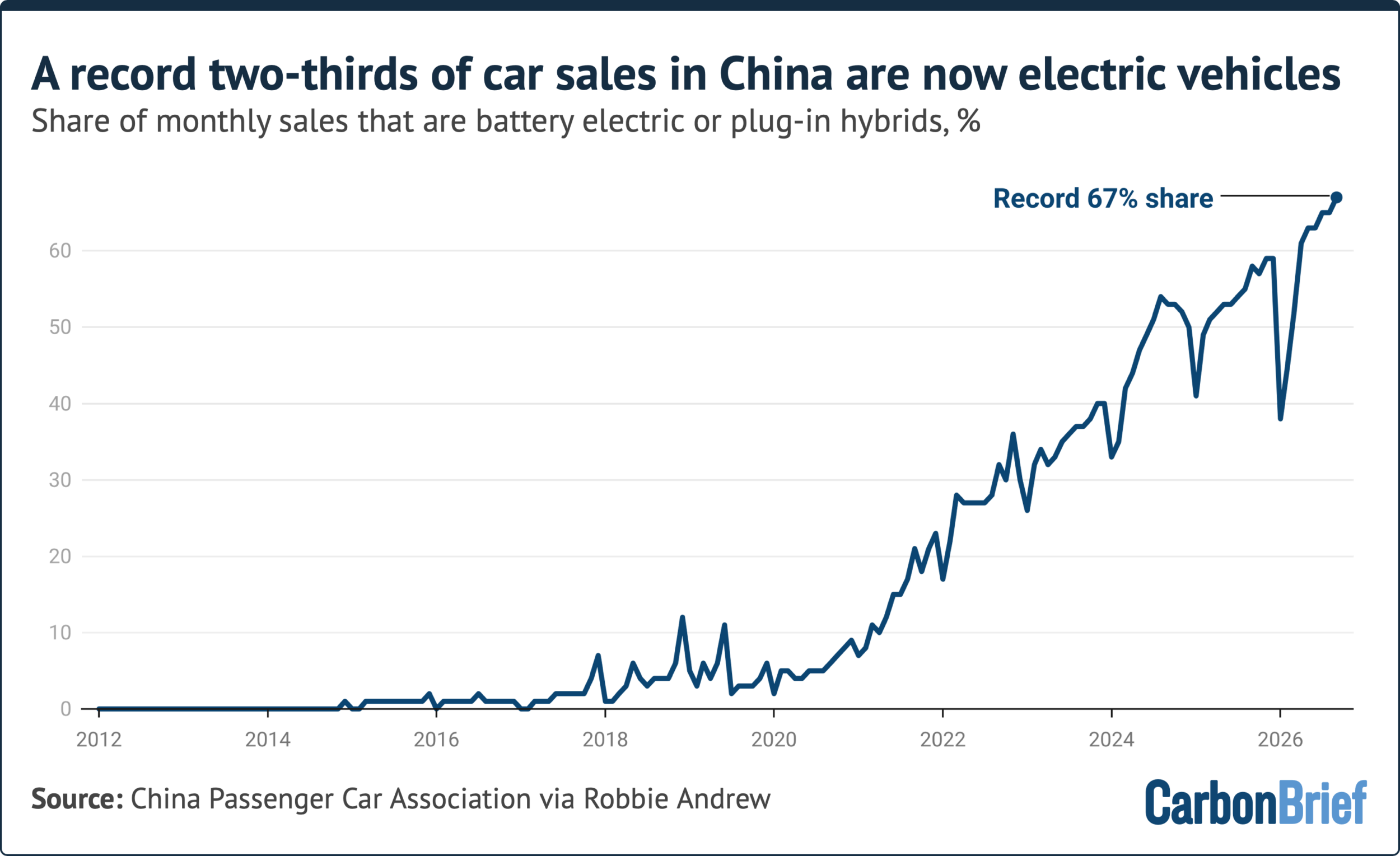
This marks a rapid rise for NEVs from just 6% of new car sales in 2020 up to 58% in 2026 to date – and a record 67% in the month of September.
This year, NEVs’ share of sales has also bounced back from a low of 39% in January, after the full purchase tax exemption that had been in place for more than a decade came to an end in December 2025.
The gain in NEV share in 2026 has come amid a slowdown across the wider domestic passenger-car market, which has hit sales of combustion-engine vehicles particularly hard.
This September, passenger-car retail sales across all categories declined, with overall sales volumes falling 28% year-on-year.
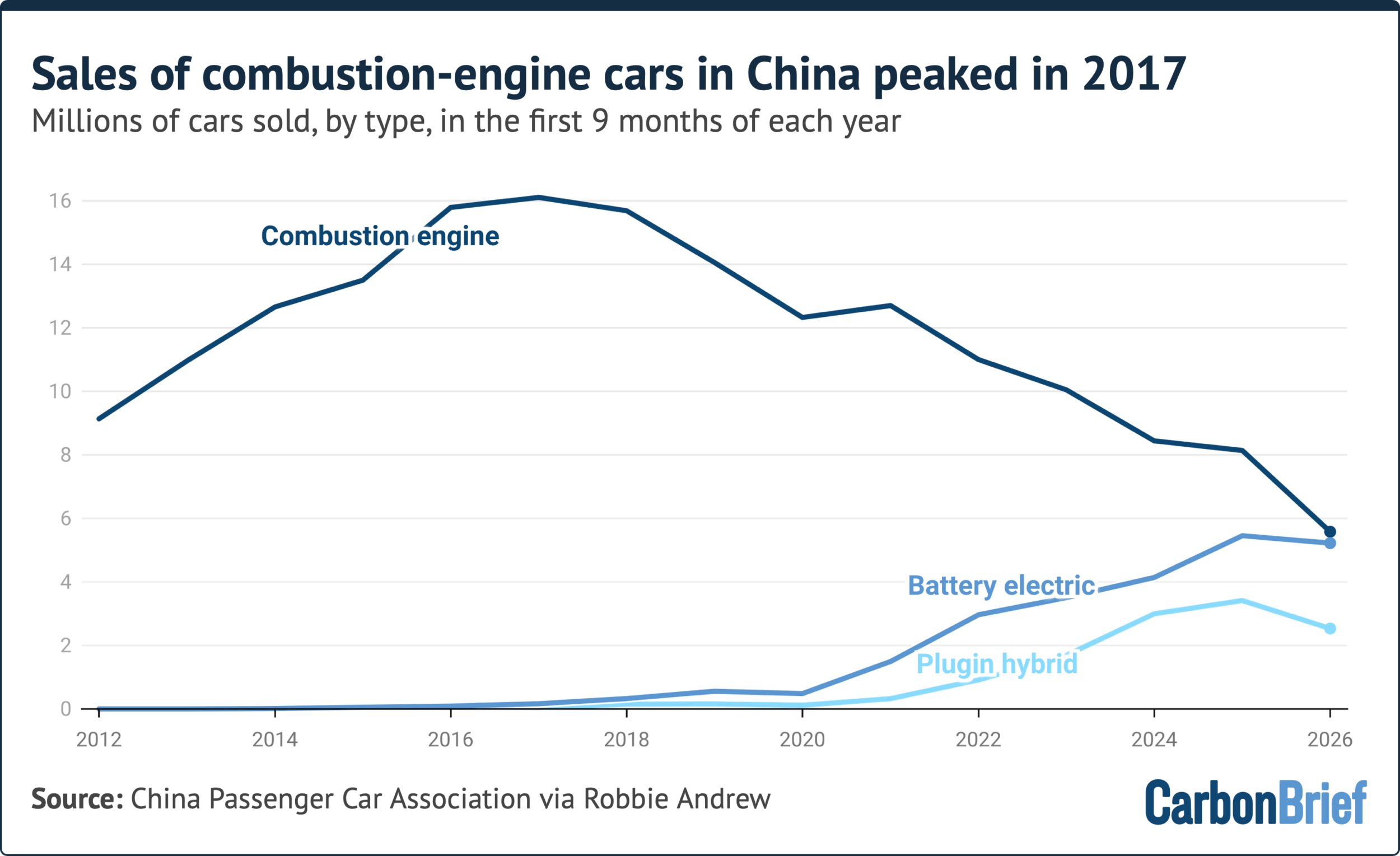
The contraction was led by combustion-engine vehicles, which saw sales fall 43% year-on-year in September and 31% in 2026 to date.
However, sales of PHEVs also fell by 36% year-on-year in September and by 26% in 2026 to date. By comparison, BEVs performed better, although sales still declined 8.5% from a year earlier in September and 4% in 2026 to date.
As a result, NEV sales overall fell by 17% in September and 13% in 2026 to date.
While the market changes in 2026 to date were particularly dramatic, they reflect a broad continuation of trends seen over the past decade.
Indeed, sales of combustion-engine cars in China peaked in 2017 and they have been declining ever since, shown in the figure below.
Impact of Hormuz
Part of the reason for the advance of NEVs in 2026, said Chinese technology news outlet OFweek, was petrol cars “giving up market share” as they were outperformed by electric alternatives.
Cui Dongshu, secretary-general of the CPCA, cited higher petrol prices as an explanation for September’s weak combustion-car sales, in comments to financial news outlet National Business Daily.
Imports of oil into China in January-September have fallen 15% compared to 2025, equivalent to 470m barrels, as ongoing conflict tightened supply and drove up prices.
China’s passenger-car NEV fleet has displaced 143m barrels of oil so far during the strait of Hormuz crisis, Euan Graham, senior energy analyst at thinktank Ember, tells Carbon Brief.
EVs “accounted for 12% of the decrease in China’s oil use post-Hormuz”, according to an estimate provided to thinktank the Brookings Institute by an unnamed analyst.