

In a late night session in Rome, the COP16 biodiversity talks – which resumed this week after failing to reach consensus last year – adopted a finance roadmap that will work towards a 2030 deadline, pushing back a final decision on how to channel scarce funding to help countries protect nature.
Under the roadmap, countries will assess whether to create a new, independent global biodiversity fund to replace the existing one sitting with the Global Environment Facility (GEF). This issue caused a major row at last year’s COP16 in Cali, Colombia – and is set to resurface in future discussions.
In an emotional final plenary in Rome in the early hours of Friday, COP16 president Susana Muhammad, who is Colombia’s outgoing environment minister, said: “I announce officially that we have given legs, arms and muscle to the Kunming-Montreal Biodiversity Framework”.
That framework, agreed in 2022 in Canada, is a global agreement to halt and reverse biodiversity loss by protecting at least 30% of the planet’s land and seas by 2030 – but it remains unclear where the money will come from to pay for the efforts required.
“More than any other issue, the successful implementation of the Global Biodiversity Framework will depend on whether the world meets its financing targets,” said Brian O’Donnell, director of advocacy group Campaign for Nature.
UK aid budget cuts threaten climate finance pledge to vulnerable nations, experts warn
Countries have agreed to mobilise $200 billion a year in finance for nature by 2030, including $30 billion from wealthy governments to poorer ones. The total for 2022 was around half that, official figures show.
Under the new finance roadmap agreed in Rome, by COP18 in 2028, countries committed to “identify and implement measures to enhance the global biodiversity finance to mobilize new and additional resources from all sources”.
A thorny issue on the horizon will be whether to expand the base of government contributors to include not only developed countries but also well-off emerging economies. That was also a major point of disagreement at last year’s COP29 climate summit in Baku.
At the COP16 talks in Rome, countries agreed to discuss the “opportunities for broadening the contributors base” by next year’s COP17.
“Quite simply, we have no chance of halting and reversing biodiversity loss without accelerating and exponentially increasing the delivery of finance to the areas most important for biodiversity,” said O’Donnell.
“This decision today lays out a roadmap. Now, it is up to leaders worldwide to prioritise urgent action for nature,” he added.
Funding gap
Finance has been one of the most contentious issues at the UN biodiversity negotiations. In Cali, countries failed to reach an agreement after clashing for two weeks over the issue. And funding was one of the key barriers holding back last decade’s Aichi targets to stop nature loss, which were largely unmet.
In this week’s three-day session in Rome, countries agreed to create two separate workstreams running until 2030: one focused on the “financial mechanism” to channel funds for biodiversity and another seeking to “improve the mobilization of finance from all sources”.
Experts estimate there is a $700-billion gap in funding for nature protection every year. To close this, countries agreed in 2022 to re-direct $500 billion now spent on subsidies that are harmful for nature, and to mobilise $200 billion from all available financial sources, including government budgets, the private sector, and multilateral development banks.
How COP16 2.0 can unlock business investment to properly fund nature
The new 2030 roadmap was criticised by some developing countries during the negotiations. “Biodiversity cannot wait for a bureaucratic process that lasts forever while the environmental crisis continues to get worse,” Bolivia’s delegate told a plenary on Wednesday.
Nonetheless the final finance agreement in Rome has broken a “longstanding policy deadlock”, said Jill Hepp, biodiversity funding lead at Conservation International. “Now that there is a path forward on how funding will flow, we all must take ambitious action to accomplish our collective goals,” she added in a statement.
New biodiversity fund?
Currently, international funds for nature protection flow through the Global Biodiversity Framework Fund (GBFF), administered by the GEF under an interim arrangement that ends in 2030. The main point of discussion at the resumed COP16 talks was what to do after that date.
The GBFF has struggled to attract funding, raising just $383 million in pledges from 12 developed countries so far. The most vulnerable nations also say the money isn’t reaching them and have criticised the GEF’s bureaucracy, leading a call to make the fund independent.
Under the Rome roadmap, countries agreed to have a permanent fund – but still need to work out whether it will stay at the GEF or whether to create an entirely new one. Governments are set to take this decision by 2028 and, if they opt for a new fund, they will discuss its operationalisation at COP19 in 2030.
Divisions over the new financial mechanism dominated discussions in Rome, while little time was spent on deciding how to increase cash flows. The BRICS group of emerging economies and African countries led the push for a new fund, while the European Union advocated for keeping it at the GEF.
“We will need to have more assurances when we embark on decisions on new financial mechanisms… that we won’t feel abandoned in the future,” said Brazilian negotiator Maria Angélica Ikeda.
Reacting to the outcome in Rome, the GEF’s CEO Carlos Manuel Rodríguez welcomed the decision and added that the GEF has gone through “a series of reforms” to better serve countries. “The GEF has been listening carefully to parties and is committed to continued improvements in order to respond to their expectations and capacities needs,” Rodríguez said in a statement.

Earlier in the week, the secretariat of the UN Convention on Biological Diversity (CBD) launched the separate Cali Fund, which was agreed at last year’s talks in Colombia and is meant to receive voluntary contributions from companies that use genetic material from biodiversity. This is common in sectors like the pharmaceutical, chemical and cosmetics industries.
The fund currently sits empty – but the UN said it is in conversations with potential donors, without revealing names due to commercial confidentiality. “The ball is now in the court of businesses around the world,” said Elizabeth Maruma Mrema, deputy executive director of the United Nations Environment Programme.
Biodiversity plans lag behind
In Rome, countries also adopted a monitoring framework for the global biodiversity pact, which includes a set of indicators for countries to track progress on their national biodiversity strategies and action plans, known as NBSAPs.
The indicators – which include, for example, the number of species at risk of extinction or land use change in Indigenous territories – will help assess the effectiveness of country plans. Yet those plans remain few and far between.
Just 47 countries have submitted NBSAPs, according to the CBD’s tracker. Despite a formal deadline of last year’s COP16, only a handful of nations have presented new plans since, with Austria being the sole country to unveil its plan at this week’s resumed session in Rome. Key so-called “megadiverse” countries like the Democratic Republic of Congo (DRC) and Brazil have yet to submit their NBSAPs.
Experts note that a lack of funding is a major obstacle for poorer countries in developing the plans, which require long consultation processes, in particular with Indigenous communities.
This is especially the case in Africa, where almost all countries have national biodiversity targets – a looser format that requires less spending – but not full NBSAPs.
With the finance decision now adopted in Rome, Hepp of Conservation International urged countries to focus on implementing their goals to safeguard nature and “urgently moving funds to protect lands and seas that sustain all of us”. “We must not take our eye off the ball,” she added.
The post UN biodiversity talks agree finance roadmap, pushing decision on a new fund to 2030 appeared first on Climate Home News.
UN biodiversity talks agree finance roadmap, pushing decision on a new fund to 2030

Three countries have been named by the Paris Agreement’s compliance committee for failing to submit a nationally determined contribution (NDC) and repeatedly snubbing offers of help with their climate plans.
After months of internal debate over whether to identify serial non-responders, the Paris Agreement’s Implementation and Compliance Committee (PAICC) named the three countries which have failed to engage with it over their NDCs on Friday.
It named Democratic Republic of Congo, Senegal and North Korea in a footnote of its annual report, adding that it decided to name them “with a view to facilitating engagement”, adding that representatives of the three nations had been invited to its meeting in early 2027 “with the purpose of identifying any challenges and constraints”.
“The Committee noted the importance of Parties engaging with the Committee in a timely manner, while noting that some delays may be due to the national capabilities and circumstances of the Parties”, the report said.
-
Under US pressure, World Bank says it will back gas “where appropriate”
The US wants the World Bank to expand its gas support while climate campaigners are pushing for it to end – its head spoke this week of limited backing for the fossil fuel -
IPCC scientists vow to press on with climate reports despite political deadlock
After governments again failed to agree a timeline, nearly 120 IPCC authors pledged to complete their assessment on time and with full scientific rigour -
Paris Agreement committee snubbed over missing NDC climate plans
Many governments have still not submitted a nationally determined contribution to the UN, breaching a key requirement of the Paris Agreement

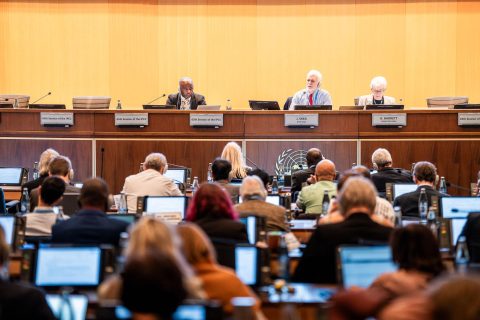

In July, PAICC said 12 countries had ignored its repeated attempts to discuss why they had not published an NDC as required every five years under the 2015 Paris accord.
Members of the committee had been divided over whether to name them, but at a September meeting decided to do so in their annual report to the annual climate COP summit.
By the time the report was published on Friday, only Congo, Senegal and North Korea “had not communicated an NDC or submitted a [Biennial Transparency Report] and had not yet responded to any of the Committee’s notifications, despite several reminders issued by the Committee in this regard”.
Rainforest and renewable energy ambitions
The silence from Congo and Senegal is notable because the former is home to much of the Congo Basin rainforest while the latter has sought billions of dollars in climate finance to support its renewable energy ambitions.
After Brazil, Congo has more rainforest than any country in the world. This forest, and the country’s peatlands, absorb huge amounts of greenhouse gas but are fast being lost to expanding farmland, charcoal production, logging and mining.
Senegal signed a Just Energy Transition Partnership with Canada and wealthy European nations in 2023, to help it meet its renewable energy targets under the-then government of Macky Sall. It was chair of the Least Developed Countries group between January 2022 and December 2023.

Tejas Rao, who is researching the PAICC as part of a doctoral thesis at Cambridge University, said the governments of the three countries should engage with the committee.
“Engagement costs these governments very little and the committee has shown it will listen,” he said.
“Silence leaves the committee with no basis to help, and it leaves the [governments] exposed to the narrative that they are simply disengaged,” he told Climate Home News.
Paris Agreement requirement
The 2015 Paris Agreement requires all parties to publish an NDC every five years outlining their emissions reduction targets, with each plan meant to be more ambitious than the country’s last NDC.
The latest set – the third round of plans, with new targets for 2035 – was due in February 2025. While most countries missed this deadline, all but around 30 – mostly small emitters but including Egypt, Vietnam and Argentina – have now submitted them.
Over the year, the PAICC – which is made up of government climate officials from developed and developing countries – has been communicating with governments that have not submitted NDCs and trying to overcome barriers to them doing so.
Some nations have cited exceptional circumstances as the reason for not submitting an NDC, a process that requires a significant amount of work in tracking emissions and consulting on how to curb them across the economy. For example, a letter from a Sudanese official to the PAICC, seen by Climate Home News, said that the country’s civil war had led to the suspension of its NDC preparation.
-
IPCC scientists vow to press on with climate reports despite political deadlock
After governments again failed to agree a timeline, nearly 120 IPCC authors pledged to complete their assessment on time and with full scientific rigour -
Under US pressure, World Bank says it will back gas “where appropriate”
The US wants the World Bank to expand its gas support while climate campaigners are pushing for it to end – its head spoke this week of limited backing for the fossil fuel -
Who shapes climate science? The equity question facing the IPCC
Early completion of the next global climate science assessment reports risks excluding research from the Global South, which is key to ensuring the findings are fair
The US and Iran are not signed up to the Paris Agreement and so do not have active NDCs, nor does Taiwan, which is not a UN member state.
Rao said that because the PAICC is “facilitative and non-punitive”, naming the countries “is meant to open a door, not close one – the invited consultation is the point”.
“In recent months, governments that explained their constraints, whether capacity, finance or domestic process, have been met with follow-up and support rather than sanction, and the number of silent governments has fallen sharply,” Rao said.
The post Paris Agreement committee names three countries snubbing it over NDCs appeared first on Climate Home News.
Paris Agreement committee names three countries snubbing it over NDCs