Countries have agreed at the resumed COP16 talks in Rome to a strategy for “mobilising” at least $200bn per year by 2030 to help developing countries conserve biodiversity.
Nations also agreed for the first time to a “permanent arrangement” for providing biodiversity finance to developing nations, “future-proofing” the flow of funds past 2030.
Faced with a highly unstable geopolitical landscape and a previous set of talks that ended in disarray in Colombia, countries forged a path to consensus on a set of texts in what many nations celebrated as a win for multilateralism in uncertain times.
The agreement on finance comes despite the world’s largest biodiversity donor – the US, which has never been a formal party within these talks – recently deciding to withdraw most of its nature funding in a foreign-aid freeze under Donald Trump.
Many European countries who signed onto the agreement have also recently cut their aid budgets.
Nations also agreed on two texts for tracking their progress towards achieving the targets of the Kunming-Montreal Global Biodiversity Framework (GBF).
The GBF is a landmark deal first made in 2022 aiming to halt and reverse biodiversity loss by 2030.
Colombian politician and COP16 president Susana Muhamad received a lengthy standing ovation for her role in guiding parties to consensus in the early hours of Friday morning in Rome.
But, amid celebrations, some countries cautioned that a vast amount of progress will be needed to have a chance of halting and reversing biodiversity loss in just five years.
Some three-quarters of nations have still not submitted their UN biodiversity plans for how they will achieve the targets of the GBF – four months after the deadline.
And a recent investigation by Carbon Brief and the Guardian revealed that more than half of nations that have submitted UN biodiversity plans do not commit to the GBF’s flagship target of protecting 30% of land and seas for nature by 2030.
- COP16’s back story
- Finance
- Global review
- Monitoring framework
- Cooperation with other conventions
- Around the COP
COP16’s back story
COP16 was the first UN biodiversity summit following the adoption in 2022 of a landmark agreement, known as the Kunming-Montreal Global Biodiversity Framework (GBF), at COP15. The overall goal of the GBF is to “halt and reverse biodiversity” loss by 2030, through four goals and 23 targets.
At COP16, many issues centred around the “means of implementation” of the GBF. Initially, the conference was set to take place in Turkey, but the country withdrew from hosting it after a series of destructive earthquakes. Colombia took on the organisation of the summit and Cali was named as host city in February 2024.
In Cali, countries agreed on a new fund for the sharing of benefits from the use of genetic data, the creation of a dedicated subsidiary body for Indigenous peoples and local communities and a new process to identify ecologically and biologically significant marine areas.
However, the final plenary ran through the night, owing to disagreements over biodiversity finance. With many delegations needing to catch flights home, COP16 was suspended the following morning due to a lack of the “quorum” needed to reach consensus.
Later that month, the COP16 presidency stated that the negotiations would be resumed in the new year to “address outstanding issues on finance and complete the mandate of this COP”.
Among the pending items left over from Cali was a new strategy for “resource mobilisation”, aimed at allocating $200bn annually for biodiversity conservation “from all sources” by 2030.
Alongside that, countries needed to agree on the mechanism for distributing funds. Global-south countries urged the creation of a new global fund for biodiversity, to be under the control of the COP. Meanwhile, global-north countries argued for maintaining the current fund, which is housed under the Global Environment Facility (GEF), a multilateral fund set up in the early 1990s to “support developing countries’ work to address the world’s most pressing environmental issues”.
Countries also had to revisit the monitoring framework for the implementation of the GBF, which seeks to “provide the common yardsticks that parties will use to measure progress against the 23 targets” of the GBF, according to the CBD.
Parties also failed to agree on a new text outlining the process for a global review of national biodiversity strategies and action plans (NBSAPs) at COP17 in Armenia in 2026 and COP19, four years later.
The CBD took up the remaining issues in two “resumed” sessions of COP16.
The first of these meetings, to approve the budget, was held in December under “silence procedure” – meaning the text was circulated and parties given a period of time to respond with any objections. The second resumed session was held in person at the headquarters of the UN Food and Agriculture Organization (FAO) in Rome, from 25 to 27 February 2025, to address all remaining decisions.
Finance
Post-2030 fund
The fight over a new, dedicated global biodiversity fund – the subject of fraught negotiations in Nairobi, Montreal and Cali – dominated the agenda at the resumed COP16 nature talks in Rome.
As a whole, COP16 was supposed to deliver a strategy for raising funds to assist countries in implementing the “ambitious” nature deal struck at COP15.
It was also expected to deliver a financial mechanism under the COP to provide developing countries with the means to meet biodiversity goals and targets.
At the resumed COP16 talks in Rome, countries made history by agreeing to set up a “permanent arrangement for the financial mechanism” under the COP by 2030 – a decision that is decades in the works.

While the decision does not establish a brand new fund immediately, it is “future proofing” global biodiversity finance beyond 2030, Georgina Chandler from the Zoological Society of London told a press briefing. The text leaves open the form that the finance will take – either under a new entity, or as part of existing funding instruments that biodiverse countries have been seeking to reform.
A permanent financial mechanism is the “unfinished business of the COP, 30 years in the making”, said Lim Li Ching from the Third World Network. While there is much to be debated at successive COPs, “at least the mechanism is locked in”, she told Carbon Brief.
The resumed COP16 also saw countries agree on a roadmap to develop the financial mechanism, reform existing financial institutions and mobilise funding from “all sources” to close the $200bn per year biodiversity funding gap.
To speed up raising these resources, the text asks the executive secretary of the CBD to “facilitate an international dialogue” of ministers of environment and finance from developing and developed countries.
This was a “highlight” of the outcome in Rome, Brian O’Donnell, director of the Campaign for Nature, said in a statement.

Per the roadmap, countries will have to decide on criteria for the mechanism by COP17 next year in Armenia. By COP18, they will have to decide whether this will take the form of a new fund and, if so, make it operational by COP19 in 2030.
At the same time, the COP has tasked its expert subsidiary body to look into “opportunities for broadening the contributor base”, accommodating a key ask from developed countries.
This means including more countries, such as China, as formal biodiversity finance providers, according to Laetitia Pettinotti from development finance thinktank ODI. Pettinotti told Carbon Brief:
“Countries have agreed to look into the contributor base. But, actually, many developing countries already contribute biodiversity finance via their funding to multilateral entities – the GEF, WB [World Bank], UN agencies, etc. So part of this discussion will need to look at recognising those contributions.”
Resource mobilisation: from Cali to Rome
The Rome talks were expected to pick up where Cali left off – with an ambitious, but divisive, draft decision on resource mobilisation issued by Muhamad in the early hours of 2 November last year.
That document contained a proposal to establish a new global biodiversity fund under the COP’s governance, to be ready by COP30.
This had been a key demand of developing countries in the run-up to the previous talks in Montreal. Instead, the final nature deal for this decade – gavelled through at COP15 in a hurry – gave the world an interim fund with a mandate to operate only until 2030.
Without enough countries in the room to pass the decision in Cali, the fight for a new fund had to wait until COP16 resumed in Rome.
Between the Cali and Rome talks, Muhamad held regional consultations and bilateral meetings with countries and ministers from around the world in an effort to find agreement.
On 14 February, Muhamad released a “reflection note” laying out the state of play in the finance negotiations. In this, she discussed some of the “important differences” remaining between countries on the resource mobilisation draft and areas of “broad agreement” that emerged in her consultations.
Some of these disagreements, she said, were partly rooted in “different interpretations of terms used”. To address this, the note contained a glossary defining terms used within the finance texts.
Muhamad put forward a roadmap towards improving global biodiversity finance architecture, which, she said, countries “broadly support[ed]” at that stage.
In an updated note on 21 February, the president issued “textual suggestions” on the most contentious paragraphs of the resource mobilisation text.
At the opening plenary on 25 February, minister Muhamad said the discussions at this COP were “not technical decisions”, but rather “political decisions”. She questioned whether countries were able to “transcend…old and outdated” institutional structures and move towards something new.
Some countries broadly supported the president’s suggestions, but were clear that more discussions were needed. Others, such as India, were sceptical and favoured the explicit language in the draft text from Cali.
Most developing countries called for establishing a dedicated financial instrument at the Rome talks, opposed expanding the donor base and highlighted the need to “honour” existing financial commitments.
In turn, most developed countries wanted to improve – not replace – existing funding instruments and broaden the list of donor countries and funding sources. They also favoured a process leading up to COP19 that would not “prejudge the outcome”.
Fiji noted in the opening plenary that adopting a clear and comprehensive resource mobilisation strategy is “critical” to the success of the GBF. They added that the future process and roadmap must be “efficient and streamlined”, given the urgency of financing needs.
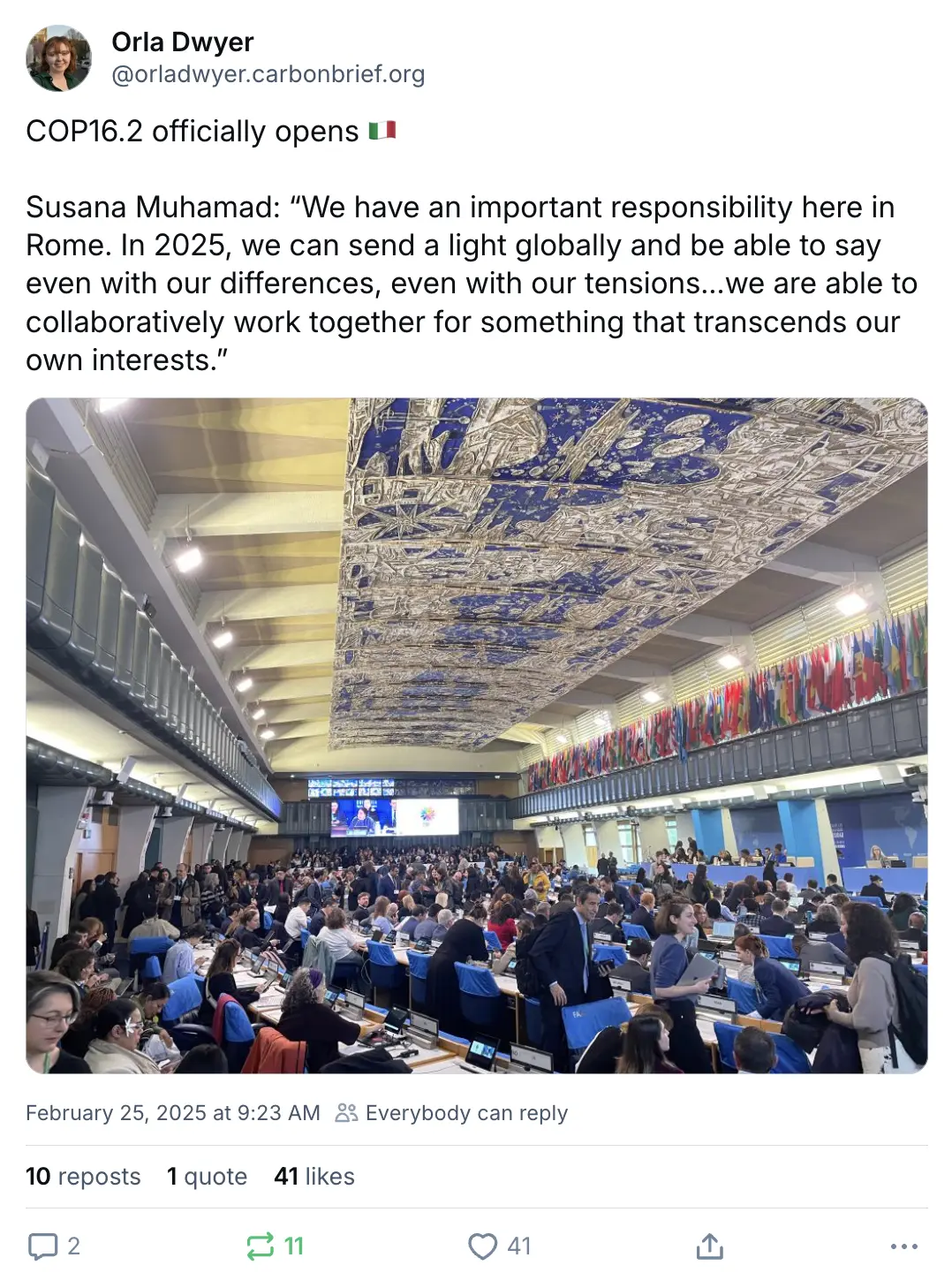
Informal consultations on resource mobilisation took place on the evening of 25 February. The next morning, Muhamad thanked delegates for the “very open and frank discussion” on their various positions on the text.
The negotiations moved slowly for most of the three days. A third of the morning plenary on 26 February, for example, was taken up by a back-and-forth over a request from the DRC to change the agenda.
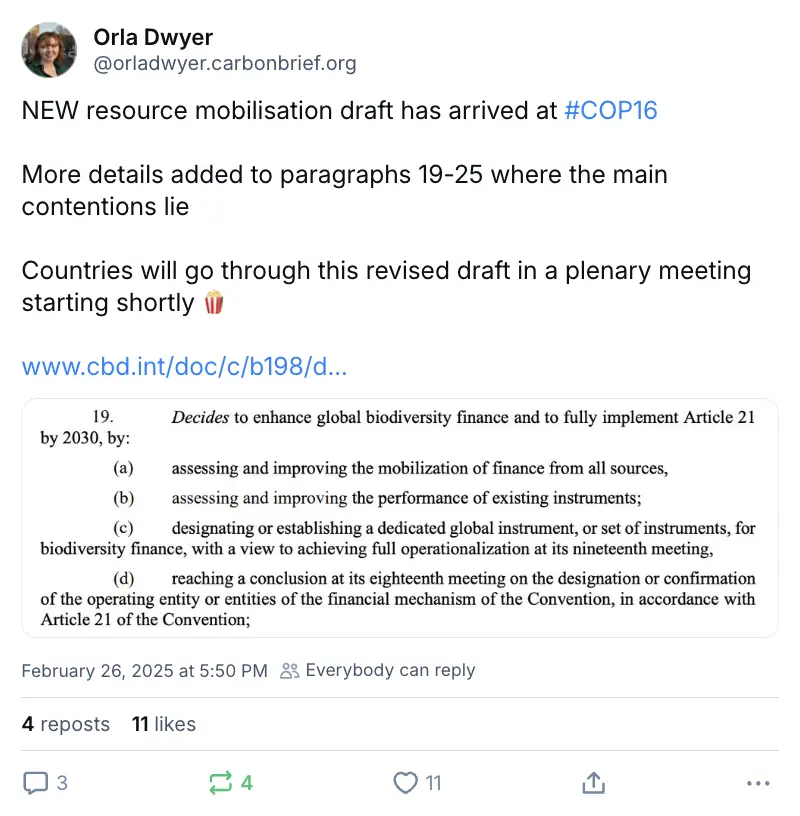
A revised resource mobilisation document was released by the presidency on the evening of 26 February. Minutes later, countries were invited to give their thoughts on the significantly updated text in plenary.

Many expressed their surprise at the revisions and requested more time to review the text, which was only available in English as it had not yet been translated into the other five UN languages.
Egypt and the DRC’s request to give the African Group a few minutes to consult on the text was denied by Muhamad, with countries instead encouraged to discuss the text and present their concerns as regional groupings the next morning.
“This is becoming a precedent that a region cannot ask for regional consultations,” said Daniel Mukubi Kikuni of the DRC at the evening plenary, adding that the draft resembled Muhamad’s “informal” reflection note more than its predecessor that was negotiated by all countries in Cali. Kikuni added:
“[This document has been] deeply changed, transformed and modified. We cannot accept it as a foundational document for our discussion.”
Panama said that it was concerned by a “lack of ambition” in the revised document. Other countries, including Ivory Coast and Egypt, expressed concern that the pace of the document’s proposed roadmap was “missing urgency” and was too “process-heavy”, given that 2030 is five years away.
While the EU, Norway and the UK appreciated the text as a “balanced package” and said it was “very close to the landing zone”, they were caught off-guard by text that suggested “possible direct allocation” of funds to countries.
The next morning, another plenary took place for regional groupings to provide consolidated feedback on the updated draft. Several blocs and countries suggested alternative text, including a “compromise” proposal submitted by Brazil on behalf of BRICS countries and Zimbabwe articulating Africa’s position.
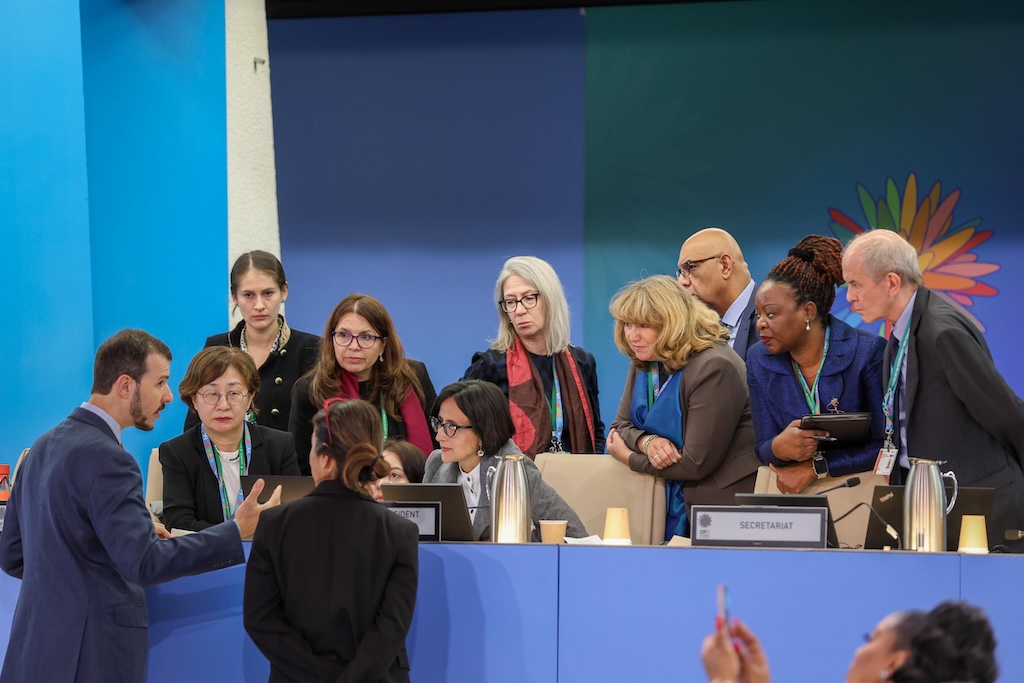
With the clock ticking and much to accomplish before midnight, Muhamad adjourned the plenary and asked up to five representatives from regions to work with her in a small group towards a consensus text to bring to the plenary.
After a six-hour closed door session, a new resource mobilisation non-paper emerged around 7pm on the final evening of talks.
The non-paper referred to the establishment of a “permanent arrangement for the financial mechanism”, mirroring text suggested by Brazil on behalf of BRICS countries earlier in the day. Instead of promising a new fund, the text said that the mechanism could be “entrusted to one or more entities, new, reformed or existing” – suggesting that a compromise had been struck between developed and developing countries
The non-paper had just one bracket in place (which, in UN documents, signals disagreement), stating that the final structure of the mechanism had to be “non-discriminatory”, which some delegates feared could potentially rule out certain funds that were limited by sanctions.

Bernadette Fischler Hooper, the head of international advocacy at WWF, told the press that this was a “make or break moment” to determine the levels of trust between countries, but that the text “showcased the high art of diplomacy”. She added:
“It doesn’t sound very exciting, but the fact that there will be [an instrument] from 2030 onwards is actually a huge step forward, because they haven’t managed to do that for the last five years. That was what nearly brought the COP15 in Montreal to fall.”
The presidency released a final revised document on resource mobilisation at 10:40pm, when the final plenary was already long-delayed.
This contained the same text as the non-paper, but with the final bracket removed. With no interventions, countries agreed and the final resource mobilisation text was gavelled through amid applause, cheers and tears in the plenary hall.
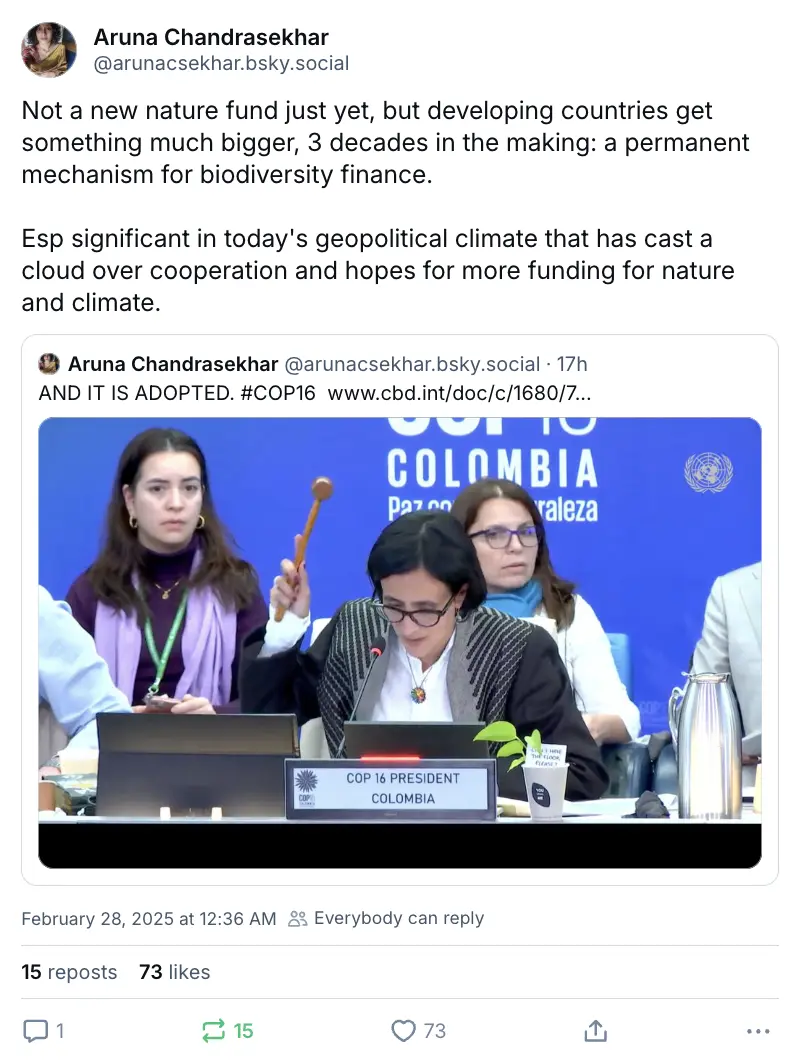
Minutes later, after interventions from the EU and Japan, Brazil cautioned against last-ditch changes to the closely related financial mechanism text, saying that “if we start to blow too close to [a castle of] cards, then everything starts to fall off”.
After a show of support from former COP-hosts Canada, the COP adopted the decision on the financial mechanism.
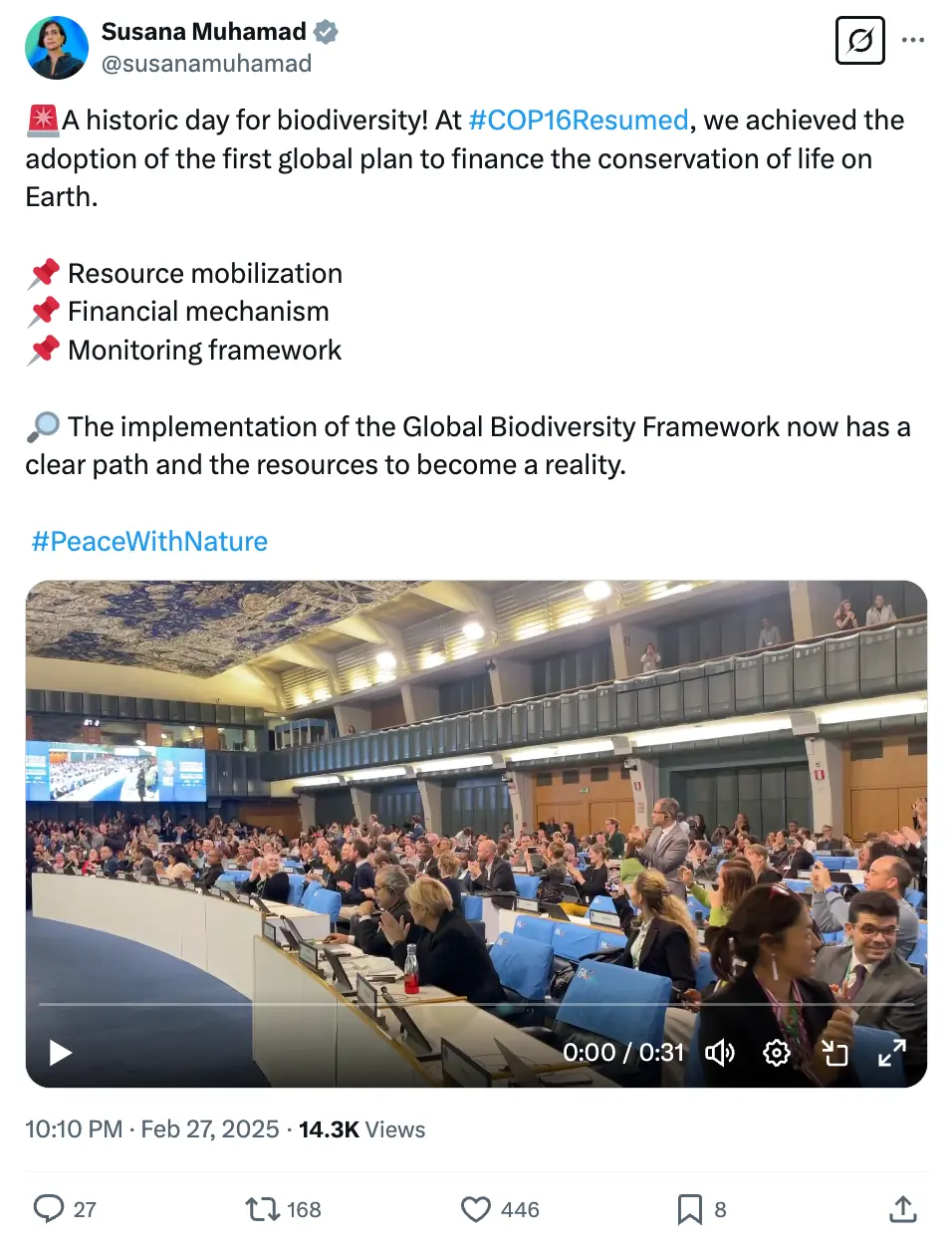
Juliette Landry of the Institute for Sustainable Development and International Relations (IDDRI) described the finance outcome to Carbon Brief as “a delicate balance” struck between “reluctant parties”. She added that countries had “agreed to lift polarised opposition” around a new fund in order to fix “systemic” gaps in existing biodiversity funding.
The figure below illustrates the development of language around a new financial instrument, in each iteration of the resource mobilisation text.

Successive iterations of language around the new financial instrument from Cali (left) to Rome (centre and right). Source: UN CBD (2024, 2025a, 2025b)
One of the drivers behind finance reform is that developing countries say they can struggle to access biodiversity finance. Ramson Karmushu from the International Indigenous Forum on Biodiversity told a press conference that submitting a funding proposal can be complicated and time-consuming.

He further noted that proposals which ask for data can be difficult for Indigenous peoples when the data is “in our minds, not in computers”.
Lim Li Ching from TWN, meanwhile, told Carbon Brief that despite the financial goals for 2025 and 2030 not being discussed in Rome, they remain “incredibly important”. She concluded:
“There’s still a long road ahead, but we live to fight another day.”
Global review
Another text that was adopted in Rome was on mechanisms for planning, monitoring, reporting and review (PMRR), including a global review of progress due to be conducted at COP17 in Armenia in 2026.
This is document outlines the schedule for how countries will assess their progress towards meeting the targets of the GBF in the coming years.
It is the first time in the history of biodiversity talks that countries have agreed to a text specifically on tracking their own progress. The groundwork for this was laid out in the GBF itself, which includes a section on “responsibility and transparency” from countries.
“Planning” refers to countries submitting national biodiversity strategies and action plans (NBSAPs). Countries were meant to submit new NBSAPs by October 2024, but, so far, three-quarters of countries have yet to do so.
“Monitoring” refers to countries using indicators set out in the monitoring framework (see below) to assess their progress towards meeting biodiversity targets.
“Reporting” refers to the need for countries to produce national reports detailing this progress by early 2026. Shortly after this, a “global report” will be produced, assessing NBSAPs and national targets to track whether countries are on track for the targets of the GBF.
“Review” refers to a global review of progress, which is due to take place at COP17.
In Cali, countries managed to produce a bracket-free version of the PMRR text.
At the time, observers said it was generally positive that nations had managed to agree to a way for tracking their own progress, but noted that the text lacked a clear follow-up procedure to ensure countries increase their efforts accordingly after the global review.
Some also lamented the lack of opportunities for all stakeholders, including civil society, to participate in the PMRR process.
Despite countries finalising the text, it was not adopted at the end of the Cali talks. This is because it was scheduled for adoption after the texts on finance, which countries ultimately failed to find consensus on.
In Rome, the CBD secretariat presented a new version of the PMRR text during a plenary on 25 February. This included an adjusted timeline reflecting that work towards the report and review will start following the end of the resumed talks, rather than December 2024 as previously set out.
A representative of the secretariat said the timeline for ensuring all the work is completed is now extremely “tight”, but still achievable.
Many nations expressed their support for the PMRR text and urged other countries to accept it without making any further changes.
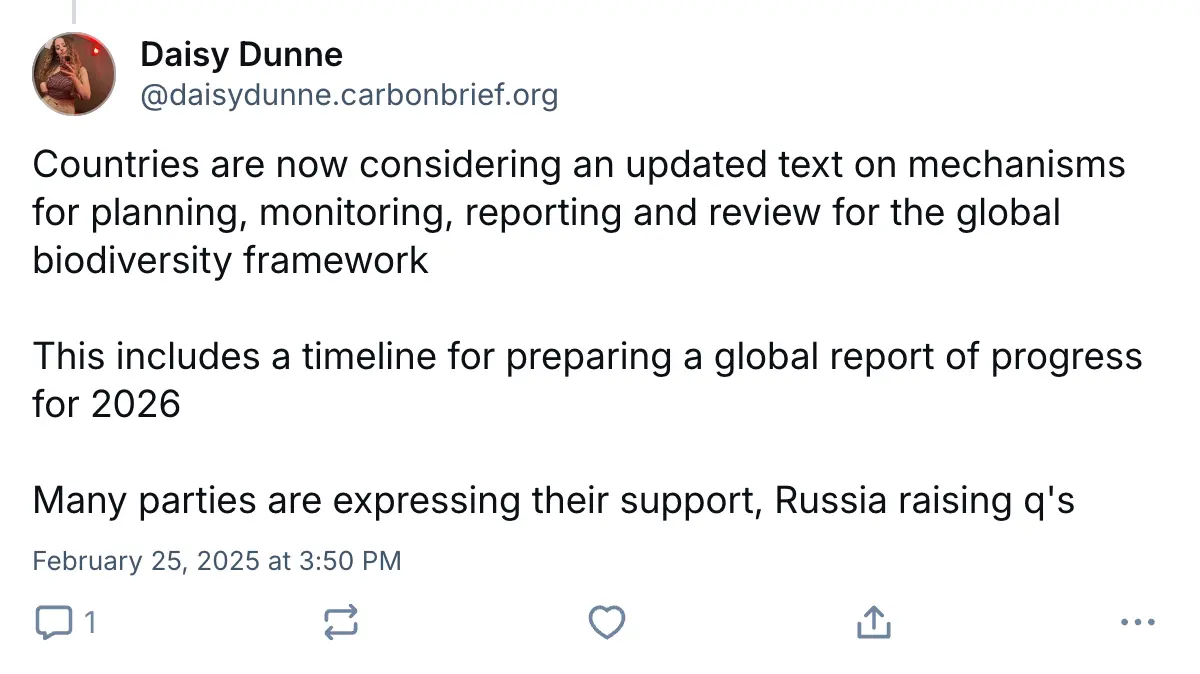
However, Russia and Zimbabwe both raised concerns with small details of the text. COP16 president Susana Muhamad said she would consult privately with parties that were not yet happy to accept the PMRR text.
In plenary on the following day, countries turned to the PMRR text again.
At this point, Zimbabwe suggested adding in a new footnote.
Zimbabwe’s specific concern was around a section of the text that invites non-state actors, such as NGOs and companies, to voluntarily contribute what they are doing to meet the targets of the GBF to the CBD’s online portal.

Zimbabwe called for a footnote noting that these submissions shall be subject to the consent and approval of the country that the non-state actor is based in.
This call was backed by Cameroon, Egypt, Indonesia, Russia, Ghana, the Ivory Coast, the DRC and Russia, according to the Earth Negotiations Bulletin. It was opposed by the European Union and Norway.
Explaining the possible motivations of including such a footnote in the text, one observer told Carbon Brief that, from a “positive” perspective, it might allow countries to block “greenwashing” from companies, adding:
“If you want to be a little bit more cynical about it, it gives countries an opportunity to be less open to hearing from voices they don’t necessarily want to hear criticism from.”
The next day, all nations agreed to include this new footnote – leaving no outstanding issues.
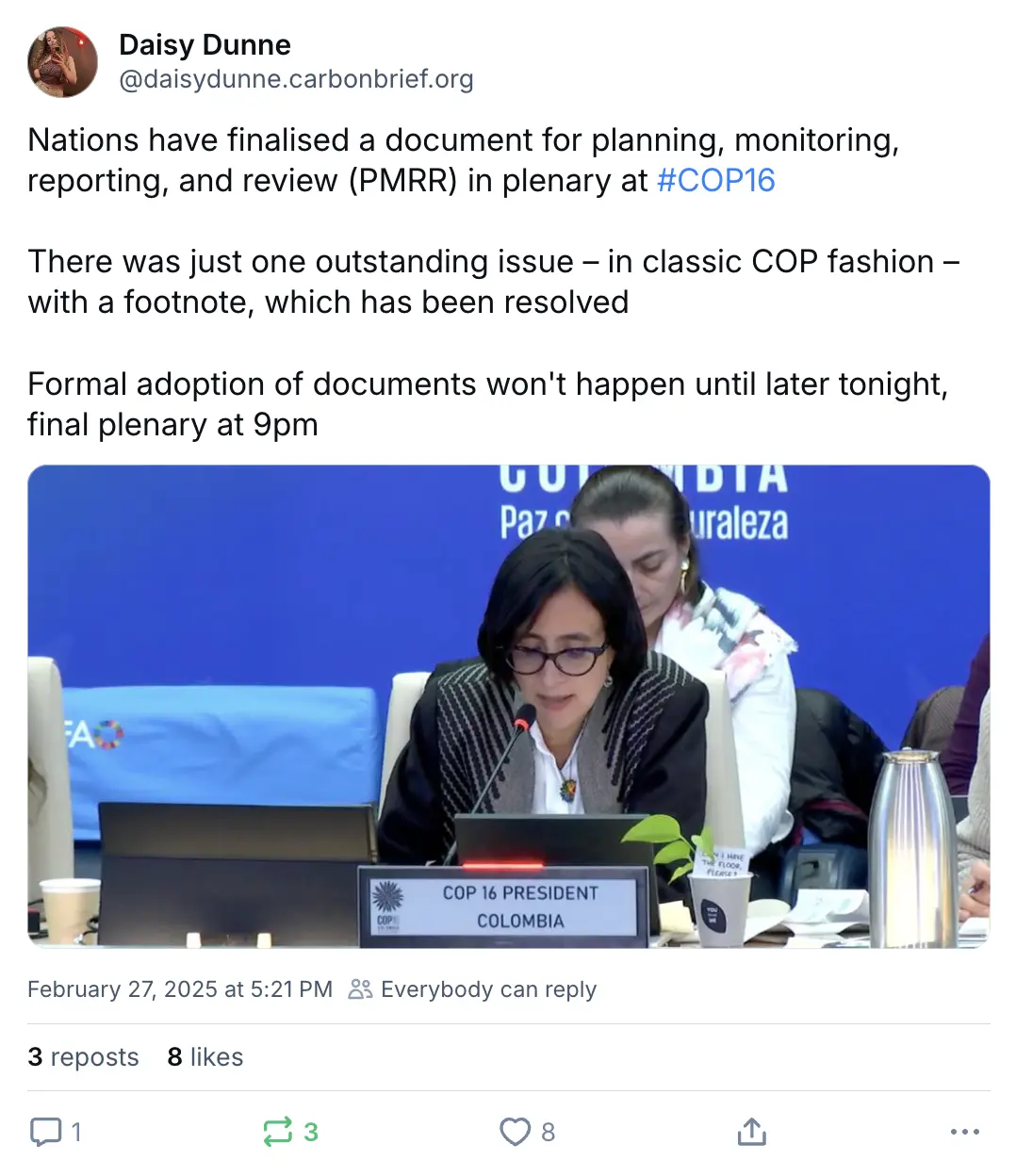
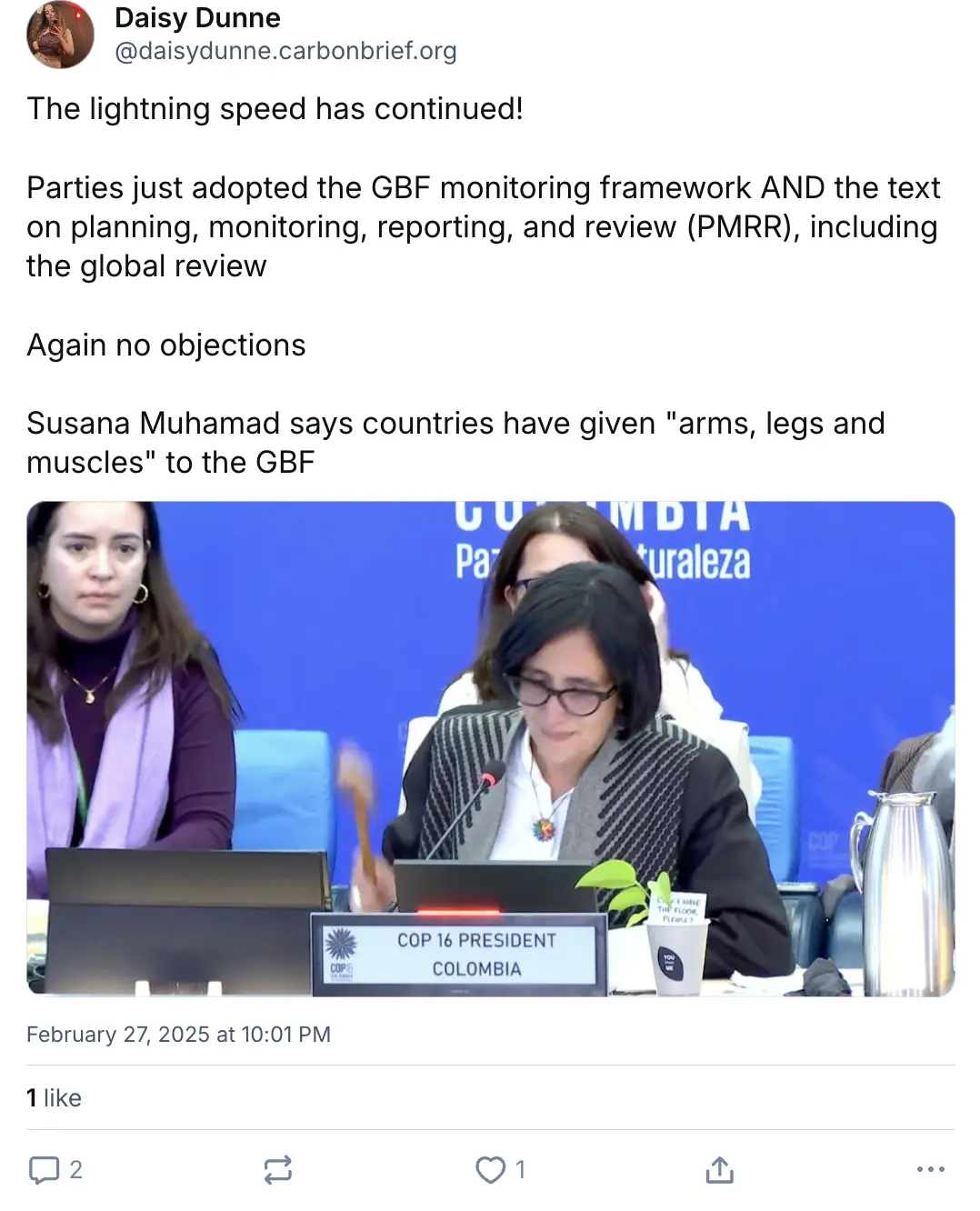
During the summit’s final plenary session, the PMRR text was gavelled through with no objections.
Monitoring framework
The monitoring framework is a document that lays out how countries will measure their progress towards the individual targets of the GBF, using four types of indicators: headline; binary; component; and complementary:
- Headline indicators: used to measure quantifiable progress towards a given target, such as the pledge to restore 30% of degraded ecosystems by 2030.
- Binary indicators: yes-or-no questions used to evaluate progress towards more qualitative goals, such as engagement with women and youth.
- Component indicators: used to measure progress towards specific parts of the targets of the GBF.
- Complementary indicators: used to measure progress towards related goals that are not made explicit in the GBF itself.
While headline and binary indicators are mandatory for countries to report, component and complementary indicators are optional.
During the Cali summit, Lim Li Lin, a senior legal and environment advisor at Third World Network, told Carbon Brief:
“Everyone’s doing a juggle, right? We want the good ones to go in the mandatory and we want the bad ones to go in the complementary, if we can’t get rid of them. And everyone’s doing the same thing from their own interest and perspective.”
Going into Rome, the entire monitoring framework was contained in brackets – meaning, in UN parlance, that the text had not been agreed. This was a result of manoeuvring by the DRC during Cali to ensure that the fate of the framework was tied to that of the finance deal.
Within the text, however, were two outstanding areas of disagreement: one on the indicator for target 7 on reducing harm from pollution, including pesticides; and one on the indicator for target 16 on enabling sustainable consumption.
On pesticide usage, parties were split between requiring countries to report their “pesticide environment concentration” and the “aggregated total applied toxicity”. The former was adopted as part of the monitoring framework during COP15, while the latter was proposed by the technical expert group that met in between COP15 and COP16.
In Colombia, parties converged on allowing both methods to be used as headline indicators, but could not reach agreement on an accompanying footnote explaining why both were being listed and how parties had to report.
In the plenary on 25 February, the UK proposed a compromise footnote text allowing parties to choose which headline indicator to use.

Although some countries suggested prioritising one indicator over the other, the proposal was approved “in the spirit of compromise”, Earth Negotiations Bulletin reported. A separate footnote explained that the FAO is working to “further develop and test the aggregated total applied toxicity headline indicator”.
On sustainable use, countries were split over non-binding component indicators on “global environmental impacts of consumption” and “ecological footprint”. Brazil suggested removing the indicator on global impacts of consumption, “noting that it cannot be validated at the national level”, according to the Earth Negotiations Bulletin.
Discussions on the sustainable-use indicators spilled over into the second day of the Rome talks. The compromise proposal, brought forward by the EU, was to remove the indicator on global environmental impacts of consumption, but retain the indicator on ecological footprint, along with a footnote on methodology and the availability of data.
The updated text was accepted with no objections during the final plenary on 27 February.
Cooperation with other conventions
A text highlighting the links between the Convention on Biological Diversity and other organisations was not discussed until the final hours of the Rome talks.
The text was not viewed as contentious near the start of the three-day summit. Amid the trickier negotiations, it was pushed down on the agenda until a dramatic finale in which the text was approved, un-approved and then gavelled through with last-minute amendments.
The Cook Islands and other countries expressed disappointment with the final tweaks, but said they agreed in order to get a deal over the line.
The agreement recognised, among other things, the ties between the three Rio Conventions – the UN treaties agreed in 1992 under which countries meet separately to negotiate on climate change, biodiversity and desertification.
The final COP16 cooperation decision “invites” countries to “strengthen synergies and cooperation in the implementation of each convention, in accordance with national circumstances and priorities”.
The presidency released a new version of the draft text on 27 February. Among the changes in this text from the previous December draft was the removal of two bracketed paragraphs stressing the importance of future collaboration between the CBD and the global treaty on governing the sustainable use and conservation of biodiversity beyond national jurisdiction (“BBNJ”, or the “High Seas Treaty”).
In the closing plenary, Iceland opposed the deletion of these “two very important paragraphs” referring to the BBNJ treaty “without any discussion”. Russia, supported later by Brazil, stood by the deletion, adding that they were “not in a position to bring [those paragraphs] back”.
The negotiations on this draft went on until close to midnight on 27 February when Muhamad said, much like “Cinderella”, they were running out of time. (The UN translators were supposed to work only until midnight, although they ended up staying through the end of the plenary.) In light of this constraint – and amid disagreement on BBNJ’s inclusion – Muhamad withdrew discussions on the text, pushing its agreement to COP17.
However, Switzerland, the EU and Zimbabwe intervened to push for the approval of the “really important” text. Iceland withdrew its intervention on BBNJ and Muhamad moved to adopt the document.
But Russia noted that the president had not addressed their proposal to delete paragraph 20, which discussed collaboration with the future UN plastic pollution treaty on the pollution-reducing target of the GBF.
After indications of support from India, Switzerland and the EU, the text was adopted by the plenary – now with paragraph 20 removed.

But it did not end there. Argentina took to the floor to suggest further amendments in three parts of the text. Muhamad said this interjection was too late, but Argentina argued that they requested to speak before the gavel fell.
Brazil backed Argentina and recalled the ending of COP15 in Montreal when the final GBF was gavelled through, despite objections by the DRC.
Brazil said this is a “wound that has not healed” for developing countries and that, while they disagree with Argentina’s position, they support their right to speak up.
Muhamad said she did not see Argentina’s request before dropping the gavel, but offered to postpone cooperation negotiations, if countries agreed. The EU did not want this and suggested deleting the paragraphs Argentina took issue with.
These included paragraph 7, referring to FAO work on a draft action plan on biodiversity for food and nutrition, and paragraph 12, discussing the rights of nature and other knowledge systems.
Georgia and Zimbabwe intervened to say that, while unfortunate to remove this text, they agreed with the EU. After more back-and-forth, the text was once again gavelled through, with the proposed amendments.
The final text also referenced outcomes from the UN Environment Programme, the World Health Organization and others.
Around the COP
The Rome COP was a more low-key affair than other summits. There were no side events, parallel meetings or working groups – just plenary sessions, followed by informal evening meetings between countries.
Around 1,000 people attended the talks, compared to 14,000 in Cali.
In the run-up to the summit, Muhamad’s COP16 presidency was called into question after she announced her resignation as Colombia’s environment minister on 9 February. The move was in protest of a controversial cabinet appointment by president Gustavo Petro, Reuters reported.
Muhamad asked Petro in her resignation letter to let her remain in the position until 3 March to allow her to conclude the COP16 talks, Climate Home News said.
In the end, she presided over the Rome talks, telling Carbon Brief in a press conference that she continued to have full capacity as environment minister.
Environment ministers and vice-ministers from Canada, Colombia, DRC, Guinea-Bissau, Madagascar, Peru, Armenia, Fiji, Germany, Suriname confirmed they would attend the talks.
The Cali Fund – a mechanism where companies can contribute money if they use digitally accessed genetic resources from nature in their products – was officially launched at a press conference in Rome on Tuesday 25 February.
The fund – which was one of the major successes of the Cali talks – is currently empty.
A number of companies are already “actively considering” paying into the fund, Astrid Schomaker said at the launch of the fund. (She would not name specific companies when asked by Carbon Brief.)
The CBD chief said the convention has actively contacted companies and business groups to discuss paying into the fund. Muhamad added at the press conference that the fund is not for “charity from the companies”, but “fair payment for the use of global biodiversity”.
The resumed nature talks came at a volatile time in climate and nature diplomacy. The new administration of the US – a major donor to climate and nature funds – caused turmoil and uncertainty across the globe when Donald Trump announced moves to shut down the US Agency for International Development (USAid).
The UN confirmed to Carbon Brief that the US did not send a delegation to Rome.
This was a first for biodiversity talks. Despite not being party to the CBD, US officials usually still attend talks to contribute to negotiations as observers.
At the opening plenary of the talks, Susana Muhamad spoke about the need for agreement amid the current “polarised, fragmented, divisive geopolitical landscape”. She added:
“We have an important responsibility here in Rome. In 2025, we can send a light globally and be able to say that still, even with our differences, even with our tensions…we are able to collaboratively work together for something that transcends our own interests.”
At the sidelines of the talks, the UK made a snap decision to belatedly publish its NBSAP, Carbon Brief reported.
Some three-quarters of nations still have not published their NBSAPs, four months after the UN deadline.
On the summit’s final day, youth activists held a demonstration in the corridors of the conference, in protest of their lack of opportunities to speak at the event.
The post COP16: Key outcomes agreed at the resumed UN biodiversity conference in Rome appeared first on Carbon Brief.
COP16: Key outcomes agreed at the resumed UN biodiversity conference in Rome
Climate Change
Factcheck: No, Europe’s heatwaves are not being ‘caused’ by declining air pollution
This summer has seen Europe suffer through a series of record-breaking heatwaves.
Amid widespread media coverage of the number of deaths and the influence of climate change, the UK’s Daily Telegraph reported on new research with the incorrect headline: “Heatwaves caused by fall in pollution.”
The article was shared on social media by Richard Tice – deputy leader of the hard-right, climate-sceptic Reform UK party – along with a number of prominent rightwing commentators.
Tice claimed that “net stupid zero is contributing to rising temperatures, not helping”, adding that “we have been gaslit and lied to”.
GB News followed up with its own article, incorrectly headlined: “Britain’s scorching heatwaves caused by falling pollution levels, researchers find.”
Scientists tell Carbon Brief that the framing of heatwaves being “caused” by declining air pollution is “wrong”.
While a drop in pollution has reduced the cooling impact it has had in the past, the scientists say, Europe’s summer heatwaves are primarily becoming more extreme “as a result of greenhouse-gas-induced warming”.
Another scientist adds that “any attempt” to link this research to net-zero policies is “simply wrong”.
Fast warming
The extensive reporting around Europe’s heatwaves in recent months has often mentioned that Europe is the world’s fastest-warming continent.

The new study in question aims to unpack why Europe’s summer temperatures are rising more quickly than other regions of the northern hemisphere’s mid and high latitudes.
The research – published in Geophysical Research Letters – explores the role of air pollution and, specifically, how it affects circulation patterns in the atmosphere.
(The study focuses on long-term trends in European summers and does not include the very recent heatwaves.)
Human-caused emissions of aerosols – tiny, light‑scattering particles produced mainly by burning fossil fuels – have long acted to “mask” global warming. This is largely because they absorb or reflect incoming sunlight and influence the formation and brightness of clouds.
To understand how the climate of Europe – or any region – is changing, scientists need to take into account a whole range of factors, says Prof Bjørn Samset, a research professor at Norway’s Center for International Climate Research (CICERO), who was not involved in the work.
This includes “greenhouse gases, aerosols, land-use change, natural variability and how they all interact”, he says, adding:
“The effects of air pollution on circulation, which is the topic here, has long been difficult to pin down.”
As European countries improved their air quality through the second half of the 20th century, the cooling effect of aerosols has gradually been removed.
This can boost heatwaves in two ways – directly, by letting more sunlight reach the land surface and, indirectly, by influencing the jet stream.
Using hundreds of simulations from nine climate models, the new study finds that a decline in aerosols is resulting in more frequent “quasi-stationary Rossby waves”.
Rossby waves are huge meanders in the jet stream. Occasionally, they become slow-moving – or “quasi-stationary” – which allows weather systems to get stuck over one region, leading to prolonged heatwaves.
These circulation changes have contributed to Europe’s rapidly warming summers.
However, while Europe’s heatwaves are being influenced by declining aerosols, it is “wrong” to say they are being “caused” by them, says Prof Erich Fischer, a climate scientist at ETH Zurich.

Fischer, who was not involved in the study, tells Carbon Brief:
“Heatwaves are caused by high-pressure systems and are now much more frequent and intense because they are happening in a climate that is much warmer than 100 years ago as a result of greenhouse-gas-induced warming.
“The paper shows that the greenhouse-gas-induced summer warming had been temporarily masked by air-polluting aerosols. The full extent for European summers only becomes visible now as the air-polluting aerosols have declined.”
Samset adds:
“Air pollution never causes or removes global warming, it only temporarily moderates it.”
Study lead author Dr Pedro Roldán‐Gómez, an associate researcher at the Barcelona Supercomputer Centre, is quoted in the Daily Telegraph saying that “most” of the “excess warming” in Europe, beyond that of comparable regions in the northern hemisphere, can be linked to declining aerosols.
But, earlier in the article, the newspaper interprets this as, simply, “most of the extra heat experienced in Britain and Europe” is down to air pollution.
GB News uses a similar phrasing, reporting that “much of the additional warming across Britain and western Europe since the 1980s is linked to the sharp decline in airborne particles known as aerosols”.
This is “misleading”, says Fischer, while Roldan-Gomez tells Carbon Brief that this is a “tricky point”, which “could lead to wrong interpretations if not properly explained”. He adds:
“The contribution of greenhouse gases is, in any case, the most important factor.”

Cleaner air
The Daily Telegraph’s article was seized upon by Reform’s Richard Tice to claim that “cleaner air” was causing higher temperatures, rather than CO2.
This continued his position – refuted by long-established climate science – that CO2 does not drive global warming.

Tice also claimed in his post that net-zero policies are “contributing to rising temperatures”. Tice appears to be linking declining air pollution to a shift from fossil fuels to renewable energy.
Samset points out that net-zero became a goal “decades later” than the cumulative efforts to reduce air pollution since the 1980s and that it is “simply wrong” to link it to the study.
“The scientific community will keep working to understand how greenhouse gas warming and air pollution interact,” he says, but “nothing we do will change the fact that the consequences of global warming are due to human-induced CO2 emissions”.
Fischer adds:
“Let us not forget that cleaning up air-polluting aerosols is highly desirable. According to the World Health Organisation, 7 million people still die prematurely every year due to air pollution.”
Clean air legislation
Finally, the Daily Telegraph article and the study itself both attribute Europe’s declining air pollution from the 1980s onwards to the Montreal Protocol.
This is a “glaring error”, Samset says, and it is “surprising that it wasn’t picked up” in the peer-review process for the study. He explains:
“The Montreal Protocol did not deal with air pollution. It dealt with ozone-depleting gases and has been an extremely successful multi-national effort against environmental damage. “
Clean air legislation was already in place in many European countries by the time the Montreal Protocol was signed in 1987, says Samset.
In response, Roldán‐Gómez says that while the protocol did not target aerosols specifically, it “boosted the clean air policies”.
The post Factcheck: No, Europe’s heatwaves are not being ‘caused’ by declining air pollution appeared first on Carbon Brief.
Factcheck: No, Europe’s heatwaves are not being ‘caused’ by declining air pollution
Climate Change
Access to finance ‘strengthens climate resilience’ among sub-Saharan women
Empowering women through greater access to finance could “strengthen” households’ resilience to “climate shocks”, according to a new study.
Published in Climate Risk Management, it analyses the impact of financial access on “women-headed households” in sub-Saharan Africa.
The study finds that where women had formal financial access – such as through owning a bank account – households were more able to withstand short-term shocks.
It adds that “climate shocks”, such as extreme weather events and the impacts of climate change, can cause economic crises, which destabilise communities and households.
However, the authors say that in order to protect households from long-term climate vulnerabilities – including “droughts, floods and sea-level rise” – financial access would need to be paired with wider efforts to tackle gender inequality.
They add that the findings could have important implications for policy in sub-Saharan Africa, where many countries and households are vulnerable to climate disasters.
Financial inclusion
The study highlights that entrenched gender disparities mean many women still have unequal access to financial services in sub-Saharan Africa
For example, women are still less likely to have their own bank accounts and instead are often dependent on male relatives for access to finance.
The number of women with access to an account in the region had risen to 52% as of 2024, according to data from World Bank Group.
However, as shown in the chart below, the gap between men and women has also increased, rising from just under 5 percentage points in 2011 to 12 in 2024.

Using survey data from Afrobarometer, the new study analyses 25,511 women-headed households across 37 sub-Saharan countries.
The authors use the Organisation for Economic Co-operation and Development’s (OECD) framework to measure “financial inclusion”. This looks at factors such as having a bank account, owning a mobile phone and having internet access.
Francis Anaisie, a co-author on the study, tells Carbon Brief the researchers were motivated by the UN’s sustainable development goals (SDGs). Anaisie, an economist at the University of Cape Coast, Ghana, says the study specifically looked at SDGs five and 13, on gender equality and addressing climate issues. He adds:
“Financial inclusion is one of the key policy tools for empowering women or for empowerment. But as to whether this actually translates into better climate outcomes for women is not known or is limited; this study seeks to address that gap.”
The study finds households with higher levels of financial access for women had higher levels of women’s empowerment, when this is defined as the ability to make choices and have control over economic and social outcomes.
This was checked by cross-comparing financial access against different measures of women’s empowerment, such as financial security, voting rights and connection to communities.
In particular, the study found that “financially included” women had greater political and economic empowerment, such as financial security and voting rights. On some measures of social empowerment, however, the link was weaker – financial access alone was not enough to erase cultural and social barriers to gender equality.
Women and climate change
It has been well documented that women are more vulnerable to the impacts of climate change than men.
Environmental shocks affect women disproportionately due to a range of factors. These include income disparities, higher rates of displacement and unequal access to land.
Financial inequality and barriers to economic resources, such as needing internet access to make digital payments, play a key role in climate vulnerability, says Tracy Kajumba. She is director for the Least Developed Countries initiative for Effective Adaptation and Resilience (LIFE-AR) interim secretariat at the International Institute for Environment and Development (IIED).
Kajumba, who was not involved in the study, explains to Carbon Brief:
“Women are on the front line doing farming, planting, harvesting and these things that are all impacted [by climate change]. If they don’t have the income to invest either in drought-resistant crops or water-saving technologies, it becomes difficult for households to adapt.”
Calculating climate resilience
The new study measures the impact of financial inclusion on women’s empowerment and, in turn, on climate resilience.
It evaluates a household’s ability to withstand and recover from “shocks and stressors” by using a UN Food and Agriculture Organization metric for “resilience index measurement and analysis” (RIMA).
For example, questionnaires are used to gather information about households in certain areas. The data is then used, together with key indicators, to quantify a household’s resilience to food insecurity, climate variability and economic crisis, amongst other risks.
The 25,511 households surveyed across sub-Saharan Africa were found to be relatively resilient overall and had a high capacity to bounce back from climate shocks. However, they had much lower ability to adapt, in order to build protective capacity in advance of extreme events.
In addition, the study finds that women’s financial empowerment had a positive impact on a household’s ability to “absorb” a climate shock, suggesting that financial access is critical for responding to climate change.

Increased empowerment through financial access enables women to make decisions about planting crops, to access credit in emergencies and to buy or sell food at a better price, the study notes.
For example, it says increased financial access and women’s empowerment help households to deal with the immediate consequences of an extreme weather event, such as a drought. This could be through building community mutual-support networks and by enabling access to savings, to keep the household running.
Anaisie says the study shows women’s empowerment has a significant impact on climate resilience. He tells Carbon Brief:
“If we include women in the financial system, in the case of any climate issue they can save, they can be independent, they can rely on investment to absorb these shocks. This empowerment will help them to be more resilient to climate shocks…We can make progress because SDG goals are all about inclusiveness. It’s all about inclusive growth.”
However, the study notes that financial access does not necessarily create long-term change, which would make the household less vulnerable to extreme weather in the first place.
The authors suggest that lasting structural and cultural change is important for bringing about long-term resilience. They say that policies to address gender inequalities would help bring this about.
They say such policies could include gender-sensitive agricultural credit schemes, subsidised climate insurance for women farmers in drought-prone regions, joint land-titling programmes and quotas for women in local climate-adaptation committees.
Such policies would have helped women impacted by recent severe floods in Ghana to protect their savings, Anaisie explains. He tells Carbon Brief:
“Women are engaged in economic activities, especially informal activities. They have resources and money, but when the flood came in, many women lost that. If they had access to insurance, this flood wouldn’t have cost them that much.
“So, if the government comes out with financial initiatives, training, civic education and gender-focused initiatives, leadership training, women will be empowered and this will translate into their resilience with regards to climate change.”
Addressing climate vulnerability in sub-Saharan Africa
The study could have policy implications for sub-Saharan Africa, a region particularly vulnerable to the effects of climate change. The region faces increasingly extreme weather, heatwaves, droughts, wildfires and floods, as well as food scarcity and threats to crops.
The study suggests that policies to address structural and cultural barriers to women’s financial autonomy could be a key way to build climate resilience across the region.
However, it recognises that even where financial access is expanded, gender norms and cultural constraints continue to shape women’s social empowerment. This, in turn, affects their ability to adapt to climate change in the long term.
Ultimately, addressing structural inequalities is needed to minimise climate vulnerability, says Kajumba. She adds that supporting adaptation with financial access can allow households to absorb shocks without falling into poverty – and to rebuild after climate impacts.
Kajumba says that supporting adaptation with women’s financial access can allow households to absorb shocks without falling into poverty – and to rebuild after climate impacts. She adds:
“When they are supported [with] microloans, savings and all that, you will see change in income, change in households, change in health and education for the children as well.”
However, Kajumba notes that structural inequalities still “amplify” women’s vulnerability to climate impacts and make it harder for them to exercise agency and leadership. She adds:
“The tools that are being used are not always favourable for women…When we look at women in leadership and participation, you cannot lead or you cannot participate unless you have some level of income.”
The post Access to finance ‘strengthens climate resilience’ among sub-Saharan women appeared first on Carbon Brief.
Access to finance ‘strengthens climate resilience’ among sub-Saharan women
Climate Change
State of the climate: Rapidly developing El Niño raises chance of record-warm 2026
As 2026 passes its halfway point, the world is watching one of the most rapidly intensifying El Niño events in the modern record take shape in the tropical Pacific.
The developing El Niño is boosting expectations for global temperatures, both this year and next.
El Niño is the warm phase of a recurring climate pattern in the tropical Pacific that releases heat from the ocean into the atmosphere, temporarily raising global temperatures and reshaping rainfall and extreme weather around the world.
Carbon Brief’s “state of the climate” report in April gave 2026 a 19% chance of setting a new global temperature record.
That chance now stands at 35% – a near-doubling in four months – with virtually all of the change driven by ever-stronger El Niño forecasts.
The key findings from the first half of 2026 include:
- The first six months of 2026 were the third-warmest start to a year on record – around 1.4C above pre-industrial levels – behind only 2024 and 2025.
- While the first few months of the year came in as the fourth or fifth warmest, both May and June were the second-warmest ever recorded as El Niño conditions took hold.
- El Niño conditions arrived in April and reached the threshold for a “strong” event by June, when the Niño3.4 index reached 1.6C. Of the 667 model runs Carbon Brief examined, 91% project a peak later this year that is above the strongest El Niño in history.
- The chance that 2026 beats 2024 as the warmest year on record has risen to 35%. Carbon Brief’s central estimate remains that 2026 will be the second-warmest year, at around 1.51C above pre-industrial levels.
- Whether 2026 sets a record will depend on the dataset: the odds range from around two-in-three in NASA and Berkeley Earth data to around two-in-10 in ERA5 and one-in-10 in the JRA-3Q reanalyses.
- June 2026 was western Europe’s hottest June on record, amid a heatwave that set hundreds of individual records. Nearly 9% of the world’s surface saw record June warmth.
- The developing El Niño will have its largest impact on 2027, which Carbon Brief projects to be around 1.7C above pre-industrial levels – this would comfortably set a new record for the warmest year.
- Arctic sea ice has spent 39 days of 2026 so far at, or below, record daily lows following its joint-lowest winter maximum in the satellite era.
Third-warmest start to a year
Carbon Brief analyses records from six different groups that report global surface temperatures: NASA GISTEMP, NOAA GlobalTemp, Hadley/UEA HadCRUT5, Berkeley Earth, Copernicus/ECMWF ERA5 and the JMA JRA-3Q reanalysis.
The first half of 2026 was the third warmest on record in every one of the six datasets, behind only 2024 and 2025. The figure below shows annual temperatures since 1970, along with the 2026 year-to-date average (January-June) for each group.

January 2026 was only the fourth- or fifth-warmest January on record, as lingering weak La Niña conditions suppressed temperatures. Since then, each month has climbed the rankings.
La Niña is the cool phase of the El Niño-Southern Oscillation (ENSO). It typically brings wetter conditions to Australia, Indonesia and equatorial South America and drier conditions to the southern US.
March was second-to-fourth warmest across datasets, April the third and both May and June were the second warmest ever recorded, behind only the corresponding months of 2024.
The chart below shows how June 2026 (thick red line) came in around 0.08C below the June record set in 2024 in the average of the six datasets.
Meanwhile, Copernicus reported that global sea surface temperatures over the ice-free oceans set a new June record.

A record-breaking El Niño
ENSO is the largest source of year-to-year variability in global temperatures.
The most common way to assess the strength of an El Niño or La Niña event is by looking at the sea surface temperature anomaly in the “Niño3.4” region of the tropical Pacific.
El Niño and its sister La Niña occur when temperatures in the tropical Pacific are more than 0.5C (El Niño) or less than 0.5C (La Niña) below normal, where normal is defined by removing the effects of long-term climate change.
The thresholds for defining the strength of an El Niño or La Niña are above/below 1C for “moderate” events, 1.5C for “strong” events and 2C for “very strong” (or “super”) events.
After two years dominated by La Niña conditions, the tropical Pacific flipped decisively in April when the Niño3.4 index crossed the 0.5C El Niño threshold. It subsequently reached 1C in May and hit 1.6C in June, marking one of the fastest onsets in the observational record.
In the first few weeks of July, the index shot above 2C, significantly outpacing the speed at which any prior El Niño events developed.
Forecast models expect even more to come.
An analysis by Carbon Brief of the median of 667 model runs from 14 different modelling groups suggests that sea surface temperatures in theNiño3.4 region could peak at 3.59C between July and December.
More than 91% of runs predict the strongest El Niño event in the modern record. The previous record was set during the event of 2015-16, when temperatures peaked around 2.75C.
This is shown in the chart below, which features a histogram of the likelihood of different possible 2026 El Niño peaks across all the models on the top. The forest plot beneath shows the best estimate and range of outcomes predicted by each individual model.

The median forecast in every one of the 14 models suggests a peak that exceeds the 2C “super” El Niño threshold, with most models peaking in November or December.
Some caution here is warranted, however. Raw model Niño3.4 anomalies are measured against a fixed climatology. Because the entire tropical ocean has warmed due to human-caused greenhouse gas emissions, the models tend to overstate event strength relative to the historical record.
A cleaner comparison uses the relative Niño3.4 index (RONI), which subtracts the average tropical ocean warming.
This relative measure suggests the median forecast peak for El Niño in the latter half of 2026 is 3.1C. The prior record stands at a lower 2.69C, set in 1982-83.
Nevertheless, 77% of model runs still show a new record event occurring. This is shown in the chart below.

In summary, on both indexes, the central expectation is now for the strongest El Niño in the observational record.
Model forecasts made in the spring and early summer have historically shown some bias toward overpredicting event strength. However, forecasts made after the spring are considerably more reliable.
Widespread record warmth and a massive European heatwave
The map below shows the temperature anomaly for the first half of 2026 in the ERA5 dataset, relative to a 1981-2010 baseline period.

It shows how the largest warm anomalies were found across the Arctic – particularly north of Scandinavia and Svalbard – as well as western Europe, the western US, northern Mexico, central Asia, western China, eastern Russia and the Antarctic Peninsula region.
The developing El Niño is clearly visible as a tongue of warm anomalies stretching along the equatorial eastern Pacific. Only a few regions – central Canada, Alaska and parts of the Southern Ocean – saw temperatures below the 1981-2010 average.
Where 2026 ranks against history is even more striking. The map below shows where the period of January-June 2026 ranked among all 87 years in the ERA5 record, which stretches from 1940 to 2026. Grid cells marked in red saw temperatures in the first half of the year that were in the top-five warmest years.

More than 30% of the global surface had a top-five warmest start to the year and 7.1% saw its warmest on record, including much of western Europe, the eastern equatorial Pacific and the seas around Japan.
Not a single grid cell had a top-five coolest start to the year. In June alone, 8.9% of the world’s surface saw record warmth for the month. This is illustrated in the map below, where grid cells marked in red saw temperatures that were in the top-five warmest years and grid cells in blue in the top-five coolest.

The standout regional temperature event was a heatwave that struck Europe in late June.
Western Europe had its hottest June on record, recording an average temperature of 3.05C above the 1991-2020 average and beating the record set only a year earlier, according to Copernicus. A heat dome over 22-30 June broke 10 all-time national heat records and around 400 long-record station records.
France set a new June national record of 44.3C, while the UK broke its June record on three consecutive days, reaching 37.3C. The humid heat drove a death toll estimated in the thousands.
A separate heat dome also brought record June temperatures to parts of North America in late June.
On track to be second warmest, but a real chance at first
Carbon Brief’s updated projection for 2026 as a whole combines the observed January-June temperatures with the latest El Niño forecast. It uses a statistical model trained on the historical relationship between the first half of the year, ENSO conditions and annual temperatures observed over 1950-2025, excluding major volcanic eruption years.
Carbon Brief estimates that 2026 will be around 1.51C above pre-industrial levels, with a 90% range of 1.45C to 1.57C, shown by the yellow dot in the chart below.
This is up from 1.47C in the projection set out in April – and is notably more certain now that half the year has passed.
This central estimate would make 2026 the second-warmest year on record, just below 2024 (1.52C) and ahead of 2023 (1.43C) and 2025 (1.41C).

Carbon Brief’s modelling puts the chance that 2026 beats 2024 as the warmest year on record at 35%, using the average of the six different surface temperature records assessed. It puts the chance that 2026 comes in above 1.5C at around 63%.
If it does, 2026 would be the second calendar year – after 2024 – where warming averaged above 1.5C, in a further sign that the world is rapidly approaching the Paris Agreement’s 1.5C limit.
A single year above 1.5C does not by itself constitute a breach of the goal, which refers to the longer term average temperature of the planet. This is defined as the midpoint of a 20-year period by the Intergovernmental Panel on Climate Change (IPCC).
These likelihood of a record have been climbing rapidly throughout 2026.
Global temperatures so far throughout the year have run well below the record-setting levels of 2024 – around 0.13C cooler over the first six months.
On their own, temperatures observed so far in 2026 would make a new annual record unlikely.
However, rerunning the projection using only the data available at the end of each month since March – including both the year-to-date observations and the El Niño forecast issued that month – shows a shifting picture.
Using March data, 2026 had just a 7% chance of setting a new record. That rose to 16% in April, 24% in May, 27% in June and 35% using the latest data in mid-July.
This is shown in the chart below.

Notably, this rise has little to do with observed temperatures. The year-to-date anomaly has actually drifted slightly down, from 1.41C after March to 1.39C after June.
Observed temperatures and fewer remaining months of the year contributed only around four percentage points of the 28-point rise in the likelihood; the remaining ~84% of the change comes from successive upward revisions to the El Niño forecast for late 2026.
However, whether 2026 ends up becoming the warmest year on record may end up depending on which dataset is used.
Running the same projection gives odds of a 2026 record of around two-in-three for Berkeley Earth (66%) and NASA GISTEMP (65%), but only 35% for HadCRUT5, 24% for NOAA and just 13% and 9% for the ERA5 and JRA-3Q reanalyses, respectively.
This is shown below.

The divergence between projections mostly reflects how exceptional each dataset’s 2024 was.
The reanalysis approaches recorded a particularly warm 2024, leaving 2026 more ground to make up. GISTEMP and Berkeley, on the other hand, project 2026 modestly above their 2024 values.
A repeat of the situation in 2015 where different groups disagreed on record rankings is a real possibility. Headlines in January 2027 may hinge on choices of dataset.
2027 likely to be the warmest year in human history
The biggest climate story of the developing super El Niño may not be 2026 at all.
Global temperatures typically lag in the tropical Pacific by around three months. So, an El Niño event peaking in November and December 2026 will have its largest warming influence on 2027.
We saw this same pattern occur in 1997-98, 2015-16 and 2023-24 – where the year in which the El Niño developed was warm, but the following year was record-smashing.
Carbon Brief has extended its projection into 2027 by using the historical relationship between year-over-year temperature changes and ENSO conditions in the preceding autumn.
This yields a best estimate for 2027 of around 1.71C above pre-industrial levels, with a 90% range of 1.49C to 1.93C. This is shown by a yellow square on the chart below.

That would give 2027 a 92% chance of setting a new global temperature record and a 94% chance of exceeding 1.5C.
Taking 2026 and 2027 together, there is a 93% chance that at least one of the two years sets a new record.
The 2027 estimate is more uncertain than the 2026 one. As with 2026, there are uncertainties in the projection due to unknowns around exactly how strong the El Niño peak proves to be and how quickly it decays.
However, even the low end of the 2027 range would put it among the warmest years on record and the central estimate of 1.71C would exceed 2024 by nearly 0.2C.
If these projections bear out, the 2020s will have delivered new global temperature records in 2023, 2024 and 2027 – and potentially 2026 too – with a number of individual years well above the 1.5C threshold.
The long-term warming trend, driven by human emissions of carbon dioxide and other greenhouse gases, has increased from around 0.18C per decade in the early 2000s to around 0.27C per decade today. El Niño and La Niña play a big role in determining which years along that rising path stand out as records.
Arctic sea ice at record lows
Arctic sea ice has spent much of 2026 in record-low territory.
Following the joint-lowest winter maximum in the satellite record in mid-March, daily extent has set or tied record lows for the date on 39 days so far this year, including extended spells in mid-to-late March and in early-to-mid June.
The most recent record-low days were in early July.
The chart below shows how Arctic sea ice in 2026 (dark red line) has been below the historical range (shaded red).
It also shows how Antarctic sea ice (dark blue), meanwhile, has remained below the 1979-2010 range for almost all of 2026 to date.

As of mid-July, Arctic extent is a bit below the 1979-2010 historical range for the date, though it remains around 0.6m square kilometres (km2) larger than the record low for the date set during 2020’s exceptional summer melt season.
The trajectory over the coming two months will determine whether 2026 challenges 2012’s record September minimum. Early-summer conditions are a poor predictor of the September minimum, which depends heavily on summer weather.
Antarctic sea ice, meanwhile, is currently around 300,000km2 below the historical envelope, but has stayed well clear of the record lows set in 2023 and has not set any new daily records yet this year.
Q&A: Europe’s May and June heatwave deaths – and how they were counted
Guest post: France’s June heatwave caused more than 2,700 heat-related deaths
Guest post: Climate change has caused one-fifth of Pine Island glacier retreat
Media reaction: How climate change intensified Europe’s record-breaking June heat
The post State of the climate: Rapidly developing El Niño raises chance of record-warm 2026 appeared first on Carbon Brief.
State of the climate: Rapidly developing El Niño raises chance of record-warm 2026
-
Greenhouse Gases12 months ago
Guest post: Why China is still building new coal – and when it might stop
-
Climate Change12 months ago
Guest post: Why China is still building new coal – and when it might stop
-
Greenhouse Gases2 years ago嘉宾来稿:满足中国增长的用电需求 光伏加储能“比新建煤电更实惠”
-
Climate Change2 years ago嘉宾来稿:满足中国增长的用电需求 光伏加储能“比新建煤电更实惠”
-
Climate Change2 years ago
Bill Discounting Climate Change in Florida’s Energy Policy Awaits DeSantis’ Approval
-
Renewable Energy9 months agoSending Progressive Philanthropist George Soros to Prison?
-
Carbon Footprint2 years agoUS SEC’s Climate Disclosure Rules Spur Renewed Interest in Carbon Credits
-
Greenhouse Gases1 year ago
嘉宾来稿:探究火山喷发如何影响气候预测


