

Weather Guard Lightning Tech
UK Bans Ming Yang, Vestas Plans Scotland Factory
The UK bars Ming Yang on security grounds while Vestas announces a €250M nacelle factory in Scotland. Also, Nordex reaches a 199-meter hub height milestone and male bats use turbines as courtship song perches.
Sign up now for Uptime Tech News, our weekly newsletter on all things wind technology. This episode is sponsored by Weather Guard Lightning Tech. Learn more about Weather Guard’s StrikeTape Wind Turbine LPS retrofit. Follow the show on YouTube, Linkedin and visit Weather Guard on the web. And subscribe to Rosemary’s “Engineering with Rosie” YouTube channel here. Have a question we can answer on the show? Email us!
[00:00:00] The Uptime Wind Energy Podcast brought to you by Strike Tape, protecting thousands of wind turbines from lightning damage worldwide. Visit strike tape.com. And now your hosts.
Allen Hall: Welcome to the Uptime Wind Energy Podcast. I’m your host Allen Hall, and I’m here with Rosemary Barnes, Matthew Stead, and Yolanda Padron. And. The hot news this week is Scotland, and Scotland is gonna be a major hub for manufacturing for all the offshore wind that is happening in the UK and around Europe.
Well, the UK government ruled that Chinese turbine maker Ming Yang poses a national security threat and blocked its products from UK offshore wind projects, which in turn killed a plan for a one and a half billion pound Scottish factory. And then a couple of hours later, Dana Danish Giant Vestus announced plans to build its own cell [00:01:00] and hub factory in Scotland with an investment of about 250 million euros and up to about 500 jobs.
Uh, but there is still a catch. Vestus is only going to move forward if it wins enough orders from the UK’s offshore wind. Auction program and allocation round eight was announced recently, so that’s gonna happen. So obviously Vestus would like to win a number of turbine orders from that, but that’s a pretty major announcement by the UK and by Vestus.
It does seem like Vestus will be the leader in offshore winds in the uk. Is that the long term play now? Is that there’ll be a primary. Wind turbine source for the uk and that would be Vestas.
Rosemary Barnes: Weren’t we just covering, didn’t we just cover last week about another Danish manufacturer who just closed in a cell, uh, manufacturing facility in Denmark?
Allen Hall: Siemens did.
Rosemary Barnes: So yeah, one week [00:02:00] Siemens is closing a factory in Denmark and the next week. As Bestus is opening similar factory in the uk. So that’s a interesting little geographic, uh, bit of information,
Matthew Stead: isn’t it? Thanks to our friends, the royal family in the uk, that they’re really promoting offshore wind.
Matthew Stead: Uh, my understanding is they own the rights to the offshore water.
Uh, well, obviously the offshore, offshore area, and they, they have promoted, um, the use of leases. And I, I understand, I might be cor incorrect, that the royal family is the one that may gain the, the benefit from the leases.
Allen Hall: It’s the crown of state in the UK that. Manages the royal family’s holdings. [00:03:00] Some part of the awarded amount or the, the leases are going to go to the royal family.
I forget what that number is. Maybe 10% of ’em. And the rest basically are the treasury of the uk.
Matthew Stead: Oh, not all of it.
Allen Hall: Yeah, not all of it. But yeah, I mean it definitely benefits the royal family.
Matthew Stead: Yeah. So kiosk to the royal family for promoting it.
Allen Hall: Well, the price of petroleum in oil products recently has skyrocketed, of course.
And, uh. The push to get renewables as the leading source of electricity generation in the UK is a massive move, which will. Promulgate all through Europe, everybody’s gonna be on that same pathway, I would think. Right now, the, the, the unique part about the UK and these, these Scottish efforts is that the speed at which the UK and Scotland in particular are going after it, you see some commitment by the Scandinavians in Germany to get to some of these numbers.
But, uh, the UK is putting in an action. And they have a in, uh, industrial growth plan, which [00:04:00] is a little bit unique that this is part of the growth strategy of the UK is they’re trying to grow jobs, they’re trying to get higher paying jobs into the uk and this is the, the one way they’re trying to accomplish it.
I was listening to a podcast today talking about this. It was someone representing, I think it was great British energy, but they are at least the, as the discussion points, they were trying to show comparisons. To what will happen and when to What has happened in the past with aerospace that the UK realized it’s good at composites, manufacturing wings, doing power plants, rolls Royce is there, right?
So there’s a number of parallel. Tracks that the UK is going to to try to do through, um, their knowledge of aerospace into the wind turbine market. We’ll see if that comes to fruition. I’m not sure where these vestus turbine blades are gonna be built. They’re gonna be V 2 36 turbines, 15 megawatt machines out in the water.
I, I assume that the turbine blades are gonna be coming from outside the [00:05:00] uk, but maybe the UK is working on something with Vestus about that.
Rosemary Barnes: I don’t know, but, but the UK government with their auctions has definitely laid the framework that would enable manufacturers to make that sort of investment or that, that sort of investment decision.
So it wouldn’t, wouldn’t surprise me if we saw more manufacturing there. They’ve got, you know, the most secure, uh, and long, long term pipeline, more the most visibility around. Future projects. So if I was a company looking for, you know, where am I gonna open another factory, that would probably be quite appealing.
That security really helps when you’re planning out a factory to know that you’re highly likely to have orders filling it for, you know, the lifetime of the factory. Even if costs are a little bit higher, I think that it would be, you know, you can offset a certain amount of cost by. The certainty.
Allen Hall: What are the short term ramifications for Chinese wind turbine manufacturers in Europe?
Are you gonna see [00:06:00] more of these type of moves like the UK just did today, where they’re gonna put some prohibitions in? Or will there be some places that, uh, Chinese manufacturers can set up base?
Rosemary Barnes: To me, it’s really strange because it’s, it’s like you’re worried about security, so you don’t let them come bring their technology to your country.
It’s. Like the, to me, the obvious thing is the other way around. If they’re worried about, um, technology transfer and IP theft, that they, um, should have prevented European wind turbine manufacturers from sitting up factories in China, because surely that’s how the big transfer of knowledge happened. Now China, you know that that’s where, that’s where they learn how to make win winter turbines 10, 20 years ago.
Um, and what they’re doing today in China is, is not, it’s not like static from that. They have also developed their own, you know, their own ideas and taken the technology in a different direction. Why don’t we take the opportunity to learn from that? I, I find it a bit, [00:07:00] a bit funny that, um. Yeah, that you would ban a manufacturer from coming to your country because you’re concerned that they have, um, you know, copied or stolen your technology in the past and can’t see how they’re gonna do that by bringing their tech to your country.
Matthew Stead: And how does that tie in with the discussion we had the other week about the tariffs and removal of tariffs on certain components? Um, Alan, do you know if that’s linked at all?
Allen Hall: I don’t think it’s linked. There hasn’t been any news articles about it. However, there’s gonna be a lot of hard choices made about where components do come from.
That does seem like the UK government is thinking about what components can be made in the uk where UK engineering and technology can be applied to, to change the marketplace and where they want to go buy components. Uh, are they gonna buy them from China or are they gonna buy them from Poland or somewhere in Eastern Europe or somewhere in South America?
There’s a lot of places to buy components today. Or India. I think India is obviously, uh, one of the top choices, [00:08:00] right? Just because it was a colony years ago. And there’s a relationship there between the UK and India. Is that where the technology transfer begins? Uh, instead of it with China? Probably so
delamination and bottomline failures and blades are difficult problems to detect early. These hidden issues can cost you millions in repairs and lost energy production. C-I-C-N-D-T are specialists to detect these critical flaws before they become expensive burdens. Their non-destructive test technology penetrates deep into the label materials.
To find voids and cracks. Traditional inspections completely. Miss C-I-C-N-D-T Maps. Every critical defect delivers actionable reports and provides support to get your blades back in service. So visit cic ndt.com because catching blade problems early will save you millions.[00:09:00]
Alright, how tall is too tall? Well, for onshore wind, the answer keeps changing with. Nordics group just receiving its first order for a turbine with a hub height of. Drum roll please. 199 meters. So there must be some sort of limitation at 200 meters is where the limit is. So they came in one meter below it.
It’s what it smells like.
Rosemary Barnes: The limitation would be on the tip height, not the hub height.
Matthew Stead: Should have been 200,
Allen Hall: just routed up to 200. See?
Rosemary Barnes: Yeah. But this is Germany, right? Where it’s like you, the number is what engineering says it should be, not what looks nice on a marketing brochure or in a press release.
You know, if, if the tower should be 199.2 meters, then that’s what it will be.
Allen Hall: Well, three of these 199 meter towers rise up in a project in the North Rhine with Flia area of Germany, and it’s gonna drink power in a very [00:10:00] low wind speed region. Uh, the. Towers are gonna be constructed in typical Nordic fashion, and the, the top portion of the tower will be steel.
The, the lower portion will be concrete. So you may be talking about what height for concrete are you talking about a 50 or a hundred meters of a concrete tower? That seems amazingly high because Nordex does a unique thing where they, they kind of jigsaw piece together and erected that way. I don’t. I think I’ve seen them do anything nearly that high.
But, uh, there are other ways to get to that hub height, but it does seem like concrete and steel are gonna be the pathway. Are we gonna see more of this? Uh, as wind turbines move off the prime spots where the wind speeds are high, that instead of looking, putting more turbines where the wind speeds are high, you’re just gonna put.
Really, really tall turbines up with massive rotor diameters to keep them spinning.
Rosemary Barnes: [00:11:00] Yeah. But I think it kind of makes sense in Europe, like this project, it’s three turbines, right? So if you had smaller turbines, like a smaller turbine might be cheaper per megawatt. Um, in terms of like if you have a really large wind farm with just a lot of them.
But this site, you know, imagine they’ve got a triangular plot and they can put one turbine at each corner. They’ve really, really wanna maximize the amount of power that they can get from each, each turbine because it, you know, like on a small site, the area it’s capturing, it kind of extends past the, the edges of the land footprint, right?
Because they’ve got, you know, such huge, huge turbines. So for those really small projects, I think that it is a different, um, equation that they’re calculating. For what the optimal turbine size is. And it, it does make sense to really go after every what that you can get from that site. Since you, you’ve got so few turbines that you can work with.
Allen Hall: Well, they need unique construction methods to get the [00:12:00]blades that high and to get them the cell on top of the tower.
Rosemary Barnes: I guess a crane, a specialized crane will be the, a tricky thing.
Matthew Stead: And then how do you repair it? You know when, when you need to change a blade out, how you gonna get it? That crane bag. Uh, how, how, how are you gonna get up and down?
I mean, it’s gonna take you half an hour to, in a little lift to get up. And what if you need to go to the toilet?
Allen Hall: Let’s get to the heart of the matter.
Yolanda Padron: Yeah. I mean, at least it’s only three, right?
Allen Hall: But it’s gonna take you how long to get up that tower if you’re in the lift. Those lifts don’t move that fast.
And it isn’t like you’re in, you know, a modern office building where the elevators move very quickly. It’s gonna take a little bit of time. Uh, I guess things, things we’re gonna have to figure out, uh, because we have seen a number of technologies that, they talked about installing blades, using cables, and you see some of that more recently, but 200, roughly 200 meters high is a long way to go.
So they must have a plan on how they’re going to do it.
Rosemary Barnes: So a co Google says that wind turbine [00:13:00] lifts slash elevators range from 0.3 meters per second to one meters per second. Um, I guess at your fast
Allen Hall: 200 seconds.
Rosemary Barnes: Yeah. So at at best, it’ll take you three and a half minutes to get up there and at worst. 10 minutes.
Matthew Stead: So definitely a toilet up
Rosemary Barnes: there. There’s no way there’s a toilet up there. Kept real, Matt, they put toilets up in wind turbines, you hold it or you know, if you’re a gross man, then you just, you, you go off the side and they will tell you, you know, like when you. When you’re doing site, your site inductions, it’s like, oh, don’t park in this location because people pee there.
Allen Hall: Are you downwind?
Rosemary Barnes: Yeah, your car could get hit.
Allen Hall: Do they have a wind sock at the bottom of each of the towers? Is that what’s going on?
Yolanda Padron: I mean, at least like 10 minutes isn’t too bad compared to like when you’re free climbing the smaller towers that didn’t have the lifts in them yet. Like that take, I mean, I might be slow.
It took me like half an hour at least
Rosemary Barnes: Last [00:14:00] time I was on site, some of the team were climbing. ’cause that’s just the exercise that they get. And they climbed the same speed as the um, as the lift roughly. Um, but I don’t think they would do that over 200 meters. You know, I think, you know, there’s a difference at a hundred meters versus 200 meters of, of climbing like that.
I mean, it makes sense. You don’t need a gym membership, you don’t need to go for a run after work ’cause you’ve got your exercise during the day.
Yolanda Padron: That’s after that.
Matthew Stead: I’m just wondering about how much it would actually be moving around, like when it’s, when it’s under maintenance, how much, um, horizontal sway you’d actually get.
Rosemary Barnes: Yeah. I mean, already when you stand at the top of a, um, a wind turbine tower, you definitely feel it.
Matthew Stead: You’re getting sway.
Rosemary Barnes: Yeah. So. More than that, but it is, I mean, it’s, it’s evolution not revolution, right? Like, we’ve already got towers that are 160, 180 meters tall, so it’s a, a little bit more than that.
It’s let’s not, let’s not get too crazy. It’s not changing the world, it’s just, [00:15:00] you know, we, we know all the bad problems for tall towers and these are a little bit worse,
Yolanda Padron: but it’s only pre, so it’s not a hundred big, big, big towers, right?
Allen Hall: I think you gotta be careful because it, when you get to these hub heights.
Everybody on the ground in the neighborhood can see it forever. Uh, it does raise concerns. I know it will in the states. I don’t think you’ll ever see a hub height that high. It could be wrong on shore, but it, it wouldn’t seem like that would be a smart move for a lot of operators. ’cause there’s a lot more ground.
Right. And the winds are pretty good in America, so you can just spread it out. But making taller turbines would be a big pushback I think, from society.
Rosemary Barnes: Then, which who, whose record are they breaking? I thought that they, this, yeah, this is the tallest hub height on shore.
Allen Hall: Their own.
Rosemary Barnes: But don’t we also have that announced project from Fortescue?
What are their Tower Heights gonna be using the NRA lift technology a hundred, 180. Those are in the absolute middle of nowhere. There’s definitely no neighbors there that are [00:16:00] complaining about heights, but there’s also absolutely no shortage of land there. You know, have as many turbines as you want, so they’re.
Doing it. Yeah. Like a totally different calculation to figure out what’s the optimal tower height. And they’ve come to similar conclusions. So that’s kind of interesting.
Yolanda Padron: Going back to the, the, you know, people complaining issue. I know of some communities who have benefited a lot from wind turbines in the states and like seeing them just because they know like, oh.
Every time that’s spinning, like, I’m getting more this quarter. You know, like that, that’ll be my nice little bonus. It’s like, it’s a nice passive income. ’cause all they have to do is just have him there. Um, and so I think it, I mean it really depends on what the community is like over there and with regards to.
How they would like, like whether or not they would like to see these huge things in their backyards or to Rosie’s point, if they’ll see them in their backyards. Right. Like it’s, it could just be like the middle of nowhere. [00:17:00]
Rosemary Barnes: Yeah. I know in some parts of Europe people don’t mind too much. Like in Denmark, you’re never very far away.
Or in Jutland, at least where I live, you’re never very far away from wind turbine. Like, I couldn’t see them. I probably could see one old one from my house, but, um, you know, like they’re, they’re not like looming over you. But people aren’t, aren’t so bothered as they would be in Australian suburbs or in parts of the us and also other parts of, like, Southern Germany is not so fond on wind turbines.
So, you know, I think it, it just totally depends on where the area is as to how, how, how happy people are gonna be to, to see them in their daily life
Matthew Stead: or offshore Japan.
Rosemary Barnes: Yeah, I think the key is that you make them, you don’t want ’em to be so tall that someone can look at it, that isn’t benefiting from it.
So. Like in the us if people are getting payments for the turbines, I’m sure they’re happy to look at them and just see dollar signs. But if you are the neighbor whose site was supposed to have a turbine and then they redrew the wind farm and now it doesn’t have a turbine, if you can still see them, they’re gonna piss you off every time you, you [00:18:00] see them.
I think so probably really depends.
Allen Hall: The Tavis billing in Germany is the Commerce Bank at 259 meters. So these turbines will be bigger than that, or taller than that? Yeah,
Matthew Stead: the whole of Germany. Wow.
Allen Hall: As wind energy professionals staying informed is crucial and let’s face it difficult. That’s why the Uptime podcast recommends PES Wind Magazine.
PES Wind offers a diverse range of in-depth articles and expert insights that dive into the most pressing issues facing our energy future. Whether you’re an industry veteran or new to wind, PES Wind has the high quality content you need. Don’t miss out. Visit PS win.com today. While wind turbines and bats have always had an uneasy relationship, now researchers in Germany have found a surprising reason why bats keep flying into the danger zone.
Male bats are using wind turbines as song purs, circling the the cells while [00:19:00] singing courtship calls to attract female bats. A study from the Museum of Nature and in Germany analyze more than. 80,000 audio recordings from its six German turbine sites and found bat songs right in the rotor web zone. The songs draw females tore the turbines, which helps explain why more females than males are found hurt underneath the turbines.
During mating season, uh, researchers say smarter curtailment strategies based on the behavior. It could reduce fatalities and without sacrificing too much energy production. So this is a unique, uh, aspect of bats. I guess there’s a mating process that happens where the bats are chirping and the females come together, but the, the, it’s not a very successful strategy if you run your mate into a winter turbine plate that’s not really accomplishing the goal.
[00:20:00] However, the, the turbine curtailment. Period would actually be limited. Right. So you would know when the bats are out doing this little disco dance or whatever they’re going doing out in Germany. What kind of, what kind of dance does Germany do right now?
What, what’s, what’s the end dance in Germany? Rosemary must know,
Rosemary Barnes: I think it’s still, still pretty, pretty electronic and um, in Berlin the last time I was there anyway,
Allen Hall: so electronic music. Okay. Well, maybe they can play some electronic music and push the male bats away ’cause that’s probably what it’ll do.
But the, this leads back to a lot of discussions about birds and bats in the United States and around the world where there’s just different things happening in every site and we, we tend to wanna have one engineering answer for the worldwide bat and bird community. And that’s not going to be the answer.
You’re gonna have to do a little bit of homework. And Rosemary has pointed this out numbers of times in regards to painting one blade. Black and that that was one experiment and one place, and it’s not transferrable. This could als this, uh, [00:21:00] bat dance span song issue. Could be very local.
Rosemary Barnes: Yeah, that’s right.
I, I think it’s a, at least a second project with the one blade black thing. But thanks for. Preemptively raising that? I guess so. No, I see everywhere. All over social media. Oh, all you need to do is paint one blade black. Anyway, moving on from that. I, I think you’re right that it’s gonna be highly localized.
It’s gonna depend on the specific kind of bat. Um, and, you know, probably a specific population of bat as well. I know, um, in the US at least, and it’s probably true around the world. There has been a, a massive increase in the amount of funding available for bat scientists, uh, since wind farms started being built and people realized that they affect bats.
So I bet that there’s some, some bat scientists who is just, you know, geeking out over. Just, you know, this new information that they have about the way that, um, bat mating rituals happen. So that’s pretty interesting. It does make me [00:22:00] sad though that, um, yeah, these, these poor bats just trying to fall in love and find a partner and.
Make baby bats and instead they’re getting whacked by a wind turbine. That, yeah, that, that’s not great. I hope that they’re able to pretty, pretty promptly learn enough to be able to at least, you know, stop the turbines and then, you know, they can work on refining it so that they reduce the, um, the losses, um, in order to do that over time.
Allen Hall: Yolanda, you live in one of the back capitals of the world?
Yolanda Padron: I do, yeah.
Allen Hall: I mean.
Yolanda Padron: I’m, I’m not, I cannot say I’m a bad expert at all, but I am really curious to see exactly like. Whether these bats would, or this type of bat would do a similar thing to other tall structures, or if it’s just dependent on structures that move like turbines or have some component that moves.
Or is it just a turbine specific thing? Because I mean, we have bat season right now [00:23:00] in Austin, so like you have all the bats coming out at Sunset, and it’s this huge. Thing and you’ll see them in like tall buildings, but they’ve, not one bat has ever hit my window in my apartment in the whole like four years that I’ve been here.
And a lot of birds have hit it because, I mean, I think birds are slightly dumber than bats, some of them at least.
Allen Hall: Whoa, easy
Rosemary Barnes: bats are amazing though. Like, think, think about it. They have developed sonar capabilities. They’re mammals just like us. They can fly. We had to develop fighter jets, basically like billions of dollars spent on defense programs to develop the capabilities that bats have just evolved for themselves.
So I think that you do have to give bats a whole lot of credit. I think you have to give birds a lot of credit too. There’s a lot of very smart birds, but birds do fly into stationary things in a way. Bats don’t seem as likely to. What you do see in Australia is a lot of bats, um, electrocute themselves on power [00:24:00] lines if they, ’cause our bats are quite big here.
Matthew Stead: Um, but I was thinking, um, you know, like, uh, a way of keeping away males from shopping malls is to play elevator music, so maybe they could change the sound that. Around the turbine, and maybe they could play like elevator music rather than disco music.
Allen Hall: I, I, I, I like you a lot. This question like, why are they there?
Like what’s, what’s attracting the bats to the turbines to begin with? Why are the male bats there? What’s their echolocation something?
Rosemary Barnes: But I mean, these are questions, I’m sure bat scientists asking these questions, and now they’ll probably have funding open up to them to know the answer. So I like, I, I think.
There’s, there’s pluses and minuses. There’s obviously minuses for the bats that are being affected right now, but in the long term I think that it’s, you know, it’s good for the field of bat science. I’m sure that there’s like some, um, technical name for a bat scientist, and I’m sorry, I dunno it. Chiro neurologist.
Chiro neurologist. [00:25:00] I.
Allen Hall: If that another episode of the Uptime Wind Energy Podcast. If today’s discussion sparked any questions or ideas, we’d love to hear from you. Reach out to us on LinkedIn, and if you found value in today’s conversation, please leave us a review. It really helps other wind energy professionals discover the show For Rosie, Yolanda and Matthew, I’m Allen Hall and we’ll see you here next week on the Uptime Wind Energy Podcast.

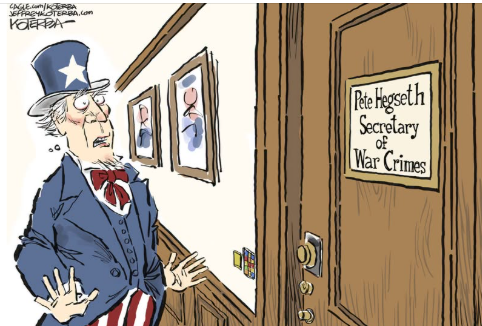 In a better world, the International Criminal Court would have much greater power to prosecute war crimes.
Today, winding up at The Hague requires terrible luck, and it’s virtually impossible to happen to a Donald Trump or a Pete Hegseth, given the enormous military might that the United States possesses.
Contrast this to what happened to Slobodan Milošević, who was arrested when his countries, Yugoslavia and Serbia, were overthrown.
 The prediction made here is nearly certain to come true.
The question is what happens at the point. E.g., how long does it take to rebuild trade deals and relationships with allies?
Keep in mind that regardless of the manner in which Trump loses power, there will always be “news” outlets like Fox and Newsmax, trying their best to convince the idiots that Trump was hounded and persecuted by the communists who hate America.
 All I can say about the me here is that personally I refused, against considerable pressure from my family, to indoctrinate my children into something I myself could not accept.
Is it actually “psychological abuse” to indoctrinate children into monotheistic religion? Whether to take it that far is an open question.
My parents, both atheists, sent my brother and me to Sunday School, as they thought it wrong to cut us off from a modality of growing up in America in the early 1960s. I don’t blame them, but again, it’s not something I was willing to replicate with my own children.



