A new global rainforest fund, unveiled by Brazil at COP30, will likely struggle to meet its initial funding target this year, after the UK failed to announce an expected pledge during London Climate Action Week and other donors have been slow to come on board.
The Tropical Forest Forever Facility (TFFF) was launched on the sidelines of last November’s UN climate summit as an innovative mechanism to fund rainforest protection. Instead of relying on grants, it seeks to raise public and private money, invest it in financial markets, and then pay rainforest countries a share of the returns.
The facility has so far raised $6.8 billion but needs to mobilise at least $10 billion by the end of 2026, under conditions set by Norway to unlock its pledge. If the fund falls short of this goal, the Norwegian contribution of up to $3 billion in loans over 10 years will not be disbursed.
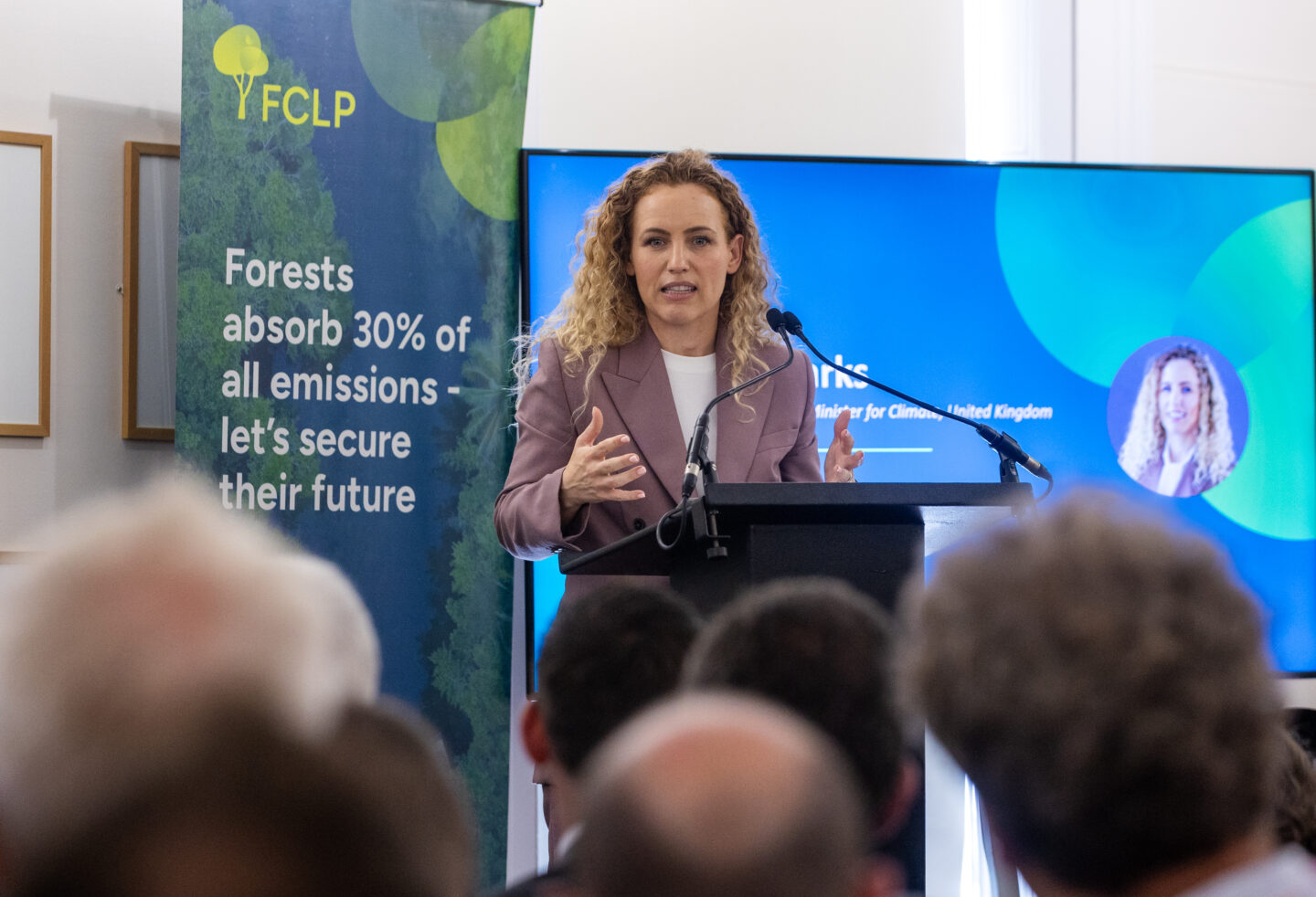
At a gathering of ministers from rainforest-rich countries at London’s Kew Botanic Gardens last Tuesday in searing heat, UK climate minister Katie White praised the TFFF and said she had held a “robust conversation in government over the last few weeks” about the importance of forests and climate action.
She had argued, she said, that “this is not a nice to have – this is absolutely vital for our security and our prosperity”. She told the small crowd of visiting ministers, officials and forest campaigners at Kew that the TFFF was an “innovative and impactful development”.
But despite climate campaigners’ hopes, the British minister did not follow Norway, Germany, France, Brazil, Indonesia and Luxembourg in pledging to the fund, whose aim is to use returns on the capital it invests in bond markets to financially reward countries who keep their tropical forests standing.
Ed Davey, UK lead for the World Resources Institute who was in the room for White’s speech, told Climate Home News afterwards that as the UK was involved in inventing the idea and the British public care about rainforests, it is “incredibly important” that the government invests in the TFFF “as soon as possible”.
“The TFFF is at a very important stage of its gestation, and if a few other critically important sovereign governments don’t come on board quite soon, there is a risk that the idea will lose momentum,” he said.
Anders Haug Larsen, advocacy director for the Rainforest Foundation Norway, was also disappointed at the lack of a British pledge during London Climate Action Week (LCAW).
The UK government’s money and its power to mobilise private sector investment are crucial to the TFFF’s success, he said, adding that “saving tropical rainforest is a key component in solving climate change and preserving life on this planet”.
Political divisions?
British newspaper The Times later reported that White’s boss – energy and climate minister Ed Miliband – had been poised to announce a £400-million ($528m) investment pledge to the TFFF but had been opposed by UK finance minister Rachel Reeves.
According to The Times, Reeves was concerned an announcement would be unpopular, as the government was being criticised by its former defence minister for not spending enough on the military, and had pushed for the announcement to be shelved.
Climate Home News understands, however, that the UK Treasury had given the climate ministry approval to tell Brazil and Norway it would invest in the TFFF, but the administrative procedures needed to make the pledge had not been completed in time to announce a contribution during LCAW.

The UK has been cutting the amount it spends on foreign aid, including on climate projects, in order to deliver what its foreign minister called “the biggest increase in defence spending since the Cold War”.
Projects affected include rainforest protection schemes like the Congo Basin Forest Action Programme, which has had its budget slashed by nearly 80%.
Despite these moves to shrink overseas assistance, defence secretary John Healey resigned a few weeks ago, calling for even more spending for his department.
Last Monday, the first day of LCAW, British Prime Minister Keir Starmer announced he would soon resign following bad local election results, with his fellow Labour parliamentarian Andy Burnham highly likely to replace him by the end of July. Reeves is looks set to be replaced as finance minister, with Miliband reportedly a leading candidate to succeed her.
Norwegian test looms
If the UK does not invest in the TFFF by the end of the year, along with other government donors, the initiative’s chances of reversing the destruction of tropical forests will be diminished, experts say.
With the US under Donald Trump unlikely to pledge and the two biggest European Union nations France and Germany already having done so, forest campaigners were hoping that the UK could fill some of the roughly $3.2 billion in new pledges needed to meet the minimum goal set by Norway.
Asked by Climate Home News if France would increase its $0.6 billion pledge, its minister for international partnerships Eleonore Caroit said last week, “I don’t have any specific information of any increase.” She added that France supports the TFFF but is also “focusing on other similar projects to achieve the same results”.
The Brazilian finance ministry has courted investments into the fund from Japan, South Korea and China. Last Friday, Brazilian finance minister Dario Durigan met Chinese finance minister Lan Fo’an and afterwards told Valor Econômico that he had raised the possibility of an investment in the TFFF.
“I think today, for the first time, China gave a stronger, firmer indication that it understands the TFFF model and is comfortable with it,” Durigan was quoted as saying. “There has been a positive signal,” he added. “Now we will work with his team to turn that into concrete commitments.”
Larsen of the Rainforest Foundation Norway said there is also hope that Middle Eastern countries, more European nations and the European Union could contribute. The UAE has expressed interest in the fund, and has provided technical assistance for its development.
Following a recent investor retreat in Rotterdam attended by government officials and private investors, a group of 12 financial institutions – including UK-based Ashmore Group and Dutch firm Robeco – endorsed the fund as an “opportunity to support the protection of up to a billion hectares of tropical forests”.
They added that the fund’s seed capital from governments is “building momentum” and that the TFFF has put in place a “robust institutional governance” that can deliver results in the long term.
Economic value for standing forests
Details of how the TFFF will work are being finalised in an attempt to encourage investment.
Earlier this month, it was announced that its investment arm (the Tropical Forest Investment Fund – TFIF) would be based in Luxembourg. The European financial hub said it will provide €50 million ($57m) to the TFIF through its Climate and Energy Fund between 2026 and 2030, after which it will “maintain a long-term annual contribution”.
The Norwegian government has tasked a veteran of its sovereign wealth fund, Knut N. Kjaer, with reviewing the TFFF’s financial model.
At Kew Gardens last week, the head of the Brazilian forest service Garo Batmanian said the TFFF and other measures are needed so that standing forests are economically valued and therefore protected.
“There is no chainsaw-wielding maniac out there cutting down trees out of pleasure,” he said. “He’s cutting down trees because he thinks he can get more money using the land for something else, so it’s not only about stopping deforestation but also promoting that the standing forest has value.”
The post Tropical forest protection fund at risk after UK stalls on pledge appeared first on Climate Home News.
Tropical forest protection fund at risk after UK stalls on pledge
Climate Change
28 quotes from new UK leader Andy Burnham on climate, net-zero and fossil fuels
The UK’s new prime minister Andy Burnham remained tight-lipped on his views on climate change during his leadership campaign.
When asked his views on allowing new North Sea drilling in June – a move that the oil-and-gas industry and right-wing media have pushed for in recent months – he said he had “something of an open mind” on the issue.
But a trawl of Burnham’s past comments about climate change, net-zero and fossil fuels reveals a different picture.
Just a year ago in June 2025, Burnham, while mayor of Greater Manchester, gave his support to the fossil fuel treaty – a proposed international pact on phasing out coal, oil and gas – calling it a “lifeline” that “all governments” should join.
In a video message endorsing the treaty, he also said that “there should be no turning away from net-zero”.
During his last bid to be Labour leader in 2015, he used similar language, saying:
“Labour under my leadership will never turn our back on either our duty to tackle climate change or the prospects offered by the green economy.”
Burnham has spoken about the threat of climate change since at least 2008, noting in 2021 that accelerated action could “create thousands of good jobs”, but also warning that net-zero risked becoming the “next Brexit”.
Burnham is yet to appoint his cabinet, but there is much speculation that he will select current net-zero secretary Ed Miliband as his chancellor – with their ally Miatta Fahnbulleh having a “strong chance” of taking Miliband’s former position.
Below, Carbon Brief recounts 28 things that Burnham has said about climate change, net-zero, fossil fuels, energy and transport.
Climate change
“Tackling climate change isn’t just about protecting the planet – it’s a powerful opportunity to build a fairer, greener future for our communities and businesses.”
Calling for local councils to be given more power and money for climate action, 29 November 2025
“There is little doubt that Greater Manchester’s biodiversity has taken a hit over the years, with habitats being lost, destroyed and becoming less diverse due to the impact of development, climate change, pollution and invasive species…We are committed to delivering a city-region for all residents to enjoy – a fairer, greener and more prosperous place for everyone.”
Statement after Greater Manchester declared a “biodiversity emergency”, 25 March 2022
“Over the next decade, if we accelerate our response to the climate crisis, we can create thousands of good jobs, improve homes, overhaul our transport system and make [Manchester] an even better place to live.”
Greater Manchester Green Summit, 18 October 2021
“The environment has never been higher on the national and international agenda.”
Statement after visiting a peat bog restoration project in England, 9 January 2020

“I think climate change [action] will be driven more quickly from the bottom up, if I’m honest. It’s the will of evolution if you wait for the government to act…When governments aren’t listening you get out and get your voice heard…so I think [climate protesters] deserve our encouragement, not our criticism.”
Speaking to Manchester Evening News at a student climate protest in Manchester, 24 May 2019
“Labour under my leadership will never turn our back on either our duty to tackle climate change or the prospects offered by the green economy.”
Labour leadership candidate speech, 15 July 2015
“Climate change can seem a distant, impersonal threat – in fact the associated costs to health are a very real and present danger…We need well-designed climate change policies that drive health benefits.”
Speaking to the Guardian about a study on climate and health, 25 November 2009
“The Stern report on the economics of climate change has changed the debate, in this country and around the world. It made it clear that the people who could suffer most from a failure to tackle climate change, or from a lack of ambition in our approach to it, are those living in the developing countries. They are the most vulnerable…[and] Stern said that the cost of not acting would be large. That is why the government took various measures in the recent spending review to ensure that we are prepared to face the challenges posed by climate change.”
Speaking in the UK parliament on the economic impacts of climate change on his final day as chief secretary to the Treasury, 24 January 2008
Net-zero
“There should be no turning away from net-zero.”
Speaking after giving his support to the fossil fuel treaty – a proposed global pact to introduce laws to phase out coal, oil and gas – on behalf of Manchester, 6 June 2025

“An opportunity is opening up for Britain as other countries move away from net-zero. We should seize that…We can make Britain a green leader. This is not the time to tiptoe, it is the time to commit to this path.”
Speaking at Innovation Zero World Congress in London, 29 April 2025
“[We] need a government that fully buys into the 2038 vision because the UK will not get to 2050 unless places like Greater Manchester are freed up to go faster – and we’re ready to go faster.”
Speaking about Greater Manchester’s aim to reach net-zero by 2038, 19 October 2022
“In Greater Manchester we have plans to build 30,000 net-zero social rented homes because we recognise that a successful city region needs good quality, affordable accommodation for everyone.”
Speech on the future of cities, 24 June 2022
“By building a broad consensus behind the drive to net-zero, we can ensure that the transition is a fair one that delivers social justice as well as climate justice. This is an opportunity for all of us to show how cutting carbon emissions in our cities can make a real difference to our communities – away from the abstractions and rooted in the real world.”
Panel discussion in Glasgow during the COP26 climate summit, 12 November 2021
“To the extent that people have picked up anything from COP26, it’s a sense that the drive to net-zero will mean cost and inconvenience for ordinary people and offsetting for the wealthy and entitled. All of a sudden, you can feel how net-zero could become the new Brexit – a debate that gets very divided on class grounds…This has got to be a wake-up call. We cannot let this happen. We need to act now to build a broad social consensus behind the drive to net-zero. How to do that? It starts with taking control of the climate narrative from those steering it in the wrong direction and turning it around…We must show how, if done in the right way, the drive to net-zero is actually an opportunity to reduce the cost of living; to make people’s lives better and society fairer.”
Writing for the London Standard, 5 November 2021

“The drive to net-zero is a chance to re-industrialise the north of England, this time in a clean way. Create really good jobs, future-facing jobs for people, better public transport, improve people’s homes…If we go quickly towards net-zero, it’s the quickest way to level up the country.”
ITV interview at COP26, 1 November 2021
“If we really embrace the drive to net-zero, that is the route to level up the country…But it needs substantial investment, upfront, now, of the kind that Rachel Reeves, shadow chancellor [and chancellor under Keir Starmer’s government], has been talking about. We need long-term predictable funding.”
Interview with GB News at COP26, 1 November 2021
“I would have preferred to hear slightly less about carbonated wine and much more about a decarbonised economy.”
Referencing a UK budget, which included tax cuts for sparkling wine and other drinks, 28 October 2021
“Decarbonising is not just about lowering costs on to people. It’s the route to get better, cheaper public transport. It’s the route to getting homes that are cheap to run. It’s actually the way we can create thousands of good jobs for the people who live in Greater Manchester. This is the route to levelling up the country by going further and faster on decarbonisation.”
Speaking to Manchester Confidential, 20 October 2021
“[I am] asking people to stop seeing the environmental agenda as a cost and a burden agenda. I think this is a barrier that we’ve got to get over. Already in the media interviews I’ve done today, people are saying ‘can you afford it?’, ‘can it be achievable when times are tough?’.
“My answer to that is, at some point in the 21st century, all homes will be zero-carbon. At some point in this century, all buildings of any kind will be zero-carbon…All cars will be zero-carbon, all public transport will be zero-carbon…The question is: when? And surely the places that embrace those things first are putting themselves in a position of economic strength when it comes to facing up to the future. Rather than seeing the whole agenda as a burden, we’ve got to see it for the benefits that it can bring.
“There may be a greater upfront cost in a zero-carbon home, but let’s stop thinking, as we tend to do in Britain, of the short-term, the short-termist approach to life. Surely let’s start talking to the public about the lifetime cost.”
Greater Manchester Green Summit, 21 March 2018
Fossil fuels
“I’ve got something of an open mind, you know. I don’t have a sort of fixed position.”
Speaking on the issue of new North Sea oil and gas in a New Statesman interview, 3 June 2026
“We would fight this in GM [Greater Manchester]…Communities across the north would face all the danger and disruption while big oil and gas walk away with all the profits.”
In response to Reform’s call for fracking, on X, 25 August 2025

“I am proud to endorse the fossil-fuel treaty proposal today on behalf of Greater Manchester. It’s not just a plan – it’s a lifeline. It’s a call to end coal, oil and gas, hold polluters accountable…I urge all governments, nationals and subnationals to join this fight.”
Statement upon endorsing the fossil-fuel treaty, 5 June 2025

“Fracking is the past, it is not the future.”
Speech at London climate protest, 20 September 2019
“I have called for a moratorium on fracking. Far too many potential risks and unanswered questions.”
On X, 22 June 2015

Energy and transport
“What I would do, if successful, is lay out a plan for more public control over water, energy, transport, so that over the period we can get those bills down, fares down, and give people and give businesses breathing space.”
LBC interview, 2 July 2026
“I am all in favour of tough decisions at a national level. I don’t believe there should be a third runway at Heathrow, for instance. But I think those are decisions for national government.”
Guardian interview, 13 June 2019
“There is a debate to be had about aviation, isn’t there? There are changing public attitudes about aviation. Rather than just saying no to people flying, don’t we need to accelerate research into low and zero-carbon forms of aviation?”
Guardian interview, 13 June 2019
“Today, I stand alongside the mayors of some of the greatest cities in the world. I’m committed to a cleaner, greener and healthier future for Greater Manchester. Around a third of greenhouse gas emissions in our city-region come from transport.”
When signing the C40 Fossil-Fuel-Free Streets Declaration, which includes support for zero-emissions vehicles and walking and cycling, on behalf of Manchester, 14 September 2018
This article was updated on 20 July to reflect Burnham replacing Keir Starmer as UK prime minister.
UK withdraws millions in funding from world’s second-largest rainforest in Congo
Analysis: UK newspapers have already printed 63 editorials in 2026 backing North Sea drilling
Livestock heat deaths in transit doubled in UK record-hot summer of 2025
Analysis: UK sales of electric vehicles just overtook petrol cars for the first time
The post 28 quotes from new UK leader Andy Burnham on climate, net-zero and fossil fuels appeared first on Carbon Brief.
28 quotes from new UK leader Andy Burnham on climate, net-zero and fossil fuels
Climate Change
Greenpeace welcomes dismissal of Woodside’s anti-democratic “SLAPP suit” against climate campaigners
SYDNEY, Thursday 23 July 2026 — Greenpeace Australia Pacific has welcomed news that a ‘fishing expedition’ brought by Woodside in connection with a 2023 climate protest has been dismissed in full, celebrating it as a win for the community in their ongoing fight to stop Woodside from drilling for oil and gas at Scott Reef.
The Supreme Court of Western Australia today threw out Woodside’s case, finding it had not succeeded in establishing it might have a cause of action against an unknown party involved in a three-year-old protest to bring attention to the harmful effects of Woodside’s gas expansion on climate and cultural heritage.
It comes as public opposition to Woodside’s plans to drill over 50 gas wells at Scott Reef continues to mount.
David Ritter, CEO at Greenpeace Australia Pacific, said: “Greenpeace welcomes the news that this case has been dismissed. Woodside’s use of a SLAPP* suit of this kind is a grotesque attempt to use legal tactics to silence people. There should be no place for SLAPP suits in Australian democracy.
“Community opposition to Woodside’s dangerous plans to drill over 50 gas wells at Scott Reef is large and growing.
“Woodside’s plan to drill for gas at Scott Reef is breaking hearts in the Australian community. Their plan to drill for gas at the pristine, magnificent Scott Reef, risking precious marine wildlife like turtles and whales, oceans and the climate, is a disaster waiting to happen, and one that over half a million Australians are calling on the WA and Federal governments to stop.”
-ENDS-
Notes for editor
A petition calling on the federal and WA governments to save Scott Reef has more than 552,000 signatures.
*SLAPP stands for “Strategic Lawsuit Against Public Participation”. It is a legal tactic used by powerful corporations, particularly within the fossil fuel industry, to censor, intimidate, and silence critics by burdening them with the high costs of a legal defense until they abandon their environmental advocacy or protests.
Media contact
Lucy Keller on +61 491 135 308 or lucy.keller@greenpeace.org
Kimberley Bernard on +61 407 581 404 or kbenard@greenpeace.org
Greenpeace welcomes dismissal of Woodside’s anti-democratic “SLAPP suit” against climate campaigners
Climate Change
Will new UK PM’s green measures at home cause climate finance pain overseas?
Britain’s new prime minister announced in his first week that he will cut the cost of public transport and electricity, making lower-emission technologies like bus travel, electric vehicles and heat pumps more affordable for voters. But some of the funding for those policies will come from the budget for international climate finance, the government has said, raising concerns about fairness.
Former Manchester Mayor Andy Burnham took over from Keir Starmer as Labour Party leader and prime minister on Monday, appointing climate advocates Ed Miliband as foreign and development minister and Miatta Fahnbulleh as climate and energy minister.
On Tuesday, Burnham said his government would cut the value added tax (VAT) households and some small businesses pay on their electricity bills from 5% to zero from October 1, saving households £45 ($60) a year.
On Wednesday, he said the maximum fare bus companies in England can charge for a single journey will be reduced from £3 ($4) to £2 ($2.67) from January 1, 2027. The government said the subsidies to achieve this would be mostly funded by switching money set aside for overseas climate finance projects from grants to loans. It did not give further information in its announcement, while the UK’s transport minister told Sky News the plan is still being worked out.
The floated changes to the climate finance budget were immediately criticised by groups working on climate justice for developing countries, including Bond, the UK network for NGOs, which described the decision as “disappointing”.
“Robbing Peter to pay Paul is not the answer and pitches marginalised communities in the UK against marginalised communities in lower-income and climate-vulnerable countries,” BOND CEO Romilly Greenhill said in a statement. “Climate finance must not worsen the debt burden of countries that are already suffering the worst – and most costly – impacts of a climate crisis they did not cause.”
Hunt for money
Burnham promoted both policies as measures to combat the rising cost of living and “give people breathing space”, with climate campaigners and industry groups noting they are also likely to reduce the UK’s climate-heating emissions by encouraging bus travel and the use of electric vehicles and heating.
But thorny questions remain over how the policies will be paid for. The government said Tuesday’s VAT cut for electricity would be funded by scrapping the previous government’s digital ID programme, but Darren Jones, a former minister involved with that policy, said it had been “unfunded” – a statement that dominated media coverage.
A day later, the government said the new bus fare cap would cost £454 million ($606m). Transport minister Heidi Alexander told Sky News that £54 million would be taken from an under-spend in the budget of the Department for Energy Security and Net Zero (DESNZ) and £400 million would come from changing unspecified international climate finance from grants to loans. The details “still need to be worked through”, she said, adding that the government “had wanted to make an announcement today”.
Mohamed Adow, director of Nairobi-based think-tank Power Shift Africa, said “climate finance was never meant to be a pot of money that governments raid when they need to pay for domestic spending”.
DESNZ had not responded to a request for comment at the time of publication. “We’re not wanting to fleece anyone here, and we actually want to maximise the development potential of this money that is available,” minister Alexander said in her TV interview.

Aside from the controversy over their funding, the policies themselves were widely welcomed by climate campaigners. Jess Ralston, energy lead at the Energy and Climate Intelligence Unit (ECIU), said the tax cut on electricity bills “could help households to switch to electric heat pumps, protecting UK homes from becoming ever more exposed to the whims of Putin and Trump when turning on their gas boiler”.
The last few months have seen global momentum build behind electrification, spurred by the US-Iran war disrupting oil and gas supplies and driving up prices. The Turkish and Australian COP31 presidencies have announced a global target to boost electrification, backed by the European Union, Canada, Philippines, UK and others.
Campaigners call for lower power prices
While reaction to the VAT cut was supportive, some questioned whether £45 a year of savings per household is enough and called for more measures to cut electricity bills.
Friends of the Earth’s energy lead Imogen Dow said those on the lowest incomes should be given cheaper electricity through a “social tariff” and the Institute for Public Policy Research (IPPR) think-tank – which is close to the Labour Party – said levies on energy bills should be shifted to general taxation.
Matthew Paterson, a politics professor at Manchester University, told Climate Home News that the most effective way to reduce electricity bills is to take on the UK’s private electricity companies, while consumer-oriented measures like the VAT cut are “tinkering around the edges”.
Jarrod Birch, head of policy and public affairs for the EV charging industry association Charge UK, said that while the policy would make home-charging cheaper, people who charge their vehicles at public points will still have to pay 20% VAT. The UK’s tax authority is fighting a court ruling that ordered it to reduce the tax motorists pay on public chargers to the current household rate of 5%.
Further measures will be the responsibility of Secretary of State for Energy Security and Net Zero Miatta Fahnbulleh, who is relatively new to politics after a career at left-wing, pro-climate think tanks the IPPR and the New Economics Foundation.

Michael Jacobs, political economy professor at Sheffield University and former adviser to UK Labour prime minister Gordon Brown, said Fahnbulleh would be a “climate advocate” who would continue the “progressive climate agenda” of her predecessor Ed Miliband.
“She’s a very creative policy wonk so I expect there to be lots of policy innovation under her,” he said, “I think she will be looking at new ways to encourage take-up of heat pumps and domestic batteries.”
Aid budget in Miliband’s hands
Despite reports he could be made finance minister, Miliband has been appointed Secretary of State for Foreign and Commonwealth Affairs. Miliband has attended many climate COP meetings over several decades, most recently representing the UK at COP29 and COP30, and has been targeted by the right-wing media for his support for climate action and opposition to new oil and gas drilling in the UK’s part of the North Sea.
In his new role, Miliband will be responsible for the UK’s overseas aid budget including its international climate finance, which the Starmer government had slashed to fund increases in defence spending.
UK cuts support for climate action abroad to fund military instead
Jacobs said he expected Miliband to prioritise climate and development in the UK’s foreign policy and to push Burnham and new finance minister John Healey to reverse Starmer’s aid cuts.
But there are fears Healey could try to cut the aid budget further to fund the military. Healey was a surprise pick for Chancellor of the Exchequer and grabbed headlines when he resigned as Starmer’s defence minister in June over what he saw as insufficient defence spending.
The post Will new UK PM’s green measures at home cause climate finance pain overseas? appeared first on Climate Home News.
Will new UK PM’s green measures at home cause climate finance pain overseas?
-
Climate Change12 months ago
Guest post: Why China is still building new coal – and when it might stop
-
Greenhouse Gases12 months ago
Guest post: Why China is still building new coal – and when it might stop
-
Greenhouse Gases2 years ago嘉宾来稿:满足中国增长的用电需求 光伏加储能“比新建煤电更实惠”
-
Climate Change2 years ago嘉宾来稿:满足中国增长的用电需求 光伏加储能“比新建煤电更实惠”
-
Climate Change2 years ago
Bill Discounting Climate Change in Florida’s Energy Policy Awaits DeSantis’ Approval
-
Renewable Energy9 months agoSending Progressive Philanthropist George Soros to Prison?
-
Carbon Footprint2 years agoUS SEC’s Climate Disclosure Rules Spur Renewed Interest in Carbon Credits
-
Greenhouse Gases1 year ago
嘉宾来稿:探究火山喷发如何影响气候预测