Connect with us

Published

on

Alejandro Álvarez Iragorry is a Venezuelan ecologist and coordinator of Clima 21, an environmental NGO. Cat Rainsford is a transition minerals investigator for Global Witness and former Venezuela analyst for a Latin American think tank.

In 1975, former Venezuelan oil minister Juan Pablo Pérez Alfonzo gave a now infamous warning.

“Oil will bring us ruin,” he declared. “It is the devil’s excrement. We are drowning in the devil’s excrement.”

At the time, his words seemed excessively gloomy to many Venezuelans. The country was in a period of rapid modernisation, fuelled by its booming oil economy. Caracas was a thriving cultural hotspot. Everything seemed good. But history proved Pérez right.

Over the following decades, Venezuela’s oil dependence came to seem like a curse. After the 1980s oil price crash, political turmoil paved the way for the election of populist Hugo Chávez, who built a socialist state on oil money, only for falling prices and corruption to drive it into ruin.

    By 2025, poverty and growing repression under Chávez’s successor Nicolás Maduro had forced nearly 8 million Venezuelans to leave the country.

    Venezuela is now at a crossroads. Since the US abducted Maduro on January 3 and seized control of the country’s oil revenues in a nakedly imperial act, all attention has been on getting the country’s dilapidated oil infrastructure pumping again.

    But Venezuelans deserve more than plunder and fighting over a planet-wrecking resource that has fostered chronic instability and dispossession. Right now, 80% of Venezuelans live below the poverty line. Venezuelans are desperate for jobs, income and change. 

    Real change, though, won’t come through more oil dependency or profiteering by foreign elites. Instead, it is renewable energy that offers a pathway forward, towards sovereignty, stability and peace.

    Guri Dam and Venezuela’s hydropower decline

    Venezuela boasts some of the strongest potential for renewable energy generation in the region. Two-thirds of the country’s own electricity comes from hydropower, mostly from the massive Guri Dam in the southern state of Bolívar. This is one of the largest dams in Latin America with a capacity of over 10 gigawatts, even providing power to parts of Colombia and Brazil.

    Guri has become another symbol of Venezuela’s mismanagement. Lack of diversification caused over-reliance on Guri for domestic power, making the system vulnerable to droughts. Poor maintenance reduced Guri’s capacity and planned supporting projects such as the Tocoma Dam were bled dry by corruption. The country was left plagued by blackouts and increasingly turned to dirty thermoelectric plants and petrol generators for power.

    Today, industry analysis suggests that Venezuela is producing at about 30% of its hydropower capacity. Rehabilitating this neglected infrastructure could re-establish clean power as the backbone of domestic industry, while the country’s abundant river system offers numerous opportunities for smaller, sustainable hydro projects that promote rural electrification.

    A fisherman walks down the coast from the Paraguana Refining Center (CRP) following a crude spill in September from a pipeline that connects production areas with the state-run PDVSA’s largest refinery, in Punta Cardon, Venezuela October 2, 2021. Picture taken October 2, 2021. REUTERS/Leonardo Fernandez Viloria

    A fisherman walks down the coast from the Paraguana Refining Center (CRP) following a crude spill in September from a pipeline that connects production areas with the state-run PDVSA’s largest refinery, in Punta Cardon, Venezuela October 2, 2021. Picture taken October 2, 2021. REUTERS/Leonardo Fernandez Viloria

    Venezuela also has huge, untapped promise in wind power that could provide vital diversification from hydropower. The coastal states of Zulia and Falcón boast wind speeds in the ideal range for electricity generation, with potential to add up to 12 gigawatts to the grid. Yet planned projects in both states have stalled, leaving abandoned turbines rusting in fields and millions of dollars unaccounted for.

    Solar power is more neglected. One announced solar plant on the island of Los Roques remains non-functional a decade later, and a Chávez-era programme to supply solar panels to rural households ground to a halt when oil prices fell. Yet nearly a fifth of the country receives levels of solar radiation that rival leading regions such as northern Chile.

    Developing Venezuela’s renewables potential would be a massive undertaking. Investment would be needed, local concerns around a just and equitable transition would have to be navigated and infrastructure development carefully managed.

    Rebuilding Venezuela with a climate-driven energy transition 

    A shift in political vision would be needed to ensure that Venezuela’s renewable energy was not used to simply free up more oil for export, as in the past, but to power a diversified domestic economy free from oil-driven cycles of boom and bust.

    Ultimately, these decisions must be taken by democratically elected leaders. But to date, no timeline for elections has been set, and Venezuela’s future hangs in the balance. Supporting the country to make this shift is in all of our interests.

    What’s clear is that Venezuela’s energy future should not lie in oil. Fossil fuel majors have not leapt to commit the estimated $100 billion needed to revitalise the sector, with ExxonMobil declaring Venezuela “uninvestable”. The issues are not only political. Venezuela’s heavy, sour crude is expensive to refine, making it dubious whether many projects would reach break-even margins.

    Behind it all looms the spectre of climate change. The world must urgently move away from fossil fuels. Beyond environmental concerns, it’s simply good economics.

    People line up as others charge their phones with a solar panel at a public square in Caracas, Venezuela March 10, 2019. REUTERS/Carlos Garcia Rawlins

    People line up as others charge their phones with a solar panel at a public square in Caracas, Venezuela March 10, 2019. REUTERS/Carlos Garcia Rawlins

    Recent analysis by the International Renewable Energy Agency finds that 91% of new renewable energy projects are now cheaper than their fossil fuel alternatives. China, the world’s leading oil buyer, is among the most rapid adopters.

    Tethering Venezuela’s future to an outdated commodity leaves the country in a lose-lose situation. Either oil demand drops and Venezuela is left with nothing. Or climate change runs rampant, devastating vulnerable communities with coastal loss, flooding, fires and heatwaves. Meanwhile, Venezuela remains locked in the same destructive economic swings that once led to dictatorship and mass emigration. There is another way.

    Venezuelans rightfully demand a political transition, with their own chosen leaders. But to ensure this transition is lasting and stable, Venezuela needs more – it needs an energy transition.

    The post There is hope for Venezuela’s future – and it isn’t based on oil appeared first on Climate Home News.

    There is hope for Venezuela’s future – and it isn’t based on oil

    Continue Reading

    Climate Change

    Climate adaptation helps African nations tackle rising conflict over resources

    Published

    on

    Somali farmers and herders battered by droughts, floods and decades of conflict are starting to get help in the form of climate-smart crops and animals, new wells and restoration of barren landscapes to boost their resilience in a warming world.

    Some of this support is being provided under Ugbaad, the Somali name for a new project meaning “fresh sprouting pasture”. Backed by an $80-million grant from the UN’s Green Climate Fund, it is enabling farmers to earn a more reliable living as climate shocks intensify. The project is also reducing conflict tensions among communities, according to a government representative.

    Abdiaziz Ibrahim Aden, adaptation and resilience lead at Somalia’s Ministry of Environment and Climate Change, said farmers who lost their land to floods and erosion have been able to rehabilitate it and plant crops like banana and sesame for export. “Their productivity is increasing now,” he told Climate Home News.

    He said the project, which aims to benefit over 2 million people in total, has made young people less vulnerable to recruitment by armed groups. Beyond improved water access for pastoralists, the initiative also includes ways to disseminate timely climate information to communities and build government capacity to keep land and ecosystems in better shape.

    Nonetheless, Somalia remains one of the countries most vulnerable to climate change, with millions of its people facing food insecurity, displacement and recurring climate disasters.

    People queue to fill containers with water near displacement camps for people impacted by severe drought on September 3, 2022 in Baidoa, Somalia. (Photo: Ed Ram/Getty Images)

    People queue to fill containers with water near displacement camps for people impacted by severe drought on September 3, 2022 in Baidoa, Somalia. (Photo: Ed Ram/Getty Images)

    Poor rains and major aid shortfalls have forced critical food and nutrition programmes to close, worsening hunger. The Integrated Food Security Phase Classification, a global system used to measure hunger crises, has warned that nearly 2 million Somali children could face acute malnutrition this year.

    Climate change – a threat multiplier

    Somalia’s economy hinges on agriculture and repeated climate shocks continue to inflame tensions related to farming and food production. According to the United Nations Development Programme (UNDP), every two in three conflicts in the country stems from competition over natural resources.

    During drought periods, disputes often flare up among neighbouring communities over scarce water sources as herders move with their livestock in search of boreholes, Haji said.

    Clashes can quickly escalate in Somalia where many herders carry guns for protection, he added. “If two people meet at the water borehole and they fight over that area, then the war prolongs and extends from that zone to other zones,” he explained.

    Aid agencies grapple with climate adaptation in fragile states

    Somalia is not alone. Across conflict-affected parts of Africa, climate change is fast becoming more than just an environmental challenge. From the shrinking of Lake Chad in the Sahel region to devastating floods in South Sudan and prolonged droughts across the Horn of Africa, stronger climate impacts are intensifying competition to maintain livelihoods in regions already struggling with weak governance, displacement and insecurity.

    Alec Crawford, director of nature for resilience at the International Institute for Sustainable Development (IISD), described climate change as a “threat multiplier” that worsens already existing social and economic tensions. “It is a contributing factor to violence and instability and conflict, but it’s not the sole driver,” he emphasised.

    Fragile states coordinate peacebuilding and adaptation

    The growing overlap between climate vulnerability and insecurity is forcing governments and development agencies to rethink adaptation efforts. This was evident at a recent conference in Nigeria that brought together conflict-affected African countries including Burkina Faso, Somalia, Mali, South Sudan, Cameroon, Central African Republic and Chad.

    At the event, governments explored how peacebuilding can be integrated with their national climate adaptation plans, helping prevent conflict in communities facing mounting pressure over fertile land, water and other natural resources.

    For many of these countries, none of the UN’s Sustainable Development Goals will be achieved until peace and security are in place, Crawford said. They are currently trapped in a vicious cycle. “Some of these climate impacts are potentially worsening the conflict dynamics, while at the same time conflict is really getting in the way of reducing vulnerabilities and adapting to climate change,” he explained.

    Politically fragile countries are increasingly looking for solutions to reduce the tensions within their borders that are preventing them from tackling climate change impacts. At the COP28 climate summit in Dubai in 2023, governments and aid agencies issued a joint call for “bolder collective action to build climate resilience at the scale and speed required in highly vulnerable countries and communities”.

    Crawford said many fragile states are overstretched and under-resourced because of conflict. He pointed to South Sudan as an example of a country simultaneously trying to house displaced people, rebuild schools and clinics, and restore basic infrastructure after war, making climate adaptation difficult to prioritise. However, ignoring climate risks could undermine any progress such countries manage to make, he warned.

    UN adaptation metrics exclude conflict

    Another thorny problem is finding ways to track progress on climate adaptation in conflict-affected states. A set of indicators to measure how countries are doing in their efforts to implement the Paris Agreement’s Global Goal on Adaptation (GGA), finally agreed 10 years later at COP30 in Brazil, deliberately left out metrics relating to peace and conflict.

    Katharina Schmidt, policy advisor at the NAP Global Network, a global initiative coordinated by IISD to help developing countries advance their climate adaptation planning, pointed to longstanding reluctance to formally integrate peace and conflict issues into core UN climate frameworks. This, she said, is partly because some countries want climate finance to stay separate from funding for peacebuilding and development.

    However, Schmidt said the absence of specific indicators in the GGA framework does not mean adaptation in fragile and conflict-affected states is being ignored. “Everybody agrees that there needs to be adaptation in [these] states,” she said, even if it is “often not reflected prominently in these negotiation documents”.

    New data shows rich nations likely missed 2025 goal to double adaptation finance

    This is why the NAP Global Network, which organised the recent conference in Abuja, is trying to strengthen coordination and peer learning among conflict-affected countries, helping them overcome some of the barriers that make adaptation planning difficult.

    Many lack the climate data and infrastructure needed to understand and respond to climate risks, in some cases because conflicts destroy weather stations and disrupt climate monitoring systems, Crawford said. To fill these gaps, the network is helping countries tap into existing global systems and open-source data platforms.

    Bridging the gap through the NAP process

    For over a decade, the process for putting together National Adaptation Plans (NAPs), established under the UN climate framework in 2010, has helped countries identify climate vulnerabilities, integrate adaptation into long-term development planning and strengthen resilience to climate impacts.

    Crawford, who also works with the NAP Global Network, said one core pillar is to strengthen governments’ capacity to plan and implement adaptation measures across ministries.

    As part of its NAP process, Somalia conducted vulnerability assessments in several states and regions, helping the government understand how climate impacts, risks and adaptation needs vary across the country, according to government official Aden. This also revealed previously undocumented challenges facing different communities, from drought and water scarcity to coastal threats and land degradation.

    “The NAP project helped Somalia identify some cases that were not known before,” he said, adding that it allowed the government to plan its budget to meet differing regional needs.

    In May 2026, Nigeria brought together African government representatives for a dialogue on strengthening national responses to their unique climate change vulnerabilities and risks, and identifying adaptation measures that reduce conflict and actively promote peace. (Photos: Jeremiah Ekpo)

    In May 2026, Nigeria brought together African government representatives for a dialogue on strengthening national responses to their unique climate change vulnerabilities and risks, and identifying adaptation measures that reduce conflict and actively promote peace. (Photos: Jeremiah Ekpo)

    More than 6,000 kilometres away, the Liberian government, through its NAP process, is also identifying potential sources of tension around land rights, tenure and resource distribution, particularly as people fleeing conflict in Burkina Faso cross into Liberia through Ivory Coast.

    Arthur Becker, Liberia’s NAP coordinator, said Liberia’s ongoing NAP review process will incorporate peacebuilding considerations that were largely absent from its current 2020-2030 adaptation plan.

    The NAP process aims to help countries move beyond short-term responses to climate disasters, Crawford said.

    “It’s really about looking to the medium and long term and saying, this is how the climate is changing within our country, this is going to have fundamental impacts on our development trajectory – how do we put adaptation to climate change at the heart of that development trajectory?”

    Nigeria addresses conflict and climate risks together

    Nigeria, which is already grappling with multiple security challenges linked to resource competition and environmental pressures, is also integrating peacebuilding into its NAP.

    A climate risk and vulnerability assessment found that factors such as drought and desertification across northern Nigeria have made food less available and encouraged criminality and banditry. Down south, sea level rise, coastal erosion and flooding are destroying livelihoods and property and displacing people. Those impacts are increasingly fuelling tensions between communities and driving protests over environmental injustice.

    Nigeria’s deadly flood exposes urgent need for climate adaptation plan

    Kayode Aboyeji, Nigeria’s NAP coordinator, said it was in the course of the NAP process that “we realised that some of the conflicts in Nigeria are not just politically driven but that environmental issues, demand for natural resources, [and the] threat of climate change are some of the triggers.”

    He said Nigeria has now integrated conflict sensitivity and peacebuilding into its NAP – which has yet to be formally approved and published – recognising the need for climate responses that do not worsen existing tensions. It is also raising awareness among key actors, including the Ministry of Agriculture and Water Resources, around the importance of adopting conflict-sensitive approaches to climate adaptation.

    In addition, Nigeria has developed adaptation strategies tailored to each of its geopolitical zones, which local authorities can use to better address climate-related challenges in their regions.

    Finance a major barrier to implementation

    While countries are increasingly integrating peacebuilding into their climate adaptation planning, financing such work on the ground remains a major challenge, especially for fragile African states already grappling with insecurity, debt and weak public finances.

    Nigeria’s Aboyeji said the country’s NAP requires resources to roll it out across the country. While the government is looking to development bodies, philanthropies and the private sector for support, it is also exploring domestic financing mechanisms such as green bonds and budget appropriations to help fund implementation.

    For countries like South Sudan – where ongoing instability continues to undermine the government’s ability to finance adaptation measures – the struggle is even more pronounced. Peter Jonglei Kureng, acting deputy director for its Budget Policy Directorate, said the government tries to include adaptation in national budgets, but implementation often stalls because the promised funds are never released.

    “We can budget for it, but when it’s time for execution, there is no money,” he said.

    Can climate funders overcome fear to tread in conflict zones?

    Liberia faces similar constraints. Becker said adaptation interventions are expensive, and the country is committing domestic resources to climate action even while expecting the bulk of financing to come from international partners.

    The financing gap remains one of the biggest hurdles to adaptation efforts. New OECD data shows that wealthy nations are likely to have missed their 2025 goal of doubling adaptation finance for developing countries, with funding reaching just under $35 billion in 2024 – far below estimated needs.

    While international support remains non-negotiable and should be increased, especially for fragile countries, Crawford said they cannot rely solely on external funding, especially as many donors are cutting their overseas development assistance.

    Governments will also need to explore how to harness more domestic resources, while recognising the role private-sector actors can play, he added.

    “Advocating for more of that financing flowing into adaptation is going to be crucial, because after all the work that goes into NAPs, it’s essential that they turn into concrete measures and don’t just gather dust on a shelf,” he said.

    The post Climate adaptation helps African nations tackle rising conflict over resources appeared first on Climate Home News.

    Climate adaptation helps African nations tackle rising conflict over resources

    Continue Reading

    Climate Change

    Threads of Earth’s Underground Fungal Networks Are Long Enough to Reach Beyond the Solar System

    Published

    on

    For the first time ever, researchers have quantified the length and mass of arbuscular mycorrhizal fungal networks globally and mapped the ecosystems where they are densest.

    Hidden underground around the world lie 110 quadrillion kilometers of arbuscular mycorrhizal fungal networks—webs of ultra-thin threads that, if connected in a single line, would stretch almost a billion times thge distance between the Earth and the sun, according to new research published in Science on Thursday. 

    Threads of Earth’s Underground Fungal Networks Are Long Enough to Reach Beyond the Solar System

    Continue Reading

    Climate Change

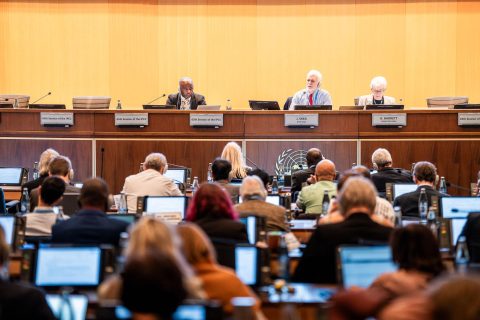
    Fewer journalists register for Bonn talks, as cuts to climate reporting bite

    Published

    on

    The number of journalists registered to attend the annual climate negotiations in Bonn has declined this year, as climate reporters have been let go and media coverage of climate issues falls around the world.

    Data from UN Climate Change, which runs the two weeks of talks, shows that just 135 media representatives have signed up to attend. Climate Home News analysis of previous data shows this is the lowest figure since 2021, when COVID-19 restrictions limited travel and the Bonn talks were held in a hybrid format to enable online participation.

    The number of journalists that actually attend the talks will not be known until later this month but is typically significantly less than are registered. Press conferences, held back-to-back each day by campaign groups, have been sparsely attended in the first few days and often filled mainly with climate campaigners and researchers rather than journalists.

    Alexandra Endres, a reporter for German-language website Table Briefings, told Climate Home News in Bonn there are fewer German journalists covering the conference in-person. “I think it is important to have more journalists covering the negotiations because when the climate coverage increases, the interest of the public grows,” she said.

    Media outlets that have registered fewer journalists than previous years, or no journalists, include global heavyweights like Reuters, Bloomberg and the BBC, as well as German outlets like Deutsche Welle and ZDF television, and specialist publications like business information service Argus and climate broadcaster We Don’t Have Time.

    Activist Harjeet Singh, who is in Bonn advising the Fossil Fuel Treaty Initiative, said that “the empty press seats here in Bonn are a warning signal. While the world’s gaze is often fixed on the annual COP summits, the real-world consequences of the climate crisis—from financing the fossil fuel transition to protecting vulnerable populations—are being shaped, or ignored, in these mid-year negotiations right now.”

    “Journalists are the essential eyes and ears of the public,” he said. “We need them to shine a light on these rooms: hold negotiators accountable, defend the principles of equity and historical responsibility, and ensure that ‘technical’ negotiations do not become an excuse for delay.”

    UN Climate Change said they could not comment on the situation at this point in the Bonn talks.

    Climate coverage is falling

    Outside of Bonn and the official UN climate negotiations, coverage of climate change is falling to lows not seen since the start of the COVID-19 pandemic, according to analysis of newspapers and television reporting conducted by the Media and Climate Change Observatory (MECCO).

    MECCO’s head Max Boykoff told Climate Home News that climate coverage in the first five months of 2025 was 35% down on the same period of 2025 and 41% less than in 2021. New analysis by the Yale Programme on Climate Change Communication found a similar fall in climate coverage in 2026.

    Boykoff said media attention has been drawn away from climate change to issues like the Iran war and now the World Cup getting underway in North America.

    While both stories have climate implications, he said, the media have “failed to connect the dots” on the conflict in the Middle East, with coverage focusing on the politics, air strikes and violence of the war. “Reporters have been pulling up short,” he said.

    He added that since 2025 there have been cuts to climate teams at US outlets like the Washington Post, CBS, National Public Radio and the Los Angeles Times. On top of this, the Thomson Reuters Foundation’s Context website has been shut down and Politico recently folded specialist environmental outlet E&E News into its broader energy coverage.

    Mark Hertsgaard, head of global journalism collaboration Covering Climate Now, also said that fewer reporters at Bonn is “part of a larger pattern”. He said no US television network sent reporters to the recent Santa Marta conference on transitioning away from fossil fuels “and as a result they missed covering what turned out to be a landmark development in the climate story”.

      “No one can know if the Bonn talks will yield something similar until the [they] actually take place and conclude. But the fewer journalists that are on the scene, the less the world’s people and policymakers will know about that. And that’s a problem,” he said.

      Media may also have been put off from attending by a new registration system which is more complicated, especially for freelance journalists. In addition, the rise in jet fuel prices has made travelling by plane to Bonn much more expensive than last year and reporters from many developing countries continue to face hurdles getting visas to enter the Schengen area, of which Germany is part.

      Diego Arguedas Ortiz, who led the Oxford Climate Journalism Network from 2022 until it was shut down by the Reuters Institute for the Study of Journalism in 2025, said journalists can’t cover the talks so well remotely.

      While press conferences, plenaries and open negotiating sessions are broadcast for the public to watch on the UNFCCC’s website, Ortiz said relying solely on this means “you miss the interviews in the hall”.

      “You can´t catch scientists and ministers as they leave the rooms. And the audience is back home suffering. Because audiences are relying on reporters and editors to explain how these seemingly abstract negotiations have daily implications for them,” he explained.

      The post Fewer journalists register for Bonn talks, as cuts to climate reporting bite appeared first on Climate Home News.

      Fewer journalists register for Bonn talks, as cuts to climate reporting bite

      Continue Reading

      Trending

      Copyright © 2022 BreakingClimateChange.com