

A cleaner cooking initiative in Myanmar is set to generate the first-ever batch of carbon credits under the new UN carbon market, more than a decade after the mechanism was first envisioned in the Paris Agreement.
The Article 6.4 Supervisory Body has approved the issuance of 60,000 credits, which correspond to tonnes of carbon dioxide equivalent reduced by distributing more efficient cookstoves that need less firewood and, therefore, ease pressure on carbon-storing forests, the project developers say. The approval of the credit issuance will become effective after a 28‑day appeal and grievance period.
The programme started in 2019 under the previous UN-run carbon offsetting scheme – the Clean Development Mechanism (CDM) – and is being implemented by a South Korean NGO with investment from private South Korean firms.
The credits are expected to be used primarily by major South Korean polluters to meet obligations under the country’s emissions trading system – a move that will also enable the government to count those units toward emissions reduction targets in its nationally determined contribution (NDC), the UN climate body told Climate Home News.
Myanmar will use the remaining credits to achieve in part the goals of its national climate plan.
Making ‘a big difference’
The approval of the credits issuance represents a major milestone for the UN carbon market established under article 6.4 of the Paris Agreement. By generating carbon credits that both governments and private firms can use, the mechanism aims to accelerate global climate action and channel additional finance to developing nations.
-
“House of cards”: Verra used junk carbon credits to fix Shell’s offsetting scandal
The registry used nearly one million bogus carbon credits to compensate for failed Shell-linked China rice offsets, raising concerns over its rules -
UN head calls for platform for “honest dialogue” on fossil fuel transition
Antonio Guterres wants producers and consumers of fossil fuels to plan the energy transition together to avoid “crisis and chaos” -
Most cookstove carbon credits ruled out of quality scheme in integrity push
The Integrity Council for the Voluntary Carbon Market has rejected widely used rulebooks for cleaner cooking, which will require projects to switch to more rigorous methods


UNFCCC chief Simon Stiell said the approval of the first credits from a clean cooking project shows “how this mechanism can support solutions that make a big difference in people’s daily lives, as well as channeling finance to where it delivers real-life benefits on the ground”.
“Over two billion people globally are without access to clean cooking, which kills millions every year. Clean cooking protects health, saves forests, cuts emissions and helps empower women and girls, who are typically hardest hit by household air pollution,” he added in a statement.
Concerns over clean cookstove credits
Carbon markets are seen as an important channel to raise money to help low-income communities in developing countries switch to less polluting cooking methods. Proceeds from the sale of carbon credits made up 35% of the revenue generated by for-profit clean cooking companies in 2023, according to a report by the Clean Cooking Initiative.
But many cookstove offsetting projects have faced significant criticism from researchers and campaigners who argue that climate benefits are often exaggerated and weak monitoring can undermine claims of real emission reductions. Their main criticism is that the rules allow project developers to overestimate the impact of fuel collection on deforestation, while relying on surveys to track stove usage that are prone to bias and can further inflate reported impacts.
As Louisiana bets big on ‘blue ammonia’, communities brace for air pollution
The project in Myanmar follows a contested methodology developed under the Kyoto Protocol that was rejected last year by The Integrity Council for the Voluntary Carbon Market (ICVCM), a watchdog that issues quality labels to carbon credit types, because it is “insufficiently rigorous”.
An analysis conducted last year by Brussels-based NGO Carbon Market Watch claimed that the project would generate 26 times more credits than it should, when comparing its calculations with values from peer-reviewed scientific literature.
‘Conservative’ values cut credit volume
But, after transitioning from the CDM to the new mechanism, the project applied updated values and “more conservative” assumptions to calculate emission reductions, according to the UNFCCC, which added that this resulted in 40% fewer credits being issued than would have been the case in the CDM.
“The result is consistent with environmental integrity requirements and ensures that each credited tonne genuinely represents a tonne reduced and contributes to the goals of the Paris Agreement,” said Mkhuthazi Steleki, the South African chair of article 6.4 Supervisory Body, which oversees the mechanism.
Over 1,500 projects originally developed under the CDM requested the transition to the new mechanism, including controversial schemes subsidising fossil gas-powered plants in China and India. But, so far, the transfer of only 165 of all those projects has been approved by their respective host nations, which have until the end of June to make a final decision.
The UN climate body said this means that “a wide variety of real-world climate projects are already in line to follow” in sectors such as renewable energy, waste management and agriculture. But the transfer of old programmes from the CDM has long been contested with critics arguing that weak and discredited rules allow projects to overestimate emission reductions.
Genuinely new projects unrelated to the CDM are expected to start operating under the Paris Agreement mechanism once the Supervisory Body approves the first custom-made methodologies.
The post UN’s new carbon market delivers first credits through Myanmar cookstove project appeared first on Climate Home News.
UN’s new carbon market delivers first credits through Myanmar cookstove project

Continue Reading
Three countries have been named by the Paris Agreement’s compliance committee for failing to submit a nationally determined contribution (NDC) and repeatedly snubbing offers of help with their climate plans.
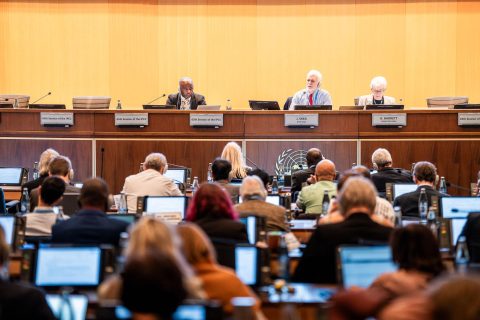
After months of internal debate over whether to identify serial non-responders, the Paris Agreement’s Implementation and Compliance Committee (PAICC) named the three countries which have failed to engage with it over their NDCs on Friday.
It named Democratic Republic of Congo, Senegal and North Korea in a footnote of its annual report, adding that it decided to name them “with a view to facilitating engagement”, adding that representatives of the three nations had been invited to its meeting in early 2027 “with the purpose of identifying any challenges and constraints”.
“The Committee noted the importance of Parties engaging with the Committee in a timely manner, while noting that some delays may be due to the national capabilities and circumstances of the Parties”, the report said.
-
Under US pressure, World Bank says it will back gas “where appropriate”
The US wants the World Bank to expand its gas support while climate campaigners are pushing for it to end – its head spoke this week of limited backing for the fossil fuel -
IPCC scientists vow to press on with climate reports despite political deadlock
After governments again failed to agree a timeline, nearly 120 IPCC authors pledged to complete their assessment on time and with full scientific rigour -
Paris Agreement committee snubbed over missing NDC climate plans
Many governments have still not submitted a nationally determined contribution to the UN, breaching a key requirement of the Paris Agreement


In July, PAICC said 12 countries had ignored its repeated attempts to discuss why they had not published an NDC as required every five years under the 2015 Paris accord.
Members of the committee had been divided over whether to name them, but at a September meeting decided to do so in their annual report to the annual climate COP summit.
By the time the report was published on Friday, only Congo, Senegal and North Korea “had not communicated an NDC or submitted a [Biennial Transparency Report] and had not yet responded to any of the Committee’s notifications, despite several reminders issued by the Committee in this regard”.
Rainforest and renewable energy ambitions
The silence from Congo and Senegal is notable because the former is home to much of the Congo Basin rainforest while the latter has sought billions of dollars in climate finance to support its renewable energy ambitions.
After Brazil, Congo has more rainforest than any country in the world. This forest, and the country’s peatlands, absorb huge amounts of greenhouse gas but are fast being lost to expanding farmland, charcoal production, logging and mining.
Senegal signed a Just Energy Transition Partnership with Canada and wealthy European nations in 2023, to help it meet its renewable energy targets under the-then government of Macky Sall. It was chair of the Least Developed Countries group between January 2022 and December 2023.

Tejas Rao, who is researching the PAICC as part of a doctoral thesis at Cambridge University, said the governments of the three countries should engage with the committee.
“Engagement costs these governments very little and the committee has shown it will listen,” he said.
“Silence leaves the committee with no basis to help, and it leaves the [governments] exposed to the narrative that they are simply disengaged,” he told Climate Home News.
Paris Agreement requirement
The 2015 Paris Agreement requires all parties to publish an NDC every five years outlining their emissions reduction targets, with each plan meant to be more ambitious than the country’s last NDC.
The latest set – the third round of plans, with new targets for 2035 – was due in February 2025. While most countries missed this deadline, all but around 30 – mostly small emitters but including Egypt, Vietnam and Argentina – have now submitted them.
Over the year, the PAICC – which is made up of government climate officials from developed and developing countries – has been communicating with governments that have not submitted NDCs and trying to overcome barriers to them doing so.
Some nations have cited exceptional circumstances as the reason for not submitting an NDC, a process that requires a significant amount of work in tracking emissions and consulting on how to curb them across the economy. For example, a letter from a Sudanese official to the PAICC, seen by Climate Home News, said that the country’s civil war had led to the suspension of its NDC preparation.
-
IPCC scientists vow to press on with climate reports despite political deadlock
After governments again failed to agree a timeline, nearly 120 IPCC authors pledged to complete their assessment on time and with full scientific rigour -
Under US pressure, World Bank says it will back gas “where appropriate”
The US wants the World Bank to expand its gas support while climate campaigners are pushing for it to end – its head spoke this week of limited backing for the fossil fuel -
Who shapes climate science? The equity question facing the IPCC
Early completion of the next global climate science assessment reports risks excluding research from the Global South, which is key to ensuring the findings are fair
The US and Iran are not signed up to the Paris Agreement and so do not have active NDCs, nor does Taiwan, which is not a UN member state.
Rao said that because the PAICC is “facilitative and non-punitive”, naming the countries “is meant to open a door, not close one – the invited consultation is the point”.
“In recent months, governments that explained their constraints, whether capacity, finance or domestic process, have been met with follow-up and support rather than sanction, and the number of silent governments has fallen sharply,” Rao said.
The post Paris Agreement committee names three countries snubbing it over NDCs appeared first on Climate Home News.
Paris Agreement committee names three countries snubbing it over NDCs