

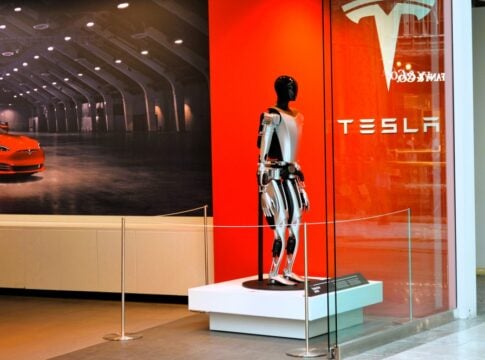
Tesla Inc. (TSLA Stock) has once again raised the stakes in the world of artificial intelligence and custom semiconductor design. CEO Elon Musk recently confirmed that Tesla’s AI5 chip has completed its design review, marking a significant milestone in the company’s efforts to develop in-house chip technology that rivals industry giants like Nvidia.
This move aligns with Tesla’s broader vision of reshaping technology infrastructure, reducing dependency on external suppliers, and driving innovation across its product ecosystem from EVs to humanoid robots.
AI5 Leads the Way: Tesla’s Bold Move Toward a Single Chip Platform
Until recently, Tesla had been developing two separate chip architectures. Musk’s latest announcement signals a shift toward consolidating these efforts into a single, unified platform.
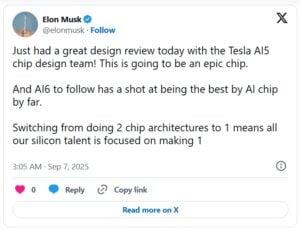
- During a post on X, Musk called the AI5 chip “epic” and hinted at its successor, the AI6, as potentially the “best AI chip by far.”
According to him, the AI5 chip will offer “the lowest cost silicon and best performance per watt” for inference tasks with models smaller than 250 billion parameters.
Dojo Disbanded?
This consolidation came after Tesla’s internal assessment determined that continuing separate paths would lead nowhere significant.
As per Bloomberg, the company discontinued its ambitious Project Dojo supercomputer initiative in August, despite analysts once attributing a potential $500 billion increase in market value to the project. Musk explained that “all paths converged to AI6,” and the supercomputer project was deemed “an evolutionary dead end.”
The unified architecture strategy reflects Tesla’s desire to streamline development and focus its engineering talent on solving broader computing challenges. By using the same chip platform for both training and inference tasks, Tesla expects to achieve greater efficiency and scalability.
Musk described this approach as a way to create supercomputer clusters where multiple AI5 and AI6 chips handle diverse workloads seamlessly, a configuration he dubbed “Dojo 3.”
TSMC and Samsung Fuel Tesla’s Manufacturing Strategy
Tesla’s chip development efforts are backed by a robust manufacturing roadmap involving partnerships with major semiconductor players.
- The AI5 chip will be produced by Taiwan Semiconductor Manufacturing Company (TSMC) at its facilities in Taiwan before production shifts to its Arizona plant. This staged approach will help Tesla ramp up production while ensuring quality and scale.
- For the AI6 chip, Tesla signed a $16.5 billion multiyear contract with Samsung Electronics to manufacture chips domestically in the United States.
Samsung’s dedicated Texas facility in Taylor will be exclusively focused on producing AI6 chips, with initial samples starting at Samsung’s South Korean sites before moving to Texas for mass production.
This dual-foundry strategy gives Tesla an edge in supply chain resilience. Unlike competitors dependent on a single supplier, Tesla’s collaboration with both TSMC and Samsung provides flexibility, experience, and speed. Analysts see this as a smart move, especially given the geopolitical tensions and chip shortages affecting global markets.
- MUST READ: Tesla’s Game-Changing $16.5Bn Samsung Deal for AI Chips – Is This a Turning Point for Tesla Stock?
Competing With Nvidia and Beyond
Tesla’s AI ambitions are part of a growing trend among technology companies aiming to build custom chips and reduce reliance on Nvidia, a dominant player in AI hardware. OpenAI, for example, has announced plans to partner with Broadcom to produce its own chips at scale, shifting away from Nvidia’s ecosystem.
At the same time, Nvidia faces regulatory challenges under the U.S. Guaranteeing Access and Innovation for National Artificial Intelligence Act (GAIN Act), which could limit its export capabilities.
Tesla’s AI5 and AI6 chips are thus positioned not only as performance-driven solutions but also as strategic assets in a rapidly shifting regulatory and market landscape.
Musk’s confidence in Tesla’s silicon capabilities is backed by analysts projecting that the company’s AI-driven initiatives could be worth upwards of $1 trillion.
Notably, Wedbush Securities’ Dan Ives sees Tesla’s autonomous driving and AI business as a game-changer, while Cathie Wood of ARK Invest has called Tesla “the largest AI project on Earth,” with forecasts suggesting that global revenue from robotaxi networks could hit $8 trillion to $10 trillion in the next decade.
AI Chips Set to Soar: A $165 Billion Market by 2030
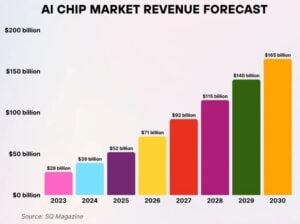
The AI chip market is growing fast. In 2023, it was worth $28 billion, showing that it is still in the early stages but gaining momentum. By 2025, experts expect the market to reach $40.79 billion and then jump to $52 billion, showing how quickly it is expanding.
Looking ahead, the market could grow even more and hit $165 billion by 2030 as more industries adopt AI technology. However, NVIDIA is still leading the way in this market and is expected to hold about 86% of the AI GPU segment in 2025. This shows how dominant NVIDIA is in the AI chip space.
AI’s Expanding Role Across Tesla’s Ecosystem
The AI5 and AI6 chips are not limited to just inference tasks in vehicles. Tesla’s broader roadmap, detailed in its Master Plan Part 4, envisions a future where artificial intelligence and robotics redefine how energy, transportation, and labor are managed.
Unlike earlier plans focused solely on electric vehicles and renewable energy, the new blueprint embraces “sustainable abundance,” where human labor and energy costs approach zero thanks to advanced robotics and AI-driven automation.
A central piece of this vision is the Optimus humanoid robot. Designed to handle repetitive and dangerous tasks in factories and eventually in homes. Optimus is seen as a cornerstone of Tesla’s next phase.
Musk predicts that humanoid robots could make up 80% of Tesla’s value in the future, with ambitious production targets ranging from several thousand units in 2025 to as many as 1 million annually by the decade’s end.
Media reports say that the AI6 chip will serve multiple roles across Tesla’s product lines. Besides powering Optimus, it will be used in the upcoming Cybercab robotaxi service and replace Dojo as Tesla’s AI training platform. The unified architecture allows these chips to be configured in clusters, seamlessly handling both training and inference tasks.
Despite Swings, TSLA Stock Inspires Investor Confidence
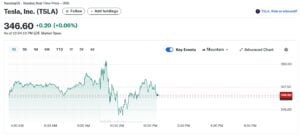
Despite these bold initiatives, Tesla’s stock (TSLA) has seen volatility. As of September 8, 2025, TSLA traded around $346.40, down about 1.2% over the previous day and pulling back from a recent high of $355.
The company’s market capitalization stands near $1.12 trillion, with a trailing price-to-earnings ratio exceeding 200—indicative of high expectations but also elevated risk.
Still, investors remain optimistic about Tesla’s AI-driven future. The combination of a unified chip architecture, diversified manufacturing strategy, and bold robotics roadmap positions Tesla at the forefront of a tech revolution. Moreover, expected shifts in global energy demand and Federal Reserve policies could further boost growth stocks like Tesla in the coming years.
In conclusion, Tesla’s AI5 chip marks a bold step beyond technology—it’s a move to lead the future of computing. With efficient chips, strong partnerships, and a unified architecture, Tesla is set to transform not just its business but global energy and labor markets. As Musk’s “sustainable abundance” vision unfolds, Tesla’s innovation could unlock a multi-trillion-dollar opportunity, drawing keen attention from investors and industry alike.
The post Tesla’s AI5 Chip Challenges NVIDIA’s Dominance in AI Hardware Innovation appeared first on Carbon Credits.

EU carbon credit claims changed on 27 September 2026, the day the Directive (EU) 2024/825 began to apply across the European Union. The change is narrow. It changes how a company can talk about the credits it buys. A product can no longer be called neutral on the strength of compensation alone; however, every specific, evidenced statement about what a company measured, reduced, and funded stays fully available.

The post Promoting Improved Cooking Practices in Nigeria appeared first on Terrapass.


-
Climate Change1 year ago
Guest post: Why China is still building new coal – and when it might stop
-

 Greenhouse Gases2 years ago
嘉宾来稿:满足中国增长的用电需求 光伏加储能“比新建煤电更实惠”
-
Greenhouse Gases1 year ago
Guest post: Why China is still building new coal – and when it might stop
-

 Climate Change2 years ago
嘉宾来稿:满足中国增长的用电需求 光伏加储能“比新建煤电更实惠”
-

 Renewable Energy12 months ago
Sending Progressive Philanthropist George Soros to Prison?
-
Climate Change2 years ago
Bill Discounting Climate Change in Florida’s Energy Policy Awaits DeSantis’ Approval
-
Greenhouse Gases1 year ago
嘉宾来稿:探究火山喷发如何影响气候预测
-

 Climate Change2 years ago
Analysis: China’s CO2 falls 1% in Q2 2024 in first quarterly drop since Covid-19